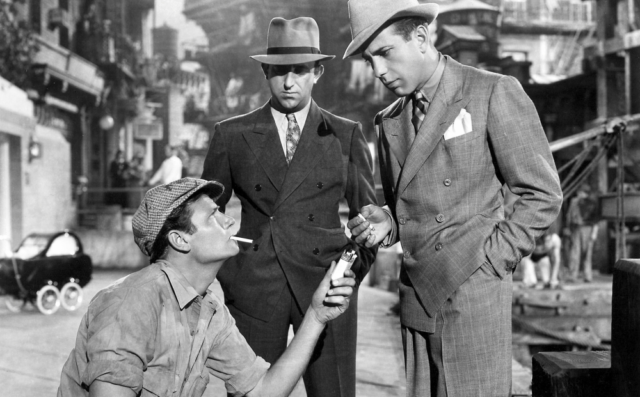
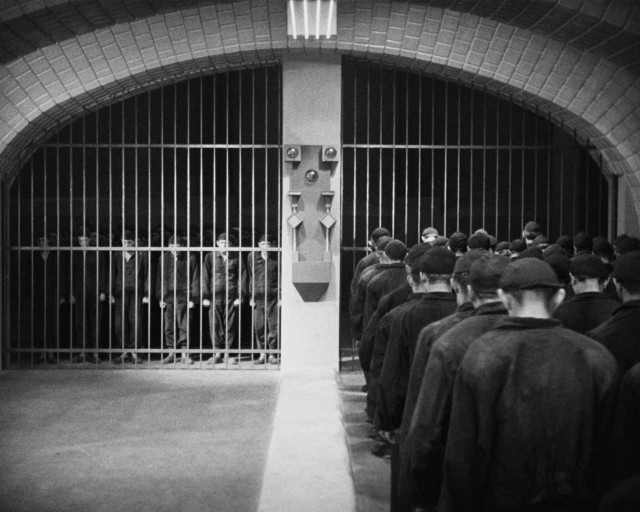
William Wyler’s 1937 Dead End is part of Film Forum “Tenement Stories” series
TENEMENT STORIES: FROM IMMIGRANTS TO BOHEMIANS
Film Forum
209 West Houston St.
February 6-26
www.filmforum.org
www.tenement.org
“The words of the prophets are written on subway walls and tenement halls,” Paul Simon sang in 1964.
Film Forum, which just named Tabitha Jackson its new director, has teamed up with the Tenement Museum to present the wide-ranging sixty-plus-movie series “Tenement Stories: From Immigrants to Bohemians,” in which there are plenty of prophets. Running February 6–26, the program includes classic favorites, lesser-known gems, and plenty of surprises that take place in old New York, from D.W. Griffith’s The Musketeers of Pig Alley with Lillian Gish and The New York Hat with Mary Pickford and Lionel Barrymore, both released in 1912, to Film Forum repertory artistic director Bruce Goldstein’s 2010 Les Rues de Mean Streets (screening with Martin Scorsese’s 1973 Mean Streets) and 2020 Uncovering the Naked City (shown with Jules Dassin’s 1948 The Naked City) in addition to Aicha Cherif’s 2025 Heat (accompanying Diego Echeverria’s 1984 Los Sures).
“In the silent and early talkie eras, Hollywood churned out cinematic fantasies about the super-rich, but there were also many movies set in New York’s so-called tenement districts, particularly the Lower East Side of Manhattan, once the most densely populated place on earth,” Goldstein said in a statement. “That and other neighborhoods, like Harlem, East Harlem, and parts of Brooklyn and the Bronx, also had an avid moviegoing population — in the 1930s and ’40s, the Lower East Side alone had over thirty movie theaters, from fleapits to palaces — so people were seeing versions of their own lives reflected onscreen. The same neighborhoods would show up in later movies, but with New York’s changing population represented.”
The festival boasts films by Francis Ford Coppola, King Vidor, Charlie Chaplin, Buster Keaton, Hal Ashby, Ken Jacobs, Sergio Leone, John Huston, D. W. Griffith, Leon Ichaso, Raoul Walsh, Preston Sturges, Sean Baker, and many more; among the stars are James Cagney, Loretta Young, Bette Davis, Humphrey Bogart, Robert De Niro, Harvey Keitel, Edward G. Robinson, Ginger Rogers, James Woods, Elizabeth McGovern, Joe Pesci, Natalie Wood, Rita Moreno, Dick Gregory, Marilyn Monroe, Sidney Poitier, Ruby Dee, Al Pacino, Diane Keaton, Jack Kerouac, and Allen Ginsberg.
Tenement Museum president Annie Polland added, “Abraham Cahan, editor of the Jewish Daily Forward, famously wrote to his readers, ‘Under your tenement roofs is real life — the very stuff of which the greatest books are written.’ In 1900, 75% of Manhattanites lived in a tenement — a shared experience for decades of New Yorkers and their descendants. Every day the Tenement Museum shares the stories of those tenement dwellers — immigrant, migrant, and refugee families — by taking people into their re-created homes. The Film Forum series shows these real life dramas through film, letting you time travel through the tenements, from the Yiddish-speaking sweatshop in Uncle Moses, to a young Irish American girl’s awakening in A Tree Grows in Brooklyn, to Martin Scorsese’s portrait of his parents in ItalianAmerican,, to more recent tenement life, as seen through the eyes of Latino, Chinese, Iranian, and other New Yorkers.”
On February 8 and 13, the museum is hosting “Love at the Tenement,” a Valentine’s Day holiday tour of 97 Orchard St., followed by “Crime in the Tenements: Fact and Fiction,” which will have their own real-life tenement stories.
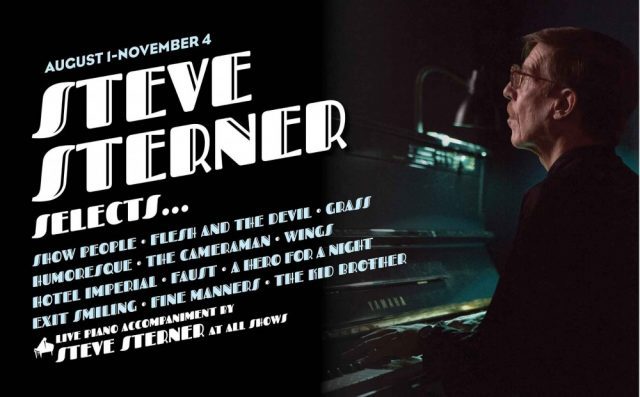
There will be numerous special presentations during the series, including live piano accompaniment by Steve Sterner; introductions by Cathy Sorsese, Uncle Floyd Show alum Michael Townsend Wright, and Kaity Tong; postscreening conversations with Peter McCrea, Cherif, and Mari Rodríguez Ichaso; and a Yiddish vaudeville performance by Allen Lewis Rickman, Yelena Shmulenson, Steve Sterner, and Shane Baker, who have been involved in such Yiddish treats as The Essence: A Yiddish Theatre Dim Sum and Tevye Served Raw. On February 16, “16mm Treasures from the New York Public Library” comprises four shorts introduced by NYPL collection manager Elena Rossi-Snook.
Below is a look at several of the films, which shine a light on the history of New York City since the turn of the twentieth century, particularly as a new home for immigrant families.
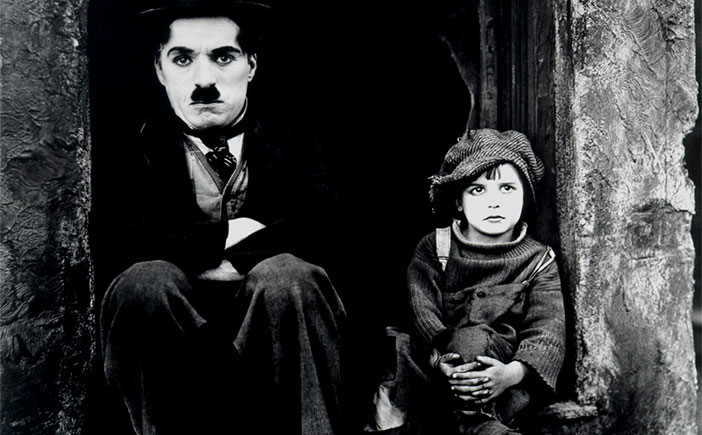
A Tramp (Charlie Chaplin) and an abandoned child (Jackie Coogan) form a family in The Kid
THE KID (Charles Chaplin, 1921)
Sunday, February 8, 11:00 am
filmforum.org
Charlie Chaplin’s first feature, The Kid, was a breakthrough for the British-born silent-film star, a touching and tender sixty-eight-minute triumph about a poor soul getting a second chance at life. When a baby arrives at his doorstep, a Tramp (Chaplin) first tries to ditch the boy, but he ends up taking him to his ramshackle apartment and raising him as if he were his own flesh and blood. Although he has so little, the Tramp makes sure the child, eventually played by Jackie Coogan, has food to eat, clothes to wear, and books to read. Meanwhile, the mother (Edna Purviance, Chaplin’s former lover), who has become a big star, regrets her earlier decision and wonders where her son is, setting up a heartbreaking finale.
In addition to playing the starring role, Chaplin wrote, produced, directed, and edited the film and composed the score for his company, First National, wonderfully blending slapstick comedy, including a hysterical street fight with an angry neighbor, with touching melodrama as he examines poverty in post-WWI America, especially as seen through the eyes of the orphan boy, played beautifully by Coogan, who went on to marry Betty Grable, among others, and star as Uncle Fester in The Addams Family. Chaplin’s innate ability to tell a moving story primarily through images reveals his understanding of cinema’s possibilities, and The Kid holds up as one of his finest, alongside such other silent classics as 1925’s The Gold Rush and 1931’s City Lights. The film is screening with Chaplin’s 1917 short Easy Street, with live piano accompaniment by Steve Sterner.
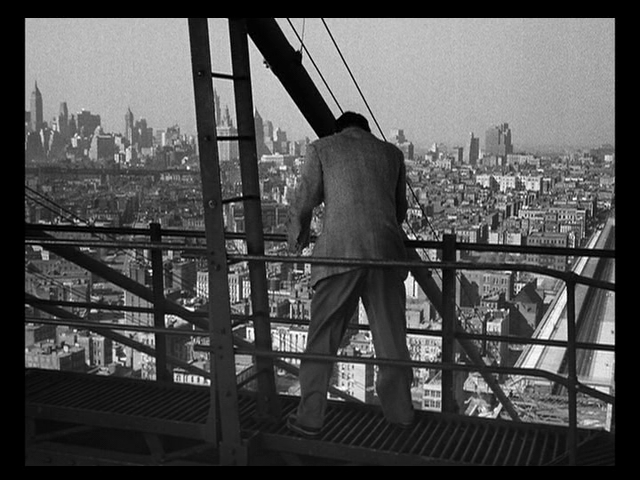
The Naked City features more than one hundred NYC locations
THE NAKED CITY (Jules Dassin, 1948)
Thursday, February 12 , 12:50
Wednesday, February 18, 8:10
www.filmforum.org
Jules Dassin’s police procedural was one of the first films shot on location in New York City, bringing to life the grit of the streets. Barry Fitzgerald stars as Lt. Muldoon, an Irish cop who knows the game, never allowing anything to get in the way of his sworn duty to uphold the law while never getting too emotionally involved. A model has turned up dead, and young detective Jimmy Halloran (Don Taylor) is heading up the investigation, which includes such suspects as swarthy Frank Niles (Howard Duff). Producer Mark Hellinger’s narration is playful and knowing, accompanying William Daniels’s great camerawork through Park Avenue and the Lower East Side, stopping at little city vignettes that have nothing to do with the story except to add to the level of reality. The thrilling conclusion takes place on the Williamsburg Bridge. The film will be followed by Bruce Goldstein’s 2020 documentary Uncovering the Naked City, which visits many of The Naked City’s locations.
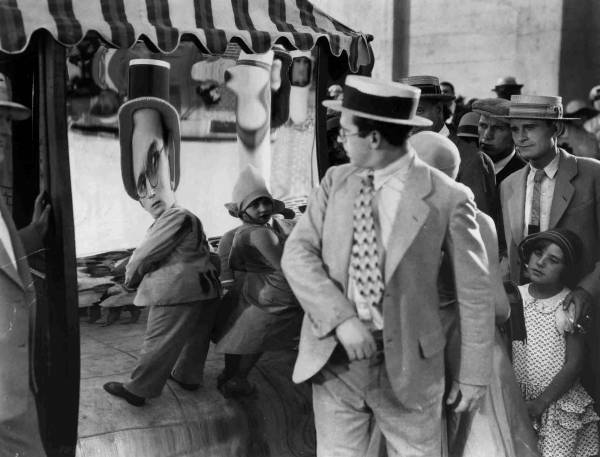
Harold Lloyd has a crazy time in Coney Island in Speedy
SPEEDY (Ted Wilde & Clyde Bruckman, 1928)
Sunday, February 15, 1:00
filmforum.org
Much like the end of the silent film era itself, the last horse-drawn trolley is doomed in Harold Lloyd’s final silent film. Big business is playing dirty trying to get rid of the trolley and classic old-timer Pop Dillon. Meanwhile, Harold “Speedy” Swift, a dreamer who wanders from menial job to menial job (he makes a great soda-jerk with a unique way of announcing the Yankees score), cares only about the joy and wonder life brings. But he’s in love with Pop’s granddaughter, Jane, so he vows to save the day. Along the way, he gets to meet Babe Ruth. Ted Wilde was nominated for an Oscar for Best Director, Comedy, for this thrilling nonstop ride through beautiful Coney Island and the pre-depression streets of New York City. The 4K restoration will feature live piano accompaniment by Steve Sterner.
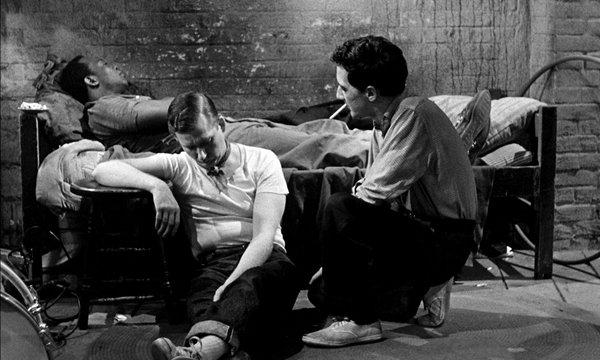
The Connection is a gritty, jazzy New York City story
THE CONNECTION (Shirley Clarke, 1962)
Thursday, February 19, 4:20
Friday, February 20, 8:00
Tuesday, February 24, 1:00
filmforum.org
“Now look, you cats may know more about junk, see,” square film director Jim Dunn (William Redfield) says midway through The Connection, “but let me swing with this movie, huh?” Adapted by Jack Gelber from his play and directed and edited by Shirley Clarke, The Connection is a gritty tale of drug addicts awaiting their fix that was banned for obscenity after only two matinee screenings back in October 1962. In 2012, a sharp new fiftieth-anniversary print was released, beautifully restored by Ross Lipman of the UCLA Film & Television Archive. In a New York City loft, eight men are waiting for their man: Leach (Warren Finnerty), the ringleader who has an oozing scab on his neck; Solly (Jerome Raphael), an intelligent philosopher who speaks poetically about the state of the world; Ernie (Garry Goodrow), a sad-sack complainer who has pawned his horn but still clutches tight to the mouthpiece as if it were a pacifier; Sam (Jim Anderson), a happy dude who tells rambling stories while spinning a hula hoop; and a jazz quartet consisting of real-life musicians Freddie Redd on piano, Jackie McLean on sax, Larry Richie on drums, and Michael Mattos on bass. Dunn and his cameraman, J. J. Burden (Roscoe Lee Browne), are in the apartment filming the men as Dunn tries to up the drama to make it more cinematic as well as more genuine. “Don’t be afraid, man,” Leach tells him. “It’s just your movie. It’s not real.” When Cowboy (Carl Lee) ultimately shows with the stuff, Bible-thumping Sister Salvation (Barbara Winchester) at his side, things take a decidedly more drastic turn.
Mixing elements of the French New Wave with a John Cassavetes sensibility and cinema verité style, Clarke has made an underground indie classic that moves to the beat of an addict’s craving and eventual fix. Shot in a luridly arresting black-and-white by Arthur Ornitz, The Connection is like one long be-bop jazz song, giving plenty of time for each player to take his solo, with standout performances by McLean musically and Raphael verbally. The film-within-a-film narrative allows Clarke to experiment with the mechanics of cinema and challenge the audience; when Dunn talks directly into the camera, he is speaking to Burden, yet he is also breaking the fourth wall, addressing the viewer. Cutting between Burden’s steady camera and Dunn’s handheld one, Clarke adds dizzying swirls that rush past like a speeding subway train. A New York City native, Clarke made such other films as The Cool World and Portrait of Jason and won an Academy Award for her 1963 documentary Robert Frost: A Lover’s Quarrel with the World. The restoration is part of Milestone Films’ Shirley Clarke Project, which has preserved and restored a quartet of her best work, inclduing the 1985 documentary Ornette: Made in America.
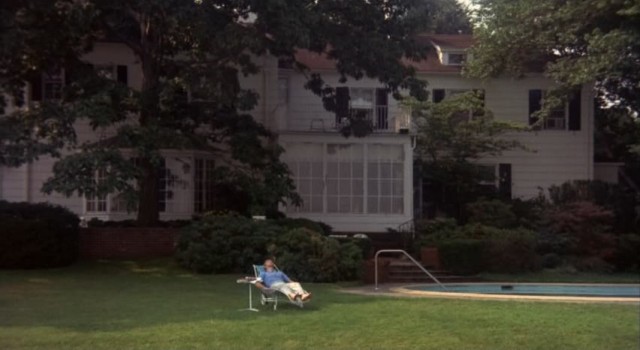
Young Elgar Winthrop Julius Enders’s (Beau Bridges) spoiled life of privilege is about to dramatically change in The Landlord
THE LANDLORD (Hal Ashby, 1970)
Friday, February 20, 3:40
Saturday, February 21, 6:10
Thursday, February 26, 4:50
filmforum.org
When rich kid Elgar Winthrop Julius Enders (Beau Bridges) finally decides to do something with his spoiled life of privilege, he takes a rather curious turn, buying a dilapidated tenement in a pregentrified Park Slope that resembles the South Bronx in Hal Ashby’s poignant directorial debut, The Landlord. At first, the less-than-worldly Elgar doesn’t quite know what he’s gotten himself into, believing it will be easy to kick out the current residents and then replace the decrepit building with luxury apartments. He pulls up to the place in his VW bug convertible, thinking he can just waltz in and do whatever he wants, but just as his car is vandalized, so is his previously charmed existence, as he gets to know wise house mother Marge (Pearl Bailey), the sexy Francine (Diana Sands), her activist husband, Copee (Louis Gossett Jr.), and Black Power professor Duboise (Melvin Stewart), none of whom is up-to-date with the rent. Meanwhile, Elgar starts dating Lanie (Marki Bey), a light-skinned half-black club dancer he assumed was white, infuriating his father, William (Walter Brooke), and mother, Joyce (a delightful, Oscar-nominated Lee Grant), who are in the process of setting up their daughter, Susan (Susan Anspach), with the white-bread Peter Coots (Robert Klein).
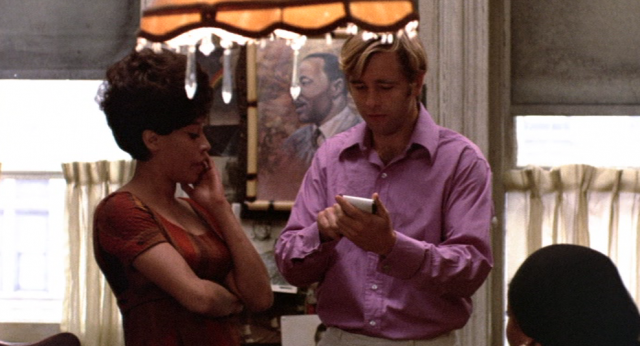
Elgar has a whole lot of learning to do in Hal Ashby’s New York City–set black comedy
Based on the novel by Kristin Hunter, The Landlord is a telling microcosm of race relations and class conflict in a tumultuous period in the nation’s history, as well as that of New York City, coming shortly after the civil rights movement and the free-love late ’60s. The film is masterfully shot by Astoria-born cinematographer Gordon Willis (Klute, Annie Hall, Manhattan, all three Godfather movies), who sets the bright, open spaces of the Enderses’ massive estate against the dark, claustrophobic rooms of the dank tenement. Screenwriter Bill Gunn (Ganja and Hess) and Ashby avoid getting overly preachy in this at-times outrageous black comedy, incorporating slapstick along with some more tender moments; the scene in which Joyce meets Marge is a marvel of both. And just wait till you see Coots’s costume at a fancy fundraiser. The Landlord began quite a string for Ashby, who followed it up with Harold and Maude, The Last Detail, Shampoo, Bound for Glory, Coming Home, and Being There in a remarkable decade for the former film editor (In the Heat of the Night), who died in 1988 at the age of fifty-nine.
[Mark Rifkin is a Brooklyn-born, Manhattan-based writer whose maternal grandparents grew up in Lower East Side tenements; you can follow him on Substack here.]
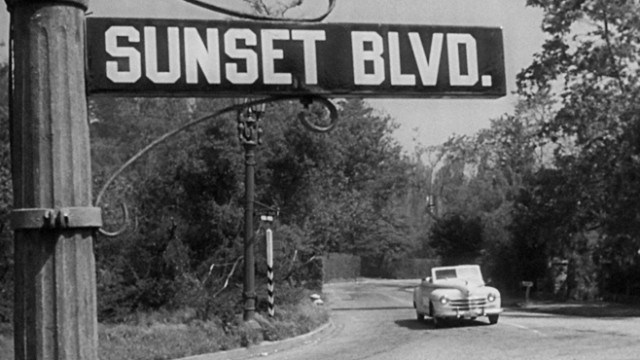
 “You’re Norma Desmond. You used to be in silent pictures. You used to be big,” handsome young screenwriter Joe Gillis (William Holden) remarks to an older woman in Billy Wilder’s Sunset Boulevard. “I am big. It’s the pictures that got small,” the former star (Gloria Swanson) famously replies. It doesn’t get much bigger than Sunset Boulevard, one of the grandest Hollywood movies ever made about Hollywood. The wickedly entertaining film noir begins in a swimming pool, where Gillis is a floating corpse, seen from below. He then posthumously narrates through flashback precisely what landed him there. On the run from a couple of guys trying to repossess his car, the broke Gillis ends up at a seemingly abandoned mansion, only to find out that it is home to Desmond and her dedicated servant, Max Von Mayerling (Erich von Stroheim). They initially mistake Gillis for the undertaker who is coming to perform a funeral service and burial for Desmond’s pet monkey. (You’ve got to see it to believe it.) When Desmond discovers that Gillis is in fact a screenwriter, she lures him into working with her on her script for a new version of Salome, in which she is determined to play the lead role. “I didn’t know you were planning a comeback,” Gillis says. “I hate that word,” Desmond responds. “It’s a return, a return to the millions of people who have never forgiven me for deserting the screen.” But just as Desmond was unable to make the transition from silent black-and-white films to color and sound pictures, getting Salome off the ground is not going to be as easy as she thinks. Hollywood can be a rather vicious place, after all.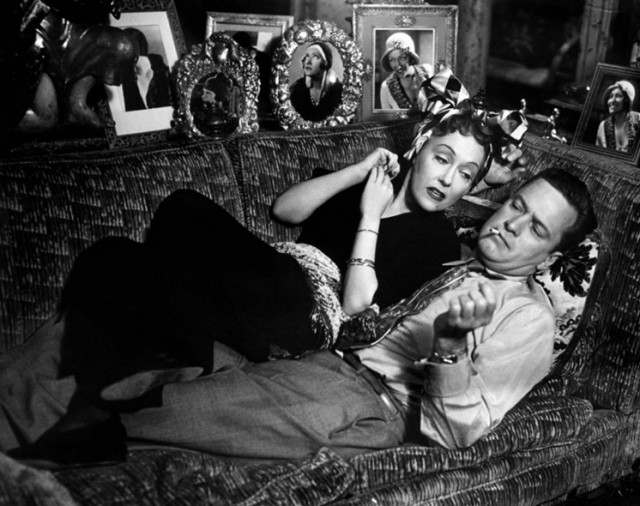
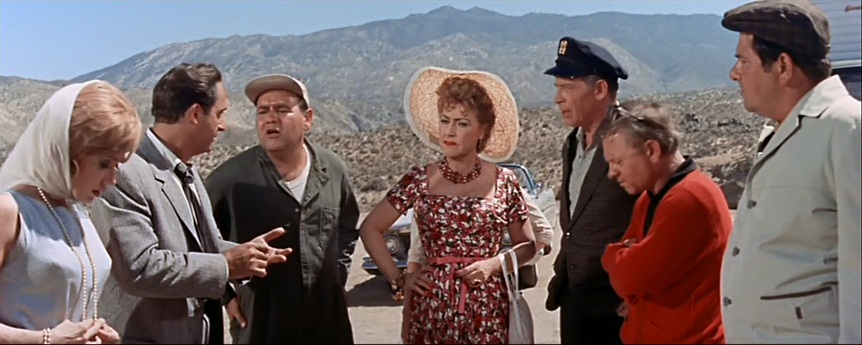
 They don’t come much crazier than the madcap 1963 comedy It’s a Mad Mad Mad Mad World. Producer-director Stanley Kramer takes a sharp turn with the wacky film, clearly needing a laugh following his rather serious string of issue pictures: The Defiant Ones, On the Beach, Inherit the Wind, and Judgment at Nuremberg. As he lays dying after a car crash, master thief Smiler Grogan (Jimmy Durante) tells a group of onlookers that there is $350,000 buried under a “big W” in Santa Rosita State Park. And off they go in search of the prize, willing to do just about anything and everything in order to get their greedy hands on the money. Hot on their trail is police captain T. G. Culpeper (Spencer Tracy), trying to solve one last case before he retires. It’s a Mad, Mad, Mad, Mad World lives up to its title, a mad, mad, mad, mad epic featuring the greatest all-star comedic cast ever assembled, including Sid Caesar, Edie Adams, Mickey Rooney, Buddy Hackett, an absolutely lunatic Jonathan Winters, Terry-Thomas, Phil Silvers, Dick Shawn, Peter Falk, Eddie “Rochester” Anderson, and Ethel Merman in addition to cameos by Jerry Lewis, Jack Benny, Joe E. Brown, Howard Da Silva, Andy Devine, Norman Fell, Selma Diamond, Leo Gorcey, Jim Backus, Marvin Kaplan, Stan Freberg, Arnold Stang, Jesse White, Carl Reiner, Don Knotts, Buster Keaton, and the Three Stooges. Basically, you can’t blink during the film’s 161 minutes or you’ll miss someone or some incredibly silly slapstick moment. And the ending is a laugh riot — literally. It’s a Mad, Mad, Mad, Mad World is screening August 15-16 as part of the Museum of the Moving Image series “See It Big! 70MM,” of old and new films being shown in all their 70mm glory, including Robert Wise’s West Side Story, David Lean’s Lawrence of Arabia, Paul Thomas Anderson’s The Master, Steven Lisberger’s Tron, and Christopher Nolan’s Interstellar.