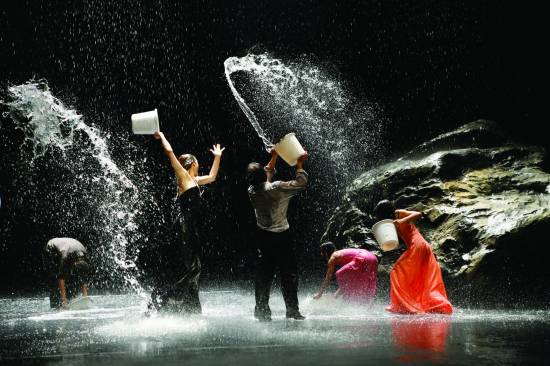
Pina Bausch’s VOLLMOND is a wet and wild experience (photo by Laurent Philippe)
Tanztheater Wuppertal Pina Bausch
BAM Howard Gilman Opera House
30 Lafayette Ave. between Ashland Pl. & St. Felix St.
Through October 9, $25 – $85 (October 1 performance reviewed)
718-636-4100
www.bam.org
www.pina-bausch.de
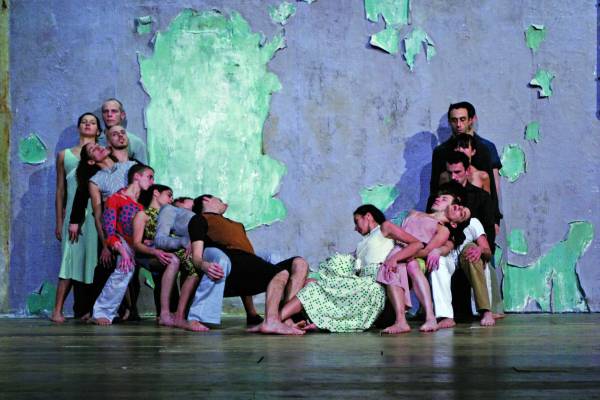
Returning to BAM for the first time since the sudden death of their founder and artistic director, Pina Bausch, in June 2009, Tanztheater Wuppertal is dazzling audiences in Brooklyn with the U.S. premiere of the 2006 evening-length piece VOLLMOND (FULL MOON). A large rock sits alone on a sparse black stage above a shallow, barely visible river of water. The first half of the 150-minute show is an utter delight as the twelve-member company enacts vignettes of love, romance, and the playful battle between the sexes, the men dressed in dark pants and button-down shirts, the women in elegant evening gowns and high heels. They flirt, kiss, and tell jokes, occasionally giving way to sparkling solos by the diminutive Rainer Behr and Ditta Miranda Jasjfi and others. Water, the elixir of life, is at the center of it all, whether the men are pouring drinks for the women or they all go for a swim in the river, rain crashing down in a breathtaking display.
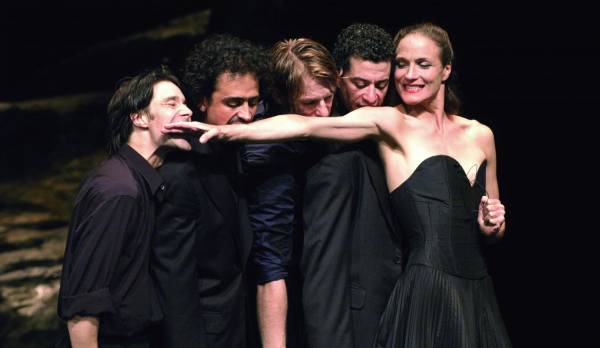
Women dominate the battle of the sexes in VOLLMOND (photo by Jan Szito)
But the second half takes a darker turn, as costumes dim and tend toward black, the kissing and jokes replaced by violence and pain, the high tides of the full moon now pulling more turbulent currents to the surface. The first three solos are performed by the troupe’s older members, new co-artistic director Dominique Mercy (who has been with the company since Bausch took it over in 1973), longtime comic relief Nazareth Panadero, and the lithe, rail-thin Julie Anne Stanzak, their movements sharper and less fluid than those of the younger dancers. Where wooden sticks were earlier used to create a cool thwooshing sound, now they are weapons. Instead of filling a wineglass with a drink, a man now shoots a plastic cup off a woman’s head using a water pistol. The music also borders on the morose, including Cat Power’s eerie “Werewolf.” But soon the sexes are back in each other’s arms for a wet and wild finale. Bausch’s unique melding of dance, theater, comedy, and music is in abundant evidence throughout VOLLMOND, another terrific crowd pleaser from one of the world’s most gifted talents. Athough no one takes the customary choreographer’s bow after the show, Bausch’s presence is felt all night long. At one point, Panadero brings out a chair and warns a man away from it, stating that even ghosts need to sit down; everyone in the theater instantly understands whom she is talking about. Discussion and speculation over the future of Tanztheater Wuppertal swirl around whether it can go on without Bausch; VOLLMOND is a must-see on its own merits, but even more so considering the possibility that it could be the company’s last stand in New York.
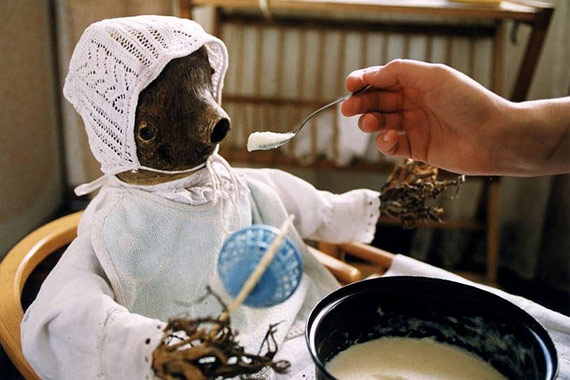
 Poor Bozena (Veronika Zilková) and Karel (Jan Hartl) are unable to have a baby, so Karel decides to carve one out of a tree for his desperate wife. Bozena showers her wooden child with lots of love — and soon the little tyke is crying and very, very hungry. Based on a poem by Czech writer Karel Jaromír Erben, LITTLE OTIK was written and directed by master stop-motion animator Jan Svankmajer, who has made such feature-length films as ALICE (1988) and FAUST (1994) as well as myriad shorts, including PUNCH AND JUDY (1966), DON JUAN (1969), MEAT LOVE (1988), and FOOD (1992). In LITTLE OTIK, Svankmajer mixes live action and animation to create a delightful, if disturbingly bizarre, fairy tale. The film will screen on August 17 as part of BAMcinématek’s “Emotional Sloppy Manic Cinema,” a two-week series curated by brothers Josh and Benny Safdie The diverse group of works range from Robert Bresson’s A MAN ESCAPED to Jafar Panahi’s THE MIRROR, from Olivier Assayas’s COLD WATER to François Truffaut’s SMALL CHANGE, from Ulu Grosbard’s STRAIGHT TIME to Ralph Bakshi’s HEAVY TRAFFIC, and from Woody Allen’s HUSBANDS AND WIVES to Elaine May’s MIKEY AND NICKY. Of course, the brothers have also included their own DADDY LONGLEGS and Red Bucket Shorts and will be on hand to introduce several of the screenings, including the 6:30 showing of LITTLE OTIK.