Tag Archives: bam harvey theater

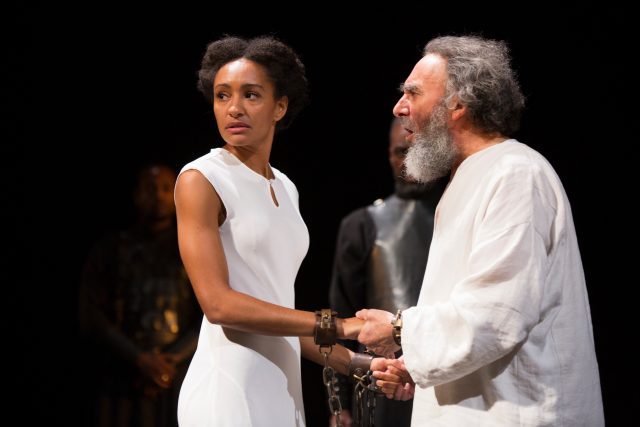
KING LEAR

(photo by Ellie Kurttz)

Sir Antony Sher bids William Shakespeare adieu in final Bard role (photo by Ellie Kurttz)

Brooklyn Academy of Music
BAM Harvey Theater
651 Fulton St.
April 7-29, $35-$125, 7:30 (plus 1:30 and 3:00 weekend matinees)
718-636-4100
www.bam.org

The Brooklyn Academy of Music has a thing for King Lear. Since 2007, it has presented three major productions, starring Sir Ian McKellen, Sir Derek Jacobi, and Frank Langella. During that time period, New York has also seen the tragic ruler portrayed by John Lithgow at the Delacorte, Michael Pennington at TFANA, and Sam Waterston and Kevin Kline at the Public. Now comes sixty-eight-year-old South African-born English actor Sir Antony Sher, in what is being billed as his final Shakespeare role. The two-time Olivier Award winner, Tony nominee, and longtime Royal Shakespeare Company member has previously played the Fool in Lear, Shylock in The Merchant of Venice, Prospero in The Tempest, Falstaff in both parts of Henry IV at BAM, Leontes in The Winter’s Tale, and the title characters in Richard III, Titus Andronicus, and Macbeth. The RSC production runs at the BAM Harvey April 7-29, directed by Gregory Doran (Sher’s longtime partner), with sets by Niki Turner, lighting by Tim Mitchell, and music by Ilona Sekacz. The cast also features Nia Gwynne as Goneril, Kelly Williams as Regan, Mimi Ndiweni as Cordelia, and Graham Turner as the Fool. In conjunction with the show, RSC assistant director Anna Girvan and members of the company will give a class on April 24 at 1:00 ($25) at the Mark Morris Dance Center “for emerging professional actors,” and Girvan and company members will lead the open workshop “Inside the Storm” on April 26 at noon ($20) at Mark Morris “for curious adult (18+) theatergoers of all abilities.”

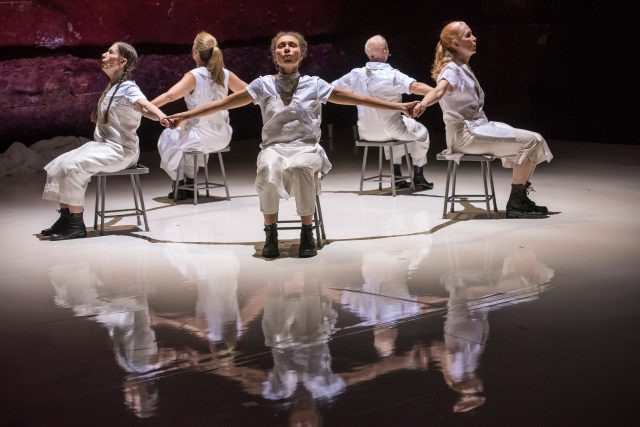
CELLULAR SONGS

(photo by Stephanie Berger)

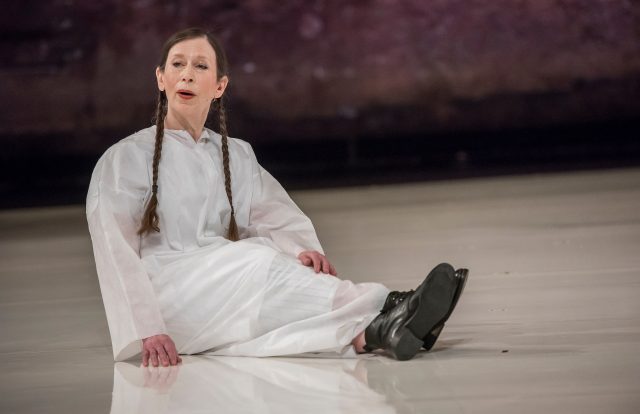
Meredith Monk (left) and Vocal Ensemble perform Cellular Songs at BAM through March 18 (photo by Stephanie Berger)

Brooklyn Academy of Music
BAM Harvey Theater
651 Fulton St.
March 14-18, $25-$55
718-636-4100
www.bam.org
www.meredithmonk.org

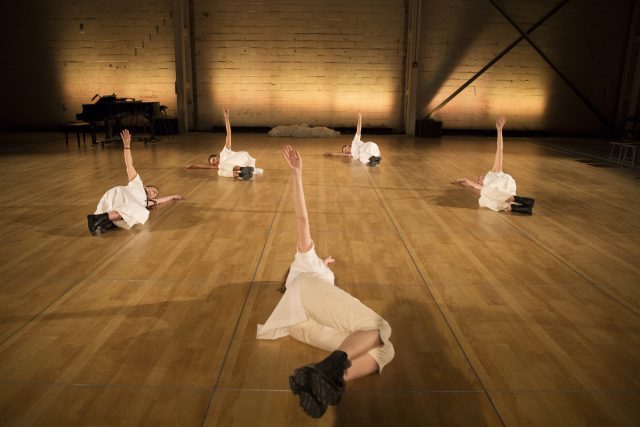
Legendary interdisciplinary artist Meredith Monk offers a brief prologue to her latest evening-length work, Cellular Songs, with an audiovisual installation in the lobby at the BAM Harvey Theater. Five small monitors, side by side and just about at eye level, show five women (the primary cast of Cellular Songs) uttering sounds as the camera cuts from facial close-ups to just their mouths and to X-rays of the human brain and hand. It serves as an aperitif to the main course, a gorgeous seventy-five-minute piece incorporating experimental sound, movement, video, and lighting. The show begins with a film by Katherine Freer of five enormous hands projected on the stage floor, touching and clutching fingers. Monk then walks out with four members of her Vocal Ensemble, Ellen Fisher, Katie Geissinger, Allison Sniffin, and Jo Stewart, all dressed in loose-fitting white and beige costumes by Yoshio Yabara, who also designed the environment, which features several chairs, a piano in one corner, and a small pile of white clothes near the back. Individually and as a unit, the five women vocalize sounds that form unique rhythms, complemented by their movement, which includes lying on the floor, gathering around the piano, and sitting in a circle, holding hands. Joe Levasseur’s lighting goes from individual and group spots to bathing the production in reds and blues. In the program, Monk explains, “Some of the pieces have much more dissonance and chromatic kind of harmonies, and the forms are almost like three-dimensional sculptures. Earlier, my music had much more to do with layering. Now you can almost see or hear the piece rotating as if it were a sculpture in space, though it’s just a musical form.”

Meredith Monk gets closer to the earth in Cellular Songs at BAM (photo by Stephanie Berger)

Meredith Monk gets closer to the earth in Cellular Songs at BAM (photo by Stephanie Berger)

Cellular Songs is a follow-up to the environmentally conscious On Behalf of Nature and was inspired by Siddartha Mukherjee’s Pulitzer Prize–winning book, The Emperor of All Maladies: A Biography of Cancer. The seventy-five-year-old New York City native has taken the concept of the cell as both healthy and unhealthy biological unit and applied it to music, as if each note is a cell. The majority of the utterances by the five performers are just sounds, although at one point Monk (Songs of Ascension, Vessel) sings the song “Happy Woman,” in which she repeats “I’m a happy woman” over and over again, along with some other adjectives replacing “happy.” The work is about transcendence and connection, about the life cycle of birth, life, and death, as revealed when the Vocal Ensemble is joined by ten members of the Young People’s Chorus of New York City; the fifteen girls and women split into three sets of five by age, each group in slightly different costumes. As Monk also explains in the program, “As artists, we’re all contending with what to do at a time like this. I wanted to make a piece that can be seen as an alternative possibility of human behavior, where the values are cooperation, interdependence, and kindness, as an antidote to the values that are being propagated right now.” Cellular Songs is a multimedia celebration of hope in a deeply troubled era, offering tired souls the opportunity to immerse themselves in a uniquely uplifting aural and visual landscape that is free of sentimentality or rage, instead a place for contemplation, harmony, and more than a little magic.

MEREDITH MONK AND VOCAL ENSEMBLE: CELLULAR SONGS

(photo by Julieta Cervantes)

Meredith Monk & Vocal Ensemble will present world premiere of Celluar Songs at the BAM Harvey this week (photo by Julieta Cervantes)

Brooklyn Academy of Music
BAM Harvey Theater
651 Fulton St.
March 14-18, $25-$55
718-636-4100
www.bam.org
www.meredithmonk.org

Eclectic New York City multidiscplinary artist Meredith Monk will unveil her latest work this week at BAM, presenting the world premiere of Cellular Songs at the Harvey March 14-18. The multimedia performance comprises voice, movement, light, site-specific video installation, instrumental music, and film; Monk, who made her BAM debut in 1976 with Quarry and was last at the Brooklyn institution in 2014 with On Behalf of Nature, will be joined by four members of her Vocal Ensemble, Ellen Fisher, Katie Geissinger, Allison Sniffin, and Jo Stewart in her Monk debut. The seventy-five-minute piece, which examines humanity’s interdependence with nature in a tech-driven world, features costumes and scenography by Yoshio Yabara, lighting by Joe Levasseur, sound design by Eli Walker, and video design by Kate Freer. Cellular Songs follows On Behalf of Nature, which Monk calls “a meditation on what we’re in danger of losing”; the new work is inspired by the Pulitzer Prize-winning book The Emperor of All Maladies: A Biography of Cancer by Siddartha Mukherjee. Speaking about the new work at Jim Hodges’s Queenslab last June, Monk, equating human cells to musical cells, says, “I started thinking that I was going deeper into On Behalf of Nature, going way inside the body but also from microcosm all the way to the universe to macrocosm, so it’s really that contrast and also between organic forms and the individual human beings and those realms.” You can get a sneak peek at Monk & Vocal Ensemble rehearsing Cellular Songs at Abrons Arts Center here.

RICHARD III

(photo by Richard Termine)

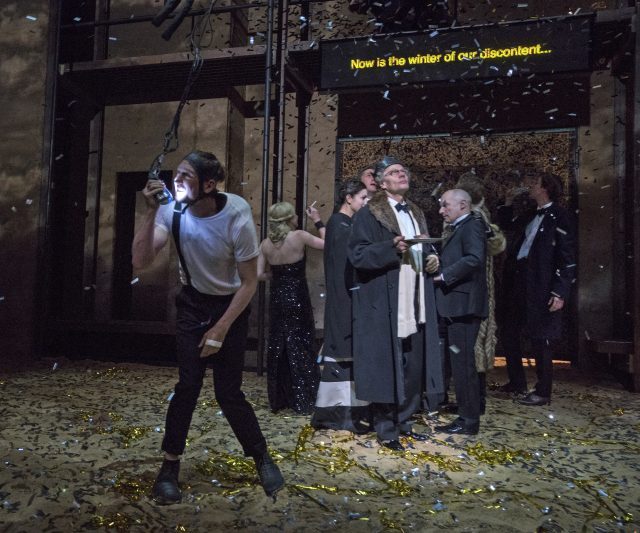
Lars Eidinger makes a major announcement as title character in spectacular staging of Richard III at BAM (photo by Richard Termine)

Brooklyn Academy of Music
BAM Harvey Theater
651 Fulton St.
October 11-14, $35-$115, 7:30
718-636-4100
www.bam.org
www.schaubuehne.de

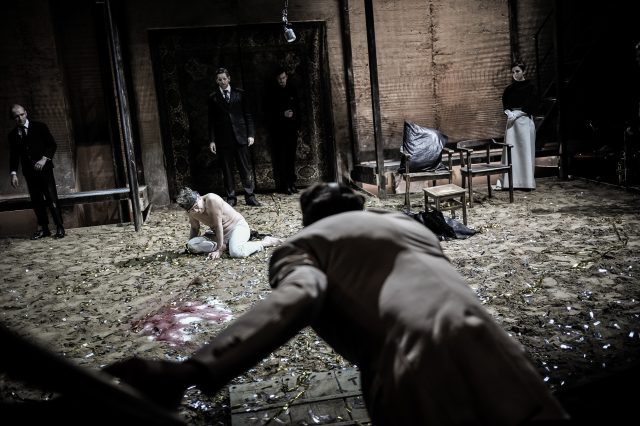
Richard III is one of the greatest characters in William Shakespeare’s canon, a hunchbacked purveyor of pure evil as he rises to power in fifteenth-century England. The deliciously maleficent and vengeful egomaniac has been played on stage and screen by a plethora of master thespians, including Laurence Olivier, Ian McKellen, Kevin Spacey, Al Pacino, Benedict Cumberbatch, Alec Guinness, Peter Dinklage, Mark Rylance, and George C. Scott. But now there’s a new monarch in town, by far and away the best portrayer of the dastardly demon I have ever seen: German actor Lars Eidinger. In Schaubühne Berlin’s ferocious, nonstop version, continuing at the BAM Harvey through October 14 and directed by Thomas Ostermeier (An Enemy of the People, Hedda Gabler, both at BAM), Eidinger is electrifying, literally and figuratively, as the extraordinary last of the Plantagenets. Eidinger speaks most of his dialogue using an old-fashioned bullet microphone that dangles from above, equipped with a light and a camera for extreme close-ups. Eidinger occasionally throws the mic away from him, then grabs it as it circles back in a kind of homage to Roger Daltrey. At one point the night I went, the mic sent out electric shocks right into Eidinger’s face, but he gamely carried on, muttering about “technical difficulties” with a wry smile. Wearing a white T-shirt, black pants and shoes, and a leather-strap helmet, his Richard is part dilapidated Alex from A Clockwork Orange, part steampunk gone wild, in a world of fashionably dressed men and women who, at the beginning, are at a decadent party straight out of a Christian Schad painting. (The fanciful costumes are by Florence von Gerkan.)

(photo by Richard Termine)

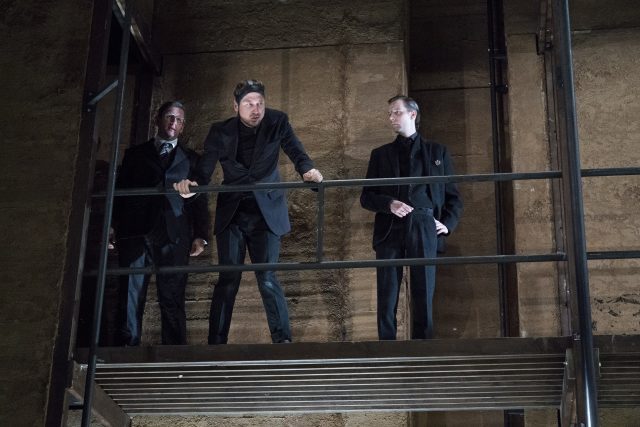
Richard (Lars Eidinger) surveys his domain in Thomas Ostermeier’s fast and furious Richard III (photo by Richard Termine)

As he takes care of business with his brothers, Clarence (Christoph Gawenda, also Dorset and Stanley) and Edward (Thomas Bading, also Lord Mayor of London and the Second Murderer), Hastings (Sebastian Schwarz, also Brakenbury and Ratcliff), Buckingham (Moritz Gottwald), Queen Margaret (Robert Beyer, also Catesby and the First Murderer), and Rivers (Laurenz Laufenberg), the hunched, club-footed Richard drags himself around Jan Pappelbaum’s set, which is fronted by a half-circle sandbox, with a two-story metal structure in the back, with poles that characters can slide down. When Richard wonderfully woos Lady Anne (Jenny König), he strips down almost completely, leaving only the black pillow that is fastened to his shoulder to form his hump. (Is it simply Eidinger’s prop, or could it be Richard’s?) Richard also makes his way into the audience several times, grabbing a seat, chatting patrons up, and waking up someone who was dozing off in the front row. He primarily speaks in German, although he ad libs in English, at which points he often looks back at one of the three surtitle screens to see if these words are projected there. He also quotes Tyler, the Creator and raps an Eminem song. But don’t let all of the unpredictable, devilish fun distract you from Richard’s real purpose: systematically dispatching anyone and everyone in his path to the throne, even a couple of puppets. Nils Ostendorf’s loud, furious score is made even more dramatic by Thomas Witte’s live drumming and Sébastien Dupouey’s video projections; Witte sits behind his kit stage left, clearly enjoying Eidinger’s antics. By the time Richard is ready for the final battle scene, there is no one else left onstage; he is fighting himself, as if the whole thing is taking place in his warped, deranged mind. It’s a captivating finale to a rousing version that breathes invigorating life into this always dependable warhorse.

BAM NEXT WAVE FESTIVAL: RICHARD III

(photo by Arno Declair)

Thomas Ostermeier transforms Richard III into a glittery spectacle in German production (photo by Arno Declair)

Brooklyn Academy of Music
BAM Harvey Theater
651 Fulton St.
October 11-14, $35-$115, 7:30
718-636-4100
www.bam.org
www.schaubuehne.de

German director Thomas Ostermeier and Schaubühne Berlin return to BAM with a wildly unpredictable, glittery, contemporary take on William Shakespeare’s paean to power and ego, Richard III, running October 11-14 at the BAM Harvey as part of BAM’s 2017 Next Wave Festival. Last at BAM in 2013 with An Enemy of the People —his previous shows at BAM include Nora in 2004, Hedda Gabler in 2006, and The Marriage of Maria Braun in 2010 — Ostermeier now presents the Bard as if caught up in endless expressionistic glam decadence. Lars Eidinger plays the hunchbacked villain, with Moritz Gottwald as Buckingham, Eva Meckbach as Elizabeth, and Jenny König as Lady Anne. The pulsating soundtrack is by Nils Ostendorf, with songs by Tyler Gregory Okonma, Laurie Anderson, Iannis Xenakis, and Thomas Tomkins and Andrew John Powell; Thomas Witte provides live drumming. The luxuriously gaudy visual style comes courtesy of set designer Jan Pappelbaum, with costumes by Florence von Gerkan, video by Sébastien Dupouey, dramaturgy by Florian Borchmeyer (who adapted An Enemy of the People), and lighting by Erich Schneider. On October 12 at 6:00 ($25) at BAM Rose Cinemas, Ostermeier will sit down for an “Iconic Artist Talk” with playwright Branden Jacobs-Jenkins (Everybody, An Octoroon), who is adapting Ostermeier and Borchmeyer’s An Enemy of the People for a Broadway run later this season.

THE BEAUTY QUEEN OF LEENANE

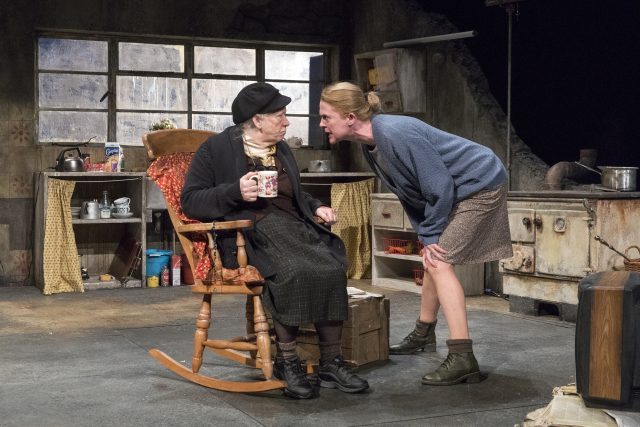
Mother and daughter go at it tooth and nail in THE BEAUTY QUEEN OF LEENANE (photo by Richard Termine)

Mother (Marie Mullen) and daughter (Aisling O’Sullivan) go at it tooth and nail in THE BEAUTY QUEEN OF LEENANE (photo by Richard Termine)

Brooklyn Academy of Music
BAM Harvey Theater
651 Fulton St.
Through February 5, $35-$110
718-636-4100
www.bam.org

Galway’s Druid Theatre Company is celebrating the twentieth anniversary of one of its biggest successes, Martin McDonagh’s Olivier- and Tony-nominated The Beauty Queen of Leenane, with a searing revival running at the BAM Harvey through February 5. Written in a week and a half when the playwright, who was born and raised in London to Irish parents, was twenty-four, Beauty Queen is set in a ramshackle house in rural Connemara, where disillusioned forty-year-old virgin Maureen Folan (Aisling O’Sullivan) takes care of her bitter, nasty seventy-year-old mother, Mag (Marie Mullen). The two are at each other’s throats constantly, fighting like married couple George and Martha in Who’s Afraid of Virginia Woolf? and sisters Jane and Blanche Hudson in What Ever Happened to Baby Jane? “You’re oul and you’re stupid and you don’t know what you’re talking about. Now shut up and eat your oul porridge,” Maureen says to her mother, who spends most of her day sitting in a rocking chair, waiting for the news to come on the television, surviving on lumpy porridge, biscuits, and the nutritional drink Complan. Early on, Maureen, after being called a “whore” by Mag, tells her mother about a daydream she has about her mother’s death, which would free her to finally have a life of her own and find a man who loves her. “Not at all is that a nice dream. That’s a mean dream,” Mag says, to which Maureen replies, “I don’t know if it is or it isn’t. I suppose now you’ll never be dying. You’ll be hanging on forever, just to spite me.” Mag: “I will be hanging on forever!” Maureen: “I know you will!” Mag: “Seventy you’ll be at my wake, and then how many men’ll there be round your waist with their aftershave?” Maureen: “None at all, I suppose.” Mag: “None at all is right!” But when Ray Dooley (Aaron Monaghan) invites Maureen to a party and she comes home with his older brother, Pato (Marty Rea), who spends the night, both women up the ante as Maureen thinks Pato, who just got a job in Boston, is her way out while Mag is determined not to be left alone to rot away.
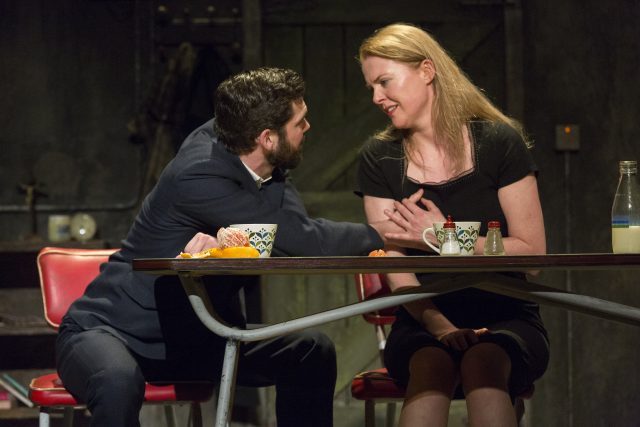
(photo by Richard Termine)

Pato Dooley (Marty Rea) and Maureen Folan (Aisling O’Sullivan) explore love and escape in THE BEAUTY QUEEN OF LEENANE (photo by Richard Termine)

Part of a trilogy with A Skull in Connemara and The Lonesome West, The Beauty Queen of Leenane is a sizzling black comedy, with nary a word or movement out of place. Original director Garry Hynes, who cofounded the Druid in 1975 with Mullen and Mick Lally, once again does a spectacular job with McDonagh’s (The Cripple of Inishmaan, The Pillowman) sharp, focused writing, which was inspired by American films; there’s a cinematic aspect to the play, as if the audience can visualize the scenes that are only referred to in the dialogue, occurring outside Francis O’Connor’s run-down kitchen set, its sides torn off as if psychologically ripped away from reality. (McDonagh has also written and directed several movies, including In Bruges and Seven Psychopaths.) In addition, the set features metal rods hanging from above like crosses and depictions of Mary and Jesus, which stand in sharp contract to mother Mag and daughter Maureen, neither of whom is a saint. The 1998 Broadway production was nominated for seven Tonys, including Best Play and nods for all four actors, and won four awards, for Best Leading Actress (Mullen as Maureen), Best Featured Actor (Tom Murphy as Ray, who beat out costar Brían F. O’Byrne as Pato), Best Featured Actress (Anna Manahan as Mag), and Best Director (Hynes, the first woman to win a Tony in that category). The four cast members of this blistering revival, who appeared together in Druid’s 2014 production of Dion Boucicault’s The Colleen Bawn, also directed by Hynes, give award-worthy performances as well. O’Sullivan is magnificent as Maureen, a nearly beaten woman who suddenly comes to life when potential love walks through the door; even her outfits, by O’Connor, are spectacular, from a sexy black dress to a slim slip. Mullen, who portrayed Maureen in the original production, is phenomenal now as Mag, who is no mere grumpy old hypochondriac. Rea is gentle and touching as Pato, wonderfully delivering the long, beautiful letter-soliloquy that opens the second act, while Monaghan serves up fine, frantic comic relief as Ray, whose wacky ramblings actually are realistic interpretations of contemporary Ireland. The heart of the story might be the relationship between mother and daughter, but Ray adds references to the state of the nation, referencing unemployment, emigration, the financial crisis, the media, and other current events that still ring true today, as does the age-old struggle for dominance in the never-ending mother-daughter battle.
BAM NEXT WAVE FESTIVAL: BATTLEFIELD

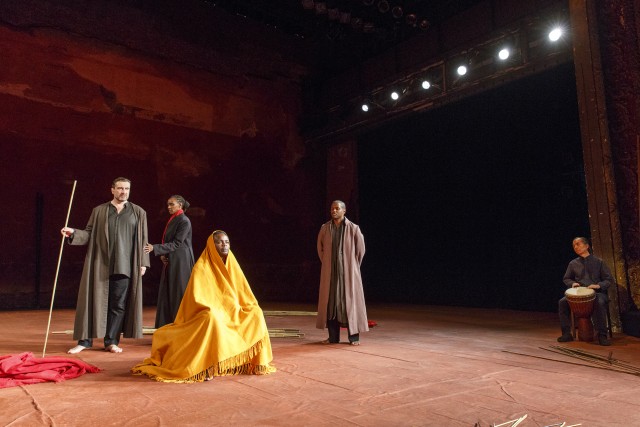
Sean O’Callaghan, Carole Karemera, Ery Nzaramba, Jared McNeill, and Toshi Tsuchitori in BATTLEFIELD (photo by Richard Termine)

Sean O’Callaghan, Carole Karemera, Ery Nzaramba, Jared McNeill, and Toshi Tsuchitori appear in BATTLEFIELD at BAM (photo by Richard Termine)

Next Wave Festival
Brooklyn Academy of Music
BAM Harvey Theater
651 Fulton St.
Through October 9, $30-$110
718-636-4100
www.bam.org
www.bouffesdunord.com

“To hell with the state of humanity,” the blind king Dritarashtra (Sean O’Callaghan) says at the beginning of Battlefield, Peter Brook and Marie-Hélène Estienne’s return to their international triumph, The Mahabharata. It’s also a return home for the ancient Sanskrit epic to the BAM Harvey, previously an abandoned movie house that was renovated back in the late 1980s specifically for the nine-hour Mahabharata. In Battlefield, codirectors Brook and Estienne and their C.I.C.T. — Théâtre des Bouffes du Nord company explore a central section of The Mahabharata, focusing on the aftermath of the bloody battle between the Pandavas and the Kauravas, which left millions dead. The sparse stage is littered with bamboo sticks that represent the victims of the fierce war; there is also a small black rectangular block where various characters sit, mournfully understanding that there is little difference between victory and defeat. The new king, Yudhishthira (Jared McNeill), seeks advice from a soothsayer (Ery Nzaramba, who also plays several victims) and learns a devastating secret from his mother, Kunti (Carole Karemera), while Toshi Tsuchitori, who also performed in the original Mahabharata, sits in a chair off to the side, playing powerfully moving percussion on his African drum. The play evokes both Shakespeare and Brook and Estienne’s adaptation of The Suit, but it is too often flat and lackluster. There are some wonderful moments, particularly the use of colored scarves to identify the characters (the costumes are by Oria Puppo) in addition to sticks that represent various objects, but the stripped-down seventy-minute production feels like it’s all middle, with no beginning or end, existing in its own unclear time and space, even as it makes relevant connections to what is going on in the world today. Brook will participate in a discussion following the October 6 performance. The play runs through October 9, after which BAMcinématek will present the series “Peter Brook: Behind the Camera,” consisting of nine of the Paris-based English director’s films, beginning October 10 at 7:00 with his five-and-a-half-hour adaptation of The Mahabharata, which he will introduce, and continuing through October 20 with such works as The Beggar’s Opera, Lord of the Flies, Swann in Love, King Lear (starring Paul Scofield), and a week-long run of 1968’s Tell Me Lies (A Film About London).