Tag Archives: bam harvey theater

LISTEN TO WHAT THE QUEEN SAID: ISABELLE HUPPERT AS MARY AT NYU SKIRBALL

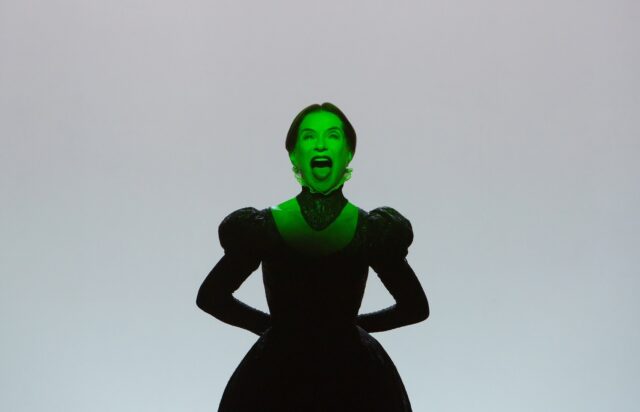
Isabelle Huppert portrays Mary, Queen of Scots in third collaboration with Robert Wilson (photo by Lucie Jansch)

ROBERT WILSON & ISABELLE HUPPERT: MARY SAID WHAT SHE SAID
NYU Skirball Center for the Performing Arts
566 La Guardia Pl.
February 27 – March 2, $125
nyuskirball.org

In October 2005, French superstar Isabelle Huppert performed Sarah Kane’s blistering solo piece, 4.48 Psychose, at BAM’s Harvey Theater. For ninety-five minutes, the Oscar-nominated, BAFTA, César, and Cannes–winning actress stood stock-still — except for occasionally scanning the audience or extending a finger — portraying a woman who had just suffered a mental breakdown.

In New York, Huppert has also appeared in Florian Zeller’s The Mother at the Atlantic in 2019 and, at BAM, in Krzysztof Warlikowski’s Phaedra(s) in 2016 and Robert Wilson’s Quartett in 2009.

Always ready to take on artistic challenges, Huppert has teamed up with Wilson for the third time with Mary Said What She Said, in which Huppert, who has made more than 135 films, including The Lacemaker, Heaven’s Gate, The Piano Teacher, and Elle, gets inside the head of Mary, Queen of Scots, the sixteenth-century Scottish monarch. The show is divided into three parts consisting of eighty-six paragraphs, beginning with “Memory, open my heart.”

Wilson, who has dazzled the world with such wildly unpredictable and visually stunning productions as Einstein on the Beach, The Black Rider, and The Old Woman, is the director of the Théâtre de la Ville-Paris commission as well as the set and lighting designer. The text, which is performed in French with English surtitles, is by longtime Wilson collaborator, novelist, and essayist Darryl Pinckney, using Mary’s own letters and Stefan Zweig’s 1935 biography of the queen in his research. The music is by Ludovico Einaudi, who has worked with such experimental composers as Luciano Berio and Karlheinz Stockhausen.

The US premiere at NYU Skirball runs February 27 to March 2; all tickets are $125 to see one of the greatest actors of our era in a show by one of the most inventive creators of our time, promising to be something special. As a bonus, Huppert will participate in a talkback following the 7:30 show on March 1.

[Mark Rifkin is a Brooklyn-born, Manhattan-based writer and editor; you can follow him on Substack here.]

CYRANO DE BERGERAC

Jamie Lloyd’s reimagining of Cyrano de Bergerac continues at BAM through May 22 (photo by Marc Brenner)

CYRANO DE BERGERAC
Brooklyn Academy of Music
BAM Strong, Harvey Theater
651 Fulton St. between Ashland & Rockwell Pl.
Tuesday – Sunday through May 22, $45-$310
718-636-4100
www.bam.org/cyrano

Jamie Lloyd reimagines Edmond Rostand’s Cyrano de Bergerac for the twenty-first century in his electrifying, Olivier-winning production that continues tearing down the house at the BAM Harvey through May 22.

As the play opens and a swarm of young people in contemporary street clothes congregate on a stark white stage, one man sits in a chair with his back to the audience, gazing into a mirror as if he can’t look away. We know it’s James McAvoy, the gorgeous Scottish superstar, portraying nobleman, soldier, and poet Cyrano de Bergerac sans the character’s famously large and ugly proboscis. But still, when he finally turns around, there’s an audible gasp from the audience; McAvoy, in tight-fitting black jeans, boots, and jacket, is even hotter than we imagined. If he has a problem with the way he looks, what does that say about the rest of us?

However, Ligniere (Nima Taleghani) declares, “The Parisian isn’t superior / just everyone else is inferior.” Thus, director Lloyd and translator and adaptor Martin Crimp are leveling the playing field from the start; we all have things about ourselves that we think are ugly, on the surface and/or inside.

Meanwhile, university student Roxane (Evelyn Miller) demands to be recognized as more than just a pretty face, insisting on being respected for her brains more than her beauty, although she has fallen head-over-heels for the simpleton Christian (Eben Figueiredo), who is most definitely not the brightest bulb in the chandelier. Roxane is not always portrayed as a strong, intelligent character who exists outside of her cousin, Cyrano, and Christian, but she is very much her own woman here. “I am so, so bored with not being taken seriously by men,” she says.

Rostand’s 1897 original is a tribute to the power and glory of speech and the written word; Lloyd and Crimp now further that to the spoken word via rap, as if Cyrano is taking place in a hip-hop battle straight out of Eminem’s 8 Mile. “They say when he came through his mother’s vagina / his nose poked out first as a painful reminder / of all the agony to come,” one character explains.

Roxane (Evelyn Miller) and Cyrano (James McAvoy) enjoy a rare laugh together in electrifying adaptation at BAM (photo by Marc Brenner)

“When you first see it you say to yourself NO! ―/ that is a party-trick ― take it off, Cyrano,” the poet and pastry chef Ragueneau (Michele Austin) says about the nose. “You expect him to reach up and somehow unscrew it. / But the damage is done: He can never undo it.” Ragueneau, played by a woman in this version, is Roxane’s best friend and regular companion.

Cyrano is madly in love with Roxane, who is being unsuccessfully set up by the villainous De Guiche (Tom Edden) to wed the young nobleman Valvert and thereafter be shared with De Guiche, who sends Cyrano and Christian off to a military conflict they might not return from. Cyrano himself declares, “If style points you in a sexual direction / You might want to refer, Valvert, to my nasal erection.”

Through all its iterations, including the 1950 film with José Ferrer, the 1987 rom-com with Steve Martin, and the 2019 theater musical (and later film) with Peter Dinklage, Cyrano is about the unrequited love of a lover of language who has to hide behind his ugly facade to help another man capture the heart of a not necessarily strong-willed, self-capable woman he believes he is destined to be with.

Lloyd (Betrayal, Three Days of Rain), who presented a more traditional Cyrano for Roundabout in 2012, complete with a balcony scene and Douglas Hodge wearing a fake nose, this time has streamlined the visuals. Soutra Gilmour’s set is a big white box in which stairs move in and out, with overhead fluorescent lights creating haunting shadows. (Gilmour also designed the costumes; the lighting is by Jon Clark, with music and sound by Ben and Max Ringham.) Instead of parrying with their swords, characters fight it out with microphones, either attached to their head, held in their hand, or on a stand.

A beatboxer (Vaneeka Dadhria) serves as a kind of narrator throughout, but the rapping, which can be thrilling, gets to be too much. Like Cyrano, Rostand is a master wordsmith with an infectious love of the lexicon, which doesn’t always come through, even when the phrase “I love words, that’s all,” is projected onto the back wall. The play works significantly better when it slows down and focuses on the relationships, when the music stops and the tension between Cyrano, Roxane, Christian, De Guiche, and Ragueneau takes center stage (although one intimate scene with Cyrano and Christian goes wildly awry).

McAvoy (The Ruling Class, The Last King of Scotland), in a role previously performed by Martin, Ferrer, Hodge, Ralph Richardson, Derek Jacobi, Richard Chamberlain, Christopher Plummer, Gérard Depardieu, and Kevin Kline, among others over the last century-plus, sizzles as Cyrano; he dominates the Harvey with a magnetic power, his intense sensuality increasing with his every move. Miller (Flowers in the Attic, Jane Eyre) brings depth and a fierce perceptiveness to Roxane, although it is never clear why such a strong, brave woman is enraptured with the dimwitted Christian, who is no hot hunk, but that is all part of Lloyd’s twisting of expectations.

And in the end, like most of us, despite Cyrano’s romance with language itself, he is at a loss of words when expressing his desire for Roxane. He stumbles, “I’m speechless, speechless, all I can say is I want — I want — I want — there is no poetry — there is no structure that can make any sense of this — only I want — I want — I want — I want you.” It’s that passion that drives Lloyd’s unique reinterpretation of a classic.
A NEW YORK SEASON: POWER

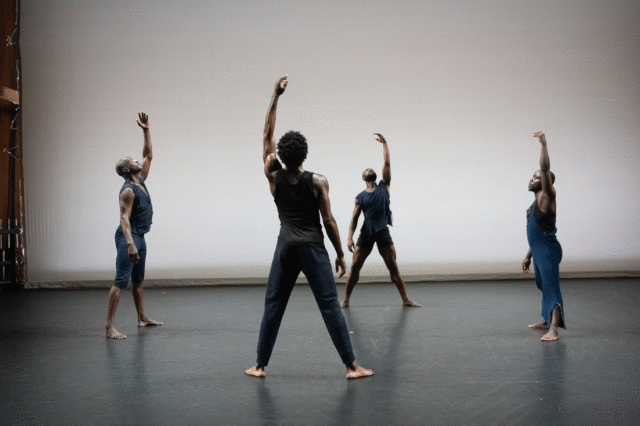
Reggie Wilson’s Power explores Black Shakers and spirituality (photo by Christopher Duggan / courtesy Jacob’s Pillow)

POWER
Brooklyn Academy of Music
Harvey Theater at BAM Strong
651 Fulton St. between Ashland & Rockwell Pl.
January 13-15, $25-$55, 7:30
718-636-4100
www.bam.org/power

Reggie Wilson and his Fist & Heel Performance Group — “Not Just Your Mama’s Post-Modern Dance Company” — return to their home borough of Brooklyn for the New York City premiere of Power, running January 13-15 at the Harvey Theater at BAM Strong. Held in conjunction with BAM’s annual celebration of MLK Day, Power is an exhilarating seventy-minute piece about freedom and spirituality set in the world of the Shakers, asking the questions “What would the worship of Black Shakers actually have looked like?” and “How were the general, core Shaker tenets of ‘heaven on earth’ realized (social activism, pacifism, gender equality, celibacy, and the confession of sin)?”

Choreographed by Wilson and inspired by Black Shaker Eldress Mother Rebecca Cox Jackson, Shaker foundress Mother Ann Lee, the First Great Awakening (the Evangelical Revival), and American Utopianism and Binary Opposition (as well as Wilson’s 1995 The Littlest Baptist), the work is performed by eight dancers and three vocalists, with costumes by Naoko Nagata and Enver Chakartash and lighting by Jonathan Belcher, featuring songs by the Staple Singers, Bessie Jones & St. Simon’s Island Singers, Meredith Monk, Craig Loftis, Omar Thiam with Jam Begum & Khady Saar, and others. Power was developed at Danspace Project, then Jacob’s Pillow and the nearby Hancock Shaker Village.

“The idea of spirituality, religiosity, being able to be manifested with the body in relationship with other bodies is something really kind of exciting, so when I heard specifically about Mother Rebecca Cox Jackson in Philadelphia having a Black Shaker community, it seemed like there were two worlds that I had never actually put together in my imagination,” Wilson says in the above BAM behind-the-scenes video. “It also seemed parallel to my eternal and ongoing obsession with thinking about Black and Africanist traditions in relationship to white or postmodern performance or religions.”

Power is part of BAM’s program “A New York Season,” which continues with Pam Tanowitz Dance’s Four Quarters and Kyle Abraham’s An Untitled Love in February and SITI Company’s The Medium and Mark Morris’s L’Allegro, il Penseroso ed il Moderato in March.

MEDEA

(photo by Richard Termine)

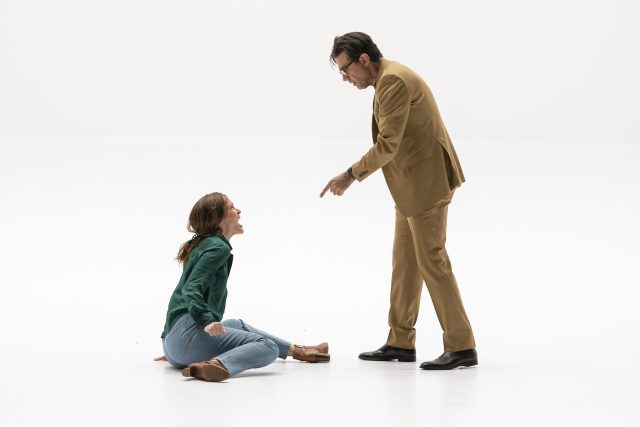
Real-life partners Rose Byrne and Bobby Cannavale star in Simon Stone’s sizzling Medea at BAM (photo by Richard Termine)

Brooklyn Academy of Music
BAM Harvey Theater
651 Fulton St. at Ashland Pl.
Tuesday – Sunday through March 8, $45-$195
718-636-4100
www.bam.org/medea

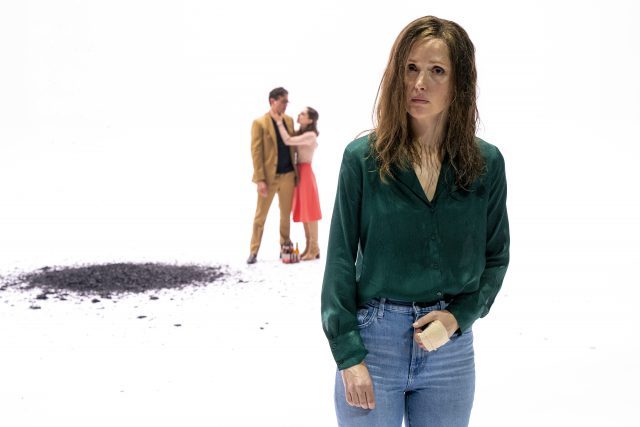
As you enter BAM’s elegantly shabby chic Harvey Theater to see Simon Stone’s Medea, there are two young boys already onstage, one stretched out on the floor, on his laptop, the other leaning against a wall, on his smartphone. Bob Cousins’s dramatic cyclorama set is blindingly white, evoking a heavenly way station, making it look as if the unconcerned brothers are floating in a mysterious void. In this riveting adaptation, inspired by Euripides’s 431 BC original and the true story of Dr. Debora Green, who committed horrific crimes against her family in Kansas in 1995, Stone instantly puts us in the kids’ shoes. It’s a thrillingly uncomfortable moment since, of course, this is Medea, and we know it will not end well for the siblings. And getting there is indeed heart-wrenching.

Contemporary stand-ins for Jason and Medea, Lucas (Bobby Cannavale) and Anna (Rose Byrne) are married pharmaceutical scientists facing a crisis. Anna has just been released from a psychiatric facility after having done something bad to Lucas, who is in a relationship with a woman half his age, Clara (Madeline Weinstein), the daughter of their boss, Christopher (Dylan Baker). Anna plans to simply walk back into their old life with their two sons, Edgar (Gabriel Amoroso or Jolly Swag) and (Gus Emeka or Orson Hong Guindo), but Lucas has other ideas. “I know your trust will be hard to regain. What I did to you,” Anna says. “We don’t need to talk about it now,” Lucas replies. Anna: “No, I want to. It was a breach of trust. Most importantly it was trust that we lost.” Lucas: “I’m not —” Anna: “In all those messy months we lost sight of everything we’d promised to be to each other and both of us did that but I overstepped the line —” Lucas: “We should never have stayed together this long.” A determined Anna later adds, “I’m going to win you back.” That does not go so well either.

(photo by Richard Termine)

Social worker Elsbeth (Jordan Boatman) does not have the easiest of jobs monitoring Anna (Rose Byrne) and her two young sons (photo by Richard Termine)

Medea is ripe for reinterpretation, particularly in a world rife with misogyny and violence. In the past ten years I have seen Aaron Mark’s Another Medea, Limb Hyoung-taek’s Medea and Its Double, and Luis Alfaro’s Mojada, all of which took the central story and reimagined it in unique and compelling ways. Born in Basel and raised in England and Australia, Stone, who moves all around the globe, rarely settling down for an extended period of time, has previously adapted such classics as The Wild Duck, Miss Julie, John Gabriel Borkman, Peer Gynt, Three Sisters, and Hamlet and dazzled New York audiences with his sizzling Yerma at Park Avenue Armory in 2018, infusing his work with personal experience, as he does again with Medea.

The set features one large rectangular white wall that occasionally rises to serve as a projection screen, showing either extreme close-ups of the action, primarily a spellbinding Byrne, her evocative eyes searching for meaning, or live-stream shots by Edgar, who is making an autobiographical film for school. (The video design is by Julia Frey, with bright lighting by Sarah Johnston.) The play was originally performed at live-streaming master and BAM fixture Ivo van Hove’s Internationaal Theater Amsterdam (formerly Toneelgroep Amsterdam); the video footage can get to be a bit too much, so it’s a relief when the device goes away in the latter parts of the eighty-minute production, when things really heat up.

The cast is all new for this US premiere, with solid support led by Tony and Emmy nominee Baker (La Bête, Happiness, The Americans) and Weinstein (The Real Thing, Mary Page Marlowe) in addition to Victor Almanzar as bookstore owner Herbert, who offers Anna a job, and Jordan Boatman as Elsbeth, the social worker in charge of her case, keeping a close watch on her treatment of Gus and Edgar. At one point Stone makes a tongue-in-cheek reference to the finale of The Sopranos that is a wry riff on what ultimately happens in his take on Medea, as two famous families meet their fate.

(photo by Richard Termine)

Anna (Rose Byrne) is none too happy that her husband, Lucas (Bobby Cannavale), is now with Clara (Madeline Weinstein) in contemporary update of Medea (photo by Richard Termine)

Byrne (Bridesmaids, You Can’t Take It with You) plays Anna with a strong-willed vulnerability; she is no mere woman scorned, seeking revenge, but an intelligent wife, mother, and scientist who had the deck stacked against her and refuses to sit back and let everyone walk over her. She has a fiery, passionate chemistry with Cannavale (The Hairy Ape, The Lifespan of a Fact), who also displays a strong-willed vulnerability, allowing the cracks in Lucas’s armor to show through. “She created this instability,” Clara argues to Lucas. “I did too,” he readily admits. This is a Medea that could only be created in today’s #MeToo sociopolitical climate.

The Australian Byrne and New Jersey native Cannavale are real-life partners with two young boys of their own; after going through hell onstage, they head back to their nearby Gowanus apartment to be with their kids. Byrne and Cannavale work together often on television and in film, but this is the first time they are acting opposite each other onstage; later this year they will portray another married couple in Arthur Miller’s A View from the Bridge for the Sydney Theatre Company. At the start of Medea, Anna shows Lucas a painting she made while at the asylum, depicting Noah’s ship in a storm, in which all the animals are drowning. “They thought they were safe and then another storm whipped up and capsized the ark,” Anna tells a confused Lucas. She continues, “You see the dead dove floating on the swell over there? With the olive branch still in its mouth?” It’s a metaphor for Anna’s state of mind, but one can also think of it as a kind of peace offering between Byrne and Cannavale as they return to a normal life following the searing heartbreak their characters experience night after night.

BAM NEXT WAVE FESTIVAL: THE BACCHAE

(photo by Craig Schwartz)

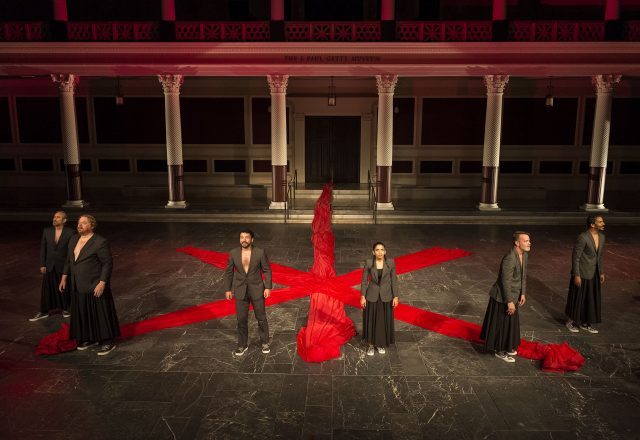
Anne Bogart and SITI Company relate Euripides’ The Bacchae to today’s sociopolitical ills in new interpretation (photo by Craig Schwartz)

THE BACCHAE
Brooklyn Academy of Music
BAM Harvey Theater
651 Fulton St. at Ashland Pl.
October 3-7, $40-$75
718-636-4100
www.bam.org

Anne Bogart and SITI Company return to BAM’s Next Wave Festival with their new interpretation of Euripides’ classic tale of gods and mortals, religion and the state, the earthly and the divine, The Bacchae. “More than any other play in Western civilization, Euripides’ is probably the one that most directly addresses the art of theater,” Bogart explains in a program note. “We are aware, for example, that we are looking at an actor or at a precisely lit staging and scenery, but at the same time we allow ourselves to enter into another world that is merely suggested by what is actually present.” The work, which premiered at the Getty Villa in California last month, is translated by Aaron Poochigian, with set and lighting by Brian H Scott, sound by Darron L West, and music composed by Erik Sanko. The cast features Ellen Lauren as Dionysus, Barney O’Hanlon as Tiresias, Stephen Duff Webber as Cadmus, Eric Berryman as Pentheus, and Akiko Aizawa as Agave. In conjunction with the show, the talk “Speaking Truth to Power: On Fear and Governance” will take place October 5 at the BAM Fisher’s Hillman Studio ($15, 6:00), with Anne Bogart and Monica Youn in conversation with Corey Robin, and BAM and the Mark Morris Dance Group are teaming up for “Introduction to Suzuki & Viewpoints,” a master class with SITI, on October 10 ($25, 12 noon) for theater artists, actors, dancers, performers, and directors.

LONG DAY’S JOURNEY INTO NIGHT

(photo by Richard Termine)

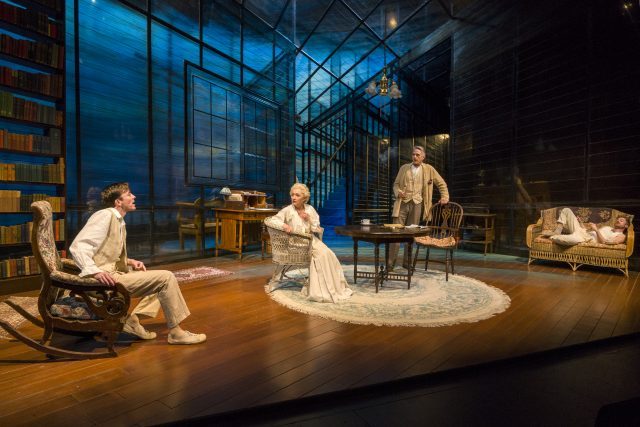
Sir Richard Eyre’s intimate staging of Eugene O’Neill classic continues at BAM through May 27 (photo by Richard Termine)

Brooklyn Academy of Music
BAM Harvey Theater
651 Fulton St.
through May 27, $25-$150, 7:30
718-636-4100
www.bam.org

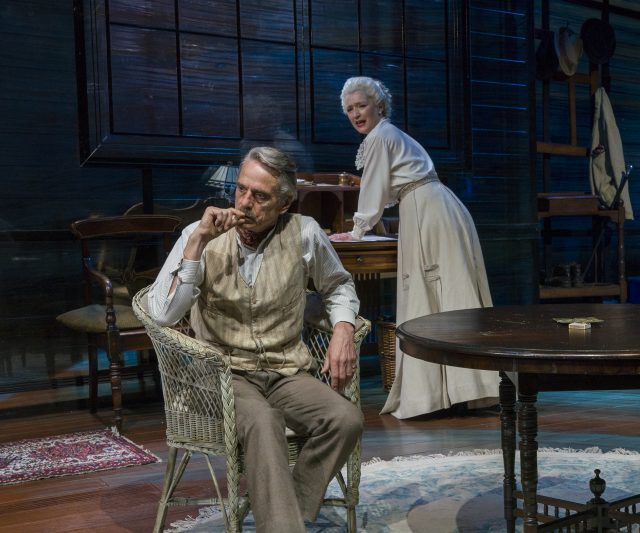
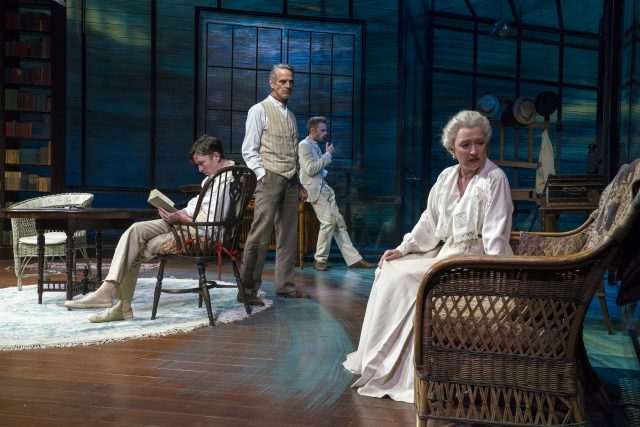
The walls are closing in on the Tyrone family and there’s not much anyone can do about it in Sir Richard Eyre’s deeply intimate staging of Eugene O’Neill’s autobiographical masterpiece, Long Day’s Journey into Night, a work so personal that O’Neill never wanted it to be performed. Eyre initially brought the show to the Bristol Old Vic as part of the venerable institution’s 250th anniversary in 2016, with Oscar, Emmy, and Tony winner Jeremy Irons as James Tyrone and Olivier winner and Oscar nominee Lesley Manville as his wife, Mary; the Bristol was where Eyre saw his first play and where Irons trained. A stunning, slightly amended production is now running at the BAM Harvey through May 27 before heading out to California. Rob Howell’s set is staggeringly breathtaking, a large living room with sharply angled glass walls and ceilings that seem to both threaten and expose James and Mary as well as their sons, the sickly Edmund (Matthew Beard) and the ne’er-do-well Jamie (Rory Keenan), along with the maid, Cathleen (Jessica Regan). James is a famous actor who, emotionally crippled by childhood poverty, chose the easy way out, a financially successful career touring his big hit, The Count of Monte Cristo, rather than pursuing artistic challenges. Despite his money, he remains fearful and miserly, and his family has been scarred by it. While James, Jamie, and Edmund drink heartily, Mary is addicted to painkillers, claiming they are for the rheumatism that is crippling her hands. She has recently returned from yet another stay in a sanitarium, and the men are keeping a close eye on her, particularly when she goes upstairs and spends time in the extra bedroom, where she loses herself in her morphine-addled world. James desperately wants to keep the truth about Edmund’s illness from Mary, but he no longer has the tight grip on his family that he might have once had.

(photo by Richard Termine)

James Tyrone (Jeremy Irons) and Mary (Lesley Manville) fight many demons in Long Day’s Journey into Night (photo by Richard Termine)

It all takes place on a foggy August day in 1912, but the show feels as relevant as ever, given the current opioid crisis that is devastating America, and O’Neill’s knowing depiction of functional alcoholism is as sharp as ever. Former National Theatre director Eyre (Ghosts at BAM, The Crucible on Broadway) focuses on conversations between two characters, making it feel like we are invading their privacy, intruding on this dysfunctional family, whether we’re watching a sweet, romantic moment between James and Mary, a warm bonding between James and Edmund, or a lovely little talk between Mary and Cathleen. The cast is exceptional, led by a brilliant performance by Manville (The Phantom Thread, Ghosts); she plays Mary with more of a firm grounding than usual, as if Mary has a legitimate fighting chance to beat her addiction. (Previous portrayers of Mary include Tony winners Florence Eldridge, Vanessa Redgrave, and Jessica Lange as well as Geraldine Fitzgerald, Zoe Caldwell, Bibi Andersson, Laurie Metcalf, Liv Ullmann, and Colleen Dewhurst.) In one scene she starts to go upstairs several times but turns back, which tortures her husband and sons and teases the audience, even though we know where she will eventually end up. Irons (Reversal of Fortune, The Real Thing) is classy and erudite as James, his long legs spread apart magnificently when he’s smoking his cigar and reading the paper at the table; he looks at Mary with real tenderness, recalling a love he might never recapture. (The role has earned Tonys for Fredric March and Brian Dennehy and nominations for Jack Lemmon and Gabriel Byrne; other portrayers include Laurence Olivier, James Cromwell, Robert Ryan, Alfred Molina, and David Suchet.)

(photo by Richard Termine)

The Tyrone family can’t look away from their troubled existence in Bristol Old Vic production at BAM (photo by Richard Termine)

Tony nominee Beard (Skylight, And When Did You Last See Your Father?) has an amiability not always associated with Edmund, while Keenan (Liola, The Kitchen) is brash and determined as Jamie, who has given up on any kind of reputable future. Regan (Doctors, Liola) makes the most of the small but important role of Cathleen. Peter Mumford’s lighting often results in characters’ being reflected in the windows, like ghostly apparitions of their troubled souls. As dark as the play is, Eyre holds out just enough hope that this time things will turn around for the Tyrones, that maybe Jamie will get a real job, Edmund will beat consumption, Mary will kick morphine, and James will go back to the stage. But as Mary says, “None of us can help the things life has done to us. They’re done before you realize it, and once they’re done they make you do other things until at last everything comes between you and what you’d like to be, and you’ve lost your true self forever.” Written seventy-five years ago, O’Neill’s words still ring true, providing yet more sparks to this American classic.

KING LEAR

(photo by Richard Termine)

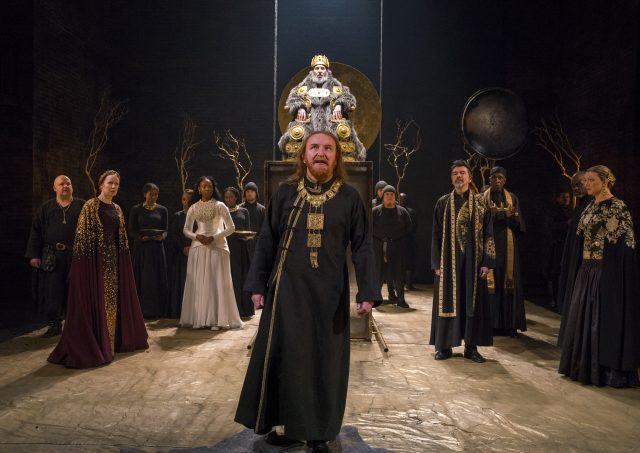
Kent (Antony Byrne) is at the ready as Lear (Sir Antony Sher) enters in Royal Shakespeare production at BAM (photo by Richard Termine)

Brooklyn Academy of Music
BAM Harvey Theater
651 Fulton St.
April 7-29, $35-$125, 7:30 (plus weekend matinees)
718-636-4100
www.bam.org

Sir Antony Sher bids adieu to Shakespeare in a dark version of the already dark King Lear, continuing at BAM’s Harvey Theater through April 27. The Royal Shakespeare Company production takes place in a dank, dreary, dismal world reminiscent of Akira Kurosawa’s The Lower Depths, where poverty and disillusionment reign. As the audience enters the theater, robed and hooded figures slowly walk onstage from the wings and sit on a vinyl tarp covering the ground, which is strewn with black gravel, while hellish mist floats in. After several minutes, they leave and a door in the back wall opens; Lear, wearing an enormous, brutal, bearlike fur coat, makes his entrance, sitting on his throne atop a large box with transparent sides. The members of the court are all dressed in black, some with gold adornments, except for one woman, who we soon learn is Cordelia (Mimi Ndiweni). Prepared to divide his kingdom into thirds, Lear listens as first Goneril (Nia Gwynne), who is married to the Duke of Albany (Clarence Smith), then Regan (Kelly Williams), wed to the Duke of Cornwall (James Clyde), profess their undying love for their father, and each is rewarded with their share of the kingdom. But when Cordelia, the youngest daughter, tells Lear she loves him as a child should love a parent, refusing to damn him with faint praise, he disinherits her. Lear’s trusted friend and adviser, the Earl of Kent (Antony Byrne), questions the king’s decision, so he is exiled. Afterward, another of Lear’s advisers, the Earl of Gloucester (David Troughton), is tricked by his illegitimate son, Edmund (Paapa Essiedu), into believing that his older son, Edgar (Oliver Johnstone), has plotted against him, leading Edgar to run away and disguise himself as Poor Tom, a crazy wanderer. Things don’t go well from there for anyone in the play, which was inspired by Raphael Holinshed’s Chronicles of England, Scotland, and Ireland and Sir Philip Sidney’s Countess of Pembroke’s Arcadia.

The Brooklyn Academy of Music has been presenting Lear for more than 150 years, with a wide range of actors portraying the king, from Ernesto Rossi and Edwin Booth to Frank Langella and Sir Derek Jacobi. “It’s all Ian McKellen’s fault,” Sher writes at the beginning of his latest book, Year of the King: The Lear Diaries; McKellen played Lear at BAM in 2007. Directed by RSC artistic director Gregory Doran, Sher’s longtime partner, this Lear is more subtle than most, if that word can be used at all to describe the Bard’s monumental tragedy. The sixty-eight-year-old Sher plays Lear as a sad, gentle, at times spoiled child who is already in decline before completely unraveling. With great understatement he towers over everyone in the storm scene, high atop the box, video of a rushing waterfall raging behind him, but he has already lost it all. Byrne is a fine, forceful Kent, boasting a shaved head with a warriorlike tattoo; he’s determined to bring the king back to reality, but he knows it’s too late. Troughton is magnificent as Gloucester, a pathetic figure on his way to certain doom, his hair so disheveled you want to go onstage and hug him (and comb his dreary locks). Johnstone’s Edgar is heartbreaking as well, a kind of sprite who has been beaten down by a cruel world he can’t understand. And Graham Turner is a memorable Fool, a tall, strong clown whose mind and body break down over time.

(photo by Richard Termine)

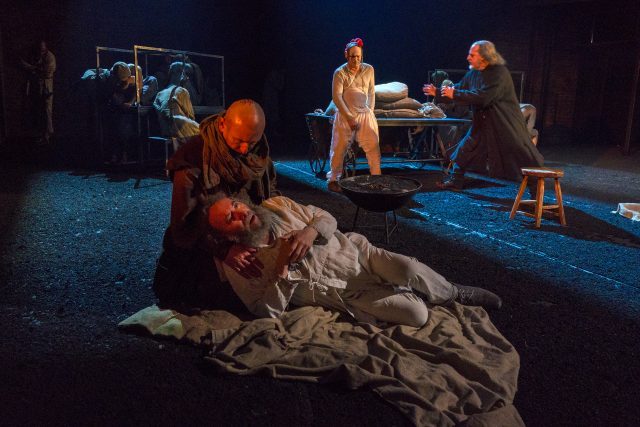
Kent (Antony Byrne) attends to a failing Lear (Sir Antony Sher) as the Fool (Graham Turner) looks on (photo by Richard Termine)

Niki Turner’s set is mostly spare, with various objects, from small trees to chairs and tables to large circles on poles representing the sun and the moon, carried by the cast. The large box is a curious addition that might not completely work — perhaps it’s a metaphor for peering inside the minds of the characters, particularly Lear’s, or else is a sign of being trapped — but it is eerily effective in the blinding scene, blood spurting and splashing onto the transparent sides. Doran focuses on the act of seeing throughout the play, giving prominence to lines about sight and eyes. “What, art mad? A man may see how this world goes with no eyes,” Lear tells Gloucester. “’Tis the times’ plague, when madmen lead the blind,” the Fool says to the old man (Edward James Walters). Tim Mitchell’s lighting, Jonathan Ruddick’s sound design, and Ilona Sekacz’s music, performed by musicians on balconies on the right and left of the stage, combine for a threatening atmosphere; the goings-on grow so somber that a surprising amount of the audience did not return after intermission for the second act, although I’d like to think that was more because those patrons were not prepared for nearly three and a half hours of gloom and doom. But this is Lear, after all, in this case featuring one of the world’s greatest Shakespearean actors taking his final Bard bow. It might be more of a whisper than a scream, but it is majestic and monumental nonetheless.