Tag Archives: andrei tarkovsky

THE SACRIFICE: 4K RESTORATION

Brand-new 4K restoration of Andrei Tarkovsky’s final film, The Sacrifice, opens October 25 at Film Forum

THE SACRIFICE (OFFRET) (Andrei Tarkovsky, 1986)
Film Forum
209 West Houston St.
October 25 – November 7
212-727-8110
www.filmforum.org
kinolorber.com

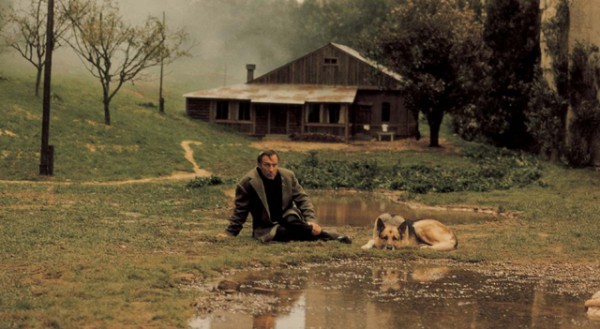
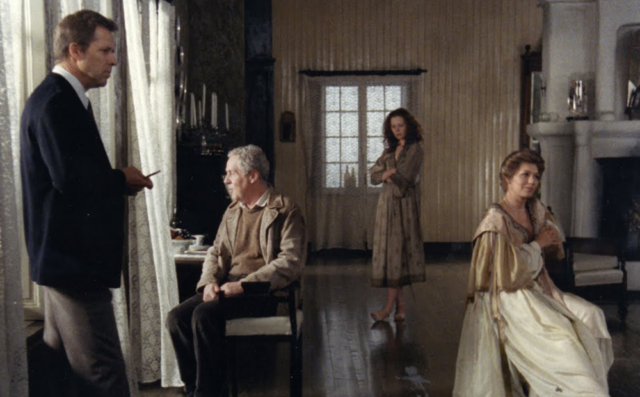
Andrei Tarkovsky’s final film, The Sacrifice, completed shortly before his death in 1986 of cancer at the age of fifty-four, serves as a glorious microcosm of his career, exploring art, faith, ritual, devotion, and humanity in uniquely cinematic ways — and you can now see it in a brand-new 4K restoration by the Swedish Film Institute at Film Forum, opening October 25. Made in Sweden, the film, which won three awards at Cannes (among many other honors), has many Bergmanesque qualities: Bergman’s longtime cinematographer, Sven Nykvist, shot the film; the production designer is Anna Asp, who won an Oscar for her work on Fanny and Alexander; Bergman’s son Daniel served as a camera assistant; and the star is Erland Josephson, who appeared in ten Bergman films as well as Tarkovsky’s previous feature, the Italy-set Nostalghia.

Josephson plays Alexander, a retired professor and former actor living in the country with his wife, the cold Adelaide (Susan Fleetwood), his stepdaughter, Marta (Filippa Franzén), and young son, Little Man (Tommy Kjellqvist), who cannot speak after a recent throat operation. It is Alexander’s birthday, and the family doctor, Victor (Sven Wollter), has come to visit, along with the odd local postman, Otto (Allan Edwall), who explains, “I collect incidents. Things that are unexplainable but true.” Also on hand are the two maids, Maria (Guðrún Gísladóttir), who Otto believes is a witch, and Julia (Valérie Mairesse). Alexander states early on that he has no relationship with God, but when a nuclear holocaust threatens, he suddenly gets down on the floor and prays, offering to sacrifice whatever it takes in order for him to survive, leading to a chaotic conclusion that is part slapstick, part utter desperation.

Although it has a more focused, direct narrative than most of Tarkovsky’s other works, The Sacrifice is far from a conventional story. Tarkovsky has written that it “is a parable. The significant events it contains can be interpreted in more than one way. . . . A great many producers eschew auteur films because they see cinema not as art but as a means of making money: the celluloid strip becomes a commodity. In that sense The Sacrifice is, amongst other things, a repudiation of commercial cinema. My film is not intended to support or refute particular ideas, or to make a case for this or that way of life. What I wanted was to pose questions and demonstrate problems that go to the very heart of our lives, and thus to bring the audience back to the dormant, parched sources of our existence. Pictures, visual images, are far better able to achieve that end than any words.”

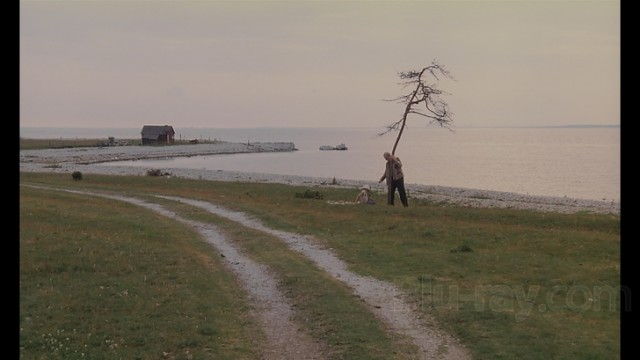
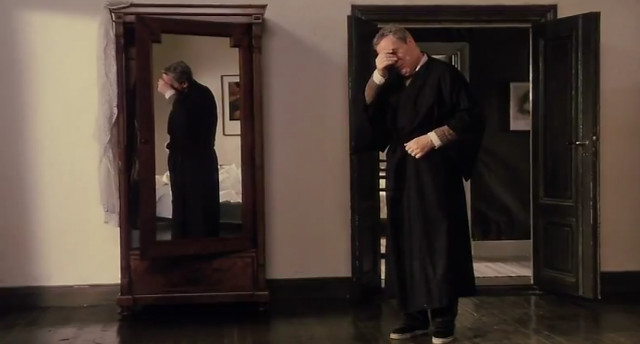
The film is filled with gorgeous visual images, beautiful shots of vast landscapes, of open doorways in stark interiors, of mirrors and windows, of Alexander and Little Man planting a dead tree by the edge of the ocean, and spoken language is often kept to a minimum, saved for philosophical discussions of God, Nietzsche, and home. Several scenes are filmed in long, continuous shots, lasting from six minutes to more than nine, heightening both the reality and the surrealism of the tale, which includes black-and-white memories, floating characters, and actors staring directly into the camera. Although Christianity plays a key role in the film — Tarkovsky considered himself a religious man, and the opening credits are shown over a close-up of Leonardo da Vinci’s Adoration of the Magi — the redemption that Alexander is after is a profoundly spiritual and, critically, a most human one as he searches for truth and hope amid potential annihilation.

[Mark Rifkin is a Brooklyn-born, Manhattan-based writer and editor; you can follow him on Substack here.]
PARADISE IS BURNING

Three sisters come of age in one summer in Mika Gustafson’s Paradise Is Burning

PARADISE IS BURNING (Mika Gustafson, 2023)
IFC Center
323 Sixth Ave. at West Third St.
August 22-29
www.ifccenter.com
www.roomeightfilms.com

“I will never disappear / For forever, I’ll be here,” Swedish electropop musician and composer Fever Ray sings in their 2009 song “Keep the Streets Empty for Me.” The tune plays a key role in Swedish filmmaker Mika Gustafson’s heart-wrenching debut feature, Paradise Is Burning.

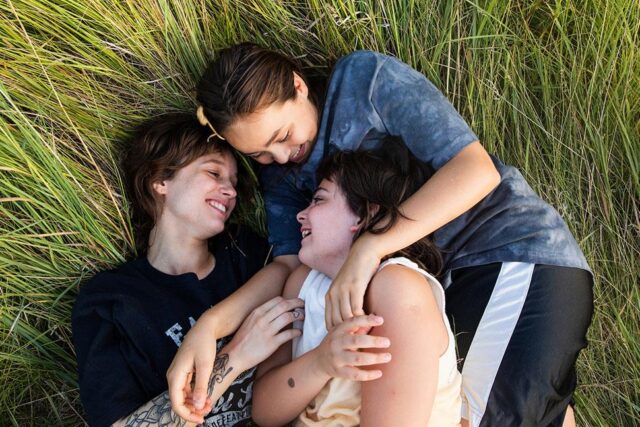
In a working-class Swedish suburb, sixteen-year-old Laura (Bianca Delbravo) is doing everything she can to keep her and her two sisters, twelve-year-old Mira (Dilvin Asaad) and seven-year-old Steffi (Safira Mossberg), together despite an absent father and a mother who disappears for long periods of time. When social services schedules a visit, Laura is worried that the three girls, who are very close, will be separated and put into foster care. Laura seeks help from her aunt Vera (Andrea Edwards) and their neighbors, Sasha (Mitja Siren) and Zara (Marta Oldenburg), an older couple who run a karaoke bar, but there’s not much they can do; Laura is on her own to preserve her family.

It’s summer, so school is not an issue. Laura comes up with elaborate plans to steal groceries from the supermarket. She avoids social services’ phone calls. She gives her sisters plenty of room to roam but fiercely protects and defends them if there are any problems. All three are going through major life events. When Mira gets her period, a group of friends hold a dramatic ritual celebration. Steffi is waiting for her first baby tooth to fall out. As Mira grows friendly with Sasha, “managing” his karaoke singing aspirations, Steffi collects stray dogs and meets Micai (Ellie Ghanati), another disaffected youth; they set up a unique little outdoor “home” where they can both let their rage out and find peace and privacy.

Laura enjoys breaking into other people’s houses and pretending to live like they do, eating their food, swimming in their pools, and trying on their clothes. She never takes anything from them; instead, she finds a kind of freedom, tinged with danger. In one house, she watches bullfighting on television; she is both matador and charging animal. Meanwhile, Andrei Tarkovsky’s Stalker is on in their own home, a film about a journey into a mysterious forbidden Zone where it is believed that people can achieve their most inner desires.

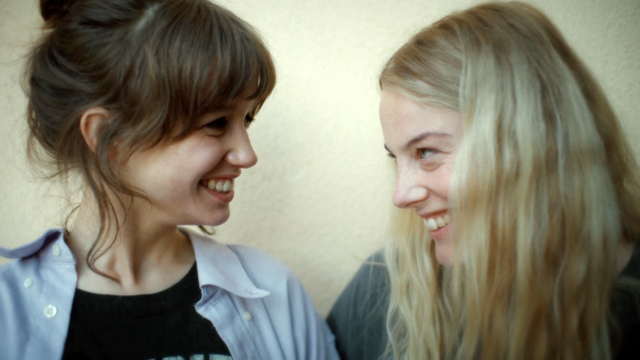
Running away after being chased out by the angry owner of a house and looking lost, she bumps into Hanna (Ida Engvoll), a thirtysomething woman who is instantly intrigued by Laura. The two quickly grow close; Hanna joins Laura on her fantasy adventures into houses, becoming friend, confidant, and maybe more. Hanna is a kind of mother figure — the type of parent Laura wishes she had — before the teenager finds out more about Hanna and her quest for freedom.

It’s no mere coincidence that the title, Paradise Is Burning, evokes Jennie Livingston’s award-winning 1990 documentary, Paris Is Burning, about BIPOC/LGBTQIA+ ball culture in New York City, where anyone and everyone can feel safe and secure being whoever they are and whoever they want to be. In nearly every scene, Laura looks like she’s ready to explode, to break free of the life she has been forced into. The sacrifices she must make are too much for any teenager to be asked to do. In one telling moment, she brings home T-shirts for her and Mira; Mira initially chooses the one with an eagle on it, but when she sees Laura put on the other one, with wolves, she asks to switch, which Laura does without complaint. Mira, who also thinks she’s ready for her mother’s fancy white high heels, aspires to be more like her older sister, who she considers tough and strong, not acknowledging that Laura is just a kid too, one whose ability to soar is being suppressed. In fact, animals figure prominently throughout the film, from rats and dogs to a Botero-like cat and three white flamingos hiding their heads in the water, emphasizing the wild nature of the sisters’ less-than-standard domestic existence.

Laura (Bianca Delbravo) finds an unexpected new friend in Hanna (Ida Engvoll) in Paradise Is Burning

In her first film, Delbravo is absolutely brilliant as Laura — she was discovered six years before shooting by Gustafson’s cowriter, Alexander Öhrstrand (who also has a small but key part in the movie), when he overheard Delbravo screaming at someone over the phone. With her pouty lips, puppy-dog eyes, and button nose, she’s a mesmerizing figure, a young woman trapped between being a child and an adult, best exemplified by subtle changes she makes in her movement and mannerisms when Laura is with her sisters as opposed to when she is with Hanna — superbly portrayed by Engvoll — who is also caught between two worlds.

Named Best Director and Best Screenwriter (with Öhrstrand) at the 2023 Venice Orizzonti, Gustafson exhibits an impressive talent in her first full-length narrative film; she previously made such works as the short Mephobia and the documentary Silvana. Her grasp of character development packs an emotional punch, as does the tempting sense of freedom lurking just around each corner for every character, reminiscent of Hirokazu Kore-eda’s Nobody Knows and Andrea Arnold’s American Honey and Fish Tank, while injecting a bit of David Lynch into the karaoke scenes.

“There’s no room for innocence,” Fever Ray also sings in “Keep the Streets Empty for Me.” Both Gustafson and Delbravo bravely navigate innocence and experience in their feature cinematic debuts, marking them as two to watch.

Paradise Is Burning opens this weekend at the IFC Center, with Gustafson participating in Q&As at the 7:00 sneak-peek screening on August 22 and the 7:15 shows on August 23 and 24.

[Mark Rifkin is a Brooklyn-born, Manhattan-based writer and editor; you can follow him on Substack here.]
REVIVAL RUNS: ANDREI RUBLEV

ANDREI RUBLEV

Icon painter Andrei Rublev (Anatoly Solonitsyn) takes off on an epic journey in Soviet masterpiece

ANDREI RUBLEV (ANDREY RUBLYOV) (Andrei Tarkovsky, 1966)
Film Society of Lincoln Center, Walter Reade Theater
144 West 65th St. between Eighth Ave. & Broadway
August 24-30
212-875-5050
www.filmlinc.org

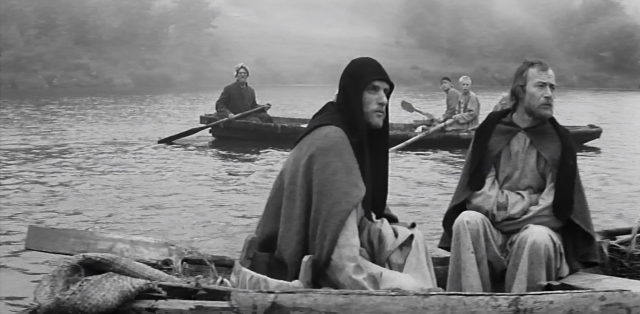
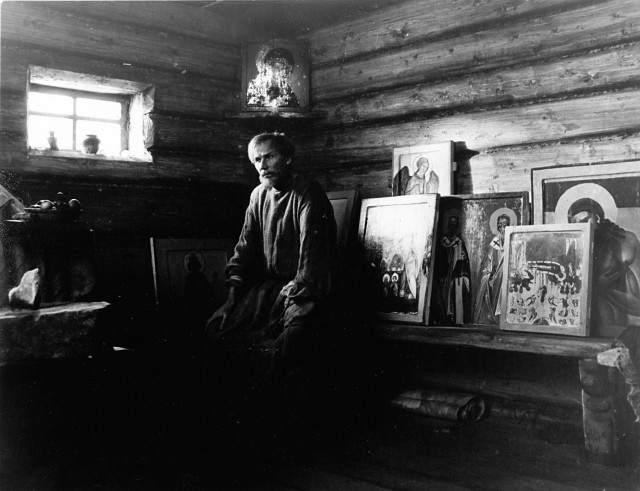
In May 2017, the Film Society of Lincoln Center’s exclusive presentation of the Mosfilm 2K digital restoration of Andrei Tarkovsky’s 1979 sci-fi masterpiece, Stalker, broke the opening-weekend box-office record at the arts institution. That was followed the same month by the digital restoration of Tarkovsky’s 1972 Solaris. Next up from Mosfilm and Janus is a restoration of Tarkovsky’s preferred 183-minute version of his epic Andrei Rublev, which arrives August 24 for a one-week Revival Run at the Walter Reade Theater. In 1966, Soviet auteur Tarkovsky followed up his dazzling debut, Ivan’s Childhood, with Andrei Rublev, a quietly powerful tale of a monk and icon painter making his way through early fifteenth-century Russia. But it is much more than a historical, biographical look at the real-life figure during the creation of tsarist Russia. “I knew it would certainly not be a historical or biographical work,” Tarkovsky wrote in his 1986 book Sculpting in Time. “I was interested in something else: I wanted to investigate the nature of the poetic genius of the great Russian painter. I wanted to use the example of Rublyov to explore the question of the psychology of artistic creativity, and analyse the mentality and civic awareness of an artist who created spiritual treasures of timeless significance.”
ANDREI RUBLEV

Tarkovsky classic explores the nature of faith and sin and art and creativity as seen through the eyes of several Russian icon painters

The film begins with a seemingly unrelated prologue in which a man named Yefim (Nikolay Glazkov) takes off in a hot-air balloon as the townspeople try to prevent him from flying, as if he is defying God by soaring in the sky. Tarkovsky then spreads out his tale over the course of eight vignettes, some of which feature Rublev (Anatoly Solonitsyn) as a minor character, more of a background observer than the protagonist. A gentle, slow-moving man with a deep contemplation of existence, Rublev, along with his traveling companions and fellow painters Daniil (Nikolai Grinko) and Kirill (Ivan Lapikov), encounters a skomorokh (Rolan Bykov) performing in a barn before being interrupted by the authorities; meets up with aging master Theophanus the Greek (Nikolai Sergeyev); has a falling-out with Kirill; is joined by a new apprentice, Foma (Mikhail Kononov); comes upon a pagan bacchanalia in the woods; befriends the beautiful holy fool Durochka (Irma Raush, Tarkovsky’s wife at the time); finds himself in the middle of a power struggle between the grand prince and his brother, leading to a brutal Tatar invasion; takes a vow of silence after committing a major sin; and watches as a young boy, Boriska (Nikolai Burlyayev, who played Ivan in Tarkovsky’s feature debut), leads the construction of a church bell in a small town, the ropes surrounding the lifting of the bell referencing the ones that Yefim hung from earlier, each trying to get closer to God in their own way.

At a surprisingly fluid pace despite the film’s length, Tarkovsky and cowriter Andrei Konchalovsky (Runaway Train, Maria’s Lovers) explore such issues as sin, guilt, fear of God, vanity, loyalty, jealousy, poverty, and the search for truth, with Rublev often more of a secondary character or commenter. “People should be reminded that they are human beings, that the Russian people are of one blood and one land. Evil is everywhere around. And there are always those who would sell you for thirty coins,” the cynical Kyrill tells Theophanus as Andrei takes part in a passion procession. “New trials are heaping on the Russian men — Tatars, famine, pestilence. But they keep on working. And carrying their cross humbly. They never despair but resign themselves to their fate, only praying to God to give them strength. Won’t the Most High forgive them their ignorance?” Tarkovsky employs many of the visual leitmotifs first seen in Ivan’s Childhood and used throughout his career, including numerous scenes with horses, water, tree roots, and dense forests, beautifully photographed by Vadim Yusov in black-and-white. Among the many memorable images: Paint spills into a river, Andrei pets a bird under a tree in the wind, and the bell is cast as if rising from the fiery pits of hell. Several moments involve brutal violence and torture, particularly of animals; Tarkovsky defended his treatment of one horse that he pushed down an outdoor staircase and is actually killed onscreen. Color brightens the epilogue of the film as Tarkovsky and Yusov lovingly pan across many of Rublev’s actual icon paintings in a kind of artistic creative epiphany. Twice during the film, a poetic masterpiece that can often be found on lists of the best films ever made, Andrei looks directly at the camera, right at the viewer, as if he can see us, imploring us to take heed of his mission. It is nearly impossible not to follow him.

THE SACRIFICE

THE SACRIFICE

A man and his son plant a dead tree they hope will grow in Andrei Tarkovsky’s final film, The Sacrifice

THE SACRIFICE (OFFRET) (Andrei Tarkovsky, 1986)
Quad Cinema
34 West 13th St. between Fifth & Sixth Aves.
Opens Friday, October 27
212-255-2243
www.quadcinema.com

Andrei Tarkovsky’s final film, The Sacrifice, completed shortly before his death in 1986 of cancer at the age of fifty-four, serves as a glorious microcosm of his career, exploring art, faith, ritual, devotion, and humanity in uniquely cinematic ways. Made in Sweden, the film has many Bergmanesque qualities: Bergman’s longtime cinematographer, Sven Nykvist, shot the film; the production designer is Anna Asp, who won an Oscar for her work on Fanny and Alexander; Bergman’s son Daniel served as a camera assistant; and the star is Erland Josephson, who appeared in ten Bergman films as well as Tarkovsky’s previous feature, the Italy-set Nostalghia. Josephson plays Alexander, a retired professor and former actor living in the country with his wife, the cold Adelaide (Susan Fleetwood), his stepdaughter, Marta (Filippa Franzén), and young son, Little Man (Tommy Kjellqvist), who cannot speak after a recent throat operation. It is Alexander’s birthday, and the family doctor, Victor (Sven Wollter), has come to visit, along with the odd local postman, Otto (Allan Edwall), who explains, “I collect incidents. Things that are unexplainable but true.” Also on hand are the two maids, Maria (Guðrún Gísladóttir), who Otto believes is a witch, and Julia (Valérie Mairesse). Alexander states early on that he has no relationship with God, but when a nuclear holocaust threatens, he suddenly gets down on the floor and prays, offering to sacrifice whatever it takes in order for him to survive, leading to a chaotic conclusion that is part slapstick, part utter desperation.

THE SACRIFICE

Alexander (Bergman regular Erland Josephson) is seeking redemption in The Sacrifice

Although it has a more focused, direct narrative than most of Tarkovsky’s other works, The Sacrifice is far from a conventional story. Tarkovsky has written that it “is a parable. The significant events it contains can be interpreted in more than one way. . . . A great many producers eschew auteur films because they see cinema not as art but as a means of making money: the celluloid strip becomes a commodity. In that sense The Sacrifice is, amongst other things, a repudiation of commercial cinema. My film is not intended to support or refute particular ideas, or to make a case for this or that way of life. What I wanted was to pose questions and demonstrate problems that go to the very heart of our lives, and thus to bring the audience back to the dormant, parched sources of our existence. Pictures, visual images, are far better able to achieve that end than any words.” The film is filled with gorgeous visual images, beautiful shots of vast landscapes, of open doorways in stark interiors, of mirrors and windows, of Alexander and Little Man planting a dead tree by the edge of the ocean, and spoken language is often kept to a minimum, saved for philosophical discussions of God, Nietzsche, and home. Several scenes are filmed in long, continuous shots, lasting from six minutes to more than nine, heightening both the reality and the surrealism of the tale, which includes black-and-white memories, floating characters, and actors staring directly into the camera. Although Christianity plays a key role in the film — Tarkovsky considered himself a religious man, and the opening credits are shown over a close-up of Leonardo da Vinci’s “Adoration of the Magi” — the redemption that Alexander is after is a profoundly spiritual and, critically, a most human one as he searches for truth and hope amid potential annihilation. Winner of three awards at the Cannes Film Festival (among many other honors), The Sacrifice opens at the Quad on October 27 in a new 4K restoration made from the original camera negative.

ANDREI TARKOVSKY, SCULPTING IN TIME: DIRECTED BY ANDREI TARKOVSKY

Documentary

Documentary follows Andrei Tarkovsky making THE SACRIFICE and getting philosophical about art, film, and time

DIRECTED BY ANDREI TARKOVSKY (Michal Leszczylowski, 1988)
Museum of Arts & Design
2 Columbus Circle at 58th St. & Eighth Ave.
Friday, August 28, $10, 7:00
Series continues Friday nights through August 28
212-299-7777
madmuseum.org

After seven consecutive Friday nights presenting all seven of Soviet auteur Andrei Tarkovsky’s feature-length films (Solaris, Stalker, Ivan’s Childhood, Andrei Rublev, The Mirror, Nostalghia, and The Sacrifice, each one a masterpiece in its own right), the Museum of Arts & Design — it’s affectionately known as MAD for a reason — is concluding its “Andrei Tarkovsky, Sculpting in Time” series on August 28 with the 1988 documentary Directed by Andrei Tarkovsky. During the shooting of what would be Tarkovsky’s last film, The Sacrifice, coeditor Michal Leszczylowski kept his own camera going, filming Tarkovsky as he collaborated with cinematographer Sven Nykvist, production designer Anna Asp, star Erland Josephson, and others, carefully orchestrating each shot, anxious about the lighting, the angles, the position of a table. Yes, that is the job of all directors, but Tarkovsky takes it to whole ’nother level, sometimes worried about the slightest hair flip, then barely concerned about a specific piece of dialogue. It is fascinating watching him in action, working with a translator to sift through the Russian, English, and Swedish being spoken on the set. The Sacrifice is about a man who is willing to suddenly give up everything to save himself; it looks like there’s not much that Tarkovsky wouldn’t sacrifice to make sure his film is perfect. Leszczylowski supplements the behind-the-scenes footage with stories from Tarkovsky’s wife, assistant director Larisa Tarkovskaya (Larisa Kizilova), as well as narration by Brian Cox, reading from Tarkovsky’s book Sculpting in Time, his poetic defense of cinema as art melding beautifully with images of the great director creating some of the most artistic cinema ever put on celluloid.

ANDREI TARKOVSKY, SCULPTING IN TIME: THE SACRIFICE

THE SACRIFICE

A man and his son plant a dead tree they hope will grow in Andrei Tarkovsky’s final film, THE SACRIFICE

THE SACRIFICE (OFFRET) (Andrei Tarkovsky, 1986)
Museum of Arts & Design
2 Columbus Circle at 58th St. & Eighth Ave.
Friday, August 21, $10, 7:00
Series continues Friday nights through August 28
212-299-7777
madmuseum.org

Andrei Tarkovsky’s final film, The Sacrifice, completed shortly before his death in 1986 of cancer at the age of fifty-four, serves as a glorious microcosm of his career, exploring art, faith, ritual, devotion, and humanity in uniquely cinematic ways. Made in Sweden, the film has many Bergmanesque qualities: Bergman’s longtime cinematographer, Sven Nykvist, shot the film; the production designer is Anna Asp, who won an Oscar for her work on Fanny and Alexander; Bergman’s son Daniel served as a camera assistant; and the star is Erland Josephson, who appeared in ten Bergman films as well as Tarkovsky’s previous feature, the Italy-set Nostalghia. Josephson plays Alexander, a retired professor and former actor living in the country with his wife, the cold Adelaide (Susan Fleetwood), his stepdaughter, Marta (Filippa Franzén), and young son, Little Man (Tommy Kjellqvist), who cannot speak after a recent throat operation. It is Alexander’s birthday, and the family doctor, Victor (Sven Wollter), has come to visit, along with the odd local postman, Otto (Allan Edwall), who explains, “I collect incidents. Things that are unexplainable but true.” Also on hand are the two maids, Maria (Guðrún Gísladóttir), who Otto believes is a witch, and Julia (Valérie Mairesse). Alexander states early on that he has no relationship with God, but when a nuclear holocaust threatens, he suddenly gets down on the floor and prays, offering to sacrifice whatever it takes in order for him to survive, leading to a chaotic conclusion that is part slapstick, part utter desperation.

THE SACRIFICE

Alexander (Bergman regular Erland Josephson) is seeking redemption in THE SACRIFICE

Although it has a more focused, direct narrative than most of Tarkovsky’s other works, The Sacrifice is far from a conventional story. Tarkovsky has written that it “is a parable. The significant events it contains can be interpreted in more than one way. . . . A great many producers eschew auteur films because they see cinema not as art but as a means of making money: the celluloid strip becomes a commodity. In that sense The Sacrifice is, amongst other things, a repudiation of commercial cinema. My film is not intended to support or refute particular ideas, or to make a case for this or that way of life. What I wanted was to pose questions and demonstrate problems that go to the very heart of our lives, and thus to bring the audience back to the dormant, parched sources of our existence. Pictures, visual images, are far better able to achieve that end than any words.” The film is filled with gorgeous visual images, beautiful shots of vast landscapes, of open doorways in stark interiors, of mirrors and windows, of Alexander and Little Man planting a dead tree by the edge of the ocean, and spoken language is often kept to a minimum, saved for philosophical discussions of God, Nietzsche, and home. Several scenes are filmed in long, continuous shots, lasting from six minutes to more than nine, heightening both the reality and the surrealism of the tale, which includes black-and-white memories, floating characters, and actors staring directly into the camera. Although Christianity plays a key role in the film — Tarkovsky considered himself a religious man, and the opening credits are shown over a close-up of Leonardo da Vinci’s “Adoration of the Magi” — the redemption that Alexander is after is a profoundly spiritual and, critically, a most human one as he searches for truth and hope amid potential annihilation. Winner of three awards at the Cannes Film Festival (among many other honors), The Sacrifice is screening August 21 at 7:00 as part of the Museum of Arts & Design film series “Andrei Tarkovsky, Sculpting in Time,” which runs Friday nights through August 28 and includes all seven of Tarkovsky’s masterpieces (Solaris, Stalker, Ivan’s Childhood, Andrei Rublev, The Mirror, Nostalghia, The Sacrifice) before concluding with the behind-the-scenes documentary Directed by Andrei Tarkovsky, which lends fascinating insight to the making of The Sacrifice in particular.

ANDREI TARKOVSKY, SCULPTING IN TIME: NOSTALGHIA

NOSTALGHIA

Andrei Tarkovsky explores the concepts of isolation and loneliness in NOSTALGHIA

NOSTALGHIA (Andrei Tarkovsky, 1983)
Museum of Arts & Design
2 Columbus Circle at 58th St. & Eighth Ave.
Friday, August 14, $10, 7:00
Series continues Friday nights through August 28
212-299-7777
madmuseum.org

In a 1984 interview with Gideon Bachmann for a special issue of the Swedish film journal Chaplin, Soviet auteur Andrei Tarkovsky said, “I don’t believe that there exists any form of art film that can be understood by everyone. . . . It is not essential for me to be understood by everyone.” Tarkovsky was referring specifically to his latest work, the 1983 poetic masterpiece Nostalghia, although he could have been referring to almost any of his seven feature-length films. Nostalghia is a gorgeously told tale of loneliness, alienation, faith, devotion, and the search for home and family, the first film that Tarkovsky made outside of Russia, in Italy. It’s also about light and dark, as Tarkovsky and cinematographer Giuseppe Lanci explore chiaroscuro effects, often incorporating candles to create mesmerizing glows and elongated shadows while alternating between color, sepia, and black-and-white. Written by Tarkovsky and Tonino Guerra, who also collaborated with Michelangelo Antonioni, Federico Fellini, the Taviani brothers, and many others, the film opens in a vast, dark, foggy landscape, where married poet Andrei Gorchakov (Oleg Yanovsky, with strange white patches in his black hair), who is in Italy researching a book on eighteenth-century Russian composer Pavel Sosnovsky, and Eugenia, his Italian translator (Domiziana Giordano), have driven to a remote church to look at a fresco of the Madonna of Childbirth. Inside the church, Tarkovsky and Lanci establish one of their key visual motifs for the film, long, slow shots that pan across vertical elements — columns here, and trees and poles later, with characters showing up in one part of the shot and then another, impossibly, without the camera cutting away. Eugenia, who has flowing blond hair, is reading a book of poems by Arseni Tarkovsky, the director’s father, in Italian, but Gorchakov tells her to throw it away. “Poetry is untranslatable, like the whole of art,” he says, a sly reference to the director’s first Italian film.

NOSTALGHIA

Russian poet Andrei Gorchakov (Oleg Yanovsky) gets homesick and tries to save the world in Andrei Tarkovsky’s NOSTALGHIA

At ancient baths where people believe they can attain immortality, Gorchakov meets up with a fanatic named Domenico (Bergman stalwart Erland Josephson) who fears that the end of civilization is coming. “Everyone must be saved, the whole world,” Domenico tells Gorchakov, explaining that he must walk across the steaming water of St. Catherine’s pool with a lighted candle. Dreams and memories mingle with the past and the present as birds fly out of a religious statue, Gorchakov sees the reflection of a younger Domenico in a wardrobe left in the street, a white feather floats slowly to the ground, Domenico stands atop a weathered statue of Marcus Aurelius and demands societal change, and Gorchakov wades through a flooded abandoned building where a young girl appears seemingly out of nowhere. Mirrors and doorways offer limitless possibilities as rain falls and puddles form, both inside and outside. The architecture seems to be crumbling all around Gorchakov as he tries to make sense of life and death, art and poetry. It’s heady stuff, and absolutely gorgeous. In a 1983 interview with Italian journalist Natalia Aspesi in Cannes, Tarkovsky said, “Nostalghia is an extremely important film for me. It is a film in which I have managed to express myself fully. I must say that it has confirmed for me that cinema is a truly great art form, capable of representing faithfully even the most imperceptible movements of the human soul.” Tarkovsky’s glorious work does indeed confirm that cinema is a truly great art form that can get right at the human soul. Nostalghia is screening August 14 at 7:00 as part of the Museum of Arts & Design series “Andrei Tarkovsky, Sculpting in Time,” which runs Friday nights through August 28 and includes all seven of Tarkovsky’s full-length films (Solaris, Stalker, Ivan’s Childhood, Andrei Rublev, The Mirror, Nostalghia, The Sacrifice) before concluding with the behind-the-scenes documentary Directed by Andrei Tarkovsky.