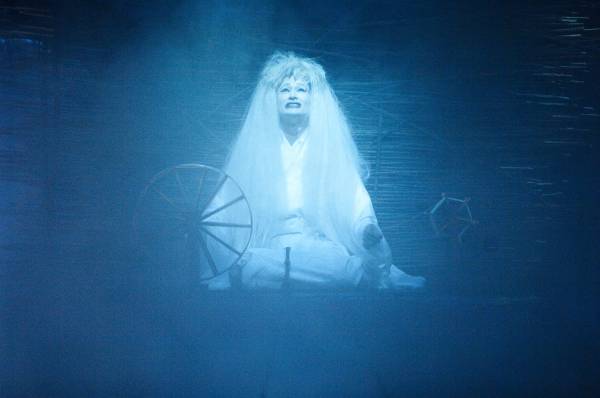
Cristofer Jean offers up some tempting and dangerous prophecies as the Forest Spirit in Ping Chong’s theatrical adaptation of Akira Kurosawa’s THRONE OF BLOOD (photo by Jenny Graham)
Next Wave Festival
BAM Howard Gilman Opera House
30 Lafayette Ave. between Ashland Pl. & St. Felix St.
November 10-13, $25-$60, 7:30
718-636-4100
www.bam.org
www.osfashland.org
Commissioned by BAM in conjunction with the Oregon Shakespeare Festival, Ping Chong’s THRONE OF BLOOD, adapted from Akira Kurosawa’s 1957 samurai reimagining of MACBETH, contains not a single line from the Bard’s tale of murderous ambition in Scotland. Kurosawa and his cowriters wrote the screenplay without referring to Shakespeare’s play, and Chong continues that tradition, working only from the movie script. Kevin Kenerly stars as Washizu, a warrior who quickly rises up the ranks after a mysterious meeting with a Forest Spirit (Cristofer Jean) who sees good things in his future, turning his wife, Lady Asaji (Ako), into a power-hungry villain. Chong incorporates elements of Noh, Kabuki, and Chinese opera into his production, which will be performed in English and features set design by Christopher Acebo, costumes by Stefani Mar, lighting by Darren McCroom, video and projections by Maya Ciarrocchi, and music and sound design by Todd Barton. The November 11 show will be preceded by an Artist Talk between Ping Chong and writer Ian Buruma at 6:00.
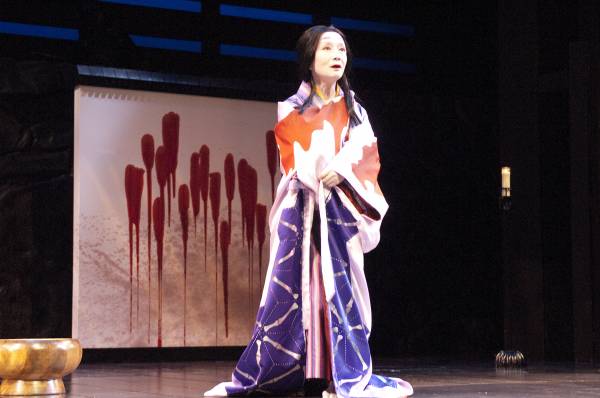
Lady Asaji has some dangerous ideas in Ping Chong’s theatrical adaptation of Akira Kurosawa’s THRONE OF BLOOD (photo by Jenny Graham)
(November 10 performance reviewed) Fans of Akira Kurosawa’s THRONE OF BLOOD are in for quite a treat with Ping Chong’s very entertaining theatrical adaptation, running at BAM through November 13. Chong, returning to the Next Wave Festival for the first time in fifteen years — he previously presented THE GAMES in 1984, THE ANGELS OF SWEDENBORG in 1986, and CHINOISERIE in 1995 — has interpreted Kurosawa’s reimagining of Shakespeare’s MACBETH for the stage, incorporating film, smoke effects, surround sound, and set changes that mimic the wipes Kurosawa favored. Set in feudal Japan, the story follows the swift rise of warriors Washizu (Kevin Kenerly) and Miki (Danforth Comins), as prophesied by an ancient white-haired spirit (Cristofer Jean) who inhabits the mysterious Spider Web Forest. When Washizu’s wife, Lady Asaji (Ako), hears about the prophecy, she hungers for the blood of everyone standing between her husband and the throne. Stefanni Mar’s costumes include wildly bizarre helmets and vestments that evoke the Star Wars films, while Maya Ciarrocchi’s projections are shown on a narrow horizontal screen that expands the stage, depicting the top of Spider Web Castle, the sky, or a pair of closed eyes ready to open at any moment. Ako delivers the show’s strongest performance, handling the Lady Macbeth role (sensationally played by Isuzu Yamada in the film) with finesse and just the right amount of evil, whether gliding ominously across the stage or standing in front of a Japanese screen dripping blood. Kenerly has the tough task of the Macbeth role so memorably played by Toshirō Mifune in the film and comes out relatively unscathed. However, many of the line readings by much of the cast leave something to be desired, with the actors too often hesitating at the wrong spots. (The production is primarily in English, with some Japanese, most of which is translated.) And Chong is a bit too worshipful of Kurosawa, including overt references in the dialogue to such films as STRAY DOG and THE LOWER DEPTHS that take the audience out of the play (which is, of course, the thing). But such are the ways of men. For those fans wondering how he pulls off the arrow-laden finale, Chong hits a bull’s-eye. Despite some silly, awkward moments, THRONE OF BLOOD is great fun, an adventurous evening of theater that will leave audiences craving more Akira Kurosawa — and more Ping Chong.
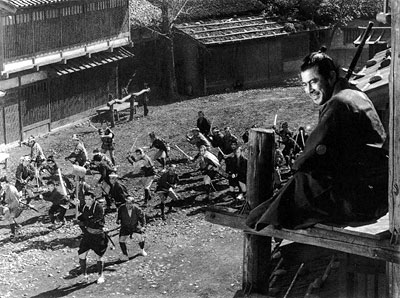
 Kuwabatake Sanjuro (Toshiro Mifune) is a lone samurai on the road following the end of the Tokugawa dynasty in yet another of Akira Kurosawa’s unforgettable masterpieces. Sanjuro comes to a town with two warring factions and plays each one off the other as a hired hand. Neo’s battles with myriad Agent Smiths are nothing compared to Yojimbo’s magnificent swordfights against growing bands of warriors that include the evil Unosuke (Tatsuya Nakadai), who is in possession of a new weapon that shoots bullets. Try watching this film and not think of several Clint Eastwood Westerns (including Sergio Leone’s pasta remake, A FISTFUL OF DOLLARS) as well as HIGH NOON. The film is being screened in conjunction with BAM’s presentation of Ping Chong’s theatrical adaptation of Kurosawa’s THRONE OF BLOOD, running at the Howard Gilman Opera House November 10-13. The series concludes with the sequel to YOJIMBO, 1962’s SANJURO, on November 14 and RAN on November 21.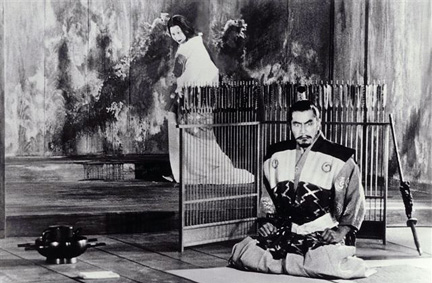
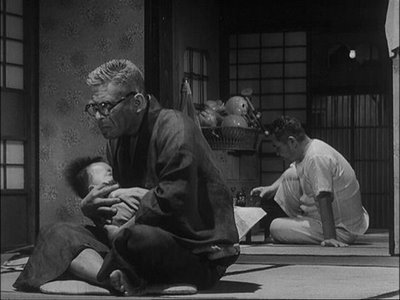
 Akira Kurosawa’s powerful psychological drama begins with a jazzy score over shots of a bustling Japanese city, people anxiously hurrying through as a Theremin joins the fray. But this is no Hollywood film noir or low-budget frightfest; Kurosawa’s daring film is about the end of old Japanese society as the threat of nuclear destruction hovers over everyone. A completely unrecognizable Toshiro Mifune stars as Nakajima, an iron foundry owner who wants to move his large family — including his two mistresses — to Brazil, which he believes to be the only safe place on the planet where he can survive the H bomb. His immediate family, concerned more about the old man’s money than anything else, takes him to court to have him declared incompetent; there he meets a dentist (the always excellent Takashi Shimura) who also mediates such problems — and fears that Nakajima might be the sanest one of all.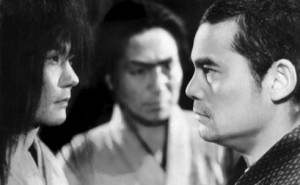
 Akira Kurosawa might be one of the greatest filmmakers of the twentieth century, but the Japanese master wasn’t immune from laying an egg or two along the way. His debut film, SANSHIRO SUGATA, released in 1943, and its sequel, made two years later (THE MOST BEAUTIFUL was released in between), are a deadly dull duo that pits two styles of fighting, judo and jujitsu, against one another. The relatively straightforward genre film, based on the novel by Tsuneo Tomita that was inspired by the real life of Shiro Saigo, stars Susumu Fujita as Sanshiro Sugata, a hesitant judo champion who is forced back into the ring by politics. While Kurosawa does show flashes of the director he would soon become, the two-part saga is far too worshipful of its subject, lacking any sense of nuance or actual drama, hitting viewers over the head with its very basic themes. The extremely rare double feature is part of the Kurosawa Festival at Film Forum, which continues through February 18 with such upcoming classics as IKIRU, I LIVE IN FEAR, HIGH AND LOW, and DRUNKEN ANGEL.