this week in theater

LAST CHANCE: SIX MISS AND DON’T-MISS SHOWS CLOSING THIS WEEKEND

Laurie Metcalf can’t believe another Broadway show she’s in is closing early (photo by Julieta Cervantes)

LITTLE BEAR RIDGE ROAD
Booth Theatre
222 West 45th St. between Broadway & Eighth Ave.
Tuesday – Sunday through December 21, $74–$206
littlebearridgeroad.com

For me, the biggest disappointment of the year in theater is the early closing of Samuel D. Hunter’s sensational Little Bear Ridge Road. Originally scheduled to run until February 14, it is instead closing December 21, after opening on October 30 to a bevy of rave reviews. The play is a gripping ninety-five minutes of nonstop tension, brilliantly directed by two-time Tony winner Joe Mantello on Scott Pask’s beautifully minimalist set. On a couch on a round, carpeted platform, Sarah (Laurie Metcalf) and her nephew, Ethan (Micah Stock), spend a lot of time watching TV and complaining about their lives following the passing of Sarah’s brother, Ethan’s estranged father, a drug addict who died a miserable death. It’s a fabulous Broadway debut for Hunter, whose previous superb works include A Bright New Boise, The Whale, Lewiston/Clarkston, Greater Clements, A Case for the Existence of God, and Grangeville. I apologize for all the superlatives, but each one is well deserved.

Perhaps it’s what I’ve just dubbed the Metcalf curse.

Despite having earned four Emmys (out of twelve nominations), two Tonys (out of six nominations), and an Oscar nod, Metcalf has been in several shows that have shut their doors early, although not because of her performance. For every success like Three Tall Women and A Doll’s House, Part 2, there’s Hillary and Clinton, Grey House, The Other Place, and the aptly titled Misery.

In Little Bear Ridge Road, Metcalf plays Sarah, a nurse and loner who seems to be mad at the world, ripping off such one-liners as “Just because it’s so complicated that you have to watch an episode recap every week doesn’t mean it’s better,” “Why are you still here?!,” and “All this time you’ve thought I had an issue with you being gay? That’s the most interesting thing about you.” Ethan is a wannabe writer who is deeply uncomfortable in his own skin and exploring a potential relationship with an astrophysicist named James (John Drea) he met online. The narrative takes place between 2020 and 2022, and the pandemic plays a key role in how characters interact with each other, whether out at a bar or sitting home watching television, especially Extraterrestrial. Heather Gilbert’s intimate lighting is exceptional, making the audience feel like it’s on the couch, hanging out with Sarah, Ethan, and James.

Talking about the Orion constellation, James tells Ethan, “Okay, so — all three stars in the belt look like they’re in a line, but they’re actually spread out over about eight hundred light years. The closest is like twelve hundred light years away and the farthest is like two thousand.” It’s a clever metaphor that relates to how far away people can be even when they’re right next to each other — or conversing online. It’s both hilarious and meaningful when Sarah thinks she is texting Kenny, a handyman who is helping them with Ethan’s father’s house, but instead finds that she has accidentally FaceTimed him.

Hunter, who wrote the play specifically for Metcalf’s return to Chicago’s Steppenwolf company after a fourteen-year absence, brings it all together in a poignant finale that incorporates so many major and minor details and what seemed to be asides but then form a cohesive and thought-provoking whole, like a musical composition without a note out of place.

So why is it closing so early?

If I knew that, I’d be a producer.

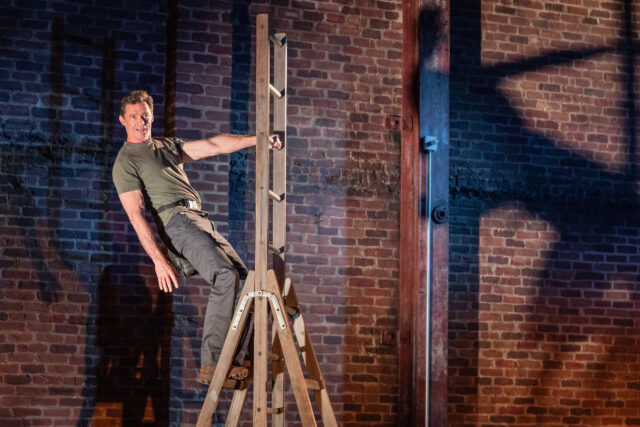
James Corden, Neil Patrick Harris, and Bobby Cannavale star as three friends reaching a crisis point in Art (photo by Matthew Murphy)

ART
Music Box Theatre
239 West 45th St. between Broadway & Eighth Aves.
Tuesday – Sunday through December 21, $136.10 – $371.10
artonbroadway.com

One of my favorite theatrical moments of 2025 occurred at the end of the matinee of Art I attended. As the curtain closed, James Corden gave a little hop, skip, and jump, grabbing onto the shoulders of his two costars, Bobby Cannavale and Neil Patrick Harris, as a wide, childlike smile broke out across his face. It was one of the most happy-making things I’d seen all year.

It made the whole experience that much more enjoyable, helping me forget some of the holes in what is a pleasurable if not nearly as deep as it wants to be show. What are these men doing in Paris? Were they ever really close friends? Can Marc (Cannavale) and Serge (Harris) just leave poor Yvan (Corden) alone already?

When the audience enters the Music Box Theatre, they are greeted by a framed white rectangle on the red curtain, not only representing the white painting that Serge has paid three hundred thousand dollars for, but also the blank slate we all come into the world with, onto which we project our personal likes and dislikes, including how we appreciate, or don’t, art itself. When the play is over, some will have loved it, some will have despised it, and other, perhaps most, will find themselves in between. Friends will defend their views, just as Serge defends his purchase to Marc, who is insulted that Serge spent so much money on a white canvas, while Yvan is caught in the middle.

After Marc calls the painting “shit,” Serge tells the audience, “He doesn’t like the painting. Fine . . . But there was no warmth in the way he reacted. No attempt. No warmth when he dismissed it without a thought. Just that vile pretentious laugh. A real know it all laugh. I hated that laugh.”

Marc decides to get Yvan’s opinion, explaining, “Yvan’s a very tolerant guy, which of course, when it comes to relationships, is the worst thing you can be. Yvan’s tolerant because he couldn’t care less. If Yvan tolerates the fact that Serge has spent three hundred grand on some piece of white shit, it means he couldn’t care less about Serge. Obviously.”

Are we nothing more than our thoughts about art — or, for that matter, politics or other loaded subjects? Can each one of us see a white painting differently without casting aspersions?

Art was written in French by Yasmina Reza and premiered at Comédie des Champs-Élysées in Paris in 1994. Christopher Hampton’s English translation debuted in London two years later, with Albert Finney, Tom Courtenay, and Ken Stott, and made it to Broadway in 1999 with Alan Alda, Victor Garber, and Alfred Molina. It’s a star-driven vehicle, so director Scott Ellis gives each actor the chance to shine, and Cannavale, Harris, and Corden chew up the scenery with glee, especially Corden, whose Yvan is a kind of everyman not wanting to fight with his besties, more concerned about his impending wedding, which has reached the crisis-level planning stage. When Marc asks Yvan if he would be happy if Serge gave the painting to him and his bride as a present, he says to the audience, “Of course it doesn’t make me happy. It doesn’t make me happy, but, generally speaking, I’m not the sort of person who can say I’m happy, just like that. . . . You’re either happy or you’re not happy, what’s why wouldn’t I be got to do with it?”

Exactly.

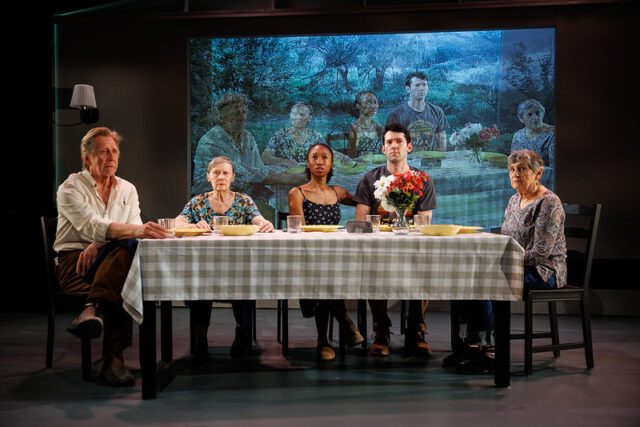
A senior retirement community is clouded with an air of mystery in Everything Is Here (photo by Mari Eimas-Dietrich)

EVERYTHING IS HERE
59E59 Theaters
59 East 59th St. between Park & Madison Aves.
Tuesday – Saturday through December 20, $75.50
www.59e59.org

One of my favorite plays of 2023 was Annie Baker’s Infinite Life, which takes place at a Northern California clinic that treats chronic pain sufferers, mainly women.

One of my favorite plays of 2025 was Talking Band’s Triplicity, an experimental work about the interconnected, overlapping lives of four strangers in New York City.

Peggy Stafford’s Everything Is Here is a charming and gentle tale that is like Talking Band’s version of Infinite Life.

Bev (Jan Leslie Harding), Janice (Mia Katigbak), and Bonnie (Petronia Paley) live at a senior community retirement facility, where they participate in programs, sit around and discuss personal issues, and are taken care of by a young nurse named Nikki (Susannah Millonzi). The play begins with Grant (Pete Simpson), who runs several of the programs, asking the women to lie down on the floor and follow his instructions:

“There are these huge old trees that you don’t even know how old they really are / Maybe they’re ancient? / You’re not sure but this thought crosses your mind: ANCIENT TREES,” he says. “You stop dead in your tracks / Stop right now / Everybody stop / Don’t move / Okay, good / Something is gone that should be there / And it was there / In your pocket and now it’s not.” The audience falls under his spell as well.

For the next eighty minutes, the characters converse about dogs and cats, Salisbury steak, the large garden gnome just outside the window, Middle Earth, assisted suicide, and trust. They feed the fish, worry about a dangerous tree branch that could fall at any moment, and help Grant audition for a local production of A Streetcar Named Desire. (The curiously comforting set is by Richard Hoover.)

We soon learn that Bev is considering leaving, Janice is a kleptomaniac, Bonnie is a fine Blanche DuBois, and Nikki and Grant take a liking to each other.

But at the center of it all is a constant feeling of loss, of something that’s missing, physically, emotionally, and psychologically, with a hovering sense of impending doom.

Everything Is Here is worth seeing for the excellent cast alone, a joy to behold, whether they’re arguing, getting their vital signs checked, or dancing in their chairs to Lisa Fagan’s minimalist choreography. (Note: Simpson and Katigbak were in Infinite Life, and Simpson and Millonzi were in Berlindia!, which also used a goldfish tank as a metaphor, so the closeness of the actors is palpable.) Finn (The Invention of Tragedy, Doomocracy) adds just the right touches, and Stafford (Motel Cherry, 16 Words or Less with Katigbak) maintains a level of mystery around the proceedings, providing no easy answers in her abstract narrative.

On the way out, don’t be surprised if you reach into your pockets, wondering if something is missing, if everything is where it’s supposed to be.

Archduke takes some playful liberties with famous assassination (photo by Joan Marcus)

ARCHDUKE
Roundabout at Laura Pels Theatre
Harold and Miriam Steinberg Center for Theatre
111 West 46th St. between Sixth & Seventh Aves.
Tuesday – Sunday through December 21, $69-$102
www.roundabouttheatre.org

On June 28, 1914, nineteen-year-old Gavrilo Princip assassinated Archduke Franz Ferdinand of Austria, which led directly to the start of WWI. Pulitzer Prize finalist and Obie winner Rajiv Joseph, who has written such complex and intriguing shows as Gruesome Playground Injuries, Describe the Night, and Dakar 2000, imagines the events leading up to that fateful day in Archduke, a delicious, if slight, dark comedy.

The assassination plot is orchestrated by Dragutin “Apis” Dimitrijevic (a scenery-gobbling Patrick Page), a real-life Serbian military officer and cofounder of the Black Hand, a secret society dedicated to “Unification or Death.” With the help of a doctor, Apis convinces three young men, Gavrilo (Jake Berne), Trifko (Adrien Rolet), and Nedeljko (Jason Sanchez), that they have tuberculosis and should accomplish one last heroic deed before they die: murder the archduke.

“I never had no meaning. Not in my life. Never had it. Never will have it,” Nedeljko says to Gavrilo. “I wasted my life.” But given a new sense of purpose, the three men go to Apis’s resplendent home, highlighted by a huge wall map of Eastern Europe, are served by Apis’s dotty housekeeper, Sladjana (Kristine Nielsen), and plan the attack.

Joseph and Tony- and Obie-winning director Darko Tresnjak mix in a little of the Three Stooges’ You Nazty Spy! here, a touch of Charlie Chaplin’s The Great Dictator there, along with a dash of Stanley Kubrick’s Dr. Strangelove. At just over two hours with an intermission, Archduke is too long, and some of the slapstick grows repetitive and falls flat, such as Sladjana’s efforts to find Apis’s “special box.” It probably would have benefited from being streamlined to a tighter ninety minutes.

That said, it’s still an enjoyable take on an international tragedy with far-reaching ramifications while also commenting on disaffected, angry, aimless young men and political violence, no laughing matter in the United States today.

“Cats do not lay eggs,” Apis says at one point. “Never let anyone ever tell you that they do.”

Yes, the Habsburg hegemony can be funny.

Oklahoma Samovar shares the story of five generations of a Jewish family in America (photo by Marina Levitskaya-Khaldey)

OKLAHOMA SAMOVAR
The Downstairs at La MaMa Experimental Theatre Club
66 East Fourth St. between Second Ave. & Bowery
Thursday – Sunday through December 21, $25-300
www.lamama.org

Prior to seeing Oklahoma Samovar at La Mama, all I knew about Jews in the American West I learned from Blazing Saddles and The Frisco Kid, two comedies starring Gene Wilder that feature a bit of Yiddish. In 1987, award-winning author, teacher, and playwright Alice Eve Cohen met her eighty-seven-year-old great-aunt Sylvia, who shared with Cohen her family’s remarkable history fleeing from persecution in Latvia and starting a farm during the 1889 Oklahoma Land Run, the only Jews to do so. Cohen has been working on the play, which won the 2021 National Jewish Playwriting Contest, since 1987, and it is now making its world premiere at La MaMa through December 21.

Directed by Eric Nightengale, the play begins in 1987, when twenty-one-year-old Emily travels from Brooklyn to an Oklahoma farm where Sylvia lives, bringing with her an urn with her mother’s ashes. She also has a tape recorder to document Sylvia’s answers to her many questions, most importantly: Why did her mother want her ashes spread over the farm, which Emily knew nothing about? Sylvia shares her story as the play goes back and forth between eras and several actors switch among multiple roles: Nadia Diamond is Emily and Rose, her maternal great-grandmother; Seren Kaiser is Clara, Emily’s mother as a little girl; Sahar Lev-Shomer is Jake, Rose and Sylvia’s pioneer father; Alex J. Gould is Ben, Rose’s husband, and Max, Jake’s best friend; Sarah Chalfie is Hattie, Rose and Sylvia’s mother, and Maxine, Ben’s gallivanting, bisexual sister; and the scene-stealing Joyce Cohen is Sylvia at ages four, fourteen, forty-five, and eighty-seven as well as some minor characters.

The narrative follows Jake as he emigrates from Latvia to New York to avoid fighting in the Russian army; meets Max, who helps him find a job; is joined by his fiancée, Hattie, who is not keen on moving to Chandler, Oklahoma, where there is no synagogue and no other Jews; and begins raising a family. Emily is initially tight on time; like Hattie, Chandler is not at first her cup of tea — she believes that Sylvia is living on stolen land — but she soon becomes enthralled with learning about her ancestors. At the center of it all is a Russian samovar that Hattie brought from the old country.

“Look at this samovar. It’s the family heirloom,” Sylvia tells Emily, continuing, “Mom and I were starting to – we were just beginning to make a connection, and — suddenly she’s gone. She wanted me to come here with her ashes, and I have to know I’m doing the right thing. Sylvia, you’ve told me stories, but not what I need to know. Could you fast-forward a few decades?” Sylvia cautions, “You’re in a big rush. Try switching from coffee to tea, might help ya slow down.”

The first act sets everything up well, but the second act slows it all down. Characters and relationships get confusing, the set changes involving colored windows/walls feel extraneous, and standard melodrama takes over. It probably would have worked much better as a streamlined ninety-minute one-act.

There are lovely, touching moments throughout and creative staging, but it tries too hard to be an epic while raising all-too-relevant issues such as immigration, assimilation, and bigotry. “There’s no antisemitism in Chandler,” Rose asserts. Ben replies, “Where there are Jews, there is antisemitism.” It ends up being not quite enough to sustain its length, although it’s nearly worth it just to watch the wonderful Cohen, who is endearing as Sylvia.

Even Kristin Chenoweth can’t save The Queen of Versailles from getting high on its own supply (photo by Julieta Cervantes)

THE QUEEN OF VERSAILLES
St. James Theatre
246 West Forty-Fourth St. between Broadway & Eighth Aves.
Tuesday – Sunday through December 21, $88.48-$441.28
queenofversaillesmusical.com

It’s never fun writing a review for a show that is closing early; it’s sort of like that old saying, Don’t speak ill of the dead.

When I went to the St. James Theatre to see The Queen of Versailles, a musical based on the hit documentary, I was fully prepared to find something to like about it despite all the negative chatter that was circulating. And indeed, I thoroughly enjoyed the first scene, which takes place in Paris in 1661, as Louis XIV (Pablo David Laucerica) is getting ready to move to his new home in Versailles.

“I am the king, Louis Quatorze / My life is shinier than yours / In fact, I am the living proof / That life is quite unfair / I am the Sun King, like Apollo, / But with better hair,” Louis sings in an extravagantly decorated room. “And now that I am twenty-three / And fin’lly firmly in command / To celebrate the glory that is I, / I want to build a palace / Splendiferous and grand, / The grandest palace ever to be seen in any land, / In a little country village called Versailles!”

I also was all in on the second scene, with the action moving to Florida in 2006, where Jackie Siegel (Kristin Chenoweth) is overseeing the construction of her own Versailles with her fabulously wealthy, much older husband, David (F. Murray Abraham).

“We didn’t know we would need / The biggest home in America / That was never part of our plan,” Jackie sings. “But ev’ryone has needs to be filled, / Add ’em all up and we’ve got to build / The biggest home in America, / Because we can.”

After that, well, I just couldn’t.

Jackie and David live with Jackie’s daughter, the cynical Victoria (Nina White), and are soon joined by Victoria’s cousin, Jonquil Peed (Tatum Grace Hopkins). Also hovering around are Gary (Greg Hildreth), David’s business associate, and Sofia Flores (Melody Butiu), the Siegels’ nanny. The story devolves quickly into tawdry melodrama, along with clunky staging and less-than-compelling musical numbers. The book, which refuses to decide whether Jackie is a strong woman, a greedy socialite, or a misunderstood wife and mother, is by Olivier nominee Lindsey Ferrentino, the director is Tony winner Michael Arden, and the music and lyrics are by Oscar winner Stephen Schwartz, all of whom should have known better.

Tony and Emmy winner Chenoweth powers through the one hundred and fifty minutes with grit and determination — and, of course, fanciful costumes (by Christian Cowan) — and it’s always a treat to see the now-eighty-six-year-old Abraham, even if it turns out that he’s not exactly a song-and-dance man. But it’s impossible to care about anything that happens on Tony winner Dane Laffrey’s often elegant set (but the less said about his video projections, the better) or about any of the characters, particularly Jackie herself.

In a script note, Ferrentino explains, “The Queen of Versailles is the story of one family that reflects an entire country — a modern fable about the American Dream and what it has become in contemporary America. Our main character does what America teaches: work harder, want bigger, never stop. Her unfinished palace becomes a mirror to a culture that mistakes accumulation for meaning. Jackie is as complicated as the nation that created her.”

Not quite, especially as the country is mired in another economic crisis propelled by the growing wealth gap between the 1% and everyone else.

[Mark Rifkin is a Brooklyn-born, Manhattan-based writer and editor; you can follow him on Substack here.]
NOT JUST BLACK AND WHITE: MEET THE CARTOZIANS AND ARMENIAN AMERICAN HERITAGE

Lawyer Wallace McCamant (Will Brill) seeks to help Armenian immigrants gain US citizenship in Meet the Cartozians (photo by Julieta Cervantes)

MEET THE CARTOZIANS
Second Stage Theater at the Pershing Square Signature Center
The Irene Diamond Stage
305 West 43rd St. between Eighth & Ninth Aves.
Tuesday – Sunday through December 14, $69-$125
2st.com/shows

Talene Yeghisabet Monahon makes a giant leap forward with her exquisitely rendered new play, Meet the Cartozians, a timely and sensitive tale of immigration, assimilation, racial profiling, and culture. The first act takes place in 1923–24 in Portland, Oregon, as Tatos Cartozian (Nael Nacer), an Armenian-born Christian, and his family must fight to prove he is white to prevent the US government from canceling his naturalization. The second act occurs one hundred years later in Glendale, California, as four American-born Armenians prepare to share stories celebrating their heritage on a reality show hosted by an immensely popular celebrity influencer (Tamara Sevunts) who is a descendant of that family.

“We are all trying to uh, let’s say, make sense? Of why this is happening now,” Hazel (Obie winner Susan Pourfar), Tatos’s daughter, says to their well-heeled lawyer, Wallace McCamant (Tony winner Will Brill), in 1923, a sly reference to the treatment of immigrants and people of color today.

A century later, Alan O’Brien (Brill), a production tech on the TV program Meet the Cartozians, tells the guests, “So let me get this straight. The original Cartozians fought to be white so that Armenians could have privileges, right? And now, it sort of feels like Armenians are fighting to not be white . . . so you can like, get more privileges. Am I right about that?”

In 1923, Tatos, a soft-spoken man who speaks heavily accented broken English, lives in a lovely home with his wife (Sevunts), their daughter, Hazel, and his mother, Markrid (two-time Tony winner Andrea Martin). While Hazel and her brother, the impeccably attired Vahan (Raffi Barsoumian), are adapting to the American way of life, the stern Markrid is trying to preserve as much Armenian tradition as she can. After insisting that Wallace take a piece of her homemade kadayif, a sweet dessert, and seeing that he has not finished it, she is offended. Hazel asserts, “I’m sorry. In Armenia, it is a bit rude not to eat. But in America, I think maybe it is rude to force someone to eat.” When Markrid brings out a plate of the sesame-based simit, Wallace declines to taste one, further upsetting Markrid.

Talking about the case, Wallace says, “In 1790, the good men who founded this country extended the offer of naturalized citizenship to all ‘free white persons of good character.’ That was who they felt oughta become American citizens.” Vahan, who works with his father, sister, and naturalized uncle in the family’s successful oriental rug business, proclaims that they are solid white Christians, but Wallace explains that other factors are involved, including skin and hair color, eye and face shape, and “the terrific tendency of Armenians to intermingle and procreate with white populations all over the world.” Wallace commiserates with the Cartozians, pointing out that his paternal grandfather emigrated from Ireland during the potato famine and experienced bigotry when he first came to America.

They also refer several times indirectly to the genocide of approximately 1.5 million Armenians at the hands of the Ottoman Empire during WWI, leaving them without a nation. “It is no longer a place,” Tatos says. Hazel counters, “I think it is fine to say Armenia still. I say Armenia when I speak of home.” Tatos responds, “This is our home. Portland. America.”

The cast of Meet the Cartozians portrays different characters in 1924 and 2024 (photo by Julieta Cervantes)

In 2024, Robert Zakian (Nacer), Rose Sarkisian (Martin), and Nardek Vartoumian (Barsoumian) are in the home of Leslie Malconian (Pourfar), which features a Christmas tree, a rack of clothes, film equipment, an oriental rug, and an empty chair facing a table and a couch. The four TV guests, who have never met before, select over-the-top costumes that are supposed to represent their heritage, but they have become so Americanized that they don’t really know that much about where they came from.

When Leslie brings out two plates of homemade simit, one gluten-free, Rose starts an argument about Armenian cuisine, which she is not fond of. “I miss the food Mama made,” Robert says wistfully, a potent comment since the actors portraying Robert and Rose played Tatos and Markrid in the first act. Alan, whose family, like Wallace’s, emigrated from Ireland, tries to commiserate with the Armenians, pointing out that his paternal grandfather experienced bigotry when he first came to America and was not considered to be white; Brill plays both Alan and Wallace.

As the characters await the arrival of the host, they get into heated discussions about Armenian history, cultural appropriation, skin color, politics, and the genocide. Praising an episode of the series in which the host visited Armenia, Rose notes, “Most people in the world never knew what the Armenian genocide was before that. Many people didn’t even know that Armenia was a country before that.” Nardek adds, “A lot of people still don’t, sadly.”

They certainly will know after seeing Meet the Cartozians.

The play was inspired by the pop-culture phenomenon Keeping Up with the Kardashians, the reality show that detailed the lives of the Armenian American Kardashian clan for twenty seasons, and the actual 1925 court case United States v. Cartozian, in which the Portland firm of McCamant & Thompson represented rug dealer Tatos Osgihan Cartozian in his quest to gain American citizenship.

Monahon, a Massachusetts-born, New York City–based actor and playwright of Armenian and Irish descent, has previously explored historical fiction in The Good John Proctor (the Salem witch trials), Jane Anger (the 1606 London plague), and How to Load a Musket (Revolutionary and Civil War reeanactors). In Meet the Cartozians, Monahon has superbly melded fact and fiction, expertly linking the two different time periods and relating the action in both eras to today’s arrest, deportation, and murder of legal and illegal immigrants, often based on racial profiling. Tatiana Kahvegian’s sets and Enver Chakartash’s costumes further delineate the differences Armenians experienced in 1924 and 2024.

Monahon and Tony-winning director David Cromer (Prayer for the French Republic, A Case for the Existence of God) have created believable characters involved in convincing situations that, although they are specifically about Armenian Americans, also relate to so many others who have come to the United States in search of a better life. The outstanding cast includes three actors of Armenian descent, Barsoumian, Sevunts, and Martin, whose name adorns the Andrea Martin Performing Arts Auditorium in Armenia.

As funny as Meet the Cartozians is, it also tackles ongoing complex sociopolitical issues that are pervasive in modern-day America, under the current administration; even Kim Kardashian herself went public with criticism of President Donald Trump’s immigration policies, particularly how ICE is tearing families apart. Somewhere, the Cartozians are smiling down on her and Monahon as the battle continues.

[Mark Rifkin is a Brooklyn-born, Manhattan-based writer and editor; you can follow him on Substack here.]

WHOSE SIDE ARE YOU ON? CHERRY LANE REOPENS WITH DELIGHTFULLY WEIRD WEER

Mark brings Christina closer to him in Natalie Palamides’s Weer at the Cherry Lane (photo by Cherry Lane Theatre/A24)

WEER
Cherry Lane Theatre
38 Commerce St.
Tuesday – Sunday through December 21, $89-$169
www.cherrylanetheatre.org

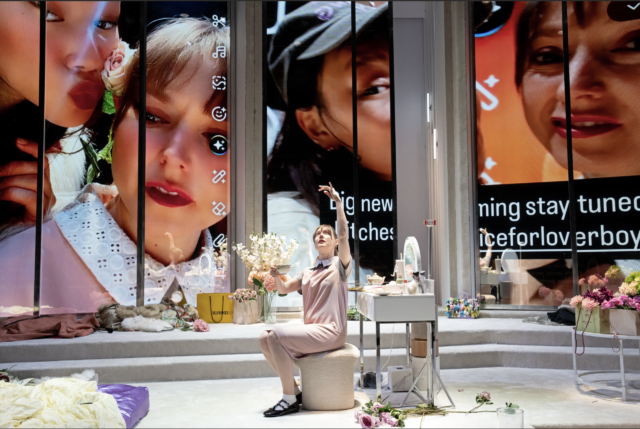
One of my favorite theatrical moments of the year happened in Natalie Palamides’s outrageously funny and insanely inventive Weer. Mark is making a critically important phone call, and I desperately prayed for Christina to quickly return to the stage and answer it. I looked to the far corner, anxiously waiting on the edge of my seat, hoping she would pick it up — when it suddenly hit me that Christina was already there: Weer is a one-woman show in which Palamides is playing both roles, the right side of her body Mark, the left side Christina. Palamides, a trained improv clown, had me believing there were two fully embodied characters in the extraordinary ninety-minute satiric, deranged rom-com like no other. I rejoiced, so thoroughly in love with my reaction.

I went into Weer knowing absolutely nothing about it; I didn’t know who was in it or what it was about. And that made it all the more memorable. The run, which was extended several times at the newly refurbished Cherry Lane, is sold out, so I don’t mind sharing the details of my experience here (spoiler alert!), but if you’re planning on trying to get rush or standby tickets, don’t read on until after you’ve given it a shot.

The Pittsburgh-born Palamides won the Total Theatre Award at the 2018 Edinburgh Fringe Festival for Nate — A One Man Show, a big success on Netflix two years later. In the wildly unpredictable and participatory performance, Palamides wrestles with male toxicity as she portrays Nate, a gruff, hirsute dude who announces early on, “I guess I get to do whatever I want . . . to whoever I want . . . in this room.”

Weer takes place during a New Year’s Eve gathering in 1999, complete with worries that all hell might break loose at midnight, when Y2K threatens to destroy the world. But for ninety minutes, all hell does break loose onstage, as the narrative shifts to 1996, when Mark and Christina meet-cute, and then back to the party, where the couple faces several challenges. Palamides’s awesome costume (by Ashley Dudek) and over-the-top makeup feature a flannel shirt, a bushy mane, a beard and mustache, and chest hair on one side, a belly-revealing red knit top, long hair with colorful clips, jewelry, and a woman’s shoe on the other, positing Mark and Christina as old-fashioned gender stereotypes; he has a deep, gravelly, full-throated voice, while she has a softer, more compassionate tone.

Natalie Palamides plays both roles at the same time in Weer (photo by Cherry Lane Theatre/A24)

Palamides, who also wrote and directed the show, expertly flips sides — or individual body parts — as Mark and Christina talk, kiss, dance, argue, shower, drive, and have sex on Gabriel Evansohn’s wonderfully scattershot set, which is filled with surprises that arrive with the pull of a rope or a step on an odd prop (designed by lucas a degirolamo). Word of warning: You will be provided with a plastic poncho if you’re in the first row, and not just because water might be sprayed.

There is no official script; the sturm and drang is all in Palamides’s head as she incorporates the audience into the controlled mayhem, mugging to the crowd, tossing out knowing glances, and asking a few people to join her onstage or speak from their seats. She has us eating out of her hand every step of the way, at least when we’re not practically rolling on the floor laughing. She has a ton of fun toying with the physical concept, sharing such self-reflexive dialogue as “She’s like my other half” and “Weer never gonna be separated like that again,” as well as the psychological approach, exploring the elements of masculinity and femininity in each of us.

Palamides, who does a lot of voice work on cartoons (Bob’s Burgers, Duncanville, Haunted Hotel) in addition to playing Mara in the Progressive insurance commercials, is irresistible as Mark and Christina, whether she is clothed or unclothed, baring her body and soul in uproarious ways. She also includes an apt Gen X soundtrack, with such songs as Aimee Mann’s “Save Me” (“If you could save me / From the ranks of the freaks that suspect / They could never love anyone”), Smash Mouth’s “All Star” (“Well, the years start comin’ and they don’t stop comin’ / Fed to the rules and I hit the ground runnin’ / Didn’t make sense not to live for fun / Your brain gets smart, but your head gets dumb / So much to do, so much to see”), and Pearl Jam’s emotive car-accident cover “Last Kiss” (“Oh, where, oh, where can my baby be?”).

The title, Weer, comes from how Mark’s family ridiculously pronounces the word deer as if they were Elmer Fudd — the hunted animal figures prominently in the show — and how both Mark and Christina are not able to exactly figure out their relationship through the years, often repeating to each other “Weer,” as in “We’re . . . ,” but unable to finish the thought.

I have to admit that when I first entered the Cherry Lane, I was extremely concerned. Purchased in 2023 by the film company A24, the theater has a smaller lobby area where ticket holders battle for space with diners waiting to go into the new, upscale Wild Cherry restaurant. There was a long, roped-off line for the restrooms, and a concession stand was selling popcorn and drinks as if we were seeing a movie. (Notably, it is now a for-profit venture where it previously was a nonprofit, making its location on Commerce St. rather apt.) Popcorn at the theater? The smell and noise had me on the brink of a conniption. Fortunately, Weer is so engaging, and the laughter so continuous, that those anticipated distractions melted away quickly, as the audience had no time to eat or drink. I do wonder what will happen during a quiet, dark drama, but that’s for another day.

Even the program gets in on the entertaining absurdities, with whimsical art, an advertisement in which Palamides offers relationship advice via email, and a spread that asks, “Whose side are you on?”

I know whose side I’m on.

[Mark Rifkin is a Brooklyn-born, Manhattan-based writer and editor; you can follow him on Substack here.]
PREACHING TO THE CHOIR: THE FAGGOTS AND THEIR FRIENDS AT PARK AVE. ARMORY

Kit Green leads a multitalented cast in disappointing North American premiere at Park Ave. Armory (photo by Stephanie Berger)

THE FAGGOTS AND THEIR FRIENDS BETWEEN REVOLUTIONS
Park Avenue Armory, Wade Thompson Drill Hall
643 Park Ave. at 67th St.
December 2-14, $40-$165
www.armoryonpark.org

The continuing attempted reclamation of the longtime gay slur “faggots” continues with the North American premiere of Ted Huffman and Philip Venables’s parable The Faggots and Their Friends Between Revolutions, running at Park Ave. Armory through December 14. In this case, it’s a lost cause.

Jordan Tannahill’s Prince Faggot, about queerness and the British royal family, just received yet another extension at Studio Seaview. In September, Baryshnikov Arts Center presented Kevin Carillo’s Figaro/Faggots, a mashup of Larry Kramer’s satirical 1978 novel, Faggots, and Mozart and Da Ponte’s 1786 opera, Le nozze di Figaro. And in August, TheaterLab staged Topher Payne’s Angry Fags, an election tale that deals with queer stories in a post-Trump world.

A baroque fantasia with music ranging from folk to medieval to opera to dance, The Faggots and Their Friends Between Revolutions was adapted from writer Larry Mitchell and illustrator Ned Asta’s 1977 book, when the F-word in question was much more a part of rampant homophobia and gay-bashing; the fifteen-member cast says “faggots” about a hundred times in a hundred minutes, but that doesn’t necessarily make its use sting any less, depending on one’s history with it.

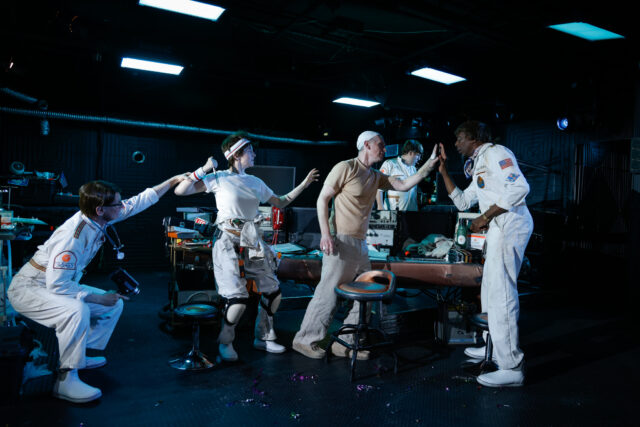
The performers are already congregating on Rosie Elnile’s wide open set as the audience enters the massive Wade Thompson Drill Hall, building a sense of community. On three sides of the neatly arranged platform stage are numerous unmatched chairs, a clothes rack, a few tables, and such instruments as a harp, a gong, a cello, and several pianos on wheels. The show begins with the following declaration, complete with surtitles projected on a small screen hanging from above:

“It’s been a long time since the last revolutions / and the faggots and their friends are still not free. / There still exists a faint memory of the past when the faggots and their friends were free. / The memory lives in the faggots’ bones. / It appears late at night when their bones are quietest. / When the memory visits them, the faggots know / that they must find each other in order to survive. / So while the men are sleeping, they emerge from the corners of the devastated city / and they go searching for other faggots in the hidden places: / in alleyways and abandoned piers and empty parks and unlit warehouses. / And there, in the moonlight, the faggots will enact the ritual of the brief encounter.”

The Faggots and Their Friends Between Revolutions is based on a 1977 illustrated gay parable/manifesto (photo by Stephanie Berger)

The show is constructed like a healing ritual as the performers, all of whom participate in the storytelling and play an instrument, hold hands, hug, dance, form a circle, and offer warm, caring smiles to one another and the audience. Olivier Award–winning transdisciplinary artist Kit Green, wearing a series of tight-fitting, colorful gowns and skirts with high heels (the otherwise casual costumes are by choreographer Theo Clinkard), serves as a kind of host and narrator, leading the festivities, along with her right-hand colleague, Yandass, who stands out in a dynamic solo dance. The rest of the energetic, multitalented cast consists of soprano Tamara Banješević, accordionist Valerie Barr, plucked-string instrumentalist Kerry Bursey, cellist Jacob Garside, chamber musician Conor Gricmanis, woodwind doubler Rianna Henriques, soprano Mariamielle Lamagat, baritone Themba Mvula, pianist and music director Yshani Perinpanayagam, transdisciplinary artist Meriel Price, countertenor and multi-instrumentalist Collin Shay, baritone Danny Shelvey, and harpist Joy Smith.

The book was inspired by Mitchell and Asta’s time living in the Lavender Hill gay and lesbian commune outside of Ithaca that they helped found in 1970, partly in response to the Stonewall riots. “People in gay liberation tended to talk about [how] gay male culture of the 1960s really centered on ideas of isolation and loneliness, and this was going to be what gay communes solved,” Yale historian Stephen Vider says in the 2014 documentary short Lavender Hill: a love story.

Unfortunately, the various components don’t come together to form a cohesive whole, unable to bear the weight of such an underwhelming narrative and never capturing the joy in Asta’s black-and-white line drawings. The Faggots and Their Friends is a fable/manifesto that pits “the faggots” against “the men,” essentially all white cis males who live in and rule the land of Ramrod, led by Warren-and-his-Fuckpole. (Ramrod may have been named for the famed Greenwich Village gay leather bar, where three years after the book was published the West Street Massacre took place, in which a former transit cop shot eight men, killing two.)

The faggots, whose friends include the fairies, women who love women, and the queens, are kind, sweet, good-natured souls filled with empathy and compassion, while the men are corrupt, violent, mean-spirited villains who worship “papers” (money); there is no middle ground, no bad faggots, no admirable men. There is no nuance, too much telling and not enough showing, no dynamic flow or tension in the story and no growth in the characters despite there still being so much hate in America in 2025 amid the rollback of so many rights that were fought for, especially in the 1960s and ’70s.

Adapter and composer Venables and director Huffman, who previously collaborated on such projects as 4.48 Psychosis, Denis & Katya, We Are the Lucky Ones, and My Favourite Piece Is the Goldberg Variations, essentially remain faithful to the book, but what might work on the page falls flat on the stage, and the changes, including repeating phrases, are too didactic, preaching to the choir, overselling the points that are being made, as in the following missive, which was adjusted slightly from Mitchell’s original:

“They attacked anyone unlike them. / After the men triumphed, all that was other from them was considered inferior / and therefore worthy only of abuse and contempt and extinction. / The men decided who was to be hated: / those without cocks, / those whose skin didn’t match their own, / those who were hungry involuntarily, / those who came from other lands, / those who refused to be over-worked, / those who loved their own kind. / These are the ones the men decided to hate.”

They also cut out the characters in the book, such as Heavenly Blue, Loose Tomato, Mildred Munich, Pat, Lee, and Meredith, instead giving us nameless people we know nothing about — except for Green, who delivers a moving, fourth-wall-breaking improvisatory monologue about herself that is cut short by an extended singalong of a difficult melody with pedantic lyrics.

On opening night, there were noticeably few bursts of spontaneous applause from the audience, and there was only a scattered standing ovation at the end, even though it’s become de rigueur for everyone to get up and cheer. In fact, at one point in the show, Green actually told the audience to clap.

That’s never a good sign, particularly when you have the excited crowd already on your side from the very start.

[Mark Rifkin is a Brooklyn-born, Manhattan-based writer and editor; you can follow him on Substack here.]

TICKET GIVEAWAY: CANDACE BUSHNELL’S TRUE TALES OF SEX, SUCCESS, AND SEX AND THE CITY

Candace Bushnell is back for a special encore presentation of her one-woman show about her life and career (photo by Joan Marcus)

CANDACE BUSHNELL: TRUE TALES OF SEX, SUCCESS, AND SEX AND THE CITY
Adler Hall at the New York Society for Ethical Culture
2 West Sixty-Fourth St. & Central Park West
Friday, December 5, $34.45- $56.06 ($187.34 for VIP meet-and-greet), 8:00
ethical.nyc
candacebushnell.com

In December 2021, Candace Bushnell presented her one-woman show, Is There Still Sex in the City?, at the Daryl Roth Theatre, an endearing production in which Bushnell shared intimate details of her life and career, centering around the gargantuan success she has had with the creation of Carrie Bradshaw (Sarah Jessica Parker), Samantha Jones (Kim Cattrall), Charlotte York (Kristin Davis), and Miranda Hobbes (Cynthia Nixon), the fictional characters on the HBO smash Sex and the City, based on her series of columns and 1996 book of the same name. The run was unfortunately cut short after Bushnell contracted Covid.

I called the play “a fab treat, a funny and candid New York story that everyone can relate to in one way or another, whether you are a fan of Sex and the City or have never watched or read it.”

Bushnell, who has also written such novels as Killing Monica, Lipstick Jungle, and Rules for Being a Girl (with Katie Cotugno), is now touring the show, renamed True Tales of Sex, Success, and Sex and the City; in the spring, she’ll be taking it to Denmark, the Netherlands, Belgium, France, and California.

But first, the solo play is returning to New York City, where it all happened.

TICKET GIVEAWAY: Bushnell, who is celebrating a birthday today (December 1), will be at Adler Hall at the New York Society for Ethical Culture on December 5 at 8:00 for a special one-night-only performance of True Tales of Sex, Success, and Sex and the City, and she has gifted twi-ny with a pair of prime tickets to give away for free to see the “real life Carrie Bradshaw.” Just send your name, phone number, and favorite Sex and the City character to contest@twi-ny.com by Wednesday, December 3, at noon to be eligible. All entrants must be twenty-one years of age or older; one winner will be selected at random.

[Mark Rifkin is a Brooklyn-born, Manhattan-based writer and editor; you can follow him on Substack here.]

THE QUEENS OF QUEENS: IN SEARCH OF THE AMERICAN DREAM

Polish immigrant Renia (Marin Ireland) dreams of a better life in Martyna Majok’s reimagined Queens (photo by Valerie Terranova)

QUEENS
MTC at New York City Center – Stage I
131 West Fifty-Fifth St. between Sixth & Seventh Aves.
Tuesday – Sunday through December 7, $109-$139
www.manhattantheatreclub.com
www.nycitycenter.org

Polish-born American playwright Martyna Majok tells stories that challenge the audience, taking risks as she explores the lives of the disenfranchised, the disabled, the underrepresented, and undocumented immigrants in search of the unreachable American dream. In Cost of Living, which earned her the Pulitzer Prize, it all came together without compromise; I wrote of the Broadway version, “The separate storylines merge at the end in an uneasy finale that acknowledges that we all encounter tremendously painful issues in life, regardless of our physical or psychological situations, which is further established during the curtain call.”

Her three other plays were not quite as successful despite intriguing setups and intricate narratives. About Ironbound, I noted, “The rest of the cast play their roles well, but their characters and tales are nowhere near as interesting and compelling as Darja’s, and they become somewhat quaint and repetitive as the show goes on and overdoes the obvious distinctions between rich and poor.” And I wrote that Sanctuary City “takes a head-scratching turn as the ending approaches, detracting from everything that came before it, which was powerful and moving.”

Queens, which originally ran at LCT3 in 2018 and is now at MTC’s New York City Center – Stage I through December 7 in a newly reimagined version, displays too many of the same issues; the play features characters and situations that you want to embrace and understand, but Martok and director Trip Cullman (Cult of Love, Six Degrees of Separation) are unable to weave their way through a web of fascinating ideas that don’t quite mesh. As with Ironbound and Sanctuary City, there’s a strong play in there that refuses to emerge.

A group of women seek common ground in MTC production at City Center Stage I (photo by Valerie Terranova)

Over the course of sixteen years, seven immigrant women move in and out of a crowded basement apartment in Queens, desperate to find a better life in America: the Belarusian Pelagiya (Brooke Bloom), the Polish Agata (Anna Chlumsky), the Polish Renia (Marin Ireland), the Ukrainian Inna (Julia Lester), the Afghan Aamani (Nadine Malouf), the Ukrainian Lera (Andrea Syglowski), and the Honduran Isabela (Nicole Villamil).

“Any regrets? In your life? In this building?” Inna asks Renia. Although she doesn’t want to admit it, Renia has plenty, having made choices that did not necessarily work out the way she expected. Inna punches her in the face before going inside and renting a room.

The basement is cluttered with clothing, a guitar, and other objects that are memories of those who came before, haunting Renia. (The effective set is by Marsha Ginsberg.) “What is your reason?” the memory of Pelagiya asks her. Aamani adds, “The reason you are here. Looking to live someplace away from the rest of your kind of people. What happened.”

The narrative then shifts to December 2001, when Renia has arrived in New York with little money in her pocket. Pelagiya wants to know what brought her there. “It’s no story,” Renia says. “It’s always story,” Pelagiya insists. Renia responds, “I need place I can stay. I come here. End of story.” Of course, it’s only the beginning of what turns out to be a dark, painful story. Even a somewhat pathetic party the women hold is tinged with fear and sadness. The appearance of the Honduran American Glenys (Sharlene Cruz) injects a burst of youthful energy, but it’s not enough to sustain the play’s 135 minutes (with intermission).

Queens does serve as a fascinating counterpoint to Bess Wohl’s dazzling Liberation, the current Broadway transfer about six diverse women who meet regularly in a rec center basement in Ohio in the 1970s to discuss the role of women in society, how it impacts their lives individually and what they can do to help change the status quo publicly; both shows delve into the relationships among women as well as mothers and daughters. The Queens women, however, have a different kind of baggage — obviously, they lack the relative privilege of the characters in Liberation, and face colossal odds stacked against them, coming from countries where women are still in search of freedom, fifty years after the Liberation women began changing America. Still, women’s search for the most basic of freedoms is the motor that drives Queens, even if the ride is bumpy and the destination uncertain.

[Mark Rifkin is a Brooklyn-born, Manhattan-based writer and editor; you can follow him on Substack here.]
BY THE SKIN OF OUR TEETH: THE SEAT OF OUR PANTS SETS WILDER TO MUSIC

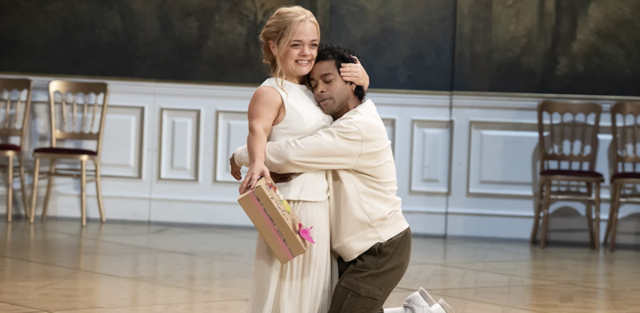
The Antrobus family faces the weight of the world in The Seat of Our Pants at the Public (photo by Joan Marcus)

THE SEAT OF OUR PANTS
Newman Theater, the Public Theater
425 Lafayette St. at Astor Pl.
Tuesday – Sunday through December 7, $125
publictheater.org

Just because The Skin of Our Teeth won Wisconsin native Thornton Wilder his third Pulitzer Prize doesn’t mean the 1942 work isn’t a slog, dense with metaphor, festooned with oddball characters and bizarre scenarios, and obsessed with strange time-shifting interventions. I’ve seen two recent productions, an overstuffed mess at Lincoln Center in 2022 and an exemplary revival from TFANA in 2017, but even the latter required significant attention from the audience to sift through Wilder’s complex storytelling as he essentially shares a tale that is nothing less than an encapsulation of the survival of living creatures on this planet.

The quartet of Leonard Bernstein, Jerome Robbins, Betty Comden, and Adolph Green attempted to turn The Skin of Our Teeth into a musical but eventually abandoned the project, as did the trio of John Kander, Fred Ebb, and Joseph Stein. But now Obie-winning composer, bandleader, playwright, and librettist Ethan Lipton has taken on the challenge and delivered an exciting and fun, if still problematic, musical adaptation called The Seat of Our Pants, continuing at the Public’s Newman Theater through December 7.

The 160-minute show (with intermission) is divided into The Skin of Our Teeth’s usual three acts, the first during the Ice Age in Excelsior, New Jersey, complete with dinosaurs and humans getting along well; the second on the boardwalk in Atlantic City at a convention of the Ancient and Honorable Order of Mammals, Subdivision Humans; and the third back in Excelsior following a devastating war. Each act is introduced by an announcer (Andy Grotelueschen), singing with a mic stand and asking the audience to join in. He advises at the very beginning, “I want to tell you that the news is good / I want to shout it out in every neighborhood / But I can’t lie to you — although I had assumed I would / The world is ending, the world is ending.”

At the center of everything is the Antrobus family: the father (Shuler Hensley), a successful and important businessman; his wife (Ruthie Ann Miles), a kind and practical woman; and their two children, the promising Gladys (Amina Faye) and the less-than-promising Henry (Damon Daunno). Holding it all together is their maid, Lily Sabina (Micaela Diamond), who often addresses the stage manager and the audience directly, complaining about the play itself. When someone apparently misses a cue, Sabina repeats a key line, “Don’t forget — we made it through the recession-pandemic-wildfire-oligarchy by the seat of our pants. One more crisis like that and then where will we be?” Fitz, the stage manager, tells her to stretch it out because of technical issues, but Sabina is having none of it.

“I will not invent words for this show,” she argues. “I hate this show and every line in it. I don’t understand a word of it anyway — all about the troubles of the human race? Now there’s a subject for you. Besides, the author hasn’t decided whether it’s set back in the caves or in New Jersey today. And now some other guy’s added songs. Songs! Because that’s what it was missing.”

Humans and animals interact in New Jersey in inventive musical based on Thornton Wilder play (photo by Joan Marcus)

But it turns out that many of the songs, including “The World Is Ending,” “Sabina’s Suite,” “Stuff It Down Inside,” and “Ordinary Girl,” inject life into the narrative, accompanied by clever staging by director Leigh Silverman (Yellow Face, Grand Horizons), boisterous choreography by Sunny Min-Sook Hitt, witty orchestrations and arrangements by Daniel Kluger, Lee Jellinek’s gleeful, open set with the audience on two sides facing each other and the band on the other two sides, and costumes (by Kaye Voyce) that range from suburban casual to convention uniforms to a talking mammoth (Geena Quintos) and turkey (Bill Buell) duo to band outfits that match the flowery yellow wallpaper. The attention to detail in the costumes and the set changes are hilarious.

But, as Sabina repeated, “Don’t forget —” that this is based on The Skin of Our Teeth, so not everything makes sense, scenes go on too long, and there are too many songs. But watching the cast, led by wonderful performances by Grotelueschen (Into the Woods, Pericles) and Diamond (Parade, The Cher Show), having so much fun — even band member Allison Ann Kelly gets in on the action — is infectious.

I’m thinking that The Skin of Our Teeth is back in favor because of the current state of the country and the world amid wars, the immigration crisis, economic instability, political dysfunction, climate change, polarization, and general havoc and maelstrom. So why not turn it into a charming musical? Obie winner and Guggenheim fellow Lipton (We Are Your Robots, The Outer Space) has done just that.

“I am skin and bones, and I have escaped only by the skin of my teeth,” Job says in the Old Testament. With The Seat of Our Pants, we escape with much more.

[Mark Rifkin is a Brooklyn-born, Manhattan-based writer and editor; you can follow him on Substack here.]