this week in theater

BREAKING BREAD: THE BAKER’S WIFE AT CLASSIC STAGE

The French village of Concorde rejoices when a new baker comes to town (photo by Matthew Murphy and Evan Zimmerman)

THE BAKER’S WIFE
Classic Stage Company, Lynn F. Angelson Theater
136 East Thirteenth St. between Third & Fourth Aves.
Tuesday – Sunday through December 21, $66-$206
www.classicstage.org

Why did it take nearly half a century for The Baker’s Wife to at last get a major New York City production? That’s a question you’ll likely be asking yourself after seeing this delightful musical at Classic Stage, marveling at what you’ve just experienced.

The show — based on Marcel Pagnol’s 1938 classic film La Femme du Boulanger, which was adapted from Jean Giono’s 1935 semiautobiographical novel Jean le Bleu — was on a pre-Broadway national tour in 1976 when it was abruptly pulled by producer David Merrick. It was reworked for a 2005 run at the Paper Mill Playhouse in New Jersey and was presented by the Gallery Players in Brooklyn for sixteen performances in 2015 and by J2 Spotlight for a ten-day showcase in 2022. Thus, this revival has been a long time coming.

The fun begins as you enter the theater, which has been transformed by Jason Sherwood into the 1935 village of Concorde in Provence, bedecked on all four sides with wandering plants, old-fashioned signage, a bakery (Boulangerie), balconies above the shop and in a far corner, double windows that open up, and small tables that seat characters at a café as well as a handful of audience members. Several men are already onstage, two playing a guitar and an accordion, the others engaged in a game of pétanque. The play proper begins as husband-and-wife café owners Claude (Robert Cuccioli) and Denise (Judy Kuhn) set the tables; Denise then turns to the audience and explains that nothing much ever changes in their town — except that their baker died and they are anxiously awaiting their new pâtissier, as they have been without bread and pastries for seven weeks, which is unconscionable.

“He could have arranged for another baker. He knew he was going to die,” Antoine (Kevin Del Aguila), the local lush, complains about the previous dough expert. The teacher, Martine (Arnie Burton), replies, “How did he know? He was drunk, he fell in a pit, and broke his neck.”

As calm and peaceful as everything appears at first, the rousing song “If It Wasn’t for You” establishes that all is not so well in Concorde, which in French means “harmony.” The priest (Will Roland) is not happy that the mayor, le Marquis (Nathan Lee Graham), is cavorting like a pimp with his “nieces,” the sexy trio of Simone (Savannah Lee Birdsong), Inez (Samantha Gershman), and Nicole (Hailey Thomas). The priest is also at odds with Martine and his recent teaching. Claude bosses around Denise, while Barnaby (Manu Narayan) suppresses his wife, Hortense (Sally Murphy). The hunky Dominique (Kevin William Paul) is not about to tie himself down with one woman, assisted by his friend Philippe (Mason Olshavsky). And the stern spinster Therese (Alma Cuervo) just wants to be left alone. “Ooh, life is hard enough for me / With all my cares and labors / Why must I be burdened with / Such irritating neighbors?!,” they sing.

When the baker, Aimable Castagnet (Scott Bakula), finally arrives, the villagers assume that the stunning young woman with him is his daughter, but it is actually his wife, Geneviève (Ariana DeBose). While the amiable Aimable is excited about this new opportunity, Geneviève seems a bit tentative, as if moving to this far-off location might be a little overwhelming. He asks her if she really likes it, and she says that she does, but it isn’t long before she is considering the attention heaped on her by Dominique, who wants to show her around the area and take her to the waterfall. She reminds him that she is married, and he wonders if Aimable would be jealous. “Jealous? Why should he be jealous?” she says. He answers like a rapscallion, “Because someone like you . . . If you were mine, I wouldn’t leave you alone for a second.”

Geneviève asks Aimable if he ever gets jealous, and he responds, “Jealous? Because other men find you beautiful? Why should I be jealous? I have a diamond and it’s shining in their eyes. Let them be jealous of me. . . . I’m going up to take a little nap.” When he tells her he loves her and she does not say the same in kind, it’s clear he might have something to worry about, but he is too wrapped up in his own world to figure out what is happening. And after something does, it affects his baking skills to the point that the villagers have to take extreme action to get their beloved bread every day.

Geneviève (Ariana DeBose) takes stock of her life in The Baker’s Wife at Classic Stage (photo by Matthew Murphy and Evan Zimmerman)

There’s a central flaw in the casting of the show — even though Geneviève is young and gorgeous and Aimable is a clueless, boring man more than twice her age, one can still imagine why she would be attracted to him because he is played by Bakula, who might be a senior citizen but is a handsome and virile guy in his later years. In the film, the baker, portrayed by Raimu, is a shlubby, silly, clownlike figure, and it’s easy to imagine him being potentially cuckolded. With Bakula in the husband role, Geneviève’s attraction to Dominique seems to happen far too quickly. But the quality of the performances makes that a minor quibble that is skillfully overcome.

Seductively directed by Gordon Greenberg (The Heart of Rock and Roll; Dracula, a Comedy of Terrors), who has been associated with the show since 2002, The Baker’s Wife features lovely music and lyrics by Oscar and Grammy winner and five-time Tony nominee Stephen Schwartz (Pippin, Wicked) and a thoughtful if straightforward book by Tony winner Joseph Stein (Fiddler on the Roof, Zorba). The enchanting music direction by conductor Charlie Alterman and orchestrations by David Cullen range from the villagers’ delicious “Bread,” expressing their glee at Aimable’s first morning as their baker (“What is there like fresh, warm bread?”), and Geneviève’s “Meadowlark,” the show’s breakout hit (“Who does he think he is?” she declares about Dominique), to “Romance,” in which the women surprisingly find themselves not surrounded by men (“How quickly the bloom is off the rose”), and Denise’s exquisite “Chanson,” which opens the first and second acts (“And then one day, suddenly / Something can happen / It might be quite simple / It may be quite small / But all of a sudden / Your world seems different”). The nine-piece band is highlighted by Alterman’s keyboards and Jacob Yates’s accordion, which help maintain the charming French feel, as does Stephanie Klemons’s fun and playful choreography.

DeBose (Pippin, Hamilton) and Bakula (Guys and Dolls, The Connector) — who played Dominique forty years ago — are wonderful together, the former capturing Geneviève’s youthful fascination, the latter embodying Aimable’s inability to see reality. Among the other standouts are Tony nominees Kuhn (Fun Home, Chess) and Cuccioli (Jekyll & Hyde, Les Misérables) as the café owners who eventually reach an important understanding, Murphy (The Minutes, Downstate) as the meek Hortense, and Tony nominee Del Aguila (Some Like It Hot, Frozen) as Antoine, who is in a way the conscience of the community.

The musical is also a celebration of women and the freedom to make their own choices. “Men! Pigs! Thank God I never married,” Therese declares. To which the marquis adds, “You know what’s wrong with the marriage vows? . . . Till death do us part. . . . That’s too long . . . much too long.”

Just as there are many types of bread, bread serves as a metaphor about life’s ups and downs. “Man does not live by bread alone,” it says in the Bible, which also states, “Give us this day our daily bread.” Mother Teresa explained, “There is more hunger for love and appreciation in this world than for bread.” The phrase “breaking bread” means that people have united over food. In most cultures it is the man who is responsible for “putting bread on the table.” And when someone is in prison, it is said that they will have to exist on “bread and water.”

In The Baker’s Wife, bread brings people together, in friendship, in romance, and in community, although it can also tear them apart, as when Barnaby refuses to allow Hortense to have a strawberry tart because he hates them, or when Aimable burns the bread one morning. But as Omar Khayyam once said, “A loaf of bread, a jug of wine, and thou.”

And a delectable musical.

[Mark Rifkin is a Brooklyn-born, Manhattan-based writer and editor; you can follow him on Substack here.]
LAST CHANCE: CAROLINE AT MCC

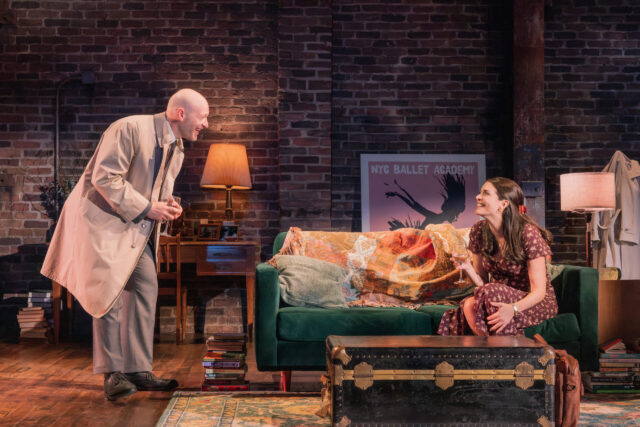
Rhea (Amy Landecker) is suspicious when Maddie (Chloë Grace Moretz) and Caroline (River Lipe-Smith) show up at her door (photo by Emilio Madrid)

CAROLINE
MCC Theater
Susan & Ronald Frankel Theater
511 West Fifty-Second St. between Tenth & Eleventh Aves.
Through November 16, $137
mcctheater.org

“Hi there, what can I get for you?” a diner waitress asks a mother and daughter at the beginning of Preston Max Allen’s deeply affecting Caroline.

It might seem like a harmless, standard question, but it gets right to the heart of the show, making its world premiere at MCC Theater. The waitress is portrayed by Amy Landecker, who later plays Rhea, mother to Maddie (Chloë Grace Moretz) and grandmother to nine-year-old Caroline (River Lipe-Smith). Maddie and Caroline, who has a broken arm, are on their way from West Virginia to Evanston, Illinois, fleeing Maddie’s abusive boyfriend and seeking help from Maddie’s parents, who have not seen her in a long time and don’t even know she has a daughter.

Maddie, who has been sober for eight years, had a troubled childhood: drinking at fifteen, doing drugs, sleeping around, stealing money from her parents, leaving home at seventeen, and getting pregnant. She hasn’t spoken to her mother and father in eleven years. When she shows up at the house she grew up in, her mother is surprised to see her and is cold and untrusting, especially when Maddie is demanding of what she wants, and doesn’t want, from her.

“Do you think I want to be here?” Maddie says. “If you don’t want us here, we’ll go. But I was hoping that maybe we could be mature about this.” Rhea, trying to suss out the situation, states, “Do you think we wanted this? Do you think we didn’t do every single thing in our power to help you? We fought for years for you. We hemorrhaged our savings trying to give you a recovery you didn’t want to have. . . . You have no idea what we went through. You can’t possibly remember what you went through, so don’t come into this house and try to tell me about my intentions.”

Rhea agrees to let them stay for one night until they agree on an acceptable plan going forward. She uses much of the time to get to know Caroline, who is trans, something that Maddie initially keeps from her mother. The three generations of women try to figure out what comes next as they argue about the past and prepare for a better future.

Caroline (River Lipe-Smith) and Maddie (Chloë Grace Moretz) try to figure out what’s next in potent world premiere at MCC (photo by Emilio Madrid)

Allen (We Are the Tigers, Storytime) writes compelling, honest dialogue that avoids the trappings of Hallmark movie-of-the-week melodrama, while the direction by Tony winner David Cromer (A Case for the Existence of God, Our Town) is swift, always in motion, on Lee Jellinek’s set, which is divided into three changing sections that include a diner table, motel bedroom, living room, and kitchen, expertly lit by Tyler Micoleau.

Landecker (Bug, Transparent) and Moretz (The Library, Kick-Ass) are terrific as Rhea and Maddie, who have work to do if they are going to reestablish their family; it takes a while to adjust to Lipe-Smith’s delivery (A Christmas Carol, Kinky Boots) but it smooths out significantly as the play goes on.

There are no men in the play; Caroline’s father is dead, Maddie’s father is away on business, and her ex-boyfriend is out of the picture. For ninety minutes, three women discuss responsibility, individuality, and what it means to be a mother and a daughter. Allen and Cromer provide no easy answers as the characters face difficult decisions that are not about to result in facile conclusions wrapped up in a neat bow.

[Mark Rifkin is a Brooklyn-born, Manhattan-based writer and editor; you can follow him on Substack here.]
NOT SO SWEET DREAMS: MICHAEL URIE AS RICHARD II

Michael Urie stars as Richard II in Red Bull production at Astor Place Theatre (photo by Carol Rosegg)

RICHARD II
Astor Place Theatre
434 Lafayette St.
Through December 21, $38-$300
www.redbulltheater.com

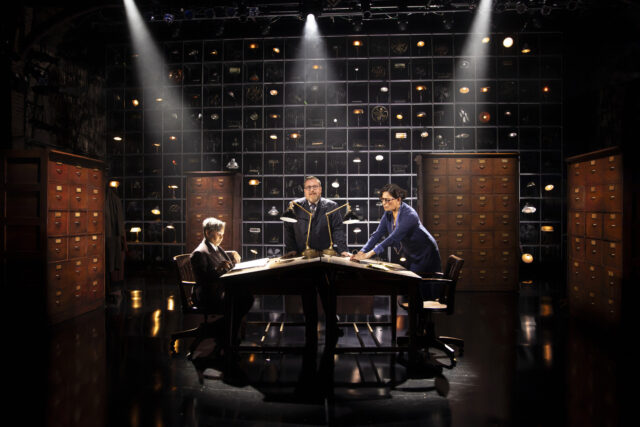
Craig Baldwin’s Red Bull adaptation of William Shakespeare’s Richard II gets off to a powerful start. As ticket holders enter the Astor Place Theatre, the king, portrayed by Michael Urie, is already onstage, kneeling in a glass cube serving as a cell, his bare back facing us. He is looking into a mirrored rear wall that reflects his face as well as members of the audience.

When the play proper begins, the jailed ruler says, “I have been studying how I may compare / This prison where I live unto the world: / And for because the world is populous / And here is not a creature but myself, / I cannot do it; yet I’ll hammer it out.” The opening soliloquy, which concludes with Richard asking, “Music do I hear?,” is followed by Aumerle (David Mattar Merten), the son of the duchess of York (Kathryn Meisle), singing along to the Eurythmics’ 1983 smash “Sweet Dreams (Are Made of This).”

The rest of the production could use a lot more hammering out as it travels between the 1960s, the 1980s, and the late fourteenth century, transforming the tragic tale of a king’s downfall into a time-warping gay fantasia that never finds its sense of purpose, its lofty ambitions misguided and bewildering.

The grandson of King Edward III, Richard took the throne when he was ten years old, and in this version, he has never grown out of his childlike nature, making seemingly arbitrary decisions to suit his whim at any given moment. Now in his early thirties, he finds himself caught in a battle between his cousin, Henry Bolingbroke (Grantham Coleman), and Thomas Mowbray, the Duke of Norfolk (Daniel Stewart Sherman); each man has accused the other of being a traitor to the king and his realm. They face off in a senseless, energy-draining game of Russian roulette with six-shooters, emceed by the courtier Bushy (Sarin Monae West) as if it’s a professional wrestling match, complete with crowd sound effects that make Thomas the villain. When neither wins, the king banishes Henry for ten years, which his father, John of Gaunt (Ron Canada), negotiates down to six, while Mowbray is exiled for the rest of his life.

Shortly after the duel, a dying Gaunt worries about the future of England in Richard’s hands; in a wheelchair and breathing through an oxygen tank, he warns, “Now He that made me knows I see thee ill; / Thy death-bed is no lesser than thy land / Wherein thou liest in reputation sick; / And thou, too careless patient as thou art, / Commit’st thy anointed body to the cure / Of those physicians that first wounded thee: / A thousand flatterers sit within thy crown.”

Soon, Bolingbroke is amassing an army to overthrow Richard, who has gone to Ireland to deal with rebel forces. Henry is supported by Lord Northumberland (Emily Swallow) and York, while the Bishop of Carlisle (Canada), the queen (Lux Pascal), Sir Stephen Scroop (Sherman), Bushy, Green (James Seol), Sir William Bagot (Ryan Spahn), and Aumerle (David Mattar Merten), the duchess’s son, remain loyal to the king.

Flashbacks reveal the king’s memories of better times, particularly hanging out with his favorites in a sauna and a drug-laden nightclub, where he does not hide his affection for Aumerle, even with his wife present. But when Henry and Richard meet again, the Bishop of Carlisle predicts, “The blood of English shall manure the ground, / And in this seat of peace tumultuous wars / Shall kin with kin and kind with kind confound.”

“Confounding” is exactly right.

Craig Baldwin’s adaptation of William Shakespeare’s Richard II searches for its center (photo by Carol Rosegg)

Richard II is not one of Shakespeare’s most popular plays; it has never been made into a film, and major productions are few and far between. For example, it has been staged by the Public Theater’s Shakespeare in the Park series only twice, in 1961 and 1987 (although it was scheduled for 2020 but instead was done as a radio play with André Holland in the lead). The Royal Shakespeare Company brought it to BAM in 2016 starring a fabulous David Tennant “portraying the dandy king with a bittersweet bisexual abandon and more than a touch of Jesus,” I wrote back then.

As much as I, and nearly the entire New York theater community, adore Michael Urie (The Government Inspector, Once Upon a Mattress), even he is not able to weave his way through the chaos and maelstrom (and fog). Onstage the entire 135 minutes, Urie does shine in a few instances, with some funny asides and gestures to the audience, but it’s hard to believe that he’s a king. The marquee depicts him wearing a pink spray-painted crown, eyes sadly cast down, so there’s more than a hint of the direction Baldwin will be taking, as many historians believe Richard was gay, but the show lacks focus; it’s all over the place. (Baldwin and Urie previously collaborated on Michael Kahn’s 2018–19 production of Hamlet for DC’s Shakespeare Theatre Company, in which Urie portrayed the melancholy Dane.)

Rodrigo Muñoz’s costumes switch from contemporary clothing, military garb, and Studio 54 chic to sauna towels, bathing suits, and Black Panther outfits, sometimes mixing in the same scene, as if the actors are in different shows. Northumberland wheels a news camera onto the set occasionally, preparing us for a live video feed that doesn’t happen; I wondered if there was a technical issue or it was done by choice. Jeanette Yew’s lighting keeps it mostly dark, although there are several moments when actors move around spotlights to shine on themselves or others, killing any pace. And “Sweet Dreams” upends the atmosphere more than once.

In a program note, CUNY English professor Mario DiGangi posits, “Why should we care about all these Yorks, Gloucesters, and Lancasters?”

As far as this production of Richard II is concerned, that’s a good question.

[Mark Rifkin is a Brooklyn-born, Manhattan-based writer and editor; you can follow him on Substack here.]
A TALE OF TWO CLASSICS: TARTUFFE AND PYGMALION

Cleante (Hannah Beck) has plenty of reason to not trust Tartuffe (André De Shields) in playful revival (photo by Joan Marcus)

ANDRÉ DE SHIELDS IS TARTUFFE
House of the Redeemer
7 East Ninety-Fifth St. between Fifth & Madison Aves.
Through November 23, $72 – $162
www.tartuffenyc.com
www.houseoftheredeemer.org

Two classic plays dealing with power and control are currently running off Broadway, one wisely built around its beloved star, the other celebrating the author but detracting from the story.

Star power needs to shine in a suitable setting, and André de Shields has one befitting his resplendence in the House of the Redeemer. Built in 1914–16, the mansion was originally owned by Edith Shepard Fabbri, a great granddaughter of Commodore Cornelius Vanderbilt, and her husband, Ernesto Fabbri, an associate of J. Pierpont Morgan’s. By midcentury it was deeded to the Episcopal Church, run by the Sisters of St. Mary until 1980, and designated a New York City Landmark in 1974.

Today it is home to concerts, Bible study, yoga, morning and evening prayers, cancer patients from Sloan-Kettering, and, through November 23, the gallantly titled and playfully rendered André De Shields Is Tartuffe. The scandalous 1664 French farce is being presented to a limited audience of one hundred a night in the historic library, which was constructed in an Italian ducal palace in the early 1600s and transported in two parts to New York City from Italy during WWI, serving as the centerpiece of the mansion.

The audience, sitting on three sides of the action, does not get to see the centerpiece of the show until the third act. Upon arriving at the House of the Redeemer, ticket holders are led into a salon with portraits, lenticular photos of Tartuffe, and a note from him that reads, “Tonight’s exorcism will redeem you as my true sycophants. The hour is upon you to seek within the sacred shelves of this salon and library six keys, six crosses, and six scrolls which will quicken your souls to a new dawn, a new day, a new life, and a new way . . . of . . .” There are also copies of D. H. Lawrence’s Lady Chatterley’s Lover, Jonathan Swift’s A Modest Proposal, and other books in the room, setting the literary mood. In the library, music director Drew Wutke is playing such sing-along pop songs as Billy Joel’s “Only the Good Die Young,” Journey’s “Don’t Stop Believin’,” and the Proclaimers’ “I’m Gonna Be (500 Miles)” as the cast interacts with the audience, effectively shifting the tone.

Under Keaton Wooden’s whimsical direction, Ranjit Bolt’s 1991 verse translation unfurls on Kate Rance’s elegant set: just a few chairs, a pink couch, a lectern, and a Persian carpet. A long table at one end boasts seasonal decorations and a few more open books. The play begins with the characters introducing themselves: patriarch Orgon (Chris Hahn), who is hiding financial difficulties from his family; his second wife, Elmire (Amber Iman); his children, Damis (Tyler Hardwick) and Marianne (Alexandra Socha); his mother, the aristocratic Mme. Pernelle (Todd Buonopane), who goes everywhere with her (stuffed) dog, Flipote; the all-knowing housemaid, Dorinne (Phoebe Dunn), who never hesitates to speak her mind; Valère (Charlie Lubeck), who is engaged to Marianne; and Cleante (Hannah Beck), Elmire’s philosophical sister who is in love with Damis’s sibling.

Orgon and his mother have fallen under the spell of a man the others refer to as an “evil, scheming, cleverly charismatic, pretty sleazy, and potentially ruinous priest” named Tartuffe (De Shields). The stage is set early on, in this wonderful piece of dialogue:

Mme P: I’ve heard you say things that were sane. / And yet, to me, this much is plain: / My son should bar you — drive you hence. / He would if he had any sense. / You stand on shaky moral ground, / The mode of life that you expound / Is one that no one should pursue — / No decent person, in my view.
Damis: Your friend Tartuffe would jump for joy . . .
Mme P: You should pay him more heed, my boy. / Tartuffe’s a good man — no, the best, / And if there’s one thing I detest / It is to see a fool like you / Carping at him the way you do.
Damis: The man is a censorious fraud / And yet he’s treated like a lord! / He’s seized control, that’s what he’s done / No one can have an ounce of fun / Do anything but sleep and eat / Unless it’s sanctioned by that creep.
Dorine: Name just one thing he hasn’t banned, / Condemned as “sinful,” out of hand — / We have some harmless pleasure planned / And straight off he prohibits it, / The pious, pompous, piece of —
Mme P: – SHHHHH! / How else are you to get to Heaven? / He should ban six things out of seven / And you should love him, all of you — / In fact, my son should force you to.

Orgon is besotted with Tartuffe, who he claims has changed his life and set him free; he declares with no remorse, “Yes, I could see my family die / And not so much as blink an eye.” When he announces that he is going to give Marianne to Tartuffe instead of to Valère, no one is happy, especially Marianne, but she lacks the ability to defy her father’s wishes. And Orgon’s devotion to Tartuffe only grows more intense and problematic as time goes on.

A family is torn apart by a con man in André De Shields Is Tartuffe (photo by Joan Marcus)

Ah, yes, and then there’s De Shields himself. He is once again given the most grand of grand entrances, as he was in Cats: The Jellicle Ball. I wrote at the time about the Tony, Obie, and Grammy winner, “This is André De Shields’s world; we only live in it.” Tartuffe only reinforces that statement.

“Here comes Tartuffe!” Dorine declares, but she is really proclaiming, “Here comes André!” In the script, it merely says, “Tartuffe enters. It deserves its own page.” There is nothing else.

Twin doors open, and there is he, Tartuffe, in a spectacular cardinal-like floor-length red robe, a giant bejeweled cross around his neck and chest, shiny rings on almost every finger, and dark sunglasses. (The costumes, a mix of period chic and standard contemporary, are by Tere Duncan.) He preens to the audience as he prepares to chew as much scenery as possible through the rest of the play, with Tartuffe making bold confessions, secretly seeking romance, and lying through his teeth, his personal hypocrisy evoking that of the Catholic church and the upper classes. He is a magnetic con man — with fantastic silver hair — who knows precisely how to play the game, ready to improvise as necessary.

When Damis tells Orgon how the priest tried to seduce Elmire, Tartuffe admits, “Why should I try to hoodwink you? / Brother, your son speaks true: I am / A sinner, yea, a wicked man! / My rank iniquities are rife / And every instant of my life / Is foul with sin! Yes, all the time / I add another heinous crime / To a long list. I roll among / The other swine in swathes of dung! / Small wonder Heaven is content / To sit and watch my punishment. / Whatever charge he wants to lay, / Nothing, not one word, will I say / In my defense — I lack the pride. / Let me be loathed and vilified. / Believe him! Give your wrath full rein! / Cast me into the street again / Like any felon. Shame? Disgrace? / I merit them in any case, / Lay ignominy at my door, / I’ve earned it, fifty times and more!” But Orgon attacks his son as his love and respect for Tartuffe intensifies.

The show is a hilarious romp, with stand-out performances by Tony, Emmy, and Grammy winner De Shields, Tony nominee Iman, and Dunn, who is always worth watching, even when Dorinne is not in a scene. It can get a little goofy at times, and if you’re in the second or third row you might have some trouble seeing every detail, but it’s all so sweet-natured that you can forgive it its minor sins.

Among those who have previously portrayed Tartuffe onstage and on film are Raúl E. Esparza, Emil Jannings, Gérard Depardieu, Antony Sher, and John Wood; later this month, Matthew Broderick will play Tartuffe in a new adaptation by Lucas Hnath at New York Theatre Workshop. None of them get to have their name in the title.

Professor Henry Higgins (Mark Evans) has plans for Eliza Doolittle (Synnøve Karlsen) in Gingold production Bernard Shaw’s Pygmalion (photo by Carol Rosegg)

BERNARD SHAW’S PYGMALION
Theatre Row
410 West 42nd St. between Ninth & Dyer Aves.
Wednesday – Sunday through November 22, $36.50 – $92.50
gingoldgroup.org
bfany.org

Upon entering the theater to see Gingold Theatrical Group’s twentieth anniversary production of Bernard Shaw’s Pygmalion — yes, the playwright’s name is part of the title — audience members are greeted by a series of posters featuring Al Hirschfeld drawings of George Bernard Shaw, including Shaw standing on the shoulders of William Shakespeare and Shaw painting a self-portrait with a colorful background. Lindsay Genevieve Fuori’s set is like a Hirschfeld tableaux, with a few chairs and tables, two steps leading to the facade of an opera house / temple with four ionic columns, a gable, and a raking cornice, and clouds with a hint of blue; in addition, there is a gold phonograph and a black recording machine that uses wax cylinders.

Hovering above is a caricature of Shaw as a winged angel, looking down as if he is a puppet master pulling all the strings. Several times during the show, thunder and lightning emerge from Shaw, reasserting his power and control over the proceedings. It comes off more as distraction than homage, artificially interrupting the narrative. Also disturbing any sense of flow is the intermittent appearance of four gods (Carson Elrod, Teresa Avia Lim, Lizan Mitchell, and Matt Wolpe, in multiple roles) who address the audience directly. They are based on a framing concept Shaw had drafted for the 1938 film adaptation but eventually scrapped; the dialogue Gingold founding artistic director David Staller uses is verbatim from the 1945 production with Gertrude Lawrence and Raymond Massey.

“Once upon a time, when we gods had a little more respect, you humans loved us. You built temples to us. We were always with you. Watching. Weaving our spells. And laughing at you,” Goddess 1 (Mitchell) says at the beginning. Goddess 2 (Lim) concurs, adding, “We laughed at you a lot. We still do.” There are not many laughs in this romantic comedy, and the satirical social commentary gets lost in the shenanigans.

The play, famously turned into the beloved 1956 musical My Fair Lady by Alan Jay Lerner and Frederick Loewe, was inspired by the Greek myth of the sculptor Pygmalion, a lonely man who carves a statue of a perfect woman he calls Galatea and then begs the gods to make real, which they do, but, as Goddess 1 explains, “There was a catch. A clause. A little hiccup that Pygmalion hadn’t thought to negotiate. The statue came to life, but with her own thoughts and feelings, with her own will. This possibility had somehow never occurred to Pygmalion. Oh, you funny humans. You men, in particular. And this, people: This is the story of that artist as reimagined by our friend, Mr. George Bernard Shaw.”

In Pygmalion, professor Henry Higgins (Mark Evans) is a persnickety phonetician lacking manners or social skills. When he encounters a poor, raggedy flower seller named Eliza Doolittle (Synnøve Karlsen) who speaks in what he considers a low-class Cockney accent, he makes a bet with his only friend, the far more practical Col. Pickering (Elrod). “You see this creature with her kerbstone English: the English that will keep her in the gutter to the end of her days,” he says to Pickering, right in front of Eliza, as if she’s not a person but a piece of clay. “Well, sir, in six months I could pass that girl off as a duchess at an Ambassador’s Garden Party.”

And so Higgins goes about molding Eliza into what he believes will be an honorable and respectable woman of society without paying attention to what Eliza wants, which is just to run her own flower shop. She defends herself by repeating over and over, “I’m a good girl, I am!” but that has no impact on Higgins, who treats her like she’s nothing more than a scientific experiment, referring to her as “so deliciously low. So horribly dirty. . . . I shall make a duchess of this draggle-tailed guttersnipe.”

Professor Henry Higgins (Mark Evans) has something to show Eliza Doolittle (Synnøve Karlsen) as Freddy (Matt Wolpe) looks on (photo by Carol Rosegg)

Meanwhile, Higgins’s mother (Mitchell) is not a fan of her son’s plan, pointing out to him and Pickering when they discuss the problem of transforming Eliza into a lady, “No, you two infinitely stupid male creatures: the problem of what is to be done with her afterwards.” Eliza’s estranged father, Alfred (Wolpe), is seeking a payoff to look the other way. Higgins’s housekeeper, Mrs. Pearce (Mitchell), insists that Higgins treat Eliza like a woman with her own mind. And Freddy (Wolpe), the sister of the prim and proper Clara (Lim), takes a shine to Eliza.

However, in inventing a new Eliza, Higgins gets more than he bargained for.

Goddess 1 strikes at the heart of the play when she says, “This is about human nature and human ridiculousness. It’s about . . . what is it about? About how easy it is to hide from ourselves. To hide from life. To wear the mask.” But Staller, who has previously helmed productions of such Shaw works as Mrs. Warren’s Profession, Heartbreak House, Arms and the Man, and Caesar & Cleopatra, with mixed results, can’t capture the essence of Shaw’s words in his staging. The humor falls flat, the acting is inconsistent, and the movement is too stagnant.

Staller might be among the most knowledgeable Shaw scholars on the planet — Gingold’s Project Shaw has presented all-star readings of every Shaw play, including “The Shewing-Up of Blanco Posnet” with André De Shields — but Bernard Shaw’s Pygmalion feels like a piece of marble that still requires a lot of chiseling and forming. Cue the lightning and thunder.

[Mark Rifkin is a Brooklyn-born, Manhattan-based writer and editor; you can follow him on Substack here.]
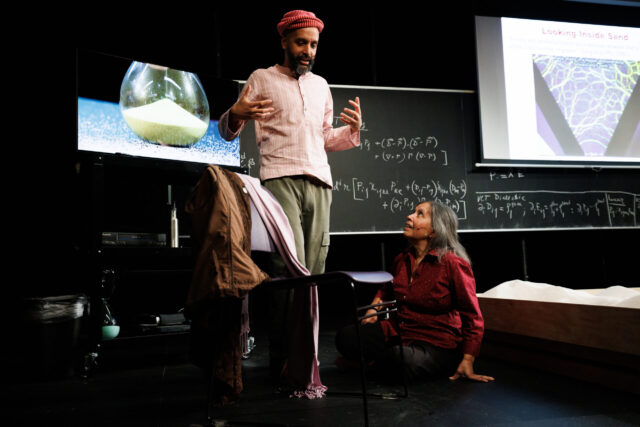
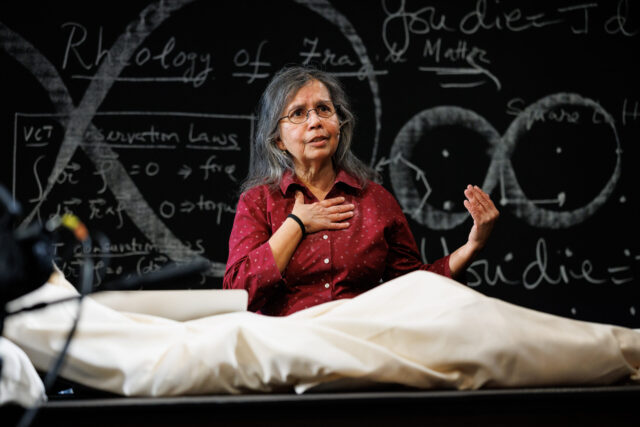
THE LANGUAGES OF LOVE: ZOË KIM’S DID YOU EAT? AT THE PUBLIC

Zoë Kim shares her childhood trauma with a glowing orb in Did You Eat? (photo by Emma Zordan)

DID YOU EAT? (밥 먹었니?)
The Shiva Theater at the Public Theater
425 Lafayette St.
Tuesday – Sunday through November 16, $80
publictheater.org

In 1992, Baptist minister and radio host Gary Chapman wrote The Five Love Languages: How to Express Heartfelt Commitment to Your Mate, in which he described five “love languages”: words of affirmation, quality time, receiving gifts, acts of service, and physical touch.

In her autobiographical solo show Did You Eat?, Zoë Kim offers her own take on love languages, as they apply to her relationship with her parents, herself, and her place in the world as a Korean American. It’s a brave but uneven journey that explores severe trauma but doesn’t quite dig deep enough during its too-brief sixty-five minutes, as she tells her story to a glowing white orb that represents her inner child.

Kim was born in Seoul to a dysfunctional family mired in resentment. Her father, Appa, was the youngest of thirteen children and the only son. His parents, who were poor, heaped all their attention on the boy, considering him to be “their only hope.” Kim explains, “Every piece of food and clothing went to keep him fed and warm. It was normal for him to wake up on a winter morning to find one of his sisters frozen or starved to death. None of his twelve sisters made it to adulthood. Harabeoji’s [Grandfather’s] future was worth the lives of twelve daughters.”

While studying for her PhD, Umma (Kim’s mother) was forced by Harabeoji to give up her dreams of becoming a scientist and instead get married. She did not want to be a mother, but she got pregnant immediately; Appa was planning on having many sons, but when Kim was born, he was more than disappointed, and Umma and Appa spent the rest of their lives taking it out on their daughter, in different ways. “The day you are born is a tragic day,” she says to the orb. As a child, she blames herself for the breakup of her parents’ marriage and the lack of love she receives from them, praying to the gods to turn her into a boy.

However, she spends a lot of time with her grandmother, Halmeoni, who introduces Kim to theater, music, and poetry. “Feeding you is her love language,” she notes happily, even as she points out how miserable Harabeoji is to Halmeoni. “You learn that your love language is to make her laugh.”

At fifteen, Kim, who does not speak any English, is sent to boarding school in America, where she is determined to thrive, fighting her fears as she attempts to balance being Korean and American. At sixteen, her father tries to kill her. “Your American dream is vaporized,” she says, and is soon battling “anxiety, depression, rage, shame, guilt, and hurt,” believing that she brought it all on herself, that she deserves all the bad things that are being heaped upon her. “Will I ever be okay?” she asks.

We might be watching her in a play that has had success since its workshop debut at the 2023 Edinburgh Festival Fringe and is now being presented at the Public by the Ma-Yi Theater Company, but that doesn’t necessarily mean she’s okay, given what she’s had to deal with since birth.

The title of the show refers to how Umma would say things to her that meant something else. For example, “Did you eat?” actually was “How are you?,” and “Are you eating?” was “I’m worried about you.” It was as if Umma could not speak to her daughter directly, would not communicate with her in a caring and loving way, skirting around reality.

Director Chris Yejin and choreographer Iris McCloughan keep Kim on the move, adding a potent level of physicality that counters the inner turmoil with a sense of impending freedom rather than doom. In a midriff-baring costume designed by Harriet Jung that reveals impressive abs, Kim flits across Tanya Orellana’s geometric set, consisting of an abstract arrangement of white platforms, walls, and doors, amid Minjoo Kim’s colorful lighting and Yee Eun Nam’s projections, which range from English translations of Korean dialogue to photos of old hands and animations of rain and falling letters.

While Kim is an engaging figure onstage, the narrative and movement occasionally dip into cliché and repetition, especially when it comes to her overuse of the concept of love languages, and it’s not always immediately clear when she shifts between characters. In addition, the orb is at times distracting, a precious prop that can be too sentimental.

At the end of the show, I was happy that Kim had overcome so many obstacles, but on the way home I couldn’t help but feel that I was still hungry, that I wanted more. Perhaps that will be sated by the next two parts of what Kim is calling the Hunger Trilogy.

[Mark Rifkin is a Brooklyn-born, Manhattan-based writer and editor; you can follow him on Substack here.]
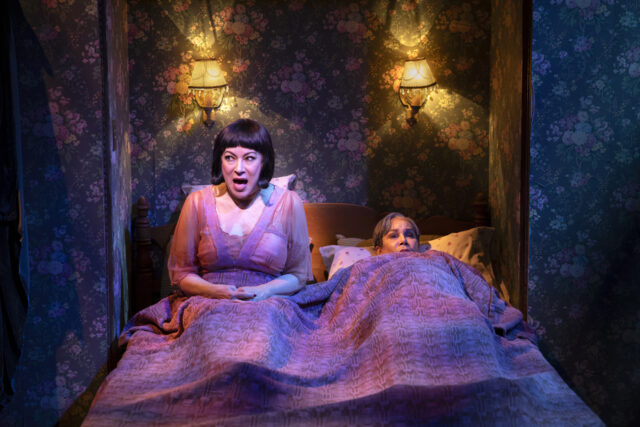
FASCISM ON THE MARCH: THEATRICAL DEPICTIONS OF HATE AND ANTISEMITISM THEN AND NOW

Torrey Townsend’s Jewish Plot takes a unique look at antisemitism (photo by Ken Yotsukura)

JEWISH PLOT
Theatre 154
154 Christopher St. between Greenwich & Washington Sts.
Through November 8, $52.24 – $73.24
www.jewishplot.com

About halfway through the shrewdly inventive Jewish Plot, one of the actors (Madeline Weinstein) reads a ferocious monologue by playwright Torrey Townsend that includes the following breathless diatribe:

“I’m just not hot right now / not exciting / not commercial / not happening / what I should do is make a pivot and frontface with something new / what I should do is start writing about Jews / it’s a subject that people love! / my god people love stories about Jews / it doesn’t even matter / stories about rich Jews / stories about poor Jews / stories about secular Jews / stories about religious Jews / Jews during World War Two / and Jews joining the underground / and Jews trying to escape the camps / and Jews being helped by non-Jews to escape the camps / and Jews being helped by other Jews to escape the camps / and Jews coming to America and assimilating / and Jews coming to America and not assimilating / and Jews experiencing trauma / yes especially above all else Jews experiencing trauma / Jews in the past experiencing trauma / Jews in the present experiencing trauma / Jews half in the past and half in the present experiencing trauma / Jews in multiple dimensions of time and place experiencing trauma / Jews beyond time and place experiencing trauma / Jews as stand-ins for all humans / the timeless truth of all humans experiencing trauma / modern Jews and ancient Jews and Biblical Jews experiencing trauma. . . .”

Right now there are numerous off-Broadway shows that tackle Jewish identity and trauma, coming at a fraught time when the mayoral race involves accusations of antisemitism and there is an uneasy ceasefire in the war in Gaza between Israel and Hamas: Jewish Plot at Theatre 154, Hannah Senesh at Theatre Row, Awake and Sing! at St. George’s Episcopal Church, Slam Frank: A New Musical at Asylum NYC, and Playing Shylock at the Polonsky Shakespeare Center; in addition, the Mint’s Crooked Cross and William Spatz’s Truman vs. Israel closed last weekend. Below I take a closer look at four of them, which I saw on four successive days.

Jewish Plot seemed problematic from the start. First, it had to move from the Brick in Brooklyn to Theatre 154 in the West Village because of an electrical fire. Then, the night I went, Weinstein made a long announcement about how various actors and musicians had quit, but the show, an adaptation of I. W. Bruntmole’s 1889 Jewish Plot; or, The Semite of Mayfair, which deals with antisemitism in Victorian England, would go on, with four performers who would do their best with the technical aspects such as sound and lighting. Oh, and Townsend was in a dressing room still putting finishing touches on the second act.

In Bruntmole’s play, Baron Morris von Azenberg (Eddie Kaye Thomas), who is Jewish, is engaged to actress Sophia Fitzkernerton (Tess Frazer), who is not. But she has to break up with him because, despite his prominent station, her family has forbidden her to marry a Jew; her mother calls the Baron a “Jew devil,” while her brothers refer to him as “the filthy Jew beast.”

The devastated Baron heads off to the Sgorg Inn, where he meets the Abbé Artemis de Romantis (Frazer), who blames all the world’s ills on the Jews. “There’s nothing in the past two thousand years that doesn’t come down to the Jews,” he tells innkeepers Owen (Neil D’Astolfo) and Conner (Weinstein). “The Jews have the money, the Jews are the ones who have robbed the Catholic Church of its power, the Jews are the ones who have brought down the French Empire. Everything’s been a plot, an ingeniously worked-out plot orchestrated by the sons of Israel, the Zionists, the New World Order — call it by any other name. — The Jews control the algorithm; all the rest of us are mice scampering around inside their system.” Offended by the Abbé’s insinuations, the Baron challenges him to a duel.

Madeline Weinstein, Neil D’Astolfo — and the audience — can’t believe what they see at Theatre 154 (photo by Ken Yotsukura)

In the second act, Townsend delivers a furious screed about Jewish theater, taking on Itamar Moses (The Ally), Jesse Eisenberg (The Revisionist), Tom Stoppard (Leopoldstadt), and, primarily, Joshua Harmon (Bad Jews), while also bringing up such antisemitic tropes as Jews “eatin’ Christian babies, and drinkin’ their blood!”

Townsend throws in a litany of anachronistic references, intimating how antisemitism continues over time. “This is a Super Bowl of scapegoating, a primordial Mardi Gras,” Townsend writes. It’s a brutal yet hilarious monologue, way too long, but it is as Jewish as it gets, particularly when he includes his mother. “Imagine a Jewish story without a Jewish mother,” he opines parenthetically. He also brings up his grandfather, Meyer Steinglass, “the head and front of the Zionist effort,” who wrote speeches for Golda Meir and raised $35 billion for Israel Bonds.

Lovingly directed with chaotic flair by Sarah Hughes, Jewish Plot is wonderfully titled; it’s about the millennia-old plot against Jews, the supposed plot by Jews to control the world, the plot of Jewish plays, and the burial plot, as antisemitism has resulted in so much death. Weinstein (The Ally) is sensational in the wildly unpredictable work, serving as our personable guide through the neverending scourge of hatred and prejudice that comes with being Jewish.

David Schechter’s Hannah Senesh tells the inspiring story of a real Jewish hero (photo by Tricia Baron)

HANNAH SENESH
National Yiddish Theatre Folksbiene at Theatre Row
410 West 42nd St. between Ninth & Tenth Aves.
Tuesday – Sunday through November 9, $92.50
bfany.org
nytf.org/hannah-senesh

Writer-director David Schechter’s Hannah Senesh, presented by the National Yiddish Theatre Folksbiene at Theatre Row through November 9, is framed by the title character’s mother, Catherine, sitting in a chair, proudly telling the audience in heavily accented English about seeing her daughter in a Budapest prison in 1944, locked up with other underground Zionists. “Hannah’s behavior before the members of the Gestapo was quite something. She always stood up to them, warning them plainly of the bitter fate what they would suffer after they lose the war,” Catherine says. “Even the warden of the prison, who I can only describe to you as . . . inhuman . . . animal . . . even he considered it a privilege to visit her cell daily to argue with her fearless criticism of the German rule and her prophecies of Allied victory. He knew she was Jewish, but he also knew that she was a British paratrooper who had come to fight them. And having been taught for years that Jews never fight back, they will accept the vilest treatment what you give them . . . he was struck . . . by her courage.”

In between, Hannah tells her true story, based on her diaries and other writings (translated by Marta Cohn and Peter Hay), taking us from Budapest in 1934, when, at the age of twelve, she declares herself a vegetarian and complains about a party dress her mother has bought her, through her teen years as she describes her ideal boy and her fury when she wins a school election but it is invalidated because she is Jewish, to her decision to become a Zionist. Quoting Polish writer Nahum Sokolow, she explains, “Zionism is the movement of the Jewish people for its revival.”

Shortly after turning eighteen, she immigrates to British Mandate Palestine, where she lives on a kibbutz. But as Hitler and the Nazis continue their march through Europe, Hannah decides she has to get her mother out before it’s too late, so she volunteers for a dangerous mission.

Jennifer Apple portrays both Hannah Senesh and her mother, Catherine, in poetic show (photo by Tricia Baron)

Jennifer Apple is terrific as both Hannah and Catherine, the former with a gleefully idealistic view of life, the latter more pragmatic; Hannah often flits about onstage, singing, dancing, and twirling a large blue-and-white multipurpose cloth that evokes what will be the colors of the Israeli flag, while Catherine, in dowdy clothing, is tense and controlled. The set features the chair and a writing desk surrounded by walls on which the sun, clouds, storms, and abstract shapes are projected.

The music, arranged by Steven Lutvak, includes Schechter’s adaptation of “Soon” and Liz Swados’s “One, Two, Three” in addition to Senesh’s popular poem “A Walk to Caesarea (‘Eli, Eli’),” in which she sings, “Oh Lord, my G-d / I pray that these things never end / The sand and the sea / The rush of the waves / The crash of the heavens / The prayer of man.”

The narrative doesn’t focus enough on what made Hannah a beloved hero in Israel — I actually had to Google her when I got home to find out more of the details — and the late inclusion of a second character (Simon Feil) feels unnecessary, but the play does a good job introducing us to this extraordinary young woman.

I can’t help but wonder what she would do if she were alive today.

Sea Dog’s adaptation of Awake and Sing!, about a Jewish family, takes place in a church (photo by Jeremy Varner)

AWAKE AND SING!
St. George’s Episcopal Church
209 East Sixteenth St. at Rutherford Pl.
Through November 8, $25-$75, 7:30
www.seadogtheater.org

Zionism and Israel don’t come up in Clifford Odets’s 1935 family melodrama, Awake and Sing!, but the play, currently enjoying a sublime ninetieth-anniversary production from Sea Dog Theater at St. George’s Episcopal Church, does deal with antisemitism, and assimilation, in its own way.

In her 1983 book From Stereotype to Metaphor: The Jew in Contemporary Drama, Ellen Schiff calls it “the earliest quintessentially Jewish play outside the Yiddish theatre. It bears the unmistakable stamp of authenticity, exactly what one would wish from a Jewish dramatist writing a slice of Jewish life problem play.”

This is the third production of Awake and Sing! that I’ve reviewed. In 2013, I saw an excellent all-Asian adaptation from NAATCO at Walkerspace, and in 2017 I caught a superb Yiddish version from New Yiddish Rep at the 14th Street Y. Sea Dog’s rendition features a diverse cast, which makes the story more universal without sacrificing its Jewishness.

It’s 1933, and the Berger family is struggling to get by in a cramped Bronx apartment. Matriarch Bessie Berger (Debra Walton) wants her children to marry well, but son Ralph (Trevor McGhie), a wannabe entertainer, is secretly dating a young woman from a poor family, and daughter Hennie (Daisy Wang) is not particularly fond of her two suitors, the acerbic and cynical Moe Axelrod (Christopher J. Domig) and the plain, uninspiring Sam Feinschreiber (Sina Pooresmaeil). Bessie’s husband, Myron (Juan Carlos Diaz), is a timid, ineffectual man with a taste for gambling, while Bessie’s elderly father, Jacob (Gary Sloan), wanders around the apartment listening to Enrico Caruso and spouting Marxist doctrine. Bessie’s brother, Morty (Alfred C. Kemp), who has a successful fashion business, stops by once in a while to defend capitalism and help out financially, but apparently not as much as he could.

Jacob (Gary Sloan) tries to get through to his grandson, Ralph (Trevor McGhie), in multigenerational Clifford Odets drama (photo by Jeremy Varner)

An early conversation emphasizes the family’s religion.

Myron: The whole world’s changing right under our eyes. Presto! No manners. Like the great Italian lover in the movies. What was his name? The Sheik . . . No one remembers? [Exits]
Ralph: Jake . . .
Jacob: Noo?
Ralph: I can’t stand it.
Jacob: There’s an expression — “strong as iron you must be.”
Ralph: It’s a cock-eyed world.
Jacob: Boys like you could fix it some day. Look on the world, not on yourself so much. Every country with starving millions, no? In Germany and Poland a Jew couldn’t walk in the street. Everybody hates, nobody loves.

When Hennie gets pregnant and the man who did it leaves town, the close-knit but argumentative family has some important decisions to make, facing difficult choices in very hard times.

Director Erwin Maas and production designer Guy De Lancey, who previously collaborated on Sea Dog’s moving Tuesdays with Morrie, make good use of the church’s narrow chantry. The audience sits in two rows on either side of the space, which is centered by a long table with chairs at each end and a green apple in the middle, the only prop in the show. The characters occasionally walk behind columns, down the hall, and into nooks, where their consternation is livestreamed on four video monitors. The actors’ voices do reverberate in the high ceilings, but your ears will quickly get accustomed to that.

Odets, the son of Eastern European Jewish immigrants, chose the title from the Old Testament, Isaiah 26:19, which declares, “Awake and sing, ye that dwell in dust,” but the added exclamation point seems almost like a tease as the men and women pursue an American dream that feels always out of their grasp, as if they will never be able to get out of the dust.

Many historians have likened this current time in the United States to 1930s Germany and the rise of fascism, and that undercurrent bristles under the play, since, with the benefit of hindsight, we know where things are heading for Jack, Morty, and the Jews of Europe.

The more things change. . . .

Mint revival is a timely look at the growth of fascism (photo by Todd Cerveris Photography)

CROOKED CROSS
The Mint Theater at Theatre Row
410 West 42nd St. between Ninth & Tenth Aves.
Closed November 1
minttheater.org
bfany.org

Sally Carson’s Crooked Cross begins on Christmas Eve, 1932, and there’s no doubt as to what it’s about and where things are heading: The title refers to the Nazi swastika.

The American premiere of the 1935 play, based on Carson’s 1934 novel, comes courtesy of the Mint Theater, which specializes in reviving lost or forgotten works. The show closed November 1 at Theatre Row but leaves a lasting impression.

In the small German town of Kranach, Moritz Weissmann (Ty Fanning) is in love with Lexa Kluger (Ella Stevens), who lives with her brothers, Helmy (Gavin Michaels) and Erich (Jakob Winter), and their parents (Katie Firth and Liam Craig). Moritz, who recently lost his mother, is taking care of his aging father (Douglas Rees).

A few months later, at a ball in a Munich hotel, Moritz is accosted by a young man (Ben Millspaugh) wearing a uniform with a swastika badge on it who yells, “Blast you! . . . You filthy Jew . . . beastly foreigner! Get out of the way . . . or I’ll . . .” Lexa is shocked by the altercation, saying, “I didn’t know it was like that.” Moritz considers ending his relationship with Lexa so as not to put her in harm’s way, but there’s no avoiding it once Helmy, Erich, and their friend Otto (Jack Mastrianni), who desires Lexa, have all joined the party and go everywhere in their brown storm trooper uniforms with swastikas on the arm. (The frightening costumes are by Hunter Kaczorowski.)

When Lexa tells Helmy that she doesn’t want to give up Moritz, he accuses her of being selfish. “But Helmy, what is being selfish? I’ve thought of so many things lately. And the more I think, the more everything gets a different value,” she tells him. “I’m sure of one thing, I can say this about Moritz, and it’s rare to be able to say it about anyone – I don’t want a single thing different about him, there’s nothing I don’t want or don’t love about Moritz.” Helmy bitterly replies, “Only his being a Jew.” Lexa answers quietly, “Perhaps even that.”

Carson pulls no punches as the Nazi party quickly grows and Moritz has to reevaluate his future in Germany with his father and Lexa.

A close German family is torn apart by Nazism in Sally Carson’s Crooked Cross (photo by Todd Cerveris Photography)

“The German youth had been brought up to believe that their country was ‘beaten’ and ‘second-class.’ They developed a feeling of inferiority,” Carson said at a 1935 postshow discussion. “Then along came Hitler who said, ‘You are not second rate and you are not going to be.’ This creed inspired the young people. . . . Whether he will continue to bamboozle the people much longer, no one knows.” The British author never saw the full force of the Nazis in WWII; she died in 1941 at the age of thirty-eight. Crooked Cross was the first of a trilogy that continued with 1936’s The Prisoner and 1938’s A Traveller Came By.

Adroitly directed by Jonathan Bank on Alexander Woodward’s cramped living room set (which converts to other tight spaces), Crooked Cross is a warning sign in 2025, nearly begging the audience to squarely face what is happening in America and around the world, to the Jews, refugees, and other minorities. The narrative avoids getting preachy, instead making its points with expert precision. The fine cast is led by a stellar performance by Stevens, in her New York debut, as Lexa, a caring and honest young woman who represents all of us who believe that the worst will not happen, that humanity can never go that far.

But as Jewish Plot, Hannah Senesh, Awake and Sing!, Crooked Cross, and so many other works dealing with antisemitism, bigotry, and injustice have revealed across the last ninety years and more, it would be folly to underestimate the power and reach of hate.

[Mark Rifkin is a Brooklyn-born, Manhattan-based writer and editor; you can follow him on Substack here.]
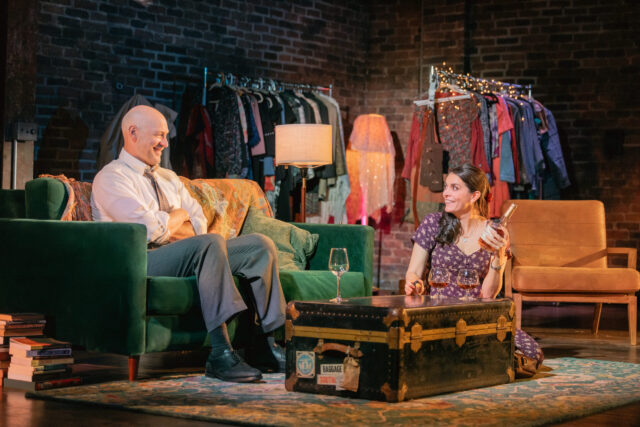
A GOOD CANCER STORY: THE LUCKY ONES AT THEATERLAB

Janie (Danielle Skraastad) and Vanessa (Purva Bedi) take a long look at their friendship in The Lucky Ones (photo by Hokun Tsou)

THE LUCKY ONES
TheaterLab
357 West Thirty-Sixth St., between Eighth & Ninth Aves., third floor
Wednesday – Sunday through November 9, $30
theaterlabnyc.com
www.boomerangtheatre.org

“I get a lot of satisfaction from measuring up to other people’s expectations,” playwright Lia Romeo explained last year. She also noted, “Being a woman in the world has always involved a certain measure of pain. . . . Being a woman in the world means there are no good choices a lot of the time.”

She wrote that in an April 2024 Newsweek Community Forum article, “Do I Reconstruct My Breasts? I’m Torn by My Decision,” but those sentiments are central to Romeo’s The Lucky Ones, her 2019 play now making its New York premiere at TheaterLab through November 9.

Staged by Boomerang Theatre Company in association with Project Y Theatre/Women in Theater Festival, the eighty-minute show offers an insightful look at female friendship in the face of tragedy. Vanessa (Purva Bedi) and Janie (Danielle Skraastad) have been besties for nearly twenty years, after meeting at an acting class. Now in their early forties, Janie is a childless, divorced middle school drama teacher with low self-esteem, while Vanessa is a steady working actress with lots of boyfriends and a fun-loving, devil-may-care spirit.

When a bumbling oncologist (David Carl, who plays all the male roles) tells Vanessa that she has stage four cancer, Janie appears to be more devastated than Vanessa. “I feel like I’m doing this badly. I’ve never done this before,” the doctor admits. Vanessa asks, “How long have you been an oncologist?” Counting backward on his fingers, the doctor answers, “Four days.” We soon learn he was previously an acrobat specializing in chair work, but an injury led him to this second career.

Calmly pointing out that she has lived a healthy life, Vanessa says, “So I guess I just don’t understand how something like this could happen.” A moment later, she uses a chair to climb up on the doctor’s desk to have a cigarette, blowing the smoke into the vent like she did in junior high. Vanessa asks Janie to join her; initially hesitant, Janie finally gets on the desk and takes a drag. It’s a potent scene that humorously sets up the seriousness that follows.

Confined to her hospital room, Vanessa quickly grows bored and decides that she will help Janie create an online dating profile and live vicariously through her, but Janie is reluctant to get back in the game, lugubriously claiming that men never ask her out “because nobody loves me and I’m going to die alone.”

Janie does at last find a botanist she swipes right on, but when she chooses a date with him instead of watching Bachelor in Paradise with Vanessa, cracks in the friendship start growing and get wider.

“It isn’t my fault that you’re sick and I’m not!” Janie argues. Vanessa replies, “No, it’s not! — But it should have been me! If one of us got to have their whole — I would have been better at it.”

David Carl, Danielle Skraastad, and Purva Bedi star in New York premiere of Lia Romeo’s The Lucky Ones at TheaterLab (photo by Hokun Tsou)

Directed with a mischievous bent by Katie Birenboim, The Lucky Ones unfolds on Ant Ma’s at times almost blindingly white set, consisting of movable chairs, a couch, a desk, and a cabinet that unfolds into a hospital bed. Just about the only color comes from flowers, pink bottles that match Vanessa’s intravenous fluid, and Jeff Croiter’s lighting, featuring three open rectangles of fluorescent bulbs. Brandon Bulls’s sound navigates through city noise, a screaming deejay, loud music, the voice of the universe (prerecorded by Christian Borle), and a wildly orchestrated meditation session. Stefanie Genda’s costumes help differentiate the unpredictable Vanessa from the more staid Janie. Romeo’s dialogue occasionally gets a bit stilted, but she is able to wiggle out of it with the actors’ help.

Carl (David and Katie Get Re-Married, Fat Cat Killers) imbues all the men with an innate goofiness and innocence despite the various characters’ complete lack of facility with women. Bedi (Dance Nation, India Pale Ale) and Skraastad (The Mound Builders, Hot Fudge) have instant chemistry as the two women who must rely on each other for love and care; when Janie says to the doctor about Vanessa, “If you’re in the room with her, you don’t want to look anywhere else,” that quote could apply to Bedi and Skraastad, who evocatively portray the friends.

Whether by choice or circumstance, the sexy, outgoing Vanessa and the more ordinary and plain Janie have no one else in their lives to turn to, even as painful truths come out. In the exhilarating finale, Brandi Carlile’s “The Story” blasts out, with the Grammy and Emmy winner singing, “All of these lines across my face / Tell you the story of who I am / So many stories of where I’ve been / And how I got to where I am / But these stories don’t mean anything / When you’ve got no one to tell them to, it’s true / I was made for you.”

Written for the Brooklyn Generator, The Lucky Ones is the fourth work in Boomerang’s nine-play “Super Season” celebrating the company’s twenty-fifth anniversary. In this case, Vanessa sums the show up well when she says, “Oh, yeah. People love a good cancer story. There are the sad ones full of chemo and radiation and surgical scars — but there are also some that are really fun.”

Oh, and beware the cobra lily.

[Mark Rifkin is a Brooklyn-born, Manhattan-based writer and editor; you can follow him on Substack here.]