this week in theater

FIDDLER’S JOURNEY TO THE BIG SCREEN

Star Chaim Topol and director-producer Norman Jewison kid around on the set of Fiddler on the Roof

FIDDLER’S JOURNEY TO THE BIG SCREEN (Daniel Raim, 2022)
Angelika Film Center
18 West Houston St.
Opens Friday, April 29
www.angelikafilmcenter.com
zeitgeistfilms.com

Daniel Raim takes viewers behind the scenes of the making of one of the most beloved musicals of all time in Fiddler’s Journey to the Big Screen, opening April 29 at the Angelika. Raim follows the development of the 1964 Broadway smash Fiddler on the Roof, which ran for 3,242 performances and won nine of the ten Tonys it was nominated for, into the classic 1971 film that was up for eight Oscars and won three.

The documentary is anchored by a series of talks with Fiddler’s director and producer, Canadian filmmaker Norman Jewison, who had previously made The Cincinnati Kid, In the Heat of the Night, and The Russians Are Coming, the Russians Are Coming and would go on to direct and produce Jesus Christ Superstar, A Soldier’s Story, and Mooonstruck. One of the first things we learn about Jewison is that he isn’t Jewish.

Recalling the initial meeting he had with United Artists executives, Jewison recalls, “[Studio head] Arthur Krim looked at me and he says, ‘What would you say if we were to say we want you to produce and direct Fiddler on the Roof?’ And my heart came up into my mouth and I thought, Oh my G-d. And I looked over, waited, and they waited, and they all kind of leaned forward. They thought, What is he waiting for? And then I said, ‘What would you say if I told you I’m a goy?’” He got the job because, as Krim explained, “We want a film for everybody.”

Documentary goes behind the scenes of the making of Fiddler on the Roof

Raim incorporates old and/or new interviews with vibrant lyricist Sheldon Harnick, who turns ninety-eight on April 30 (the score was composed by Jerry Bock, who passed away in 2010); musical director and conductor John Williams, who is featured extensively; production designer Robert F. Boyle, who was Raim’s professor at AFI; cinematographer Oswald Morris; American film critic Kenneth Turan; and Israeli star Chaim Topol, who nabbed the role of Tevye from Zero Mostel, who played the anguished, deeply religious father on Broadway. The film is worth seeing just for the lovely interviews with the three actresses who portrayed the three oldest daughters, none of whom marry the men their parents prefer: Rosalind Harris (Tzeitel), Michele Marsh (Hodel), and Neva Small (Chava). “What a gift I was given,” Marsh, nearly in tears, remembers.

Discussing his approach to the cross-cultural nature of the story, which was based on the 1894 Yiddish tales of Tevye the dairyman by Sholem Aleichem, Jewison points out, “Themes of family is universal; everybody has a family — good or bad, right or wrong, we all have a family, and we all have our little problems. But we all end up sitting around the table. And I thought, this is so common, this is something people can understand. They can understand a family. They can understand Golde. They can understand Tevye; they can understand his problems with life and his relationship to G-d. I think all of these things, all put together, make the story of Fiddler on the Roof so compelling.”

More than a dozen years in the making, Fiddler’s Journey can be a bit scattershot and is supplemented with occasional narration by Jeff Goldblum that feels like filler, consisting primarily of excerpts from Jewison’s This Terrible Business Has Been Good to Me, Alisa Solomon’s Wonder of Wonders: A Cultural History of Fiddler on the Roof, and Morris’s Huston, We Have a Problem: A Kaleidoscope of Filmmaking Memories. Unfortuntely, these distract from the main narrative, which is packed with fabulous details about everything from the construction of the synagogue, Frank Sinatra’s desire to play Tevye, and the stocking Boyle placed over the lens of the camera to the influence of Marc Chagall’s paintings, Harris understudying Bette Midler onstage, and the involvement of Isaac Stern.

The wealth of material includes archival stills and film footage, Mentor Huebner’s storyboards, and photos by Roman Vishniac that inspired the look of the movie, which was shot in Lekenik in what was then Yugoslavia. There are also in-depth looks at such treasured songs as “Matchmaker, Matchmaker,” “If I Were a Rich Man,” “Sunrise, Sunset,” and “Do You Love Me?”

The Fiddler on the Roof movie might be fifty years old now, but its impact is as powerful and, sadly, as relevant as ever. “One of the things that Fiddler is about: Nothing is permanent,” Turan says. Long before the Russian invasion of Ukraine — Aleichem was born and raised in Kyiv — the show (most recently revived in Yiddish by the National Yiddish Theatre Folksbiene at the Museum of Jewish Heritage) and the film captured the pain of refugees forced to leave their home. Raim’s (Harold and Lillian: A Hollywood Love Story, The Man on Lincoln’s Nose about Boyle) documentary was completed prior to the invasion, but it’s impossible to watch it without thinking about all the Anatevkas we see on the news every day, in Ukraine and around the world.

(Raim will be at the Angelika on April 29 and 30 for Q&As following the 7:25 screenings, joined by Small and Harris.)

BIRTHDAY CANDLES

Ernestine (Debra Messing) lives a relatively simple life in Noah Haidle’s Birthday Candles (photo by Joan Marcus)

BIRTHDAY CANDLES
American Airlines Theatre
227 West 42nd St. between Broadway & Eighth Ave.
Tuesday – Sunday through May 29, $39-$250
212-719-1300
www.roundabouttheatre.org

“Have I wasted my life?” Ernestine (Debra Messing) asks her mother, Alice (Susannah Flood), at the beginning of Noah Haidle’s Birthday Candles, continuing through May 29 at the Roundabout’s American Airlines Theatre.

Haidle’s Broadway debut is a touching and bittersweet, if at times Hallmark-y, look at ninety years in the life of an average American woman in Grand Rapids, Michigan. The play is built around her annual preparation of her birthday cake, a recipe handed down from mother to daughter in their family. Each scene takes place in the same kitchen, which never changes. Ernestine wears essentially the same costume (by Toni-Leslie James) in every scene as she ages, the time shifts indicated only by a sharp chime that arrives in the middle of the action and contextual clues given by the dialogue and the outfits of the other characters, which range from her boyfriend and future husband, Matt (Tony nominee John Earl Jelks), to her numbers-obsessed neighbor, Kenneth (Enrico Colantoni), who has a serious crush on her, to a parade of children, their spouses, their children, etc. (Jelks, Crystal Finn, Susannah Flood, and Christopher Livingston play multiple roles, their character not always immediately apparent as the next generation arrives. I saw understudy Brandon J. Pierce stepping in for Livingston.)

Ernestine serves as a witness to birth and death, illness and infidelity, success and failure, devoid of any references to the outside world. Whereas Jack Crabb, portrayed by Dustin Hoffman in Arthur Penn’s 1970 epic revisionist Western Little Big Man, spends his 121-year life on the road, meeting famous people (General Custer, Wild Bill Hickok), encountering a diverse series of events (battles with Native Americans, saloon shootouts, getting married and operating a small store), and watching everything change around him, Ernestine lives in a self-contained bubble, with no inkling of what is happening in society at large; there are no references to politics, sports, entertainment, anything that can put us in a specific time and place, only what is occurring within the family at any given moment, and always on her birthday. Another signifier is Ernestine’s annual measurements penciled on a doorframe; she grows taller until she begins shrinking as an old woman. Birthday Candles also recalls Thornton Wilder’s 1931 The Long Christmas Dinner, a one-act play that covers ninety years of the Bayard clan without ever leaving the dining room.

The show opens as Ernestine is turning seventeen, filled with the excitement of all that life offers. “I am a rebel against the universe. I will wage war with the everyday. I am going to surprise God!” she announces to her mother, who is more concerned with teaching her daughter the basic but cherished recipe for the cake.

Ninety years pass by in ninety minutes in Birthday Candles (photo by Joan Marcus)

“Eggs, butter, sugar, salt. The humblest ingredients,” Alice tells Ernestine. “But when you turn back and look far enough, you see atoms left over from creation,” implying that the history of the family — perhaps of humanity itself — is embodied in the cake.

Ernestine responds, “Stardust. The machinery of the cosmos is all here, I get it. Will you help me with my audition?”

Ernestine is practicing for the lead in her high school’s gender-switching production of Queen Lear, signaling that Birthday Candles is going to be a matriarchal tale about mothers and children; the men play second fiddle. “Madam, do you know me?” Alice reads as Cordelia. Ernestine, as the queen, answers, “You are a spirit, I know. When did you die?” In King Lear, the elderly monarch starts losing his mind as he deals with his three daughters, the calculating Regan and Goneril and the youngest, Cordelia, the only one who truly loves him. By having Alice reading the part of Cordelia and Ernestine portraying Lear, Haidle is alerting us to the casting choices and plot that follow.

As time marches on, new characters enter and old characters depart, the future replacing the past. Jelks portrays Ernestine’s husband, Matt, and their son, Billy; Finn is Billy’s wife, Joan, and their daughter, Alex; and Flood is Ernestine’s mother, Ernestine’s daughter, Madeline, and Alex’s daughter, Ernie. Finn and Livingston also appear as a surprise couple. People discuss their jobs, their relationships, and their personal identities in a vacuum. At one point, Madeline tells her parents and brother, “I don’t have a definition anymore. There aren’t any. In me. Or in the world.”

The actors make only small adjustments as their characters age, except for Messing once she passes her real-life age of fifty-three. Her slow decline as she survives so many of the others is heartbreaking, but she’s not about to stop making that cake on her birthday, no matter how old she is or who is around to enjoy it with her.

Ernestine’s (Debra Messing) life flashes before our eyes in Noah Haidle’s Broadway debut (photo by Joan Marcus)

One who is always there with her is her pet goldfish, given to her by Kenneth when they were seventeen and named Atman, the Sanskrit word for an individual’s essence, or soul. Kenneth explains, “The Katha Upanishad is the first to use the concept of Atman as a beginning argument of achieving liberation from human suffering. I quote, and please forgive my basic translation. ‘Like fire spreads itself throughout the world and takes the shape of that which it burns, the internal Atman of all living beings, while remaining one fire, takes the form of what He enters and is at the same time outside all forms.’” He points out that goldfish have only three-second memories and “then the world begins anew.” That’s one way to forget the pain, although the pleasurable moments vanish as well; Ernestine’s life is filled with plenty of both.

Haidle (Vigils, Smokefall) has created an emotional, gripping tale that is haunted by the fear of death as it explores various concepts of love, between married couples, parents and children, siblings, owners and pets, and a devoted neighbor. Director Vivienne Benesch, who helmed the play’s world premiere at the Detroit Public in 2017, manages the time shifts with aplomb as characters come and go through several open doorways on Christine Jones’s welcoming kitchen set, over which hangs dozens of household objects — remnants of a long life — in addition to the phases of the moon, a reminder of time itself.

Emmy winner Messing (Will & Grace,Outside Mullingar) is enthralling as Ernestine, who could be any of us. The different paths her life takes, each twist and turn, lead to familiar small dramas that are fully relatable; as she ages, it is hard not to consider what your own future holds. I am not a crier, but I have to admit that I was wiping away tears in the final scenes, and I was not the only one.

Colantoni (The Distance from Here, Fear) is utterly charming in his Broadway debut as Kenneth, an oddball who spends more than half a century pining for Ernestine, a regular reminder of the things in life we want that are so close but can so often be just out of reach. The rest of the cast is excellent as well, with a memorable comic turn by Finn as Joan, who has no filter and talks to herself out loud.

At a 1974 press conference, Muhammad Ali said, “If a man looks at the world when he is fifty the same way he looked at it when he was twenty and it hasn’t changed, then he has wasted thirty years of his life.” Did Ernestine waste her life? It’s a question we all ask ourselves as our birthdays come and go.

TWO BY SYNGE: IN THE SHADOW OF THE GLEN / THE TINKER’S WEDDING

The Irish Rep’s Two by Synge features several musical interludes (photo by Carol Rosegg)

TWO BY SYNGE: IN THE SHADOW OF THE GLEN / THE TINKER’S WEDDING
Irish Repertory Theatre, W. Scott McLucas Studio Theatre
132 West 22nd St. between Sixth & Seventh Aves.
Wednesday – Sunday through May 22, $50
212-727-2737
irishrep.org

I am here to sing — pun intended — the praises of the great John Keating, currently starring in the theatrical twinbill Two by Synge: In the Shadow of the Glen & The Tinker’s Wedding at the Irish Rep. It’s a rave long in coming. If you don’t know the name, you must not have visited the Irish Rep much in the last quarter century, during which time the Tipperary native has appeared in more than a dozen productions (as well as numerous Shakespeare adaptations at TFANA).

Keating, a wiry fellow who stands six-foot-three with wildly curly hair and an immediately recognizable face, portrayed the fearful, deeply religious Shawn Keogh in John Millington Synge’s Playboy of the Western World at the Irish Rep in 2002; he is not the same John Keating who illustrated a 1927 edition of the work.

Directed by Irish Rep founding artistic director Charlotte Moore, Two by Synge consists of a pair of early short works about Irish peasantry, which the Dublin-born Synge based on stories he heard and saw, then wrote about at the urging of his friend and colleague W. B. Yeats. They take place in the company’s downstairs W. Scott McLucas Studio Theatre, a tiny, intimate black box where you can practically reach out and touch the actors — while getting the sensational opportunity to revel in Keating’s extraordinary talent.

It begins with The Tinker’s Wedding, Synge’s bawdy tale of a poor couple, Sarah Casey (Jo Kinsella), the onetime Beauty of Ballinacree, and Michael Byrne (Keating), a tinker, who want to get married. Their relationship is more out of necessity than true love.

A couple of peasants want the local priest to marry them in The Tinker’s Wedding (photo by Carol Rosegg)

Sarah harasses Michael, arguing, “It’ll be small joy for yourself if you aren’t ready with my wedding ring. Is it near done this time, or what way is it at all?” He replies, “A poor way only, Sarah Casey, for it’s the divil’s job making a ring, and you’ll be having my hands destroyed in a short while the way I’ll not be able to make a tin can at all maybe at the dawn of day.” Sarah says, “If it’s the divil’s job, let you mind it, and leave your speeches that would choke a fool.” Michael retorts, “And it’s you’ll go talking of fools, Sarah Casey, when no man did ever hear a lying story even of your like unto this mortal day. You to be going beside me a great while, and rearing a lot of them, and then to be setting off with your talk of getting married, and your driving me to it, and I not asking it at all.”

Sarah tries to force the local priest (Sean Gormley) to perform the ceremony, but he is not about to do so without getting some form of payment, as Sarah and Michael are not church regulars and she does not live the life of a model Christian. “A holy pair, surely! Let you get out of my way,” the harried priest declares, attempting to leave them, but Sarah is adamant. Soon arriving is Michael’s mother, Mary (Terry Donnelly), a well-known drunk who has a way of ruining everything. She tells the priest, “Isn’t it a grand thing to see you sitting down, with no pride in you, and drinking a sup with the like of us, and we the poorest, wretched, starving creatures you’d see any place on the earth?” When the priest threatens again to not marry the couple, Sarah and Michael come up with a bizarre plan to ensure their union.

The Tinker’s Wedding — which Synge never got to see performed, as he died of Hodgkin’s lymphoma at the age of thirty-seven, more than seven months before its 1909 debut — is a bit too jumbled at first but eventually finds its legs. Daniel Geggatt’s set features stone walls, a fireplace, a small gate, and the facade of a house that resembles a huge Native American drum. Keating is a joy to watch, whether he is front and center or drifting off into the background, tinkering with the ring or a tin can. In full character, he follows the action with intricate gestures, from smiles and nods of agreement to frowns and head shakes. His eyes gape open in wonder and shudder in fear. While that might be what good acting is about, he takes it to another level, in the simplest moments as well as the turning points.

Keating (The Naturalists, The Winter’s Tale) is even better in the second play, the significantly superior In the Shadow of the Glen, the first of Synge’s works to be staged (in 1903). Keating plays a tramp in a shoddy coat (courtesy of costume designer David Toser) who has wandered in from a storm to seek temporary shelter in the home of Nora Burke (Kinsella) and her husband, Dan (Gormley), who is lying lifeless in the bed. (The set is essentially the same save for the “drum,” which has been rotated to reveal the bedroom.) She seems relatively nonplussed by the corpse, and the tramp is taken aback.

“It’s a queer look is on him for a man that’s dead,” the tramp points out. Nora responds, “He was always queer, stranger, and I suppose them that’s queer and they living men will be queer bodies after.” The tramp adds, “Isn’t it a great wonder you’re letting him lie there, and he is not tidied, or laid out itself?” She answers, “I was afeard, stranger, for he put a black curse on me this morning if I’d touch his body the time he’d die sudden, or let any one touch it except his sister only, and it’s ten miles away she lives in the big glen over the hill.” Tramp: “It’s a queer story he wouldn’t let his own wife touch him, and he dying quiet in his bed.” Nora: “I’m thinking many would be afeard, but I never knew what way I’d be afeard of beggar or bishop or any man of you at all. It’s other things than the like of you, stranger, would make a person afeard.”

The tropes of a classic ghost story turn on a fabulous plot twist and the arrival of the Burkes’ neighbor, young farmer Micheal Dara (Ciaran Bowling) — the character Keating played in his first professional performance in 1994 — in whom Nora sees a rescuer from her sudden predicament. “What way would I live and I an old woman if I didn’t marry a man with a bit of a farm, and cows on it, and sheep on the back hills?” she asks.

A tramp finds himself caught between a young farmer (Ciaran Bowling) and a woman (Jo Kinsella) mourning her husband in J. M. Synge’s In the Shadow of the Glen (photo by Carol Rosegg)

Keating (Autumn Royal, The O’Casey Cycle) is again magnificent in Glen, his body movements and shifting of his eyes utterly hypnotizing. He is an actor’s actor, making everyone around him better; watching him watching the other characters also offers another way into the play for the audience, no matter how successful it already is, and In the Shadow of the Glen is just that, a short but satisfying foray into the fear of death that hovers over Irish stories. Moore (The Streets of New York, The Playboy of the Western World) and lighting designer Michael O’Connor makes sure to never have Keating fade too far into the background as members of the rest of the fine cast take center stage.

The two shows, which total seventy-five minutes, also include six songs, two by Synge, three traditionals, and one original by Gormley, “A Smile upon My Face,” which comes between the two comedies. Yes, despite such lines as “It’s a cruel and a wicked thing to be bred poor,” said by Sarah Casey, Two by Synge is very funny.

In his preface to The Tinker’s Wedding, the playwright explained, “The drama is made serious — in the French sense of the word — not by the degree in which it is taken up with problems that are serious in themselves, but by the degree in which it gives the nourishment, not very easy to define, on which our imaginations live. We should not go to the theatre as we go to a chemist’s, or a dram-shop, but as we go to a dinner, where the food we need is taken with pleasure and excitement. . . . Of the things which nourish the imagination humour is one of the most needful, and it is dangerous to limit or destroy it. Baudelaire calls laughter the greatest sign of the Satanic element in man; and where a country loses its humor, as some towns in Ireland are doing, there will be morbidity of mind, as Baudelaire’s mind was morbid. In the greater part of Ireland, however, the whole people, from the tinkers to the clergy, have still a life, and view of life, that are rich and genial and humorous. I do not think that these country people, who have so much humor themselves, will mind being laughed at without malice, as the people in every country have been laughed at in their own comedies.”

Whenever you’re not sure if something is funny or not, just follow Keating’s lead and he’ll make sure you’re on the right path.

THEATER OF WAR: THE NURSE ANTIGONE

Who: Tracie Thoms, Taylor Schilling, John Turturro, Ato Blankson-Wood, Keith David, Craig Manbauman, Sandy Cayo, Elizabeth Hazlewood, Jumaane Williams, Bryan Doerries
What: Dramatic reading and community discussion
Where: Theater of War Zoom
When: Thursday, April 21, free with RSVP, 6:00
Why: Theater of War Productions teams up with the Greater NYC Black Nurses Association for its latest live, interactive presentation, exploring caregiving and death. On April 21 at 6:00, an all-star cast will deliver a dramatic reading of Sophocles’s Antigone, about one of the daughters of Oedipus and Jocasta who is determined to give a proper burial to her brother Polynices, who has been branded a traitor, his body left to rot.

The fifth-century play will be performed by actors Tracie Thoms, Taylor Schilling, John Turturro, Ato Blankson-Wood, and Keith David, joined by frontline nurses Craig Manbauman, Sandy Cayo, and Elizabeth Hazlewood and New York City public advocate Jumaane Williams; the discussion, which explores the themes of the play as they relate today to the coronavirus crisis and other health issues, will be facilitated by Theater of War artistic director Bryan Doerries and held in conjunction with the Johns Hopkins School of Nursing, the Johns Hopkins Berman Institute of Bioethics, and the Resilient Nurses Initiative — Maryland.

HEATHER CHRISTIAN: ORATORIO FOR LIVING THINGS

Heather Christian’s Oratorio for Living Things is an exhilarating journey through time, space, and shared human experience (photo by Ben Arons)

HEATHER CHRISTIAN’S ORATORIO FOR LIVING THINGS
Ars Nova at Greenwich House
27 Barrow St. at Seventh Ave. South
Tuesday – Sunday through May 15, $35-$65
arsnovanyc.com/oratorio

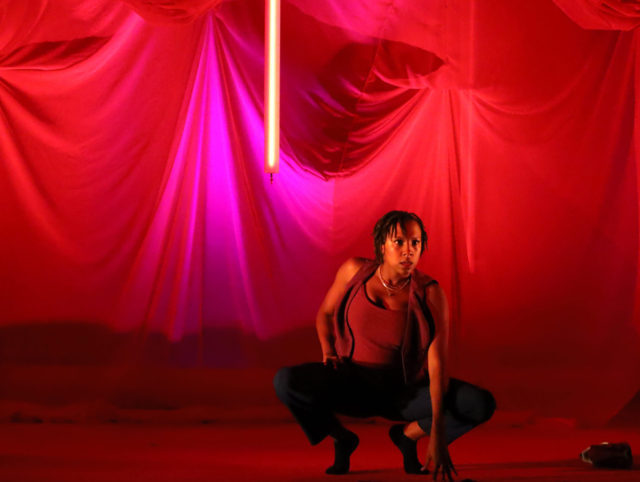
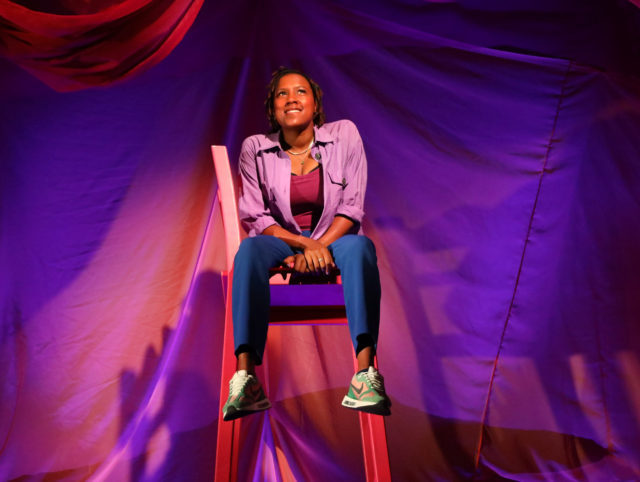
Heather Christian’s Oratorio for Living Things is a gloriously exhilarating ninety-minute celebration of life, art, and nature, an immersive journey through the complex quantum, human, and cosmic time and space of our daily existence.

Oratorio is Obie winner Christian’s follow-up to Animal Wisdom, a confessional of music and storytelling dealing with the personal and communal aspects of ritual and superstition, grief and loss, ghosts and the fear of death, and I Am Sending You the Sacred Face, a solo virtual musical about Mother Teresa, performed in drag in a closet by Theater in Quarantine’s Joshua William Gelb.

The Ars Nova production takes place in a reconfigured, in-the-round Greenwich House, where the audience sits in a few steeped rows of rafters, each section separated by a dozen steps; it’s such a small group that you feel specially privileged to be there. Twelve lovely performers (Sean Donovan, Carla Duren, Ashley Pérez Flanagan, Brian Flores, Quentin Oliver Lee, Angel Lozada, Barrie Lobo McLain, Ben Moss, Onyie Nwachukwu, Dito Van Reigersberg, Kirstyn Cae Ballard, and Divya Maus) in casual, carefully considered dress move up and down the stairs and through the tiny center stage area, over which dangles a glowing orb that evokes an unstructured, abstract globe or meteor. At the top of either side is the outstanding band: Johnny Butler on woodwinds, Jane Cardona on piano, Clérida Eltimé on cello, Odetta Hartman on violin, John Murchison on upright and electric bass, and Peter Wise on percussion.

Greenwich House has been transformed into a unique communal space for Oratorio for Living Things (photo by Ben Arons)

Throughout, the singers make warm, intimate direct eye contact with the audience, signaling we are all on this planet together and need to live in unison with one another and nature. Christian’s libretto, which is handed out to each audience member as they’re seated, is in English and Latin; the lights are usually dimmed just enough to still allow you to follow along, but you certainly don’t have to.

As Christian notes in a program letter, “Don’t worry! You do not need a degree in astrophysics, antique languages, or microbiology to ‘get’ this piece. In fact, one would argue that Oratorio for Living Things could function as a Rorschach test. It’s made to engage with you at whatever level you’d like to do so.”

However, it can become a bit distracting when a lot of heads are buried in the white libretto instead of watching the performers, particularly when they’re right in front of them. But this is a judgment-free zone. (The comforting set is by Kristen Robinson, with costumes by Márion Talán de la Rosa, lighting by Jeanette Oi-Suk Yew, and sound by Nick Kourtides.)

The score morphs from classical oratorio to jazz, gospel, blues, and a burst of Godspell-like musical theater as Christian guides us through canticles, hymns, choruses, and poems with such titles as “Beginning (Infinite Fractal),” “Alligatum (membranes),” “Dust to Dust (water),” “Hydrogen and Helium: History of Violence,” and “Vesuvius,” which contains the warning: “Now we have arrived at something truly Frightening.”

In “Memory Harvest,” individual singers recall major and minor moments from their past, one example of which is: “I’m five years old and my cousin is seven years old and we jump from one foot to the other standing on the side of the road across from the train tracks. Our excitement builds as the train approaches, our arms flailing, pump up and down, we want the engineer to pull the chain to blow the train whistle. And he does.”

In “Carbon/DNA Iteration 4: Building DNA via Ticker Tape on Time Spent,” the performers use numbers to quantify life, including such observations as “Three and a half hours throwing away unopened mail / Forty minutes putting lids on Tupperware / Eighteen days looking for a bathroom / One year in the ‘Bag Drop’ line / Eleven days trying to remember why you came into the room / Four hours changing pants / Two and a half years being too cold / Four years and eleven days being too hot.” It’s a gorgeous, often very funny look at the little things that add up, equating a wide range of items that we all have in common and which feel particularly meaningful as we emerge from a pandemic lockdown that severely limited our presence in society and has led to so much grief and loss.

Twelve singers and six musicians envelop the audience in Heather Christian’s glorious Oratorio for Living Things (photo by Ben Arons)

Obie-winning director Lee Sunday Evans (Dance Nation, Intractable Woman: A Theatrical Memo on Anna Politkovskaya) has just the right touch to make it all flow seemingly effortlessly, like a babbling brook where you rest and casually reflect on the beauty of everything. Evans also makes sure we don’t feel like we’re trapped in science class amid mentions of entropy, energy, evolution, chloroplasts, mitochondria, diatoms, and covalent bonds.

Inspired by Italian physicist Carlo Rovelli’s The Order of Time, American astronomer Carl Sagan’s Cosmos, and German composer Carl Orff’s cantata “Carmina Burana,” Christian imbues Oratorio with an existential hope that fuels who we are as individuals and as a harmonic unit. In the libretto, she describes “Fields” as “a brief indulgence in an environment (now established). A reminder that because something is devoid of human consciousness or observation does not mean that it is empty.” In “Vesuvius: Dormancy,” we are told, “Do not mistake dying for stopping,” and in “Vesuvius: Eruption” that “we are in the middle / we aren’t at the end / of a loop.”

Do whatever you can to see Oratorio for Living Things, which has been extended through May 15; this extraordinary shared pilgrimage is sold out, but standby and rush tickets might be available. As Christian writes in the libretto, “A very smart person once said that given the choice between living in a universe where only some things are known and knowable and living in a universe where either everything or nothing was known, they’d take the former. Because out of mystery evolves curiosity, and out of confoundment evolves wonder.” And that is exactly what Oratorio delivers.

HARMONY: A NEW MUSICAL

Barry Manilow musical tells real-life story of the Comedian Harmonists (photo by Julieta Cervantes)

HARMONY: A NEW MUSICAL
National Yiddish Theatre Folksbiene
Museum of Jewish Heritage — A Living Memorial to the Holocaust
Edmond J. Safra Hall, 36 Battery Pl.
Through May 15, $79-$129
nytf.org/harmony

“A Bulgarian singing waiter, a doctor, a bass from the Comic Opera, a musical prodigy, a whorehouse pianist . . . and a Polish Rabbi walk into a bar,” Josef Roman “Rabbi” Cykowski (Chip Zien) says near the beginning of Harmony, the biographical musical that opened tonight at the Museum of Jewish Heritage — A Living Memorial to the Holocaust, presented by the National Yiddish Theatre Folksbiene.

Throughout his nearly sixty-year career, Brooklyn-born songster Barry Manilow has won a Tony, two Emmys, a Grammy, and an honorary Clio for his classic jingles and has released more than three dozen albums (including eight gold and eight platinum records) that have sold more than eighty-five million copies. But his favorite creative endeavor is Harmony, the twenty-five-plus-years-in-the-making musical about the Comedian Harmonists, the real-life a cappella German singing group whose international success was ultimately thwarted by the Nazis; composer Manilow and his longtime collaborator, Queens native Bruce Sussman, who wrote the book and lyrics, seek to restore the Harmonists’ legacy in this glittering show.

The story is told in flashback by the older Rabbi, who details how the group formed and became a sensation despite some initial stumbles; he pontificates on many of the choices they made, especially those by his younger self (Danny Kornfeld), while sometimes joining them in song. Originally known as the Melody Makers, the ensemble was put together by actor and composer Harry Frommerman (Zal Owen) and consisted of Rabbi, Comic Opera bass Robert “Bobby” Biberti (Sean Bell), medical student Erich Collin (Eric Peters), piano player Erwin “Chopin” Bootz (Blake Roman), and singing waiter Ari “Lesh” Leshnikoff (Steven Telsey). In addition to their glorious harmonies and goofy charm, they used their voices as instruments, making it sound like they were performing with a band.

Ruth (Jessie Davidson) is ready to fight what’s coming in Germany in Harmony (photo by Julieta Cervantes)

As their fame spreads, Rabbi falls in love with Mary (Sierra Boggess), a Christian who considers converting to Judaism but is also worried about the growing anti-Semitism emerging from the National Socialists, and Chopin marries Ruth (Jessie Davidson), a staunch Jewish activist who is ready to fight against the rise of the far right. As Nazi officers start showing up at their concerts, including a standartenführer (Andrew O’Shanick) and his wife, Ingrid (Kayleen Seidl), who are huge fans, the Comedian Harmonists realize they are caught in the middle of something a lot bigger than themselves and have to take a long, hard look at their personal and professional futures.

Harmony premiered at La Jolla Playhouse in 1997, with Danny Burstein as Rabbi and Rebecca Luker as Mary. (The two got married in 2000 and remained so until Luker’s tragic death in 2020.) Manilow and Sussman, writing partners for more than forty years, have continued to tweak the show since then; today it feels oddly prescient as dictators and the far right gain power around the world and so many oppressed people become refugees as they try to escape bad situations that are only getting worse. It is also an excellent way to celebrate the little-known a cappella group, as there are only limited archival footage and audio recordings available online, in addition to a 1991 German documentary, a 1997 German biopic, and a 2010 English-language book.

The six actors portraying the Comedian Harmonists are terrific, forming a cohesive unit in, well, perfect harmony. Director and choreographer Warren Carlyle (After Midnight, On the Twentieth Century) has fun with the sextet, particularly in a scene in which they have no pants. Characters often enter and leave through the aisles, approximating the feel of watching the Comedian Harmonists in a 1920-’30s theater rather than a contemporary venue. And the Museum of Jewish Heritage is just the right place to stage this show, an institution dedicated to preserving the Jewish experience before, during, and after the Holocaust.

Chip Zien gives a bravura performance as Rabbi Josef Roman Cykowski and others in Harmony (photo by Julieta Cervantes)

The musical is about a tight-knit ensemble, but it’s worth seeing for Zien (Into the Woods; Caroline, or Change) alone; a New York City theater treasure, Zien is spectacular as Rabbi, who can’t help but get emotional as he watches mistakes his younger self and the troupe make. Zien also dazzles by taking on a number of minor roles, changing costumes — and wigs — lightning fast as he transforms himself into Marlene Dietrich, Richard Strauss, and Albert Einstein. (The costumes, which range from humble street clothes to pristine tuxedos to Nazi uniforms, are by Linda Cho and Ricky Lurie, with hair and wigs by Tom Watson.) Zien leaves Ana Hoffman to regale us as Josephine Baker, who did in fact perform with the Harmonists.

Three-time Tony winner Beowulf Boritt’s set is anchored by a wall of mirrors that reflects the performers — and the conductor, who leads the orchestra from a pit in the right side of the audience — and also on which are projected archival photographs, text identifying the time and place, and Nazi symbols. Among the locations are various nightclubs in Berlin, Tivoli Park in Copenhagen, a movie set in Cologne, a night train to Munich, the tailor shop where Mary works, and Carnegie Hall, where the Comedian Harmonists headlined in 1933.

Barry Manilow and Bruce Sussman rehearse with the cast of Harmony (photo by Julieta Cervantes)

At 165 minutes (with intermission), the show, featuring music direction and additional arrangements by John O’Neill, is at least a half hour too long, dragging primarily during the romantic numbers; there’s much more life when the German boy band is performing and when the political tension increases — to a point where the characters are making potential life-or-death decisions.

And as much as Harmony is specifically about the Comedian Harmonists, it also reminds us how we all should be with others, particularly in times of strife. As the cast sings in the title song: “Oom-pah-pah, oom-pah-pah, / Oom-pah oom-pah oom-pah, / Harmony, / We sing in harmony / Like the robins in Herald Square. / Harmony, / The thing is harmony, / Always knowing there’s someone there. / In this joint / All encounters with counterpoint / End in harmony. / And it’s clear / No man’s a solo here. / Not even me! Me! Me! Me! Me! Me! / No solo mio! / Just harmony.”

TAKE ME OUT

Much of Take Me Out happens in the locker room — with and without uniforms (photo by Joan Marcus)

TAKE ME OUT
Helen Hayes Theater
240 West 44th St.
Tuesday – Sunday through June 11, $79-$199
2st.com/shows

Scott Ellis’s hit Broadway revival of Richard Greenberg’s Tony-winning Take Me Out is well on its way to the playoffs (Tony nominations) and the World Series (Tony wins), but you don’t have to know anything about baseball to root for this compelling tale of ego, homophobia, and winning and losing.

It all starts with the brilliant title itself, which refers to: the traditional 1908 tune “Take Me Out to the Ball Game,” sung by fans during the seventh-inning stretch of every contest; a reverse riff on the chorus of John Fogerty’s 1985 hit, “Centerfield,” in which the former CCR leader declares, “Put me in, coach / I’m ready to play, today”; going out on a date; the public revelation that someone is gay; and the slang for a mob hit, as in “take him out.”

It’s 2002, and the world champion Empires, a stand-in for the Yankees — one backdrop features a silhouette of the Yankee Stadium wooden facade — are off to another good season. The story is narrated in flashback by shortstop Kippy Sunderstrom (Patrick J. Adams), a good friend of superstar Darren Lemming (Jesse Williams), a five-tool centerfielder who comes out of the closet with a sudden, unexpected announcement that he is gay. Darren did not do it to become a role model, to fight for gay rights, or to make a sociocultural statement; throughout the play, Darren’s motivations are private, driven primarily by ego and self-importance.

“Now, I’m not a personal sort of guy, really, and that’s not gonna be any different,” Darren, a handsome mixed-race player reminiscent of Bronx Bomber legend Derek Jeter, tells his teammates. “I mean, don’t expect the free flow of information. Don’t expect the daily update. I’m just here to play ball. I’m just here to have a good time. That’s no different. . . . And if, incidentally, there’s any kid out there who’s struggling with his identity, I hope this sends a message that it’s okay. They can follow their dream, no matter what. Any young man, creed, whatever, can go out there and become a ballplayer. Or an interior decorator.”

But he also tells Kippy, “You think you know me? You think you know my secret? Shit, that wasn’t a secret — that was an omission. I’ve got a secret — but that’s not it.” Even his last name, Lemming, is a warning for others not to follow him.

Friends and rivals Darren Lemming (Jesse Williams) and Davey Battle (Brandon J. Dirden) sit down for a chat in Take Me Out (photo by Joan Marcus)

As one would expect, his declaration creates significant problems in the locker room. Emerging from the shower to find a naked Darren, Toddy Koovitz (Carl Lundstedt) complains, “So now I gotta go around worrying that every time I’m naked or dressed or whatever you’re checking out my ass.” Because, of course, every gay man immediately wants to sleep with every male he sees. But Darren always gives better than he gets, telling Toddy, “Why’re ya lookin’ at it’s the question.” As the quippy Kippy noted earlier, after Darren confirmed, “I don’t want to fuck any of you,” he responded, “It’s not about that, Darren. It’s about us wanting to fuck you.”

When their ace pitcher, Takeshi Kawabata (Julian Cihi), slumps, they call up hard-throwing closer Shane Mungitt (Michael Oberholtzer) from Double A, who leads them back on track until he opens his mouth one day and spews forth bigoted remarks that would make even former Braves reliever John Rocker wince.

The tension in the locker room grows to epic proportions as no one can have a civil conversation, exacerbated by Kawabata’s, Martinez’s (Hiram Delgado), and Rodriguez’s (Eduardo Ramos) inability to speak English, a sports trope that enrages more conservative fans who believe that if you play ball in America, you need to speak the language — and the same fans are likely to have problems with a gay player.

“We were Men,” Kippy slyly philosophizes to his teammates. “This meant we could be girlish. We could pat fannies, snap towels; hug. Now . . . What do we do with our stray homosexual impulses?” After not-too-bright new catcher Jason Chenier (Tyler Lansing Weaks) asks if he was talking specifically to him and then turns red out of embarrassment because of the topic, Kippy adds, “We’ve lost a kind of paradise. We see that we are naked.” It’s as if they have taken a bite out of that apple and are being cast out of the garden.

Meanwhile, Darren keeps meeting with his new business manager, Mason Marzac (Jesse Tyler Ferguson), a gay accountant who at first knows nothing about baseball except that Darren is also gay, which makes him fall in love with the sport and worship his client. “A couple of weeks earlier I would have barely recognized the name! Then the announcement — that incredible act of elective heroism — and it was as if I’d known him my whole life — as if he’d been something latent in my subconscious.”

As the Empires prepare for a big game against the club that Darren’s best friend, Davey Battle (Brandon J. Dirden), is on, the world around Darren and the Empires turns into a lot more than just “the mess” Kippy alluded to at the start of the show.

Shane Mungitt (Michael Oberholtzer) has a rude awakening in store in Broadway revival of Richard Greenberg play (photo by Joan Marcus)

Take Me Out is an exceptional drama that uses baseball as an apt analogy for the state of the country. “I have come (with no little excitement) to understand that baseball is a perfect metaphor for hope in a Democratic society,” Mason says. “It has to do with the rules of play. It has to do with the mode of enforcement of these rules. It has to do with certain nuances and grace notes of the game. . . . Everyone is given exactly the same chance. . . . And baseball is better than Democracy — or at least than Democracy as it’s practiced in this country — because unlike Democracy, baseball acknowledges loss.”

In the history of the four major sports leagues, only one NBA player and one NFL player have revealed they were gay and kept playing: Brooklyn Nets center Jason Paul Collins in 2013 and current LA Raiders defensive end Carl Nassib in 2021. The revelation that a baseball superstar in his prime is gay would be a major deal today, but in the twenty years since Take Me Out premiered at the Public, no MLB player and only one umpire, Dale Scott, has come out and stayed on the diamond. Greenberg’s (The Assembled Parties, Three Days of Rain, The Perplexed) play feels fresh and alive in 2022, like it could have been written yesterday, save for the lack of cellphones onstage (and, thanks to strict rules, in the audience as well).

The two-hour play (plus intermission) moves much faster and more smoothly than baseball games. Ellis (On the 20th Century, The Elephant Man) is a superb manager, guiding the actors through David Rockwell’s splendid sets, which range from the ballpark and the locker room to a lounge and actual showers. Linda Cho’s costumes, primarily baseball uniforms, spend nearly as much time off the actors as on. (The nudity is the reason audience members must have their phones sealed in a Yondr pouch that the staff will open for you during intermission and then upon exiting.)

In their Broadway debuts, Adams (Suits, Equivocation) displays an easygoing, likable charm as Kippy, earning the audience’s devoted attention from his very first words, while Williams (Grey’s Anatomy, The Sandbox) shows off his numerous tools as the secretive hotshot Darren. (He will reprise the role in an upcoming television series, according to Deadline.) Dirden (Skeleton Crew, Jitney) excels in his supporting role, like a solid, dependable DH who always gets good wood on the ball and comes through in the clutch.

But the MVP might just be Ferguson (Modern Family, The 25th Annual Putnam County Spelling Bee), who knocks it out of the park every chance he gets. Mason is the glue that holds it all together, the only one who seems to really understand Darren as both a wealthy athlete and a gay man. Ferguson’s growing enthusiasm is infectious, spreading throughout the theater; he’s just the kind of person every locker room needs.