Who: Tom Stoppard, Daniel Kehlmann What:Conversations & Performances discussion Where: Unterberg Poetry Center, 92nd St. Y, Kaufmann Concert Hall, 92Y online When: Sunday, September 18, in person $15-$31, online $20, 4:30 Why: “Anti-Semitism is a political fact. It’s a bit soon for it to be a party platform, but when it is there will be Austrians to vote for it,” a character states in Tom Stoppard’s new Olivier Award–winning play, Leopoldstadt, which opens October 2 at the Longacre Theatre on Broadway. On September 18, Stoppard will be at the 92nd St. Y to inaugurate the eighty-fourth anniversary of the Unterberg Poetry Center — a year younger than he is — to discuss the play, which was partly inspired by his family history. The British playwright and screenwriter will be joined by German and Austrian author and translator Daniel Kehlmann, who has written such novels as You Should Have Left,Tyll, and Fame and translated Leopoldstadt into German.
Stoppard, born Tomáš Sträussler in 1937 in what is now the Czech Republic, is arguably the greatest living playwright of the last sixty years; his works include Rosencrantz and Guildenstern Are Dead,Travesties,The Real Thing,Arcadia,The Invention of Love, and The Coast of Utopia, earning four Tonys and two Oliviers for Best Play. Sir Thomas has also won a Best Original Screenplay Oscar for Shakespeare in Love. His latest play, his most personal, begins in Vienna in 1899, in the Jewish quarter known as Leopoldstadt, and features more than three dozen characters; directed by Tony and Oscar nominee Patrick Marber (Closer,Notes on a Scandal), it is currently scheduled to run through January 29, 2023.
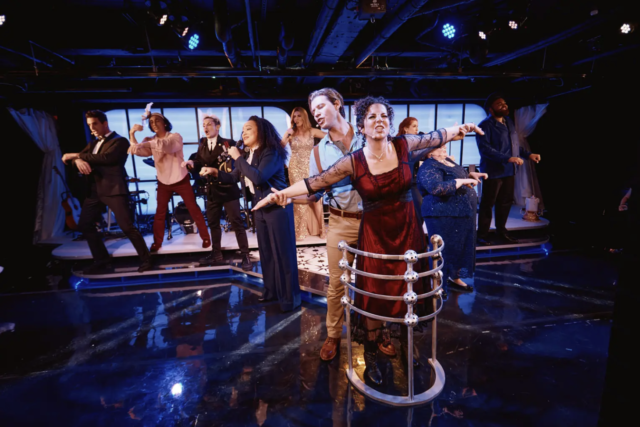
Rose Dewitt Bukater (Alex Ellis) is desperate for a brand-new day in Titanique (photo by Emilio Madrid)
TITANIQUE: UNE PARODIE MUSICALE
The Asylum Theatre
307 West Twenty-Sixth St. at Eighth Ave.
Tuesday – Sunday through November 6, $39-$98
[ed. note: Moved to the Daryl Roth Theatre through February 19, $80-$171] titaniquemusical.com asylumnyc.com
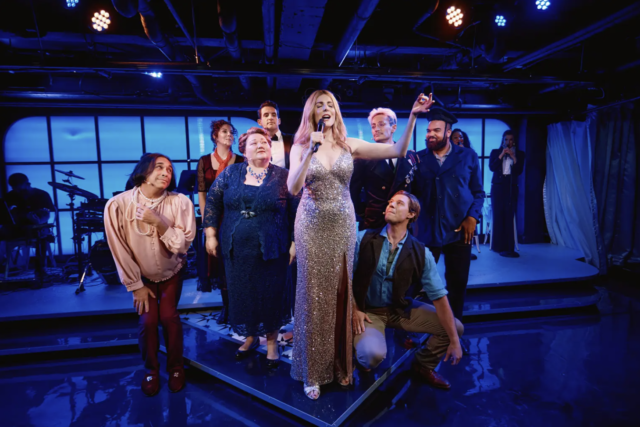
While I may have been severely disappointed with James Cameron’s disastrous Oscar-winning Titanic and I’ve never been known to blast out Canadian superstar Céline Dion’s songs in the shower, I couldn’t help but fall under the bewitching spell of Titanique, a wild and wooly musical parody of the beloved 1997 weepie shipwreck rom-com. Playing to sold-out houses at the basement Asylum NYC nightclub, Titanique is filled with hysterical anachronisms, inside jokes, and campy humor, beginning with the premise itself: A tour guide is leading a group of people through the Titanic Museum when Dion (Marla Mindelle) suddenly shows up, in a fancy gown, declaring that she will tell the real story of the disaster since she was on board at the time of the sinking.
“Bonjour, everybody! It is me, Céline Dion. I am here because this is not how I remember the story of Titanique,” she announces. “But Céline Dion, you just sang the theme song to the movie; you weren’t actually on the Titanic,” the tour guide says. “Or was I?” Dion responds with more than a hint of mystery. “But . . . that would make you at least one hundred and fifty years old,” the tour guide points out. “And you are confused because . . . ,” Dion adds. “People don’t live that long,” the tour guide offers. “Or do they?” Dion wonders with a smirk.
Dion proceeds to tell the tale of the young and lovely Rose Dewitt Bukater (Alex Ellis), who is engaged to marry the rich, pompous Cal Hockley (John Riddle) until she is saved from a possible suicide by the lowly but impossibly handsome Jack Dawson (Constantine Rousouli), who earned his ticket by winning a card game. “Well, Jacqueline, how are the accommodations down in steerage?” Rose’s snobby aunt, Ruth Dewitt Bukater (Ryan Duncan), asks snottily of the unruffled Jack, who replies, “The best I’ve ever seen, ma’am. Hardly any rats. You see, I don’t have any need for caviar and fancy things. All I need is the air in my lungs and my rustic Italian sidekick.” Ruth retorts, “And do you find that sort of rootless existence appealing, you poor unfortunate troll?”
Everyone is hoping their hearts will go on in parody musical (photo by Emilio Madrid)
Also on board is the unsinkable Molly Brown (Kathy Deitch), who is modeled after Kathy Bates, who played the role in the film, and ship builder Victor Garber (Frankie Grande); in the movie, real-life ship builder Thomas Andrews was portrayed by Tony and Emmy nominee Victor Garber. (With danger afoot, Ruth says to Garber, “You’ve been in so many movies and I can never quite say which ones but I’m always like . . . ‘Oh wow, there’s Victor Garber!”)
Garber the character is pushing the pedal to the metal, as Cal has insisted that the builder turn up the speed because he has a critical appointment at an exclusive salon in New York. While Jack and Rose fall in love, a seaman and Molly worry that the ship is going too fast. “Shut it, seaman!” Garber declares. “Cal has a hair appointment in Soho, and they book way out! Get downstairs and put more fire in this boat’s engine or else your ass is gonna be Goldie Hawn in Overboard. Beat it!”
Lo and behold, awaiting all of them is, of course, the Iceberg (Jaye Alexander), who is lying in wait to do just a little bit of damage.
Titanique, cowritten by Mindelle, Rousouli, and director Tye Blue, features seventeen Dion songs (“I’m Alive,” “Taking Chances,” “You and I”) performed by Mindelle and the rest of the cast (including ensemble members Courtney Bassett, Donnie Hammond, and Dimitri Moise), highlighted by two prominent covers, one from a Disney movie (with Peabo Bryson), the other by Ike & Tina Turner (sung here by Alexander). The arrangements and orchestrations by music supervisor Nicholas Connell are tongue-in-chic fun, performed live by a three-piece band and a trio of backup singers. Ellenore Scott’s choreography is playful and fun, making the most of Gabriel Hainer Evansohn’s small set and Alejo Vietti’s swanky costumes. Lawrence Schober’s sound and Paige Seber’s lighting keep the audience thoroughly engaged as they down their cocktails.
Fans of the movie will love the many direct and indirect references, from the extra-large heart of the ocean necklace to the revelation of Jack’s artistic talents, while everyone should get a kick out of the anachronistic mentions of American Horror Story, iPhones, Full House, #metoo, Caesars Palace, Patti LuPone, and Vicky Christina Barcelona.
Titanique, which Dion proudly calls the gayest show in town, is a delicious cruise cabaret extravaganza that pokes fun at Hollywood, and itself, in hysterical ways. And even if you hate the movie — and are not big on Dion and her music — you’ll have no choice but to surrender to the many charms of this unique reimagining of just what happened aboard the unsinkable Ship of Dreams.
STRINGS ATTACHED
Pulse Theatre at Theatre Row
410 West 42nd St. between Ninth & Tenth Aves.
Wednesday – Sunday through October 1, $57.50 pulseensembletheatre.org bfany.org
I decided to take no chances when going to Carole Buggé’s Strings Attached at Theatre Row; I brought along a genuine, dyed-in-the-wool nuclear physicist. You don’t have to bring your own nuclear physicist in order to enjoy the play, but it certainly helped as he confirmed that the various mathematical equations we saw projected onto the closed curtain before the show were correct, and he also explained that an abstract dance at the end of the first act was most likely the performers moving like protons, neutrons, and electrons.
Buggé’s reworking of an earlier play takes place in a large train berth as three scientists travel from a convention to London to see Michael Frayn’s Copenhagen, a Tony-winning, well-researched, but imagined account of the real-life meeting between physicists Neil Bohr and Werner Heisenberg in 1941. In that play, Frayn imagines Bohr and Heisenberg’s discussion of nuclear power, the atomic bomb, the latter’s uncertainty principle, and the responsibilities of the scientific community to the future of humankind.
Buggé’s play, produced by Pulse Ensemble Theatre, is also inspired by an actual event, about three physicists debating the Big Bang while on a train heading to a string theory conference in Cambridge. The lithe rock climber June (Robyne Parrish) and the stoical, upper-class George (Paul Schoeffler) are married cosmologists who recently lost a child in a train accident. They are joined by their friend Rory (Brian Richardson), a prickly, hard-edged particle physicist who has a thing for June. While George is a string theorist, Rory advocates for M theory, leading to lofty jokes and rejoinders.
“Ten dimensions of space but only one of time,” George says when he almost misses the train. “How many physicists does it take to screw in a lightbulb?” Rory asks. “I don’t know,” June responds. “It depends,” Rory adds. “On what?” George asks. “On whether the light is a particle or a wave,” Rory explains. My companion chuckled at what turned out to be the first of several screw-in lightbulb jokes.
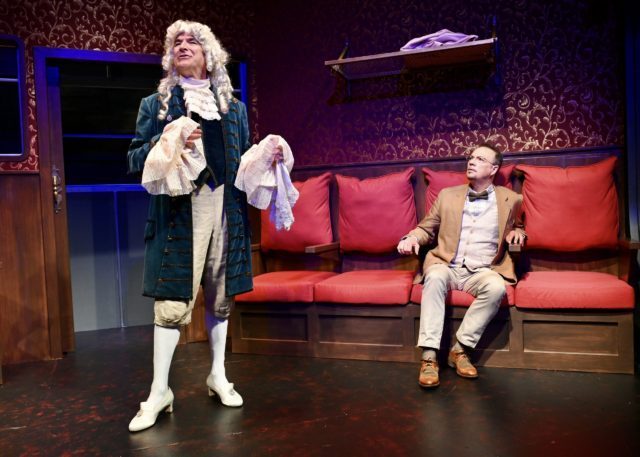
The trio is occasionally visited by two strange fan-geek couples (Bonnie Black and Russell Saylor), who turn out to know a surprising amount of science, as well as by George’s, June’s, and Rory’s respective heroes: Sir Isaac Newton (Jonathan Hadley), Marie Curie (Black), and Max Planck (Saylor), who have been keeping up-to-date on what is happening in the world long after their deaths. Topics of discussion range from William Wordsworth, T. S. Eliot, James Joyce, Albert Einstein, Galileo, and William Blake to Schrodinger’s cat, quantum physics, membrane theory, Planck’s constant, and the singularity. The second act explores the concept of alternate parallel universes, with many clever nuances.
At one point, talking about Frayn’s play, Rory tells George, “A bit dodgy, writing about a real event. Seems you’re setting yourself up for failure.” Here Buggé is also referring to herself, but she manages to pull it off, for the most part. Director and Pulse cofounder Alexa Kelly (W. E. B. Du Bois: A Man for All Times, Harlem Summer Shakespeare) maintains order amid the potential chaos, like a train conductor staying on track and on schedule. Buggé and Kelly do a good job incorporating ideas of love, loss, fear, and faith while not getting lost in all the science, making sure to go relatively easy on the technical language, which is helpful even if you’re sitting next to a nuclear physicist — who had seen Copenhagen on Broadway in 2000.
Jessica Parks’s set is an open, tearaway train car that looks like it’s been in a crash itself. Joyce Liao’s lighting and Louis Lopardi’s sound make it feel like the characters are on a moving train. Katerina Vitaly’s projections add to the science. Schoeffler (Sunset Boulevard,Rock of Ages) has a soothing quality as the serene George, while Parrish (A Man Called Otto,Gossip Girl) is thoroughly charming as June; it’s obvious why both George and Rory are in love with her.
Richardson (W. E. B. Du Bois: A Man for All Times,The Lower Depths) is too one-note as Rory, overly severe, while Black (Citizen Wong, Margarethe Bohr in Riverside Theatre’s Copenhagen) and Saylor (Screams of Kitty Genovese,Starlight Express) overplay the two couples, who are overwritten with too much slapsticky humor and seem out of place on the train and in the play itself. Hadley (Jersey Boys,Caesar and Cleopatra) is wonderfully flamboyant as Newton and sweetly endearing as the Irish train conductor.
Describing her love of rock climbing, June tells George and Rory, “It forces you to be in the moment. Time doesn’t exist — there’s only now.” The same can be said about theater — particularly at Theatre Row, where multiple shows are going on at the same time, each creating its own universe.
Who:Red Bull Theater What: Online benefit reading and free discussions Where:Red Bull Theater online When: Monday, September 12, $25, 7:30 Why: Red Bull Theater kicked off its “Hispanic Golden Age Classics — Lope de Vega” initiative on September 8 with the panel discussion “Lope de Vega & Shakespeare,” exploring how the Bard and Spanish playwright and novelist Félix Lope de Vega y Carpio both wrote works about the Capulets and the Montagues; UCLA professor Barbara Fuchs and UCLA PhD candidate Rhonda Sharrah were joined by actor Dakin Matthews, who wrote the new rhyming translation that is being used. The “Diversifying the Classics” programming is centered by a live, online reading of Lope de Vega’s The Capulets and the Montagues (Castelvines y Monteses) on September 12 at 7:30 (available through September 18 at 11:59 pm), performed by Junior Nyong’o as Romeo and Cara Ricketts as Juliet, along with Anita Castillo-Halvorssen, Christian DeMarais, Carson Elrod, Topher Embrey, Alejandra Escalante, Jake Hart, Paco Lozano, Maria-Christina Oliveras, Timothy D. Stickney, and Matthews, directed by Melia Bensussen. On September 15 at 7:30, members of the creative team will participate in the interactive online Bull Session “The Capulets and the Montagues.”
“Castelvines y Monteses is the sixth comedia I have translated, and my first Lopean adventure — after three Alarcóns, one Tirso, and one Moreto. It was a bracing experience to dip for the first time into the font from which sprang all later comedias,” Matthews explains in an introductory essay. “And it was just as bracing to work with material that so closely accorded with that of Shakespeare, who has been the subject of my lifelong fascination and study. And there, of course, lies the first trap that I — and any translator who comes to Lope’s version of the Romeo and Juliet story — must try to avoid. (Which I did not make any easier on myself, I confess, by my determination to use the equivalent Shakespearean proper names in an effort to make the play more appealing to English-speaking producers and audiences.)” Meanwhile, Sharrah notes, “Miguel de Cervantes, [Lope’s] contemporary and rival, may not have meant it entirely as a compliment when he called Lope a ‘monster of nature’ (monstruo de la naturaleza). Yet Lope’s prodigious output was fundamental to developing the theater of his age, and to our understanding of it today. The monster of nature left us many gifts.”
CROSSING THE LINE FESTIVAL
FIAF and other locations
55 East 59th St. between Madison & Park Aves.
September 9–October 28, free – $75
212-355-6100 fiaf.org
FIAF’s fifteenth annual Crossing the Line Festival is another journey into exciting, challenging, and experimental music, dance, and theater from the French-speaking world. Running September 9 through October 28, the programs take place at such venues as Abrons Arts Center, New York Live Arts, the Chinese Consolidated Benevolent Association, the Joyce, and BAM in addition to FIAF’s Gallery, Florence Gould Hall, and Skyroom.
“For our first year curating this festival, we wanted to honor its founding principles: presenting compelling multidisciplinary art forms throughout the city, bringing acclaimed cutting-edge French and Francophone productions to our shores, and nurturing dialogue between international and New York-based artists,” curators Mathilde Augé and Florent Masse write in a program note. “The fifteenth edition of the festival features a diverse group of audacious artists engaging with the most pressing issues of our time — including gender, sexuality, human connection, race, and climate change — and exploring new territories in performing arts.”
None of the nine live performances — there were supposed to be ten but Caroline Guiela Nguyen’s FRATERNITY, A Fantastic Tale had to be canceled because of visa problems — has ever been seen before in New York, including several North American, US, and world premieres. The mix of dance, theater, art, music, and literature hails from Senegal, France, South Africa, Rwanda, the United States, and Morocco, examining societal change, Vaslav Nijinsky, science, Cheikh Anta Diop, intergenerational culture, the political views of René Char and Frantz Fanon, and a Detroit rave.
In addition, FIAF is hosting the fall open house celebration Fête de la Rentrée, highlighted by an opening reception for Omar Ba’s “Clin d’oeil” art exhibition on September 9 at 6:00 (free with RSVP) and a Sunset Soirée at Le Bain on October 12 at the Standard Hotel (free with RSVP). Below is the full Crossing the Line schedule.
September 9 – October 28
Exhibition: “Clin d’oeil,” by Omar Ba, FIAF Gallery, free
Wednesday, September 14, and Thursday, September 15
Theater: _ jeanne_dark _, by Marion Siéfert, starring Helena de Laurens, North American premiere, FIAF Florence Gould Hall, $40, 7:30
Wednesday, September 21
Theater: Traces – Speech to African Nations, by Felwine Sarr and Étienne Minoungou, with Étienne Minoungou and Simon Winsé, New York premiere, Abrons Arts Center, $25, 8:30
Thursday, September 22, through Saturday, September 24
Dance: And so you see… our honourable blue sky and ever enduring sun… can only be consumed slice by slice…, by Robyn Orlin, performed by Albert Ibokwe Khoza, US premiere, New York Live Arts, $15-$35, 7:30
Saturday, September 24
Theater: Freedom, I’ll have lived your dream until the very last day, by Felwine Sarr and Dorcy Rugamba, featuring Marie-Laure Crochant, Majnun, Felwine Sarr, and T.I.E., North American premiere, Florence Gould Hall, $40, 7:30
Thursday, September 29, and Friday, September 30
Performance: Fire in the Head, by Christopher Myers, world premiere, Chinese Consolidated Benevolent Association, $20, 7:30
Thursday, October 6, through Saturday, October 8
Dance: The Encounter, by Kimberly Bartosik, performed by Kimberly Bartosik, Claude “CJ” Johnson, Burr Johnson, Joanna Kotze, Ryan Pliss, Kalub Thompson, Mac Twining, River Bartosik-Murray, Logan Farmer, and Ellington Hurd, world premiere, FIAF Skyroom, $30, 7:30
Thursday, October 13, through Saturday, October 15
Dance: CROWD, by Gisèle Vienne, US premiere, BAM Howard Gilman Opera House, $35-$75, 7:30
Tuesday, October 18, through Sunday, October 23
Dance: Näss, by Fouad Boussouf, New York premiere, the Joyce Theater, $20-$55
Thursday, October 27, and Friday, October 28
Theater: The Terrestrial Trilogy, a Performance in Three Parts: Inside,Moving Earths, and Viral, by Bruno Latour and Frédérique Aït-Touati, with special guest Bruno Latour, North American premiere, FIAF Florence Gould Hall, $40
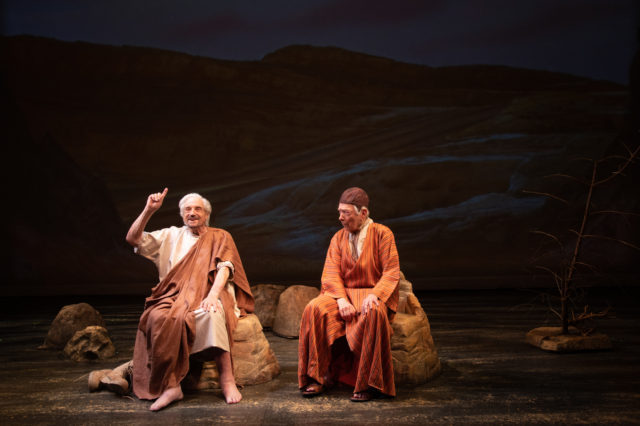
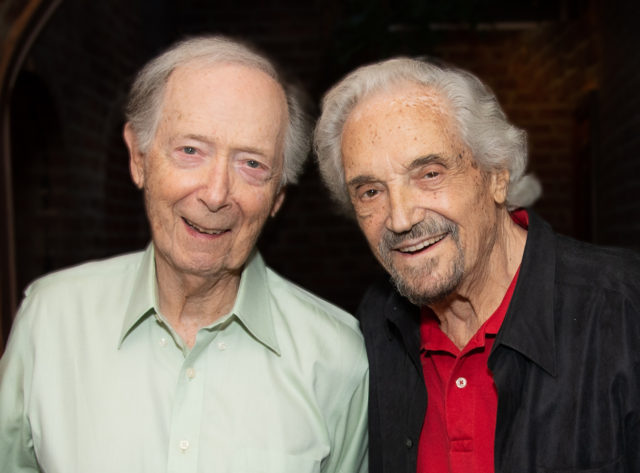
Hal Linden and Bernie Kopell star in Two Jews, Talking at Theatre at St. Clement’s (photo by Russ Rowland)
TWO JEWS, TALKING
Theatre at St. Clement’s
423 West Forty-Sixth St. between Ninth & Tenth Aves.
Friday – Sunday through October 23, $88-$127.50 www.twojewstalking.com
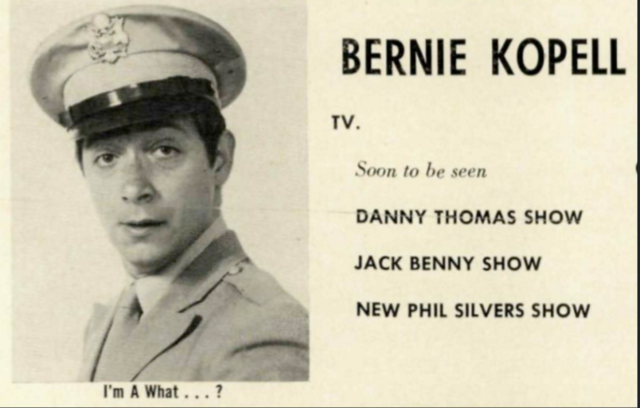
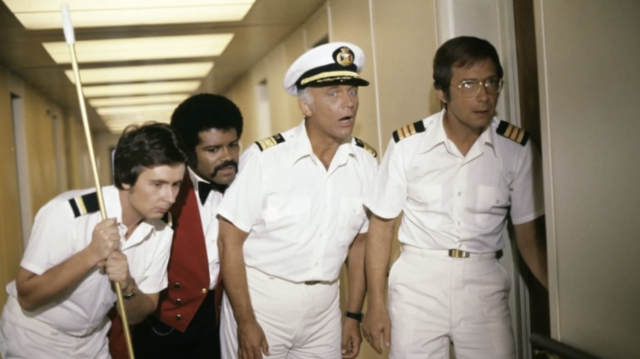
There’s something special happening at the Theater at St. Clement’s right now: Television icons Hal Linden and Bernie Kopell are starring in the two-act comedy Two Jews, Talking. For an hour and a half, the ninety-one-year-old Linden, a Tony and three-time Emmy winner best known for playing the titular New York City police captain in Barney Miller, and the eighty-nine-year-old Kopell, who portrayed the evil KAOS agent Siegfried on Get Smart and charming ship’s doctor Adam Bricker on The Love Boat, argue and complain about life, love, and religion.
In the first act, Kopell is Bud and Linden is Lou — a nod to the classic duo Abbott and Costello — two Jews taking a break as the Israelites are making their way through the desert, having escaped from their Egyptian taskmasters. They discuss the Ten Commandments, the rules of kashrut, and the debauched celebration with the Golden Calf.
“What a night that was,” Lou says. “Our cares, like our robes, thrown to the wind. Then Moses comes down from his mountain and ruins everything.” Bud asks, “What did you expect? He was angry. He turns his back for a minute and all hell breaks loose.” Lou responds, “Four hundred years we were slaves — finally we’re free and we can’t throw a party?”
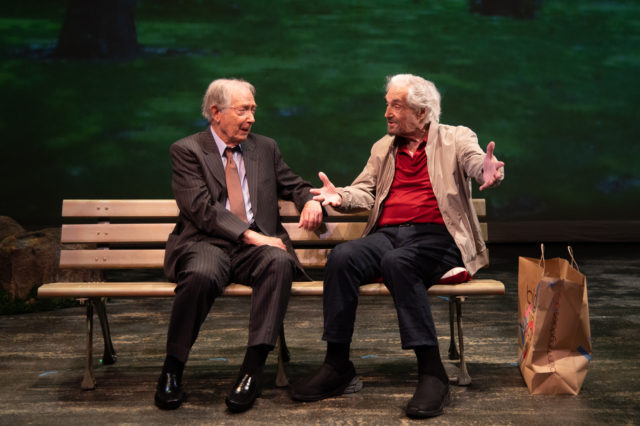
In the second act, Phil (Kopell) and Marty (Linden) are sitting on a park bench, griping about the state of the world and the pitfalls of aging. “In a million years, you’ll never guess where I was this morning,” Marty says. “Probably not,” Phil answers. “Mount Sinai,” Marty tells him. “The hospital?” Phil asks. “No, the place where Moses handed down the Ten Commandments. Of course the hospital,” Marty says. “You don’t look sick,” Phil adds.
The play was written by seventy-seven-year-old Emmy and Peabody winner Ed. Weinberger, who wrote and cocreated such television classics as Taxi and The Cosby Show, and is directed by Obie winner Dan Wackerman (Ten Chimneys,Morning’s at Seven).
Last week I sat down with Linden and Kopell in one of their dressing rooms at the theater — I had brought rugelach, and Linden immediately partook — and we kibbitzed about the play, Judaism, and their long and distinguished careers in show business, including naming their favorites as well as their not-so-favorites. It all began with me fumbling with my iPhone recorder.
twi-ny: Sorry about this; I’ve only had a phone for about a year.
hal linden: So you never had a phone.
Stage manager Catrina Honadle, pointing at Kopell: That’s him too.
twi-ny: Never had a phone. I always carried around dimes, then quarters.
hl: They don’t have pay phones anymore.
twi-ny: There are actually a few left.
hl: Back in the day, we had answering services, and you had to constantly stay in touch with them. They would get angry at you if you didn’t keep calling in. “You didn’t call in; you missed your appointment!”
bernie kopell: Harvey Korman, we’d call him up and ask, “Anything for Harvey Korman today?” “No, sorry.”
twi-ny: Another funny man.
hl: Another funny man.
bk: I spoke at his memorial. A lovely human.
hl: Yeah. I think was there.
bk: Mel [Brooks] was there.
hl: I think I was there. I’m trying to remember where it was.
bk: Carol Burnett was there.
twi-ny: Do you remember any of what you said about him?
bk: He was a dear friend. We would play ferocious ping-pong, drink vodka, and listen to Mel Brooks’s 2000 Year Old Man again and again. And it was always funny.
twi-ny: It’s funny that you bring that up, because I see your show as a kind of Waiting for Godot meets The 2000 Year Old Man.
[Kopell and Linden both laugh.]
twi-ny: I mean, you’ve got the set with the tree, the boots, two guys waiting to go to the holy land. And, for the most part, Bernie is the straight man and Hal is the one who’s kvetching.
hl: Kvetching.
bk: Kvetching.
twi-ny: I saw the show on the first Saturday night preview. So it was very early, but I wanted to see it before speaking with you both.
hl: That was a little touch and go, that one.
twi-ny: You know what, I had a blast. It was a lot of fun. Okay, so we’re Hal from the Bronx, Bernie from Brooklyn, Mark from Brooklyn — Flatbush — and we’re three New York Jews sitting, talking in a church.
hl: I always thought that was a wonderful irony. Two Jews talking in a church.
bk: Another irony just before I left California, I played a Catholic priest on Grey’s Anatomy. The check cleared; it was wonderful.
twi-ny: Bernie, like you, my father graduated from Erasmus Hall also. He went to Brooklyn College.
hl: Do you know how far Brooklyn was from where I grew up?
twi-ny: It was like a different country, wasn’t it?
hl: I was a Brooklyn Dodger fan. In the Bronx.
twi-ny: Oh, wow.
hl: Yes. Only because I hated the Yankees ’cause they won all the time and it was, you know, Brooklyn was Dem Bums. I only saw one game in Ebbets Field in my life. Do you know how far it would be to go? I was a musician as a young boy, actually; my whole social life was I would be playing in the band and trying to pick up some beautiful girl, and she was interested, but she lived in Brooklyn. We called it GU —
hl & bk: Geographically undesirable.
hl: I couldn’t go out to Brooklyn; it would take me another two and a half hours to get home.
twi-ny: Today, I have friends who go to the theater, go out all the time. And they’ve never been to Brooklyn, even from Manhattan, which is kind of absurd.
hl: There are five planets here.
twi-ny: My parents, when they were dating, could walk to Ebbets Field. They’d also go to Coney Island.
bk: Nathan’s hot dogs.
twi-ny: My wife and I ate at Nathan’s last week. We go to Coney Island every year.
hl: The one thing I had to give up was hot dogs — hot dogs, sausage.
twi-ny: But rugelach is still on the menu.
hl: Rugelach — I’m gonna have to check to see if I can have another one.
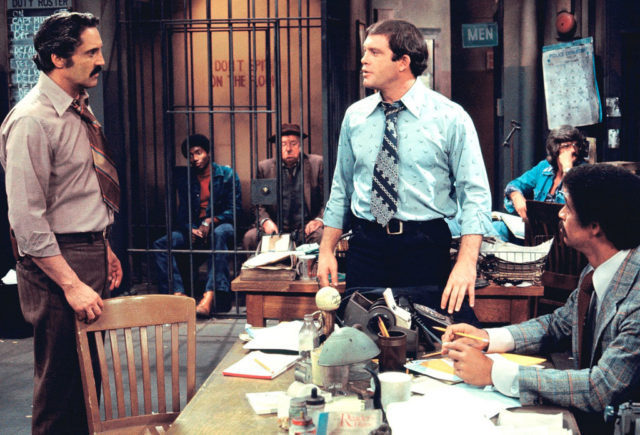
Hal Linden, Max Gail, and Ron Glass get real on Barney Miller
twi-ny: So I want to thank you guys for keeping me personally entertained over the course of the pandemic. I watched every single episode of Barney Miller. I watched a whole bunch of Love Boats. Then, all of a sudden I’m watching B Positive and there’s Bernie. I’m watching Better Things and there’s Bernie. Popping up all over the place.
bk: I keep saying, If you don’t fuck up too badly, they let you continue.
twi-ny: So you’ve been busy with lots and lots of appearances like that.
bk: Yes, I have. I’m very grateful.
twi-ny: And Hal, I also saw you in Off Broadway, the virtual play that you did. Where you come in at the end.
hl: Yes. I shot that on my terrace in California. You never saw anybody else. We had to really do it on the fly because I was the only one who was not sitting in front of a computer. That was my suggestion because I didn’t have a computer that I could get out on the balcony. So I said, Why don’t I just do it handheld and put the camera down on the chair. So it was kind of weird. It was interesting. I never did see the whole thing.
twi-ny: What kept you entertained over the last two plus years?
hl: Sports. I’m still a Dodger fan.
twi-ny: So you stuck with them when they moved.
hl: Yeah. I am a Dodger fan from when Red Barber did games out of town on ticker tape. That’s how long. I remember sitting around; my father had a Stromberg Carlson radio — it was this high, that big — and sitting around listening to the World Series with Mickey Owen’s passed ball. It was 1941, I think. So I’ve been a Dodger fan since I was a little boy listening on my little radio next to my bed.
twi-ny: And now the Dodgers and the Mets are playing this week at Citi Field.
hl: I know. I’m trying to go to the game tomorrow.
bk: I’m dittoing the Dodgers, because my kid [Adam, named after Kopell’s character on The Love Boat], he just turned twenty, is a great Dodger fan, and he’s a charming kid. The publicity people have kind of adopted him. He goes to games for free. We watch the games sometimes at home and he’s cheering for the Dodgers. He has a picture with Sandy Koufax, he has a picture with Tommy Lasorda, these great, great people.
twi-ny: I come from one of the families where, if I wanted to do something on Yom Kippur, my parents said, Sandy Koufax wouldn’t pitch on Yom Kippur, so you can’t do that.
hl: That’s right.
twi-ny: And in my father’s office at home, there was only one thing on the wall, a picture of the ’55 Dodgers. But a few years after the Dodgers left, he came over to the Mets.
hl: I went to the Mets for a few years, but then when I went back to LA, I went back to the Dodgers.
twi-ny: Bernie, have you worked at all over Zoom over these two years or online in any way?
bk: I wouldn’t know if it was Zoom or what.
twi-ny: So you didn’t have to even rehearse on Zoom, like when you were preparing for this show?
hl: We lived in California. So we got together and worked on it.
bk: We rehearsed at his place, sometimes we rehearsed at my place.
twi-ny: Avoid that whole computer thing.
hl: Yes.
bk: Can I just throw this in?
twi-ny: Yes, of course. This is just three Jews, talking.
bk: I’ve worked with Maurice Schwartz, the great Yiddish tragedian. The chairman of the drama department at NYU, professor Randolph Somerville, said, If you get a chance, work with Maurice Schwartz. So I’m in the Navy, and finally I catch up with Maurice Schwartz at the Ivar Theater in California. And James Drury, who is a co-student of mine, we zoom over to the Ivar Theater and say, Let’s bring up Somerville and he’ll cast us. So we brought up Somerville and he cast us. The problem was, he was at the end of his mental power, tragically. He was so mean to the actors and actresses. And there was an actor by the name of Philip Cary Jones, who was a little cockeyed.
So he was supposed to say, [in a Yiddish accent] “As a fleeing Jew, the sun is down, the ship, I suppose, will also go down.” It was called A Lonely Ship. So Schwartz didn’t like his reading, says, “Do it this way: The sun is down, the ship, I suppose, will also go down.” He tried it the same way: “The sun is down, the ship, I suppose, will also go down.” Schwartz said, “Mr. Philip Cary Jones, you may have worked with Katharine Cornell, but I’ll tell you the truth. You’re setting the theater back a thousand years.” Oh, this is how he was, at that time in his life.
twi-ny: Well, you know, Yiddish theater is making a comeback over the last ten years or so. There’s the New Yiddish Rep and the National Yiddish Theater Folksbiene.
twi-ny: They do it in Yiddish with Russian and English surtitles.
hl: I’m on the album. They made an album of that [Fiddler on the Roof in Yiddish: 2018 Cast Recording], but they added songs cut from the original. Sheldon Harnick did one. I did one [“Get Thee Out,” with Richard Kind, Tam Mutu, Shaina Taub, and Matthew Sklar].
twi-ny: Well, you know, you need to see it because in Yiddish, “If I Were a Rich Man,” do you know what it translates as?
hl: “If I Were a Rothschild.”
twi-ny: And there’s the Tony that you won, for The Rothschilds.
bk: I saw the film recently and I thought it was brilliant.
twi-ny: And there’s a new documentary about Norman Jewison and the making of the movie [Fiddler’s Journey to the Big Screen]. He tells the story where he admits to the studio, You know, you’re hiring a goy.
bk: They assumed that Jewison is Jewish.
hl: I was not a fan of Topol.
twi-ny: As an actor or as a person?
hl: No, I didn’t like his interpretation after I saw Zero do it.
twi-ny: My parents saw Herschel Bernardi.
hl: I saw Herschel Bernardi.
bk: Norman Jewison directed the first film I ever did, which Carl Reiner wrote, The Thrill of It All.
twi-ny: Well, this is a good time to turn our attention back to Two Jews, Talking. When you guys began working together, did you automatically know who was gonna play which role or did you work that out over time?
hl: It was interesting. I was on it before Bernie and there was a question because it was originally written with Ed Asner in mind.
twi-ny: And Jamie Farr.
hl: That was the original. And when I read it for the first time, it was with Jamie; Ed had died. Ed had been immobile, so he played the two parts where you don’t move. So Ed played Bernie’s part in the second act but my part in the first act. But once I read it, I said, If we’re gonna make a play out of it, you gotta have some continuity, some relationship so that we can enunciate the themes, that I’m the one who’s cynical and skeptical. And the other part is the believer. That was right off the bat. I switched to that part, but then again, I became semi-immobile [laughs] because I just had a hip operation.
bk: Let me throw this in about Ed Asner. One of the sweetest human beings. I guested one time on The Mary Tyler Moore Show. He comes over and says, “Bern, come with me.” He leads me into the prop room and he says, “Whenever you get hungry, we got nuts here, we got cookies. You’ll have a little bite.” I said, “That is so sweet.” But that’s how he was.
twi-ny: He was a mensch.
bk: A mensch.
hl: A mensch, I agree. Yeah. Ed was a poker player. We had a regular poker game.
twi-ny: Can I ask who else was at the game?
bk: Jason Alexander . . . It was a showbiz game, which was about 30% poker and about 70% bullshit. It was just wonderful. Unfortunately, I don’t know if it’s ever gonna be again.
twi-ny: Did you have a usual, big winner?
hl: No, there’s no big winners; you bet for a dollar or two, you couldn’t be a big winner, you couldn’t be a big loser.
bk: I don’t play cards. My father convinced me that as a Jew, I’m the only Jew who can’t count.
twi-ny: Bernie, when I saw the show on that first Saturday night, you said a word that immediately made my heart soar. And then when I read the new script, it’s out.
bk: What did I say?
twi-ny: You said the word “chaos.” It was in the original script, and I remember you saying it.
bk: It reminded me of my organization [KAOS, in Get Smart].
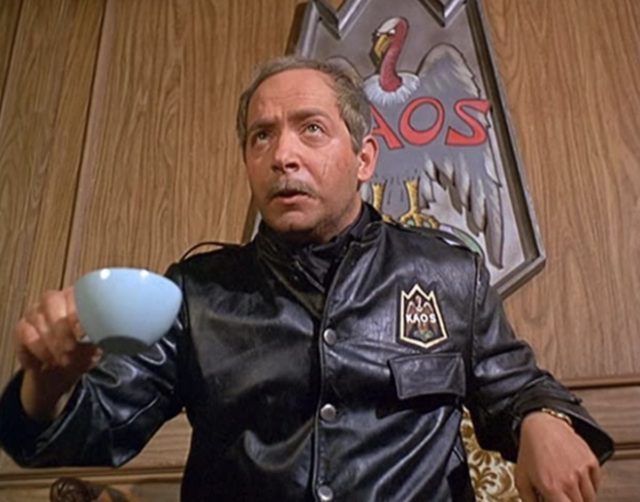
Bernie Kopell starred as devious KAOS agent Siegfried in Get Smart
twi-ny: Right. But I’d never heard you say it without Siegfried’s accent before.
hl: I didn’t even notice it was in or out.
bk: “Without structure there would be anarchy and chaos.”
twi-ny: That’s the line! My heart actually did a flip.
hl: [laughs]
twi-ny: As Hal noted before, Bernie, your characters are the ones that are more faithful — you have faith in Moses, you have faith in God — but Hal, your characters are —
hl: Skeptical. I won’t say cynical. I’ll say skeptical.
twi-ny: Do your personal relationships with Judaism relate at all to your characters’ relationships?
bk: Okay. I have to be truthful here. My father was very rough. He didn’t know that I had dyslexia. So in synagogue, I wasn’t keeping up fast enough in the cheder. He dug his nails into my forearm, just like that motherfucking Danny Kaye did. Danny Kaye was awful. I made a horrible mistake on The Danny Kaye Show: I got a laugh. He was way too rough. And he ended badly. There was some possibility that he might have done his Italian Giovanni character on Love Boat. So all the Love Boat people are at the Beverly Wilshire. And I see Danny there. And by this time he had done [the 1970 Broadway musical] Two by Two, which did not go well.
hl: No, it did not go well.
bk: And he’s having a big argument with our producer. So I go across the room to see my pal Pat Harrington, and as I’m coming back, Kaye is out of control, screaming at our producer, “You’re full of shit!” Not too great.
hl: In answer to your question, I’m a secular Jew. I do not attend synagogue. I am a tribal Jew. I’m the celebrity spokesman for the Jewish National Fund. I’ve been there for twenty-some-odd years, doing appearances for them and things like that. But that’s on the tribal level.
Phil (Bernie Kopell) and Marty (Hal Linden) discuss life and death in Two Jews, Talking (photo by Russ Rowland)
twi-ny: So Bernie, you and your characters are not the same.
bk: No. Vastly different.
hl: I have a lot of skepticism.
twi-ny: It’s hard not to these days, right?
hl: Yeah.
twi-ny: When you deliver certain jokes in the play, can you tell if it’s a more Jewish audience?
hl: We did this as a reading in North Carolina. In Mark Meadows’s district. I mean, western North Carolina.
twi-ny: That’s gotta be a tough audience.
hl: There wasn’t a Jew in miles, and they got a lot of the jokes. A few of the jokes they didn’t understand.
bk: I think part of it was they’re happy to see us, who’d been on television.
hl: But there was way more response than I expected.
bk: Me too.
twi-ny: Well, I know Bill Maher, who was raised Roman Catholic but whose mother was Jewish, talks about taking his political comedy nationwide, and he goes to red states and they laugh sometimes harder than the blue states.
bk: Bill Maher is a genius in my humble opinion. He’s brilliant.
twi-ny: So Hal, you said that you came into the project first. Have you been friends a long time?
hl: We were not that close. We’ve appeared in celebrity events together and things like that. We never worked together.
twi-ny: The only time I could find you guys on a stage at the same time was a 1980 ABC promo where you both danced in white tuxedos, with other stars from the upcoming season.
hl: I don’t remember doing that.
bk: I don’t either. But then again, at our age, what do we remember?
hl: I can’t tell you how many times I’ve seen things, particularly now with YouTube.
twi-ny: Well, that’s where you’ll find this, on YouTube.
twi-ny: Another interesting thing that I discovered was that Hal was on the first Love Boat pilot episode, which Bernie was not in. Dick Van Patten played the ship’s doctor.
bk: Dick was under contract to ABC. So when Eight Is Enough came about, they pulled him out, opening it up for other people. So I tested with a number of other guys.
twi-ny: You know who else was on that pilot episode?
hl: Harvey Korman.
twi-ny: Yes! And Don Adams.
hl: I only interacted with Karen Valentine. Maybe a couple of the regulars, I don’t recall.
bk: Well, let me throw this in. In the first pilot, the captain was an amazingly handsome Australian [Ted Hamilton]. He was gorgeous. But ABC said, No, he’s gorgeous, but he doesn’t have the authority. He doesn’t have the humor. He doesn’t have the kindness. So now we go to the second guy, the second guy worked on soaps. He wrote soaps. He acted in soaps. Quinn Redeker, I think his name was. And they said no. So now ABC is really getting pissed off because it’s so much money they’re putting into it and it’s not happening. So Gavin MacLeod had just come off of McHale’s Navy. And I had met him on McHale’s Navy. He was depressed because he’d done Operation Petticoat with Cary Grant, and he’d done The Mary Tyler Moore Show.
twi-ny: He was in the fabulous Kelly’s Heroes.
bk: Yes. So it opened it up for Gavin, and they were very happy. He had all the qualities they wanted and he became a great friend. A great friend. This was Gavin: There was some kind of a fakakta tradition in film and television that the director will perceive who is the weakest one in the cast.
hl: That’s the story of every play.
bk: And pick on them so that they can assert their authority.
hl: Jerry Robbins was notorious. He would always pick on the weakest link and destroy him.
bk: So Gavin says, Bern, let’s have a little chat with [director] Jack Arnold. Jack, come on over here. And we say in harmony, Jack, you may not behave that way on our set. Is that clear? Okay. Hey. All right. Fine. No problem. So he was a pussycat the rest of the way.
twi-ny: Getting back to Barney Miller, one of the things I noticed was how many of the regular cast members and guest stars I’ve seen recently onstage — Barbara Barrie, Linda Lavin, Kenneth Tigar, James Cromwell, Bob Dishy, Christopher Lloyd, David Paymer.
hl: The thing about Barney Miller, if you watched every episode, I’m sure you noticed this: Danny didn’t give a shit about repeaters.
twi-ny: What struck me is all these repeat actors, it gave it a theatrical feel, and it felt like the way the episodes were shot was very theatrical.
hl:Barney started out like a traditional sitcom. Three days of rehearsal, one day of blocking. And you do two shows on Friday night. Danny Arnold was a perfectionist. He was the head producer, the creator. The scripts were coming out later and later and later and later.
twi-ny: Five minutes before showtime, here you go, new pages.
hl: Yeah. Finally at about, I don’t know, I think it was about the fifth week or so, he didn’t have the last scene and we had to cancel the audience because we didn’t have a full script to do. What are you gonna do? He was still working on it. That’s a sin. People would come from all over the world to see the show — give them an ending. So the question was, Are you gonna have an audience next week? You gotta tell us now. And he wasn’t sure, so we never had an audience again.
twi-ny: Did you miss not having an audience?
hl: Believe it or not, when I was offered Barney Miller, I was offered three pilots. There were two hour shows and Barney Miller, which was a sitcom. I thought since I had spent so much time on Broadway, working to an audience would be easier for me. So that’s why I chose Barney out of the three — good choice, because the other two died. Anyway, the point is I quickly learned that the audiences are really a distraction, that you must close them off and work to the camera. If I’m talking to you, the camera’s over there; onstage, I would talk to you like this because the audience is out here. You know what I mean? The cameraman finally said to me, Hey, over here, because I kept crossing the line, working to the audience. So I quickly was dissuaded from that.
My point is that from then on, it was done actually like a movie. We’d start in the beginning, stage the first scene, work on it, shoot it; we’d only have two days of rehearsal, because that’s all the script we had. And on the third day we’d start shooting the show scene by scene, and because it was an independent production, we’d just do it until we figured it was right. The only people on the set were from the network to make sure we didn’t say anything wrong.
twi-ny: I also noticed how many of the episodes dealt with important issues. I hadn’t remembered it being so political.
hl: I was not a part of the writing of it, but a lot of it, the writers all came in and read the morning newspaper and found things. The atomic bomb, marital rape, racism, police violence. Danny Arnold was the genius behind it. Let me tell you a story. One of the episodes, do you remember the episode where Wojo falls for a hooker? [“Wojo’s Girl”] He keeps arresting everybody in the house to stop her from plying her trade. He finally goes and asks her for a date and she says, Sure, like everybody else, fifty bucks. At the end of the show, we have this kind of father-son-related talk as we’re about to go home. And just as he goes out the door, he turns back to me and says, Uh, Barney, can you lend me fifty bucks to payday?
The network says, You can’t say that. Danny says, Why not? They say, That means he’s going with the girl. Danny says, Very astute, you figured that out. So we’re shooting the show on the soundstage. He’s up in the office arguing with standards and practices. It’s the last line of the show, basically. We shot everything up to there. This was only about the third year; we weren’t a hit. We were still on the borderline. Eventually the director [Noam Pitlick] calls up and says, Okay, we’re about to shoot the last scene. What do we do? And Danny says, Shoot it the way it’s written, and hangs up. He says to the network, I’m shooting the show the way it’s written. If you don’t put it on the air, I’m not gonna make anymore. The network put it on the air: X-rated. Did you ever hear of an X-rated sitcom? It made the show. The ratings went way up and from there on in, they didn’t even come to the set.
bk: Can I do a Danny mishegas?
twi-ny: Absolutely.
bk: Before Barney, he worked with us on The Marlo Thomas Show. And he got very frustrated with lunch. For one hour, everybody zoomed out and they went to some restaurant and it was a big waste of time. He says, No, we’re not gonna do that anymore. So one day he ordered sandwiches and coffee and tea for everybody. But everybody zoomed out because he didn’t tell anybody that he had done this. So all this food is sitting here and Danny ate about half of it himself.
The crew of The Love Boat eavesdrop on the latest superstar guest
twi-ny: So Hal is working with a lot of theater actors while on The Love Boat, Bernie is working with —
bk: Academy Award winners.
twi-ny: Superstars from around the world.
bk: Some were lovely. One in particular was a gigantic pain in the ass.
twi-ny: And you’re gonna tell us.
bk: Yes. No, not mentioning any names. Shelley Winters.
hl: Oh, well, Shelley was a pain in the ass everywhere.
bk: But Ernie Borgnine, he worked with her on The Poseidon Adventure. So he knew her mishegas very intimately. So she’s on the show, and you know, it was so difficult to be on the ship — you gotta get on a little boat, bring all the equipment and all the people to Capri, for example, and then get on a truck. Everybody goes to location. Well, she didn’t like her hair, and she says, These lines are terrible. They don’t really suit me. She was just awful. Awful. Ernie Borgnine ripped into her with every Italian curse. And I think she was looking forward to that. She finally behaved.
twi-ny: New superstars every week.
bk: Eva Marie Saint, this is her personality. Shelley Winters, dreadful human being, couldn’t help it. So I’m outside in the parking lot. Eva Marie Saint comes by. Bernie, what are you doing? Oh, I’m studying. Would you like me to cue you? I said, I couldn’t possibly, you know, you being who you are. She said, I do it for all my friends. She said, Please, I’d love to do it. And she did it. What a mensch.
twi-ny: So there are some sweethearts in the business.
hl: We have two old actors who have worked with —
bk: Everybody.
hl: Everybody. I could tell you, some were magnificent. Judy Holliday was the most generous actress to work with. And some were . . . Ethel Merman. Ugh.
bk: I still have an earache from working with Ethel Merman.
Bernie Kopell and Hal Linden have been in show business a combined 127 years (photo by Russ Rowland)
twi-ny: And now, for the first time, you’re working with each other. What’s that been like?
hl: I put up with it.
bk: [laughs]
twi-ny: You sound like an old married couple.
bk: I’m so great.
hl: Yeah. You should be great.
bk: I am.
twi-ny: It does look like you’re having fun doing it.
bk: It’s fun.
hl: You know, this is not Arthur Miller. This is just two Jews talking and the more laughs, the better. And that’s the way we approached it.
bk: We haven’t said one word yet about our director.
twi-ny: I am a fan of Dan Wackerman’s. I like his shows a lot.
hl: You know, as I said, we did the show only once in North Carolina, that was a reading. And there was only Ed. Weinberger; there’s no staging. So it was hardly directed. We were kind of on our own . . .
bk: Sitting in chairs.
hl: And Dan took it and tried to break it down and put it back together, you know, with some sense of where we’re going. He really turned it from just a conversation into a sketch. Let’s put it that way.
bk: Our director just keeps at us until we continue to improve, to get it right.
hl: It’s been two old guys who get to try again —
twi-ny: And succeed. Standing ovations, right? Selling out?
hl: Ovations aside, our critics are ourselves. “We did it.” “We didn’t do it.” “We gotta work on this.” And the more you do that, the longer you hang around.
twi-ny: Well, thank you for hanging around with me here. I hope the show runs as long as you want it to.
hl: It’s a limited run. He’s already got the next gig.
bk: And so do you.
hl: And I got the next gig.
twi-ny: Can you talk about it yet?
hl: In Kansas City, I’m going to do Come Blow Your Horn, the Lou Jacobi part [Mr. Baker].
bk: We have a cruise honoring Gavin MacLeod, who passed away a few months ago, on the Princess ship, going down to Mexico. That’s where we started: Mexico, Mexico, Mexico. Somebody whispered in Aaron Spelling’s ear, Schmuck, we’re a hit, we can go other places. So we went to the Caribbean, we went to the Mediterranean, we went everywhere in the world.
hl: And I got stuck on one set.
———————————————————————–
[For a behind-the-scenes look at the interview, go here.]
A diverse cast of amateurs and pros comes together in As You Like It at the Delacorte (photo by Joan Marcus)
AS YOU LIKE IT
Central Park, Delacorte Theater
Tuesday – Sunday through September 11, free, 8:00 publictheater.org
In celebration of the sixtieth anniversary of the Delacorte Theater and the tenth anniversary of the Public Theater’s Public Works program, which brings together professional artists and community members in short-run, large-scale productions, Shakespeare in the Park has brought back Public Theater artist-in-residence Shaina Taub and Public Works director Laurie Woolery’s 2017 adaptation of the Bard’s pastoral comedy favorite, As You Like It. Continuing in Central Park through September 11, the musical is a delightful take on the story of hidden identity, family dysfunction, and true love, set in and around the forest of Arden and given a decidedly twenty-first-century twist while often referencing the show.
“All the world’s a stage / and everybody’s in the show / Nobody’s a pro / All the world’s a stage / and every day, we play our part / acting out our heart / Year by year, we grow / learning as we go / trying to tell a story we can feel / How do you make the magic real?” Taub, as the melancholy Jaques, sings as a form of introduction, words that relate to the musical, to Public Works, and life itself.
Later, Duke Senior (usually portrayed by Darius de Haas but I saw Amar Atkins), who has been exiled by his younger brother, Duke Frederick (Eric Pierre), and leads a poor but tight-knit community in Arden, declares, “I will not be free / until we are all free / Under the greenwood tree / you shall see no enemy / Do not fear / All / All are welcome here,” letting everyone onstage and in the audience know that this is an inclusive experience. The cast of 127 features performers from ages 7 to 82, mostly amateurs, from partner organizations across the five boroughs: Brownsville Recreation Center, Casita Maria Center for Arts and Education, Center for Family Life in Sunset Park, Children’s Aid, DreamYard, Domestic Workers United, the Fortune Society, and Military Resilience Foundation. Each participant is listed in the program and gets to make a personal statement.
Taub, who wrote the music and lyrics, and Woolery, who directs, have created a multiethnic spectacle with key gender swaps, which deliver added depth to the narrative. Tired of being persecuted by his older brother Oliver (Renrick Palmer), orphaned gentleman Orlando (Ato Blankson-Wood, Trevor McGhie) believes he can prove his worth by winning a wrestling tournament. The bouts are hilariously choreographed in a ring that rises from below the stage; the competitors range from the masked and massive Bronco to Frankie Flow and a wiry and vicious caveman (actual lucha libre wrestlers from the Bronx Wrestling Federation).
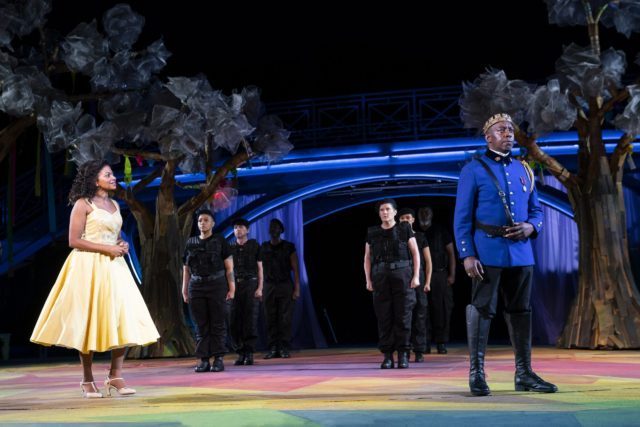
Rosalind (Rebecca Naomi Jones) is banished by her uncle, Duke Frederick (Eric Pierre), in Shakespeare adaptation (photo by Joan Marcus)
After pulling out a surprise victory, Orlando falls instantly in love with Rosalind (Rebecca Naomi Jones), the daughter of Duke Senior, and is subsequently banished by her uncle. Rosalind, accompanied by her best friend, Celia (Idania Quezada), Duke Frederick’s daughter, disguise themselves as Ganymede and Aliena, respectively, and head out into the forest joined by their loyal fool, Touchstone (Christopher M. Ramirez). Orlando flees the court and goes to Arden as well, seeking out his sweetheart.
Soon Orlando, not recognizing that Ganymede is in fact Rosalind, is befriended by his disguised love, who teaches him the art of wooing. Celia develops a liking for Oliver. Touchstone becomes desperate to hook up with farmhand Andy (Jonathan Jordan), who might have a thing for farmer William (Damion Allen). And shepherdess Silvia (Brianna Cabrera; Claudia Yanez) is mad for shepherdess Phoebe (Bianca Edwards), who wants nothing to do with her and instead develops a taste for Ganymede.
Distressed by Phoebe’s spurning, Silvia sings, “You Phoebe me / Why you gotta Phoebe me?” Phoebe cruelly retorts, “You say my glance is lethal / but girl, I know you’re lying / cause I’m giving you a death stare / and I don’t see you dying!” To “Phoebe” someone becomes a joke throughout the rest of the play.
Meanwhile, whenever Orlando bursts out into a solo, he is joined by a riotous backup group dressed in gleaming all-white, De Boys band dancers (Tristan André, Pierre Harmony Graves, Bobby Moody, Edwin Rivera), who groove with him seamlessly to the immense delight of the audience.
But trouble awaits when Duke Frederick decides to invade the forest and put an end to all the romantic shenanigans.
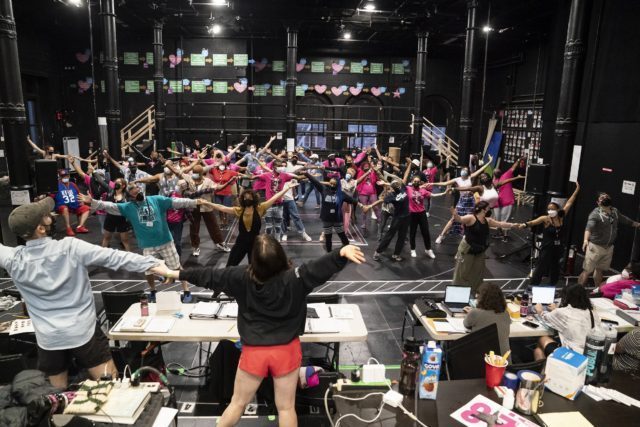
The large cast rehearses indoors for As You Like It (photo by Joan Marcus)
Taub, who previously adapted Twelfth Night for Public Works, serves as a kind of narrator as Jaques, appearing now and then to offer such warnings as “We shall make the same mistakes and never learn!,” “The worst fault you have is to be in love,” and “Give me leave to speak my mind and I will through and through cleanse the infected world, if they will patiently receive my medicine!” Of course, the medicine she and Woolery (Manahatta,Eureka) deliver is more than just a panacea but at the very least a temporary cure for whatever ails you.
The songs run the gamut from pop to R&B to rap and romantic ballads, with wonderful orchestrations by Mike Brun and original choreography by Sonya Tayeh, playfully restaged with additions by Billy Griffin. Duke Frederick’s entrances and exits are particularly memorable, accompanied by a royal guard that proclaims, “All hail Duke Frederick” to a melody that recalls the evil Imperial March theme from Star Wars, while the De Boys boy band brings down the house each time they put on the moves.
The set, anchored by a rear bridge and three trees on a revolving center, is by Myung Hee Cho, with lavish costumes by Emilio Sosa, lighting by Isabella Byrd, and sound by Sun Hee Kil. The animal puppets are by James Ortiz, the designer behind the remarkable puppets in The Skin of Our Teeth and Into the Woods.
The cast is a delight, from the leads to the bit players; in the program, the actors are listed alphabetically and each gets the same amount of space, three or four lines, whether it’s Taub, Jones, Blankson-Wood, or Ramirez or Vivian Jett Brown as Miss Amiens, Tommy Williams or Jason Asher as the referee, or Monica Patricia Davis or Alfreda Small as Ada.
The show was written in response to the 2016 presidential election and how it has torn apart the nation. It returns at a time when we all need healing and a way to come together despite our differences. In As You Like It, Jaques calls it “a miserable world,” but it’s significantly better with musicals like this in it.