this week in theater

iNEGRO, A RHAPSODY

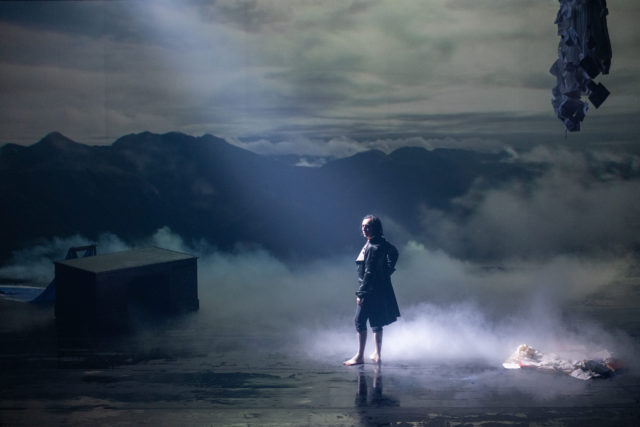
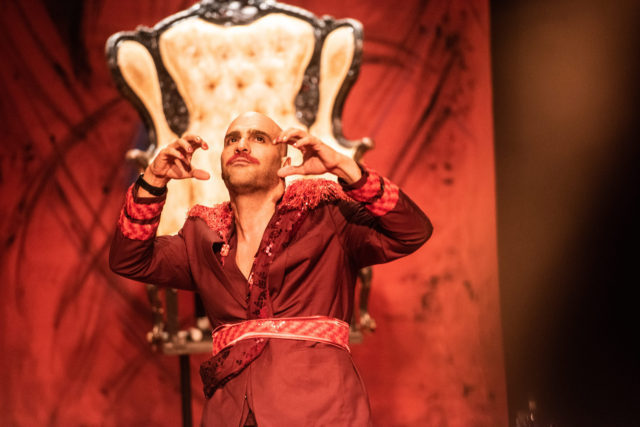
Kareem M. Lucas confesses his sins and reveals those of others in new solo show iNegro, a Rhapsody, (photo by Russ Rowland)

iNEGRO, A RHAPSODY
New Ohio Theatre
154 Christopher St.
Through May 14, $25-$75
newohiotheatre.org
www.kareemmlucas.com

There are only a few more chances to catch Kareem M. Lucas’s one-man Afro-surrealist show, iNegro, a Rhapsody, which continues through May 14 at New Ohio Theatre. In the fifty-minute production, part of New Ohio and IRT Theater’s Archive Residency, Lucas confesses his sins and shares his thoughts on the world. “I want to write something so Black that God can’t ignore me,” he explains. As he delves into Disney, religion, race, class, family, and other topics, he is tied to a cross. The concept is by Obie winner Stevie Walker-Webb (The Folks at Home, one in two), with direction by Zoey Martinson (Skype Duet, Gutting) and an original jazz score and sound design by multi-instrumentalist Mauricio Escamilla (aka MOWRI). The set, which evokes a three-dimensional Kehinde Wiley painting, is by David Goldstein, with lighting by Josh Martinez-Davis and costume design by Tyler Arnold. The name of the play recalls both Rubin Goldmark’s 1922 orchestral work for the New York Philharmonic, A Negro Rhapsody, and the title of the 2016 James Baldwin documentary I Am Not Your Negro.

Told in seven movements, iNegro, a Rhapsody is the first part of Lucas’s “3 Ages of a Negro” trilogy; his previous solo shows include Black Is Beautiful, But It Ain’t Always Pretty; Rated Black: An American Requiem; From Brooklyn with Love; A Boy & His Bow; and A Warm Winter. The Brooklyn-born, Manhattan-based Lucas has dedicated the world premiere of iNegro to the memory of the late Craig muMs Grant, the well-respected poet and actor who appeared in such television series as Oz and Boston Legal and such films as No Sudden Move and The Price; muMs, who was Lucas’s mentor on the piece — then known as The Maturation of an Inconvenient Negro when they were working on it at Cherry Lane Theater’s Mentor Project — passed away in March 2021 at the age of fifty-two.

for colored girls who have considered suicide/ when the rainbow is enuf

for colored girls who have considered suicide/ when the rainbow is enuf is facing an early closing notice at the Booth Theatre (photo by Marc J. Franklin)

for colored girls who have considered suicide/ when the rainbow is enuf
Booth Theatre
222 West 45th St. between Broadway & Eighth Ave.
Tuesday – Sunday through June 5, $49 – $225
forcoloredgirlsbway.com

As I write this, there is a movement afoot to prevent the first Broadway revival of Ntozake Shange’s for colored girls who have considered suicide/ when the rainbow is enuf from closing early; the show opened April 20 to good reviews and was scheduled to run through August 14, but it was announced a few days ago that it would be leaving the Booth after the May 22 matinee. To help fill seats and keep the choreopoem, in which seven women share intimate stories of misogyny, abuse, and their retaking of power, from shutting its doors, journalists, artists, and theater bigs (Ayanna Prescod, Bebe Neuwirth, Mickalene Thomas, Chita Rivera, Lorin Latarro) have been sponsoring free ticket giveaways to lift the current average attendance, which is barely half capacity. The night I saw it, the audience seemed much larger than that and loved every second of the play, built around a series of monologues with music and dance in between. [ed. note: The show has now been extended through June 5.]

Director Leah C. Gardiner and choreographer Camille A. Brown collaborated on a sensational 2019 revival at the Public, where the original production moved in 1976 after earlier iterations at smaller venues in Berkeley and downtown New York (and shortly before moving to Broadway). Toni-Leslie James’s ravishing costumes featured multiple images of the face of each actor’s most beloved female relative, honoring the ancestors; Myung Hee Cho’s inclusive set was highlighted by three rows of chairs for audience members along the back arch of the circular stage, in front of a large mirror, which reflected the rest of the audience so they appeared right behind the cast; and Jiyoun Chang’s bright lighting often illuminated everyone in the theater. The show has been reimagined and reinvented for the Booth, unfortunately not for the better, but Shange’s striking words are as sharp as ever.

It all begins with a voice-over from Obie-winning, Oscar-nominated poet, novelist, playwright, kids’ book author, activist, and essayist Shange herself — who portrayed Lady in Orange back in 1976 and updated the script in 2010 — offering, “Aunt mamie was a lil colored girl, Auntie Effie was a lil colored girl, Mama was a lil colored girl, you’re a lil colored girl . . . / Imagine . . . if we could get all of them to talk, what would they say? / Imagine all the stories we could tell about the funny looking lil colored girls, and the sophisticated lil colored girls, and the pretty lil colored girls . . . the ones just like you!”

Seven women share their heartbreaking and celebratory stories in Ntozake Shange’s powerful choreopoem (photo by Marc J. Franklin)

Over the course of the next ninety minutes, Lady in Orange (Amara Granderson), Lady in Brown (Tendayi Kuumba), Lady in Red (Kenita R. Miller), Lady in Green (Okwui Okpokwasili), Lady in Blue (Stacey Sargeant), Lady in Purple (Alexandria Wailes), and Lady in Yellow (D. Woods) poignantly relate key moments from their lives, with such titles as “dark phrases,” “no assistance,” “latent rapist,” “abortion cycle #1,” and “i usedta live in the world.” (Okpokwasili and Wailes return from the Public; I saw three understudies: Treshelle Edmond as Lady in Purple, McKenzie Frye as Lady in Orange, and Alexis Sims as Lady in Green.)

Hee Cho’s set is now dominated by a half dozen screens on the left and right, on which Aaron Rhyne’s mostly abstract (and distracting) visuals are projected. Sarafina Bush’s costumes are contemporary street clothing, the colors not as boldly obvious. Chang’s lighting is more standard, and Justin Ellington’s sound is built for the music, which is by Martha Redbone and Aaron Whitby and tends toward light jazz and R&B. Brown is the director and the choreographer, the first Black woman to do both on Broadway since Katherine Dunham for her three-act revue in November 1955.

The Obie, Tony, and Bessie-winning Brown has choreographed for her own company, Camille A. Brown & Dancers, as well as Alvin Ailey American Dance Theatre and such Broadway shows as Choir Boy and Once on This Island; she also choreographed and codirected (with James Robinson) the Metropolitan Opera’s premiere of Terence Blanchard’s Fire Shut Up in My Bones. Her style is rarely subtle, and that can work well in a dance presentation, but in for colored girls it quickly becomes overwhelming; instead of giving agency to the characters, it takes away from the narrative. Perhaps Gardiner was a calming influence; her deft touch is missing from this version.

for colored girls who have considered suicide/ when the rainbow is enuf is the first Broadway show to be directed and choreographed by a Black woman since 1955 (photo by Marc J. Franklin)

The cast is terrific, with an especially superb turn by the pregnant Miller, who thrillingly delivers “no assistance,” ending an affair with a lover (“this note is attached to a plant / i’ve been waterin since the day i met you / you may water it / yr damn self”), and “no more love poems #1” (“this is a requium for myself/ cuz I have died in a real way/ not wid aqua coffins & du-wop cadillacs/ i used to joke abt when i waz messin round / but a real dead lovin is here for you now/ cuz i dont know anymore/ how to avoid my own face wet wit my tears/ cuz i had convinced myself colored girls had no right to sorrow”).

The centerpiece is Lady in Green’s “somebody almost walked off wid alla my stuff,” in which she fights for her own being, for who she is and what is hers. She declares, “somebody almost walked off wid alla my stuff / not my poems or a dance I gave up in the street / but somebody almost walked off wid alla my stuff / like a kleptomanic working hard & forgettin while stealing / this is mines / this aint yr stuff / now why don’t you put me back & let me hang out in my own self.”

Despite the shortcomings of this production, for colored girls deserves a longer life on Broadway, telling an important story that particularly needs to be heard as Roe v. Wade is under fire and a woman’s right to her own body is threatened by a white patriarchy trying desperately to hold on to its fading power. It’s a truly American story; the characters hail from outside Atlanta, Boston, Brooklyn, Chicago, Detroit, L.A., and Newark, cities that have faced racial violence. It seems clear they’ve had enough and that the lives of women, and specifically women of color, would be different if they were in charge.

WEDDING BAND: A LOVE/HATE STORY IN BLACK AND WHITE

Brittany Bradford is sensational as a Black woman in love with a white man in Alice Childress’s Wedding Band (photo by Henry Grossman)

WEDDING BAND: A LOVE/HATE STORY IN BLACK AND WHITE
Theatre for a New Audience, Polonsky Shakespeare Center
262 Ashland Pl. between Lafayette Ave. & Fulton St.
Tuesday – Sunday through May 15, $90-$125
866-811-4111
www.tfana.org

Alice Childress is finally having her moment. Born in South Carolina in 1916 and raised in Harlem, the playwright, actress, columnist, and novelist made her posthumous Broadway debut last fall with Trouble in Mind, which was heading for the Great White Way in 1957 until producers pulled it after Childress would not make any changes. A rare revival of her 1966 play, Wedding Band: A Love/Hate Story in Black and White, opens tonight at Theatre for a New Audience’s Polonsky Shakespeare Center. While it’s exciting to see Childress at last receive acclaim, both productions turned out to be disappointing.

The back story as to why these plays had nearly disappeared is primarily that Childress ultimately stood by her scripts, refusing to touch a single word. However, after having now seen both of them, I’m of the belief that each could have used at least a little revision in certain places to avoid repetition and overwrought melodrama; Childress is a master at building characters, but too many of her scenes languish. You can read my take on Trouble in Mind here; my thoughts on Wedding Band continue below.

First staged at the New York Shakespeare Public Theater in 1972 (and not seen again in the city till now), codirected by Joseph Papp and Childress (Papp initially insisted that the author direct but he stepped in, giving them both credit) and starring Ruby Dee and James Broderick (with Albert Hall, Polly Holliday, and Clarice Taylor), Wedding Band centers on the controversial relationship between a Black seamstress, Julia Augustine (Brittany Bradford), and her partner of ten years, a white baker named Herman (Thomas Sadoski). Julia has to move around a lot to avoid the racism the two of them encounter when their situation becomes known, no matter how careful they try to hide it.

It’s the summer of 1918, just a few months till the end of WWI and a year before Red Summer, during which white mobs of civilians and veterans attacked Blacks in twenty-six cities, at least in part because of the Great Migration. Julia has rented a small house in a tiny community for Blacks on the outskirts of Charleston, South Carolina, run by Fanny Johnson (Elizabeth Van Dyke), a faux-elegant landlord who keeps a close watch on her handful of down-on-their-luck tenants.

TFANA’s Wedding Band features a gorgeous open set (photo by Hollis King)

Jason Ardizzone-West’s gorgeous set is a long, open rectangular space with a bed and night table at one end leading to a dirt path flanked by rows of tallgrass; the audience sits on opposite sides behind the knee-high grass. There are no actual doors, so all the characters can see one another whenever they are onstage, entering through the aisles, or wandering across the upper levels of the theater. Stacey Derosier’s lighting keeps most of the audience at least partially illuminated at all times, and Rena Anakwe’s sound design immerses the small crowd in the goings-on. It’s a powerful effect, particularly since the audience members are predominantly white and wearing masks, while onstage the 1918 influenza pandemic is raging across the country.

Among those at Mrs. Johnson’s establishment are Mattie (Brittany-Laurelle), a candy maker who is waiting for her husband, October, to come back from the Merchant Marine with much-needed funds, and their delightful eight-year-old daughter, Teeta (Phoenix Noelle), who plays with the white girl, aptly named Princess (Sofie Nesanelis), whom Mattie cares for; and the widowed Lula Green (Rosalyn Coleman), whose adopted son, Nelson (Renrick Palmer), is home from the war to march in a parade and chase down some women.

When Julia first arrives, she begs for peace and quiet, but Mrs. Johnson and the other residents want to find out everything about her, thumping the Bible as they seek out her sins. Childress points out their poverty from the very beginning; Teeta has lost something, and Mattie is desperate to find it. “Gawd, what’ve I done to be treated this way! You gon’ get a whippin’ too,” Mattie tells her. She explains to Mrs. Johnson, “Dammit, this gal done lost the only quarter I got to my name.”

Julia introduces herself to her new, nosy neighbors, who are taken aback when she quickly reaches into her purse and gives Teeta twenty-five cents. A few moments later the Bell Man (Max Woertendyke) shows up with his traveling salesman’s suitcase of random items; Lula owes him three dollars and ten cents but can’t pay anything now. Julia asks if he has any sheets, and soon the Bell Man, who recognizes her and knows that she is with a white man, is sitting on her bed, implying that she should fulfill his needs if she wants him to remain silent.

She throws him out, saying to the others, “I hate those kind-a people.” Lula responds, “You mustn’t hate white folks. Don’tcha believe in Jesus? He’s white.” Julia replies, “I wonder if he believes in me.”

When her lover, Herman, shows up, Julia is excited to see him. He’s upset because his mother (Veanne Cox) and sister, Annabelle (Rebecca Haden), are being harassed because they’re German, even though they’re American citizens. “It’s the war. Makes people mean,” Julia, who is always understanding of everyone, says. But Herman knows the truth about his family. “A poor ignorant woman who is mad because she was born a sharecropper . . . outta her mind ’cause she ain’t high class society. We’re red-neck crackers, I told her, that’s what.”

When Herman falls ill, it’s not as easy as simply calling a doctor, for their interracial relationship, in an era of anti-miscegenation laws, complicates everyone’s situation.

Bradford (Fefu and Her Friends, Bernhardt/Hamlet, Mac Beth) is spellbinding as Julia, her every move filled with the constant heavy weight on her heart. She portrays her with a gentle compassion until she explodes during Julia’s unforgettable confrontation with Herman’s racist mother.

Herman (Thomas Sadoski) battles illness as his sister (Rebecca Haden), mother (Veanne Cox), and longtime partner (Brittany Bradford) look on (photo by Hollis King)

The stage setup allows every audience member to follow Bradford’s riveting eyes, depicting the pain of being an independent-thinking Black woman in love with a white man, a relationship that nearly everyone looks down on. It takes on additional meaning as privacy rights are under attack again in the United States in 2022.

The rest of the cast is solid, but director Awoye Timpo (In Old Age, The Loophole, Carnaval), who so smoothly guided the show through the first half, gets too caught up in the mawkishness of the later plot developments, leading to a head-scratching magic-realist finale that feels as tacked on as it is.

Wedding Band is part of TFANA’s CLASSIX residency, which was founded by Timpo with Bradford, A. J. Muhammad, Dominique Rider, and Arminda Thomas to focus on Black performance and works by Black writers across the African diaspora. On May 14 at 4:30, TFANA will host the panel discussion “CLASSIX: In Search of Alice Childress,” with the CLASSIC collective, moderated by Jonathan Kalb. And on May 15 at 4:30, the TFANA Talk “Reflections, with Bianca Vivion Brooks” pairs Bradford with Juliana Canfield, who starred in Adrienne Kennedy’s He Brought Her Heart Back in a Box at TFANA in 2018, a show that also deals with interracial relationships.

I hope to see more plays by Childress, who died in New York City in 1994 at the age of eighty-one and also wrote such novels as A Hero Ain’t Nothing but a Sandwich, Like One of the Family, and A Short Walk. Even in productions that fall short, there are compelling, prescient moments and important, beautifully drawn characters.

As she wrote in a letter to Dee, “Wedding Band is about yesterday and today . . . far away and right at hand . . . old and ever present. It is the past, present, and future . . . recollection, attention, and anticipation . . . It is about the humiliation of an entire nation . . . not a tale of star-crossed lovers. My play is about manless women. Women in need of love, name, protection. It concerns itself with love and the seeking of love in a racist society . . . the love of country, the love of material things, and spiritual love.” Childress is clearly a playwright for these troubled times.

RemarkaBULL PODVERSATION: EXPLORING LADY MACBETH WITH ISMENIA MENDES

(photo by Richard Termine)

Lady Macbeth (Ismenia Mendes) reaches out to her royal husband (Isabelle Fuhrman) in inventive reimagining of Shakespeare tragedy (photo by Richard Termine)

Who: Ismenia Mendes, Nathan Winkelstein
What: Livestreamed conversation about Lady Macbeth
Where: Red Bull Theater online
When: Monday, May 9, free with advance RSVP (donations accepted), 7:30
Why: Macbeth is all the rage now, with a much-derided version starring Daniel Craig and Ruth Negga currently playing at the Longacre on Broadway and Joel Coen’s film version with Denzel Washington and Frances McDormand having garnered three Oscar nominations. One of the best and most innovative adaptations in decades was staged by Red Bull Theater at the Lucille Lortel in 2019, directed by Erica Schmidt and set at a girls school. The fierce and furious, sexy and sinister ninety minutes starred Isabelle Fuhrman as Macbeth and Ismenia Mendes as Lady Macbeth.

In conjunction with the streaming release of the 2019 production, available on demand May 16-29, Red Bull is hosting its latest RemarkaBULL Podversation, “Exploring Lady Macbeth,” with Mendes (Troilus and Cressida, Henry V) and associate artistic director and host Nathan Winkelstein performing the “How now! what news?” scene, followed by a discussion and an audience Q&A. In the dastardly dialogue, Lady Macbeth tells her husband, “What beast was’t, then, / That made you break this enterprise to me? / When you durst do it, then you were a man; / And, to be more than what you were, you would / Be so much more the man. Nor time nor place / Did then adhere, and yet you would make both: / They have made themselves, and that their fitness now / Does unmake you. I have given suck, and know / How tender ’tis to love the babe that milks me: / I would, while it was smiling in my face, / Have pluck’d my nipple from his boneless gums, / And dash’d the brains out, had I so sworn as you / Have done to this.” Previous RemarkaBULL Podversations, which are always a treat, have featured Kate Burton, André De Shields, Elizabeth Marvel, Chukwudi Iwuji, Patrick Page, Lily Rabe, Jay O. Sanders, Michael Urie, and others and can be viewed for free here.

CYRANO DE BERGERAC

Jamie Lloyd’s reimagining of Cyrano de Bergerac continues at BAM through May 22 (photo by Marc Brenner)

CYRANO DE BERGERAC
Brooklyn Academy of Music
BAM Strong, Harvey Theater
651 Fulton St. between Ashland & Rockwell Pl.
Tuesday – Sunday through May 22, $45-$310
718-636-4100
www.bam.org/cyrano

Jamie Lloyd reimagines Edmond Rostand’s Cyrano de Bergerac for the twenty-first century in his electrifying, Olivier-winning production that continues tearing down the house at the BAM Harvey through May 22.

As the play opens and a swarm of young people in contemporary street clothes congregate on a stark white stage, one man sits in a chair with his back to the audience, gazing into a mirror as if he can’t look away. We know it’s James McAvoy, the gorgeous Scottish superstar, portraying nobleman, soldier, and poet Cyrano de Bergerac sans the character’s famously large and ugly proboscis. But still, when he finally turns around, there’s an audible gasp from the audience; McAvoy, in tight-fitting black jeans, boots, and jacket, is even hotter than we imagined. If he has a problem with the way he looks, what does that say about the rest of us?

However, Ligniere (Nima Taleghani) declares, “The Parisian isn’t superior / just everyone else is inferior.” Thus, director Lloyd and translator and adaptor Martin Crimp are leveling the playing field from the start; we all have things about ourselves that we think are ugly, on the surface and/or inside.

Meanwhile, university student Roxane (Evelyn Miller) demands to be recognized as more than just a pretty face, insisting on being respected for her brains more than her beauty, although she has fallen head-over-heels for the simpleton Christian (Eben Figueiredo), who is most definitely not the brightest bulb in the chandelier. Roxane is not always portrayed as a strong, intelligent character who exists outside of her cousin, Cyrano, and Christian, but she is very much her own woman here. “I am so, so bored with not being taken seriously by men,” she says.

Rostand’s 1897 original is a tribute to the power and glory of speech and the written word; Lloyd and Crimp now further that to the spoken word via rap, as if Cyrano is taking place in a hip-hop battle straight out of Eminem’s 8 Mile. “They say when he came through his mother’s vagina / his nose poked out first as a painful reminder / of all the agony to come,” one character explains.

Roxane (Evelyn Miller) and Cyrano (James McAvoy) enjoy a rare laugh together in electrifying adaptation at BAM (photo by Marc Brenner)

“When you first see it you say to yourself NO! ―/ that is a party-trick ― take it off, Cyrano,” the poet and pastry chef Ragueneau (Michele Austin) says about the nose. “You expect him to reach up and somehow unscrew it. / But the damage is done: He can never undo it.” Ragueneau, played by a woman in this version, is Roxane’s best friend and regular companion.

Cyrano is madly in love with Roxane, who is being unsuccessfully set up by the villainous De Guiche (Tom Edden) to wed the young nobleman Valvert and thereafter be shared with De Guiche, who sends Cyrano and Christian off to a military conflict they might not return from. Cyrano himself declares, “If style points you in a sexual direction / You might want to refer, Valvert, to my nasal erection.”

Through all its iterations, including the 1950 film with José Ferrer, the 1987 rom-com with Steve Martin, and the 2019 theater musical (and later film) with Peter Dinklage, Cyrano is about the unrequited love of a lover of language who has to hide behind his ugly facade to help another man capture the heart of a not necessarily strong-willed, self-capable woman he believes he is destined to be with.

Lloyd (Betrayal, Three Days of Rain), who presented a more traditional Cyrano for Roundabout in 2012, complete with a balcony scene and Douglas Hodge wearing a fake nose, this time has streamlined the visuals. Soutra Gilmour’s set is a big white box in which stairs move in and out, with overhead fluorescent lights creating haunting shadows. (Gilmour also designed the costumes; the lighting is by Jon Clark, with music and sound by Ben and Max Ringham.) Instead of parrying with their swords, characters fight it out with microphones, either attached to their head, held in their hand, or on a stand.

A beatboxer (Vaneeka Dadhria) serves as a kind of narrator throughout, but the rapping, which can be thrilling, gets to be too much. Like Cyrano, Rostand is a master wordsmith with an infectious love of the lexicon, which doesn’t always come through, even when the phrase “I love words, that’s all,” is projected onto the back wall. The play works significantly better when it slows down and focuses on the relationships, when the music stops and the tension between Cyrano, Roxane, Christian, De Guiche, and Ragueneau takes center stage (although one intimate scene with Cyrano and Christian goes wildly awry).

McAvoy (The Ruling Class, The Last King of Scotland), in a role previously performed by Martin, Ferrer, Hodge, Ralph Richardson, Derek Jacobi, Richard Chamberlain, Christopher Plummer, Gérard Depardieu, and Kevin Kline, among others over the last century-plus, sizzles as Cyrano; he dominates the Harvey with a magnetic power, his intense sensuality increasing with his every move. Miller (Flowers in the Attic, Jane Eyre) brings depth and a fierce perceptiveness to Roxane, although it is never clear why such a strong, brave woman is enraptured with the dimwitted Christian, who is no hot hunk, but that is all part of Lloyd’s twisting of expectations.

And in the end, like most of us, despite Cyrano’s romance with language itself, he is at a loss of words when expressing his desire for Roxane. He stumbles, “I’m speechless, speechless, all I can say is I want — I want — I want — there is no poetry — there is no structure that can make any sense of this — only I want — I want — I want — I want you.” It’s that passion that drives Lloyd’s unique reinterpretation of a classic.

WISH YOU WERE HERE

Five friends get ready for a wedding in world premiere of Sanaz Toossi’s Wish You Were Here at Playwrights Horizons (photo by Joan Marcus)

WISH YOU WERE HERE
Playwrights Horizons, Mainstage Theater
416 West 42nd St. between Ninth & Tenth Aves.
Tuesday – Sunday through June 5, $49-$89
www.playwrightshorizons.org

First-generation Iranian-American playwright Sanaz Toossi follows up her wonderful professional debut, English, which ran earlier this year at the Atlantic, with the even better Wish You Were Here, which opened tonight at Playwrights Horizons.

Written in 2018 as her NYU thesis in response to Donald Trump’s Muslim travel ban and anti-immigration policies, English is set in a TOEFL classroom in Karaj, Iran, in 2008, where four Iranian adults are learning to speak English as they and their teacher question the meaning of home and how language and culture impact their identity.

Written in 2019 as a response to Trump’s threat to retaliate against Iran after the Western Asian republic shot down an unmanned US drone, Wish You Were Here follows the trials and tribulations of five close female friends in Karaj from 1978 to 1991 who experience what Toossi calls “detached homesickness” as the nation goes through major changes, from the Islamic Revolution to the Iran-Iraq War.

The story unfolds in ten scenes that all take place in the same well-accoutred living room. Salme (Roxanna Hope Radja) is in a giant wedding gown, getting ready for her special day. Shideh (Artemis Pebdani) is giving Zari (Nikki Massoud) a pedicure, announcing so everyone can hear, “Your toes are disgusting.” (There are a lot of bare feet throughout the play.) Nazanin (Marjan Neshat) makes adjustments to the dress while flirting with Rana (Nazanin Nour), who is très elegant in her shiny silk pajamas, smoking a cigarette as she does Salme’s hair.

As they continue to primp, they regale one another with a string of hysterical dirty jokes and good-natured insults. “I’m steaming out of my dress, Shideh,” Nazanin says, referring to her nether regions. “Ew,” Shideh replies. “My pussy could iron a shirt,” Nazanin adds. Rana asks, “Oh what kind of shirt?”

Shideh (Artemis Pebdani) has a lot to say as Nazanin (Marjan Neshat) applies makeup to Zari (Nikki Massoud) and Salme (Roxanna Hope Radja) hovers behind them (photo by Joan Marcus)

“If a man saw her toes, I think his penis would fall off,” Shideh says about Zari. Rana admits, “Silk does not breathe well. Whatever you’re smelling is me and I don’t want to talk about it.” And Zari advises Salme what to do when encountering a man’s member: “When you first see one, smile. Smile so big. Smile bigger than you’ve ever smiled in your life. Like you need to swallow a plate.”

It’s an enchanting scene in which we fall in love with the characters while learning key facts about each of them: Shideh is studying to be a doctor and is considering going to school in America; Salme is the most religious one, regularly praying, believing that you “can’t jinx G-d’s will”; the easygoing Zari is in the market for a husband; and the ultracool Rana and the occasionally mean Nazanin plan to avoid marriage and children, although Nazanin lets it be known that she wants to eventually return to Iran after living it up in Miami. (Coincidentally, in English, Neshat plays a teacher who made a life for her and her family in London but came back to Karaj, perhaps regretting that decision.)

A year later it is Zari who is getting married, but a pall is cast over the proceedings when Shideh mentions Rana’s name; Rana, who is Jewish, has gone missing, along with her parents and brother. Salme is trying to find her, but Nazanin says, as if trying to convince herself, “If she wanted to vanish into thin air, with no trace, no word, without shit, then that’s how she wanted to do it.”

Nazanin (Marjan Neshat) and Salme (Roxanna Hope Radja) cement a bond in Wish You Were Here (photo by Joan Marcus)

But as we soon discover, Nazanin has a problem with people leaving, whether it’s a friend moving away with a new husband, another friend going off to study abroad, or a best friend disappearing in a country becoming ever-more dangerous. As many Iranians choose to escape their homeland because of war and an oppressive regime, Nazanin feels stuck, resenting those who attempt to make a new life for themselves and their family instead of getting out while she still can. It’s a bitter pill, especially when seen in retrospect. “Why don’t I want to leave?” she wonders. It’s a question people ask themselves every day across the globe.

Wish You Were Here is directed by Gaye Taylor Upchurch (Animal, The Year of Magical Thinking) with a warm and welcoming intimacy that invites us into these women’s complex lives with, as the characters often say, “no judging.” The comforting set is by Arnulfo Maldonado, with handsome costumes by Sarah Laux, subtle lighting by Reza Behjat, and meticulous sound by Sinan Refik Zafar and Brian Hickey.

The hundred-minute play was also written by Toossi as a love letter to her mother and her mother’s friends, immigrants who started all over in the United States; parts of the story are based on real experiences. Toossi, who was born and raised in Orange County, California, and is now based in Brooklyn, has beautifully depicted the ups and downs, the sheer joys and the petty jealousies, that define female friendship.

Over the course of thirteen years, Iran underwent tremendous change, but Toossi does not focus so much on world events as on how they impact the women’s relationships with each other; the scenes involving only two of the women at a time are particularly emotional and heart-wrenching as Toossi explores the many layers of attachment, mere cordiality, and sincere love the women share. While Salme is afraid of pulling off the tape when Nazanin is waxing her legs for fear of hurting her physically, Zari is not afraid to tell Nazanin, “You have a way of making me feel really lonely.”

The cast is exceptional; it truly does seem like you’re watching five friends go about their daily existence, dealing with love and loss as they dance wildly to a song on the radio, hide under a table during a bombing, kneel down to pray to Mecca, or deliver yet another pussy joke. In between scenes, the actors make minor changes to the living room to indicate a shift in location, moving around tables or opening the curtain in the back to reveal a bright garden. It’s as if the five actors, and the audience, need a short break from the intensity of the play while getting ready to see what the next year holds in store for everyone. I can’t wait to see what Toossi has in store for all of us next.

A CASE FOR THE EXISTENCE OF GOD

Ryan (Will Brill) and Keith (Kyle Beltran) find out they have more in common than they think in Signature world premiere (photo by Emilio Madrid)

A CASE FOR THE EXISTENCE OF GOD
The Pershing Square Signature Center
The Irene Diamond Stage
480 West 42nd St. between Tenth & Eleventh Aves.
Tuesday-Sunday through May 29, $35-$70
212-244-7529
www.signaturetheatre.org

Samuel D. Hunter’s brilliantly human A Case for the Existence of God itself makes a strong case for the existence of God. In the first work of his three-play, five-year residency at the Signature, the award-winning Idaho native has written an almost brutally realistic but gentle story of a down-to-earth bromance between two thirtysomethings facing single fatherhood with excitement and apprehension.

The ninety-minute play takes place in a small cubicle open at an angle to the audience; above it hovers a rectangular industrial office light. The cubicle is surrounded by a vast emptiness, as if alone in the universe. The two actors remain seated in the same chairs for nearly the entire show; time and location shifts are indicated by the dialogue and subtle changes in lighting. (The spare set is by Arnulfo Maldonado, with lighting by Tyler Micoleau and sound by Christopher Darbassie.)

Ryan (Will Brill) has come to see Keith (Kyle Beltran), a mortgage broker he met at their children’s daycare; Ryan, who is white and straight, works at the local yogurt plant in Twin Falls, Idaho, and is going through a divorce that involves a custody battle over his fifteen-month-old daughter, Krista. Keith is fostering to adopt Willa, who is the same age as Krista. Ryan is trying to get a loan to purchase a twelve-acre plot that used to belong to his family; he is desperate to recover a part of the past to ensure a better future for him and his daughter. Meanwhile, Keith, who is Black and gay and without many prospects for a partner, is frustrated by problems with the adoption process and Willa’s birth family.

The two men form a quick bond because neither of their lives is going as they’d planned or expected. “I hope this isn’t weird of me to say but — I think we share a specific kind of — sadness. You and me,” Ryan says to Keith in a deeply touching moment. Keith doesn’t respond at first but a few days later says, “I think you’re right. I think we share something, too.”

Samuel D. Hunter’s new play explores a growing friendship between two men trying to be single fathers (photo by Emilio Madrid)

As Keith works hard to find a way to get Ryan, who has no collateral, the loan, they become friends, hanging out together, watching movies, comparing their kids’ sleep habits, drinking whiskey, discussing mental illness and bullying, and growing more and more honest with each other. Keith explains his interest in early music, while Ryan doesn’t hesitate to admit that he doesn’t know what “harrowing” and “tacitly” mean but loves when his daughter says “popsicle.”

Embarrassed by his financial situation, Ryan tells Keith, “I just think there’s like a really specific kind of stress that I have about money? I mean I know everyone stresses out about money, but I’m not talking about that. It’s like . . . I guess I feel like having money is the only real permission I have to be alive? Like without it, I don’t have permission to exist.”

Meanwhile, Keith shares his innermost fears with Ryan. “I’m like the most anxious dad on the planet. I feel the phone in my pocket vibrate and I immediately think someone is calling me to tell me that my daughter is dead,” the broker says. Later he confesses, “I’m so scared, Ryan. I’m so fucking scared.” The anxiety both men experience is palpable and wholly relatable in the general sense of what we all have to deal with on a daily basis; it’s just unusual to see such remarks occur between two guys, especially a pair who are probably not used to divulging their feelings with anyone. “I feel like my life is so centered on being a dad right now, it’s actually just nice to have a conversation with another adult,” Ryan says. It’s actually just nice to hear these conversations as well.

Keith and Ryan are searching for what we all want, something that none of us ultimately can have: permanence. As we watch them struggle to get their lives in order, we can’t help but think about the impermanence in our own lives as well.

The forty-year-old Hunter’s previous plays all feature ordinary people up against ordinary situations, seeking companionship and connection, often with the past: The Whale is about a six-hundred-pound recluse; Greater Clements details an effort to save a former mining town from closing down; The Few focuses on a man and his former lover deciding if they should save the paper they run for lonely interstate truckers; A Bright New Boise warns against the dangers of blind faith; and Lewiston/Clarkston is a pair of one-acts in which the audience eats dinner together in between shows.

Samuel D. Hunter’s A Case for the Existence of God takes place in a small cubicle (photo by Emilio Madrid)

When Keith explains that harmony did not always exist in the Western musical tradition, Ryan is flummoxed. “That’s so sad,” he says. “I guess I feel guilty. I mean I’m trying to picture living in a world that only has music without harmony, I can’t even —. And I’m not like even a music guy. Jesus.” Keith asks, “But why does that make you feel guilty?” Ryan answers, “Because like — I’ve just been taking it for granted my entire life.” For him “harmony” means companionship and connection, an alternative to being alone.

Sensitively directed by Tony and Obie winner David Cromer (The Band’s Visit, A Prayer for the French Republic, The Sound Inside) with a sincere affection for both characters, A Case for the Existence of God beautifully explores the pain and pleasure of being a single father, balancing the constant angst and worry with the joy and love. In some ways it is reminiscent of Robert Benton’s 1979 Oscar winner Kramer vs. Kramer, one of the first major films to intelligently and fairly depict a father (Dustin Hoffman) fighting for custody of his son while going through a bitter divorce.

But the play, which Hunter wrote shortly after he and his husband adopted a child and sought to buy a two-bedroom apartment in a New York City co-op, is seen only through the eyes of the two men, flawed, complex human beings played with tenderness and understanding by Beltran (Blue Ridge, The Amateurs) and Brill (Oklahoma!, Tribes), who are used to being together in tight quarters; they were roommates while studying drama at Carnegie Mellon. Just as they don’t judge each other — well, they do, but then they don’t — we don’t judge them. There’s no toxic masculinity in the air, no homophobia or racism, no frat jokes, just an ever-deepening platonic friendship between a gay Black man and a straight white man.

“This feels like a chance to — hit the reset button,” Ryan says about buying the property. It’s a button we all reach for at one time or another in our lives. And if you’re searching for proof of the existence of a higher power, some kind of supreme being, Hunter’s play is a prime piece of evidence that there must be something bigger than us out there.