this week in theater

STRAIGHT LINE CRAZY

Ralph Fiennes as Robert Moses in David Hare’s Straight Line Crazy (photo by Kate Glicksberg)

STRAIGHT LINE CRAZY
The Griffin Theater at the Shed
The Bloomberg Building at Hudson Yards
545 West 30th St. at Eleventh Ave.
Tuesday – Sunday through December 18
646-455-3494
theshed.org

David Hare’s sparkling, intense Straight Line Crazy, which opened Wednesday night at the Shed’s Griffin Theater, begins with Ralph Fiennes walking down Bob Crowley’s T-shaped stage, barefoot and wearing a suit. He does not need to introduce his character to the New York City audience; he is portraying infamous urban planner Robert Moses. Before he can say anything, the sold-out crowd erupts in entrance applause for the two-time Oscar and Emmy nominee and Tony winner. In a brief monologue, Moses says, explaining his penchant for swimming, “The further I swim the happier I am. At night, best of all. So how do I feel when people say ‘We were worried. You were gone so long. We called the coast guard.’ How do I feel? I tell them, ‘Why did you panic? Nothing’s going to happen to me.’”

A moment later, Helen Schlesinger, in frumpy attire — Crowley also designed the costumes — approaches, announcing, “I’m Jane Jacobs.” The audience again bursts into applause, but it’s not for the British television and theater actress as much as for her character, a woman whose name is instantly familiar to so many New Yorkers as Moses’s longtime archnemesis even though, as she points out, they never met. Explaining her original lack of interest in architecture, she states about her change of mind, “What made me think about architecture was that moment when I realized I was going to die. I remember thinking, what will be left of us? After we’re gone? And I remember reading that only two things remain. Cities and songs.”

Straight Line Crazy begins in 1926, as Moses, the chairman of the New York State Council of Parks (and later secretary of state and Parks and Recreation commissioner), is hard at work developing plans for the building of the Southern State and Northern State Parkways on Long Island. He sees the automobile as the future and is determined to bring access to Jones Beach to the masses, despite strong pushback from such wealthy landowners as the Morgans, the Whitneys, and the Fricks.

Jane Jacobs (Helen Schlesinger) won’t give up the fight against Robert Moses in Straight Line Crazy (photo by Kate Glicksberg)

“Every summer those few adventurous souls who dare to head this way are brought to a halt, as their overheated engines expire on badly maintained tracks,” Moses tells Henry Vanderbilt (Guy Paul). “Everything possible is done to discourage them. Well, no longer. My new parkways will make travelling as attractive as arriving.” Vanderbilt promises “impassioned and intransigent opposition to all your plans . . . unified, organized, and unyielding.” But there’s nothing Moses enjoys more than a good fight. When Vanderbilt calls him a revolutionary, Moses responds, “To the contrary. The very opposite. My aim is to forestall revolution, not to incite it.” However, his revolution is strictly for cars; he adamantly refuses to include any form of public transportation, no buses or trains.

Moses is a bold, severe man, unwilling to accept that he’s ever wrong, unable to consider compromises or concessions of any kind, unafraid of brazenly skirting the law. He speaks in aphorisms whether discussing plans with the two main members of his team, the fictional duo of Finnuala Connell (Judith Roddy) and Ariel Porter (Adam Silver), or the rambunctious, cigar-chomping New York governor, Al Smith (Danny Webb). “I made the mistake of thinking that if I proposed something which was logical, reasonable, and effective, people would at once see its merits and fall in behind it. . . . They blocked it at every turn,” Moses tells Porter. He says to Connell, “I’m a ditchdigger, I’m not an academic. I put academia behind me. It’s for the young. It’s for the inadequate. . . . The people lack imagination. The job of the leader is to provide it.”

In a swirling, exciting conversation with Smith, Moses explains, “I never ask favors. I ask my due.” On his way out, Smith tells Porter and Connell, “Hard to leave a meeting with Moses without feeling you’ve been robbed. But just as hard to know what the fuck you’ve been robbed of.”

Meanwhile, in the background, Jacobs starts making her case against Moses. “If you think fighting power is fun, I’d advise you to think again,” she says to the audience. The second act moves to 1955, as Jacobs is leading the battle against Moses’s plan to run a sunken highway right through the middle of Washington Square Park. While he claims it is to liberate traffic and offer a desperately needed throughfare into Lower Manhattan, Jacobs, along with fellow activists Shirley Hayes (Alana Maria), Sandy McQuade (Al Coppola), Carole Ames (Krysten Peck), Nicole Savage (Mary Stillwaggon Stewart), and Lewis Mason (Andrew Lewis), are arguing against the project.

Robert Moses (Ralph Fiennes) lets Gov. Al Smith (Danny Webb) know what’s on his mind in Straight Line Crazy (photo by Kate Glicksberg)

Also expressing her displeasure is one of Moses’s newest employees, Mariah Heller (Alisha Bailey), a Black architect with dreams of supporting the public good while harboring nightmares about how Moses’s destruction of the South Bronx negatively impacted her family. “You’re no different from anyone else, Mr. Moses,” she says to him. “Sometimes you’re right and sometimes you’re wrong. And in this particular instance, you’re handling things wrong.” Heller represents all the people of color who were seemingly cast aside by Moses through five decades of racist and classist public planning, as brought to light in Robert Caro’s seminal biography, The Power Broker, and by other historians.

But after all that time, Moses is as intransigent as ever. With Porter and Connell still at his side, Moses is even more cold and distant, ultimately a lonely, ill-tempered man whose reputation — for achievements that include Jones Beach, Lincoln Center, the West Side Highway, the United Nations, the state park system, and the Robert Moses Causeway — has been torn down by the wrecking ball of time, faster than it was built.

Directors Nicholas Hytner (Miss Saigon, The History Boys) and Jamie Armitage (Six, Southern Belles) manage to keep things interesting despite several stagnant scenes with lots of sitting and standing around as characters explicate and speechify. George Fenton’s original music, which is thankfully not used very often, is faint and distracting, complicating George Dennis’s sound design.

Webb (King Lear, Pennyworth) injects much-needed electricity as Smith, who is willing to go toe-to-toe with Moses, swilling bourbon, chomping on a stogie, and loudly pontificating on his relationship with the people of New York. You practically get swept up by the wind swirling around him as he marches across the stage.

Silver (Masters of the Air, Sons of the Prophet) and Roddy (Translations, Knives in Hens) are solid as two longtime Moses employees who understand their boss all too well and have remained loyal despite his failure to see them as individuals with lives outside the office. There’s not much Bailey can do in the thankless, anachronistic role of Heller, who openly calls Moses out on his racist tactics; her character seems forced, included primarily as a way for Hare (Plenty, Skylight) to address Moses’s biases.

Fiennes (Schindler’s List, The English Patient), who previously played architect Halvard Solness in Hare’s adaptation of Henrik Ibsen’s The Master Builder and teamed with Hare and Hytner in Hare’s coronavirus play, Beat the Devil, is dazzling as Moses, a larger-than-life figure played by one of the greatest actors of his generation. Fiennes’s previous stage appearances in New York City came on Broadway in 1995 in Hamlet, at BAM in 2000 in Coriolanus and Richard II, and back on Broadway in 2006 in Brian Friel’s Faith Healer, all as the title character. When he stands atop an enormous layout of New York on the floor, a man bigger than the city itself, you can the sovereignty that is surging inside him is palpable.

Fiennes’s turn as the iconoclastic Moses was greatly anticipated here: The show’s entire run sold out and resale tickets are available online for between $800 and $1800. It is a giant of a performance; Fiennes, who played Lord Voldemort in the Harry Potter films, commands the stage with a powerful authority and determination that matches that of Moses himself, although he is much more generous with the actors surrounding him than Moses was to his supporting cast.

It is also fitting that the show, a London Theatre production, takes place at the Shed, the entertainment venue at Hudson Yards, home to a chic, high-end mall and a tourist-attraction sculpture (the Vessel) with a sad history of attracting suicides, next to the West Side train lot, the High Line, and the Javits Center, where buses compete with car traffic. I think not even Moses would know what to make of it all.

BAM NEXT WAVE: A LITTLE LIFE

Ivo van Hove brilliantly stages Hanya Yanagihara’s epic novel at BAM (photo © Julieta Cervantes)

A LITTLE LIFE
Brooklyn Academy of Music
BAM Howard Gilman Opera House
30 Lafayette Ave. between Ashland Pl. & St. Felix St.
October 20-29, $45-$180
718-636-4100
www.bam.org
ita.nl/en

“You are so damaged,” Willem Ragnarsson (Maarten Heijmans) tells Jude St. Francis (Ramsey Nasr) in Ivo van Hove’s brilliant staging of Hanya Yanagihara’s 2015 bestselling novel, A Little Life, continuing at BAM’s Howard Gilman Opera House through October 29. It’s 250 minutes — with one blessed intermission — of torture porn of the highest order, a tragic tale that takes the emotional tenor of Lars von Trier’s Breaking the Waves and Aki Kaurismäki’s The Match Factory Girl to another level.

Adapted by Koen Tachelet and translated by Kitty Pouwels and Josephine Ruitenberg, the play is presented in Dutch with English supertitles. The first act can be confusing as the story develops; as with many works by von Hove and his Internationaal Theater Amsterdam, you’re not always sure where to look. Jan Versweyveld’s set is a large room with a sink and doctor’s office on one side, a desk and couch at the other, a cast-iron sink standing at the center. A pair of videos by Versweyveld and Mark Thewessen, repeating, slow footage of narrow, empty New York streets, flank the stage, playing throughout the show. The only live video — a mainstay of van Hove’s productions — is of a record spinning on a turntable in the back, behind which sit five rows of audience members. Supertitles are projected above the stage and off to the right and left.

Thus, for the first hour or so, I wasn’t sure where to direct my vision. The matter was further complicated when there was a disturbance among several audience members in the back and an usher that lasted for several minutes. Ultimately, the usher escorted a few people off by walking across the length of the stage. At first I wondered if it was part of the play, van Hove adding to my confusion. It might have just been a sick person.

Four friends discuss life and love in A Little Life at BAM (photo © Julieta Cervantes)

Eventually, I started figuring out who is who. Four close friends from college are hanging out, talking about life and love. Willem Ragnarsson (Maarten Heijmans) is a handsome actor. Malcolm Irvine (Edwin Jonker) is a talented architect deciding whether he should leave a small company and work for a corporate firm. Jean-Baptiste “JB” Marion (Majd Mardo) is an artist who takes photographs of his friends and paints them on canvas. And Jude St. Francis (Ramsey Nasr) is a lawyer under the tutelage of his mentor, Harold (Jacob Derwig). Their banter is reminiscent of Mart Crowley’s queer classic, The Boys in the Band.

But as the plot turns primarily to Jude and his horrific past, adversity piled on adversity at the hands of men he trusted, a darkness hovers over everything. Jude refuses to talk about what happened to him as a child except with his therapist, Ana (Marieke Heebink), who he imagines is almost always there with him. As he recalls in flashback his treatment by Brother Luke, Caleb, and a man named Traylor (all played by Hans Kesting), involving sexual abuse and brutal violence, he turns more and more inward, unable to face truths that can set him free from the prison he has built around himself, one in which he has to cut himself to fight off the inner pain. He seeks help from his doctor, Andy Contractor (Bart Slegers), but that is only for the physical damage inflicted on him, and inflicted by him.

In the far superior second act, Willem attempts to bring some kind of solace to Jude, who wears the same bloodied shirt throughout, except when he’s naked, which is often. As he digs deeper into his troubled existence, every time there is the possibility of hope, misfortune rears its ugly head. But it makes for gripping theater; it is intense and thrilling, anchored by a stunning performance by Nasr, who is also a poet, writer, and director. He portrays Jude with a yearning agony that echoes throughout the theater and into your soul.

But then the man sitting two rows in front of me annoyingly turned his phone on and held it up, and I saw that it was eleven o’clock. I am not a clock watcher at shows; I don’t want to know how much time is left, as it can impact my experience and expectations. But knowing that there were still about fifteen minutes till the end, I had no idea where von Hove could take it from there. In the short remaining span, I counted five places where I thought the play was over — wanted it to be over — but it kept going, even adding a completely unnecessary coda that angered me, manipulating my emotions, telling me how I was supposed to feel. Tony, Obie, and Oliveier winner van Hove (A View from the Bridge, Scenes from a Marriage, Kings of War) had trusted us until then, so the finale felt like he was piling on, in some ways echoing the constant torment that engulfed Jude.

In a program note, van Hove explains, “A Little Life is not a book, it is an excess, an excess of words, feelings, sexual abuse, automutilations, and heroic attempts at love and friendship.” It is all that and more, in a play with an excess of about fifteen minutes.

JILL SOBULE: F*CK7THGRADE

Jill Sobule and her band rock out in F*ck7thGrade at the Wild Project (photo by Eric McNatt)

F*CK7THGRADE
The Wild Project
195 East Third St. between Aves. A & B
Through November 19, $35-$45
thewildproject.com

I remember seventh grade all too well, a turning point in my development. I got bar mitzvahed. I asked a girl out for the first time, a cheerleader, and she said no. I went to my first concert, Paul McCartney and Wings at Madison Square Garden. A friend and I hid in the guidance counselors’ office when two big guys from an extramural basketball team we had beaten the night before — affiliated with a local church — were seeking to rearrange our faces. I watched other kids get bullied and hoped I would not suffer the same consequences. At a party, I kissed a girl.

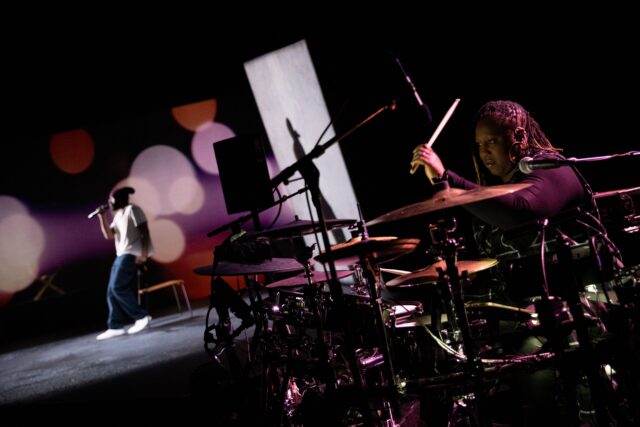
Beloved singer-songwriter Jill Sobule uses that year of her life as a jumping-off point in her delightful, poignant, and utterly charming queer coming-of-age show, deftly titled F*ck7thGrade. Continuing at the Wild Project through November 8 and fully deserving of a longer run there or elsewhere [ed. note: the show has been extended through November 19], the ninety-minute production consists of Sobule sharing intimate moments from her past, standing front and center with her guitar, joined by her all-woman band, Secrets of the Vatican: Julie Wolf on keyboards, Kristen Ellis-Henderson on drums, and Nini Camps on bass, each of whom also plays various characters from throughout Sobule’s life.

“It fucking sucked being a teenager, didn’t it?” Sobule asks the audience, a mix of Sobule fans and adventurous theatergoers. “Did any of you feel awesome when you were thirteen? Raise your hand if you wanted to die. Well, I had it worse than any of you.”

Wearing an Orange Crush T-shirt, blue jeans, and red high-top Converse All-Stars (the costumes are by David F. Zambrana), Sobule alternates between personal stories and songs from throughout her career, from 1990’s Things Here Are Different to 2018’s Nostalgia Kills. Born in Denver in 1961, Sobule changed schools often while experimenting with drugs, wondering about her sexual orientation, and trying to find her place.

“The freaks got stoned, wore cooler clothes, and listened to better music. That sounded fun. I tried acid. We were thirteen,” she admits. She becomes infatuated with Mary (Camps), the new girl in school. “I loved how she smelled — a mix of Jean Naté and Marlboro Reds. And as I thought that, I suddenly was like: mmmm is this weird? This is weird, isn’t it.” That introduction leads into “Forbidden Thoughts of Youth,” in which Sobule sings, “Forbidden thoughts of youth — / They will never know — / My forbidden thoughts of you. / You will never know the truth.” That flirtation ends in a pathetically funny, very-seventh-grade way that many of us can identify with.

Jill Sobule shares her intimate story in poignant and funny F*ck7thGrade (photo by Eric McNatt)

Sobule relates how she traveled to Spain, started playing at open-mic nights, went to Nashville, and ultimately scored one of the biggest hits of the 1990s, the fabulously hooky “I Kissed a Girl,” but her instant success was bittersweet, as she was not allowed to actually kiss a girl in the video and the industry typecast her. She later delves into Katy Perry’s appropriation of the title.

As the show (which was delayed because of Covid, resulting in some rehearsals taking place over Zoom) nears its touching conclusion, Sobule comes to terms with various elements of her life — including her career, her feelings toward music, and her seventh-grade nemesis, Cathy Pepper — and Wolf, Ellis-Henderson, and Camps share their own memories as well.

Supplemented by a companion lobby exhibition of paintings by Marykate O’Neil, F*ck7thGrade features a lovely book by Liza Birkenmeier (littleghost, Dr. Ride’s American Beach House) and cogent direction by two-time Obie winner Lisa Peterson (Hamlet in Bed, Shipwrecked) on Rachel Hauck’s (Hadestown, What the Constitution Means to Me) set, basically a band rocking out in front of a row of high school lockers that occasionally are used. Oona Curley’s lighting and Elisabeth Weidner’s sound help further the intimacy between performer and audience. The leather-clad Camps, who is in the group Antigone Rising with Ellis-Henderson, is a standout as Sobule’s right-hand person, taking on multiple roles and singing harmony.

As always, Sobule is absolutely adorable, with her impish smile and short-cut blond hair; she might not be an actress, but you can feel and relate to her every emotion while laughing your head off. She points out that she had to learn all of Birkenmeier’s words and laments that she doesn’t have a monitor like Springsteen did. Her eyes connect with the crowd as she plays such memorable numbers as “Raleigh Blue Chopper,” “I Hate Horses,” “Strawberry Gloss,” ”I Put My Headphones On,” and “Mexican Wrestler,” all of which are likely to send you back to your own past.

Her tunes are an intoxicating mix of folk, pop, country, and blues rock. Early on, she sings, “I could play a bar chord when I was six, / play ‘Hey Joe’ with the Hendrix lick. / Yeah, I was a star, but Mr. Hill said: / ‘Girls fingerpick. It’s the boys who shred,’” so she makes sure to demonstrate that she can indeed shred. By the time she finishes up with two participatory songs, you’ll be a Jill Sobule fan, if you weren’t already. And, if you haven’t already, you’ll think to yourself, “Yeah, fuck seventh grade.”

9000 PAPER BALLOONS

9000 Paper Balloons tries to bridge the distance between generations

Who: Maiko Kikuchi and Spencer Lott
What: A Contemporary Puppet Theater Piece
Where: Japan Society, 333 East Forty-Seventh St. at First Ave.
When: October 28–30, $30
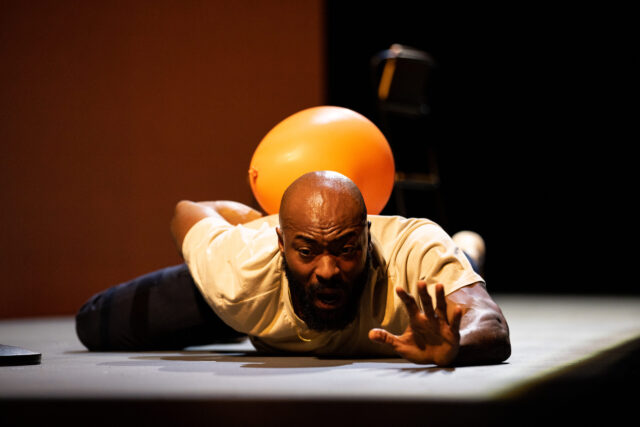
Why: During WWII, Japan employed Fu-Go balloon bombs, hydrogen balloons made of paper or rubberized silk that carried incendiary devices and an anti-personnel explosive, launching more than nine thousand from Honsho in 1944-45 with the express purpose of flying across the Pacific Ocean and starting forest fires on the West Coast of the United States. American puppeteer Spencer Lott and Japanese animator Maiko Kikuchi share the true tale of this little-remembered weapon in 9000 Paper Balloons, making its in-person world premiere October 28–30 at Japan Society; Lott will portray his grandfather, a navigator on a US bomber plane, while Kikuchi will play her grandfather, who fought for Japan and was a prisoner of war.

“Distance is definitely a central theme to the play, the distance between our generation and our grandfathers, the difference between America and Japan, the distance between a fighter jet and a paper balloon,” Lott said in a statement. “We know that war capitalizes on that distance, both real and perceived. War is a throughline in our play, but our central question is, How can we collapse the distance between us? We are witnessing moments in 2022 that remind us that the distance between our generation and the WWII generation may not be all that distant after all.”

The play, which was presented virtually by HERE in November 2021, is told in the form of a ghost story, with live-feed cameras, animation projections, masks, dioramas, and more than one hundred puppets, with a fascinating behind-the-scenes look at how it’s all done as the narrative unfolds; it is directed by Aya Ogawa, who was most recently at Japan Society with their intimate and personal The Nosebleed, in which they played their own father and son. The October 28 performance will be followed by a reception with the creators, and the October 29 show will conclude with an artist Q&A.

“Because of a war, one that happened eighty years ago, there is a gap between us and our grandfathers and this gap exists in so many families, this play is our desperate attempt to collapse the distance between us and our grandparents,” Kikuchi and Lott have also said. “We aren’t pretending that this puppet show is going to end conflict or AAPI violence, but in a world that is heavy with social and political strife, we think it’s a good opportunity to gather in the dark, together as a community, and share a remarkable story that is as much about ingenuity as it is war.”

HOUND DOG

Anneh (Ellena Eshraghi) and Ayse (Olivia AbiAssi) share a rare calm moment in Hound Dog (photo by Ben Arons)

HOUND DOG
Ars Nova @ Greenwich House
27 Barrow St. at Seventh Ave.
Tuesday – Saturday through November 5, $5-$100
arsnovanyc.com
playco.org/events/hound-dog

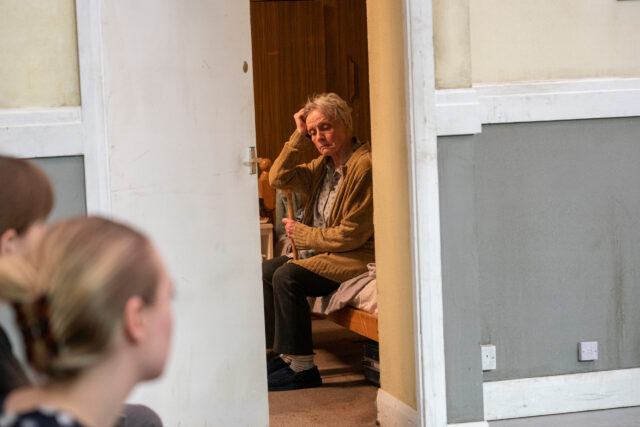
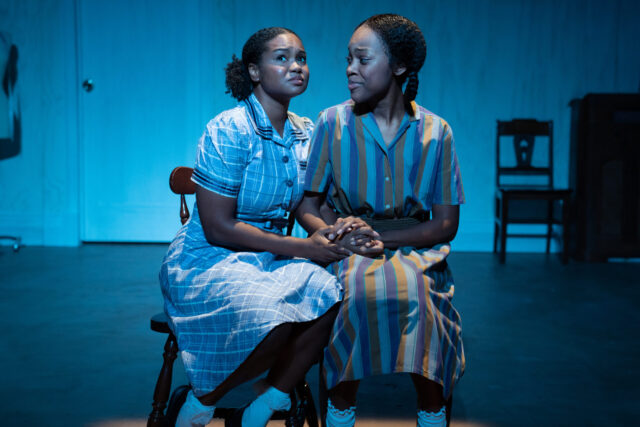
A young woman reexamines critical decisions she made about her future and grief over her mother’s death in Melis Aker’s Hound Dog, an entertaining if scattershot mishmash that opened tonight at Ars Nova @ Greenwich House for a limited run through November 5.

Anneh, aka Hound Dog (Ellena Eshraghi), is a Harvard grad and guitarist-singer who returns to her home in Turkey while considering whether she should attend the Royal Academy, which has accepted her after her successful audition. Her father, the rock-and-roll-loving Baba (Laith Nakli), has been suffering since the loss of his wife, lost in a fog of alcohol and television as he dreams of going to Graceland.

Anneh’s best friend, Ayse (Olivia AbiAssi), is thrilled that she’s back, but Anneh seems distracted. She is more interested in talking with Yusuf (Jonathan Raviv), the neighborhood garbage man and flute player, than she is in creating music with Ayse. Anneh also is attracted to Charlie Callahan (Matt Magnusson), an American who was her former piano teacher.

Frank J. Oliva’s set offers a surreal fantasy in Ars Nova / PlayCo world premiere (photo by Ben Arons)

Anneh travels between reality and what appears to be some kind of fantasy world that exists inside her house, the interior of which turns into an aluminum-foil-covered concert and dance hall as music and life merge in a surreal way that seems normal to everyone but her. Amid the phantasmagorical scenes, her confusion mounts when Professor Feliz, her musicology professor at Harvard, tells her that Elvis Presley was “born in the majestically boring city of Ankara, Turkey, in the year 1961” and “was often seen strutting around Seymenler Park, accompanied by his friend, the local garbage collector and traditional Turkish instrument maestro, Yusuf.”

Through it all, a singer-songwriter and her band keep entering scenes, playing such songs as “There She Goes,” “Where It’s All Gone,” “The Groove Is on the Loose,” and “An Emptying Thing,” serving as outside observer and muse. (The songs were written by Aker and brothers Daniel and Patrick Lazour.) Channeling Joni Mitchell, Liz Phair, and others, the singer shares such thoughts as “Time is lost / In my room / While you break free / From the gloom / Waking hours / You stay up late / What is life / But the breaking of the days” and “So if we choose to let you go / How will you know / That I remember / How to feel alive / Only in time / Only in time.”

As decision time approaches, Anneh’s mind is flooded with confusion, trying to figure out what to do next and where she belongs in a world where she thinks she doesn’t fit.

Directed by Machel Ross, the ninety-five-minute Hound Dog, a coproduction of Ars Nova and PlayCo, wanders all over the place, the nonlinear narrative often hard to follow. It takes a while to warm up to the characters, although eventually they become familiar and their struggles legitimate. Frank J. Oliva’s set is the star, a facade of a home with three sets of double doors on the ground floor and three sets of windows above, lit in different colors by Tuçe Yasak. Sound designer Avi Amon also serves as music director, with costumes by Qween Jean.

The crack band features Maya Sharpe on guitar, Mel Hsu on bass, Ashley Baier on drums, and Sahar Milani on lead vocals. The cast, several of whom are making their off-Broadway debuts (Eshraghi and Magnusson) and another an Emmy winner (Raviv), is fresh and engaging as they navigate a few too many awkward plot devices.

The story is a deeply personal one to Aker; in the script, she refers to Hound Dog as “me,” the setting as “a version of my hometown . . . through time and space,” and several characters as “alternate versions” of her father, childhood best friend, and teachers. Aker might be a little too close to the material; although she tackles universal issues, they don’t always gel cohesively.

In celebration of its twentieth anniversary season, Ars Nova is introducing “What’s Ars Is Yours: Name Your Price,” with tickets for Hound Dog running $5 to $100, depending on what you can afford.

STRANGER SINGS!
 THE PARODY MUSICAL

Dustin (Jeremiah Garcia), Mike (Jeffrey Laughrun), and Lucas (Jamir Brown) prepare for battle in Stranger Sings! The Parody Musical (photo by Evan Zimmerman_MurphyMade)

STRANGER SINGS! THE PARODY MUSICAL
Playhouse 46 at St. Luke’s
308 West Forty-Sixth St. between Eighth & Ninth Aves.
Thursday – Tuesday through August 13, $39-$111
www.strangersingsthemusical.com
playhouse46.org

Fans of Stranger Things — and I am proudly one of them — can’t get enough of the Netflix series, an engrossing horror story that premiered in 2015 and will present its fifth and final season in 2024. In addition to books, comics, video games, and podcasts, there is also Stranger Things: The Experience, an immersive presentation that has traveled to New York, San Francisco, Atlanta, Los Angeles, and London, and Stranger Sings! The Parody Musical, which has returned to Manhattan, continuing at Playhouse 46 at St. Luke’s through August 13.

Stranger Things takes place in the mid-1980s in the small, close-knit all-American town of Hawkins, Indiana. “We wanna welcome you to Hawkins / Where everything is a total cliché! / We’re just like folks from classic films and TV shows / It’s nostalgic and you love us that way! / We live a safe, simple life here in Hawkins / Our government says there’s nothing to fear! / Expect nothing but the everyday normal / Cuz stranger things have never happened here,” the cast announces at the beginning.

Nerdy twelve-year-olds Lucas Sinclair (Jamir Brown), Dustin Henderson (Jeremiah Garcia), and Mike Wheeler (Jeffrey Laughrun) stop their Dungeons & Dragons game to help find the missing Will Byers, a shy young boy who has disappeared. Will’s mother, Joyce (usually played by Caroline Huerta but I saw the vibrant Hannah Clarke Levine; the actor portraying Joyce also operates Will, a small puppet), is distraught and determined to locate her son, with or without the support of the local sheriff, Jim Hopper (Shawn W. Smith), who has his own scars when it comes to family. Also involved are Will’s older brother, Jonathan (Garrett Poladian), an oddball aspiring photographer; the oh-so-cool and handsome Steve Harrington (Poladian), who has the hots for Nancy Wheeler (Harley Seger), Mike’s adorable older sister; and Barb Holland (SLee), Nancy’s best friend and perpetual third wheel.

Joyce Byers (Caroline Huerta) is determined to find her son in playful parody (photo by Evan Zimmerman_MurphyMade)

Strange things start occurring following the mysterious appearance of Eleven (Seger), a young girl with scary powers. “She looks like an escaped mental patient,” Dustin says. He’s not that far off; Eleven, whose real name is Jane, has run away from a government-run testing facility where she was under the care of Dr. Brenner (Poladian), known as Papa. “I always wanted a dad / Who never would make me cry / One who’d tell me, ‘Kid, I’m so proud of you,’ / Instead of ‘Stay in your cell til July,’” she sings. Throughout the show, Dr. Brenner and two men in white lab coats keep trying to track down Eleven and bring her back to the facility, supposedly for her own safety.

Oh, there’s also a murderous demogorgon hanging around, an evil creature in tight spandex that has emerged from the Upside Down, a creepy hell where Will and Barb have been taken.

You don’t have to be a big fan of Stranger Things to get a kick out of the parody musical, but it does help, as it is filled with inside jokes and aural and visual references to the show as well as the 1980s themselves. Audience members, a few of whom arrive dressed like some of the characters, sit on all four sides of the central staging area, which is surrounded by tree branches, as if the Upside Down is ever-present (the set is by Walt Spangler), and dozens of props (courtesy Brendan McCann) that are used in the show, from a 1980s telephone and bicycle handlebars to gynormous walkie-talkies and a boombox. There are also four beanbag chairs for audience members who want occasional interaction with the performers.

Barb Holland (SLee) stands up for herself and lets everyone know it in Stranger Sings! (photo by Evan Zimmerman_MurphyMade)

Jonathan Hogue wrote the book, music, and lyrics, which are lots of fun, with arrangements and orchestrations by Michael Kaish and playfully goofy choreography by Ashley Marinelli. The production, which features such musical numbers as “Hopper Triggered,” “Getting Closer,” and “Where There’s a Will,” is too long at 110 minutes with intermission, but director Nick Flatto keeps it all from descending into chaos; the creepy lighting and sound are by Jamie Roderick and Germán Martínez, respectively, and Matthew Solomon’s costumes immediately identify who is who. (You can come in your own costume October 21-31 and qualify for audience-voted prizes each night.)

The engaging cast captures the essence of the series, the feeling of constant impending doom along with the promise that comes with adolescence as the residents of Hawkins explore who they are and who they might be. Levine is terrific as Joyce, although a scene about Winona Ryder, who plays the mother on the show, although funny, jars you out of the narrative. Smith is fab as the brave, heroic sheriff, and Poladian is a hoot switching between the heartthrob Harrington and the weird Jonathan. Eleven is relegated to a relatively small role in the parody and, curiously, Dr. Brenner, played by a composed and careful Matthew Modine on Netflix, is portrayed here as a bumbling idiot.

Stranger Sings! does seek to right a terrible wrong from the streaming series in resurrecting Barb, who is mostly forgotten after a pool party; she doesn’t even make the cut in the nineteen-character cast list on Wikipedia. But the parody gives her several star turns, complete with well-deserved grudges. When Jonathan asks, “I’m confused . . . who is that?” Barb replies, “That’s right. Who IS that? Could that be poor Barb Holland, the throw-away plot device who not one person thought to look for??” SLee brings down the house a few times, but there ends up being too much of Barb; I wanted more Eleven. And for fans of Max, as I am, the show primarily stays within the first season, with some Easter eggs of what is to come.

COST OF LIVING

Eddie (David Zayas) and Ani (Katy Sullivan) face adversity in Cost of Living (photo © Jeremy Daniel)

COST OF LIVING
Samuel J. Friedman Theatre
261 West Forty-Seventh St. between Broadway & Eighth Ave.
Tuesday – Sunday through November 6, $74-$298
www.manhattantheatreclub.com

When I saw Manhattan Theatre Club’s production of Martyna Majok’s Cost of Living at New York City Center’s Stage I five and a half years ago, I did not anticipate that it would win the Pulitzer Prize for Drama. I also never imagined that the show, which I called “a tender, emotional play about four lonely people seeking connections,” would eventually transfer to Broadway. But Cost of Living has made a terrific transition to MTC’s Samuel J. Friedman Theatre, with all its tenderness, emotion — and sense of humor — fully intact. In fact, it is now even better.

The play is once again directed by Obie winner Jo Bonney on Wilson Chin’s set, which rotates between the homes of John (Gregg Mozgala), a Harvard grad working on his PhD at Princeton and confined to a wheelchair with cerebral palsy, and Ani (Katy Sullivan), a quadriplegic also in a wheelchair.

While John is looking for a caregiver and interviews and hires Jess (Kara Young), a Princeton grad scrambling to make a living by working multiple jobs and who assures John that despite her slight build she can handle his needs, Ani initially refuses help from her ex-husband, Eddie (David Zayas), a former truck driver with a new girlfriend.

The play opens with Eddie sitting at a bar, talking to an unseen person in what is essentially a long, compelling monologue delivered directly to the audience. “The shit that happens is not to be understood. That’s from the Bible,” he says. “That life is good for people. I was thankful for every day they ain’t invented yet the trucker-robots. That life is good. The road. Sky. The scenery. Except the loneliness. Except in the case of all the, y’know, loneliness. This was what my wife was good for. Not that this was the only thing.”

John (Gregg Mozgala) and Jess (Kara Young) come to an agreement in Cost of Living (photo © Jeremy Daniel)

The loneliness and vulnerability experienced by all four characters is palpable, expressed most effectively in scenes of back-to-back caretaking. In the first, Jess washes John in the shower, moving him out of his chair and then back into it, followed by Eddie giving Ani a bath.

Describing his sensations, John tells Jess that his body feels as if he’s constantly under attack. “That’s what it’s like. Under my skin. From underneath my skin. Like people hitting me from beneath my skin. And that’s what you’ll be working with. Every morning. Is touching, shaving, undressing, washing, and clothing — that. That’s what I’m like.”

Meanwhile, Eddie visits Ani on a day her nurse hasn’t shown up, so Eddie asks Ani to hire him instead. “What do you think’s gonna happen you come take care of me a few hours a day? Huh?” she spurts out. “You brush my teeth a couple mornings, dump my bedpan a few times, and BOOM, conscience — fuck-shit, clap yer hands when I say Boom. . . . Yer not doin’ penance on me.”

The separate storylines merge at the end in an uneasy finale that acknowledges that we all encounter tremendously painful issues in life, regardless of our physical or psychological situations, which is further established during the curtain call.

Both Mozgala (Teenage Dick, Diagnosis of a Faun), who has cerebral palsy, and Sullivan (The Long Red Road, Finish Line), who was born without lower legs, return from the original cast, and both give intense, superb performances again, neither one pulling any punches. Young (Clyde’s, Halfway Bitches Go to Heaven) displays a tenacious fragility as Jess, who might be getting in over her head, while Zayas (Dexter, Anna in the Tropics) proves once more that he is one of New York City’s finest actors, balancing toughness with a sweet gentleness that shines through. Jeff Croiter’s lighting and Rob Kaplowitz’s sound capture the pervasive loneliness playing out onstage.

“Self-pity has little currency in these characters’ worlds. Humor, however, has much,” Majok (Ironbound, Sanctuary City) explains in a script note. Her and Bonney’s (Father Comes Home from the Wars, Fucking A) approach feels honest and unambiguous, as summarized in this exchange between Jess and John:

Jess: Sorry, I never worked with the, differently-abled —
John: Don’t do that.
Jess: What?
John: Don’t call it that.
Jess: Why, I —
John: Don’t call it differently-abled.
Jess: Shit, is that not the right term?
John: It’s fucking retarded. . . .
Jess: So what do I, how do I, refer to you?
John: Are you planning on talking about me?
Jess: No.
John: Why not? I’m very interesting.

The Broadway debut of Cost of Living, which was expanded from Majok’s 2015 short play John, Who’s Here from Cambridge, is a lot more than interesting, and you’ll be sure to be talking about it long after seeing it.