this week in theater

CHESTER BAILEY

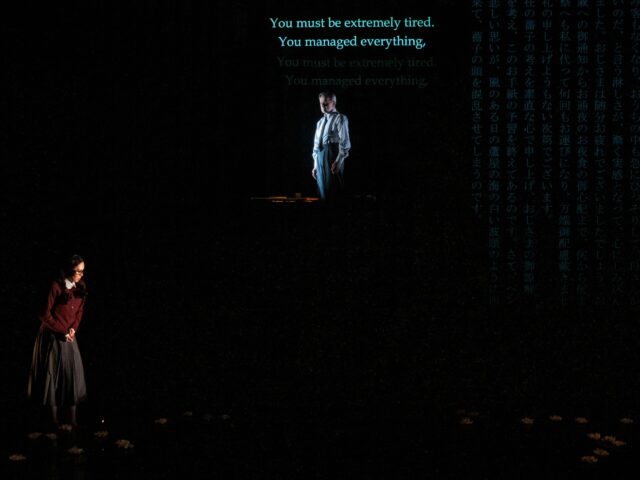
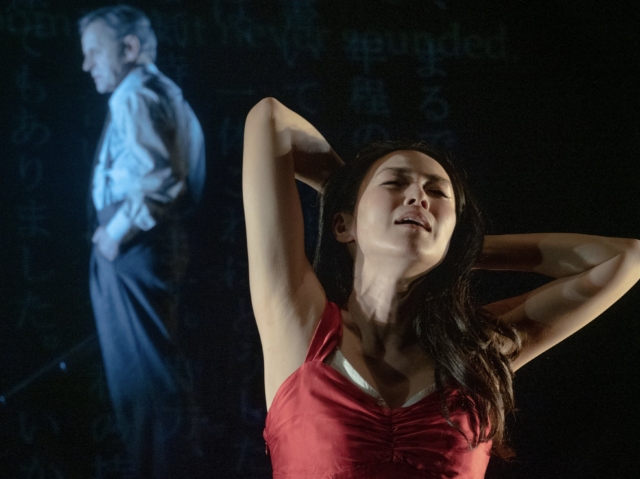
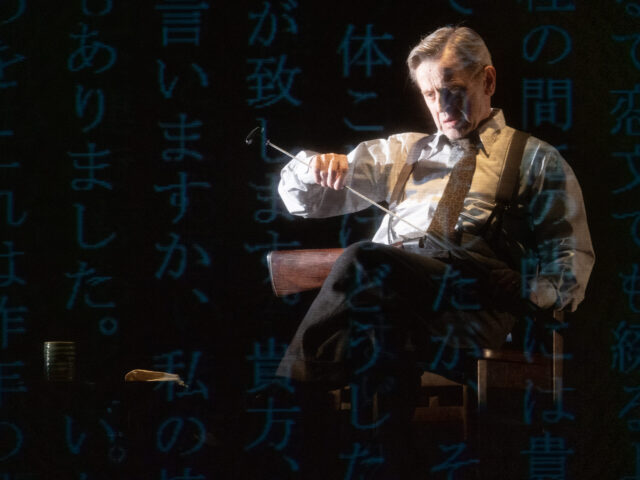
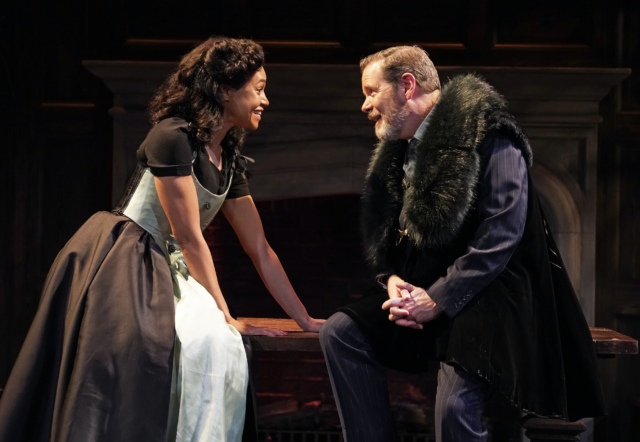
Real-life father and son Reed Birney and Ephraim Birney star in Chester Bailey at the Irish Rep (photo by Carol Rosegg)

CHESTER BAILEY
Irish Repertory Theatre, Francis J. Greenburger Mainstage
132 West 22nd St. between Sixth & Seventh Aves.
Wednesday – Sunday through November 20, $50-$70
212-727-2737
irishrep.org

Chester Bailey is one of the best plays of the year, a pristine example of the beauty and power of live drama.

In January 2015, the Irish Rep presented a free staged reading of Emmy-nominated writer and producer Joseph Dougherty’s Chester Bailey at the DR2 Theatre, directed by Emmy and Tony nominee Ron Lagomarsino and featuring Tony nominee Reed Birney as a doctor caring for a young man (Noah Robbins) who has suffered extreme, unspeakable trauma.

The show has been transformed into a touching, gorgeous, must-see production, running at the Irish Rep through November 20. Birney stars as Dr. Philip Cotton, a specialist working with soldiers, including amputees, suffering from battle fatigue and “other injuries that might keep a man from getting back to the life he had as a civilian.” It’s 1945, near the end of WWII, and Dr. Cotton has accepted a position at a Long Island hospital named after Walt Whitman, the poet who served as a nurse during the Civil War.

“The families of the men I was treating wanted their sons and husbands to be the way they were before the Solomons and the Philippines,” Dr. Cotton tells us. “I tried. Tried to take that look out of their eyes. That look acquired in the jungle. My successes were ‘limited.’”

Dr. Cotton’s newest case is Chester Bailey — played by Birney’s son, Ephraim Birney — a man in his midtwenties who refuses to acknowledge that he has lost both eyes and hands in a horrific incident at the Brooklyn Navy Yard, where he worked along the keel of a mine sweeper. Dr. Cotton might technically be unable to take that look out of Chester’s eyes, but the character is played with eyes and hands that are filled with emotion. Chester is overwhelmed with guilt because his parents got him the job in order to keep him out of the war; he had wanted to enlist, like most of the men he knew were doing, but his mother was determined to protect him.

Chester Bailey (Ephraim Birney) creates his own reality out of trauma in superb New York premiere (photo by Carol Rosegg)

“One night, I was reading the paper in the kitchen with the radio on, listening to the war news, and my folks came in and my mother was smiling,” he explains directly to the audience. “She said, ‘We’ve got a late Christmas present for you, Chester. Your father got you a job at the Navy Yards. Isn’t that wonderful?’ When she said job, she meant reserved occupation. She meant I wouldn’t be drafted because I’d be doing war work. Doing my patriotic part, but coming home to Vinegar Hill at the end of my shift. . . . My father looked up at me and I could see in his eyes this was just how it was going to be and there was nothing either one of us could do about it.” The horrible irony was that Chester ended up with the type of injuries men get on the field of battle anyway.

Chester has created a fantasy world in which he can still see and touch things. He describes in detail a copy of van Gogh’s Langlois Bridge at Arles that he thinks is hanging in his room. The 1888 painting relates to Chester’s state of mind: It depicts a woman in black standing on a small drawbridge under blue skies, holding a black umbrella as if in a dark storm. In the actual historical war, the bridge was blown up by the Germans in 1944, so it wouldn’t have existed in 1945 when Chester was supposedly seeing the print of it, made by an artist who would shortly thereafter cut off his own ear and live in an asylum. In fact, Chester believes that the only lasting effect the incident had on him was that he lost one ear. Meanwhile, we learn that Dr. Cotton is color blind, so he cannot process critical aspects of the painting that Chester believes is on the wall.

The first part of the play primarily goes back and forth between Chester and Dr. Cotton talking to the audience, delivering monologues about themselves. Chester discusses his parents and recalls going dancing with a former girlfriend at Luna Park, heading into Manhattan by himself for what he hoped would be a night of revelry, and falling instantly in love with a young red-haired woman selling papers at a newsstand in Penn Station.

Dr. Cotton carefully watches Chester sharing these memories, as if he’s not in the room with him, then adds elements from his own personal and professional life that intersect with similar themes that Chester’s deals with, just from a different angle; the doctor discusses his daughter, Ruthie; his wife’s infidelity and their eventual divorce; his career choices; going to the country club; his flirtation with his boss’s wife; and waiting at Penn Station to get home to Turtle Bay after work.

“It was difficult for Chester’s father to visit him on Long Island,” Dr. Cotton says. “He’d come on weekends, get off the train at the same station I used before I moved, walk the mile and a half around Holy Rood Cemetery to the hospital on Old Country Road. I think of him standing on the platform I used. Each of us waiting for the light of the westbound. Waiting. Not thinking. Trying not to think.”

In the second half, doctor and patient interact, as Dr. Cotton is determined to make Chester face what has happened to him and Chester keeps insisting he has eyes that can see and hands that can touch. Revisiting the incident, Chester tells his incorrect version. “Remember anything else?” Dr. Cotton says. “Nothing real,” Chester responds. “Do you remember anything that isn’t real?” the doctor asks before exploring Chester’s dreams and hallucinations.

The Irish Rep is justly celebrated for its sets, and Chester Bailey is no exception. Two-time Tony winner John Lee Beatty’s (Sweat, Junk) stage design combines a hospital room with bed, wheelchair, and table with the grandeur of old Penn Station, with stanchions in concrete blocks and a curved metal ceiling seemingly made out of railroad tracks. Brian MacDevitt’s lighting includes dangling lightbulbs that glow like stars in the night sky, going on forever in the mirrored walls. “The concourse of Penn Station is like the hull of a ship turned upside down, like you were looking up at the keel,” Chester says. “But instead of being all dark like where I work, it’s light. The light is just in the air. And there are no shadows. You want to know what the light looks like in heaven? You go to the main concourse of the Pennsylvania Station.” Beatty and MacDevitt have captured that image beautifully.

One of New York’s finest, most consistent actors, Reed Birney (The Humans, Man from Nebraska) inhabits the role from the very start, portraying Cotton not as a heroic wartime doctor but as a man with his own shortcomings. Whether he wants to or not, he becomes a kind of father figure to Chester, made all the more palpable since Ephraim (Exploits of Daddy B, Leon’s Fantasy Cut), who was cast first, is his son. While Reed moves slowly and carefully, Ephraim is much more active, jumping around with an eagerness that counters his character’s inability to come to terms with what has happened to him.

Two-time Drama Desk–nominated director Ron Lagomarsino (Digby, Driving Miss Daisy) guides the ninety-minute show with a graceful elegance; there’s nary a stray note in the play, which is not just about the travails of a single man but about family and everyday existence, about the big and small moments. The relationship between parents and their children are echoed here by a doctor and patient who happen to be father and son. At one point, Chester asks Dr. Cotton why he didn’t go into his father’s printing and binding company. “How come it wasn’t Cotton and Son?” he wonders. Dr. Cotton answers, “He wanted me to go to college. I wanted to be a doctor.” It takes on extra meaning in that Ephraim has followed his father and mother, actress Constance Shulman, into the family business. (All three appeared in the offbeat 2022 film Strawberry Mansion.)

Early on, Dr. Cotton states, “If there’s one thing reality can’t tolerate, it’s competition.” It’s a great line in a great play that brilliantly explores the human condition and the realities that each of us creates to help us deal with whatever life throws our way.

GOOD ENEMY

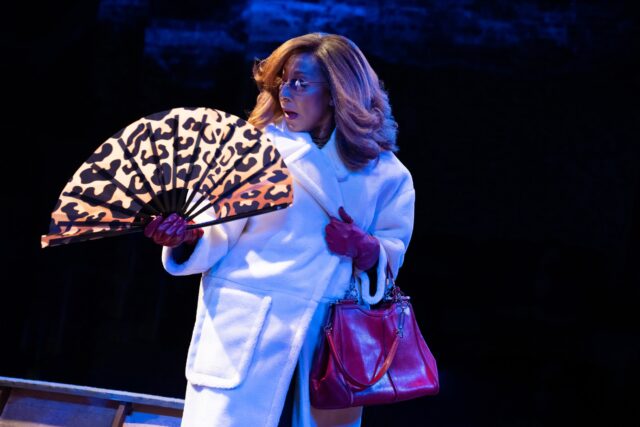
Howard (Francis Jue) pays a surprise visit to his daughter (Geena Quintos) and her unexpected roommate (Ryan Spahn) in Good Enemy (photo by Joan Marcus)

GOOD ENEMY
Audible Theater’s Minetta Lane Theatre
18 Minetta Lane between Sixth Ave. and MacDougal St.
Tuesday – Sunday through November 26, $69.95
www.audible.com
goodenemyplay.com

In 2018, Audible, which produces audiobooks, audio plays, and podcasts, began staging solo shows at the Minetta Lane Theatre that would also be available as Audible Originals. They got off to a terrific start with Billy Crudup in David Cale’s Harry Clarke, Carey Mulligan in Dennis Kelly’s Girls & Boys, and Lili Taylor in Wallace Shawn’s The Fever as well as Jade Anouka’s Heart, Faith Salie’s Approval Junkie, and Aasif Mandvi’s Sakina’s Restaurant.

The Amazon company has now turned to works with full casts, and the results have not been as successful. Earlier this year Robert O’Hara reimagined Eugene O’Neill’s Long Day’s Journey into Night as a streamlined Covid story clocking in at a mere 110 mostly disappointing minutes, and now comes the world premiere of Yilong Liu’s hackneyed Good Enemy, which opened tonight and runs through November 26. The play, originally scheduled as two hours with intermission, has been trimmed to 105 minutes without a break but could use more cutting.

In the spring of 2021, Chinese-born Howard (Francis Jue) has enlisted the scraggly Dave (Alec Silver), who sells drugs to school kids, to drive him cross-country so he can pay a surprise visit to his daughter, Momo (Geena Quintos), who is going to college in New York City. Along the way, Dave tries to get Howard to tell him the story of how he escaped Mainland China, hoping that it will be an exciting tale he can turn into a blockbuster Hollywood movie. But Howard refuses to say anything about his past to Dave, or to Momo, who is none too happy about her father’s unannounced arrival at her doorstep. While she had not told him that she was living with Jeff, her white maybe-boyfriend (Ryan Spahn), she lets Howard know that she’s upset that he never talks to her about her mother, who has recently passed. Howard gets riled up whenever anyone brings up his life in China, and it eventually becomes apparent why.

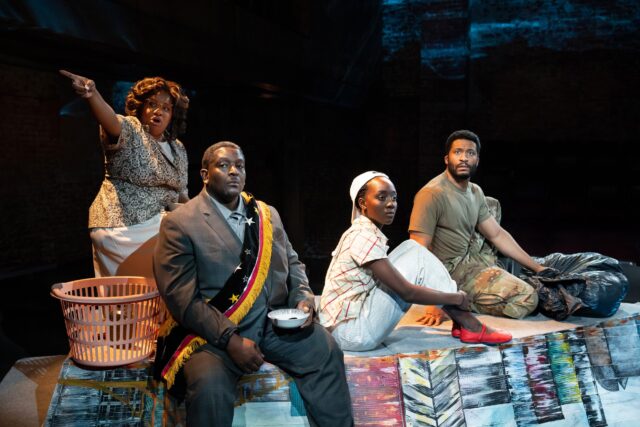
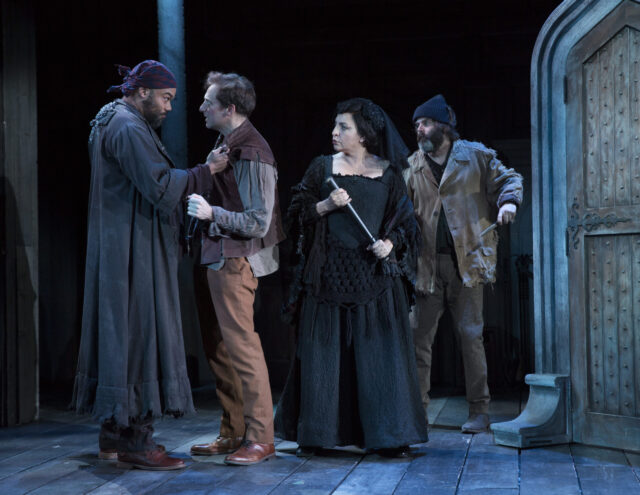
Jiahua (Jeena Yi) tempts Hao (Tim Liu) with the prospect of freedom in Audible Original play (photo by Joan Marcus)

The narrative goes back and forth between 2021 New York and the summer of 1984 in Southern China, where Hao (Tim Liu) — Howard’s Chinese name — a rookie officer for the PRC, is assigned by his superior, Xiong (Ron Domingo), to infiltrate a group of youths experimenting with Western-style freedoms. Hao wants to do his duty, but it becomes complicated when he falls for Jiahua (Jeena Yi), a would-be revolutionary who titillates him and begins teaching him how to swim, perhaps so they can make their way together across the sea to Hong Kong. But Xiong holds something over Hao and Hao knows a secret about Xiong, both of which could ruin the other. Howard watches his earlier self, remembering everything but unwilling to face it all four decades later.

Directed by Obie winner Chay Yew (Cambodian Rock Band, Mojada) Good Enemy is a frustrating play that dangles a carrot that remains confoundingly out of reach. Junghyun Georgia Lee’s set consists of three large, rectangular sections in the back, lit in different colors by Reza Behjat, and with several large white blocks that serve as couches, car seats, desks, and other furniture. Part of the floor occasionally opens up to reveal a river below, where Hao finds peace as he washes his clothes, until Jiahua discovers him there. While touching, the scenes that take place in the river are hard to see for most audience members, since the characters’ heads are so low. Mikhail Fiksel’s sound design often features the ripple of water, particularly at the beginning and the end, but it can get overly loud, applying a metaphor — water as freedom or death, river as an ever-changing living body and a place to wash away one’s sins — with too much force.

Xiong (Ron Domingo) places Hao (Tim Liu) in a difficult position in Good Enemy (photo by Joan Marcus)

The language barrier also gets confusing; everyone speaks in English, but Howard/Hao, Momo, Jiahua, and Dave are actually communicating in Chinese, while Jeff has to use Google Translate to understand the others. In addition, far too many line readings were out of rhythm, with the actors stopping at the wrong moment in sentences, furthering the disorientation of the choppy narrative.

The heart of the play has an important story to tell about the continuing ramifications of Mao’s Great Proletarian Cultural Revolution of 1966 that tore families apart, but Chinese native Liu (The Book of Mountains and Seas, Joker) tries to stuff too much in, eventually making us not care enough about the carrot, no matter how hungry we might be.

MY BROKEN LANGUAGE

A cast of five extraordinary women share roles in Quiara Alegría Hudes’s My Broken Language (photo by Julieta Cervantes)

MY BROKEN LANGUAGE
The Pershing Square Signature Center
The Romulus Linney Courtyard Theatre
480 West 42nd St. between Tenth & Eleventh Aves.
Tuesday – Sunday through November 27, $49-$159
212-244-7529
www.mybrokenlanguage.net

Quiara Alegría Hudes’s My Broken Language is an exhilarating ninety minutes of love and loss among a close Puerto Rican family in North Philly over the course of sixteen years.

During the pandemic, Hudes, who won the Pulitzer Prize in 2012 for her play Water by the Spoonful, about an Iraq War veteran returning to his home in Philadelphia, published a memoir, My Broken Language, detailing her childhood from 1988, when she was ten, to 2004, when she went to the Brown University Grad School for Playwriting. The book is divided into four parts: “I Am the Gulf between English and Spanish,” “All the Languages of My Perez Women, and Yet All This Silence . . . . ,” “How Qui Qui Be?,” and “Break Break Break My Mother Tongue.” At a public reading, Hudes, also known as Qui Qui, invited a group of actors to read different chapters, which sparked the development of the book into a play with multiple women sharing the lead role. The stirring result is at the Romulus Linney Courtyard Theatre at the Signature, where it opened tonight for a limited run through November 27. Get your tickets now.

The audience sits on three sides of Arnulfo Maldonado’s beautifully bright, intimate set, a tiled courtyard with three porcelain bathtubs filled with plants, a shower, and steps leading to the door of a house with a facade of two long rows of windows, behind which is greenery, as if life is growing inside. Tucked next to the steps is a piano where Ariacne Trujillo Duran occasionally plays Chopin and original music by Alex Lacamoire.

The play, which Hudes calls “a theater jawn,” begins with Zabryna Guevara, Yani Marin, Samora la Perdida, Daphne Rubin-Vega, and Marilyn Torres declaring in unison, “My Broken Language. North Philly. 1988. I’m ten years old.” Each “movement” of the jawn kicks off with similar declarations as time passes, with a different actor taking over the lead role of Qui Qui, complete with singing, dancing, and poignant and prescient monologues; the rest of the cast play other roles as well.

Daphne Rubin-Vega plays the ten-year-old author in Signature world premiere (photo by Julieta Cervantes)

“Cousinhood in my big-ass family was a swim-with-the-sharks wonderland,” ten-year-old Qui Qui says on the way to an amusement park in New Jersey. “When Cuca invited me to Six Flags with the big cousins, I was Cinderella being invited to the ball. These weren’t the rug rats of the family, my usual crew. Five to ten years my elder, my big cousins were gods on Mount Olympus, meriting study, mythology, even fear.” A moment later, she adds, “Cuca, Tico, Flor, and Nuchi. Saying their names filled me with awe. They had babies and tats. I had blackheads and wedgies. They had curves and moves. I had puberty boobs called nipple-itis. They had acrylic tips in neon colors. I had piano lessons and nubby nails. They spoke Spanish like Greg Louganis dove — twisting, flipping, explosive — and laughed with the magnitude of a mushroom cloud.”

As 1988 becomes 1991 in West Philly, 1993 in North Philly, 1994 in Center City, 1995 back in West Philly, and 2004 in Providence, Qui Qui, identified as “Author” in the script, has her period, is fascinated by her mother’s mysterious Yoruba religious rituals, discovers great literature (Flannery O’Connor, Ralph Ellison, Toni Morrison, Lawrence Ferlinghetti, Sandra Cisneros, Esmeralda Santiago) and art (Marcel Duchamp’s Bicycle Wheel, Nude Descending a Staircase No. 2, Fountain), and learns too much too quickly about death.

“One day I would dream of a museum, a library I might fit into. One with space to hold my cousins, my tías, my sister, mi madre. An archive made of us, that held our concepts and reality so that future Perez girls would have no question of our existence or validity,” sixteen-year-old Qui Qui fantasizes. “Our innovations and conundrums, our Rashomon narratives could fill volumes, take up half a city block. Future Perez girls would do book reports amid its labyrinthine stacks, tracing our lineages through time and across hemispheres. A place where we’d be more than one ethnic studies shelf, but every shelf, the record itself. And future Perez girls would step into the library of us and take its magnificence for granted. It would seem inevitable, a given, to be surrounded by one’s history.”

That soliloquy gets to the heart of My Broken Language, which is an inclusive celebration of who the Perez family is and what they can be. Despite the constant adversity, Hudes focuses on the individuality of the characters and the author herself, portrayed by five distinct women who represent the vast range of Puerto Rican women, in mind and body, washing away ethnic and gender stereotypes. Even as “asterisks” point out future tragedy, the play is life-affirming as the actors stand firm and bold, singing Lacamoire’s “La Fiesta Perez” and “Every Book, a Horizon,” Ernesto Grenet’s “Drume Negrita,” and Joni Mitchell’s “Hejira” and moving to Ebony Williams’s engaging choreography in Dede Ayite’s colorful, dramatic costumes that trace the development of young women. (Yes, that’s Daphne Rubin-Vega in pigtails!)

Tiled bathtubs figure prominently in My Broken Language (photo by Julieta Cervantes)

In her directorial debut, Hudes allows each actor the freedom to incorporate their own realities into their characters, including a wonderful moment in which all five line up on the steps and, one by one, grab the person next to them in their own way. Although a scene about Qui Qui’s favorite books feels didactic — the listing in the digital program, which also includes a glossary of terms and pop-culture references, would have sufficed — everything else flows together organically, immersing the audience in the story of the Perez family. Jen Schriever’s lighting never goes completely dark, allowing the audience to see the actors, the actors to see the audience, and audience members to see themselves, all part of an intimate, caring community.

The cast, led by the fabulous Rubin-Vega, who has also appeared in Hudes’s Daphne’s Dive at the Signature and Miss You Like Hell at the Public, and Guevara, who starred in the playwright’s Water by the Spoonful at Second Stage and Elliot, a Soldier’s Fugue at 45 Below, revels in the flexibility Hudes gives them; in the script, she notes, “No need for them to act, speak, or move like one cohesive character. The point is a multiplicity of voices, bodies, and vibez.” That advice works for the audience as well, during the play and as they exit back into real life.

[On November 13 at 5:00, the Bushwick Book Club will hold a special free event at the Signature, hosted by Guevara and featuring readings from Hudes’s memoir along with original music and movement by spiritchild, Patricia Santos, Anni Rossi, Susan Hwang and Troy Ogilvie.]

BAM NEXT WAVE: TRANSVERSE ORIENTATION

Dimitris Papaioannou returns to BAM with another extravaganza, Transverse Orientation (photo by Julian Mommert)

Who: Dimitris Papaioannou
What: US premiere of dance-theater work
Where: Brooklyn Academy of Music, BAM Howard Gilman Opera House, 30 Lafayette Ave. between Ashland Pl. & St. Felix St.
When: November 7-11, $44.50 – $144, 7:30
Why: In 2019, Greek painter, comics artist, director, choreographer, performer, and set, costume, makeup, and lighting designer Dimitris Papaioannou made his BAM debut with The Great Tamer, which was heavily influenced by the legacy of Pina Bausch; in fact, Papaioannou was the first person invited to create a piece for Tanztheater Wuppertal following Bausch’s passing in 2009. Papaioannou is back at BAM, in the Howard Gilman Opera House, for the US premiere of Transverse Orientation, running November 7-11.

The 105-minute work, which delves into concepts of myth and religion in unusual ways, is performed by Damiano Ottavio Bigi, Šuka Horn, Jan Möllmer, Breanna O’Mara, Tina Papanikolaou, Łukasz Przytarski, Christos Strinopoulos, and Michalis Theophanous, with music by Antonio Vivaldi, sets by Tina Tzoka and Loukas Bakas, sound by Coti K., costumes by Aggelos Mendis, lighting by Stephanos Droussiotis, sculptures and special constructions by Props Nectarios Dionysatos, and mechanical inventions by Dimitris Korres. Bausch fans, and other lovers of experimental dance theater, are sure to delight in what looks to be a mind-blowing experience.

GABRIEL BYRNE: WALKING WITH GHOSTS

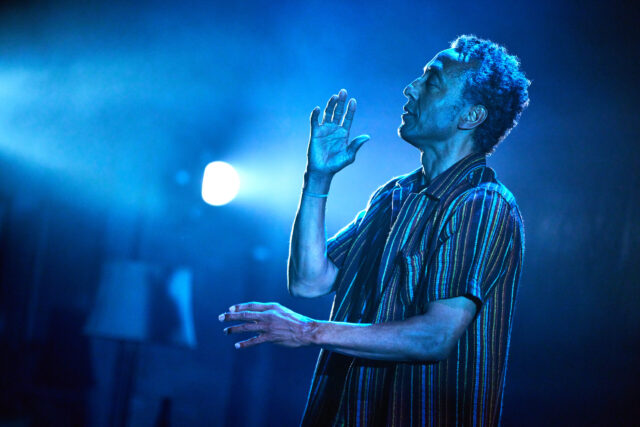
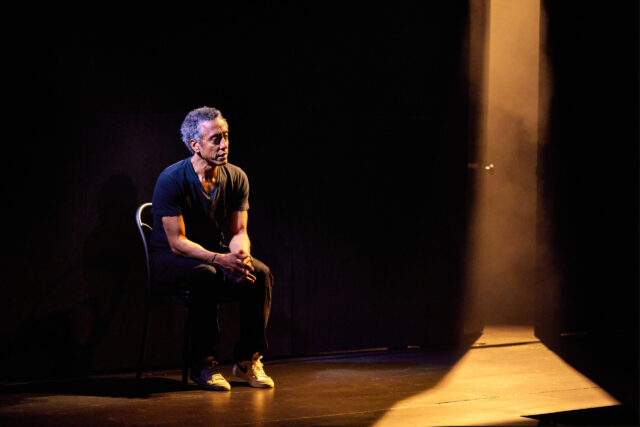
Gabriel Byrne points to key moments in his life in Walking with Ghosts (photo by Emilio Madrid)

GABRIEL BYRNE: WALKING WITH GHOSTS
Music Box Theatre
239 West Forty-Fifth St. between Broadway & Eighth Ave.
Tuesday – Sunday through December 30, $58-$288
gabrielbyrneonbroadway.com

Recounting a dream at the beginning of his one-man show, Walking with Ghosts, Gabriel Byrne remembers seeing himself as “the man I am now longing to see the world as a child again, when every sight and sound was a marvel.” He laments how the places of his youth, “the chapel, the cinema, the factory, the fields are all gone.” He admits, “And I feel like an intruder in my own past. Emigrant, immigrant, exile. Belonging everywhere but nowhere at all.”

Adapted from Byrne’s widely acclaimed 2021 memoir, the play affirms the Tony, Grammy, and Emmy nominee belongs on the stage and on the big and small screen, a humble actor of immense talent who is instantly likable, winning our hearts from the very start. If only he dug a little deeper, reaching for our souls.

Casually dressed in a button-down shirt, slacks, vest, and jacket (the costumes are by Joan O’Clery), Byrne takes us through several dozen episodes from his life organized as individual, chronological scenes that don’t always flow seamlessly one into the next. Byrne ambles slowly around Sinéad McKenna’s spare set, consisting of a desk, a chair, three large frames, and a shattered mirror as Byrne paints his verbal self-portrait taking a long, intimate look at himself. McKenna’s soft lighting occasionally creates an upside-down shadow of Byrne on the facade above the stage, immersed in an amorphous primordial cloud. As much as we learn about Byrne over the course of two acts and two hours and fifteen minutes (with intermission), there is much more we do not learn. He is a superb storyteller in the classic Irish tradition; early on, he recalls taking the bus on his first day of school and seeing a drunk man singing. “That man, my mother said, is a famous writer. His name is Brendan Behan, and he’s known all over the world. And he’s on the wrong bus, the poor creature.”

Behan had a wild abandon, but Byrne rarely breaks out of his steady demeanor, whether discussing sexual abuse he suffered at the hands of a priest, seeing a friend of his drown, drudging through a series of jobs, or having high tea with his mother at a fancy hotel. Each episode is given equal weight, although he does perk up when he talks about film and theater, going to the movies with his grandmother and joining a troupe of amateur actors. “I realized then I had been so lonely, and this new sense of belonging and purpose overwhelmed me to tears,” he wistfully explains. “You are welcome here, they had said. Welcome. I felt at last that I belonged.”

Gabriel Byrne considers the choices he’s made in one-man show (photo by Emilio Madrid)

Byrne doesn’t delve into his many successes — from Miller’s Crossing, The Usual Suspects, and Jindabyne on film to In Treatment, Madigan Men, and The War of the Worlds on television and his Eugene O’Neill Broadway trilogy of Long Day’s Journey into Night, A Moon for the Misbegotten, and A Touch of the Poet — but instead focuses on smaller key moments in his career, without name-dropping who he’s worked with or what movies or shows he has been in. He does ruminate on his breakthrough, on the popular Irish television series The Riordans, and he regales us with the night he spent drinking with Richard Burton, but he doesn’t mention the name of the eight-hour film they did together, 1983’s Wagner, or the other members of the cast, which included Vanessa Redgrave, Marthe Keller, Sir John Gielgud, Sir Laurence Olivier, and Sir Ralph Richardson.

The seventy-two-year-old Byrne also avoids most of his personal life as an adult, never bringing up his relationships with women (he’s been married twice) or his three children. Perhaps he didn’t want to rehash anything that was previously in his 1994 autobiography, Pictures in My Head, and Pat Collins’s 2008 documentary, Gabriel Byrne: Stories from Home, but the gaps are clear.

Directed by three-time Emmy winner Lonny Price (Sunset Boulevard, Lady Day at Emerson’s Bar and Grill), Walking with Ghosts has an elegance and charm about it, but in this case the whole is not greater than the sum of its parts; there are excellent chapters, but we don’t get enough of the bigger picture.

MONTHLY ANIME: MY NEIGHBOR TOTORO / CONTEMPORARY THEATER TALK: BEHIND-THE-SCENES

Hayao Miyazaki’s My Neighbor Totoro wonderfully captures the joys and fears of being a child

MY NEIGHBOR TOTORO (TONARI NO TOTORO) (Hayao Miyazaki, 1988)
Japan Society
333 East 47th St. at First Ave.
Film: Friday, November 4, $15, 7:00
Talk: Thursday, November 10, $20, 6:30
japansociety.org
www.nausicaa.net

The Royal Shakespeare Company is currently presenting a live-action stage adaptation of Hayao Miyazaki’s beloved My Neighbor Totoro at the Barbican, where it is receiving glowing reviews. The show was written by Tom Morton-Smith and is directed by Phelim McDermott, with a score by longtime Miyazaki collaborator Joe Hisaishi and puppetry by Basil Twist. As part of its monthly anime series, Japan Society will be screening a 35mm print of the 1988 film on November 4 at 7:00, followed November 10 at 6:30 by a discussion with Twist (Symphonie Fantastique, Dogugaeshi) about the making of the show.

In many ways a precursor to Miyazaki’s masterpiece, Spirited Away, the magical multi-award-winning My Neighbor Totoro is a fantastical trip down the rabbit hole, a wondrous journey through the sheer glee and universal fears of childhood. With their mother, Yasuko, suffering from an extended illness in the hospital, Satsuki and her younger sister, Mei, move to a new house in a rural farming community with their father, anthropology professor Tatsuo Kusakabe. Kanta, a shy boy who lives nearby, tells them the house is haunted, and indeed the two girls come upon a flurry of black soot sprites scurrying about. Mei also soon discovers a family of totoros, supposedly fictional characters from her storybooks, living in the forest, protected by a giant camphor tree. When the girls fear their mother has taken a turn for the worse, Mei runs off on her own, and it is up to Satsuki to find her.

Basil Twist will be at Japan Society to share behind-the-scenes stories of the Totoro stage show

Working with art director Kazuo Oga, Miyazaki paints the film with rich, glorious skies and lush greenery, honoring the beauty and power of nature both visually as well as in the narrative. The scene in which Satsuki and Mei huddle with Totoro at a bus stop in a rainstorm is a treasure. (And just wait till you see Catbus’s glowing eyes.) The movie also celebrates the sense of freedom and adventure that comes with being a child, without helicopter parents and myriad rules suffocating them at home and school. Twist’s talk will go behind-the-scenes of the RSC production, discussing the creation of puppets based on animated characters and sharing backstage images.

BAM NEXT WAVE: HAMLET

Thomas Ostermeier and Theater Schaubühne Berlin’ Hamlet continues at BAM through November 5 (photo © Stephanie Berger)

Who: Theater Schaubühne Berlin
What: Hamlet
Where: Brooklyn Academy of Music, Harvey Theater at the BAM Strong, 651 Fulton St.
When: October 27 – November 5, $74-$175
Why: Five years ago, Lars Eidinger electrified Brooklyn with his stunning portrayal of Richard III, the wildest and best I have ever seen, in Thomas Ostermeier and Theater Schaubühne Berlin’s ferocious adaptation at the BAM Harvey Theater. Eidinger, Ostermeier, and Schaubühne Berlin are back at the Harvey with their frantic take on the Bard’s Hamlet, running through November 5. The tragedy has been seen here in New York in numerous recent versions and reimaginings, from Robert Icke’s staging at Park Ave. Armory in repertory with The Oresteia and James Ijames’s Pulitzer Prize–winning Fat Ham at the Public to Potomac Theatre Project’s revival of Tom Stoppard’s Dogg’s Hamlet at Atlantic Stage 2, Dead Centre’s Hamnet at BAM Fisher, and Yaël Farber’s variation starring Ruth Negga at St. Ann’s Warehouse.

You can expect Eidinger to be a prince of Denmark unlike any other in this 165-minute adaptation, directed by Thomas Ostermeier and translated into German by dramaturg Marius von Mayenburg. The cast pairs Damir Avdic as Horatio and Guildenstern, Konrad Singer as Laertes and Rosencrantz, Robert Beyer as Osric and Polonius, amid other dual depictions, but it is Eidinger front and center, a mesmerizing actor who never holds anything back. You have been warned.

Lars Eidinger reinvents the prince of Denmark in Hamlet at BAM (photo © Stephanie Berger)

Update: It takes only minutes to realize that this Hamlet will resemble nothing you’ve ever seen. It opens with Eidinger, who at forty-six is about twice the age of his title character, beginning the “To Be, or Not to Be” soliloquy, which is supposed to unfurl in Act III. But he delivers only a few lines before joining the funeral of his murdered father, the former king, while his mother, Gertrude, and uncle, Claudius, stand under an umbrella at the burial. A cemetery worker has trouble with the coffin, water is sprayed from a hose, and the already unbalanced Hamlet, looking a bit doofy in his suspenders, falls face-first into the dirt over his father’s grave.

It’s Hamlet as vaudeville shtick, but with a camera that Hamlet uses to film himself and others as nefarious truths come out. Jan Pappelbaum’s set features lots of dirt and two white tables that move between the front and back of the stage, separated by a hanging curtain on which the live video is projected. (The costumes are by Nina Wetzel, music by Nils Ostendorf, video by Sébastien Dupouey, and lighting by Erich Schneider.)

A few moments later, when Claudius says, “But now, my nephew Hamlet, and my son — ,” a shocked Hamlet, unaware that his mother is betrothed to his uncle, does a double take and wonders aloud, “What? I didn’t get that,” then says to himself the more well known line, “A little more than kin, and less than kind.”

Eidinger is given free rein by Ostermeier, like an improv comic portraying the prince of Denmark. At one point, Eidinger jumped off the stage and approached a young man sitting front and center in the first row, wearing a black mask and a hoodie. Eidinger, who speaks German as Hamlet but English when he goes off-script, tried to get the man to interact with him, with no luck, leading to some yucks. Later, Eidinger tossed a shovel that accidentally bounced off the stage and landed near a woman in the audience. In the middle of his dialogue, Eidinger realized what happened and asked the woman if she was okay. It’s often hard to know what is scripted and when Eidinger is going with his instincts; just wait till you see his fencing battle with Laertes.

Even when he’s not lumbering across the stage (and off it), Hamlet is toying around, as if he has ADHD, banging on the table like a spoiled child and putting silly things on his face. The rest of the cast — Damir Avdic as Horatio and Guildenstern, Konrad Singer as Laertes and Rosencrantz, Robert Beyer as Osric and Polonius, Urs Jucker or Thomas Bading as Claudius and the ghost king, and Jenny König as Gertrude and Ophelia, a pairing that intensifies Hamlet’s cries of incest — is merely in service of Eidinger.

It can be a bit much in the 105-minute first act, which can get so chaotic it loses the narrative thread; if you’re not familiar with the story, you’re unlikely to know what’s going on all the time, especially with the doubling of characters who don’t change costumes. But the show comes together fabulously in the forty-five-minute second act — Eidinger even assures us that it’s much shorter than the first act — as the plot is more apparent and Hamlet (and Eidinger) is somewhat more focused if still as wildly unpredictable. There’s a method to his madness, even if Polonius’s classic pronouncement, “Though this be madness, yet there is method in’t,” has been cut from the production. You also won’t hear anything about a “rogue and peasant slave,” “pernicious woman,” or “damned villain,” but Hamlet will command you to “please switch off your mobile phones!”

Hamlet explains, “It’s all just theater and yet also reality.” Throughout Shakespeare’s tragedy, Hamlet is battling reality, encountering ghosts and interpreting events through his own warped world view. But Ostermeier and Eidinger continually remind us that we are watching theater. And what theater it is, unique, original, flabbergasting, exciting, hilarious, and downright strange.