this week in theater

CHAIN LINKS: ONE-ACT WINTER FESTIVAL RETURNS WITH BEVY OF STARS

CHAIN WINTER ONE-ACT FESTIVAL
Chain Theatre
312 West Thirty-Sixth St. between Eighth & Ninth Aves.
February 5 – March 1, live and virtual, $24–$35
www.chaintheatre.org

The Chain Winter One-Act Festival is back with an impressive lineup of plays through March 1, featuring twenty-eight programs consisting of between two and four works totaling sixty to eighty minutes. Soap opera fans will be especially excited, as many of the participants come from that genre (As the World Turns, All My Children, One Life to Live, Falcon Crest).

This year is highlighted by Jeryl Brunner’s Sweet Tart, directed by two-time Oscar nominee Jesse Eisenberg and starring Emmy nominee Ralph Macchio and his daughter, Julia Macchio, who played Vanessa on Cobra Kai. Sweet Tart is on a can’t-miss bill with Lyle Kessler’s Shit Kickers, starring two-time Emmy winner and Oscar nominee Carol Kane and Margaret Ladd, and John Arthur Long’s The Fusion Experiment, with David Rey and Christina Elise Perry, helmed by Chain artistic director Kirk Gostkowski. [Ed. note: It was announced on February 23 that Carol Kane will no longer be appearing in Shit Kickers; she will be replaced by Sachi Parker.]

“We don’t do safe — we do real,” Gostkowski said in a statement. “This is where audiences and artists meet on equal ground to explore the world as it is, and imagine what it could be.”

Two-time Obie-winning playwright José Rivera presents the world premiere of the fabulously titled Look What Crashed through the Portal and Ended up in Brooklyn, Emmy winner Jennifer Pepperman writes and directs Ray, David Zayas Jr. directs Diego Aguirre, Joseph Russo, and Jacob Lumet Cannavale in Aguirre’s Stalled, and three-time Emmy winner Cady McClain takes the lead in three-time Emmy-winning director Christopher Goutman’s The Oblique. Other shows to watch out for are Annabel McConnachie’s Waiting for Gadot, Sarah Swift’s True Crime, John Corins’s Brad Pitt and the Exploding Head, and Melanie Acampora’s Too Much Fondant.

General admission tickets begin at $24; if it’s too cold for you to venture outside, four of the programs will be livestreamed.

[Mark Rifkin is a Brooklyn-born, Manhattan-based writer and editor; you can follow him on Substack here.]
SIGHING AND SWOONING AT THE MOON: JOE WHITE’S BLACKOUT SONGS

Abbey Lee and Owen Teague star as a couple seeking escape from the world in Blackout Songs (photo by Emilio Madrid)

BLACKOUT SONGS
Robert W. Wilson MCC Theater Space
Susan & Ronald Frankel Theater
511 West Fifty-Second St. between Tenth & Eleventh Aves.
Tuesday – Saturday through February 28, $59-$129
www.blackoutsongs.com

“I spoke about wings / You just flew / I wondered, I guessed, and I tried / You just knew / I sighed / But you swooned / I saw the crescent / You saw the whole of the moon,” Mike Scott sings in the 1985 Waterboys tune “The Whole of the Moon.” The propulsive song appears several times in Joe White’s scintillating, Olivier-nominated Blackout Songs.

Running at the Susan & Ronald Frankel Theater through February 28, the show stars Owen Teague and Abbey Lee as an initially unnamed American college student studying painting and a free-spirited British wannabe poet who meet at their first AA meeting. While she looks stylish in jeans, a faux fur coat, a belly-revealing shirt, and sunglasses, he is ragged and unsteady, with torn pants and a denim jacket. (The costumes are by Avery Reed.) He speaks in a stammer, wearing a neck brace that he can’t explain.

Finding a tooth in her pocket, she says, “Some people might (panic), you know, but my brain, my brain’s just gone ‘pfff, don’t worry about it.’ Gone. And that’s — Well, that’s what, exactly? That’s mercy, isn’t it? This is what mercy looks like, you go out, get pissed, get hurt, fall in love, whatever, doesn’t matter, in the morning it’s gone anyway, new day — do you know you’re shaking?” He doesn’t.

That opening sets the stage for the rest of the play, in which the two alcoholics fall in and out of love, disappear for extended periods, and remember and forget significant parts of their toxic relationship. They are both completely right and completely wrong for each other; you can’t help but root for them even when it’s clear they are caught on a dangerous downward spiral, unable to avoid the “medicine” they still think can help them. They role-play, attend a funeral, and dance in a bar, as beautiful moments intersect with bad decisions. One night, when he shows up bleeding from the mouth, she says, “I think it’s sexy, actually. Desperately romantic. You’re so doomed, aren’t you.” He later professes, “There’s no life without you.”

They exist in an amorphous time and space, where no one else is ever around, just the two of them reveling in and falling prey to their inner demons. When she talks about her father, who essentially abandoned her when she was six, he asks, “Don’t you think you’re memorable? Is that what you think — Cos he — Cos he sent you away, that means he tried to forget you?” She responds, “OK, alright, thanks, Dr. Freud, but I’m done here — Let’s go get a drink.”

The past and the present intertwine as the man and the woman contemplate their future, minute by minute, depending on what they can remember.

Stacey Derosier’s extraordinary lighting nearly steals the show in Blackout Songs (photo by Emilio Madrid)

Blackout Songs unfolds in a mostly empty space designed by three-time Tony winner Scott Pask, with a small pub table on one side against the wall, a folding table with coffee and snacks on the other, and a church pulpit near a far corner, next to large windows that later reveal a glowing cross. In the first scene, the woman is convincing the man to leave the meeting and get some medicine; looking directly at the audience, she says to him, “Don’t look at them,” as if we’re not only watching the play but are also fellow recovering addicts at the meeting — and we have no right to judge them because we all have our failings.

The concept of the moon is a theme throughout the story; in addition to the Waterboys song, the man recalls the beauty of the moon when showing the woman one of his paintings, and he later says, “Won’t forget this, will you. Full moon, holy wine, it’s like a song or something. You know the world is different under a full moon? People are. People fall in love. Cos it pulls liquid around, doesn’t it. Tides. And there’s liquid in us too. Blood and. Other liquids. Chemicals. The brain is the moistest organ in the body. Moon drunk is different.”

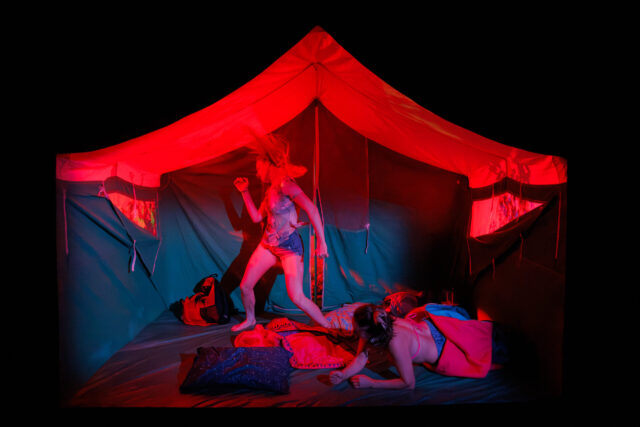
Brian Hickey’s striking sound and original music and Stacey Derosier’s extraordinary lighting — almost a character unto itself — help define the shifts in time to startling effect. The production, under Rory McGregor’s (The Wasp, Buggy Baby) expert direction, evokes such other complex works as Nick Payne’s Constellations, in which a couple’s relationship constantly changes in the quantum multiverse, Philip Ridley’s Tender Napalm, about an unnamed man and woman whose intense passion leads them on mysterious mini-adventures, and David Ives’s Venus in Fur, in which a theater director and an actor turn an audition into a reality-bending treatise on gender, sexuality, and degradation, as well as Blake Edwards’s 1962 film Days of Wine and Roses, about a married couple who trap themselves in a haze of alcohol. (McGregor directed Tender Napalm at Theaterlab in late 2024, with a crew that included Reed, Hickey, and Derosier.)

Blackout Songs boasts a trio of firsts: Two-time Olivier nominee White’s (The Little Big Things, Mayfly) and Lee’s (Florida Man, Black Rabbit) American stage debuts and Teague’s (Kingdom of the Planet of the Apes, You Hurt My Feelings) US debut. Lee is a force of nature in the play, her character never slowing down, always on the move, while Teague lends a sensitive air to the man, who thinks he knows what he wants but keeps making choices that hold him back. It’s a beguiling, heart-wrenching ninety-minute pas de deux as two lost souls try to find love and escape together.

The play does have a hard time figuring out how to end, but by then you’ll be so entranced by the two characters, and the two actors, that you won’t mind, especially if you’re addicted to good theater.

[Mark Rifkin is a Brooklyn-born, Manhattan-based writer and editor; you can follow him on Substack here.]
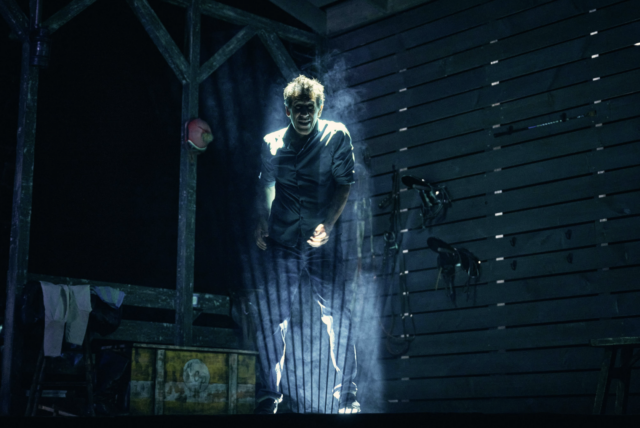
SPACE IS THE PLACE: SETTING THE SCENE

There are no actors on hand but the Mabou Mines production of All That Fall boasts a magnificent set (photo by twi-ny/mdr)

“Space is the place,” Sun Ra sang on the title track of his 1973 album, Space Is the Place. “There’s no limit to the things that you can do. . . . And your life is worthwhile.”

The jazz legend might have been referring to the cosmos, but one of the (many) things that makes my life worthwhile is entering a theater with no idea what to expect visually. I’m not talking about standard setups where the proscenium stage is in front of rows of affixed seats but rooms that can be reshaped and reconfigured in multiple ways. For example, I am filled with anticipation every time I walk into Park Ave. Armory’s Wade Thompson Drill Hall, TFANA’s Polonsky Shakespeare Center, the Shed’s McCourt, BAM Fisher, and the Signature’s Romulus Linney Courtyard Theatre, all of which can be transformed into fascinating rearrangements.

Below are four recent shows I’ve seen that offered unique spatial experiences.

The cast of All That Fall does not appear in person at the 122 Community Center (photos by Jeri Coppola)

UNDER THE RADAR: ALL THAT FALL
Mabou Mines@122CC
150 1st Ave. at Ninth St.
January 8–25, $20-$50
www.maboumines.org
utrfest.org

Since 1970, the experimental avant-garde Mabou Mines troupe has been challenging the boundaries of theater, and they do it again with their adaptation of Samuel Beckett’s 1957 radio play, All That Fall. When audience members get off the elevator at the 122 Community Center, they encounter a series of objects in the hallway and a side room that prepare them for the show: a photo of the Orangedale train station next to a radio playing a Big Band–era instrumental; a poster of a railway man’s “hand, flag and lamp signals” with an actual rusty lamp; a photo of the train station interior, with empty benches, which hints at what we’ll soon see; horse-racing information; and a piece of paper with the opening quote from Beckett’s 1938 novel, Murphy, “The sun shone, having no alternative, on the nothing new,” along with a drawing of a tree by Harry Bliss with the caption “A tree greeting the morning sun, because it has no choice.”

Inside the theater, the seats are arranged in a traditional manner, but the set is like an art installation, a large model of a miniature town with tiny houses, bumpy hills, rocky streets, a river, two bridges, hens near the tracks, and an elevated train station, all surrounded by a map on the walls; in the back are regular-size remnants, an abandoned bicycle and parts of some kind of moving vehicle. In front of the model, a man is projecting slides on an old carousel of costumed men and women — the characters the actors will be portraying. Shortly after the projections stop and the man leaves, we realize that there will be no actors for us to watch; in true radio-play fashion, they will only be heard, prerecorded, but we now know what they look like.

The narrative is fairly straightforward: Mrs Maddy Rooney (Randy Danson) is worried when her blind husband, Dan (Tony Torn), is late getting home. She finds out that the ever-dependable train has not arrived yet, and she is concerned why. Along her journey, she meets up with Christy the carter (Jesse Lenat), Mr Barrell the station master (Lenat), Mr Tyler the retired bill collector (Steven Rattazzi), Mr Slocum the racecourse manager (Torn), Tommy the railway porter (Tẹmídayọ Amay), the pious Miss Fitt (Wendy vanden Heuvel), the little girl Dolly (Lila Blue), and the little boy Jerry (Sylvan Schneiderman). They have absurdist conversations about dung, the Matterhorn, damnation, sex, bicycles and vans, the Titanic and the Lusitania, and “the horrors of home life.”

Mrs Rooney’s dialogue is filled with lovely snippets about human existence: “What kind of a country is this where a woman can’t weep her heart out on the highways and byways without being tormented by retired bill-brokers!” she complains to Mr Tyler. “Christ what a planet,” she declares to Miss Fitt. “I do not exist,” she says to Tommy. “I am not half alive nor anything approaching it,” she explains to Mr Tyler. “Have you no respect for misery?”

The breathtaking set is by Thomas Dunn, lit by Jennifer Tipton, with a bevy of sound effects by Bruce Odland, from animal noises to a storm that shakes your seat almost like Sensurround. Mabout Mines cofounder JoAnne Akalaitis directs with a wry sense of humor.

Wally Cardona and Molly Lieber revive David Gordon’s Times Four for its fiftieth anniversary (photo by Maria Baranova)

LIVE ARTERY: TIMES FOUR / DAVID GORDON: 1975/2025
New York Live Arts / Pick Up Performance Co. Studio
541 Broadway between Spring & Prince Sts.
January 11–13, $33.85
newyorklivearts.org

In May 1977, husband-and-wife dancers David Gordon and Valda Setterfield performed their 1975 piece, Times Four in the SoHo loft where they lived and worked. Their son-in-law, Wally Cardona, has brought their little-seen pas d’deux back for a fiftieth-anniversary tribute, teaming up with Molly Lieber to re-create it from a video rehearsal, Setterfield’s handwritten notes, photographs, and other ephemera, taking place in the same loft. It is like a 1960s happening: The limited seating is a single row of folding chairs around the periphery of the otherwise empty room; in addition, the night I attended, there were numerous familiar choreographers and dancers in the audience, all greeting one another. There is no score; the only sounds are Cardona’s (Interventions, The Set Up) and Lieber’s (Rude World, Gloria) breathing and their feet and other body parts touching the floor, sometimes landing softly, sometimes hard. They stare at the walls and windows, rarely making eye contact with the audience, as they glide primarily in unison to four beats, then deleting one move and replacing it with another.

Concentrating mostly on their legs and feet, they move forward, backward, sideways, lifting here, pounding there, almost always in unison. They fall to the ground, extend their bodies, come within inches of the audience. When slight differences occur, you can feel it in your bones. You never know which direction they are going to turn in, resulting in a thrilling suspense to it all.

They both exert remarkable strength as they perform difficult maneuvers, their muscles rippling, sweat forming. It’s a compelling feat of human endurance that last about sixty tense, exhilarating minutes. A poem associated with the dance explains, “well worn wood floor / smooth burnished brown / the kind of floor that begs to be danced on / that wants to seduce me out of my shoes and socks. . . . I face my back to the windows / I imagine 1975.”

Consider me seduced.

Paul Lazar and Annie-B Parson stage first revival of Richard Foreman’s What to wear at BAM (photo by Stephanie Berger)

PROTOTYPE: WHAT TO WEAR
Brooklyn Academy of Music
BAM Strong Harvey Theater
651 Fulton St. at Ashland Pl.
January 15-18
www.bam.org
www.prototypefestival.org

In September 2006, experimental avant-garde legend Richard Foreman and composer Michael Gordon debuted their surreal post-rock opera, What to wear, at the Redcat in LA. It took twenty years, but the show has finally made it to New York at the BAM Strong Harvey Theater as part of the Prototype festival, in its first-ever revival. To prepare everyone for what awaited inside the theater, in the lobby was Foreman’s detailed original concept design model for the complex, fabulously overstuffed stage, a kind of mind-blowing melding of Monty Python, Pablo Picasso, and Alice in Wonderland. It is thrilling to walk into the Harvey and see how that set has been painstakingly re-created at full size by Michael Darling, like magic; Darling also did the props, and the wild costumes are again by E. B. Brooks. Big Dance Theater’s Paul Lazar and Annie-B Parson direct, honoring the 2006 production, which you can watch online here.

The show begins with fancy lighting coming down from the ceiling as a giant cartoonish duck emerges from a doorway and the deep voice of Richard Foreman booms from the heavens: “As of this moment, this ugly duckling is now effectively banished from the realm of the oh so beautiful people.” The duck exits, and sopranos Sarah Frei and Sophie Delphis, mezzo Hai-Ting Chinn, and tenor Morgan Mastrangelo sing, “This is Mad’line X” eight times, then adding, “In a terrible world / One unpleasant world / Such a bad, bad world.” Over the next sixty-plus minutes, those four are joined by St. Vincent, an ensemble of more than a dozen vocalists and dancers, and the seven-piece Bang on a Can orchestra caged in one corner as the story goes through such chapters as “Mad’line X, who understands now,” “So sad but I reject you,” and “When a duck enters a fine restaurant.”

Marchers in kilts hold signs with a big X on them, a pointing finger drops down from above like the hand of G-d, skulls abound, headpieces feature little colored balls on top, a character walks around in a barrel, golf clubs become weapons, a head is locked in a box, and cool wizardry occurs just about everywhere. The unsatisfying ending does not diminish the triumph of this engaging revival. We are told that “Madeline X lives in this terrible world,” but any world that includes works by Foreman can’t be all bad.

AN ARK
The Griffin Theater at the Shed
The Bloomberg Building at Hudson Yards
545 West 30th St. at Eleventh Ave.
Tuesday – Sunday through March 1, $45
theshed.org

“Don’t panic. Don’t be scared. This must feel strange to you. It felt strange to me,” an unnamed character played by Sir Ian McKellen says at the beginning of British playwright Simon Stephens’s An Ark, continuing at the Shed through March 1.

Too late.

In the summer of 2021, Stephens’s Blindness was reimagined for the pandemic, presented at the Daryl Roth Theatre in Union Square, where a maximum of eighty-six masked and blindfolded people were seated in chairs in pods of two, either facing the same or opposite directions, each couple at least six feet away from other pairs. Everyone listened to the play, about a spreading virus that leads to chaos, through individual binaural headphones; the prerecorded narrative was performed by Juliet Stevenson.

In the summer of 2023, Tin Drum brought Kagami to the Shed’s Griffin Theater, which began with a historical multimedia installation that led to a mixed-reality concert in which everyone put on specially designed optically transparent devices that made it appear that the late pianist Ryuichi Sakamoto was playing live, enveloped in augmented reality art. In actuality, the room was completely empty except for a row of chairs along the perimeter where audience members could sit and watch, although it was much better to walk around and get up close and personal with Sakamoto — you could even go right through him.

So I was beyond excited when I heard that Tin Drum had teamed up with Stephens (Sea Wall, Heisenberg, The Curious Incident of the Dog in the Night-Time) and the Shed for An Ark. The play features McKellen (Waiting for Godot, King Lear), Golda Rosheuvel (A Christmas Carol, Not Your Superwoman), Arinzé Kene (Misty, Get Up, Stand Up!), and Rosie Sheehy (Machinal, The Brightening Air) as four futuristic humans in a kind of intergalactic weigh station.

The prep for the show is mind-bogglingly annoying. The audience is encouraged to arrive at least fifteen or twenty minutes before showtime in order to check their coats and bags, which is mandatory; however, the line was so long when we go there that we were advised to just bring our stuff in with us. At the Griffin, a sign announced, “wipe your feet / check your glasses / store your shoes / enter through the curtain / find a seat / put on your headset / sit back / enjoy the ride.” There was no curtain; the open doorway revealed a large room with plush red carpeting, a giant glowing orb hanging in the center from the ceiling, and three circular rows of chairs with a pathway through the middle. While my guest waited for corrective lenses — glasses won’t work with the headset — I took off my shoes and jacket, placed them on the floor, and tried to grab a specific seat, then come back and store my garb in one of the small cubby-hole benches, but I was told by a guide that I couldn’t do that; first I had to put the shoes and coat away, then someone would guide me to a chair. The shoes fit in the little cubby, but I had to really force the coat into another slot, only to be told that I had placed them in the wrong bench and had to move them. By then, my guest was already seated — with her jacket, which she was allowed to keep on her lap, and bag, which she could put under her chair.

Mixed reality An Ark at the shed is a confusing jumble (photo by Marc J. Franklin)

Next, you put on the headsets, and four white holographic chairs appear in front of you; mine had to be adjusted by a guide because the chairs were enormous and floating in the ether. I was disappointed that I could also see everyone else in the room, which detracted from the personal nature of the show, even though theater is usually meant to be a communal experience. Then, guides wheeled the cubby benches straight through the middle of the theater and out the curtain on the other side of the room, further disturbing the alternate reality that was being created. As the play proper began, with the four characters, all barefoot and wearing white, entering the space and sitting down, it was hard not to wonder why the floor had to be carpeted and why we had had to take off our shoes; perhaps it was some kind of ASMR thing.

For forty-seven minutes, the actors perform just for you, making intense direct eye contact, reaching out with their hands, and using the second person as they recount multiple versions of a life, from birth, childhood, and adolescence to adulthood, the senior years, and death. For example: “At school you work hard but you never really feel like you belong,” “You’ll want to tell people about the things that have happened to you in here,” and “You get on first name terms with your pharmacist.” The dialogue is filled with detailed descriptions of objects and scenarios that involve all five senses; while poetic, they don’t propel the plot, which remains mysterious through the end.

Recorded in one take and directed by Sarah Frankcom (Our Town, Punk Rock) with sound by Ben and Max Ringham, set and costumes by Rosanna Vize, and lighting by Seth Reiser, An Ark has numerous beautiful moments, and the interaction between the characters and you can be utterly chilling (Sir Ian McKellen is only a few feet away!); when Sheehy reached a hand out to me, I reached back, attempting to grasp it.

But too much of it was confusing and unnecessary; I’m eager to see where the technology goes. Hopefully the kinks will be smoothed out and creators will have more faith in the story itself, without all the bells, whistles, and rules.

As McKellen says early on, “When this is over . . . things will have changed forever.” Well, hopefully not too much.

[Mark Rifkin is a Brooklyn-born, Manhattan-based writer and editor; you can follow him on Substack here.]
STATE OF THE ARTS: WE THE PEOPLE AT DANSPACE PROJECT

Who: Gregory Mosher, Sarah Calderón, Sara Farrington, Ty Jones, Lisa Kron, Mino Lora, Gary A. Padmore
What: “We the People: An Assembly of New York Artists”
Where: Danspace Project, St. Mark’s Church in-the-Bowery, 131 East Tenth St. at Second Ave.
When: Monday, January 26, free with advance RSVP, 4:00-7:00
Why: On May 1, 2025, the Office of the Arts at Hunter College, under the leadership of film and stage director Gregory Mosher, hosted “We the People: A Forum on Working Class Artists in America,” in which artists, arts administrators, policymakers, economists, scholars, elected officials, students, and journalists discussed the financial and social barriers that artists and audiences face around the country.

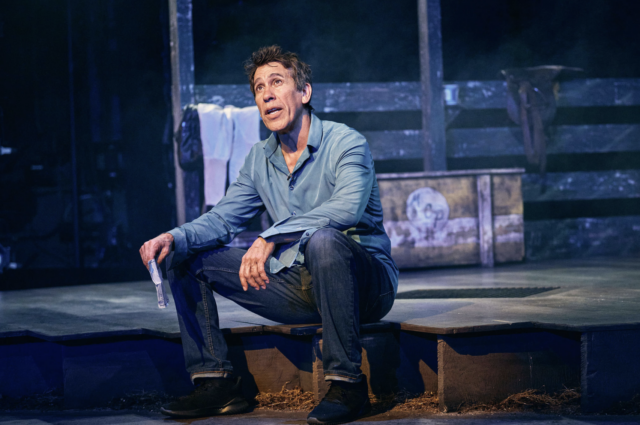
On January 26, they are following that up with “We the People: An Assembly of New York Artists,” a town-hall-style gathering at St. Mark’s Church in-the-Bowery where the focus will be more local. The panel features Classical Theatre of Harlem producing artistic director Ty Jones, award-winning playwright and performer Lisa Kron (Fun Home, Well), the People’s Theatre executive artistic director and cofounder Mino Lora, former Creatives Rebuild New York executive director Sarah Calderon, New York Philharmonic vice president of education and community engagement Gary A. Padmore, and playwright and author Sara Farrington (CasablancaBox, A Trojan Woman). Farrington, who writes the indispensable Substack Theater Is Hard, will make her way through the audience with a microphone, giving members of the community the chance to speak their mind for sixty seconds (and maybe more); it is pointed out that “everyone who comes will already know that art is good, so be specific.”

The presentation will be recorded for online viewing, and a detailed report will be sent to Mayor Mamdani and Governor Hochul. Attendance is free with advance RSVP, although it is all dependent on the weather.

[Mark Rifkin is a Brooklyn-born, Manhattan-based writer and editor; you can follow him on Substack here.]
BOXING SHADOWS: JUXTAPOSING CORNELL, JEUNET, AND TATI AT 59E59

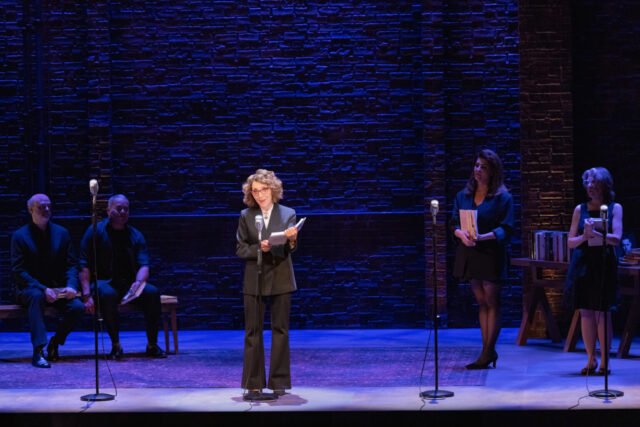
Juxtapose brings the shadow boxes of Joseph Cornell to life (photo by Leah Huete)

JUXTAPOSE
59E59 Theaters
59 East 59th St. between Park & Madison Aves.
Tuesday – Sunday through January 25, $44
www.59e59.org

“Shadow boxes become poetic theater or settings wherein are metamorphosed the elements of a childhood pastime,” Nyack-born artist Joseph Cornell wrote. “The fragile, shimmering globules become the shimmering but more enduring planets — a connotation of moon and tides — the association of water less subtle, as when driftwood pieces make up a proscenium to set off the dazzling white of sea foam and billowy cloud crystallized in a pipe of fancy.”

Or, as a character declares in Happenstance Theater’s Juxtapose: A Theatrical Shadow Box, which advertises itself as being inspired by the art of Cornell and the films of Jean-Pierre Jeunet and Jacques Tati, “Sacre bleu! What a mess.”

You can say that again.

You have to look hard to find those art and film references in the final product, a confusing seventy-five minutes in which five actors wander around an abstract rooming house doing odd, repetitive things that don’t make much sense, psychologically or geographically. They consist of an unnamed collector (Mark Jaster), concierge Rosabelle (Sabrina Selma Mandell), Spilleth, a bird-woman who falls from the sky and through the roof (Gwen Grastorf), Étoile, a ballerina (Sarah Olmsted Thomas), and Blue, a childlike juggler-magician (Alex Vernon). The set and props, by Vernon and codirectors Jaster and Mandell, are centered by a large, empty white frame that is occasionally filled with various objects, from a laundry clothing line and a ladder to a window and a white scrim on which a circular image is projected. The stage also includes an old phonograph, a coat rack, a wrapped package, a conch shell, and a globe. Étoile makes weird noises when she locks and unlocks her door. Blue bounces a ball. The collector toys with his hat. Rosabelle puts on a scratchy record. Étoile tries on a new costume. Spilleth — well, I’m not sure what she does.

Among the Cornell works that served as inspiration were Observatory: Corona Borealis Casement, Toward the Blue Peninsula, and Andromeda: Grand Hôtel de l’Observatoire, but the show never fully captures the surreal nature of Cornell’s constructions, the quirky atmosphere of Jeunet’s films (Amélie, Delicatessen), or the comic genius of Tati’s Monsieur Hulot (Mon Oncle, Playtime). However, the soundtrack is a highlight, featuring songs by Irving Berlin, J. S. Bach, Hoagy Carmichael, George Frideric Handel, and Jacques Offenbach.

When the pandemic lockdown took effect, Happenstance reimagined the in-progress piece as Juxtapose Tenement, an interactive website in which you click on each character’s key to enter their unique shadow box and follow their narratives. I found that far more charming, inventive, and engaging than what is brought to life onstage, which failed to stir the audience the night I saw the play.

If this whets your appetite for more Cornell online, it’s worth checking out The House on Utopia Parkway, Wes Anderson’s Paris re-creation of the artist’s Queens studio; interestingly, Cornell never left America, and he traveled outside New York only to attend Phillips Academy in Andover, Massachusetts.

[Mark Rifkin is a Brooklyn-born, Manhattan-based writer and editor; you can follow him on Substack here.]
FLIRTING WITH DISASTER: THE DISAPPEAR

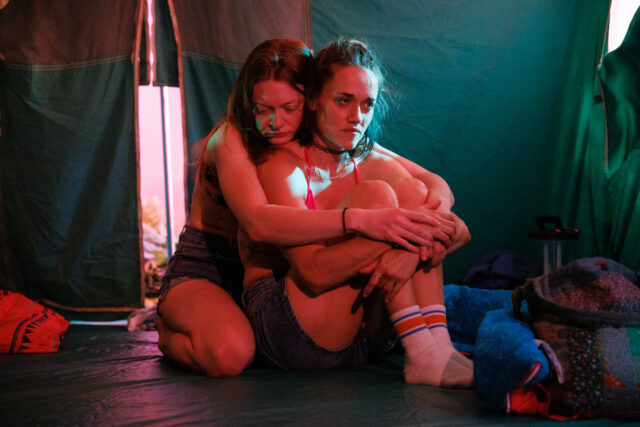
Hamish Linklater and Miriam Silverman play spouses forced to collaborate on a film in The Disappear (photo by Jeremy Daniel)

THE DISAPPEAR
Audible’s Minetta Lane Theatre
18 Minetta Lane between Sixth Ave. and MacDougal St.
Tuesday – Sunday through February 22, $54-$130
www.audible.com

In writer-director Erica Schmidt’s wildly entertaining The Disappear, Hamish Linklater stars as an egocentric narcissistic film director who is considering deleting all the dialogue from the violent horror movie he is working on. Fortunately, Schmidt has not opted to silence Linklater’s character, who spends the first act spouting so much self-centered cringy bluster that you want him to shut up already, but after intermission you can’t wait to hear what idiotic blather he’ll spit out next.

Making its world premiere at Audible’s Minetta Lane Theatre through February 22, the play takes place in the rustic living room of a farmhouse in the Hudson Valley, where Benjamin Braxton (Linklater) lives with his understanding wife, successful novelist Mira Blair (Miriam Silverman), and their teenage daughter, climate activist Dolly (Anna Mirodin). While Mira misses the city, Ben is insistent that he needs the peace and quiet of the country to finish editing the screenplay he is preparing to shoot.

“Am I exhausting? Am I exhausting to you?” Ben asks Mira at the very beginning. We soon find out that he’s exhausting to everybody.

Much to the chagrin of his longtime friend and producer, the erudite Brit Michael Bloom (Dylan Baker), Ben has his heart set on casting ingénue Julie Wells (Madeline Brewer) as Mirabella, a name suspiciously like his wife’s. Ben is instantly smitten with Julie, declaring her his muse, and they seal the deal with a kiss. It turns out that this is not the first time Ben has fallen for his leading lady. “Oh, Ben. It isn’t happening again, is it? You haven’t . . . ,” Michael says with concern.

When Michael refuses to let Ben hire Julie, Ben decides to write a new film specifically for her, a nearly dialogue-free tale about a man having an affair who makes a joke about wishing his wife were dead, only to have her actually vanish. Ben gets handsome movie star Raf Night (Kelvin Harrison Jr.) for the male lead, which further excites Julie (and, later, Mira).

But soon they are all working together on an adaptation of Mira’s book All the Silence and All the Wonder, and hilarious mayhem ensues as a torrential storm threatens.

The Disappear is a hilarious seriocomedy about art and love (photo by Jeremy Daniel)

With its numerous Chekhovian elements, The Disappear has a timeless quality; Ben works at a small table with pencil and paper, there are no electronics in the living room, candles line the fireplace mantel, and many of Jennifer Moeller and Miriam Kelleher’s costumes are old-fashioned, highlighted by Julie’s silly bonnet-topped outfit. Only later does the contemporary world appear: a smartphone and laptop show up and Julie enters wearing a half green-screen VFX suit, while the repartee often recalls sly British drawing room comedies.

And oh, what repartee! Among Ben’s fanciful lines are “God, Mira. Was your heart consumed by your efficiency?,” “I look at you and I see my death — like: this is it?!? This is it until I die?,” and “I will not think before I speak. God. You’re so restrictive! Ughhh.” When Ben asks Mira, “Do you know how smart one has to be to play dumb really well?,” she replies, “Tell me more about that, Ben.” And when Mira says, “Aren’t you always lying — just a little bit,” Ben answers, “At least I’m honest about it.”

Ben is so obnoxious and self-obsessed that he even admits that he loves filmmaking more than he does Dolly. Despite Ben’s endless flaws, Michael sticks by him, and Mira claims she loves him. Ben says about his film, “It’s an epic story about human connection,” but he has no idea how to connect with people or the world, which is the play’s central focus. He is an inconsiderate man-child who can’t relate to Julie’s fascination with butterflies, Dolly’s desire to plant trees, or Mira’s caring nature.

Linklater (The Pain of My Belligerence, Seminar) is sensational as the boorish Ben, imbuing him with a riotous physicality as he lumbers across Brett J. Banakis’s charming set. Tony winner Silverman (The Sign in Sidney Brustein’s Window, Junk) is an excellent foil as Mira, who sees through his shenanigans but remains as loyal as she can for as long as she can. (“Mira” means “look” in Spanish, perhaps referring to how she regards him.) Tony and three-time Emmy nominee Baker (La Bête, Not About Heroes) is a joy as Michael, who gets to shine in an uproarious late scene. Brewer (Cabaret, Little Shop of Horrors), best known as Janine on The Handmaid’s Tale, is sublimely seductive as the mysterious Julie, who can quote from Dido and Aeneas and King Lear while also playing coy. Harrison Jr. (Cyrano, The Lion King) is extremely funny as Raf, a self-aware, practical man who knows what he wants and goes after it. And Mirodin makes a wonderful New York stage debut as Dolly, nearly stealing the second act right out from under Linklater.

In the script, Schmidt, whose previous works include the gorgeously rendered Lucy, the beautifully frenetic Mac Beth, and the musical adaptation Cyrano, aptly describes the play as “a seriocomedy about making art while the world is falling apart,” and at one point Mira explains, “We all have to plan around disaster.”

The world may be falling apart, but seeing The Disappear would be part of any good plan around disaster.

[Mark Rifkin is a Brooklyn-born, Manhattan-based writer and editor; you can follow him on Substack here.]
2026 NEW YORK JEWISH FILM FESTIVAL: NOTHINGNESS, EVERYTHING, AND MATZOH BALLS TOO

Anat Maltz’s Real Estate screens January 21 at the New York Jewish Film Festival

THIRTY-FIFTH ANNUAL NEW YORK JEWISH FILM FESTIVAL
Walter Reade Theater, Film at Lincoln Center
165 West 65th St. between Broadway & Amsterdam Aves.
January 14-28
www.filmlinc.org
thejewishmuseum.org

The New York Jewish Film Festival is now celebrating its thirty-fifth year of bringing narrative features, documentaries, and shorts dealing with Judaism, Israel, and the Jewish diaspora, from romantic comedies and poignant dramas to hard-hitting looks at the state of the world amid ever-growing antisemitism. As I’ve noted before, it sometimes feels like a political statement just to attend the festival.

A joint production of the Jewish Museum and Film at Lincoln Center, the 2026 edition runs January 14-28, consisting of twenty-nine works from the United States, France, Germany, Spain, Belgium, Argentina, the Netherlands, Switzerland, Poland, Canada, Denmark, Uganda, and Israel, including many New York premieres. The festival opens with Ken Scott’s Once Upon My Mother, about a Moroccan family in Paris with a matriarch determined to ensure her son lives a happy life, based on an autobiographical novel by Roland Perez, who will participate in Q&As following both screenings. The centerpiece selection is Guillaume Ribot’s All I Had Was Nothingness, which follows director Claude Lanzmann during his twelve years making Shoah. NYJFF26 concludes with actor Matthew Shear’s writing and directing debut, Fantasy Life, in which a schlubby but endearing schlemiel/schlimazel/shmegege/shmendrik becomes a manny for an actress, her rock musician husband, and their three young daughters, starring Amanda Peet, Judd Hirsch, Andrea Martin, Bob Balaban, Alessandro Nivola, Jessica Harper, and Zosia Mamet.

Among the other highlights are Abby Ginzberg’s Labors of Love: The Life and Legacy of Henrietta Szold, about the founder of Hadassah; Marisa Fox’s My Underground Mother, who finds out that her mother was a spy and freedom fighter against the Nazis; Anat Maltz’s Real Estate, which takes place over the course of one day as a young couple about to have a baby are forced out of their Tel Aviv apartment; and a restoration of Aleksander Marten’s 1936 I Have Sinned, the first Yiddish sound film made in Poland. And this year’s winner for best title is Emily Lobsenz’s A Bit of Everything and Matzoh Balls Too.

Below are several films to watch out for; most screenings throughout the festival will be followed by a discussion with directors, producers, subjects, cast members, or experts.

All I Had Was Nothingness follows Claude Lanzmann as he makes Shoah

ALL I HAD WAS NOTHINGNESS (Guillaume Ribot, 2025)
Walter Reade Theater
Thursday, January 22, 2:30 & 7:45
www.filmlinc.org
mk2films.com

In 1985, Claude Lanzmann’s extraordinary nine-and-a-half-hour epic, Shoah, changed the discussion surrounding the Holocaust, as Lanzmann, a French Jew, traveled around the world interviewing survivors, witnesses, collaborators, and perpetrators. In honor of the fortieth anniversary of Lanzmann’s award-winning magnum opus, French director and photographer Guillaume Ribot, who is not Jewish, has made All I Had Was Nothingness, a remarkable documentary, produced by Claude’s widow, Dominique Lanzmann, that follows Lanzmann on his journey, filled with self-doubt, doors slammed in his face, and a lack of funds that constantly threaten the project. Ribot and editor Svetlana Vaynblat went through two hundred hours of unused footage to put the film together, with Ribot adding narration taken directly from Lanzmann’s writings, primarily from his 2009 memoir, The Patagonian Hare. Even though we know that Shoah gets released to widespread acclaim — and is followed by such other Holocaust films as Sobibor, 14 October 1943, 4 p.m., The Last of the Unjust, and Shoah: Four Sisters before Lanzmann died in 2018 at the age of ninety-two — the story plays out like a gripping, intimate thriller.

“Making Shoah was a long and difficult battle,” Lanzmann (voiced by Ribot) says early on. “I wanted to film, but all I had was nothingness. The subject of Shoah is death itself. Death and its radicality. On some evenings it felt like senseless suffering, and I was ready to give up. But during those twelve years of work, I always forced myself to stare relentlessly into the black sun of the Shoah.”

Among the people Lanzmann meets are Abraham Bomba, who survived Treblinka, where he was forced to cut the hair of women who were gassed to death; Simon Srebnik, a Chelmno survivor whose father was killed in the Łódź Ghetto and whose mother was murdered in a gas van in the concentration camp; SS commander Gustav Laabs; convicted Treblinka exterminator Franz Suchomel; locals who lived next to concentration camps and claim to have not known what was going on inside; Treblinka train engineer Henryk Gawkowski; Heinz Schubert from the Einsatzgruppen; Treblinka survivor Richard Glazar; Einsatzgruppe Obersturmführer Karl Kretschmer; and Yitzhak “Antek” Zuckerman, deputy commander of the Warsaw Ghetto Uprising. “Daily, we tackled a new prey,” Lanzmann notes as he attempts to “deceive the deceivers.”

Along the way, Lanzmann obtains a fake passport under the name Claude-Marie Sorel, quarrels with his cameraman William Lubtchansky (whose father was gassed in Auschwitz), wonders what the overall message of the film will be, uses a special hidden camera, and is unable to raise a single dollar from potential American investors. He also smokes a lot of cigarettes.

Ribot, whose previous films include Le Cahier de Susi, inspired by the discovery of a notebook by an eleven-year-old girl who was murdered in Auschwitz, and Treblinka, je suis le dernier Juif, about camp survivor Chil Rajchman, turns the focus on Lanzmann and the lengths documentarians will go to tell their stories. All I Had Was Nothingness is a valuable addition to films about the Holocaust, but it is much more than that in its search for the truth, which can be so easily hidden, while providing a behind-the-scenes look at the making of a masterpiece.

“I could have been one of the victims. I knew nothing of it, truly,” Lanzmann says about his knowledge of the Holocaust prior to doing his research for the film. “My knowledge was nil. Nothing but a statistic, an abstract figure.” Through such necessary films as Shoah and, now, All I Had Was Nothingness, the world knows.

Lanzmann often lingers on his own eyes and the eyes of his subjects, penetrating shots that are emotionally and psychologically powerful. “My journey has led me to capture eyes that have seen horror. The eyes that saw, I saw them too,” he says. And now we can seem them as well, bearing witness.

(All I Had Was Nothingness is screening January 22 at 2:30 and 7:45, with Vaynblat on hand for Q&As.)

Actor, writer, director, activist, and family man Charles Grodin is subject of fascinating documentary

CHARLES GRODIN: REBEL WITH A CAUSE (James L. Freedman, 2025)
Walter Reade Theater
Sunday, January 25, 6:15, and Monday, January 26, 1:00
www.filmlinc.org
charlesgrodinfilm.com

James L. Freedman’s Charles Grodin: Rebel with a Cause reveals that the man best known to the general public for the Beethoven movies and his oddball, awkward, but hilarious talk-show appearances was in fact a deeply beloved, respected, and humble husband, father, and grandfather, a hugely successful actor, director, and writer on the big screen, the small screen, and the stage, and a fierce fighter of injustice.

“Robert Kennedy once said, ‘Each time a man stands up for an ideal, or strikes out against injustice, he sends forth a tiny ripple of hope,’” writer, director, producer, and narrator Freedman says at the beginning of the documentary. “Charles Sidney Grodin, inspiring, cajoling, and annoying people every step of the way, unleashed a tidal wave of hope.”

Grodin was born in Pittsburgh in 1935 to Orthodox Jewish parents; his maternal grandfather was a talmudic scholar from Belarus, and he was estranged from his difficult father. He was impeached as fifth-grade class president and thrown out of Hebrew school. Deciding to become an actor after seeing George Stevens’s 1951 classic A Place in the Sun, Grodin left college and moved to New York City, where he worked as a cabdriver and a nightwatchman while studying acting with Uta Hagen and Lee Strasberg. By the late 1950s, he was appearing on episodic television, including numerous Westerns, made his Broadway debut in 1962, and starred in the long-forgotten Sex and the College Girl in 1964; his big breaks came in 1968, when he played Dr. Hill in Roman Polanski’s Rosemary’s Baby and directed Lovers and Other Strangers on the Great White Way. In archival interviews, he talks about turning down the role of Benjamin Braddock in The Graduate, battling Polanski on set, being fired three times from Candid Camera, directing the controversial television special Simon & Garfunkel: Songs of America, and the failure of his first marriage.

Then, in the 1970s, he made it big with such films as Catch-22, The Heartbreak Kid, and Heaven Can Wait and the Broadway hit Same Time, Next Year. Among those singing his praises as a performer and friend are Robert De Niro (Midnight Run), Marlo Thomas (Thieves), Martin Short (Clifford), Ellen Burstyn (Same Time, Next Year), Lewis Black (Madoff), Jon Lovitz (Last Resort), Carol Burnett (Fresno), Alan Arkin (Catch-22), Art Garfunkel, and director Martin Brest (Midnight Run).

“He was a phenomenal actor. There is no actor better than him,” says Elaine May, who directed Grodin in The Heartbreak Kid. Marc Maron calls him a “cranky comedic genius.” Steve Martin (The Lonely Guy) points out, “None of us could do what he did.” Richard Kind (Clifford) explains, “Chuck was the most caring, loving narcissist.” Television executive Henry Schlieff and producer Julian Schlossberg discuss their positions on Grodin’s ever-changing top-ten-friends list. Grodin’s second wife, Elissa, a journalist he met when she was doing a story on him, notes, “He was unbelievably annoying, and I adored him.” Freedman also speaks with Grodin’s son, Nick, and daughter, Marion.

The documentary takes a fascinating shift when it turns its attention to Grodin’s extensive work for unjustly imprisoned people serving long sentences because of the Felony Murder Rule and the Rockefeller Drug Laws. He helped free Elaine Bartlett, June Benson Lambert, Randy Credico, and Jan Warren, all of whom participate in the film. “He rescued me,” Warren states. Elissa Grodin says, “He was always defending underdogs.” He brought his activism to The Charles Grodin Show, which ran on CNBC from 1995 to 1998; he was hired by Roger Ailes, who later founded Fox News.

Freedman and editor Frank Laughlin interweave new interviews with home movies, news reports, and lots of film clips of Grodin — who died in 2021 at the age of eighty-six — in films and on talk shows (Jon Stewart declares him “the best talk show guest ever . . . ever!”). It’s a joyful celebration of an extraordinary human being, a supremely talented and endlessly inventive individual whose impact on everyone he met was profound.

De Niro sums it all up when he says, “Chuck was a very special person.”

(Charles Grodin: Rebel with a Cause is screening January 25 at 6:15 and January 26 at 1:00, both followed by Q&As with Freedman.)

Amanda Peet and Matthew Shear star in Shear’s Fantasy Life, the closing night selection of NYJFF26

FANTASY LIFE (Matthew Shear, 2025)
Walter Reade Theater
Wednesday, January 28, 1:15 & 7:15
www.filmlinc.org

After losing his job, Sam (Matthew Shear) becomes a manny for actor Dianne (Amanda Peet), rock bassist David (Alessandro Nivola), and their three young girls (Riley Vinson, Romy Fay, Callie Santoro), and a touching hilarity ensues as Sam contemplates his future, not always making the best choices. Judd Hirsch and Andrea Martin play David’s parents, Bob Balaban and Jessica Harper are Dianne’s father and mother, and Holland Taylor makes a cameo as a therapist. Peet is in top form, building a gentle and tender chemistry with Shear, in his debut as a writer-director. Fantasy Life closes the festival on January 28 at 1:15 and 7:15, preceded by Jack Feldstein’s six-minute Animated New Yorkers: Joel and followed by a Q&A with Shear and Peet.

[Mark Rifkin is a Brooklyn-born, Manhattan-based writer and editor; you can follow him on Substack here.]