SHOCKWAVE DELAY
La MaMa Experimental Theatre Club
The Ellen Stewart Theatre
66 East Fourth St. between Second Ave. & Bowery
June 1-11, $35-$40 (use code FAM10 for $10 tickets)
212-475-7710 www.lamama.org
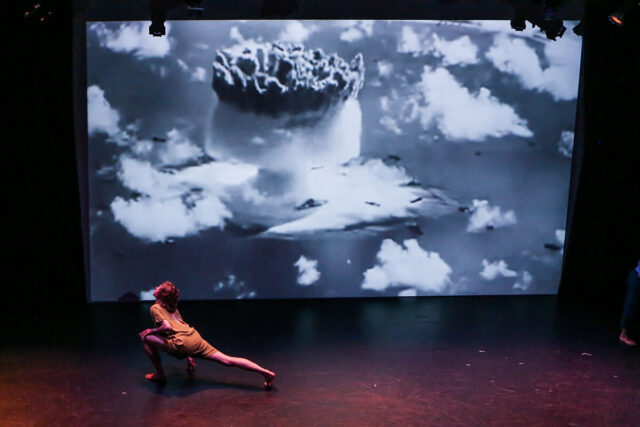
In her artistic statement for her latest show, Shockwave Delay, Bessie-winning multidisciplinary artist and creator Yoshiko Chuma explains, “My work has been called ‘choreographed chaos.’ I have intentionally avoided presenting an ordered universe in my work because I don’t see an ordered universe in my life. I don’t usually think of myself as a choreographer. Sometimes, I think of myself as a counterpoint composer, pitting note against note, placing several singular voices in parallel motion, creating a new harmony. Sometimes, I still consider myself a journalist because my work tends to begin with an outside point of view. I’m interested in the little personal issues of everyday life and how they can affect survival. It is a struggle for me to expand my concepts into something larger that an audience can share. I am always looking for a twist or a variance. Some people have called my work ‘spectacle,’ but I don’t think in these terms. ‘Organized happening’ is a term that might better suit me.”
Running at La Mama June 1-11, Shockwave Delay should be a fascinating “organized happening,” in part a culmination of a forty-year oeuvre but not a retrospective. The world premiere consists of ten unscripted docudramas overlapping twenty chapters melding sound, text, and movement, considering war and utopia in relationship to the circle of life through music, film dance, and theater, early iterations of which have been staged at numerous venues over the last handful of years. It will be performed by a rotating cast of actors (Jim Fletcher, Eileen Myles, Kate Valk), dancers (Agnê Auželyte, Ursula Eagly, Claire Fleury, Mizuho Kappa, Stephanie Maher, Miriam Parker, Emily Pope, Owen Prum, Ryuji Yamaguchi, Yoshiko Chuma), musicians (Robert Black, Jason Kao Hwang, Christopher McIntyre, Dane Terry, Aliya Ultan), and other special guests, ensuring that every performance will be unique. The team also includes visual artists Tim Clifford, Claire Fleury, Elizabeth Kresch. Jake Margolin & Nick Vaughan, Van Wifvat, and Kelly Bugden and photographers Hugh Burckhardt and Julie Lemberger. The June 11 finale will be followed by an auction of archival items accumulated by the School of Hard Knocks since its founding in New York City in 1982. In addition, forty artists and collaborators will be named to Chuma’s “Final Exam: Graduation.”
The Osaka-born Chuma adds, “It has been seventy-nine years since WWII, but Japan still smells of occupation, as if it is a US colony. The United States is my home, but the country’s aggressive influence over the world intrigues me artistically. In the sixties and early seventies, there were a growing number of anti-American and anti-war demonstrations in Japan. I was swept up in this sentiment and attended and ultimately led a number of demonstrations. A demonstration is a like a ‘production,’ and this was truly where I received my artistic training. I was not the type to stand in front of a microphone and rally the crowd, so I did the publicity papers for the demonstrations. I was a silent agitator. I still am an agitator, both silent and not so silent. Art can be revolutionary, but is not always. Art must be guided, and there are limits. I can organize people in space, but it’s hard to organize people in life.”
There’s no telling what might happen at each show, so don’t delay to get tickets to what promises to be a series of unpredictable and awe-inspiring events.
Life of Pi explores religion as a family tries to make a better life away from home (photo by Matthew Murphy & Evan Zimmerman for MurphyMade)
LIFE OF PI
Schoenfeld Theatre
236 West Forty-Fifth St. between Broadway & Eighth Aves.
Tuesday – Sunday through September 3, $58-$244 lifeofpibway.com
On the way to my seat in the Schoenfeld Theatre to see Life of Pi, I passed by two women who had purse dogs with them, small pooches who almost, but not quite, could disappear into their laps. Maybe they were emotional support pets (really?), or maybe it’s part of the growing trend of dog owners bringing their animals with them everywhere they go, although I can’t remember ever having seen any beast other than guide dogs in a Broadway house before. But as it turned out, the two pups were quiet and respectful throughout the 130-minute play (including intermission), unbothered by the wild theatrics involving animals happening onstage.
Canadian author Yann Martel’s 2001 award-winning bestseller was first adapted into a 2012 film that was nominated for eleven Oscars, winning four, for Best Director (Ang Lee), Best Cinematography (Claudio Miranda), Best Original Score (Mychael Danna), and Best Visual Effects.
The play, adapted by Lolita Chakrabarti and directed by Max Webster, grabbed Best Play honors at the 2022 Olivier Awards, but, after seeing it on Broadway, I cannot figure out why.
The story is told by seventeen-year-old Piscine Molitor Patel (Hiran Abeysekera, replaced by Adi Dixit on Tuesdays), known as Pi, who has survived a terrible tragedy on the high seas. It’s 1978, and he’s recovering in a hospital in Mexico, being cared for by a Spanish-speaking nurse (Mahira Kakkar).
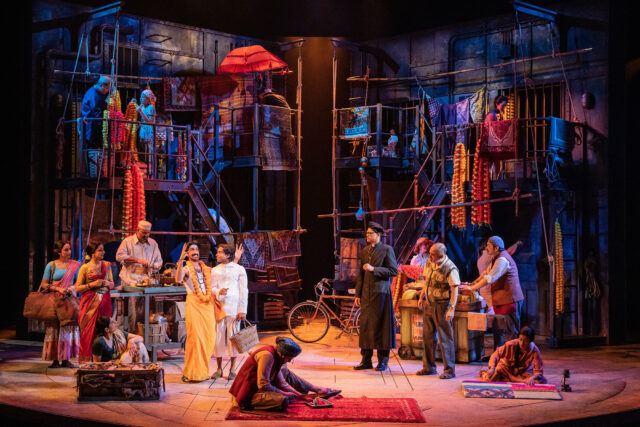
One day he’s visited by Mr. Okamoto (Daisuke Tsuji), from the Japanese Ministry of Transport, and Lulu Chen (Kirstin Louie), from the Canadian Embassy; the former is compiling the official report of the incident, primarily for insurance purposes, while the latter is there to protect Pi’s interests. The tale unfolds in a series of flashbacks told from Pi’s point of view, starting with his life in Pondicherry in India, where his family ran a zoo: his strict father, Baba (Rajesh Bose), his warmhearted mother, Amma (Kakkar), and his older sister, Rani (Sonya Venugopal). The clan includes Pi’s aunt, Mrs. Biology-Kumar (Salma Qarnain), who teaches the siblings about the importance of the natural world, and family friend Mamaji (Sathya Sridharan), who taught Pi how to swim (which comes in handy when you’re lost in the middle of the ocean). Among the animals in the zoo are Richard Parker the Royal Bengal tiger, Orange Juice the orangutan, a zebra, and a hyena.
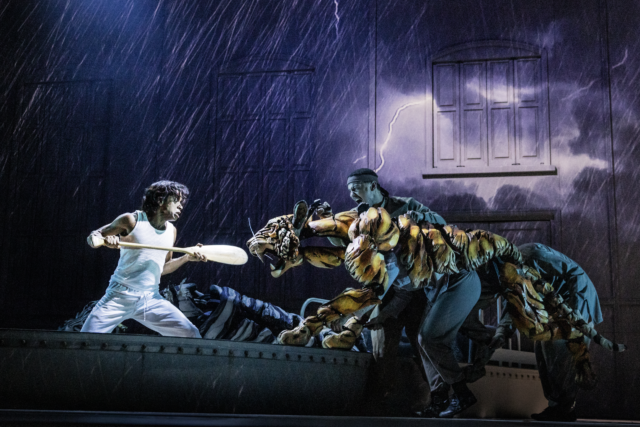
Pi (Hiran Abeysekera) battles Richard Parker the tiger in Life of Pi (photo by Matthew Murphy & Evan Zimmerman for MurphyMade)
A key exchange early on sets the tone for the show.
Pi: Are you a religious man, Mr. Okamoto? Mr. Okamoto: That’s a rather personal question . . . erm . . . no . . . not really . . . Pi: Why not? Mr. Okamoto: Well faith is . . . erm . . . not something that . . . Pi: Many of us lose God along life’s way. Mr. Okamoto: I didn’t lose God. Pi: Then what do you believe? Mr. Okamoto: Mr. Patel, I’d really like to . . . Pi: Please. Mr. Okamoto: I’ve never been a believer. Religion is a habit rather than a truth. A crutch in times of need. Pi: So you’re an atheist. Mr. Okamoto: Yes. Pi: I respect that. Atheists are believers of a different faith. It’s agnostics I don’t understand. They don’t commit to anything. Choosing doubt as a philosophy of life is like choosing immobility as a mode of transport . . . I will tell you everything, Mr. Okamoto . . . because my story will make you believe in God.
Mr. Okamoto is essentially a fictional representation of the audience, many of whom might not be strongly connected to any organizational faith. The play feels like an evangelical attempt to push religion — any religion — on theatergoers. One afternoon in the market, Pi meets with Father Martin (Avery Glymph) of the Catholic church, Zaida Khan (Qarnain) from a Hindu temple, and Pandit-ji (Sridharan) of a Muslim mosque, testing all three denominations. “I just want to love God,” he tells his sister and parents.
Seeking a better life in Canada, the family boards a cargo ship with their animals, but a terrible storm leaves Pi on a large lifeboat with a few of the animals. It’s like a flood of biblical proportions has wiped out humanity, except for the ever-faithful Pi, who is cast adrift with the hyena, Orange Juice, the zebra, and Richard Parker. When Richard Parker attacks him, Pi ecumenically calls out, “Jesus, Mary, and Joseph. Rama, Sita, Durga, and Shiva.”
While at sea, Pi imagines he is visited by his relatives who were killed in the storm, and from time to time Admiral Jackson (Glymph) stops by to offer survival tips. As days extend to weeks and months, Pi fights hunger as he and Richard Parker struggle to stay alive, talking to each other as they face the unknown.
Back in the frame story, Mr. Okamoto finds Pi’s account frankly unbelievable, demanding the truth so he can close the case and absolve both Japan and the shipping company of liability, but when Pi offers a different version of events, the government functionary has to reevaluate his decision. “Which is the better story?” Pi asks him, as if trying to sell him a Bible.
The stagecraft of Life of Pi can be breathtaking when the narrative avoids going overboard. Numerous people operate the animal puppets, with one of the puppeteers or actors providing the voice; it won’t take long before you stop thinking of Richard Parker as a puppet and more of a vicious threat who can tear Pi to bits. The storm scene is truly scary. The ensemble playfully depicts fish swimming in the ocean or butterflies flitting past, accompanied by projections that further the illusions.
The technical team deserves mountains of kudos: The quickly morphing, magical set and effective costumes are by Tim Hatley, the projections by Andrzej Goulding, the puppet design by Nick Barnes and Finn Caldwell, the lighting by Tim Lutkin, and the sound by Carolyn Downing, all of whom have been nominated for Tonys. Nikki Calonge, Fred Davis, Rowan Ian Seamus Magee, Jonathan David Martin, Betsy Rosen, Celia Mei Rubin, Scarlet Wilderink, and Andrew Wilson operate the puppets, with Richard Parker voiced by Brian Thomas Abraham, who also plays the cook, and Orange Juice voiced by Kakkar; the original music is by Andrew T. Mackay.
Abeysekera makes a strong impression in the lead role, able to stand out amid all the scintillating puppetry, but his performance cannot make the audience forget about the overwhelming religious message.
On the way out, I saw those two dogs again; they looked exactly the same as they did on my way in, unchanged by the events of the past two hours. One of the pups let out a big yawn; I can’t say I blame him.
Ellen Lauren and Violeta Picayo portray two versions of the same character in first-ever revival of Evelyn Brown (A Diary) (photo by Steven Pisano)
EVELYN BROWN (A DIARY)
La MaMa Downstairs Theater
66 East Fourth St. between Second & Third Aves.
Friday – Sunday through June 4, $30 www.lamama.org
What does a dramaturg do? In the case of the first-ever revival of María Irene Fornés’s long-lost Evelyn Brown (A Diary), dramaturg Gwendolyn Alker spent five years reconstructing the script from fragments and interviews with members of the original cast and crew. The show opened in 1980 at Theater for the New City, just a few blocks from where it is now being remounted in a beautiful production continuing at La MaMa’s Downstairs Theater through June 4.
The one-act play was adapted from the handwritten journal of Evelyn Brown, a housekeeper in rural Melvin, New Hampshire. Brown, who was born in 1854 and died in 1934, details her daily activities in the 1909 notebook, which was given as a gift to Fornés but is now missing. The protagonist is portrayed by Ellen Lauren as Evelyn and Violeta Picayo as Evelyn Brown, her younger self, in roles originated by Margaret Harrington and Aileen Passloff, respectively. It opens with a blindfolded Evelyn standing front and center on Donald Eastman’s poignant set, which consists of numerous entries and a floor made of unfinished wooden paneling, the white doors contrasting with the dark hallways.
Evelyn removes the blindfold and starts reciting from memory (all spelling, punctuation, and capitalization is transcribed verbatim from the script): “January 1st. Here with Aunt Kate in Wolfboro. spent the day with her went down to Nat’s Store with her also to the Post Office. Got a letter from the Church in Alfred, also a New Years present from Dr. Gardner. in the evening Margaret and I called on Mrs. Davis and Mable.” Between each day, she does a little dance, shuffling her feet backward and forward in a rectangular shape, almost like a square dance but without a partner.
“Second. Cold this morn 6 below zero. have got to go to Melvin. Went over to Plumie’s and took dinner, then Wesley J- came for me and I came with him to Melvin. Stopped here to Charlie’s found the School Teacher still here.”
Evelyn Brown appears, initially watching from the back before joining Evelyn to make Mrs. Hiram Hill’s domestic bread. Both women wear patterned aprons over button-down shirts and long skirts; the costumes are by Fornés’s longtime designer Gabriel Berry. It’s an extremely funny scene as they carefully go through the recipe, only skipping the recommended time for boiling, rising, and baking the ingredients, which scatter across the table and floor as they slice, mash, and knead. It’s an excellent introduction to the next series of daily accounts, which highlight the monotony, drudgery, and sameness of their existence.
They write about doing the laundry. Sweeping and ironing. Preparing and serving meals. Doing the dishes. Dusting. Making beds. Going shopping. Tending to the baby. We learn tidbits about Mr. and Mrs. Porter, Aunt Lydia, Arthur Caverly, Mrs. Gordon, Lizzie, Rob Hunt, and Lillian, about who in the community has died and what the weather is.
María Irene Fornés revival at La Mama is a labor of love (photo by Steven Pisano)
Evelyn Brown and Evelyn “read” entries from empty prop journals as they sit at opposite sides of a long table, slowly climbing on top of it and twisting their bodies in experimental gestures and movements. Evelyn explains where all the cleaning supplies and tools are stored.
Evelyn Brown brings a chair onstage, sitting on it for a moment, then moving it to different locations and sitting on it again and again; Christina Watanabe’s lighting casts her in a glow that is part ghost, part superstar. Evelyn’s recorded voice is heard, taking us through the end of March and into April. (The sound design, which also features music by Mary Z. Cox, is by Jordan Bernstein.)
A long section involves the two women setting, moving, and resetting a series of tables with great precision, a symbol of time passing as the tables get bigger and smaller, including one for children.
The premiere of Evelyn Brown (A Diary) was directed by the Cuban-born Fornés, who died in Manhattan in 2018 at the age of eighty-eight, leaving behind a legacy that includes nine Obies and such plays as The Conduct of Life,Mud,The Danube,Fefu and Her Friends,Drowning, Molly’s Dream, and Pulitzer Prize finalist What of the Night? Revival director Alice Reagan (Fornes’s Promenade and Enter the Night) has done a superb job resurrecting the play, which documents what is/was called “women’s work” with grace and elegance.
Its inherent feminism is reminiscent of Chantal Akerman’s 1975 drama Jeanne Dielman, 23 quai du Commerce, 1080 Bruxelles, about a widowed housewife going through the motions of a drab, repetitive existence, although the film is a humorless three and a half hour affair while Evelyn Brown (A Diary) is a potent seventy minutes, with its fair share of laughs. (However, both feature a potato-slicing scene.) It is also reminiscent of the extraordinary reimagining of Ping Chong’s Lazarus in the same theater this past fall, which also incorporated recorded dialogue, a protagonist with much of his face covered, an intricate table-setting scene, and a theme of otherness. In Evelyn Brown (A Diary), it’s like the Evelyns exist in their own space, separate from everyone else, othered.
Lauren (Chess Match No. 5,Radio Macbeth) and Picayo (Three Little Girls Down a Well,Sense and Sensibility) are outstanding, each one connecting with the audience in their own way. Picayo is more innocent and optimistic as Evelyn Brown, making eye contact with audience members and smiling and laughing more than Lauren, who, in the later version of the same character, does what she needs to do but lacks the hope of her younger self. She takes great care of her responsibilities, but she is far more practical.
The play is no mere time capsule of 1909 New Hampshire or 1980 New York City avant-garde theater; in 2023, it still feels fresh and relevant, radical and alive, in a gorgeous and tender production that deserves wide notice.
Young and old Neil Diamond (Will Swenson and Mark Jacoby) explore their life and legacy in A Beautiful Noise (photo by Julieta Cervantes)
A BEAUTIFUL NOISE: THE NEIL DIAMOND MUSICAL
Broadhurst Theatre
235 West Forty-Fourth St. between Broadway & Eighth Aves.
Tuesday – Sunday through January 7, $84.50-$318.50 abeautifulnoisethemusical.com
There are few things I dread more in theater than jukebox bio musicals, which generally consist of a fawning, glossed-over book and mediocre orchestrations of famous songs that always sound better on the albums made by the star who’s being celebrated. For every well-received Jersey Boys, about Frankie Valli and the Four Seasons, there are unfortunate, overblown, clichéd shows about Michael Jackson,Cher,Tina Turner,the Temptations,Donna Summer, and Carole King. That’s not a good track record.
But every once in a while an extremely clever jukebox musical hits Broadway, taking familiar, existing songs and building an exciting and original story around them. Rock of Ages was a hugely entertaining tale constructed out of songs by such ’70s dinosaurs as Styx, Journey, REO Speedwagon, Foreigner, and Quarterflash. American Idiot re-created the fictional narrative of a Green Day concept album without Broadway-fying the music. Jagged Little Pill examined American suburbia through Alanis Morissette’s oeuvre. And Head Over Heels smoothly inserted hits by the Go-Go’s into a little-known Elizabethan drama like they were a natural fit.
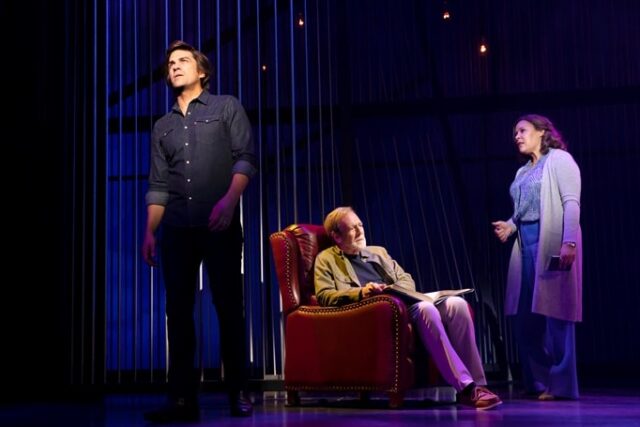
A Beautiful Noise: The Neil Diamond Musical, scheduled to run through January 7 at the Broadhurst, is a major disappointment. The frame story is that the Brooklyn-born Diamond (Mark Jacoby) is meeting with a therapist (Linda Powell) to explore key moments in his life and career. “This isn’t going to work,” he tells her. He’s not kidding.
The book, by four-time Oscar nominee Anthony McCarten (The Collaboration,The Two Popes), goes back and forth between the present day, as Diamond begins to open up to his doctor, who is making him revisit his songs in the huge volume The Complete Lyrics of Neil Diamond, and the past, as his younger self (Will Swenson) rises from shy Brill Building songwriter to folkie to pop superstar. Along the way we meet his parents, Rose (Bri Sudia) and Kieve (Tom Alan Robbins), his early supporter Ellie Greenwich (Bri Sudia), predatory producer Bert Berns (Robbins), and the women who would become his wives, Jaye Posner (Jessie Fisher), Marcia Murphey (Robyn Hurder), and Katie (unseen).
Neil Diamond (Will Swenson) goes for the glitter in jukebox bio musical (photo by Julieta Cervantes)
Tony-winning director Michael Mayer (Spring Awakening, Hedwig and the Angry Inch) can’t find the right rhythm as the narrative meanders, and Tony-nominee Swenson (Hair,Les Misérables) swaggers as Diamond but is unable to embody him as the show presents us with spiritless versions of “I’m a Believer,” “Solitary Man,” “Song Sung Blue,” “Cherry, Cherry,” “Love on the Rocks,” “America,” “Cracklin’ Rosie,” and the obligatory singalong “Sweet Caroline.” (The arrangements are by Sonny Paladino, with orchestrations by Paladino, Bob Gaudio, and Brian Usifer.)
David Rockwell’s set is plenty flashy, with bright lighting by Kevin Adams, standard choreography by Steven Hoggett, and a wide range of costumes by Emilio Sosa. I found myself more involved with the woman a few rows in front of me who kept taking her phone out to video several songs than the actual narrative.
“I don’t . . . I don’t like to talk about myself,” Diamond tells the doctor early on. A Beautiful Noise doesn’t have that much to say about Diamond that we don’t already know (or need to know), so if you really need to hear his music — and you should, because his catalog is one of the best in the business — stream one of his albums or find a tribute band playing in your area.
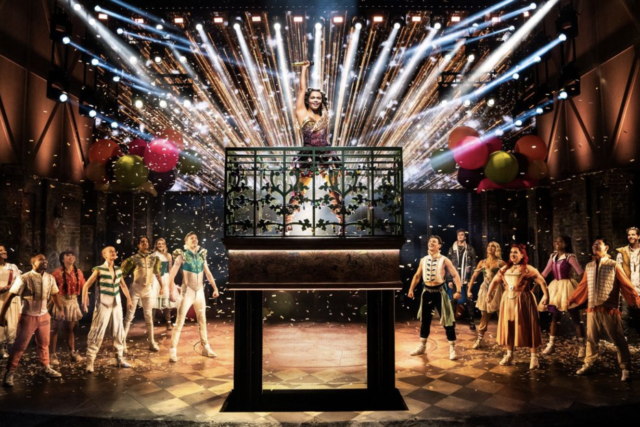
A delightful cast parties its way through & Juliet (photo by Matthew Murphy)
& JULIET
Stephen Sondheim Theatre
124 West Forty-Third St. between Sixth & Seventh Aves.
Tuesday – Sunday through April 21, $89-$338 andjulietbroadway.com
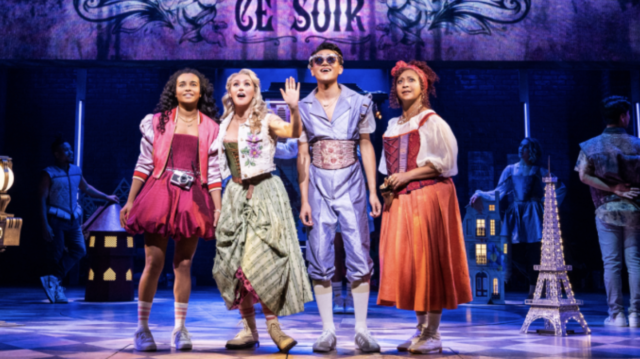
Meanwhile, something inspiring and exhilarating is happening over at the Stephen Sondheim Theatre, where they are taking a new spin on the Bard, whose catalog is unquestionably the best in the business. David West Read’s & Juliet does a fantastic job with a sensational concept: Anne Hathaway (Betsy Wolfe) argues that her husband, William Shakespeare (Stark Sands), screwed up the ending of Romeo and Juliet, and she has decided to change it so Juliet (Lorna Courtney) actually survives and is now in search of a new life, without Romeo (Ben Jackson Walker).
Soutra Gilmour’s lively set prepares the audience from the start, with the curtainless stage containing a large neon sign of the title, the word Romeo having fallen off, as well as a glistening jukebox ready to fill the room with great music. Bill Sherman’s orchestrations and arrangements will delight you, no matter what your preconceived feelings are about the Backstreet Boys, Britney Spears, Robyn, Demi Lovato, Katy Perry, *NSYNC, and Justin Timberlake. But for good measure, Bon Jovi, Ellie Goulding, and P!nk are added to the mix (and Céline Dion!).
However, the songs were not chosen randomly; they were all written or cowritten by Swedish producer Max Martin, who’s clearly an experienced hitmaker of the highest order. (The conceit of sticking with one songwriter’s work doesn’t always pan out, as evidenced by Bat Out of Hell, with famously bombastic songs Jim Steinman wrote for Meat Loaf and others.)
The story begins in Elizabethan England, as Will is about to present the world premiere of Romeo and Juliet, but Anne steps in the way, asking, “What if . . . Juliet didn’t kill herself? . . . I mean, what do I know, but it seems like she’s got her whole life ahead of her, she’s only had one boyfriend. Maybe she doesn’t kill herself just because he killed himself?”
Against his better judgment, Will collaborates on the new plot, making Romeo a serial cheater and creating a new best friend for Juliet, a gender-neutral character named May (Justin David Sullivan). To avoid being sent to a nunnery by her parents (Nicholas Edwards and Veronica Otim), Juliet takes off for Paris with May and Angélique (Justin David Sullivan and Melanie La Barrie), her nurse and confidante. Anne writes herself into the play and portrays the carriage driver.
In Paris, they go to a Renaissance Ball, where Juliet meets a musician named François DuBois (Philippe Arroyo, although I saw the excellent understudy Brandon Antonio), whose testosterone-fueled father, Lance (Paulo Szot), is the host of the fancy soirée. “As you can see, I play the virginal,” François tells Juliet, who responds, “Me too. I feel like doing it once shouldn’t count.”
Juliet (Lorna Courtney) looks for love in charming Broadway musical (photo by Matthew Murphy)
Pretty soon there’s all kinds of couplings and uncouplings going on as Angélique and Juliet sing “Oops! . . . I Did It Again,” May and François lead the company through “I Kissed a Girl,” Anne and Juliet duet on “That’s the Way It Is,” Lance, François, and May team up on “Shape of My Heart,” and everyone joins in on “Can’t Stop the Feeling!”
Directed with virtuoso aplomb by Luke Sheppard (The Secret Diary of Adrian Mole,In the Heights), who turns the proceedings into a kind of affectionate adult fairy tale, & Juliet is a rousing success. It tackles misogyny, homophobia, gender bias, and other forms of social injustice with a playful sense of humor and a genuine heart, from Paloma Young’s elegant costumes, which mix the traditional with the modern, Howard Hudson’s frenzied lighting, Andrzej Goulding’s dazzling projections, and Gareth Owen’s explosive sound. Jennifer Weber’s appropriately energetic choreography keeps it all moving through Gilmour’s set, which includes miniature landmarks, fun furniture, and, yes, a balcony.
Native New Yorker Lorna Courtney (Dear Evan Hansen,West Side Story) is thoroughly engaging as Juliet, a young woman ready to take control of her own life. Sullivan portrays May with a touching bittersweetness, and La Barrie is eminently likable as Angélique, who remains by Juliet’s side even when she thinks she’s making some very bad choices. Two-time Tony nominee Sands (Kinky Boots,To Kill a Mockingbird) and Wolfe (The Mystery of Edwin Drood,Falsettos) make a great pairing as a husband and wife battling over more than just theatrical conventions and expectations.
At its heart, the wonderful show is centered around Emmy winner Read’s (Schitt’s Creek,The Performers) terrific book, which provides plenty of room for character development while never missing an opportunity for a clever literary laugh.
At one point, Juliet declares, “This is already the best night ever, and all we’ve done is leave my bedroom!” Angélique explains, “Juliet, we have to go. If your parents see you, you’ll be forced to join the nunnery.” Anne cuts in, proclaiming, “Well, we will have none of that.” Angélique asks, “What?” May says, “Ew.”
“Sorry, my husband makes puns. It’s a force of habit,” Anne clarifies, even explaining the joke for those who might not have gotten it immediately.
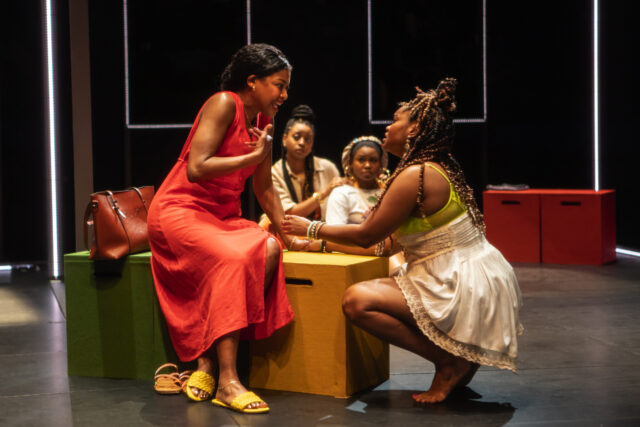
Sisters gather at the family home in Flatbush to figure out what happens next (photo by Monique Carboni)
BERNARDA’S DAUGHTERS
The Pershing Square Signature Center
The Romulus Linney Courtyard Theatre
480 West Forty-Second St. between Ninth & Tenth Aves.
Tuesday – Sunday through June 4, $37-$87 thenewgroup.org www.nationalblacktheatre.org
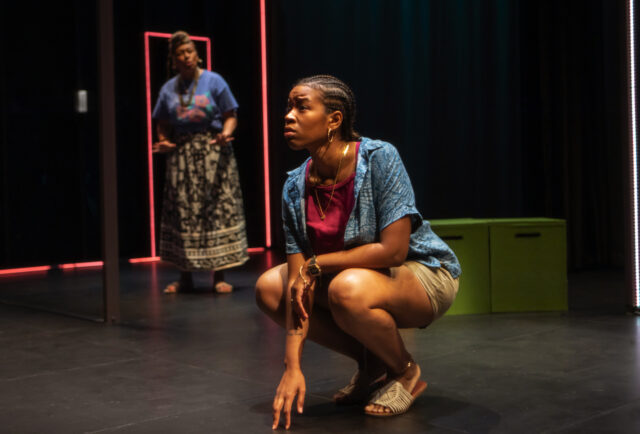
Carlos J. Soto’s set is a harbinger of what is to come in the world premiere of Diane Exavier’s Bernarda’s Daughters, a powerful and moving coproduction from the New Group and National Black Theatre that opened at the Romulus Linney Courtyard Theatre at the Pershing Square Signature Center this week. The audience sits on three sides of the staging area, a sparse room with several painted wooden boxes on the floor and the skeleton of a house, with only the frames of doors and windows, occasionally illuminated in a string of LED lights. While it appears that the five protagonists in the title can leave at any moment, just walk through the empty doors or even climb through the windows, they are trapped by both fear and legacy. For ninety minutes the characters discuss their futures, but it always ends up with them back in the house, their life at a standstill.
Bernarda’s Daughters was inspired by Spanish poet and playwright Federico García Lorca’s last completed play, The House of Bernarda Alba, which he wrote in 1936, the year he died at the age of thirty-eight. First produced in 1945, the story has been adapted into a musical, an opera, a dance, and several films, with the location changing from Spain to Iran, India, Australia, the American south, and other places around the world, proving the universality of the themes.
Exavier’s version is set in modern-day Flatbush, Brooklyn (my hometown), where five sisters have gathered in the family home: Louise (Pascale Armand), Harriet (Alana Raquel Bowers), Lena (Kristin Dodson), Maryse (Malika Samuel), and Adela (Taji Senior). Their mother is in Haiti, attending the funeral of their father. The play begins with each sister delivering a brief introduction. For example, Louise, a city nurse who has a different mother but the same father as the other four, explains, “Each of us sisters is a room in our mother’s house, our grandmother a countryside. Intimate and immense. If you were to, say . . . put on a play about us, there would be no center-staged couch, no staircase, no fabrication of a gentrifying city just outside the windows, no nod to some ancestral land. Our city is dying and our city is inside of us. There are countries that are dying and those countries are inside of us. We are at the edge of living. We are the world we live in.”
Florence Delva (Tamara Tunie) is concerned about Adela (Taji Senior) in Bernarda’s Daughters (photo by Monique Carboni)
Outside, the noise of construction and protest pierces through their conversations; amid gentrification, there’s been another police shooting of a young, mentally ill, unarmed Black man. “They don’t see the people in the neighborhood. They live in those castles with the police as their front desk,” Adela says of the influx of white people flooding into the neighborhood. “They dial 911 like they’re out of toilet paper. ‘Excuse me, can you just?’ ‘Would you mind?’ It’s sick. I’m so tired of it.” Adela wants to join the march but can’t take action, instead watching it through the window, her face only a few feet from the audience, implicating us in what is happening to their community.
Louise and Harriet have a plan to use land their father left Louise in Jacmel, Haiti, to build a small vacation villa. They all discuss whether they will be moving out of the house — which their parents might have acquired under suspicious circumstances — or staying there with their grandmother, Florence Delva (Tamara Tunie), once their mother returns from her mourning period. When they find out what havoc their parents’ decisions have wrought, however, their lives are suddenly turned upside down.
“Louise, you know you can’t buy, you can’t rent, you can’t be dead here. Shit’s insane,” Adela says. Louise replies, “It’s ridiculous. Whatever happens, just don’t put me in Long Island.”
But as Adela says, “I feel like the house is killing us slowly. . . . You guys have to get out.”
Exavier fills the dialogue with poetic interludes and quotes based on writings and statements by James Baldwin, Louise Glück, Mary Ruefle, Trumbull Stickney, Morgan Parker, Kamau Brathwaite, Toni Morrison, and Florence Miller, whose husband was choked to death in Crown Heights by the police in 1978. In a compelling monologue about sex, sun, cats, and the dead, Maryse, who is a school librarian, says, “I love watching the sun on graves, illuminating names, how bright the light is, blazing the stone, and the sky so blue above recalling the color of bone.”
Later, Harriet says, “You really think I love love so much? You don’t know anything. I’m mourning it! I’m so far past love I never even stood a chance. I was born beyond it. We all were. Love — in this fucking country? My womb was full of rocks. That’s what bodies like ours think of love: babies made of stone. . . . I really think we are the end of it all. And I think that’s what makes us so goddamn American. Because this stupid country is like the waking end of a crazy-ass fever dream. And you trying to out-America everyone you lay down with because the only way to have a little power is to step on somebody else’s back is just wrong! But even worse than that, it’s useless.” Meanwhile, the words free and freedom appear seven times in the play, ideals that seem to be just out of the characters’ reach.
The actors portraying the sisters are outstanding, with native Brooklynite Dodson standing out as the boisterous Lena. The women believably argue and share personal intimacies like real sisters; however, Obie winner Tunie (Building the Wall,Familiar) has her hands full as the over-the-top Florence, who hearkens back to the old days in Haiti but is overdrawn here. The curtain at the rear of the stage feels unnecessary, but Rodrigo Muñoz’s costumes meld Brooklyn with Port-au-Prince, and Marika Kent’s lighting and Kathy Ruvuna’s sound are effective, particularly the never-ending commotion going on outside.
Directed by Dominique Rider with a clear connection to the characters, Bernarda’s Daughters is a potent look at what the Haitian community in New York City has, what it’s lost, and where it might be heading. Like Adela proclaims, “I keep telling you guys. It’s a different Brooklyn out there.” She’s not just talking about Flatbush.
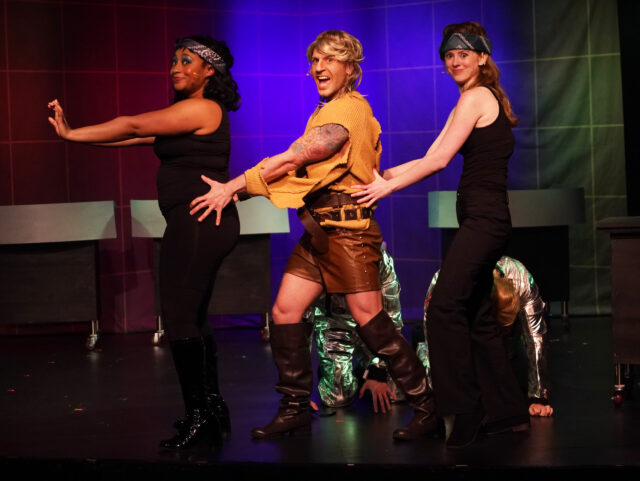
Khan (Zachary Kropp) is flanked by two of his minions (Crystal Marie Stewart and Laura Whittenberger) in Star Trek parody (photo by Carol Rosegg)
KHAN!!! THE MUSICAL! A PARODY TREK-TACULAR
Players Theatre
115 MacDougal St.
Thursday – Sunday through June 4, $25-$65 www.khaniscoming.com
Brent Black’s Khan!!! The Musical! is a series of missed opportunities, unable to pass its own Kobayashi Maru training exercise, trapping itself too often in no-win situations.
In the 1967 Star Trek episode “Space Seed,” Captain James T. Kirk (William Shatner) of the USS Enterprise exiles Khan Noonien Singh (Ricardo Montalbán) and his Botany Bay crew of genetic superhumans to the abandoned planet Ceti Alpha V. Fifteen years later, Khan returns to seek revenge in Nicholas Meyer’s hit 1982 film Star Trek II: The Wrath of Khan.
Khan!!! The Musical!, subtitled “The Parody Trek-Tacular,” running at the Players Theatre through June 4, takes place in 2336, as Lt. Commander Data (Julian Manjerico) is writing a musical about Kirk and Khan’s intense battle, to be performed by a holographic cast of members of Starfleet. The emotionless Data regularly stops the show to inquire how the artificially intelligent audience program is enjoying it and to introduce the next scene.
“Musical theater. Is it merely an archaic four-hundred-year-old art form gone the way of disco, boy bands, and Klingon disco boy bands? Or does musical theater hold insights for all humanoids?” he begins. “As part of my mission to become more human, I wanted to find out. So I forced myself to watch one thousand hours of twentieth-century Earth musicals, then synthesized them all into a playwriting subroutine, and assembled a musical comedy based on one of the most dramatic events in Starfleet history.”
Despite some very clever lines and funny moments, too much of Khan!!! The Musical! ends up feeling like it was written by AI or ChatGPT.
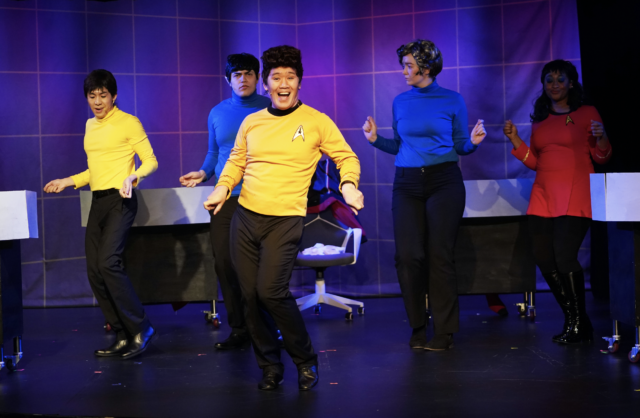
On hand are all the beloved favorites of the starship Enterprise: Mr. Spock (Max Nusbaum), chief medical officer Leonard “Bones” McCoy (Lindsey M. E. Newton), chief engineer Montgomery “Scotty” Scott (Newton), helm officer Hikaru Sulu (Clayton Matthews), communications officer Uhura (Crystal Marie Stewart), and Admiral Kirk (Shyaporn Theerakulstit, who played Sulu on three episodes of Star Trek Phase II); in addition, Pavel Chekov (Matthews) is now the first officer of the USS Reliant, the starship taken over by Khan (Zachary Kropp). New to the cast are Lt. Saavik (Laura Whittenberger), a half-Vulcan cadet who believes in following the rules; Joachim (Manjerico), Khan’s subservient right-hand man; Peter Preston (Manjerico), Scotty’s nephew; Dr. Carol Marcus (Stewart), head of Project Genesis; and her son, David (Manjerico).
Oddly, Captain Terrell, who in the film was played by Emmy winner and Oscar nominee Paul Winfield, has been changed into a redshirt, the term used for extremely minor characters who get killed on away missions; he’s listed in the script as Terrell, but my guess is that since there’s no Black actor in the cast, they opted not to have a person of a different background portray him. (The script requests that productions avoid whitewashing.)
Admiral James T. Kirk (Shyaporn Theerakulstit) leads a song and dance as he battles an old enemy in Khan!!! The Musical! (photo by Carol Rosegg)
Khan!!! The Musical! starts off with a bang as it sets the stage for what is to come. Ivey Jenkins-Long’s ultra-low-budget set features bridge consoles on wheels, a handmade cardboard Genesis missile, and a makeshift engineering room. Jolene Richardson’s costumes evoke those of the television series and films, with Kropp looking particularly fine in his torn, open-shirted warrior getup, although I still can’t figure out why they didn’t make a joke about “fine Corinthian leather,” as Montalbán described the interior of the Chrysler Cordoba in a series of mid-1970s car commercials.
Otherwise, inside jokes, pop-culture references, and shots at numerous Star Trek inconsistencies abound. “You know, Khan . . . you seem to leave a trail of death everywhere you go, but like some kind of Imperial Stormtrooper, you keep missing the target!” Kirk growls at his adversary. “The no-win scenario isn’t really about passing or failing. The point is your character,” Bones tells Saavik, who replies, “I have often wondered what the point of my character is.”
Nicholas Kaminski’s music direction and Angel Reed’s choreography pay homage to such classics as Chicago,Les Misérables,Grease, and The Rocky Horror Picture Show in such songs as “Young,” “The Needs of the Many,” and “Buried Alive,” but they quickly become repetitive, and too many numbers are unnecessary, particularly “When the Chickens Come Home,” with giant mutant fowl laying an egg kicking off the second act. Constant mentions of the game Battleship and Joachim’s desire to go bowling are tedious, as are Kirk and Spock calling each other by fan-fiction-inspired lover nicknames, “Frosty-buns” and “Jim-jam”; the concept is good, but it would have been better if they changed the nicknames each time. The show was co-conceived by Black with Alinca Morgan, who contributed “additional materials,” and is directed by John Lampe, who will have to take the Kobayashi Maru again.
It also gets confusing as some actors closely impersonate their characters’ voice and movement while others don’t; Theerakulstit’s embodiment of William Shatner is fun at first but slows down the pace as it continues, and the decision to have David talk like Shatner peters out immediately. And the amount of time spent on Preston is inexplicable.
Star Trek II: The Wrath of Khan is one of my favorite movies, so maybe I was expecting too much from Khan!!! The Musical! There were a lot of Trekkies in the audience the night I went, many of whom were off to the Trek Long Island convention that weekend, and they were having a great time.
The most famous moment in the film is when an angry Kirk clenches his fist and screams out, “Khan!”
After the show, I wanted to scream out, “Khan!!! The Musical!”
Who: Julie Benko, Andréa Burns, Carolee Carmello, Nikki Renée Daniels, Laura Darrell, Ali Ewoldt, Marina Kondo, Emilie Kouatchou, Bryce Pinkham, Scarlett Strallen, Jessica Vosk, Sally Wilfert, more What:Tribute to Broadway favorite Rebecca Luker Where:Symphony Space, 2537 Broadway at Ninety-Fifth St. When: Monday, May 22, $35-$250, 8:00 Why: On May 10, 2018, Alabama-born Broadway star Rebecca Luker presented “Project Broadway: The Rebecca Luker Songbook” at Symphony Space, a concert featuring the world premiere of eighteen songs written specifically for her by such composers as Deborah Abramson, Sam Davis, Stephen Flaherty, Jenny Giering, Sheldon Harnick, Henry Krieger, Andrew Lippa, Matthew Sklar, and Joseph Thalken. The three-time Tony nominee (Show Boat,The Music Man,Mary Poppins) announced in 2020 that she had ALS, and she died on December 23 of that year, survived by her husband, Tony winner Danny Burstein, and his two sons.
On May 22, a wonderful collection of Broadway stars will honor Luker and the fifth anniversary of “The Rebecca Luker Songbook” when they gather at Symphony Space and debut twenty-four different songs written for Luker, by Carmel Dean, Scott Eyerly, Giering, Mike Heitzman and Ilene Reid, Krieger, Lippa, David Loud, Martin Lowe, Joshua Rosenblum, Sam Willmott, and others. (The project included more than eighty original numbers.) Among those performing will be Julie Benko, Andréa Burns, Carolee Carmello, Nikki Renée Daniels, Laura Darrell, Ali Ewoldt, Marina Kondo, Emilie Kouatchou, Bryce Pinkham, Scarlett Strallen, Jessica Vosk, and Sally Wilfert; Thalken will serve as music director, with Deborah Avery on clarinet, Katherine Cherbas on cello, Craig Magnano on guitar and ukulele, and Benny Koonyevsky on percussion. The concert will raise funds for Project ALS, which “identifies and funds the most promising scientific research that will lead to the first effective treatments and a cure for ALS. We recruit the world’s best scientists and doctors to work together — rationally and aggressively — to develop a better understanding of the ALS disease process and, in parallel, better therapeutic strategies.” Tickets range from $35 to $250; the concert, directed by producer Annette Jolles, will also be livestreamed for $35.