this week in theater

GABE MOLLICA — SOLO: A SHOW ABOUT FRIENDSHIP / COLIN QUINN: SMALL TALK

Gabe Mollica shares his difficulty in making friends in one-man show (photo by Mindy Tucker)

GABE MOLLICA: SOLO: A SHOW ABOUT FRIENDSHIP
Soho Playhouse
15 Vandam St. between Varick St. & Sixth Ave.
Wednesday – Saturday through February 25, $36, 9:00
Extension: Connelly Theater Upstairs
220 East Fourth St. between Aves. A & B
Tuesday – Saturday through November 18, $40
www.sohoplayhouse.com
www.gabemollica.com

Having earned multiple extensions since opening at Soho Playhouse on November 2, comedian Gabe Mollica and his one-man Solo: A Show About Friendship are hard not to love. Yet the night I went, there were fewer than twenty people in the audience, several of whom Mollica knew, referring to them by name as they nodded in agreement with something he said onstage. In his easygoing, not-quite-self-deprecating demeanor, Mollica started the sixty-minute confessional pointing out that he has performed Solo for three people at the Edinburgh Fringe Festival — “the same three people that an hour earlier I had had dinner with” — and for a packed Soho Playhouse on a Saturday night, so he was not bothered by such a sparse turnout on a cold Thursday. In fact, it fit the theme of the evening, which he explains early on: “This is a show about how I don’t have friends.”

Mollica, who recently turned thirty, hails from Garden City, and lives in Astoria, spends an hour detailing his lifetime of seeking male companionship that goes beyond mere camaraderie. He provides a spot-on description of his “six bros,” complete with their going-out and staying-home rituals. One of the bros, Nick, makes ranked lists, from types of music and wood to Adam Sandler flicks. (Yo, Nick, how is Uncut Gems not in the top ten?). Mollica also reveals that his mother, who is named Joy, is sick. (“She’s feeling a lot better now. Thank you for asking.”)

Obsessed in high school with Stephen Sondheim and terrible at sports, Mollica found himself trapped in the middle, “too straight for the gay kids but too gay for the straight kids.” At college he meets Tom, and they hit it off right away, becoming inseparable. Mollica is thrilled beyond belief that he finally has someone he can say anything to, can receive unconditional support from, and is able to be completely honest with.

Gabe Mollica admits to being “too straight for the gay kids but too gay for the straight kids” in Solo (photo by Mindy Tucker)

Mollica relates his and Tom’s adventures and misadventures, but because he’s already told us that today he has no friends, there’s some well-executed narrative tension as we await the inevitable funny/not-funny punchline. Before he gets to that, Mollica discusses his origins as a stand-up comic, his relationships with a few women, and his job working at a summer camp, occasionally supplemented with photos projected on a screen at the back of the stage, which otherwise features only a small stool and a carpet.

Smoothly directed by comedian and monologist Greg Walloch (Hasan Minhaj: Homecoming King, F**k the Disabled), Solo is an engaging and heartfelt look at male bonding and the need to have friends, regardless of gender. The show is smartly written, with a finale that circles back to the beginning and results in a poignant conclusion that makes you want to immediately get in touch with your best friend(s). Mollica has a natural charm that, well, will compel you to want to be his friend. After the show, he greeted audience members outside the theater, shaking hands, hugging, and posing for photos. We invited him to an upcoming tribute to Stephen Sondheim; we don’t know whether he’ll be coming solo.

Colin Quinn offers more than just small talk in Small Talk (photo by Monique Carboni)

COLIN QUINN: SMALL TALK
Lucille Lortel Theatre
121 Christopher St.
Monday – Saturday through February 11, $49-$59
Greenwich House
27 Barrow St. at Seventh Ave. South
Tuesday, Saturday, Sunday, March 30 – May 6, $49-$79
www.colinquinnshow.com

There’s a fine line between thematic stand-up comedy and a one-person theatrical show. Recent presentations such as Mike Birbiglia’s The Old Man & the Pool, Alex Edelman’s Just for Us, and Ryan J. Haddad’s Hi, Are You Single? qualify as the latter, as does Gabe Mollica’s aptly titled Solo.

Brooklyn-born actor and comedian Colin Quinn is a master of the one-man show, having explored the history of New York, America, and the world in such highly praised works as Long Story Short, Unconstitutional, The New York Story, and Red State Blue State.

His latest solo foray is Colin Quinn: Small Talk, continuing at the Lucille Lortel Theatre through February 11 (and now extended March 30 to May 6 at Greenwich House). The seventy-five-minute show explores how strangers connect, or don’t, by taking part in brief, generally inconsequential face-to-face conversations in elevators, at stores, at work, or on the street, chatting about the weather, sports, what day of the week it is, and other minor tidbits. “Small talk is intimate. It’s an acknowledgment,” he explains. “It’s like two ships that signal each other in the ocean. . . . It’s how we unite by common experience in under a paragraph.”

He worries that the way kids today are being raised, the end of small talk, which began with cavemen and reached new levels with Socrates, is fast approaching, since it depends on one of humankind’s most important inventions, “citizen personality,” which we no longer teach or value. “Personality is who the people that know you think you are. Your reputation is who the people who don’t know you think you are. Your social media profile is who you think you are, and your browser history is who you are,” he says.

Colin Quinn discusses banter, personality, and the history of small talk in latest solo performance (photo by Monique Carboni)

Walking around the stage in a black tee, unbuttoned black shirt, black pants, and white sneakers, Quinn, in his familiar gravelly voice, fills the show with pop-culture references, controversial political issues, and the top five “last words.” Individual jokes can be incisive, immediately relatable, and very funny, but the show, directed by James Fauvell, feels at times like it’s still a work-in-progress. Several tangents and digressions don’t seem to arise naturally from the narrative.

Quinn, who had a heart attack on Valentine’s Day in 2018 when he was fifty-eight, scans the audience for reactions as if he’s testing out new material. After seeing him look up numerous times at a spot in the back of the theater, I turned around and noticed a monitor where the text was scrolling by. He also uses a handheld microphone, which is more associated with stand-up than theatrical productions. Zoë Hurvitz’s set consists of ten blackboards with chalk drawings on them, linking images of hands and faces with Ancient Greek words and modern emojis, but they are never incorporated into the show or identified, which left me scratching my head.

From his days on MTV’s Remote Control and Comedy Central’s Tough Crowd with Colin Quinn through his solo presentations and film and television appearances (Girls, Trainwreck), Quinn has demonstrated his unique personality along with his hilarious and all-too-real take on society at large. “Some people don’t like small talk,” Quinn says in the show. I liked Small Talk, but I wanted to love it. Quinn’s response might be, as he says about one friend’s thoughts on sausage and peppers, “Nobody gives a shit and nobody asked you.” To which I might respond, “Hey, how ’bout this weather?”

THE COLLABORATION

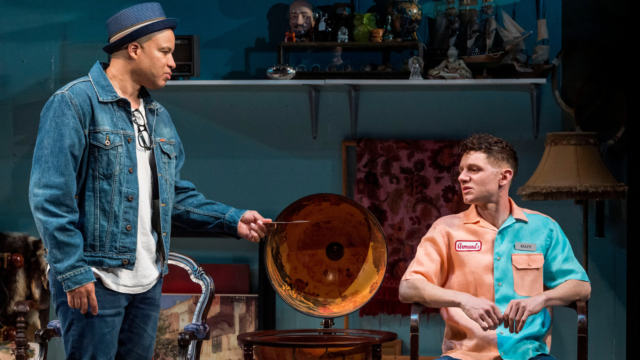
Andy Warhol (Paul Bettany) and Jean-Michel Basquiat (Jeremy Pope) collaborate in new Broadway play (photo by Jeremy Daniel)

THE COLLABORATION
Samuel J. Friedman Theatre
261 West Forty-Seventh St. between Broadway & Eighth Ave.
Tuesday – Sunday through February 11, 474-$318
www.manhattantheatreclub.com

In the fall of 1985, gallerist Tony Shafrazi and art dealer Bruno Bischofberger presented “Warhol Basquiat: Paintings” on Mercer St., an exhibition of works made in tandem by Pop Art maestro Andy Warhol, looking to restore himself to relevance, and rising street-art superstar Jean-Michel Basquiat, who wanted to reach the next level of fame and fortune. The story of this unusual alliance is told in Anthony McCarten’s boldly titled The Collaboration, extended through February 11 at Manhattan Theatre Club’s Samuel J. Friedman Theatre.

While Basquiat and Warhol’s teaming up might have been a lightning strike of an idea in the art world, it’s more than a bit presumptuous to declare that it was the collaboration; if you didn’t know what the play was about, the title wouldn’t make you first think of this unexpected partnership. That aside, it was a fascinating moment in art history, and just as the collaboration was not wholly successful, so goes The Collaboration on Broadway.

In September 1985, Vivian Raynor wrote about the exhibit in the New York Times, “It’s a version of the Oedipus story: Warhol, one of Pop’s pops, paints, say, General Electric’s logo, a New York Post headline, or his own image of dentures; his twenty-five-year-old protege adds to or subtracts from it with his more or less expressionistic imagery. The sixteen results — all ‘Untitleds,’ of course — are large, bright, messy, full of private jokes, and inconclusive.” The same can be said of the play itself.

Alternatively, artist Keith Haring wrote in “Painting the Third Man” in 1988, “Jean-Michel and Andy achieved a healthy balance. Jean respected Andy’s philosophy and was in awe of his accomplishments and mastery of color and images. Andy was amazed by the ease with which Jean composed and constructed his paintings and was constantly surprised by the never-ending flow of new ideas. Each one inspired the other to outdo the next. The collaborations were seemingly effortless. It was a physical conversation happening in paint instead of words. . . . For me, the paintings which resulted from this collaboration are the perfect testimony to the depth and importance of their friendship. The quality of the painting mirrors the quality of the relationship. The sense of humor which permeates all of the works recalls the laughter which surrounded them while they were being made.”

Meanwhile, poet, songwriter, and playwright Ishmael Reed offered little love for Warhol in his recent show, The Slave Who Loved Caviar, feeling that Warhol treated Basquiat like a mascot; Reed wrote, “As Basquiat, the Radiant Child of the downtown art scene of the 1980s, was sacrificed to sustain the dying career of a fading Super Star, Antonius was sacrificed so that Hadrian would recover from a mysterious illness.”

Andy Warhol (Paul Bettany) films Jean-Michel Basquiat (Jeremy Pope) in The Collaboration (photo by Jeremy Daniel)

Part of McCarten’s Worship Trilogy, which also includes The Two Popes and Wednesday at Warren’s, Friday at Bill’s, The Collaboration takes place alternately in Bischofberger’s (Erik Jensen) Manhattan gallery, Warhol’s (Paul Bettany) studio near Union Square, and Basquiat’s (Jeremy Pope) loft apartment and studio on Great Jones St. At first both artists are hesitant to work together; being shown Basquiat’s paintings for the first time by Bischofberger, Warhol, referring to them as “art therapy things,” says, “They’re so . . . busy. Is it too much? Or am I getting old? And so much anger. All these skulls and gravestones everywhere. I thought I was bleak. And all these words and symbols, what’s it all mean? What’s he trying to say? Bruno? Do you know? And why do they have to be so ugly? Did he tell you? Does he talk about that? They’re so ugly and angry and yeah, well, they’re kinda violent. I’d be careful; he’s really in trouble, I think.”

Basquiat is also unsure of the potential partnership, telling Bischofberger, “I’m better than Andy. I don’t need this. . . . And how come he doesn’t paint anymore, you know? Just mechanically reproduces all these prints? There’s no soul. I’m Dizzy Gillespie, blowing a riff, he’s one of those pianos that plays all by itself. The same tune. Over and over. You seen those things? Pink, pink plonk, pinkety pinkety pink.”

Bischofberger, who represents both artists, promises Warhol, “It will be the greatest exhibition ever in the history of art.” Warhol says, “Please don’t exaggerate.” The dealer boasts, “Warhol versus Basquiat.” The Pop maestro wonders, “Oh, versus? Gee, you make it sound so macho, like a contest. I don’t know. I thought you said it would be a collaboration?” Bischofberger answers, “Painters are like boxers; both smear their blood on the canvas.” The promotional posters for the exhibition — which eventually will become more famous than the actual works (one of the original posters hangs in my apartment) — feature Warhol and Basquiat wearing boxing gloves, ready to do battle.

But soon the soft-spoken Warhol, who hadn’t picked up a paintbrush in more than twenty years but has amassed a fortune through his silkscreens, photography, films, and business savvy, is creating canvases with Basquiat, who is far more spontaneous and unpredictable, taking drugs, sleeping around (Krysta Rodriguez plays Maya, a fictionalized version of Basquiat’s girlfriend Suzanne Mallouk), and keeping his cash in the refrigerator.

Once the playwright finally gets Andy and Jean putting paint to canvas, their debates about the purpose of art sound a bit sanctimonious. No one knows what their conversation was really like: Within three years, they would both be dead, Basquiat in 1987 at the age of twenty-seven, Warhol in 1988 at the age of fifty-eight.

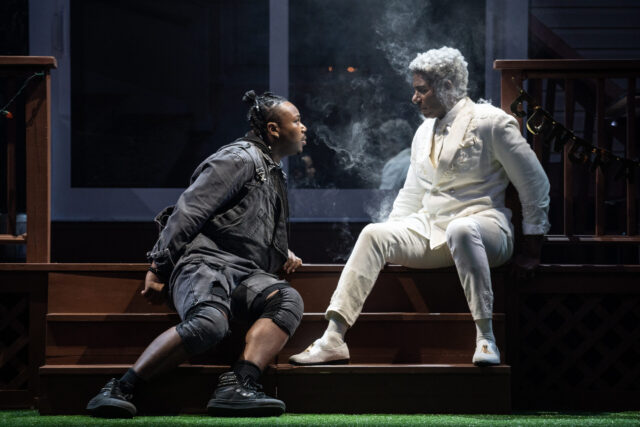
Directed by Kwame Kwei-Armah (Things of Dry Hours, One Night in Miami), The Collaboration works best when Warhol and Basquiat get down to brass tacks, exploring what they might do together, each suspicious of the other’s motives and abilities. In roles previously played by David Bowie and Jeffrey Wright, respectively, in Julian Schnabel’s 1996 film, Basquiat (Dennis Hopper was Bischofberger), Bettany (Love and Understanding, WandaVision) and Tony nominee Pope (Choir Boy, Ain’t Too Proud) are phenomenal. Pope embodies Basquiat’s untethered energy, his lust for life, and his social conscience, particularly when learning that his friend, graffiti artist Michael Stewart, is in the hospital after an altercation with the police. Bettany not only looks great in Warhol’s trademark white fright wig and black turtleneck and sneakers (the wigs are by Karicean “Karen” Dick and Carol Robinson, with sets and costumes by Anna Fleischle) but captures his awkward, strange public persona.

Rodriguez (Into the Woods, Seared) does what she can as the underwritten Maya, an amalgamation that stretches the truth of Basquiat’s relationships with women, and Jensen (Disgraced, How to Be a Rock Critic) provides a solid middle ground to highlight the disparity between his two artists.

Andy Warhol (Paul Bettany) watches Jean-Michel Basquiat (Jeremy Pope) paint in The Collaboration (photo by Jeremy Daniel)

The narrative takes a sharp turn beginning at intermission, when large monitors just outside both sides of the stage show footage of Bettany’s Warhol and Pope’s Basquiat collaborating, painting on transparent glass, mimicking the style Warhol uses when filming Basquiat on his 16mm spring-wound Bolex movie camera. As they did prior to the beginning of the show, DJ theoretic spins thumping 1980s music from a booth on the stage as the prerecorded film plays.

During the second act, Kwei-Armah and McCarten, who has written such fact-based films as The Theory of Everything, Darkest Hour, and Bohemian Rhapsody and the book for the current Neil Diamond musical A Beautiful Noise, become obsessed with Warhol’s live footage of Basquiat (the projections are by Duncan McLean), so it’s hard to know where to look. (Oh, what Ivo van Hove has wrought.) A notoriously private person despite his fondness for late-night celebrity-studded parties, Warhol wants to capture the real Basquiat on film, but Basquiat doesn’t want to be seen as a commodity. This dichotomy further emphasizes the difference, and psychological distance, between Basquiat and Warhol, whose shows are still blockbusters today. (For example, Basquiat’s biographical “King Pleasure” in Chelsea last year and the Whitney’s 2018-19 “Andy Warhol — From A to Be and Back Again.”

None of Warhol’s footage exists today, so we don’t know what really happened, but what McCarten and Kwei-Armah depict grows more confusing and annoying by the second. We also don’t see enough of the artists’ collaboration itself, but that output is not considered among either one’s most well regarded works. Alas, the same can be said of the creators of the play. But as Warhol explains to Basquiat, “I don’t think there’s going to be a revolution, but if there is it will be televised, with commercial breaks, cause it’s all about brands now. Even us, we’re not painters, we’re brands. Jean. We’re brands. Well, you’re almost a giant brand, and after this exhibition with me you will be too. Then just watch the language change, Jean.”

The Collaboration concludes on the same note as Eduardo Kobra’s large-scale 2018 mural in Chelsea above the Empire Diner, a reimagined Mount Rushmore with the faces of Andy Warhol, Frida Kahlo, Keith Haring, and Jean-Michel Basquiat, all of whom remain brands to this day.

BETWEEN RIVERSIDE AND CRAZY

Stephen McKinley Henderson is unforgettable as Pops in Stephen Adly Guirgis’s Between Riverside and Crazy (photo by Joan Marcus 2022)

BETWEEN RIVERSIDE AND CRAZY
Hayes Theater
240 West 44th St. between Broadway & Eighth Ave.
Tuesday – Sunday through February 19, $68-$210 (live simulcast $68)
2st.com/shows

At the 2015 Drama Desk Awards, I had the option of being seated in the audience with the cast and crew of any nominated show; without hesitation, I chose Stephen Adly Guirgis’s searing dark comedy Between Riverside and Crazy. The Atlantic Theater production had three nominations: Best Play, Outstanding Actor in a Play for the amazing Stephen McKinley Henderson, and Outstanding Director of a Play for legendary actor, teacher, and director Austin Pendleton. The show, which had just won the Pulitzer Prize for Drama, was up against such staunch competition as The Curious Incident of the Dog in the Night-Time, Airline Highway, and Let the Right One In; among those competing for Best Musical were An American in Paris, Hamilton, and Something Rotten!

As the evening progressed, Pendleton slumped lower and lower into his chair as he, Henderson, and Guirgis failed to take home a trophy, losing each time to Curious Incident (Simon Stephens for Best Play, Alex Sharp for actor, and Marianne Elliott for director). In January 2015, Between Riverside and Crazy received an encore run at Second Stage’s Tony Kiser Theater, with nearly the full original cast. Last month, the show opened at Second Stage’s Hayes Theater on Broadway, where it has been extended through February 19. It still packs the same punch it did almost nine years ago at the Atlantic.

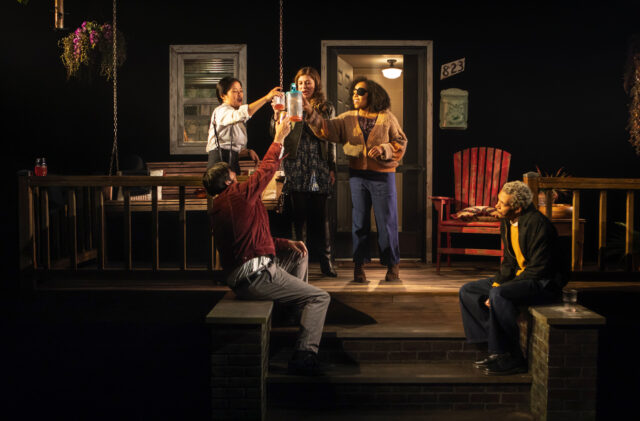
The extended family of Between Riverside and Crazy makes a toast (photo by Joan Marcus 2022)

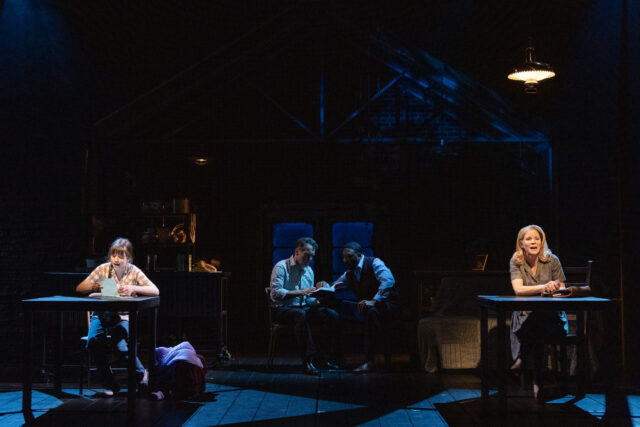
The 130-minute show (with intermission) unfolds in a cramped rent-controlled apartment and rooftop on Riverside Drive (the rotating set is by Walt Spangler), where the recently widowed Walter “Pops” Washington (Henderson) lives with a motley crew of younger folks, including his ne’er-do-well son, Junior (Common), who is on parole; Junior’s scantily clad girlfriend, Lulu (Rosal Colón); and Oswaldo (Victor Almanzar), a tough-talking young man in recovery who Pops has taken in. All three call Walter either Pop, Pops, or Dad, even though he’s hardly the loving, nurturing type. Pops spends most of his time in the kitchen, eating pie, taking swigs of alcohol, and sitting in his wife’s wheelchair, pontificating on life.

His daily reflections don’t exactly reflect popular psychology. As Oswaldo discusses his health and why he no longer eats Ring Dings and baloney, which he ate because he didn’t feel safe or cared for by his parents, Oswaldo tells Pops, “I’m not trying to get all up in your business, but maybe that’s also the reason you always be eating pie — because of, like, you got emotionalisms — ya know?” Pops replies, “Emotionalisms.” Oswaldo continues, “I know — it sounded funny at first to me too — but emotionalisms is real, and pie — don’t take this wrong, but they say pie is like poison.” To which Pops concludes, “Pie ain’t like poison, Oswaldo — pie is like pie!”

A retired cop facing eviction, Pops is in a major fight with the city and the NYPD, demanding more cash in compensation for his shooting by a white rookie officer eight years earlier. One night his former partner, Det. Audrey O’Connor (Guirgis regular Elizabeth Canavan), and her fiancée, Lieutenant Caro (originally played by Michael Rispoli, though I saw understudy J. Anthony Crane, who was excellent; the role has now been taken over by Gary Perez), come over for dinner. They try to convince him to take the deal, as time is running out, but Pops stands by his principles while also understanding Caro’s motive in urging him to sign off. “An honorable man can’t be bought off,” he previously explained to Junior. “An honorable man doesn’t just settle a lawsuit ‘No Fault’ and lend his silence to hypocrisy and racism and the grievous violation of all our civil rights.”

Pops changes some of his views on life — and death — after a visit from the new church lady (Maria-Christina Oliveras) ends up sending him to the hospital.

Pops (Stephen McKinley Henderson) and Lulu (Rosal Colón) share a moment in powerful New York play (photo by Joan Marcus 2022)

I called Between Riverside and Crazy one of the best plays of 2014, and currently it’s the best nonrevival on Broadway. (The best new musical on Broadway, Kimberly Akimbo, also got its start at the Atlantic.) Seventy-three-year-old Tony nominee Henderson (A Raisin in the Sun, Guirgis’s The Last Days of Judas Iscariot), a longtime staple in the work of August Wilson, is unforgettable as Pops, a character who’s hard not to love even as you learn some questionable things about him. Henderson has an endearingly round face, gentle eyes, and an infectious smile that makes you want to call him Pops too. The play is very much about fathers and sons: Pops’ relationship with Junior, Oswaldo’s troubles with his dad, and Pops’ feelings about his own father. Even Det. O’Connor tells Pops, “You’re like my father.”

The set includes a rooftop veranda where Henderson gets even closer to his adoring audience. The rest of the cast is terrific under Pendleton’s (Gidion’s Knot, Orson’s Shadow) expert direction. Guirgis (Our Lady of 121st Street, Jesus Hopped the “A” Train), who grew up on Riverside Drive, writes gritty, believable dialogue and creates hard-hitting situations that are quintessentially New York, mixing comedy and tragedy with subtle, and not-so-subtle, narrative shifts.

If I were going to the 2023 Tony Awards and had the choice of which show to sit with, I just might choose Between Riverside and Crazy again. In the meantime, get yourselves to the Hayes and become part of this beautiful extended family.

NOW IN PROCESS 2023

Untitled Ukraine Project kicks off “Now in Process” at New Ohio Theatre (photo courtesy the Mill)

NOW IN PROCESS 2023
New Ohio Theatre
154 Christopher St.
February 1-12, $15, 7:00
newohiotheatre.org/now-in-process

New Ohio’s annual “Now in Process” series returns February 1-12 with sneak peeks at four intriguing works-in-progress, either in person at the theater’s downstairs space on Christopher St. or available via livestream (for each second performance).

The showcase begins February 1-2 at 7:00 with Untitled Ukraine Project, Sara Farrington’s adaptation of short stories from Kyiv-born photographer and author Yevgenia Belorusets’s 2022 book, Lucky Breaks. In the note before the preface, Belorusets explains, “With these photographic sequences and stories I want to show how collisions of different contexts inform and transform the manufacture of narratives, resulting in the rejection of any instrument of certainty.” In the hourlong play, Monica Goff, Rachel Griesinger, Kara Jackson, Jennifer McClinton, and Aurea Tomeski portray five women impacted differently by war. In her collaborations with her husband, Reid Farrington, including CasablancaBox, BrandoCapote, and the upcoming film Mendacity, which will premiere February 17 at the NYC Indie Theatre Film Festival at the New Ohio, Sara Farrington mixes fantasy and reality in cutting-edge ways, developing “collisions of different contexts [that] inform and transform the manufacture of narratives,” so she’s the right person for this job. Presented by the Mill, Untitled Ukraine Project is directed by Jaclyn Biskup, with costumes by Kristy Hall and lighting by Jackie Fox.

“Now in Process” continues February 4-5 with writer-director Jaime Sunwoo’s Embodied, a multimedia production from Free Rein Projects in which Ella Dershowitz, Blaze Ferrer, Vanessa Rappa, and Saadiq Vaughan portray fifty-five interviewees responding to the prompt “Describe a time you were acutely aware of your race.” The forty-five-minute work features sound and lighting by Matt Chilton and video design by Andrew Murdock, with interactive projections and live camera feeds.

Rubalee follows the plight of a solitary whale trying to return home (photo courtesy Caborca)

On February 8-9, Caborca presents excerpts from writer-director Javier Antonio González’s Rubalee, an experimental musical about a North Atlantic right whale journeying from the equator to her ancestral home of Eubalena (named after their genus, Eubalaena), battling global warming, human hunters, industrial pollution, and more. The forty-five-minute work, performed by Yaraní del Valle Piñero, Courtney Ellis, Susannah Hoffman, Marty Keiser, Tania Molina, Jordan Rutter, Pelé Sanchez Tormes, and David Skeist, combines choral singing and black metal percussion; the music was composed by Skeist and Michael Rekevics.

The festival concludes February 11-12 with writer-director Deniz Khateri’s Longing Lights, an adaptation of thirteenth-century poet and mystic Attar Neishabouri’s Tazkirat al-Owlia, about Sufi saints and their miracles. The thirty-five-minute opera, with music by Bahar Royaee, focuses on the only female subject in the book, Rabia of Basra.

UNDER THE RADAR: FIELD OF MARS

Richard Maxwell’s Field of Mars explores the history of human existence from an Applebee’s in Chapel Hill, North Carolina (photo by Whitney Browne)

NEW YORK CITY PLAYERS: FIELD OF MARS
NYU Skirball
566 LaGuardia Pl.
January 19-22, 24-29, $60
publictheater.org
nyuskirball.org

“OMG.”

That three-letter digital exclamation is said throughout Richard Maxwell’s new play, Field of Mars, stated plainly by several characters as if it is just another article or preposition. As has been Maxwell’s style since he started his company, New York City Players, in 1999, all words are given similar treatment, delivered dryly, sans any deep emotion, all of equal weight and meaning. omg.

Named after an ancient term for a large public space or military parade ground, Field of Mars is about the beginning and the end of everything on Earth, with God himself portrayed by Phil Moore, who, with equal weight and meaning, also plays a manager at an Applebee’s in Chapel Hill, North Carolina, which serves as a kind of way station for humanity.

The audience sits on four rows of rafters onstage, facing the actors, in the otherwise empty NYU Skirball Center, which commissioned the piece for the Public’s Under the Radar Festival. The nonlinear story takes place on lighting designer Sascha van Riel’s relaxing set, a relatively featureless restaurant booth on one side, a bar/hostess station on the other, where Gillian Walsh is an alternate version of St. Peter at the gates of heaven, more concerned with her cover band and her BF than the future of the planet. The set is reminiscent of the one van Riel built and gets torn down in Maxwell’s The Evening, identified in that 2015 work as “a garbagey void” in “a lonely corner of the universe.”

Brian Mendes and Jim Fletcher rehearse for NYCP’s Field of Mars (photo courtesy New York City Players)

The show opens with Adam (Brian Mendes) and Eve (Walsh) in the Garden of Eden, disguised as a popular American chain eatery, and moves through various bizarre, seemingly unconnected scenarios involving music, invisible food, both evolution and creationism, and one hell of an orgy.

In the lengthiest segment, an early version of which I saw at the Clemente and is now more fully formed, two older musicians (Jim Fletcher and Mendes, the latter in his trademark Jerry Garcia T) are pitching their new song to a pair of younger producers (Nicholas Elliott and James Moore), one of whom is, well, an asshole who claims that punk rock never existed. The men’s long, Don DeLillo–like list of cool bands could have used some shortening — the play is too long at two and a half hours, with intermission — but Maxwell (The Vessel, Isolde, Paradiso) is not in a hurry here.

Characters in Kaye Voyce’s everyday costumes walk and squiggle slowly, the narrator (Tory Vazquez) has an extensive phone conversation about pigments with what sounds like a chatbot, early humans (Elliott, James Moore, Eleanor Hutchins, and Paige Martin) evolve, and three of the musicians, after discussing what their songs are really about, lamely “jam” on electric guitars, which are not plugged into amps, as life goes on around them. Meanwhile, the Applebee’s employees (Walsh, Moore, Martin, Lakpa Bhutia) wear masks around their chins as if understanding there’s a health crisis but not worrying about it.

So, what is Field of Mars really about? As one character notes, “Sometimes the confusion is part of it.” Perhaps we’re sitting onstage because we’re all part of this confusion, part of the problem as we potentially face the end times, masks around our chins.

There’s no program, just a glossy one-sheet with only the most basic of information, along with a free souvenir paper poster that features a drawing of a stick figure in a doorway on one side and advises on the other, “I promise I will not look to the natural world to make up for my lack of spirituality ever again.”

OMG. It all makes perfect sense to me.

TICKET ALERT: THE STRANGE UNDOING OF PRUDENCIA HART

National Theatre of Scotlands THE STRANGE UNDOING OF PRUDENCIA HART

The Strange Undoing of Prudencia Hart is making a return engagement to the McKittrick Hotel (photo by Jenny Anderson)

THE STRANGE UNDOING OF PRUDENCIA HART
The Heath in the McKittrick Hotel
542 West 27th St. between Tenth & Eleventh Aves.
Wednesday – Monday, March 10 – April 30, $123.50 – $150.50
mckittrickhotel.com

Six years ago, the McKittrick Hotel presented The Strange Undoing of Prudencia Hart, a devilishly fun immersive show in its Heath Bar. The production is back for a return engagement March 10 – April 30, and tickets are going fast, so you better hurry if you want to catch this popular international hit. Below is my original rave from January 2017.

Since March 2011, audiences in masks have been roaming around the McKittrick Hotel in Chelsea, following characters into nearly every nook and cranny in Punchdrunk’s Sleep No More, a show, inspired by Macbeth, that redefined immersive theater. Now the same production company, Emursive, is presenting a twist on theatrical immersion with the National Theatre of Scotland’s international hit The Strange Undoing of Prudencia Hart, which continues at the McKittrick’s Heath Bar through April 23. This time, instead of the audience chasing the characters, the characters, who don masks at one point, move throughout the pub, talking to audience members, weaving around the space, sitting and standing on tables and chairs, and requesting audience help manufacturing some paper props. Created by writer David Greig (who appropriately enough wrote Dunsinane, a sequel to Macbeth) and director Wils Wilson, The Strange Undoing is about Edinburgh academic Prudencia Hart (Melody Grove), who is attending a conference in Kelso on border ballads, folk songs that were most famously written and collected by Sir Walter Scott. Also at the conference is Prudencia’s archrival, the motorcycle-riding Dr. Colin Syme (Paul McCole), who is described as “Dr. Colin Syme blokeish — obsessed with his kit / He’d eat himself if he was a biscuit.” (Much of the tale is related in delightful rhythmic couplets.) Snowed in on Midwinter’s Night, the prudish Prudencia rejects Colin’s offer to stay with him and instead makes her way through a Costco parking lot to a bed and breakfast that appears to be run by the devil himself (Peter Hannah). Meanwhile, musical director Alasdair Macrae and Annie Grace play multiple roles as well as various instruments, singing traditional ballads in addition to shanties written for the show, imbedded with a sly sense of humor. There’s even karaoke.

(photo by Jenny Anderson)

The National Theatre of Scotland’s The Strange Undoing of Prudencia Hart is devilishly good fun (photo by Jenny Anderson)

There are also plenty of self-referential treats. “This is exactly the sort of snow that if it were in a border ballad would poetically presage some kind of doom for an innocent heroine or an encounter on the moor with a sprite or villain or the losing of the heroine’s selfhood in the great white emptiness of the night,” Prudencia says at a critical juncture. Movement director Janice Parker keeps the cast, dressed in terrific period costumes with a contemporary twist, from knocking into the customers on Georgia McGuinness’s set, as references are made to the Proclaimers and Kylie Minogue, such topics as “Border Ballads: Neither Border nor Ballad?” and “The Topography of Hell in Scottish Balladry” are raised, the legendary ballad character Tam Lin is discussed, and free shots of Scotch are offered before the show and complimentary finger sandwiches are passed around at intermission. As with Sleep No More, the more you invest yourself into the proceedings, the more you will get out of it. Our enjoyment of the production was enhanced by our tablemates, who just happened to be the parents of one of the actors, making for some great conversation and many toasts. It’s all devilishly good fun, a time-traveling ballad that would make Sir Walter Scott proud.

KIMBERLY AKIMBO

Kimberly (Victoria Clark) and Seth (Justin Cooley) become good friends in Kimberly Akimbo (photo © Joan Marcus)

KIMBERLY AKIMBO
Booth Theatre
222 West 45th St. between Broadway & Eighth Ave.
Tuesday – Sunday through March 26, $84 – $419
kimberlyakimbothemusical.com

Broadway shows about death and dying tend to be serious affairs. Plays such as The Shadow Box, Marvin’s Room, Angels in America, ’night, Mother, and Whose Life Is It Anyway? are not lighthearted comedies; Wit is not exactly a laugh riot. (By the way, those six works have four Pulitzers between them.) But right now, Mike Birbiglia is facing his own mortality every night in his hilarious one-man show The Old Man & the Pool, at the Vivian Beaumont, while Kimberly Akimbo, an unusual, life-affirming musical about a high school girl with a terminal illness, is delighting audiences at the Booth.

Making a smooth transition from its fall 2021 debut at the Atlantic, Kimberly Akimbo is the must-see musical of the season. Adapted by Pulitzer winner David Lindsay-Abaire from his 2000 play of the same name, the show tackles how awkward kids can be during their teen years, as evidenced by the title. Kimberly Levaco (Victoria Clark), who is approaching her sixteenth birthday, becomes friends with super-nerd Seth (Justin Cooley), who is obsessed with anagrams; rearranging the letters in her name, he rechristens her Cleverly Akimbo. The show, the character, and Clark are all that and more.

Kimberly has an extremely rare genetic disorder, similar to progeria, in which she ages at four or five times the normal rate. Most girls look forward to turning sweet sixteen, but for Kimberly, she would be nearing the equivalent of eighty; she is magnificently portrayed by Tony winner Clark, who is sixty-three but infuses the part with a glorious enthusiasm and affection for life and what it offers, living every minute to its fullest, understanding it could — and will — all be over at any second.

Kimberly’s mother, Pattie (Alli Mauzey), is pregnant, stuck at home with carpal tunnel in both hands and making videos for her unborn child. “There’s a high probability that I might be dead soon. / So I won’t be around when you’re growing up, / and this video is the only way for you to know who I was. / And I want you to know who I was because / people are going to tell you things about me that just aren’t true,” she sings insensitively, bringing up her own potential death and focusing on her fetus instead of paying attention to Kimberly, who really is dying and might never get to meet her sibling.

Kimberly’s father, Buddy (Steven Boyer), is a low-level gambler and drinker who works at a gas station and does not know how to express love for his daughter; he’s still too much of a child himself. “I should be happy for her,” he sings when she makes a new friend, but he doesn’t know how. “I should be happy.” Later, he says, “I never pictured myself a father. I mean, I like kids, I just . . . I’m more of a bachelor uncle type.” He is more excited than Kimberly when he wins a Game Boy in a bet.

Kimberly (Victoria Clark, center) has issues with her parents (Alli Mauzey and Steven Boyer) in Broadway musical (photo © Joan Marcus)

Kimberly teams up with Seth for their sophomore bio class project, in which they have to explore a disease. Seth wants to use Kimberly’s condition, but she’s not so sure. Meanwhile, the quartet of Delia (Olivia Elease Hardy), Martin (Fernell Hogan), Aaron (Michael Iskander), and Teresa (Nina White) is pairing up for the project and preparing for Show Choir, a competition against other schools. In a fab subplot, they are also trying to figure out how to pair up relationship-wise, not quite knowing yet who’s gay or straight and who likes who.

They are planning on performing a medley from Dreamgirls.. It’s no accident that Lindsay-Abaire chose that particular musical, whose title song begins, “Every man has his own special dream / and your dream’s just about to come true / Life’s not as bad as it may seem if you / open your eyes to what’s in front of you.” High school kids are supposed to dream about the future, but Kimberly is running out of time. Meanwhile their main rival, West Orange, is doing Evita, a musical about Argentinian leader Eva Perón, whose life was cut short by cancer at the age of thirty-three.

Everything goes even more akimbo when Buddy’s sister, Debra (Bonnie Milligan), the black sheep of the family, arrives unexpectedly; the Levacos had escaped Lodi to get away from Debra, who has a penchant for breaking the law with a greedy selfishness and spending time in the hoosegow. She has a master plan involving bank fraud and a stolen US mailbox — itself a funny prop because the younger generations today mainly think of them as relics in the age of social media and texting, similar to pay phones — and attempts to get Kimberly, Seth, Delia, Martin, Aaron, and Teresa to help her with the scheme.

As Kimberly’s sixteenth birthday approaches, the cleverly askew storylines all come together for a poignant finale.

Debra (Bonnie Milligan) finds a crew to attempt a heist in Kimberly Akimbo (photo © Joan Marcus)

Kimberly Akimbo is about much more than a teen with a horrible disease; it’s a spectacularly insightful depiction of the joys and fears that teens experience, at school and at home, with friends and family, as they mature into young adults. Kimberly has an illness that strikes only one in fifty million people — meaning only seven people in the United States might have it — but she represents us all, children and grown-ups. Lindsay-Abaire’s (Rabbit Hole, Ripcord) book and lyrics capture the exhilarating highs and the devastating lows that are parts of everyday life, which is like an endless series of anagrams we try to unravel; when Pattie says, “I hate getting old,” she’s not just speaking for herself. And when she shares her anxiety over having another baby and Kimberly declares, “Scared it would be like me?,” it’s a feeling many can relate to. As Kimberly sings in “Anagram”: “With a change of perspective . . . ha-ha-ha-ha . . . / nothing’s defective / I wonder what you see / when you look at me.”

Tony winner Jeanine Tesori’s (Fun Home, Caroline, or Change) score matches the ups and downs of the plot, from the tender piano of “Anagram” to the jubilance of “Skater Planet” and “This Time,” with playful choreography by Danny Mefford (how do they ice skate like that?), realistic costumes by Sarah Laux, and terrific sets by David Zinn that range from a suburban skating rink to a high school hallway to the Levaco living room.

Mauzey (Wicked, Cry-Baby) and Boyer (Hand to God, Time and the Conways) are terrific as Kimberly’s parents, who attempt to navigate through what for them is also a traumatic situation, knowing their teenage daughter will not be with them much longer, while Jimmy Awards finalist Cooley excels as the awkward but determined and hopeful Seth, and Milligan (Head Over Heels, Gigantic), as a thief, essentially steals every scene she’s in.

But the centerpiece of the show is the unforgettable performance by Clark (Gigi, Sister Act), who won her Tony for The Light in the Piazza before most of the rest of the cast members were born, or were mere babes. Her every movement and gesture, her voice, and, most critically, her bright, searching eyes will have you convinced she is a fifteen-year-old high school student carrying all the requisite baggage — while also knowing that any day could be her last. But the show is not about aging and death; it’s an infectious celebration of life.

At one point, Martin says, “Who cares? It’s not like any of this counts.” Seth responds, “What do you mean?” Martin answers, “I mean, high school. This town. It’s not even real life. It’s just the crap you have to get through before you get to the good part.” Teresa chimes in, “And what’s the good part?” Martin answers, “Um, the rest of our lives?” Kimberly Akimbo makes it clear that right now is the good part, no matter how long the rest of your life is.