Volcano gushes forth over four episodes and nearly four hours at St. Ann’s Warehouse
VOLCANO
St. Ann’s Warehouse
45 Water St.
January 10-21, $54 stannswarehouse.org
Luke Murphy’s Volcano is an eruption of ingenuity, a multimedia, multidisciplinary melding of past, present, and future bathed in mystery.
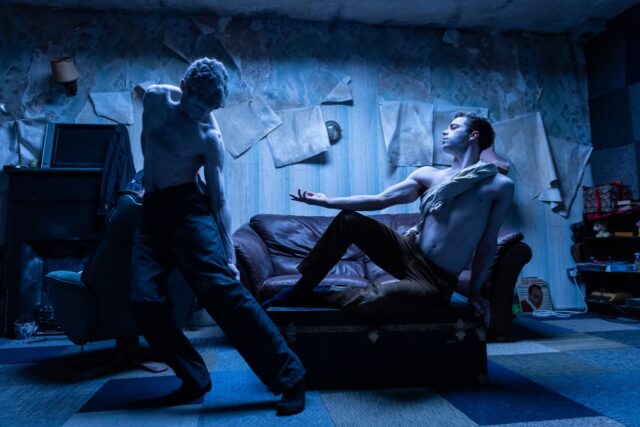
Continuing at St. Ann’s Warehouse through January 21 as part of the Under the Radar festival, the nearly four-hour presentation takes place in a large transparent box, with the audience sitting on two sides in rising rafters. Alyson Cummins and Pai Rathaya’s set is a ramshackle room with drooping wallpaper, television monitors, a disco ball, a black trunk, toy figurines, and other odd, seemingly random items.
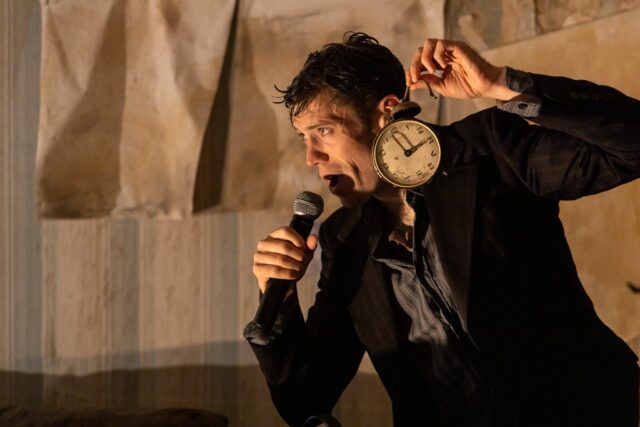
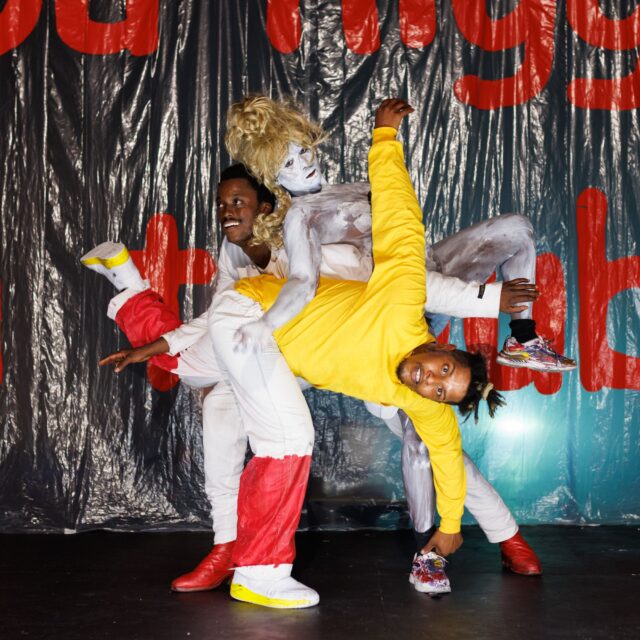
Every time an old-fashioned radio suddenly blurts on, two unidentified men, portrayed by Irish writer, director, and choreographer Murphy (X) and London-born dancer and actor Will Thompson (Y), they grab a camera on a tripod and try to film themselves dancing. Other times they glide into compelling duets in silence, interrupted by light and sound glitches that make it feel like they are under someone else’s control. Which, to some extent, they are.
The two men are participants in the Amber Project, a 1950s-like space mission. “We at the Amber Project are ready to take the next step in the exciting and illustrious heritage of exploration and technological advancement,” a spokesman tells them on the monitors. “This Alinia rocket with the mission designation Pod 00 will soon hurl a crewless spacecraft into orbit — the first of a series of interstellar vehicles, similar to the one which will soon carry two travellers past the reaches of our solar system for the first time.” But what’s really going on?
Volcano pours out over the course of four forty-five-minute episodes — “Frequency,” “Realia,” “Gift,” and “Pod 261” — with two five-minute pauses and one standard intermission in between. If you’re looking for easy answers to what’s happening, you’re not going to find them.
“I’m confused. And I’m scared. I don’t know anything. It’s like my mind’s a library and I just went to a section of shelves I don’t normally go to, and all the book are gone. . . . I don’t even know what books are supposed to be there. And that scares me. I . . . keep wondering . . . What are we doing?” Y says at one point. “I keep wondering whether the things I recognize, the things that make me feel comfortable . . . Do I trust them because I know them, or do I trust them because I don’t know anything else? . . . Now, I know something’s changed here, but I can’t tell if I’ve lost focus on something I used to see or if I’m only now noticing what I couldn’t see before. And mainly . . . I’m wondering who knows all the things I don’t. And that . . . that makes me scared.”
The abstract, surreal narrative breaks out into a game show, a weather report, Amber Project testimonials, magic tricks, a nod to virtual reality pioneer Morton Heilig, and songs by Hot Chip, the Beach Boys, Dirty Beaches, and Billie Holiday. Visual references are made to Superman, Marilyn Monroe, Michelangelo, and iconic 1960s sci-fi television.
The dialogue doesn’t make things much clearer, only adding to the conundrum:
Y: You know, I feel like we’ve got a real opportunity here, you know? X: I’m not sure I understand what you mean. Y: Well, you know, we can’t walk away from this; we should, you know, grab the bull by the horns. X: You were saying you felt confused? Y: This feels . . . this is important. X: I believe you, I think.
And:
Y: Do you ever just wanna do something different? X: What do you mean? Y: Never mind.
Volcano is a technical marvel, mixing analog and digital in complex and humorous ways; the lighting is by Stephen Dodd, with sound by Rob Moloney. The prefilmed videos were directed by Pato Cassinoni, with a cast that includes Adam Burton, Amaya Gill, Ciaran Bermingham, Emily Terndrup, Ghaliah Conroy, Gina Moxley, John McCarthy, Lily Ockwell, Mufutau Yusuf, Pearse Donoghue, Rocio Dominguez, and Sile Maguire.
Does Volcano need to be as long as it is? Probably not. Should the audience have to wait about two and a half hours before a proper intermission? Not really. But if you give in to its conceits, it’s not unlike binging a limited sci-fi series that is as perplexing as it is riveting, with the added bonus of captivating choreography.
Murphy (Slow Tide,Pass the Blutwurst, Bitte) and Thompson are a dynamic duo, immersed in a cryptic world that reveals humanity losing its grip on reality — but always with a ray of hope somewhere out there on the horizon.
[Mark Rifkin is a Brooklyn-born, Manhattan-based writer and editor; you can follow him on Substack here.]
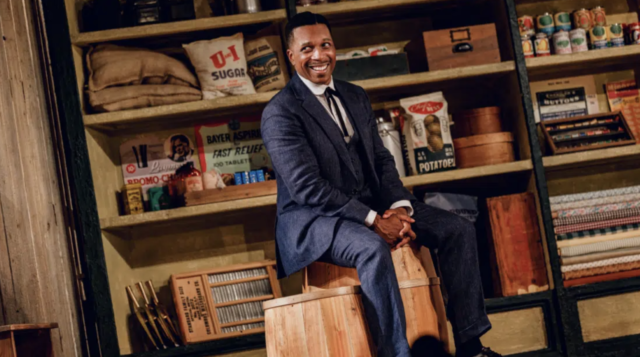
Leslie Odom Jr. stars as the title character in the prescient and uproarious Purlie Victorious: A Non-Confederate Romp Through the Cotton Patch (photo by Marc J. Franklin)
PURLIE VICTORIOUS: A NON-CONFEDERATE ROMP THROUGH THE COTTON PATCH
Music Box Theatre
239 West 45th St. between Broadway & Eighth Aves.
Wednesday – Sunday through February 4, $58 – $298 purlievictorious.com
Kenny Leon’s revival of Ossie Davis’s Purlie Victorious: A Non-Confederate Romp Through the Cotton Patch was already a special experience; they’re now upping the ante with a series of talkbacks as the show heads into its final weeks at the Music Box Theatre.
The original premiered on Broadway in 1961, with a cast that included Davis as fast-talking preacher-dreamer Purlie Victorious Judson, Ruby Dee as Lutiebell Gussie Mae Jenkins, Sorrell Booke as cotton plantation owner Ol’ Cap’n (Stonewall Jackson) Cotchipee, Alan Alda as his ne’-er-do-well son, Charley, Tony-nominated Godfrey Cambridge as obedient servant Gitlow Judson, Helen Martin as his wife, Aunt Missy, who runs the house, and Beah Richards as Idella Landy, who watches out for Charley.
Leon has assembled another ace cast for his sparkling adaptation, a prescient play so funny and on point that you’ll be wondering why you haven’t heard about it before — although some will recall the 1970 musical version, Purlie, which featured Cleavon Little as Purlie and Melba Moore as Lutiebell. Leslie Odom Jr. is phenomenal as the title character, who wants to pretend that Lutiebell (a scene-stealing Kara Young) is his cousin Bee so she can collect her late mother’s $500 inheritance from Ol’ Cap’n (Jay O. Sanders) and Purlie can reclaim Big Bethel as his church. Missy (Heather Alicia Simms) is highly suspicious of the plan, while Gitlow (Billy Eugene Jones) doesn’t want to get involved in anything that might upset Ol’ Cap’n. When Charley (Noah Robbins) goes missing, Idella (Vanessa Bell Calloway) is beside herself, but Purlie isn’t about to let anything get in the way of his acquisition of Big Bethel. Meanwhile, Derek McLane’s evolving sets are so fabulous that the last one draws gasps of approval and applause from the audience.
“There’s a whole lotta things about the Negro question you ain’t thought of!” Purlie proclaims to Lutiebell. “The South is split like a fat man’s underwear; and somebody beside the Supreme Court has got to make a stand for the everlasting glory of our people!”
Purlie Victorious must close on February 4; they’ve added a series of “Victorious Talkbacks” that began January 11 with Adrienne Warren and continues January 18 with Moore and January 25 with Lin-Manuel Miranda.
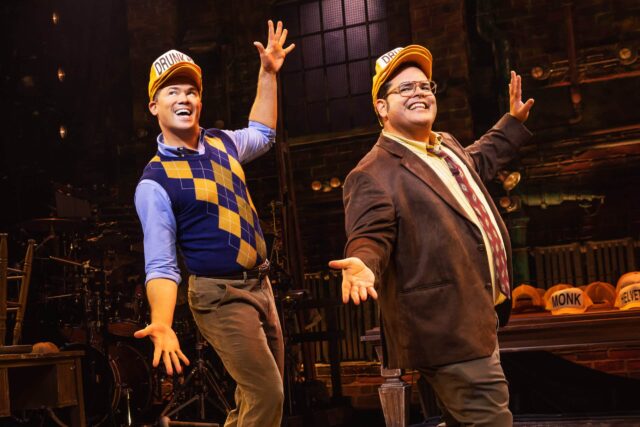
Andrew Rannells and Josh Gad team up again in Gutenberg! The Musical! (photo by Matthew Murphy)
GUTENBERG! THE MUSICAL!
James Earl Jones Theatre
138 West Forty-Eighth St. between Sixth & Seventh Aves.
Tuesday – Sunday through January 28, $74-$498 gutenbergbway.com
Lightning doesn’t strike twice for Josh Gad and Andrew Rannells, who first teamed up for the nonstop juggernaut The Book of Mormon in 2011, both earning Tony nominations. The dynamic duo is back in the double-exclamation-pointed Gutenberg! The Musical!, which are two bangs too many. It’s scheduled to close January 28.
Written by Scott Brown and Anthony King, the two-act version premiered off Broadway in 2006 with three-time Tony nominee Christopher Fitzgerald and Obie winner and Tony nominee Jeremy Shamos. In this new iteration of the meta-musical, Bud Davenport (Gad) and Doug Simon (Rannells), both from Nutley, New Jersey, have rented the James Earl Jones Theatre for one night to present their show, a musical about fifteenth-century German printer Johann Gutenberg, to a group of producers. They play all the characters, identifying them by putting on different hats, which say “Drunk #1,” “Helvetica,” “Bootblack,” “Trimmer,” and “Gutenberg,” among others.
Directed by Tony winner Alex Timbers, it starts out very funny, particularly as they discuss how they are including a serious issue in order to make sure the show is important — antisemitism — but as the story continues, it gets repetitive, going around in circles (literally and figuratively) as Bud and Doug keep interrupting the musical-within-a-musical to explain what they are doing, and why. The 2006 production was one act and forty-five minutes, and that feels about right; at two acts and two hours, it drags like a Saturday Night Live sketch that doesn’t know when to end.
The night I went, the best moment came when a woman from the audience shouted out to Bud, “You’re hot,” which Gad and Rannells ran with, cracking up themselves and the crowd with some fun improvisation.
There are plenty of good scripted lines — “In an actual production this song would include a gospel choir and lasers,” Doug notes; “I wish I was gay! But I’m just . . . not,” Bud opines — but the laughs dry up like, well, an underused, out-of-date printing press.
SPAMALOT
St. James Theatre
246 West Forty-Fourth St. between Broadway & Eighth Aves.
Tuesday – Sunday through July 28, $49-$225 spamalotthemusical.com
Monty Python’s Spamalot is back on Broadway and as hilarious as ever in this updated version gleefully directed and choreographed by Josh Rhodes.
With a book and lyrics by Python Eric Idle and music by John Du Prez and Idle, the endlessly punny show debuted on Broadway in 2005, with Tim Curry as King Arthur, Sara Ramirez as the Lady of the Lake, Hank Azaria as Sir Lancelot, David Hyde Pierce as Sir Robin, Michael McGrath as Patsy, Christopher Sieber as Sir Galahad, and Christian Borle as Prince Herbert, garnering fourteen Tony nominations and winning for Best Musical, Best Director (Mike Nichols), and Best Featured Actress (Ramirez). Based on the 1975 comedy Monty Python and the Holy Grail, one of the funniest movies ever made, Spamalot still holds up, skewering everything in its path.
This time around Tony winner James Monroe Iglehart is King Arthur, three-time Tony nominee Christopher Fitzgerald is Patsy, Leslie Rodriguez Kritzer is the Lady of the Lake, Tony nominee Ethan Slater is the Historian and Prince Herbert, two-time Tony nominee Alex Brightman has replaced the scene-stealing Taran Killam as Sir Lancelot, and Michael Urie is Sir Robin through January 21, after which he will be replaced by Jonathan Bennett.
While Sir Lancelot doesn’t get to save Sir Galahad from almost certain temptation and no one is asked to answer these questions three to cross the Bridge of Death, you will find just about everything else here, from a killer rabbit, the French taunter, and the Knights Who Say Ni to Dennis’s treatise on the exploitation of the workers, the Plague Village, and Sir Robin’s not-quite-bravery.
There are also tons of self-referential jokes: “We won’t succeed on Broadway / if we don’t have any Jews,” Sir Robin sings. “One in ev’ry show / there comes a song like this / It starts off soft and low / and ends up with a kiss,” the Lady of the Lake explains. “How are we going to put on a Broadway show? Broadway’s a thousand years in the future in a country that hasn’t yet been discovered,” Arthur worries. Also on the menu are “Find Your Grail,” “Whatever Happened to My Part?,” and “Always Look on the Bright Side of Life.”
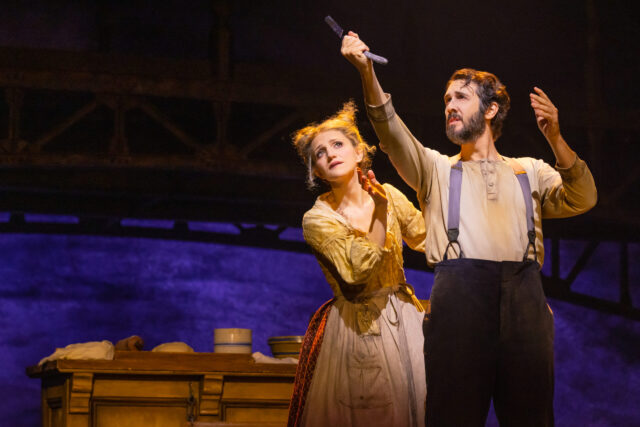
Annaleigh Ashford and Josh Groban go into devilish business together in Sweeney Todd (photo by Matthew Murphy and Evan Zimmerman)
SWEENEY TODD: THE DEMON BARBER OF FLEET STREET
Lunt-Fontanne Theatre
205 West Forty-Sixth St. between Broadway & Eighth Ave.
Wednesday – Sunday through May 5, $89-$435 sweeneytoddbroadway.com
Thomas Kail’s revival of Sweeney Todd: The Demon Barber of Fleet Street is devilishly delicious. The dark tale of a mysterious master barber who teams up with a macabre pie maker features memorable music and lyrics by Stephen Sondheim and a delightful book by Hugh Wheeler, based on a 1970 play by Christopher Bond.
The 1979 original Broadway production starred Len Cariou as the title character and Angela Lansbury as Mrs. Lovett and won eight Tonys, including Best Musical, Best Score, Best Leading Actor, and Best Leading Actress. The current third Broadway revival opened last March with Josh Groban as Sweeney Todd and Annaleigh Ashford as Mrs. Lovett, earning eight Tony nods and winning for Best Lighting and Best Sound.
On February 9, Tony winner Aaron Tveit picks up the shaving blade as Sweeney, with two-time Tony winner Sutton Foster taking over baking the pies; an unrecognizable Ruthie Ann Miles continues her Tony-nominated performance as the beggar woman.
The exhilarating Buena Vista Social Club continues at the Atlantic through January 28 (photo by Ahron R. Foster)
BUENA VISTA SOCIAL CLUB
Atlantic Theater Company
Linda Gross Theater
336 West 20th St. between Eighth & Ninth Aves.
Tuesday – Sunday through January 28 atlantictheater.org
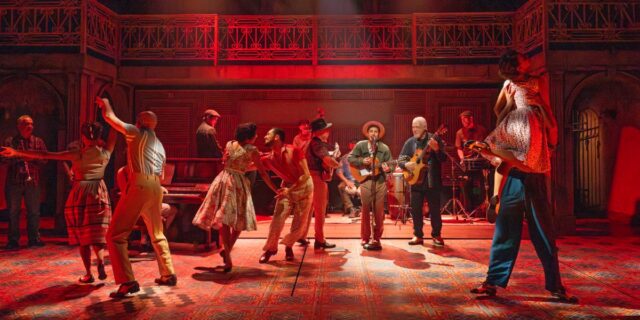
It would not be surprising if the Atlantic Theater’s world premiere of Buena Vista Social Club soon finds itself on Broadway; in the meantime, the sold-out run continues at the Linda Gross through January 28.
The two-hour musical was inspired by Wim Wenders’s 1999 Oscar-nominated documentary about Ry Cooder and his son, Joachim, traveling to Cuba to record an album with an ensemble known as the Buena Vista Social Club. Book writer Marco Ramirez has created a narrative, based on actual events, that goes back and forth between the 1950s, as the Cuban Revolution is simmering, and the economically depressed Special Period of the mid-1990s. Juan De Marcos (Luis Vega), who serves as narrator, explains early on, “Some of what follows is true / Some of it only feels true.” The real Juan De Marcos is a consultant on the show.
In 1996, Juan is trying to convince legendary singer Omara Portuondo (a sensational Natalie Venetia Belcon, in a gorgeous costume by Dede Ayite) to record an album in a Cuban studio with a band he has put together, including singer Eliades Ochoa (Renesito Avich). The possibility of singing some of her old songs takes her back to her youth, when she (Kenya Browne) and her sister, Haydee (Danaya Esperanza), were singing to tourists at the Tropicana until Haydee is enticed by guitarist Compay Segundo (Jared Machado) and pianist Rubén Gonzalez (Leonardo Reyna as a young man, Jainardo Batista Sterling as the older Rubén) to join them instead at the Buena Vista Social Club, a seedy nightspot in a dangerous part of town run by vocalist Ibrahim Ferrer (Olly Sholotan, although I saw understudy Justin Showell). Decades later, Compay (Julio Monge) seeks out Ibrahim (Mel Semé) to join in the recording, but he has no desire to revisit the past.
Although it does get sidetracked by bits of treacly melodrama, Buena Vista Social Club is splendidly directed by Tony nominee Saheem Ali, with energetic choreography by Patricia Delgado and Justin Peck on Arnulfo Maldonado’s inviting two-level set. The band is fantastic, performing such songs as “Silencio,” “Dos Gardenias,” “Veinte Años,” “El Carretero,” and “Y Tu Que Has Hecho?” Each member is worthy of mention: David Oquendo, Avich, and Monge on guitars, Javier Díaz, Mauricio Herrera, and Román Díaz on percussion, Guido Gonzalez on trumpet and flugelhorn, Hery Paz on woodwinds, Gustavo Schartz on bass, and Eddie Venegas on trombone. The performance of “Candela” alone is worth the price of admission, one of the best musical scenes of the year.
[Mark Rifkin is a Brooklyn-born, Manhattan-based writer and editor; you can follow him on Substack here.]
The Whole of Time offers a new look at Tennessee Williams’s The Glass Menagerie (photo by Maria Baranova)
THE WHOLE OF TIME
Torn Page
435 West Twenty-Second St. between Eighth & Ninth Aves.
Thursday – Monday through January 27, suggested donation $44 www.tornpage.org
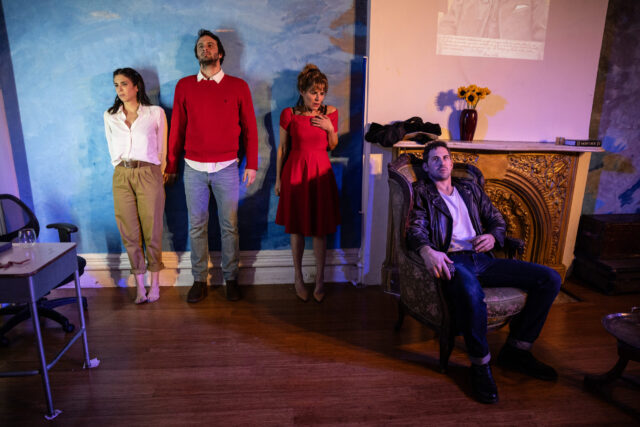
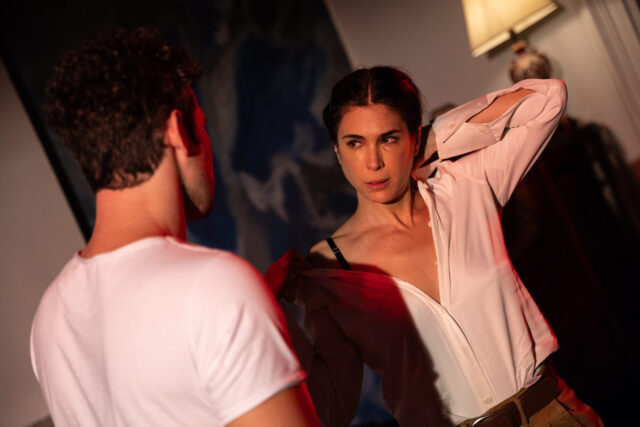
About halfway through the US premiere of Argentinian playwright Romina Paula’s The Whole of Time, there’s a powerful, poignant scene between Antonia (Josefina Scaro), a young woman who prefers to spend her life inside her family’s house, and Maximiliano (Ben Becher), a leather-jacketed macho friend of her brother’s.
When Maximiliano asks her what she does with her life, she replies, “Oh, nothing.” Startled, he says, “What do you mean nothing?” She answers, “Yeah, nothing. At least according to the terms you’re asking me, nothing.” She tells him confidently that she doesn’t work or go to school. “You must do something,” he presses. She responds, “No, I don’t believe in doing.” Her younger brother, Lorenzo (Lucas Salvagno), who is reading Moby-Dick, calmly explains, “Antonia doesn’t go out.”
Lorenzo exits, and Maximiliano continues to ask her about her lifestyle choice, which he cannot understand. “This is who I am, I’m this way,” she declares. He asks, “But don’t you think it’s sad?” They disagree over what’s considered free or wasted time and what happiness is. As they move in closer to each other, she puts on Rata Blanca’s “La leyenda del hada y el mago,” a song about magic, love, and loneliness in a fairy-tale world.
Lorenzo and then their mother, Ursula (Ana B. Gabriel), enter, cutting off whatever might have been happening between Maximiliano and Antonia. “Oh, thank God you’re alive!” Ursula proclaims. Lorenzo interjects, “Awake, Mom. Thank God we’re awake.”
Unfortunately, that’s the only scene with any life to it; the rest of the play is a befuddling snooze.
Ben Becher and Josefina Scaro bring the heat to The Whole of Time (photo by Maria Baranova)
Translated from the original Spanish by Jean Graham-Jones, The Whole of Time is a contemporary reimagining of Tennessee Williams’s memory play The Glass Menagerie, but it goes way off track. It takes place in a small rectangular room at Torn Page, the Chelsea home where actors Rip Torn and Geraldine Page lived. Torn and Page starred onstage and onscreen in Williams’s Sweet Bird of Youth and were friends with the two-time Pulitzer Prize winner (for A Streetcar Named Desire and Cat on a Hot Tin Roof). An audience of no more than twenty-two people sit in two rows of folding chairs on one side of the room, across from the set that features a table where Antonia spends time on her laptop, an old armchair where Lorenzo reads, a fireplace, a vanity table, and a chifforobe; the back wall is a swriling blue, evoking Frida Kahlo’s Casa Azul in Mexico City. The set and video design is by Tony Torn, Rip and Geraldine’s son, who also directs the play; Donald Gallagher painted the backdrop.
It begins with a discussion about Mexican artist Marco Antonio Solís’s song “Si no te hubieras ido” (“There’s Nothing More Difficult Than Living without You”) that leads them to Kahlo’s Self-Portrait with Cropped Hair and talk of murderers. Projections on the back wall above the fireplace include a video of Solís performing his song and images of works by Kahlo, including the self-portrait and Portrait of My Father. The family lives in Argentina but Antonia and Lorenzo were born in Mexico; Ursula is from Hungary, which Antonia notes is like Kahlo’s father, photographer and painter Guillermo, who was born in Germany, died in Mexico, and might or might not have had Hungarian-Jewish roots. (Frida claimed he did, whereas a 2005 book debunked that using genealogy studies.)
Scaro, who strongly resembles Sarah Silverman and is the cocurator of events at Torn Page, is terrific as Antonia, a young woman not realizing that she has trapped herself; instead of having a limp like Laura in The Glass Menagerie, her physical affliction is represented by her obsession with Kahlo, who suffered severe injuries in a bus crash when she was eighteen and lived in terrible pain the rest of her life. Becher, who also serves as the preshow bartender, is seductive and charming as Maximiliano — the gentleman caller — a tough guy with a tender heart who just wants to enjoy life. Salvagno and Gabriel do what they can with their indistinct characters, he playing a calm, unassuming son and she a mother who still wants to dance and party, trying to find quick happiness that remains elusive. There’s a pall over the family, but it’s not the abandonment of the patriarch that hovers over Menagerie.
Jay Ryan’s lighting design is sparse, usually the standard lighting in the room, with occasional turns into darkness. Torn was sitting in one corner, often checking his cell phone, next to stage manager Berit Johnson, who works tech, which can be distracting if you’re sitting nearby. At one point, two characters were on either side of the space, engaged in a conversation that made audience members swivel their heads back and forth like they were watching a lackadaisical tennis match. There are a couple of avant-garde touches, but they feel out of place. Even at a mere seventy minutes, the production lags, meandering in and out of the story in confusing ways.
In The Glass Menagerie, Tom tells the audience, “Yes, I have tricks in my pocket, I have things up my sleeve. But I am the opposite of a stage magician. He gives you illusion that has the appearance of truth. I give you truth in the pleasant disguise of illusion.” That’s precisely what’s missing from The Whole of Time.
[Mark Rifkin is a Brooklyn-born, Manhattan-based writer and editor; you can follow him on Substack here.]
No need to worry if you missed your chance to get tickets to the site-specific play The Voices in Your Head, running this month at St. Lydia’s storefront dinner church in Brooklyn.
Created by Grier Mathiot and Billy McEntee, the sixty-minute dark comedy about a support group with eight members who share an unusual bond has just added another performance and a pair of seats for each show, which is now limited to eighteen guests at a time.
The impressive cast features Christian Caro, Marcia DeBonis, Patrick Foley, Vanessa Kai, Tom Mezger, Daphne Overbeck, Erin Treadway, and Jehan O. Young. Ryan Dobrin directs for the collective Those Guilty Creatures, which he cofounded with movement director Carina Goebelbecker. The company’s previous productions include Courtship,The Homiesexuals: A Social Media Tragedy,Dutchman, and She’s a Witch!
HAMLET | TOILET
Japan Society
333 East 47th St. at First Ave.
January 10-13, $35 japansociety.org
To go, or not to go? That is the multilayered question asked in Yu Murai and Kaimaku Pennant Race’s absurdist, scatological HAMLET | TOILET, continuing at Japan Society through January 13 as part of the Under the Radar festival.
As you enter Japan Society, you are greeted by a different kind of step and repeat; instead of posing in front of a show logo, you can snap a selfie with a glitteringly white Japanese Toto washlet on a red platform, a fancy toilet with such special features as a heated seat and a bidet. It sets the mood for what is to follow, ninety minutes of controlled chaos involving more flatulence than the beans scene in Mel Brooks’s Blazing Saddles.
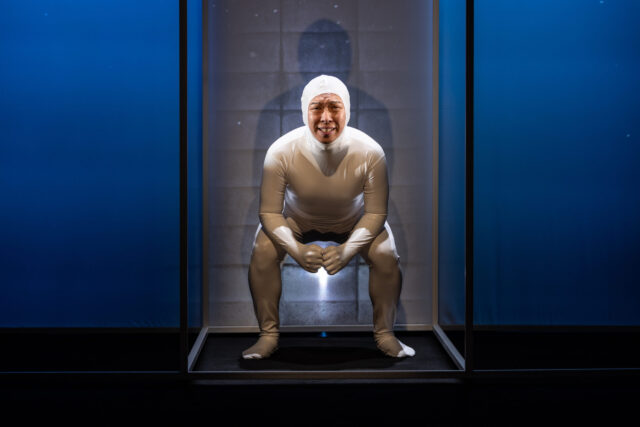
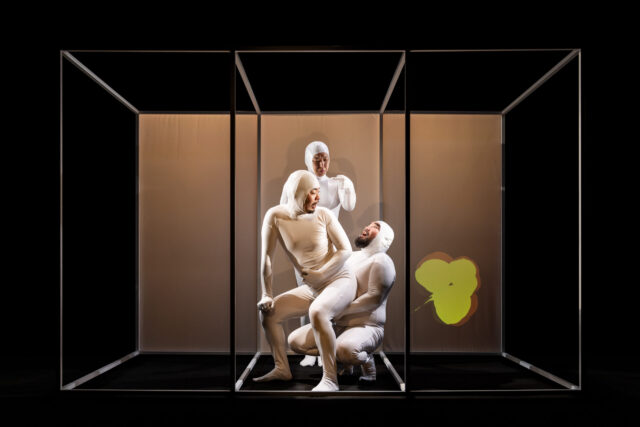
Murai has previously reimagined works by William Shakespeare in Romeo and Toilet and Ashita no Ma-Joe: Rocky Macbeth, wildly unpredictable tales that incorporate dance, music, strange props, and bizarre costumes. HAMLET | TOILET sits comfortably within that oeuvre. The production takes place in and around a three-stall installation, an open cube with a back wall and no doors. The three actors, Takuro Takasaki, G. K. Masayuki, and Yuki Matsuo, are dressed in unflattering white body-hugging latex suits reminiscent of the spermatozoa in Woody Allen’s Everything You Always Wanted to Know About Sex* (*But Were Afraid to Ask).
The essence of the Bard’s tragedy is in there, somewhere: Hamlet’s (Takasaki) uncle, Claudius (Masayuki), has killed Hamlet’s father, married his mother, and become king. Hamlet is in love with Ophelia (Masayuki), whose brother, expert fencer Laertes (Matsuo), is not a Hamlet fan. Hamlet’s besties, Horatio (Masayuki) and Marcellus (Matsuo), have encountered the ghost of their friend’s father, who tells his son that his murder must be avenged. To do so, Hamlet has to face his conscience, which is not lodged in his brain or heart but in his painful belly — the load he is carrying is an intensifying bowel movement that his multidimensional constipation will not allow him to release.
For much of the show, the actors are in the middle stall, trying to take dumps, either squatting by themselves or sitting on a cushiony human bowl formed by the other two actors. They gleefully pass gas that is projected in colorful animation by Takashi Kawasaki, accompanied by the appropriate sounds. The characters discuss aspects of making number two in ways that no play or novel that I know of ever has; no bathroom subject or feces joke is off limits, regardless of how silly or lowbrow. Nobody can find relief, not even from Ophelia’s headdress, which consists of dozens of rolls of toilet paper.
Amid deep dives into the shape, consistency, aroma, and chocolatey nature of human waste, Murai also delves into cowardice, sanity, suffering, and revenge. The dialogue is similarly mixed; Hamlet veterans will appreciate such real Shakespearean lines as “That adulterate beast won to his shameful lust . . . my queen,” “Never make known what you have seen [and heard] tonight,” “[I am going to] put an antic disposition on,” and “I should have fatted all the region kites / With this slave’s offal: bloody, bawdy villain!”
Purists might grimace at the more coarse language, such as “Something must be born that will trace a single line / like a magnificent line of feces / straight through all of this wonderful society,” “Please, just this once / couldn’t it be soft and gently flow like water,” “You must cleanly and completely defecate me!” and “In a world that is moved by the strict laws of almighty God / that which should not have moved has passed / That’s why my movement will not pass!” Even the subtitles themselves are in on the fun, changing the spelling and capitalization of nec-ASS-arily and BUTT (instead of but).
The three actors occasionally break out into song and dance; the music is by DJ and hip-hop producer Tsutchie from Shakkazombie, with hilarious choreography by Shinnosuke Motoyama. There’s far too much repetition, as numerous jokes spew out like the preparation for a colonoscopy, and in one scene the play makes fun of that itself as repeated statements fill up the subtitles monitor in ever-smaller type. But just when you think the production is merely a fart-fantasy concocted by Eric Cartman or Beavis and Butt-Head, Murai slips in something ridiculously clever so you won’t lose your appetite; it’s not merely Shakespeare as bathroom reading, although that’s in there too. Murai is not claiming that Shakespeare, or theater in general, is full of shit, but it might be in need of a thorough cleansing.
Which brings us back to the original question: To go, or not to go? HAMLET | TOILET is certainly not for everyone; some gags were met with laughter and applause, while others received random chuckles or guffaws — or silence. If you do get a ticket — the January 12 performance will be followed by an artist Q&A — be sure to use the facilities, which have several washlets, in addition to doors to ASSure your privacy.
[Mark Rifkin is a Brooklyn-born, Manhattan-based writer and editor; you can follow him on Substack here.]
A jubilant cast lifts Hell’s Kitchen at the Public Theater (photo by Joan Marcus)
HELL’S KITCHEN
Newman Theater, the Public Theater
425 Lafayette St. at Astor Pl.
Tuesday – Sunday through January 14, $175 publictheater.org
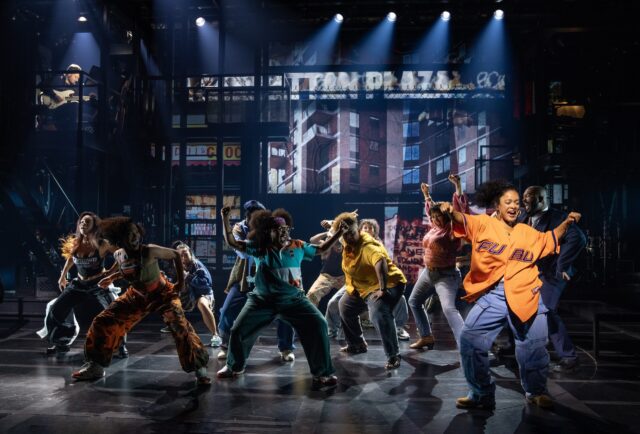
Hell’s Kitchen, heading from the Public to the Shubert — it ends its run downtown January 14 and starts previews on Broadway on March 28 — (mostly) succeeds where New York, New York failed. Both stories take place in the city, use stage scaffolding to replicate fire escapes, follow the relationship between a man and woman involved in music, and are built around a hugely popular hit song about New York.
The latter, based on Martin Scorsese’s 1977 film, declares, “If I can make it there, I’d make it anywhere,” while the former proclaims that New York is a “concrete jungle where dreams are made of / There’s nothing you can’t do / Now you’re in New York!” But where New York, New York felt like a miscast movie shot in Toronto, Hell’s Kitchen, inspired by the life of Alicia Keys (who wrote the music and lyrics), has a far more legitimate feel, a more “empire state of mind,” flaws and all.
Maleah Joi Moon makes an explosive professional debut as Ali, a seventeen-year-old girl living with her extremely protective single mother, Jersey (Shoshana Bean), in a “one-bedroom apartment on the forty-second floor of a forty-four-story building on Forty-Third Street between Ninth and Tenth Avenues, right in the heart of the neighborhood some people know as Hell’s Kitchen.” The building is filled with artists, including a trumpeter on thirty-two, a dance class on twenty-seven, opera singers on seventeen, poets on nine, painters on eight, a string section on seven through four, and a gospel pianist in the Ellington Room on the ground floor.
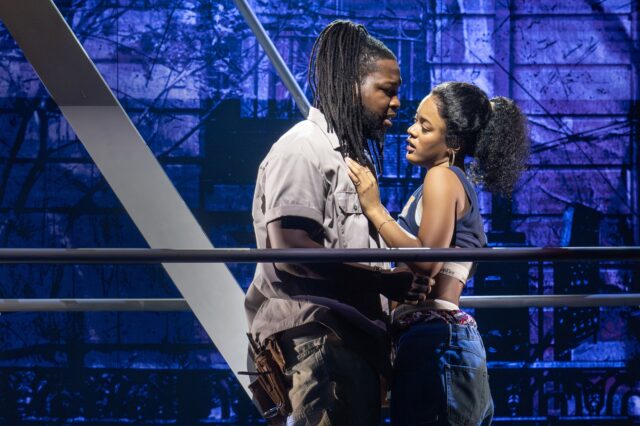
It’s summer in the 1990s, and Ali has decided it’s time for her to get busy with the older Knuck (Chris Lee), who drums on buckets in the street with his friends Q (Jakeim Hart) and Riq (Lamont Walker II). Ali and her homegirls, Jessica (Jackie Leon) and Tiny (Vanessa Ferguson), are sure the men are “up to no good,” but as Ali says, “We need that trouble in our lives.”
Knuck (Chris Lee) and Ali (Maleah Joi Moon) find themselves in trouble in Alicia Keys musical (photo by Joan Marcus)
That’s the last thing Jersey wants for her daughter, so she enlists her besties, Millie (Mariand Torres) and Crystal (Crystal Monee Hall), and jovial doorman Ray (Chad Carstarphen) to keep an eye on Ali’s comings and goings. Jersey does not want what happened to her — an early, unwanted pregnancy by an unreliable man, a jazz musician named Davis (Brandon Victor Dixon) — to happen to her stubborn daughter.
As she prepares for her potential sexual awakening, Ali becomes intrigued by Miss Liza Jane (Kecia Lewis), the elderly woman who plays the piano in the Ellington Room and soon becomes Ali’s mentor. But the trouble that Ali soon encounters is not the trouble she needs.
Hell’s Kitchen is structured around two dozen Keys songs, from such albums as 2001’s Songs in A Minor, 2003’s The Diary of Alicia Keys, 2007’s As I Am, 2012’s Girl on Fire, 2020’s Alicia, and 2021’s Keys, and three new tunes written specifically for the show, “The River,” “Seventeen,” and “Kaleidoscope.” The orchestrations by Tom Kitt and Adam Blackstone are lively, and Camille A. Brown’s choreography captures the energy of the street on Robert Brill’s set, enhanced by projections of the neighborhood by Peter Nigrini. The naturalistic costumes are by Dede Ayite, with effective lighting by Natasha Katz and sound by Gareth Owen.
The show is directed with a vibrant sense of urgency by Tony nominee Michael Greif (Dear Evan Hansen,Next to Normal), but the book by Kristoffer Diaz (The Elaborate Entrance of Chad Deity,Welcome to Arroyo’s) languishes in clichés, including several cringey scenes that don’t feel real, creating a choppy narrative that doesn’t flow like Keys’s music.
Moon is magnetic as Ali; you can’t take your eyes off her for even a second. Tony nominee Bean (Mr. Saturday Night,Waitress) is engaging as the overwrought mother, shaking things up with “Pawn It All,” while Obie winner Lewis (Dreamgirls,Ain’t Misbehavin’) nearly steals the show as Miss Liza Jane, channeling Maya Angelou when she says such lines as “I will not allow you to let the pain win,” then bringing down the house with “Perfect Way to Die.” Lee (Hamilton) has just the right hesitation as Knuck, acknowledging the obstacles he faces every step of the way, and Carstarphen (Between the Bars,Neon Baby) is eminently likable as the adorable doorman.
Get tickets to such shows as Volcano at the Under the Radar festival before time runs out (photo by Emijlia Jefrehmova)
UNDER THE RADAR 2024
Multiple venues
January 5-21 utrfest.org
There was quite an uproar in June when Public Theater artistic director Oskar Eustis announced the cancellation of the widely popular Under the Radar festival, which the Public had hosted since 2006. Held every January, the series featured a diverse collection of unique and unusual international theatrical productions, discussions, and live music and dance, from the strange to the familiar, the offbeat to the downright impossible to describe. Eustis followed that outcry with another message:
“Last week, difficult news was shared that the Under the Radar festival would not return for the Public’s 23–24 season. We made the painful decision to place the festival on hiatus. I understand and share the hurt that those who participated in and loved the festival have expressed over the past few days. . . . Unfortunately, these are exceptionally challenging times in our field. The Public, like almost every other nonprofit theater in the country, is facing serious financial pressure. . . . In the certainty that better times will come, we continue to work to preserve the health and mission of the Public. We look forward to a time when we can fully expand back into the robust and expansive theater we need to be.”
Festival founder and director Mark Russell was determined that the show must go on, and he brought it back to life. “Festivals are celebrations. They mark harvests and other moments of abundance or recognition,” he said in a statement. “Under the Radar is a festival that each year celebrates the vibrancy of new theater, in New York and internationally. At this moment, even in very challenging times, there is still innovative work rising from communities around New York and in far-reaching parts of the globe. Under the Radar aims to spotlight this work for audiences — not only those ‘in the know’ but from a wider stretch of communities, diverse in all respects, that could benefit by engaging with these creative leaders.”
The 2024 program includes two dozen presentations at seventeen venues, taking place from January 5 to 21. Below are my top five choices, which do not include two highly praised and strongly recommended works that are making encore appearances in New York, Dmitry Krimov/Krymov Lab NYC’s Pushkin’s Eugene Onegin: In Our Own Words at BRIC and Shayok Misha Chowdhury’s bilingual Public Obscenities at Theatre for a New Audience’s Polonsky Shakespeare Center. In addition, the UFO sidebar of works in progress consist of Matt Romein’s Bag of Worms at Onassis ONX Studio, Zora Howard’s The Master’s Tools at Chelsea Factory (with Okwui Okpokwasili as Tituba from The Crucible), Holland Andrews and yuniya edi kwon’s How does it feel to look at nothing at National Sawdust, Theater in Quarantine and Sinking Ship Productions’ live debut of the previously streamed The 7th Voyage of Egon Tichy at the Connelly Theater, Jenn Kidwell and *the Blackening’s We Come to Collect [A Flirtation, with Capitalism] at the Flea, and Penny Arcade’s The Art of Becoming — Episode 3: Superstar Interrupted [1967-1973] at Joe’s Pub. In addition, a free symposium at NYU Skirball Center on January 12 at 9:30 am features Inge Ceustermans, Hana Sharif, Sunny Jain, Taylor Mac, Jeremy O. Harris, Ravi Jain, and Kaneza Schaal, hosted by Edgar Miramontes, looking at the future of independent theater.
A book club offers unique insight into Miranda July’s The First Bad Man (photo by Ros Kavanagh)
THE FIRST BAD MAN
Lincoln Center for the Performing Arts
Samuel Rehearsal Studio, 70 Lincoln Center Plaza
January 5-13, choose-what-you-pay (suggested admission $35) www.lincolncenter.org www.panpantheatre.com
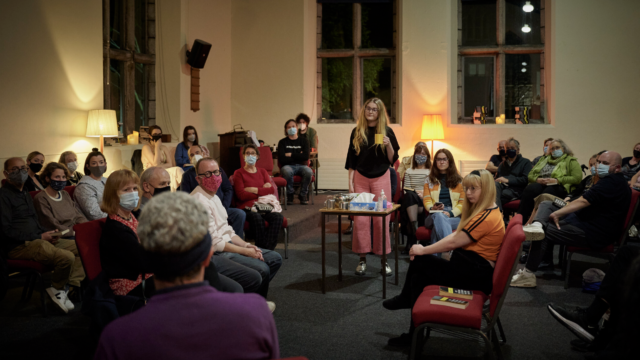
Ireland’s Pan Pan Theatre has staged unique versions of Beckett’s Embers and Cascando as well as Gina Moxley’s The Patient Gloria. The company now turns its attention on a unique aspect of literature; for The First Bad Man at Lincoln Center’s Samuel Rehearsal Studio, audience members watch a book club dissect Miranda July’s wildly original 2015 novel, as characters and story lines intersect with reality.
A bouncy castle becomes more than just a fun children’s place in Nile Harris’s this house is not a home (photo by Alex Munro)
this house is not a home
Playhouse at Abrons Arts Center
466 Grand St. at Pitt St.
January 6-14, $30.05 www.abronsartscenter.org
A bouncy castle helps Nile Harris explore how the world has changed over the last two years, with the assistance of Crackhead Barney, Malcolm-x Betts, slowdanger, and GENG PTP along with a gingerbread minstrel, vape addicts, a movie cowboy, and others, in this house is not a home. Afropessimism is on the menu in this collaboration between Abrons Art Center and Ping Chong Company.
Hamlet | Toilet makes its NYC debut at Japan Society (photo courtesy Kaimaku Pennant Race)
HAMLET | TOILET
Japan Society
333 East 47th St. at First Ave.
January 10-13, $35 japansociety.org
In 2019, Yu Murai and Kaimaku Pennant Race blew our minds with the outrageous Ashita no Ma-Joe: Rocky Macbeth, a bizarrely entertaining mashup of Shakespeare’s Macbeth and Sylvester Stallone’s Rocky Balboa. They’re now back with another mad mix at Japan Society; I’m not sure there’s much more to say that what’s in the press release: “Notoriously iconoclastic and scatological director Yu Murai’s Hamlet | Toilet runs the Bard’s highbrow tale of existential woe through the poop chute.” Each ticket comes with free same-day admission to the exhibition “Out of Bounds: Japanese Women Artists in Fluxus.”
VOLCANO
St. Ann’s Warehouse
45 Water St.
January 10-21, $54 stannswarehouse.org
Melding theater, dance, and sci-fi, Irish writer, director, and choreographer Luke Murphy (Slow Tide,Pass the Blutwurst, Bitte) introduces audiences to the mysterious Amber Project in this four-part miniseries of forty-five-minute multimedia segments starring Murphy and Will Thompson, exploring their past as they face an uncertain future.
OUR CLASS
BAM Fisher, Fishman Space
321 Ashland Pl.
January 12 – February 4, $68-$139 www.bam.org ourclassplay.com
During the pandemic, Igor Golyak and Massachusetts-based Arlekin Players Theatre broke through with innovative, interactive livestreamed productions, attracting such stalwarts as Jessica Hecht and Mikhail Baryshnikov to join the troupe. Following shows at BAC and Lincoln Center, the company brings a timely new adaptation of Tadeusz Słobodzianek’s Our Class to BAM, about a 1941 pogrom in Poland that severely impacts the relationships of a group of students. Broadway veterans Richard Topol, Alexandra Silber, and Gus Birney star, alongside Jewish and non-Jewish cast and crew members from Russia, Ukraine, Poland, Israel, Germany, and the US.
[Mark Rifkin is a Brooklyn-born, Manhattan-based writer and editor; you can follow him on Substack here.]