this week in theater

BONNIE & CLYDE: THE MUSICAL

Bonnie & Clyde pull into Broadway in new musical (AP Photo/Jeffrey Richards Associates, Nathan Johnson)

Schoenfeld Theatre
236 West 45th St. between Seventh & Eighth Aves.
Tickets: $66.50 – $226.50
www.bonnieandclydebroadway.com

Products of poverty-stricken depression-era America, Bonnie Elizabeth Parker and Clyde Chestnut Barrow both dreamed of a better life: Bonnie wanted to be a Hollywood movie star like Clara Bow, while Clyde wanted to be a famous gangster like Al Capone. Their love story is at the heart of the new Broadway musical Bonnie & Clyde, which enters with guns blazing but leaves firing a series of blanks. The show opens with a blood-spattered Bonnie and Clyde front and center, lying dead in their machine-gun-riddled car, real headlines of their demise projected on the wooden-slat backdrop. The story then goes back to their childhood, with young Bonnie (Kelsey Fowler) singing of making it in Tinseltown (“Picture Show”) and young Clyde (Talon Ackerman) predicting his daring future (“The World Will Remember Me”). Soon nineteen-year-old Bonnie (Laura Osnes) is slinging hash in a local diner, while twenty-year-old Clyde (Jeremy Jordan) has escaped from yet another prison stay and is on the run. They fall instantly and madly in love, Bonnie reading Clyde her poetry on a starry night. Joined by Clyde’s brother, Buck (Claybourne Elder), and his Bible-thumping wife, Blanche (Melissa van der Schyff), they hit the road, becoming folk heroes as they rob banks, sign autographs, and are chased by the cops, leaving a bloody path behind them. “Freedom is something I gotta steal,” Clyde declares.

Laura Osnes and Jeremy Jordan are the best things about misguided BONNIE & CLYDE (AP Photo/Jeffrey Richards Associates, Nathan Johnson)

Osnes (Grease, Anything Goes) and Jordan (Newsies, West Side Story) will inevitably be compared to Faye Dunaway and Warren Beatty from Arthur Penn’s iconic 1967 film, which is unfair and does them a disservice, as they each deliver strong, sexy performances even as the material soars downhill faster than Clyde can drive. Book writer Ivan Menchell’s (The Cemetery Club) story is choppy and disjointed, with far too many throwaway scenes and filler (including Clyde and Buck singing about driving and a preacher and his congregation proclaiming that “God’s Arms Are Always Open”), Jeff Calhoun’s (Newsies) direction and choreography are uninspired, except for the appearance of cool classic cars, Don Black’s (Sunset Boulevard, numerous James Bond themes) lyrics are trite and stale, and Frank Wildhorn’s (Jekyll & Hyde, The Scarlet Pimpernel) score flirts with Americana roots music, blues, country, and folk in the first act but doesn’t even try in the second, instead turning to overly standard and unsatisfying Broadway pabulum. The musical is supplemented with projections of actual photos, newspaper articles, mug shots, and other paraphernalia as it seeks to tell the true story of these two antiheroes, wisely choosing not to be a musical version of the movie, but it lacks the power and pace of the film, becoming a rambling tale that is determined to fill two and a half hours no matter what. They would have done better throwing away the boring, unnecessary subplots and filler and just followed Bonnie and Clyde themselves, leaving Osnes and Jordan center stage, where they belong.

CHINGLISH

Vice Minister Xi Yan (Jennifer Lim) and sign maker Daniel Cavanaugh (Gary Wilmes) talk business and more in CHINGLISH

Longacre Theatre
220 West 48th St. between Broadway & Eighth Ave.
$31.50 – $126.50
www.chinglishbroadway.com

The current signage on Broadway is packed with some pretty major star power, with such names as Samuel L. Jackson, Kim Cattrall, Hugh Jackman, Stockard Channing, Alan Rickman, Marlo Thomas, Daniel Radcliffe, Angela Bassett, Harry Connick Jr., and others adorning various theater marquees. But don’t let that steer you away from a charming little show at the Longacre that might not feature big Hollywood names but still serves up quite a tasty treat. In Chinglish, Gary Wilmes stars as Daniel Cavanaugh, an American businessman who comes to the relatively small city of Guiyang, China — home to a mere four million people — to convince them that his Ohio company should make all the signs for their new state-of-the-art cultural center. With the help of British consultant Peter Timms (Stephen Pucci), Cavanaugh meets with the somewhat goofy Minister Cai (Larry Lei Zhang), who seems interested, but Vice Minister Xi Yan (Jennifer Lim) is far more dubious of hiring Ohio Signage. But soon the tables are turned, and Daniel finds himself joining forces with Xi — in more ways than one — as secrets are revealed about all four major characters and relationships are severely tested. Written by David Henry Hwang (M. Butterfly) and directed by Leigh Silverman (Well), Chinglish is a sweet romantic comedy about communication, in both the boardroom and the bedroom. Setting China’s economic boom against America’s continuing collapse, Hwang and Silverman focus on how language and meaning can bring people together or tear them apart. The play is filled with jokes about Chinese signs and bad translations, but at its heart it’s about honesty and being “a good man,” as Xi says to Daniel. David Korins’s scenic design keeps things moving wonderfully, as rotating sets circle in and out of one another, offering cute vignettes that make clever use of every moment. Chinglish, produced by the team behind August: Osage County, is more chef’s special than combination plate, a timely and funny look at how people communicate in the modern age.

PRIVATE LIVES

Paul Gross and Kim Cattrall are the latest pair to take on the roles of Elyot and Amanda in Noël Coward’s PRIVATE LIVES (photo by Cylla von Tiedemann)

Music Box Theatre
239 West 45th St. between Broadway & Eighth Aves.
Through February 5, $46.50 – $176.50
www.privatelivesbroadway.com

Following in the footsteps of such Broadway duos as Alan Rickman and Lindsay Duncan (2002), Simon Jones and Joan Collins (1992), Richard Burton and Elizabeth Taylor (1983), and Brian Bedford and Tammy Grimes (1969) — as well as the 1931 cinematic pairing of Robert Montgomery and Norma Shearer — Due South’s Paul Gross and Sex and the City’s Kim Cattrall are now taking on the roles of Elyot and Amanda in Noël Coward’s 1930 battle of the sexes, Private Lives, which opened November 17 at the Music Box Theatre. On a hotel terrace in Deauville, newlyweds Elyot and the younger, somewhat naive Sybil (Anna Madeley) can’t stop talking about his ex-wife, Amanda, who, it turns out, is in the next room, celebrating her marriage to the older and stuffy Victor (Simon Paisley Day), unable to stop talking about her ex-husband. While their initial impulses are to run away, it is clear that Elyot and Amanda belong together — or at least deserve each other — and soon they are flitting off to Paris, hiding away in Amanda’s Art Deco love nest. But in director Richard Eyre’s (Mary Poppins on Broadway, the film Notes on a Scandal) new production, the heat generated in the first act dissipates in the second, as the idea of Elyot and Amanda in love is more electric and exciting than their actual coupling, which quickly becomes tiresome to watch, the earlier promised spark reduced to an occasional flicker. It’s a combination of both a dated script, which includes lighthearted talk of men hitting women, and a lack of physical chemistry between the two leads. Individually, Gross and Cattrall turn in more than respectable performances, but they fizzle in the middle of the play.

Fortunately, things turn around in the third and final act when the slapstick level rises with the return of Sybil and Victor and all heck breaks loose. The show does feature several minor distractions that get in the way: In the first act, David Howe’s lighting of Gross and Madeley on the right side of the stage casts shadows on the left side that sometimes makes it look as if a character is about to enter (when they’re not), and in the second act, a tattoo is evident on one of Gross’s ankles, which does not fit with his character. (There wasn’t much that could have been done about the dead goldfish floating on top of the three-part fishtank, and it certainly wasn’t the production’s fault that an older gentleman in the orchestra continually let out deep throat rumblings that echoed throughout the theater during the entire two-hour-plus show.) Despite the shortcomings of the second act, the current version of this classic comedy of manners — which in 1930 made its London debut with Coward himself as Elyot, Adrianne Allen as Sybil, Gertrude Lawrence as Amanda, and Laurence Olivier as Victor — is a pleasurable and enjoyable experience, if not quite the success it could have been.

BURNING

Andrew Garman, Evan Johnson, Danny Mastrogiorgio become an unusual family in BURNING (photo by Monique Carbon)

The Acorn Theatre at Theatre Row
410 West 42nd St. between Ninth & Tenth Aves.
Through December 17, $61.25
212-560-2183
www.thenewgroup.org
www.theatrerow.org

During intermission of the New Group’s Burning, which kicks off their 2011-12 season at the Acorn Theatre at Theatre Row, we discussed whether we thought Thomas Bradshaw’s multistory show was a bedroom farce, a sly send-up of theatrical conventions, a black comedy, a campy examination of love and sex, a self-reflexive absurdist narrative, a meditation on art and death, or a serious melodrama about different kinds of family. After the second act, we came to the conclusion that unfortunately, it is all of those things, and none of them, two and a half hours that cause nervous giggles, blank stares, and looks of confusion and disbelief. On a set divided into three sections — a bed, a living room with a couch, and a small table surrounded by a few chairs — three interconnecting stories evolve. In the early 1980s, Broadway producer Simon (Danny Mastrogiorgio) and his partner, stage star Jack (Andrew Garman), take in Chris (Evan Johnson), a fourteen-year-old wannabe actor whose mother has just OD’d. Simon and Jack are trying to get playwright Donald (Adam Trese) to turn his play about child sex trafficking into a one-man vehicle for Jack; meanwhile, all three men are interested in more than Chris’s woeful acting talent. In modern day, African-American painter Peter (Stephen Tyrone Williams) is preparing to head to Berlin for a solo show, not knowing that one of the gallery workers, neo-Nazi Michael (Drew Hildebrand), thinks he is a white artist who must certainly be a true believer. While Peter and his wife, Josephine (Larisa Polonsky), are going to have a baby, Michael is taking care of his half-sister, Katrin (Reyna de Courcy), who is confined to a wheelchair as the result of a car accident that claimed the lives of their parents a year earlier. And Peter’s young cousin, Franklin (Vladimir Versailles), needs money so he can give a proper burial to his recently deceased mother.

Bradshaw (Southern Promises, The Bereaved) goes all over the place with Burning, taking on the AIDS crisis, the neo-Nazi skinhead movement, drugs, pederasty, racism, prostitution, incest, and more, featuring a multitude of extremely graphic sex scenes that are at times funny, erotic, shocking, and heart-wrenching but eventually become overwhelming and boring. It’s as if Bradshaw had so much to say that he decided to put it all in one play instead of two or three, leaving director Scott Elliott, the founding artistic director of the New Group, with the impossible job of making it all come together. Burning has its moments, but not nearly enough of them, and the conclusion is hard to swallow, resulting in a lukewarm show with lofty ambitions that are always just out of reach.

OTHER DESERT CITIES

Secrets and lies unfold on Christmas Eve in Jon Robin Baitz’s exceptional Broadway drama OTHER DESERT CITIES (photo by Joan Marcus)

Booth Theatre
222 West 45th St. between Broadway & Eighth Ave.
Tuesday – Sunday, $61.50 – $126.50
www.lct.org

It’s Christmas Eve, 2004, and the Wyeth clan has gathered together to celebrate the holiday in Palm Springs, where WASPy parents Polly (Stockard Channing) and Lyman (Stacy Keach) raised their family, playing tennis and hanging out at the country club. Joining them is daughter Brooke (Rachel Griffiths), son Trip (Thomas Sadoski), and Polly’s sister, Silda Grauman (Judith Light). What transpires over the course of the next two hours is a classic tale of family dysfunction, filled with secrets and lies, masterfully told by playwright Jon Robin Baitz and director Joe Mantello. Other Desert Cities unfolds on John Lee Beatty’s wonderful set, a modern living room complete with working fireplace, tall windows that look out at the desert wasteland, and a long stone wall that seems to trap the family inside, combining California warmth with an icy coldness. After six years of writer’s block and months hospitalized for depression, Brooke has emerged with the follow-up to her successful debut novel, but it’s not fiction. This time she has written a tell-all memoir about the one thing the family never talks about and which brought them great public shame and embarrassment — eldest son Henry, a deeply troubled young man who joined an anarchist cult and participated in a terrorist attack that killed an innocent man, leading him to take his own life.

Former Hollywood players Polly and Lyman are true believers who have counted the Bushes and Reagans as close personal friends; in fact, Polly proudly declares that Nancy is her role model. While the parents are in favor of the Iraq war, Brooke and Silda, a recovering alcoholic, are vigilant lefties; Trip, a reality-TV producer, does his best to remain in the center, desperately trying to keep all conversations away from politics. But he has a lot more trouble attempting to be the voice of reason as long-held secrets emerge that threaten to tear the family apart. Other Desert Cities is everything a play should be: Sharp, incisive dialogue, nearly flawless acting, and seamless, flowing direction, with a laugh-out-loud first act and a much darker, far more serious second act. A Lincoln Center Theater production that originally ran at the Mitzi E. Newhouse this past January and February (and that also starred Channing, Keach, and Sandoski, with Linda Lavin as Silda and Elizabeth Marvel as Brooke), Other Desert Cities is an exceptional piece of work, an intelligent, thought-provoking drama that melds the political and the personal in thrilling ways.

RELATIVELY SPEAKING: 3 ONE-ACT COMEDIES

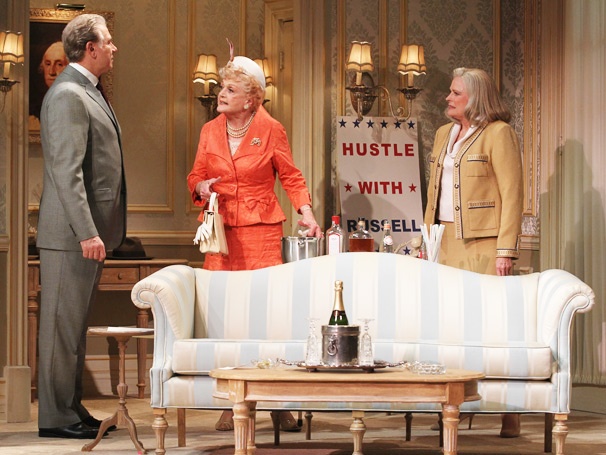
Doreen (Marlo Thomas) and Carla (Lisa Emery) try to figure out what to do with George in Elaine May’s GEORGE IS DEAD

Brooks Atkinson Theatre
256 West 47th St. between Broadway & Eighth Ave.
Opens Thursday, October 20, $65-$135 (October 14 performance reviewed)
www.relativelyspeakingbroadway.com

“I don’t have the depth to feel this bad,” Doreen (Marlo Thomas) says in the second of three one-act comedies that make up Relatively Speaking, which opened October 20 at the Brooks Atkinson Theatre. While the trio of short plays that deal with family — by writers much better known for their film work — might lack depth individually and as a group, two of the three don’t have much to feel bad about it. The evening opens with Oscar winner Ethan Coen’s (Fargo, No Country for Old Men) extremely slight Talking Cure, which is divided into two sections that feel like they were vignettes that Coen couldn’t think of how to use elsewhere so he threw them together here and hoped for the best. In the first part, Danny Hoch plays a patient in a mental institution trying to convince a psychiatrist (Jason Kravits) that there is nothing wrong with him. The second part reveals why he just might be crazy, flashing back to his parents (Katherine Borowitz and Allen Lewis Rickman) having an argument about Hitler. (Rickman replaced A Serious Man’s Fred Melamed, who left over creative differences with Coen. One can see why.)

After a four-minute pause, Elaine May’s (A New Leaf, Heaven Can Wait) George Is Dead begins, set in a small, cramped New York City apartment where Doreen barges in on Carla (Lisa Emery) in the middle of the night. Doreen announces that her husband has just died — and that she has left him in a Colorado hotel room because she doesn’t know what to do. A wealthy socialite wearing a glittering dress, Doreen has unexpectedly turned to the daughter of her old nanny (Patricia O’Connell), who is not exactly thrilled to suddenly have to take care of her former nemesis. Thomas gives a breathless tour-de-force performance as the ditzy, discombobulated Doreen; at one point she says to Carla, who is in the midst of an awful fight with her husband (Grant Shaud), “You’re so dear. Am I being too horribly demanding? Am I being awful? I can never tell.” The play’s final scene seems tacked on and unnecessary, but the rest of it is a small pleasure.

Nina (Ari Graynor) and Jerry (Steve Guttenberg) set in motion a farcical family drama in Woody Allen’s HONEYMOON MOTEL

Following a fifteen-minute intermission, Woody Allen’s (Annie Hall, Crimes and Misdemeanors) Honeymoon Motel takes over, a drawing-room farce that pays tribute to the Marx Brothers’ classic stateroom scene from A Night at the Opera. Jerry Spector (a solid Steve Guttenberg) and the much younger Nina (Ari Graynor) arrive at a wonderfully cheesy Vegas-like motel room (courtesy of set designer Santo Loquasto), apparently to consummate their marriage, but it turns out that Jerry is actually the stepfather of the groom (Bill Army) and has fallen in love with the sexy blonde. As the room slowly fills up with the whole mishpucha — Mark-Linn Baker and Julie Kavner as Nina’s dysfunctional parents; Caroline Aaron as Judy, the groom’s overbearing mother; Kravits as Jerry’s shrink; Hoch as the pizza delivery guy; and Richard Libertini as a tipsy rabbi — Allen lets the Borscht Belt one-liners flow, with more hits than misses. “What did I do? You two were planning on divorce anyway,” Nina says. “We were? It’s news to me,” responds Judy. “I never said divorce,” adds Jerry. “I was thinking of faking my own death.” After Judy calls Jerry’s best friend, Ed (Shaud), an enabler, Ed says, “Enabler? I was trying to talk him out of it when you came.” Judy: “You’re the first one that told him about sex in a Jacuzzi.” Ed: “I’ve never been in a Jacuzzi in my life.” Judy: “Well, he made me try it and we ended up dialing 911.” Jerry: “She accused me of waterboarding her.” Not exactly high-brow humor, but a lot of fun, even if Libertini’s rabbi falls flatter than a Kol Nidre pledge speech. Directed by John Turturro, who has appeared in films by Coen and Allen, Relatively Speaking is like a family reunion, complete with its fair share of ups and downs, touching moments and long-simmering arguments, at least one or two people you’d rather not see, and enough laughs to make you glad you went.

LAST CHANCE: JERUSALEM

Tony winner Mark Rylance and JERUSALEM end dazzling Broadway run this Sunday

The Music Box
239 West 45th St. between Broadway & Eight Ave.
Through Sunday, August 21, $61.50 – $226.50
www.jerusalembroadway.com

British actor Mark Rylance (Boeing Boeing) won his second Tony award for his epic performance as drug-and-booze-addled Johnny “Rooster” Byron in Jez Butterworth’s brilliant Jerusalem. As the play opens, Rooster is hosting a loud, blasting rave at his home, an old Airstream in the woods on the outskirts of a community that wants him gone. The trailer is marked “Waterloo,” an ever-present reminder of Rooster’s continuing downfall. The three-hour play takes place on St. George’s Day, the annual holiday celebrating the legendary dragon killer on which the William Blake hymn “Jerusalem” is traditionally sung (“I will not cease from Mental Fight / Nor shall my sword sleep in my hand: / Till we have built Jerusalem / In England’s green and pleasant land”). Rooster has been served with an eviction notice, but he pays it no mind, ready to fight the power as he entertains his minions (a very motley, colorfully costumed crew that includes original Office sycophant Mackenzie Crook as would-be DJ Ginger, Alan David as the Professor, Jay Sullivan as Lee, Danny Kirrane as Davey, Molly Ranson as Pea, and Charlotte Mills as Tanya) with mad tales of fairies and giants told with a Falstaffian gallantry that mixes in plenty of Don Quixote and Baron Munchausen.

The Shakespearean play takes a turn from the bawdy to the serious when Rooster’s ex-girlfriend (Geraldine Hughes) and their young son, Marky (alternately Aiden Eyrick or Mark Page), show up, expecting Rooster to take the boy to the local fair. But Rooster is in no condition to play dad at this point and casts his family away, and he is soon plummeting for rock bottom after learning a nasty secret about his supposedly loyal followers. The former artistic director of Shakespeare’s Globe, Rylance is spectacular as Rooster, embodying the larger-than-life character with his every movement, from his severe limp to his magical intonation. Swiftly directed by Ian Rickson and also featuring Aimeé-Ffion Edwards as a missing girl who opens each act in song, Jerusalem is a must-see production that is ending its four-month run at the Music Box on Sunday. Tickets are still available at the box office and at the TKTS booth; don’t miss this last chance to experience this dazzling production, led by an unforgettable performance by a master craftsman.