this week in theater

SEMINAR

Wannabe writers get a whole lot more than they bargained for in SEMINAR

Golden Theatre
252 West 45th St. between Broadway & Eighth Ave.
Starring Alan Rickman through April 1, followed by Jeff Goldblum starting April 3, $51.50 – $121.50
www.seminaronbroadway.com

Inspired by her three years writing for David Milch on NYPD Blue, Theresa Rebeck’s Seminar is a solidly entertaining, very funny examination of competition and the creative process. Kate (Lily Rabe), Martin (Hamish Linklater), Douglas (Jerry O’Connell), and Izzy (Hettienne Park) are members of a private writing class led by the rather acerbic Leonard (Alan Rickman), a famous novelist and editor who charges the eager would-be writers five grand a piece for his services. Held in Kate’s family’s ritzy Upper West Side apartment, each class session consists of Leonard’s critique of a different student’s work. Desperate for his approval, they find out quickly that their story — as well as their life — is more likely to be shredded apart by the cynical Leonard, who rambles on about his travels to war-torn nations while debasing three of the writers; he has only kind things to say about Izzy, turned on by her erotically charged writing and sexy demeanor.

Alan Rickman will continue dishing out biting literary criticism on Broadway through April 1

Although the plot features few surprises, the dialogue by the prolific Park Slope-based Rebeck — she’s written numerous plays, several novels and screenplays, and is the creator and executive producer of the new television series Smash — is sharp and incisive, alternating between biting and laugh-out-loud funny. The part of Leonard seems tailor made for Rickman, who revels in the character’s love of language; just when it seems that Rickman is drifting off a bit, he charges back with a quiet fury that dominates the stage. The supporting cast, featuring O’Connell (Stand by Me, Jerry Maguire), Shakespearean regular Linklater (The New Adventures of Old Christine), and Park (The Intelligent Homosexual’s Guide to Capitalism and Socialism with a Key to the Scriptures) making their Broadway debuts alongside Tony nominee Rabe (The Merchant of Venice), is strong throughout, each actor adding just the right nuance to avoid becoming caricatures. Although most of Seminar takes place in a single room, director Sam Gold gives it a swift vitality, a strength he also displays in the current production of Look Back in Anger at the Roundabout. As a bonus, the night we saw Seminar, Jeff Goldblum, who replaces Rickman in the role of Leonard on April 3, was sitting nearby, apparently seeing the show for the first time. He leaned forward through most of the ninety-five minutes, his mouth hanging open, his eyes darting from character to character, following every movement with an extended hand, studying the play almost as if he were a student preparing for the most important class of his life.

LOOK BACK IN ANGER

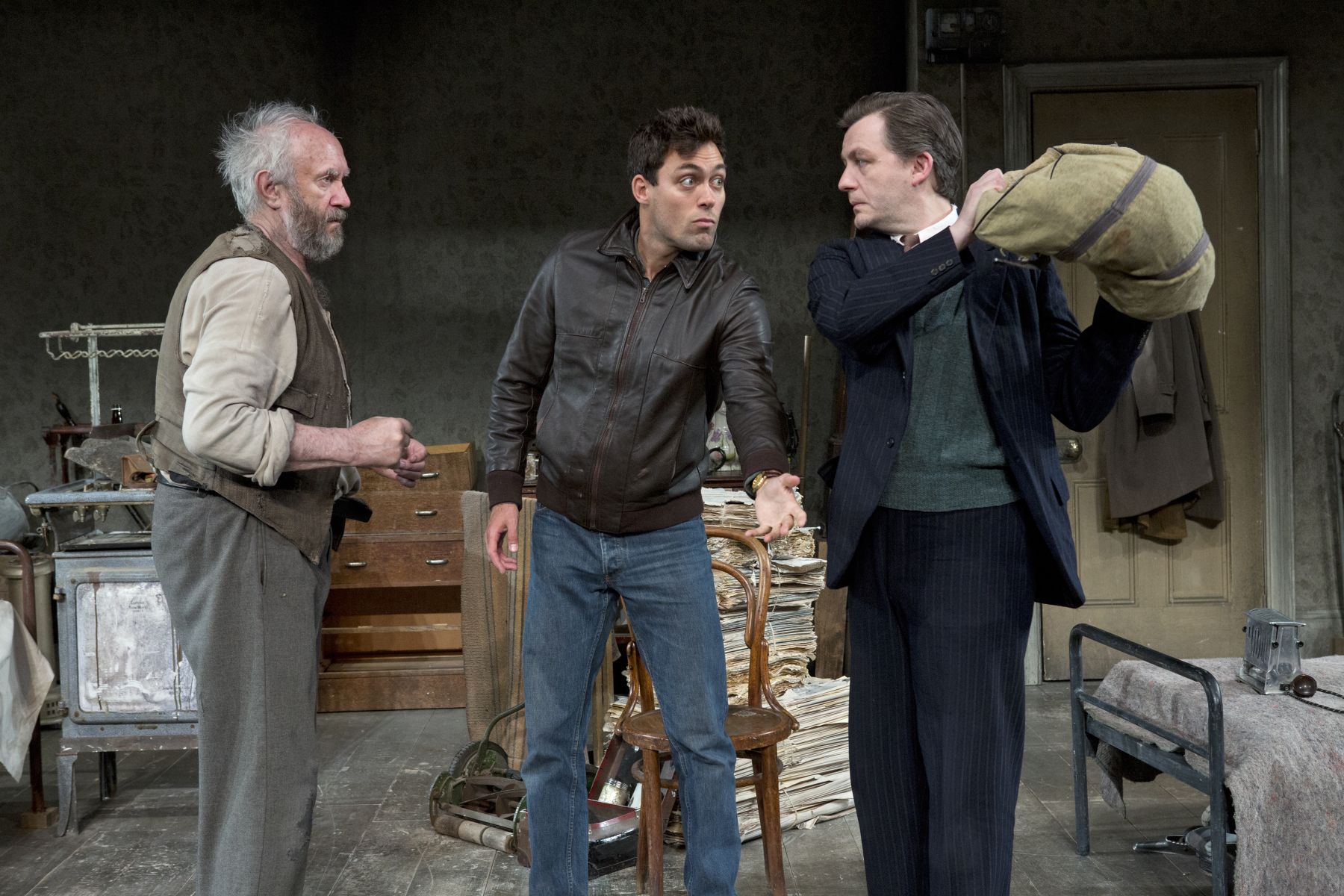
Cliff (Adam Driver), Alison (Sarah Goldberg), and Jimmy (Matthew Rhys) are rather intimate roommates in Roundabout revival (photo by Joan Marcus)

Roundabout at Laura Pels Theatre
Harold and Miriam Steinberg Center for Theatre
111 West 46th St. between Sixth & Seventh Aves.
Through April 8, $71-$81
212-719-1300
www.roundabouttheatre.org

In 1956, John Osborne’s autobiographical Look Back in Anger exploded onto the British theater scene, taking the familiar English drawing-room comedy and turning it inside out and upside down, railing about class warfare, politics, sex, family, and social structure in a less-than-polite manner. It was written by an angry young man, Osborne, about an angry young man, Jimmy Porter, who spewed venom at every opportunity. The original stage production moved to Broadway in 1957, where it was nominated for a Tony for Best Play, and the next year it hit the big screen with Richard Burton playing Jimmy; all three versions were directed by Tony Richardson, who went on to make such highly regarded films as The Entertainer (cowritten by Osborne), Tom Jones, and The Border. (A 1989 television movie directed by Judi Dench starred Kenneth Branagh and Emma Thompson.) Upon being named associate artist at the Roundabout, director Sam Gold (Seminar, August: Osage County) decided that his first production would be an updated version of the controversial drama, which makes an immediate impact via Andrew Lieberman’s powerful set, which transforms the Laura Pels Theatre into an intimate black box, with the stage a long, narrow horizontal platform only several feet deep, backed by a floor-to-ceiling black wall. Strewn about the stage are empty cans, half-eaten bites of food, and ragged clothing. When the cast enters, they’re nearly sitting on the audience’s lap; Gold leaves the lights on at first, as if everyone is inside this fleabag attic apartment. As Jimmy (Matthew Rhys) and his best friend, Cliff (Adam Driver), read the papers, argue, and wrestle, Jimmy’s wife, Alison (Sarah Goldberg), is busy at an ironing board, her shirt open to reveal her bra as if it’s no big deal. At the start, it’s hard to tell which of the men, if not both, is with Alison; while Jimmy goes on and on about British society, Cliff lays a flurry of kisses on Alison, who happily accepts them. But it soon becomes apparent that the loud, ranting Jimmy and the sweetly innocent, well-born Alison are indeed husband and wife, although perhaps not for long if Jimmy cannot control his nasty temper. And when Alison’s friend Helena (Charlotte Parry) arrives, she drives a wedge between the married couple that sets up a heated second act.

Alison and Jimmy share a rare quiet moment in LOOK BACK IN ANGER (photo by Joan Marcus)

Making his New York theater debut, the Welsh Rhys is a commanding force onstage, searing with electric energy while hiding a subtle vulnerability looming just beneath his angry veneer. The play has lost some of its punch over the years; the original’s attack on British society is much tamer and too general in a world all too familiar with such public criticism. Gold’s direction overcomes many of those flaws, adding a suprising intimacy; when Jimmy and Cliff fight, it feels like they could fall off the stage at any moment. And the night we saw the show, when Jimmy slams a drawer against the back wall, one of the resulting pieces of broken wood nearly struck a man sitting in the first row. Gold has also eliminated one of the main characters, Colonel Redfern, which turns out to be a wise decision, as he’s not missed at all. But this is Rhys’s show all the way; his Jimmy is a compelling character who initially does not elicit sympathy for all his mean-spirited mad ramblings, but by the end it is clear why Alison, Cliff, and Helena are so drawn to him, as you will be too. Look Back in Anger might not be quite as angry as it once was, but it is still well worth a look back in this strong, fiery production.

WIT

Cynthia Nixon gives a remarkably uplifting performance as a terminal cancer patient in Broadway premiere of WIT (photo by Joan Marcus)

Manhattan Theatre Club at the Samuel J. Friedman Theatre
261 West 47th St. between Broadway & Eighth Aves.
Through March 11, $57-$121
witonbroadway.com

It might at first seem odd that a play about a stern forty-eight-year-old teacher obsessed with the Holy Sonnets of John Donne and dying of stage IV metastatic ovarian cancer is called Wit. But as it turns out, kindergarten teacher Margaret Edson’s only play, which was written in 1991, was first performed in 1995, won the Pulitzer Prize in 1999, and is now making its Broadway debut in a marvelous Manhattan Theatre Club production at the Samuel J. Friedman Theatre, is extremely funny, as well as being emotionally involving and exceedingly intelligent. Tony and Emmy winner Cynthia Nixon beautifully embodies Dr. Vivian Bearing, an English professor who has agreed to participate in an experimental cancer program at a university teaching hospital. The gaunt woman, wearing a hospital gown, a red baseball cap, and white socks, begins the play by directly addressing the audience, explaining that she is in fact a character in a play in which people should not necessarily expect a happy ending. For the next one hundred minutes, Bearing goes through several medical examinations — which harken back to tests she gave her classes — regularly interrupting the action to talk to the audience, mixing an appealing irony and sarcasm into her very serious condition, which she describes as “insidious cancer with pernicious side effects.” Bearing is a fascinating, complex character, whether debating the punctuation of Donne’s “Death Be Not Proud” (“And Death shall be no more; Death, thou shalt die”) with her mentor, professor E. M. Ashford (Suzanne Bertish), discussing her options with nurse Susie Monahan (Cara Patterson), or dealing with young clinical fellow Dr. Jason Posner (Greg Keller), who has a lot to learn about bedside manner. Nixon is magnificent as Bearing, a role previously played onstage by Kathleen Chalfant and in an HBO movie by Emma Thompson; for all her eccentricities, Bearing should not be a sympathetic character, but Nixon turns the lonely, snarky woman, who has no real friends or family, into a delightful character who is not afraid to look death in the face. MTC artistic director Lynne Meadow guides the production with a steady, at times gleeful hand, with scenes cleverly changing via a revolving wall in the center of the stage. Nixon and Meadow, who are both breast cancer survivors, do a wonderful job of not allowing any overwrought melodrama to seep into Edson’s carefully composed, tightly constructed play, resulting in a mesmerizing exploration and even celebration of life, death, poetry, and the theater itself.

RUSSIAN TRANSPORT

RUSSIAN TRANSPORT explores the immigrant experience of a wacky family in Brooklyn (photo by Monique Carboni)

The Acorn Theatre at Theatre Row
410 West 42nd St. between Ninth & Tenth Aves.
January 30 through March 24, $61.25
212-560-2183
www.thenewgroup.org
www.theatrerow.org

When her grown-up baby brother, Boris (Morgan Spector), finally immigrates to America from his native Russia, Diana (Janeane Garofalo) can’t be happier. The mother of two teenagers, eighteen-year-old Alex (Raviv Ullman) and fourteen-year-old Mira (Sarah Steele), and wife to Misha (Daniel Oreskes), Diana kicks Mira to an air mattress on the living-room floor, giving her daughter’s upstairs bedroom to Boris, who, she says, “makes the girls pregnant only from looking. Always, he is like this.” It quickly turns out that Boris Fodorovsky is not quite the innocent, fresh-off-the-boat émigré he first appears to be, bringing mystery and danger to the family’s wacky Sheepshead Bay home. In fact, everyone has secrets they’re hiding in Erika Sheffer’s delightful off-Broadway debut, Russian Transport, which is having its world premiere at the Acorn Theatre at Theatre Row in a New Group production directed by Scott Elliott. Garofalo, in her first major dramatic theatrical role, does a fine job as the foul-mouthed matriarch, seamlessly going back and forth between English and Russian as she takes care of Mira, who is just discovering boys and wants to spend the summer in Europe; Alex, who is not exactly the mobile-phone salesman he claims to be; and big and burly Misha, who runs a car service from a small office connected to the house. Insults and jokes in two languages fly fast and furious on Derek McLane’s bilevel stage, but things get serious in a hurry when Alex and Mira discover some unsavory things about their uncle Boris. The acting is uniformly solid in this involving exploration of the immigrant experience, which unfolds in Russian Transport like the matryoshka dolls that Mira collects.

THE GERSHWINS’ PORGY AND BESS: THE BROADWAY MUSICAL

Audra McDonald and Norm Lewis deliver terrific performances in memorable new version of PORGY AND BESS (photo by Michael J. Lutch)

Richard Rodgers Theatre
226 West 46th St. between Seventh & Eighth Aves.
Tickets: $40-$145
877-250-2929
www.porgyandbessonbroadway.com

Forget the controversy; the new Broadway production of the Gershwins’ Porgy and Bess — the full title of which is actually now The Gershwins’ Porgy and Bess — is one for the ages. Based on the DuBose Heyward 1925 novel Porgy, the show has been undergoing constant change since its debut in 1935, facing cries of racism, plot and music tinkering, and other criticisms as it went from opera to musical theater to film and television. But pay no attention to all the naysayers who are furious that alterations have been made yet again; the current production of Porgy and Bess, which opened January 12 at the Richard Rodgers Theatre, is a wonderful evening of outstanding theater that hopefully enjoys a much-deserved long run. Adapted by award-winning playwright Suzan-Lori Parks and composer Diedre L. Murray at the behest of the Gershwin estate, the A.R.T. production stars Norm Lewis and Audra McDonald as the ill-fated titular characters, he a poor cripple, she married to the strong-armed town bully, Crown (Philip Boykin). They live on South Carolina’s dilapidated Catfish Row, a poverty-stricken wharf area where the close-knit residents can’t even afford to bury their dead. After Crown kills Robbins (Nathaniel Stampley), the brute takes off, leaving Bess behind. With her husband gone, Bess moves in with Porgy, an older, wise man who needs to walk with a cane, dragging his feet horribly as he moves around. The townspeople might have no money, but temptation is always in their midst, in the form of slick city gambler and drug dealer Sporting Life (David Alan Grier). As Porgy and Bess grow closer and closer, situations both within and beyond their control threaten to tear them apart forever.

NaTasha Yvette Williams and David Alan Grier offer solid support in stellar PORGY AND BESS (photo by Michael J. Lutch)

With music by George Gershwin and lyrics by DuBose and Dorothy Heyward and Ira Gershwin, Porgy and Bess is chock-full of memorable songs, from “Summertime,” “I Got Plenty of Nothing,” and “Bess, You Is My Woman Now” to “It Ain’t Necessarily So,” “I Loves You, Porgy,” and “I’m on My Way,” delivered by a stellar cast headed by beautiful performances by the two leads, four-time Tony winner McDonald, whose operatic voice soars, and Lewis, whose dulcet tones rumble through the soul. The pair makes the iconic roles — previously played by such duos as Todd Duncan and Anne Brown on Broadway in 1935, Louis Armstrong and Ella Fitzgerald on a 1948 record, William Warfield and Leontyne Price in a 1952 touring company, Harry Belafonte and Lena Horne on a 1959 album, Dorothy Dandridge and Sidney Poitier in Otto Preminger’s 1959 movie, Simon Estes and Grace Bumbry at the Met in 1985, and Clarke Peters and Nicola Hughes in Trevor Nunn’s 2006 adaptation — their own, energizing the theater for a mesmerizing two and a half hours. Diane Paulus directs the show with just the right mix of humor and heartbreak, enhanced by Ronald K. Brown’s exciting, fast-paced choreography. Controversy? What controversy? This is a don’t-miss Porgy and Bess, making a very memorable and welcome return to Broadway.

ON A CLEAR DAY YOU CAN SEE FOREVER

Jessie Mueller and Harry Connick, Jr., star in Broadway reincarnation of ON A CLEAR DAY

St. James Theatre
246 West 44th St. between Broadway & Eighth Aves.
Tickets: $35 – $162
www.onacleardaybroadway.com

Falling firmly into the “What in the world were they thinking?” category, Michael Mayer’s reincarnation of the middling 1965 Burton Lane and Alan Jay Lerner Broadway musical On a Clear Day You Can See Forever is a convoluted mess, one that clearly should not have been brought back to life. Previously nominated for a Tony for his performance in The Pajama Game, Harry Connick, Jr. is all stiff shoulders as Dr. Mark Bruckner, a psychiatrist detailing a bizarre case at a 1974 industry convention. Bruckner addresses the audience directly, describing his unorthodox treatment of a young, gay florist, David Gamble (a rather limp David Turner), who came to him requesting hypnosis to help him stop smoking. But while the subject is under, Dr. Bruckner, who has not gotten over the death of his wife several years before, falls in love with 1940s chanteuse Melinda Wells (the dazzling Jessie Mueller), whom he believes to be David’s previous incarnation. As the doctor romances Melinda, David begins to wonder if Bruckner is falling in love with him, Dr. Bruckner’s colleagues at the institute, including Dr. Sharone Stein (Kerry O’Malley), who believes she is the right one for him, start thinking he might be going off the deep end, and the audience is left to consider just how this “revival” made it back to Broadway for another life. With a book by Peter Parnell adapted from the original, which starred Tony nominees John Cullum and Barbara Harris and featured Harris playing Daisy Gamble and an eighteenth-century Melinda Wells, this new version is more confusing than ever, adding songs from the 1970 Vincente Minnelli film that paired Yves Montand and Barbra Streisand as well as from Lane and Lerner’s 1951 MGM musical, Royal Wedding, performed by Mueller in the 1940s scenes. While Mueller is a standout belting away at such numbers as “Open Your Eyes” and “Too Late Now,” the rest of the production falls flat, with uninspired choreography by Joann M. Hunter, silly optical designs by Christine Jones, and a plot that can’t decide whether it’s serious or camp. This is one Clear Day that is overcast and gray.

STICK FLY

The LeVay clan has gathered for what will become a very stormy weekend on Martha’s Vineyard in STICK FLY

Cort Theatre
138 West 48th St. between Sixth & Seventh Aves.
Through February 28, $35 – $131.50
www.stickflybroadway.com

Race and class collide in both familiar and unique ways in Lydia R. Diamond’s emotionally charged dysfunctional family drama, Stick Fly. The LeVays are gathering for their annual weekend on Martha’s Vineyard, but things are a little different this year. Younger son Kent (Psych’s Dulé Hill) is bringing his fiancée, Taylor (Cold Case’s Tracie Thoms), the daughter of a prestigious and respected cultural intellectual, to meet the clan, and eldest son Flip (Mekhi Phifer in his Broadway debut) will be introducing his new girlfriend, Kimber (Rosie Benton), a well-off white woman who works with troubled inner-city youth. Meanwhile, stubborn patriarch Joe (Tony and Obie winner Ruben Santiago-Hudson), a prominent neurosurgeon, has arrived without his wife, claiming she will be coming later. In addition, the LeVays’ longtime maid, Miss Ellie, is seriously ill and has sent her daughter, Cheryl (Ruined’s Condola Rashad), to take care of everyone in her stead. Joe is clearly proud of Flip, a successful plastic surgeon, but he is disappointed in Kent, whom Taylor, an entomologist, calls Spoon and Joe considers a failed ne’er-do-well even when he tells everyone that his first novel is going to be published by a major house. As Taylor and Kimber do battle over the rich and the poor, the self-centered Flip tries to hide a previous dalliance with Taylor. But in the middle of it all is Cheryl, an intelligent, prideful young woman who understands a lot more than she lets on but is about to get the shock of her life.

Joe LeVay (Ruben Santiago-Hudson) discusses insects and more with Taylor (Tracie Thoms) in insightful new Broadway drama

Produced and composed by Alicia Keys and directed by Kenny Leon, who is also currently helming Samuel L. Jackson and Angela Bassett in The Mountaintop, Stick Fly is an involving drama with sharp dialogue, an incisive sense of humor, and a solid cast. Detroit native Diamond, a Steppenwolf veteran making her Broadway debut, has written a compelling tale that flirts with clichés but usually manages to skirt just around them. David Gallo’s inventive set features a carefully sliced wall that allows the kitchen to be seen through the living room, cutting through works of art (by the likes of Romare Bearden and Jean-Michel Basquiat) in a way that echoes the cross-cultural arguments that continue among the characters. Rashad, the daughter of actress Phyllis Rashad and former NFL wide receiver and broadcaster Ahmad Rashad, is particularly effective as Cheryl, who sees through a lot of the LeVay facade as she goes about her menial duties, being treated differently by everyone in the house, a dramatic device that helps to define the inherent biases in each of the characters. “Racism, discrimination, whatever,” Kimber says at one point. “You can’t imply that it exists. It’s like we’re supposed to have come so far that it’s taboo to suggest we have any further to go.” Stick Fly offers a fascinating counterpart to Jon Robin Baitz’s Other Desert Cities, which is currently running at the Booth Theatre. While the former tells the story of a Huxtable-like wealthy black family meeting on the Vineyard, the latter focuses on a rich white family gathering together in Palm Springs, each group dealing with long-simmering insecurities, a book written by one of the adult children, and a not necessarily well-hidden (to the audience) secret that explodes in the second act. But each play handles their situations differently, especially at the very end. Seen together, they offer intriguing insight into the state of the American family, and perhaps not coincidentally they are two of the best plays on Broadway right now.