Former child star Donna Moore treads into cougar territory in new musical
COUGAR THE MUSICAL
St. Luke’s Theatre
308 West 46th St. between Eighth & Ninth Aves.
Previews begin August 10 prior to an August 26 opening, $39.50-$89.50
cougarthemusical.com
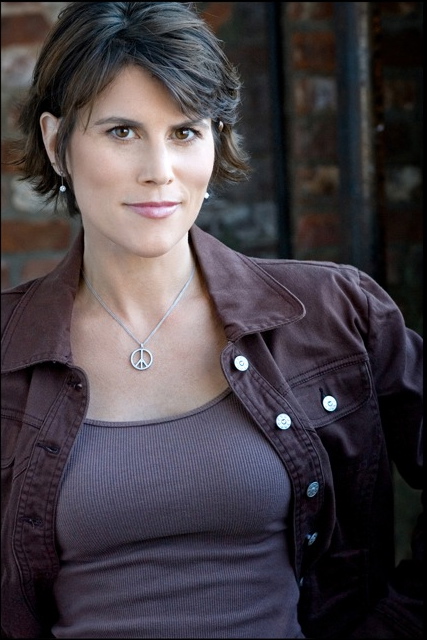
Cougars are hot hot hot these days, and the same can be said for Donna Moore. A stunning fortysomething single mother of two, Moore has revamped her two-person cabaret show about older women with a thing for younger men into Cougar the Musical, a full theatrical production that begins previews at St. Luke’s on August 10 prior to an August 26 opening. The NYU grad, who starred on the children’s television series Zoom back in the mid-1970s, has teamed up with Tony-nominated director and choreographer Lynne Taylor-Corbett to present the sexy story of a trio of older women (Brenda Braxton, Catherine Porter, and Babs Winn) who have the hots for a series of young studs with such names as Buck, Twilight Dude, Bourbon Cowboy, and Naked Peter (all played by Danny Bernardy). The perennially upbeat Moore, who battled Lupus after giving birth to her first child, is also an affirmationist who believes strongly in the power of positive thinking, telling herself such mantras as “I love and accept myself exactly as I am,” “I am forgiven as I forgive others,” and “I am connected to the flow of life.” Moore discussed Cougar, young studs, Lupus, and more in our latest twi-ny talk. (For a chance to win free tickets to see Cougar the Musical, go here.)
twi-ny: You were a cast member on Zoom back in the mid-1970s. At the time, did you anticipate a future in the entertainment business?
Donna Moore: I started performing when I was nine as a modern dancer and all I know is that something would happen when I would get on stage — like this free spirit that was my higher self would channel through me and a nine-year-old was transformed into an ageless, graceful creature. After Zoom, I always knew I wanted to continue to perform, but I think I was more concerned about survival from my childhood fame in a city public school (I was beaten up and threatened on a daily basis in junior high) to think about my future as a performer.
twi-ny: Cougar the Musical goes back to a cabaret you performed with Danny Bernardy back in 2007. How did it develop into a bigger musical with a full cast and crew?
Donna Moore: “The Cougar Cabaret” came out of a co-creation with R. K. Greene (who is now one of my “above line” associate producers). I had a cabaret show about my divorce that ran for a year called “The unBalancing Act” and the eleventh-hour number was a song called “The Cougar” that I cowrote with John Baxindine. It brought the house down every night, and one evening R.K was in the audience with Olson Rhodes (my current and wonderful GM) and they discussed how if I wrote a whole show about the cougar, how R.K would get behind me and coproduce.
“The Cougar Cabaret” came ran for one and a half years with my beloved Danny Bernardy. We each played three different characters. (I also played his Jewish mother from Boca who wasn’t too happy her son was dating a woman old enough to be her sister, “my older sista . . . it’s just wr-aw-ng!”) The show got a lot of buzz and there were a number of Broadway producers who said if I developed it into a larger book play they would get behind me. It took threes years (a number of separate book musicals and thirty songs later) and my partnering with director and dramaturg Lynne Taylor-Corbett [LTC] to turn the two-person, six-character cabaret script into a fully fleshed (no pun intended) four-person script.
In cabaret and stand-up, you can talk to the audience, tell it like it is, but I had to work painstakingly and determinedly to show the character development and not tell. I do credit LTC with helping me become a playwright worth her salt.
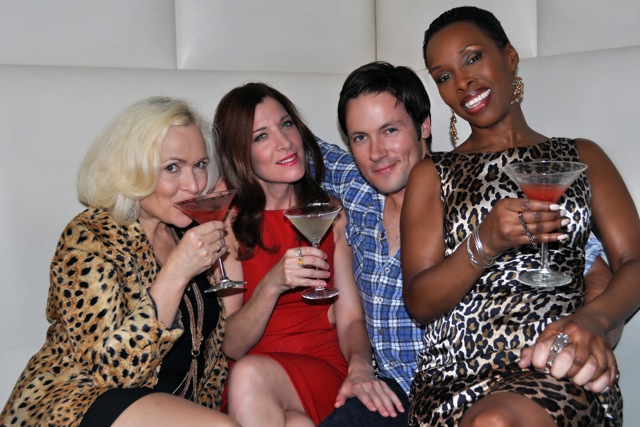
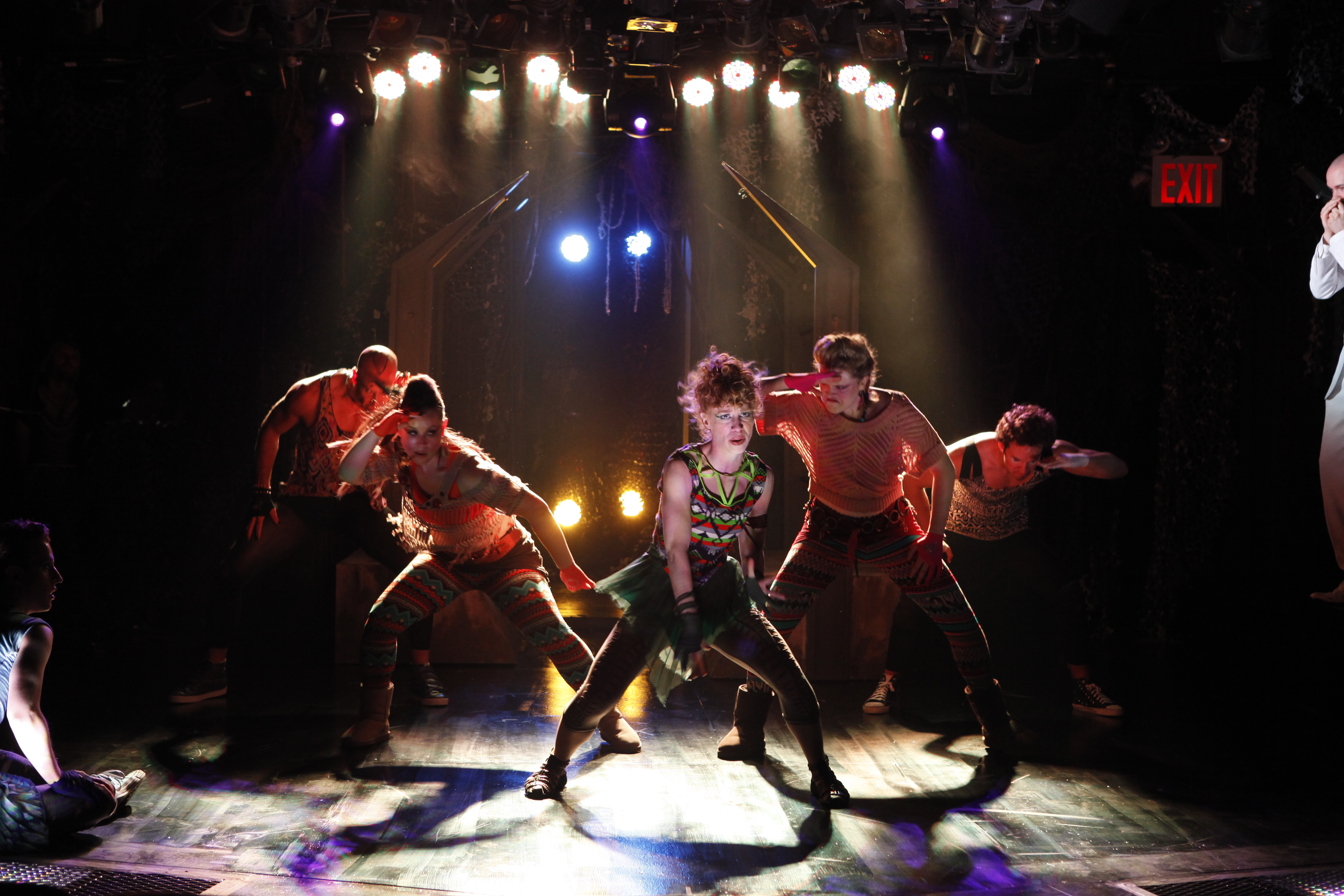
A trio of women have a thing for young studs in COUGAR THE MUSICAL (photo by BittenByAZebra)
twi-ny: What do you think of the whole Cougar phenomenon in general? What’s the difference between a cougar and a MILF?
Donna Moore: I’ll start with the easiest and then get deep on you: A MILF can be a cougar but a cougar cannot necessarily become a MILF. A MILF is required to be a mother and it’s incumbent upon the young men around her, who are friends with her teenage child, to desire this older woman, so it’s a “passive” term. A cougar is not necessarily a mom, and her cougar status has less to do with a young man desiring her as it has to do with the empowered woman desiring the young man.
I’ve been working on this project for eight years and have been interviewed by national magazines and newspapers as a “cougar expert” because of my cabaret show, lol, and there have been so many twists and turns but one thing that remains the same is my take on this cougar phenomenon. I believe the sociopolitical reason we are fixated on the cougar/older woman is that as a collective whole, we are yearning to embrace a more matriarchal system after a millennia of patriarchal dictation. And the “cougar” represents the medicine woman and the intuitive healer that older women used to represent in older societies. I believe that women have a chance to say “yes” to their innate sacred power and the access to that is to “embrace the sacred feminine” in all of us.
twi-ny: Speaking of sacred power, you are a strong believer in the healing properties of affirmations. Why do you think they work?
Donna Moore: I believe that life is holistic and metaphysical and that our experience is made up of mental, spiritual, and physical components that all exist as one whole. The thoughts you think create results, the context of which one thinks creates an attitude that serves well-being or shoots you in the foot, literally.
After the birth of my first child (who is turning twenty-two in November), I was diagnosed with Lupus, a horrible autoimmune disease where your immune system attacks your body and sees itself as a foreign threat. I was very sick, with horrible joint pain, unending fatigue, and depression. I had to crawl up the stairs and had no energy to do anything but sleep. I was only twenty-nine. I decided to take a spiritual approach and rid myself of my dis-ease. I refrained from any sort of gossip, I started to eat organically, and I submerged my consciousness with 100% positivity. I actively repeated affirmations of self-love and acceptance, ones that viscerally changed my state of being, and, happily, I was able to cure myself of Lupus. The ANA antibody is no longer positive, I was able to have a second child, and I have not experienced symptoms in over twenty years.
So yes, I believe affirmations are a powerful metaphysical medicine . . . or for those who may not be as a open-minded, it is a way to change your state into one that supports growth and happiness.
twi-ny: You are a vivacious fortysomething mother of two, prime cougar territory. Do you have any personal cougar stories you’re willing to share?
Donna Moore: I did date a man nine years my junior on and off for eight years. However, I never felt like I was older than he. . . . We were just two people who connected.