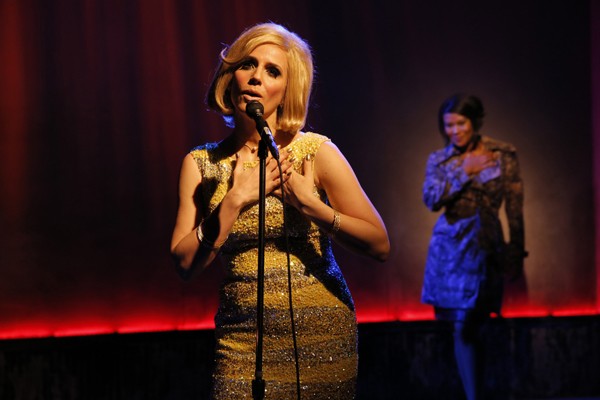
Kirsten Holly Smith sings her heart out as she channels legendary British singer Dusty Springfield in FOREVER DUSTY (photo by Joan Marcus)
New World Stages
340 West 50th St. between Eighth & Ninth Aves.
Wednesday – Monday through March 3, $69-$79
www.foreverdusty.com
www.newworldstages.com
After more than seven years and several transformations, the hit off-Broadway musical Forever Dusty has settled comfortably into its home at New World Stages, where it opened in November and is currently scheduled to run through March 3. The biographical show examines the career of Mary Isobel Catherine Bernadette O’Brien, better known as British singing sensation Dusty Springfield — dazzlingly channeled by Forever creator Kirsten Holly Smith — from her childhood to her superstardom through her death in 1999 at the age of fifty-nine. The ninety-minute musical also delves into Springfield’s personal life, including her long estrangement from her brother (played by Sean Patrick Hopkins) and her relationships with women, embodied in the show by a composite character named Claire (Christina Sajous). There are family matters going on behind the scenes, too, as Smith cowrote Forever Dusty with her husband, journalist and author Jonathan Vankin. Smith, who is from Pittsburgh, has previously appeared in such plays as Three Sisters, Of Mice and Men, and Twelfth Night and such films as Isle of Lesbos and Firecracker, while Vankin, who hails from Williamstown, Massachusetts, has written for comic books, the New York Times Magazine, and Salon as well as authoring books in the Greatest Conspiracies series. Below the two discuss their collaboration and their still-growing admiration of Dusty Springfield.
twi-ny: Whose initial idea was it to create a show about Dusty Springfield? What was it about Dusty that drew you to her?
Jonathan Vankin: Forever Dusty is Kirsten’s idea, her vision, her baby. I came on as her writing partner a few years into her process. So on one level, it is Kirsten Holly Smith who drew me to Dusty.
That said, I’ve always been a huge fan of ’60s music in general and, specifically, the era that Dusty came out of — the British Invasion, Swinging London era. I knew about Dusty and of course I knew “Son of a Preacher Man,” like everyone. But once I became involved in this project and started to listen to every song that Dusty ever recorded and watch every bit of film and video I could find, I immediately became a die-hard fan. Our show covers her life story, which was tragic and triumphant in itself and has become something of an obsession for me over the past few years. But sometimes I have to take a step back, put on one of her records, and just let myself be astonished by how unbelievably good Dusty really was.
Everyone starts with her Dusty in Memphis album, and that is an excellent place to start. But I’d also strongly recommend seeking out her other albums from the 1960s, especially my favorites, A Brand New Me, which was her Philadelphia soul album, and Dusty . . . Definitely, her final British album before her relocation to America.
There are some fantastic female vocalists out there today. Adele, for example, is a phenomenal talent. But I don’t think anyone can or will ever equal what Dusty Springfield was able to do with her voice, her uncanny instinct for selecting great material — and her incredible charisma.
Kirsten Holly Smith: Looking back, I would have to say I was naive about where this journey would take me. It has taken a lot of courage and commitment to not give up on this piece. Somehow we just kept going and a few miracles happened. We are very fortunate and excited to be open off Broadway at New World Stages.
The first thing about Dusty that drew me in was her voice. There was a vulnerability, a grit. The soul that I heard in it — I was immediately fascinated. Then came her look: the blonde beehive, the black panda eye makeup, the incredible costumes and theatrical gestures. The whole package pulled me in. I slowly became obsessed. As I started to learn more about her story, it was like gold. I knew it had to be told. She was the first to stand against apartheid in South Africa and was put under house arrest. She was gay when it was literally a crime in England. Her deep love of soul music, which led her to produce a televised concert called The Sound of Motown with Little Stevie Wonder, the Temptations, Martha Reeves and the Vandellas, and others. She in many ways inspired a nation and introduced them to soul and R&B music. You can still strongly see her influence today with artists like Adele, the late Amy Winehouse, and Duffy.
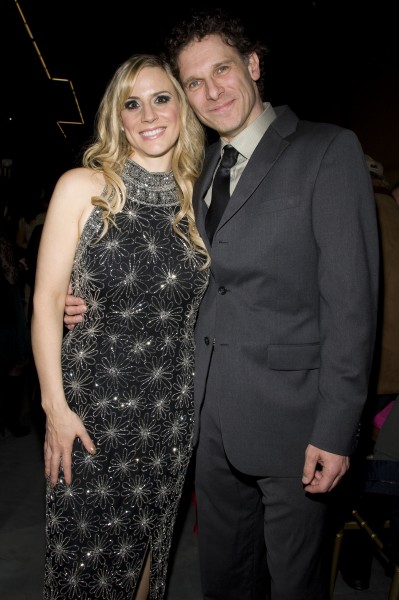
Kirsten Holly Smith and Jonathan Vankin are professional collaborators as well as husband and wife (photo by Monica Simoes)
twi-ny: In doing your research, what was the most surprising thing you learned about Dusty?
JV: Well, as far as surprises go, it’s hard to say because there are so many. After studying her life and career for the past four or five years, I’d think I should know everything about her. But in fact, every time I go back into her story, I find something new. One of my favorite fun facts about Dusty that I think would surprise a lot of people is that she was responsible for the career of a little band some people may have heard of, by insisting that Ahmet Ertegun, the legendary head of Atlantic Records, sign them. Which he did, sight unseen, on Dusty’s suggestion alone. That band went on to have a pretty decent career, despite their funny name — Led Zeppelin.
KHS: I think the most surprising thing about Dusty is that no matter how much I learn or listen or study about her, there is always something new that pops up that I don’t know. Or someone who was close to her will reach out to me or come see the show and tell me an anecdote about her. I am always learning and discovering new things about her, and that is after many years of research. She is endlessly fascinating as a character study. I am grateful that I picked a character that continually inspires me. Not to mention all the cool and lovely people who are now in my life because of doing this project. Thank you, Dusty!
twi-ny: What do you think is the most misunderstood aspect of her career?
JV: It depends on who’s doing the understanding. I think that for today’s generation, it’s very difficult to understand the intense struggles that Dusty faced in her era — being a woman in the music business, especially. Dusty was producing her own records from the start of her career, but she was never given or took credit for it because she knew that the industry, and for that matter the public, wouldn’t tolerate the idea of a woman controlling her own career the way she did. I think that’s very difficult for people in our era to understand — even a female superstar like Dusty was supposed to stay in her “place.”
KHS: I think there was a lot about her career that was misunderstood, but [I agree that] one thing that comes to mind is that she produced her own records at a time when women did not take that kind of role in the studio. Although she never really took credit for it, she really pushed producers in England into that soul sound.
twi-ny: Do you have a particular favorite Dusty song?
JV: Hard to pick one. Like the Beatles, she recorded so many great songs that my favorite changes on an almost daily basis. Lately I’ve been listening to the lead track on her final album, A Very Fine Love (though the original, and better title, was Dusty in Nashville). The song is called “Roll Away,” and given its place in Dusty’s life and career, it’s a very moving epitaph and a beautiful number.
KHS: That’s really tough for me. Dusty literally recorded hundreds of great songs and many of them hits. I would probably have to break it down by decade. Early ’60s: “I Only Want to Be with You.” Mid-’60s: “You Don’t Have to Say You Love Me.” Late ’60s: “Son of a Preacher Man.” ’70s: “Crumbs Off the Table.” (She also recorded a lot of backup vocals in the ’70s under the pseudonym Gladys Thong; I love that. Fun fact: She sang backup on Elton John’s “The Bitch Is Back.”) The ’80s: “What Have I Done to Deserve This” or “Soft Core.” I also love her version of “Can I Get a Witness” and her cover of a Baby Washington song called “Doodlin’.” But . . . if I was stranded on a desert island and only had to pick one song, it would have to be “Son of a Preacher Man.”
twi-ny: Kirsten, you make a lot of eye contact with the audience during the show. In general, how have the crowds been?
KHS: In general, I only make eye contact in the context of there being a live performance that is incorporated into the story. As much as I can, I see the audience through that filter in my imagination. That is, the filter of what part of the story I am telling when I am singing that particular song to the audience.
I am also aware of the audience and how they are responding. I do my best as an actor to just focus on what is happening onstage; listen, receive, and respond to the other actors in the moment. That is my job, and that is hopefully where most of my focus lies during the performance. We move through the story at a fast pace. I do feel that if I am off my game in any way that the audience directly responds to that, so I do my best to be in the moment. Being in such an intimate space as the 199-seat house we are in at New World keeps me very grounded and honest in my work. I can’t really fake it, and it makes me work harder. It’s a good, fertile training ground to make me stronger as an artist and performer. I also think it gives the audience a direct experience with the artist, and I believe that can be very powerful to experience.
JV: I can say that just from being in the crowd myself at quite a few of the performances so far, audiences love this show. People are on their feet at the end of every show, and when Kirsten heads into the lobby afterward, she’s always swarmed with autograph and photo requests — all of which she happily obliges.
KHS: In general the crowds have been really supportive. I do go out to meet the audience in the lobby after the show and people can be very emphatic about the show. It’s delightful and makes me feel like all of our hard work is worth it. The audience members seem to have a very positive and emotional reaction to the story and the music. I get a lot of, “I didn’t know that about her.” And “Thank you for keeping her memory alive.” Or “I loved the music; you brought me back to my youth.”
There are younger people too who are just getting to know Dusty and are coming to the show; they too really love the story and are moved by it. Forever Dusty is a slice of rock-n-roll history and one that I think is really cool for younger people to take in as well. I feel very moved, proud, and grateful when people are inspired by the piece. Art is all about sharing and inspiring people. Theater is a very direct medium for storytelling: There is no filter; you are living the story. When theater is done right, it is truly a very powerful experience for the audience.
JV: What I find most meaningful is when people who actually knew Dusty in her life come to see the show (and there have been a number of them). Inevitably, they have tears in their eyes when they approach Kirsten and tell her that she brought Dusty back for them. What could mean more than that?
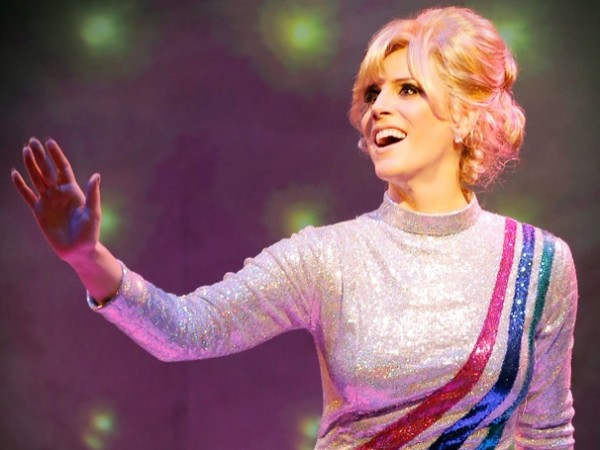
Kirsten Holly Smith has been playing to enthusiastic crowds as Dusty Springfield at New World Stages
twi-ny: You wrote the show together. Do you work well with each other, or can it get a little crazy?
JV: To tell you the truth, it went great. Any collaboration has its bumps in the road, but in this case we know each other’s talents and abilities so well that we always knew what to expect from each other and what we each had to contribute.
KHS: Jonathan and I did write this version of the show together. The show was born out of a piece that I started writing in 2005 that ended up being produced in 2008. Then Jonathan and I got together and wrote a screenplay that encompassed more of Dusty Springfield’s entire story. It was a big, sprawling biopic about her life. We went in and did a lot more research, fleshed out the story, added a lot more music. Our screenplay was twice a finalist at the Sundance Screenwriters Lab 2.
While we were writing the film script, we were working on getting the play up in New York, but there was not a lot of movement happening with it so we decided to flesh out the play script that was produced in L.A. (which was a one-woman musical) and create a bigger theatrical piece. This eventually became Forever Dusty, the show we currently have in place, which has five actors and four band members onstage. I am really proud of where it landed.
I think Jonathan and I work really well together. Yes, it can get crazy, but we seem to somehow always be able to work through it. We balance each other out well; it’s a strong partnership.
Jonathan has extensive experience as a writer and editor, and I always learn an immense amount working with him. He’s very detailed about the choices a character makes and why they make them. He has an incredible talent. I have seen few people who can craft a story and character with the depth and ease that Jonathan does. It is truly a gift and honor to work with him. He is more of a mentor to me when it comes to writing. I am a strong ideas person and creative. It can be really fun bouncing ideas around and coming up with dialogue.
twi-ny: Do you have plans to write together again?
KHS: I will always work with Jonathan, but he is busy with other projects right now. I think he just finished a screenplay for a producer and is now working on writing another play for another producer. We have talked about several other projects that could work. I guess time will tell. Right now we are still pretty focused on building Forever Dusty into the long-term success we know it can be. We need all the support we can get right now from the community.
JV: Sure, we’d love to write together again. (And here’s a secret — we already have.)