this week in theater

NEXT WAVE FESTIVAL: RHINOCEROS

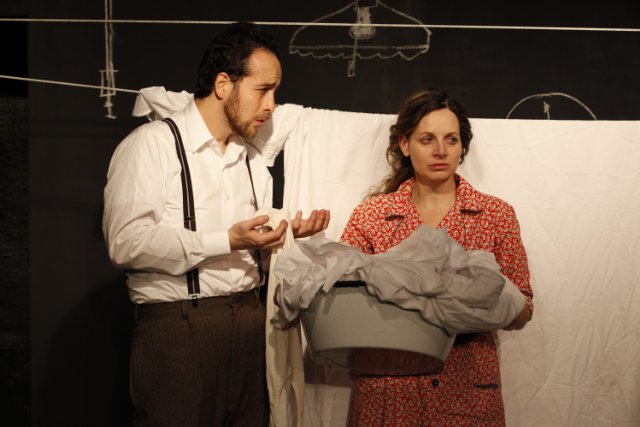
Théâtre de la Ville, Paris, will present Eugène Ionesco’s classic absurdist tale RHINOCÉROS this week at BAM (photo by Jean-Louis Fernandez)

BAM Howard Gilman Opera House
30 Lafayette Ave. between Ashland Pl. & St. Felix St.
October 4-6
718-636-4100
www.bam.org
www.theatredelaville-paris.com

As much as Jean-Paul Sartre is associated with the idea of existentialism, playwright Eugène Ionesco is linked with the word absurd. Born in Romania in 1909 and raised primarily in France, Ionesco changed the face of dramatic narrative with such works as The Lesson, The Chairs, The Killer, and Exit the King. One of his most famous plays, 1959’s Rhinocéros, which was turned into a 1973 film starring Zero Mostel, Gene Wilder, and Karen Black, can now be seen in an inventive adaptation by Emmanuel Demarcy-Mota and Théâtre de la Ville, Paris, running at BAM’s Howard Gilman Opera House October 4-6 as part of the thirtieth Next Wave Festival. “I like to come back to playwrights who question the place and role of the individual in collective history, on his responsibility, his freedom of thought, beyond any form of individualism,” Demarcy-Mota, who has also recently directed works by Horváth and Brecht, explains on the company website. The allegory about totalitarianism features set and lighting by Yves Collet, music by Jefferson Lembeye, and costumes by Corinne Baudelot, with François Regnault serving as artistic collaborator; Serge Maggiani plays Bérenger, Hugues Quester is Jean, and Valérie Dashwood takes on the role of Daisy. “”Ionesco knows how to depict dialectically every man’s cowardice, conformism and hypocrisy,” Demarcy-Mota adds. Rhinocéros “is a funereally burlesque play that we wish to render with full energy.” As a bonus, on October 5 at 5:00 at the Rosenthal Pavilion at NYU’s Kimmel Center, the esteemed panel of Demarcy-Mota, Edward Albee, Israel Horovitz, and Marie-France Ionesco will participate in the free “Next Wave Talk: On Ionesco,” moderated by NYU French literature professor Tom Bishop.

Nowhere is safe in Théâtre de la Ville’s thrilling production of Eugène Ionesco’s absurdist classic (photo by Pavel Antonov)

Update: Théâtre de la Ville director Emmanuel Demarcy-Mota promised a Rhinocéros rendered “with full energy,” and he and the company deliver all that and more in their engaging version of Eugène Ionesco’s 1959 absurdist classic, running October 4-6 at BAM’s Howard Gilman Opera House as part of the thirtieth Next Wave Festival. Following a short introductory excerpt from Ionesco’s sole novel, The Hermit, the curtain opens on a group of people in a town square just going about their daily business. Jean (a big, blustery Hugues Quester) bikes in to meet his friend Bérenger (Serge Maggiani), a bedraggled man recovering from a hangover, not able to remember much of what occurred the night before. A rhinoceros suddenly roars through the town like a tsunami, leaving in its wake a stunned crowd not quite sure what it really just saw, instead getting caught up in existential discussions of cats’ paws. Eventually life goes on, with Bérenger, who has a crush on Daisy (Valérie Dashwood), arriving at the publishing house where he works, only to encounter another stampeding rhino. As everyone around him starts turning into rhinos, the hapless Bérenger is determined not to succumb to the mass hysteria. Featuring terrific staging (courtesy of Yves Collet) that includes a raised-level office, collapsing rooms, and a majestically morphing figure in addition to a slowly building score by Jefferson Lembeye that nearly explodes at the end, Théâtre de la Ville’s Rhinocéros cleverly captures the philosophical underpinnings of Ionesco’s tale of the fight for individualism in the face of growing totalitarianism and an ever-increasing conformity that is overwhelming a consumer-driven society. Evoking Franz Kafka’s novella The Metamorphosis, Don Siegel’s sci-fi classic Invasion of the Body Snatchers, and such recent disasters as Hurricane Katrina and the 2011 Japanese earthquake and tsunami, the show combines humor, pathos, and playful investigations of logic as the community is overcome by a collective consciousness that seems unstoppable. Ionesco might have written Rhinocéros because of what he saw occurring in Eastern Europe in the 1930s, but it still feels as fresh and relevant as ever in this outstanding production.

TICKET GIVEAWAY: THE OTHER JOSH COHEN

Steve Rosen stars as Josh Cohen in THE OTHER JOSH COHEN

THE OTHER JOSH COHEN
SoHo Playhouse
15 Vandam St.
Previews October 10-20, $35; October 21 – November 11, $65
www.theotherjoshcohen.com

Based on a true story, The Other Josh Cohen is a new musical comedy about bad luck, Jewish guilt, and Neil Diamond. David Rossmer (Peter and the Starcatcher, the Misconceptions) and Steve Rosen (Spamalot, The Farnsworth Invention) collaborated on the book, music, and lyrics and both play the title character, who is broke and lonely as Valentine’s Day approaches, the only thing left after his apartment was robbed being a Neil Diamond CD. A presentation of Amas Musical Theatre, The Other Josh Cohen is directed by Ted Sperling, choreographed by Andrew Palermo, and features Kate Weatherhed as a Lot of People, music director Vadim Feichtner as a Bunch of People, Hannah Elless as a Bunch of Other People, and Ken Triwush as the Rest of the People.

David Rossmer stars as Josh Cohen in THE OTHER JOSH COHEN

TICKET GIVEAWAY: The Other Josh Cohen, begins previews at the SoHo Playhouse on October 10 prior to an October 21 opening, and twi-ny has four pairs of tickets to give away for free. Just send your name, daytime phone number, and all-time favorite Neil Diamond song to contest@twi-ny.com by Thursday, October 4, at 5:00 to be eligible. All entrants must be twenty-one years of age or older; four winners will be selected at random.

CHAPLIN

Rob McClure embodies the Little Tramp in new Broadway musical about Charlie Chaplin (photo by Joan Marcus)

Ethel Barrymore Theatre
243 West 47th St. between Broadway & Eighth Ave.
Through February 3, $49.50 – $135.50
www.chaplinbroadway.com

From his Dickensian upbringing to Hollywood stardom to his penchant for underage women and his long exile overseas, followed by a final redemption, Charles Spencer Chaplin lived quite a life, something book writers Christopher Curtis and Thomas Meehan are only partially successful in bringing to the big stage with Chaplin. The new musical, directed and choreographed by Warren Carlyle, glories, perhaps a bit too much, in Rob McClure’s dazzling performance as Chaplin, embodying the multitalented actor, writer, director, musician, composer, political rebel, and womanizer whose socially relevant silent comedies brightened up hard times in America during the 1920s and 1930s. The show starts in London, as young Charlie (a charming Zachary Unger) grows up in the seedy alleys and burlesque clubs with his mother, Hannah (an outstanding Christiane Noll), a bawdy performer whose husband has essentially abandoned the family. An older Charlie soon catches a break and is working for Mack Sennett (a strong Michael McCormick) in Hollywood; the scene in which Charlie is ordered to be funny and transforms into the Little Tramp is splendidly done, adding a deft touch of magic to the invention of this seminal character. Hiring his brother, Sydney (Wayne Alan Wilcox), as his business manager, Charlie finds massive success with such films as The Kid, The Gold Rush, and The Circus, but the musical oddly chooses which to focus on; while Carlyle does a good job equating The Kid with Chaplin’s real-life experiences as a child (clever casting has Unger also playing Jackie Coogan), shorter (or stranger) shrift is given to such critical works as City Lights and Modern Times, and later films such as Monsieur Verdoux and Limelight warrant nary a mention, despite their many inside references to his personal situations.

The musical does, however, devote a major sequence to The Great Dictator that reveals the development of his public political persona. But in the second act, Chaplin spends way too much time concentrating on Hedda Hopper’s (Jenn Colella) mission to destroy Chaplin by labeling him a communist in order to get even for his refusal to be interviewed by her. And the musical deals with Chaplin’s ultimately disastrous marriages to Mildred Harris (Hayley Podschun), Lita Grey, and Paulette Goddard in a baffling boxing scene that sideswipes the show, while his relationship with Oona O’Neill (Erin Mackey) swoops in from nowhere and then essentially disappears. Beowulf Boritt’s sets, Amy Clark and Martin Pakledinaz’s costumes, and Ken Billington’s lighting, along with Jon Driscoll’s inventive video projections, give Chaplin the look and feel of a black-and-white movie, but few of the songs stand out, aside from Noll’s “Look at All the People” and the ensemble piece “Just Another Day in Hollywood.” Much like Chaplin’s career, Chaplin kicks off with quite a bang but eventually dissipates into the disappointment of what could have been.

THE EXONERATED

Powerful, intense, and crucially important, THE EXONERATED is back at the Culture Project for a special tenth-anniversary engagement (photo by Carol Rosegg)

Culture Project
45 Bleecker St. between Lafayette & Bowery
Tuesday – Sunday through November 4, $30-$99
866-811-4111
www.cultureproject.org
www.theexonerated.com

Ten years ago, married couple Jessica Blank and Erik Jensen’s groundbreaking The Exonerated debuted at the Culture Project. The riveting, multiple-award-winning play, which follows the true, harrowing stories of five men and one woman who found themselves on death row for crimes they did not commit, is now back at 45 Bleecker St. for a special return engagement, and it’s as powerful as ever, as innocent people continue to be incarcerated and executed in this country. On a dark stage, ten people sit in front of black music stands, relating their stories as overhead lights single them out, with occasional interstitial music by David Robbins. The production, again directed by Bob Balaban, features a regular cast of six actors, along with a rotating selection of four guest stars taking on some of the major roles. The central figures are Gary Gauger (Brian Dennehy), Kerry Max Cook (Chris Sarandon), Robert Earl Hayes (JD Williams), David Keaton (Curtis McClarin), Delbert Tibbs (Delroy Lindo), and Sonia “Sunny” Jacobs (Stockard Channing), each of whom was wrongly arrested, convicted, and sentenced to death. They are joined by Jim Bracchitta and Bruce Kronenberg as various cops, prosecutors, and other public officials, April Yvette Thompson as Hayes’s wife, and Amelia Campbell as Cook’s and Gauger’s wives; Campbell, McClarin, and Kronenberg reprise their roles from the original stage production, while Dennehy and Lindo previously played their parts in the 2005 Court TV movie. Every single word of The Exonerated is taken from interviews, court transcripts, letters, and other primary sources; nothing is fictionalized, which adds to the play’s intense power. The terrifying personal journeys of the six wrongly convicted people explore such issues as racism, homophobia, and political maneuvering in which the truth seems to always take a backseat. Even though the audience knows that the six people have been freed, the play is beautifully paced, cutting from one character to another as the tension mounts and the details grow more and more amazing and hard to believe. The acting is solid throughout, but Lindo is particularly mesmerizing, speaking Tibbs’s poetic words with a masterful grace. Dennehy, Channing, and Sarandon continue through September 23 and Lindo through September 30; upcoming celebrity guests include Steve Earle, K’naan, Lyle Lovett, Brooke Shields, and the real Sunny Jacobs. Numerous shows will also be followed by panel discussions featuring such groups as the Innocence Project, Amnesty International, the New York Civil Liberties Union, the Center for Constitutional Rights, and the Reinvestigation Project. The Exonerated not only makes for terrific theater, but its importance cannot be overstated. Don’t miss it — especially if you’re in favor of the death penalty.

COSÌ

Louis Nowra’s COSÌ examines love and madness in the theater in wacky ways (photo by Samir Abady)

Urban Stages
259 West 30th St. between Seventh & Eighth Aves.
Through September 23, $!8
212-868-4444
www.urbanstages.org
www.australianmadeentertainment.com

For its inaugural production, Australian Made Entertainment, a New York City-based organization founded by husband-and-wife performers Kathleen and Matthew Foster to promote Australian plays in the United States, has chosen both carefully and wisely: award-winning playwright Louis Nowra’s semiautobiographical 1992 work Così, a very funny examination of theater, madness, love, and the fine line between illusion and reality. Adam Zivkovic stars as Lewis, a recent theater graduate who has accepted a job directing a show in a Melbourne asylum, where it’s hoped that the patients will come out of their shells by participating. While his girlfriend, Lucy (Olivia Etzine), and best friend, Nick (Zach Bubolo), think he’s crazy for taking on such a job and instead devote their time preparing for a professional production of Brecht’s Galileo and joining the growing Australian ant-Vietnam War movement, Lewis immerses himself in the trials and tribulations of a wacky band of characters, consisting of manic-depressive wannabe opera star Roy (Matthew Foster), OCD-riddled Ruth (Laura Iris Hill), sex-obsessed Cherry (Annie Worden), pyromaniac Doug (Clint Zugel), silent lawyer Henry (Stuart Williams), medicine-dependent piano player Zac (Duke Anderson), and drug addict Julie (Kathleen Foster). Even though none of them can sing or knows Italian, Roy insists they put on Mozart’s Così fan tutte, and mad hijinks ensue as they prepare for opening night. Christopher Thompson’s dank, gray set wonderfully equates the stage with a room in a mental ward, as if the two are one and the same. Matthew Foster is loud and boisterous as Roy, celebrating the myriad possibilities that theater can offer, while the rest of the cast offers more subtle support, particularly Zugel as Doug, who threatens danger at every turn, and Worden as Cherry, who nearly steals the show with hysterical herky-jerky movements and riotous little tics. Fluidly directed by Jesse Michael Mothershed without getting heavy-handed, Così — which was also made into a 1996 film starring Toni Collette, Colin Friels, Rachel Griffiths, and Colin Hay — is a delightful beginning to the Fosters’ new company. The two-hour play, which has general admission seating, runs through September 23 at Urban Stages; be sure to stop by the concession table, where you can pick up such Australian treats as Dub Pies and salted caramel bites to further the Down Under experience.

HEARTLESS

Roscoe (Gary Cole) rages in the background as Sam Shepard’s new play about a crazy family (photo by Joan Marcus)

The Pershing Square Signature Center
The Irene Diamond Stage
480 West 42nd St. between Tenth & Eleventh Aves.
Extended through September 30, $75
212-244-7529
www.signaturetheatre.org

In 1996-97, Sam Shepard was the playwright-in-residence at the Signature Theatre, presenting Curse of the Starving Class, Chicago, Tooth of Crime (Second Dance), and The Sad Lament of Pecos Bill on the Eve of Killing His Wife. He is now making his debut at the new Pershing Square Signature Center on West 42nd St. with the new play Heartless, which has been extended at the Irene Diamond Stage through the end of September. Developed specifically for the space, Heartless takes place in a Los Angeles house overlooking the San Fernando Valley, where the extremely cynical Sally (Julianne Nicholson), who has a frightening scar running down the length of her torso, has brought home Roscoe (Gary Cole, who is too young for the role), a professor more than twice her age who has just left his wife. Roscoe soon meets the rest of Sally’s crazy family, including sister Lucy (Jenny Bacon), a dour spinster who carries in a serving platter of meds for Sally as if it were breakfast, and mother Mable Murphy (Lois Smith), a wheelchair-bound old woman who says exactly what’s on her mind, no matter who it might hurt. Mable is cared for by nurse Elizabeth (Betty Gilpin), a beautiful young woman who rarely, if ever, speaks. From the start, it’s hard to get a footing on the story; in the first act, the unlikable nature of most of the characters rises quickly to the surface, although Lucy’s wry sense of humor and Mable’s ranting soliloquies eventually rescue the play from the confounding mix of reality and surrealism that hampers the second act. Heartless is a rare Shepard work with more female than male characters, with the sole male, Roscoe, seeming lost much of the time, merely a prop to engage the stronger, more powerful women. Much of Heartless actually lacks heart, which might relate to the plot but causes an uncomfortable distance between the audience and what’s happening onstage. The stand-out is Smith, trapped in a wheelchair but able to rage like a tornado, including one speech in which Mable mentions watching the movie East of Eden, a film that Smith actually appeared in, something that Shepard has said was just a coincidence.

THE TRAIN DRIVER

Leon Addison Brown and Ritchie Coster dig down deep in Athol Fugard’s THE TRAIN DRIVER (photo by Richard Termine)

The Pershing Square Signature Center
The Romulus Linney Courtyard Theatre
480 West 42nd St. between Tenth & Eleventh Aves.
Through Sunday, September 23, $25
212-244-7529
www.signaturetheatre.org

Athol Fugard’s year as the inaugural Residency One playwright at the new Signature Theatre concludes in triumphant fashion with the New York premiere of the subtly powerful The Train Driver, following previous productions of Blood Knot and My Children! My Africa! On a wide, shallow stage covered in sand, dirt, rocks, and garbage, Simon Hanabe (Leon Addison Brown), an old, slow-moving black man with a shovel, approaches the audience, explaining that he has a story to share. The play then shifts to a flashback as Simon, the caretaker who buries the men, women, and children with no names in this makeshift graveyard/junkyard, is approached by Roelf Visagie (Ritchie Coster), a destitute white man desperate to find the grave of a black woman and her baby, claiming that she ruined his life. As Roelf’s harrowing tale emerges in long soliloquies (wonderfully delivered by Coster), Simon (expertly played with understated simplicity by Brown) goes about his daily business, sweeping the sand, heating canned food over a candle in his dilapidated shack, and sleeping on a ratty reclining chair. He tells Roelf that they both will be in serious danger if the local band of tsotsi, murderous thugs, catches him there, where no white man is supposed to be, but Roelf doesn’t listen as he continues his search for the dead woman and child. Fugard also directs the ninety-minute show, maintaining a mood of quiet grace as day turns to night and back to day again. The relationship between the two men never falls into cliché as they drive the story to its relentless conclusion, brought together by death and white guilt. The Train Driver runs at the Signature through September 23; on September 24, the Signature will present a screening of Gavin Hood’s Oscar-winning film, Tsotsi, which is based on Fugard’s only novel.