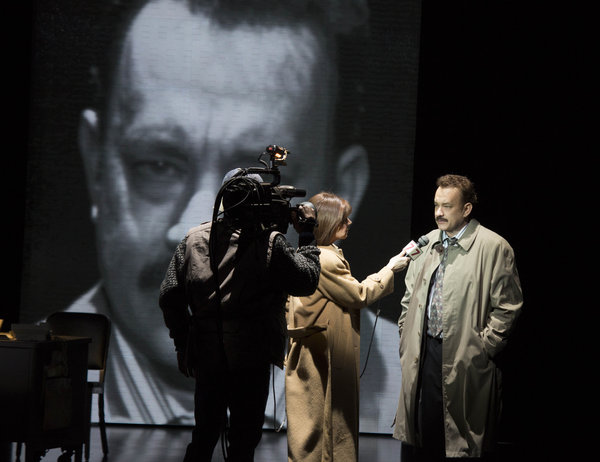
this week in theater

THE PLAY ABOUT THE COACH

Coach (Paden Fallis) is exasperated by life and basketball in THE PLAY ABOUT THE COACH (photo by  Charlotte Jardat)

Coach (Paden Fallis) is exasperated by game and life in one-man show, THE PLAY ABOUT THE COACH (photo by Charlotte Jardat)

4th Street Theatre
83 East Fourth St. between Bowery & Second Ave.
Through March 17, $18
www.padenfallis.com

Just in time for March Madness, Paden Fallis’s one-man show, The Play About the Coach, has arrived in New York, running at the Fourth Street Theater through March 17. Directed by Tamara Fisch (Sons of the Prophet, On the Tenth Floor) and written by Fallis, the play takes place during the last two minutes and forty-seven seconds of an NCAA tournament quarterfinal match-up. Fallis is the coach of a team that is in the midst of blowing a fourteen-point second-half lead; he paces up and down the sideline, calling out to his players, conversing with the opposing coach, and engaging in an ongoing discussion with the ref, Joey, which at times turns existential. “Look, Joey,” he says calmly to the official. “Three minutes left in this game. That’s an eternity of time, okay? Remember your job: Deal with the facts or conditions as perceived without distortion of personal feelings, prejudices, or interpretations.” As his team’s lead whittles away, the coach removes various parts of his suit, downs cups of water like it’s whiskey, and compares the game to Shakespeare’s Timon of Athens.

Basketball coach doesn’t like what he sees as big lead whittles away (photo by Charlotte Jardat)

Basketball coach doesn’t like what he sees as big lead whittles away (photo by Charlotte Jardat)

Fallis does a terrific job of making the audience think they’re seeing the players, the crowd, the ref, and the heated action through his writing and his penetrating eyes. However, the play loses momentum — so critical at the end of a close contest — whenever the coach calls for time-outs that last much longer than they would in an actual game, and in scenes in which Gillian Wolpert’s lights dim and Gennaro Marletta’s sound lowers, giving the coach time to reflect on his life. Little details are troublesome as well, like when he throws crushed cups into the corner and slams his belt to the ground, items that inch onto the court, which would cause any ref to stop the game. In addition, the coach improbably keeps answering his cell-phone, getting calls from an unknown person — possibly his wife, upset about his total dedication to basketball instead of his family? — but no coach would ever do such a thing, especially during the final three minutes of a do-or-die game. “‘Live we how we can,’” he says. “Guys, look around. Look around you. They don’t understand. They will never understand you. They will ridicule you. They will inform you that there is no hope. They will leave you. You will ask for time and you will ask for space. You will say, ‘Three minutes, it’s only three minutes, things hang in the balance, give me three minutes.’” The Play About the Coach attempts to be about a lot more than just a coach or a game, but although it’s by no means an air ball, it’s also far from a slam dunk.

TICKET GIVEAWAY: F#%KING UP EVERYTHING

Rock musical F#%KING UP EVERYTHING makes its off-Broadway debut this month (photo by Bethany Jacobsen)

Rock musical F#%KING UP EVERYTHING makes its off-Broadway debut this month (photo by Bethany Jacobsen)

F#%KING UP EVERYTHING
Elektra Theatre
669 Eighth Ave. between 42nd & 43rd Sts.
Previews begin March 15, $25-$30
Opens March 24 (through May 18), $25-$79 ($49 tickets available for $39 with code RRM39)
866-811-4111
www.fuckingupeverything.com

The people behind the rock musical F#%King Up Everything clearly have a sense of humor. The show, which was a winner at the 2009 New York Musical Theatre Festival and will be making its off-Broadway debut March 15, has taken flack over its name, which it just changed because of the controversy. “We’ve agonized over this issue since the show first took the stage,” producer Jeremy Handelman said in a statement announcing that the original name, F#@King Up Everything, would be changed to F#%King Up Everything. “But I believe in change, and this opens up a whole new window of opportunity for the marketing of our show.” F#%King Up Everything tells the story of a potential Brooklyn romance between children’s puppeteer Christian Schwartzelberg (Max Crumm) and singer-songwriter Juliana (Katherine Cozumel). The book was written by David Eric Davis and Sam Forman, with music and lyrics by Davis; the show is directed and choreographed by Jen Wineman, with orchestrations and music direction by Matt Hinkley. The cast also includes George Salazar, Lisa Birnbaum, Jason Gotay, Dawn Cantwell, and Douglas Widick.

TICKET GIVEAWAY: F#%King Up Everything begins previews March 15 prior to a March 24 opening at the Elektra Theatre, and twi-ny has four pairs of tickets (good through April 27) to give away for free. Just send your name, daytime phone number, and all-time-favorite curse phrase to contest@twi-ny.com by Thursday, March 7, at 5:00 to be eligible. All entrants must be twenty-one years of age or older; four winners will be selected at random. All responses will be kept confidential.

MY NAME IS ASHER LEV

MY NAME IS ASHER LEV

Ari Brand stars as the title character being torn in opposing directions in MY NAME IS ASHER LEV

Westside Theatre
407 West 43rd St. between Eighth & Ninth Aves.
Tuesday – Sunday through May 26, $39-$85
www.asherlevtheplay.com

Aaron Posner’s theatrical adaptation of Chaim Potok’s highly regarded 1972 novel, My Name Is Asher Lev, is a moving, powerful story of art and tradition as a young man tries to find his way in a complex world. The story takes place in 1950s Brooklyn, where Asher Lev (Ari Brand) lives with his father, Aryeh (Mark Nelson), and mother, Rivkeh (Jenny Bacon). From the time he was virtually a baby, Asher has shown a natural talent for drawing, but as he grows up and considers becoming a professional artist, his father, who works for the Rebbe (Nelson), the spiritual leader of the community, is deeply disturbed, afraid that Asher will turn his back on Judaism. Meanwhile, his supportive mother goes through a dramatic change when she suffers a tragic loss. But Asher is in fact determined to become a successful painter while also maintaining his responsibilities as a Hasidic Jew, something that is harder and harder to do as he is mentored by older artist (and lapsed Jew) Jacob Kahn (Nelson) and celebrated by Manhattan gallerist Anna Schaeffer (Bacon), for whom he creates a startling work that threatens to tear his family apart. Directed by Long Wharf Theatre artistic director Gordon Edelstein (The Road to Mecca, The Glass Menagerie), My Name Is Asher Lev insightfully captures the tug-of-war going on inside of Asher. Posner, who has previously adapted such novels as Ken Kesey’s Sometimes a Great Notion and Potok’s The Chosen, tends go get right to the point, without a lot of nuance, but he cleverly steers clear of potential clichés as he develops the characters. Nelson and Bacon are excellent playing a series of roles, while Brand is likable even if a little overly eager and wide-eyed as Asher. At approximately one hundred minutes without intermission, My Name Is Asher Lev is, well, like a good book you can’t put down, an involving tale that raises intriguing questions about family, responsibility, and artistic desire, and it remains ever-relevant today as religions around the world continue to try to balance modern needs with fundamentalist tradition. (On March 28 at 12 noon, the cast will take part in a special conversation at 92YTribeca with New York Drama Critics’ Circle president Adam Feldman and perform excerpts from the play.)

CLIVE

CLIVE

Director and star Ethan Hawke wonders just what he got himself into in pal Jonathan Marc Sherman’s CLIVE

Acorn Theatre, Theatre Row
410 West 42nd St. between Ninth & Tenth Aves.
Monday – Saturday through March 9, $61.25
212-239-6200
www.thenewgroup.org

Partway through Clive, the title character tells a burly friend, “You lost me, man.” The audience can say the same thing to playwright and actor Jonathan Marc Sherman (Knickerbocker, Evolution) and director and title character Ethan Hawke in the New Group’s awkward adaptation of Bertolt Brecht’s first full-length play, Baal. In a program note, Sherman explains, “Clive is based on, inspired by, and stolen from the German version of Bertolt Brecht’s Baal published in Potsdam in 1922. I worked from a literal translation courtesy of Google Translate. I do not recommend that you try this.” Indeed, the hundred-minute play is annoying and confusing, very much like Google-translated prose. Hawke and Sherman, who previously collaborated on the New Group’s Things We Want, turn the main character into an aging, debauched punk rocker, in spiked white hair and black leather jacket, who prefers sex and drugs to rock and roll. Early on, during a game of Truth or Dare, he spits in the face of a record deal in favor of snorting different kinds of coke and coming on rather heavily to a prominent producer’s wife. He ultimately beds her, as well as a bandmate’s virgin girlfriend and just about every other woman he comes into contact with, and that’s a big part of the problem with the play, based on a work that famously ran for only one performance when it was first staged in 1923: there isn’t a likable character anywhere to be seen, starting with Clive himself, who is as uninteresting as he is despicable, making it hard to believe that all of these women are such suckers. Over the years, the role of Baal has been played by a diverse range of actors, including Oskar Homolka, Rainer Werner Fassbinder, and David Bowie, with varying success; Hawke, who won an Obie for his performance in the New Group’s Blood from a Stone, is unlikely to garner any awards for transforming Baal/Clive into a psychotic escapee from a Billy Idol video who doesn’t really have much to say. The most compelling part of the production is the stage itself, with its beer-label wallpaper, front pit, and seven musical doors designed by the sibling art duo GAINES. The doors, scattered in strategically yet seemingly random places, are visually and aurally intriguing, occasionally played by the supporting cast, which includes Brooks Ashmankas and Zoe Kazan in multiple roles and Vincent D’Onofrio as a bald hulk who regularly lets loose bizarre howls. But the design doesn’t meld with the rest of the show, instead feeling out of place, a whole lot of art for art’s sake, which pretty much sums up the misbegotten Clive as well.

WORKING ON A SPECIAL DAY

(photo by Carol Rosegg)

Gabriel (Antonio Vega) and Antonietta (Ana Graham) discuss life, love, and fascism in WORKING ON A SPECIAL DAY (photo by Carol Rosegg)

59E59 Theaters
59 East 59th St. between Park & Madison Aves.
Tuesday – Sunday through February 17, $35
212-279-4200
www.59e59.org

It’s May 8, 1938, and there’s a parade making its way through the streets of Rome celebrating Adolf Hitler’s visit with Benito Mussolini as the Fascist leaders plot their takeover of Europe. A bored housewife, Antonietta (Ana Graham), is left alone by her husband and kids, cleaning the apartment and doing the laundry while everyone else heads out to the festivities. After her parrot flies out of its cage and out the window, Antonietta tracks it down in the apartment of a stranger, Gabriel (Antonio Vega), the only other person remaining in the complex. Unbeknownst to Antonietta, Gabriel was about to blow his brains out until she suddenly showed up. Soon the two lonely souls are sharing secrets and more in the offbeat yet engaging Working on a Special Day. The seventy-five-minute show was adapted and translated by Graham, Vega, and Danya Taymor from Ettore Scola’s Academy Award–nominated 1977 film, Una giornata particolare, which starred Sophia Loren as Antonietta, Marcello Mastroianni as Gabriele, and John Vernon as Antonietta’s husband (played onstage by Vega also). The intriguing drama takes place in small black box theater in which two of the walls and a pair of doorways are like chalkboards that Graham and Vega constantly draw on, creating windows, telephones, a birdcage, and more. They also make all the sound effects themselves. Thus, when Graham makes the sound of a telephone, Vega draws one on the wall and pretends to answer it. It’s an odd conceit that grows more endearing as the two characters spend more time together and get to know each other much better. Although it’s not interactive or participatory, it is warm and welcoming; when the two actors first appear, the house lights are on, and they change into their costumes using actual seats in the audience, as if crowd and performer are one and the same. A coproduction of the New York–based Play Company and Mexico City’s Por Piedad Teatro Foundation, Working on a Special Day has been extended at 59E59 through February 17.

ROBOT THEATER PROJECT

Robot Theater Project (photos by Tsukasa Aoki and Tatsuo Nambu)

Robot Theater Project includes a pair of one-act plays starring real robots at Japan Society (photos by Tsukasa Aoki and Tatsuo Nambu)

Japan Society
333 East 47th St. at First Ave.
February 7-9, $28, 7:30
212-715-1258
www.japansociety.org

Last month the Resonance Ensemble revived Karel Čapek’s 1920 play, R.U.R., the work that introduced the word “robot” to the world — and a highly influential story that involved machines gaining sentience and threatening humankind. Seinendan Theater Company takes that to the next level this week at Japan Society with Robot Theater Project, a pair of one-act plays written and directed by company founder Oriza Hirata in which real robots play characters onstage. In Sayonara, a woman with a terminal illness is cared for by Geminoid F, described in the cast biographies as “a female type tele-operated android [with the] potential to go beyond an experimental platform and become a commonly used robot in human society.” In I, Worker, a man struggles to deal with the loss of his child while his robot questions the meaning of life; the mechanical being is played by Robovie R3, “a life-sized robot invented to research communications between humans and robots.” While Geminoid F is making its theatrical debut, Robovie R3 previously appeared in Hirata’s Three Sisters, Android Version. The human actors include Bryerly Long, Hiroshi Ota, and Minako Inoue. The two plays, developed in collaboration with Dr. Hiroshi Ishiguro of the Intelligent Robotics Laboratory at Osaka University, will be performed February 7-9 at Japan Society, Sayonara in English and Japanese with subtitles and I, Worker in Japanese with subtitles. Hirata and Dr. Ishiguro will participate in Q&As following the February 8-9 shows. In addition, Hirata will lead an acting workshop, “Exploring Naturalism,” on February 9 at 1:00, delving into his unique “contemporary colloquial theater.”

robots and humans interact in moving ways at Japan Society

Robots and humans interact in moving ways at Japan Society

Update: As the audience enters the Japan Society theater for Sayonara, the first of a pair of one-act plays, two characters are already onstage, sitting in chairs. Although it appears to be two women, one brunette and Asian, the other blonde and Caucasian, it turns out that while the latter is a living, breathing female, Bryerly Long as a young woman dying of a terminal disease, the former is Geminoid F, a remarkably realistic android playing a robot who has been hired by the woman’s father to recite beautiful poetry to make his daughter’s final days peaceful. Geminoid F, who is powered through air pressure via twelve motorized actuators, doesn’t mouth the words exactly, which, along with her vacant eyes, are the only things that give her away as a mechanical being until she is carried off at the end, a long tube connecting her to electronic controls. The interplay between the android and the human is quite moving and believable, with a new scene added involving the nuclear disaster at Fukushima and how robots can help in the aftermath. In I, Worker, Hiroshi Ota (who also plays a small part in Sayonara) and Minako Inoue (who voices Geminoid F) are parents trying to cope with the death of their child. The husband is having more difficulties getting back to a relatively normal existence, which is also the case with the family’s two robots, played by Robovie R3s. While Geminoid F was created to look like a human, Robovie R3 is more in the mode of a futuristic R2D2/Dr. Who type, with fanciful colors and round, wide eyes. Just like the parents, the male robot has lost purpose in his life and is trying to find the will to go on, but I, Worker contains much more humor, supplied by the robots themselves, including how they exit the stage at the end. The two plays work because writer-director Oriza Hirata has created two pieces in which the stories themselves deal with the interchange between humans and robots; he has not cast the androids as real people going through completely real situations, and human actors are not playing robots. The plays would not be successful if they were performed only by robots or only by humans; instead, by bringing the two together, Hirata and robotic scientist Dr. Hiroshi Ishiguro have built a fascinating meta that surrounds the tales, a harbinger of things to come both on- and offstage in our ever-evolving world.

CULTUREMART 2013

Bora Yoon collaborates with Adam Larsen and R. Luke DuBois in surreal WEIGHTS AND BALANCES (photo by James Chung)

Bora Yoon collaborates with Adam Larsen and R. Luke DuBois in surreal WEIGHTS AND BALANCES (photo by James Chung)

HERE
145 Sixth Ave. at Dominick St.
Through February 10, $10 in advance, $15 within twenty-four hours of show
212-647-0202
www.here.org

The HERE Artist Residency Program, known as HARP, is now in the second week of its annual Culturemart festival, consisting of unique, experimental works, often in double features, from emerging presenters in such disciplines as dance, theater, music, visual arts, and puppetry as well as a melding of several of them. On February 4-5, Mei-Yin Ng’s Lost Property Unit explores loneliness and solitude in the digital age, referencing television and movies through dance, live and prerecorded music, and robot sculptures, while in Hai-Ting Chinn’s Science Fair the mezzo-soprano combines opera with science in a multimedia performance. On February 6-7, Robin Frohardt’s The Pigeoning uses music and puppets to look at the end of the world, while Joseph Silovsky’s Send for the Million Men is a solo piece that reexamines the Sacco and Vanzettti case with puppets and handmade projectors. Also on February 6-7, Bora Yoon’s Weights and Balances is a surreal opera featuring an interactive performance design by R. Luke DuBois. On February 8-9, Stein / Holum Projects’ The Wholehearted is a work in progress about a woman boxer looking back at her glory days. On February 9 at 2:00, there will be a free performance of David T. Little’s opera-theater piece Artaud in the Black Lodge, which links Antonin Artaud, William S. Burroughs, and David Lynch through a libretto by Anne Waldman. The festival, which also celebrates HERE’s twentieth anniversary, concludes February 9-10 with HERE artistic director Kristin Marting and David Morris’s Trade Practices, a live, interactive market in which audience members become participants in the event.