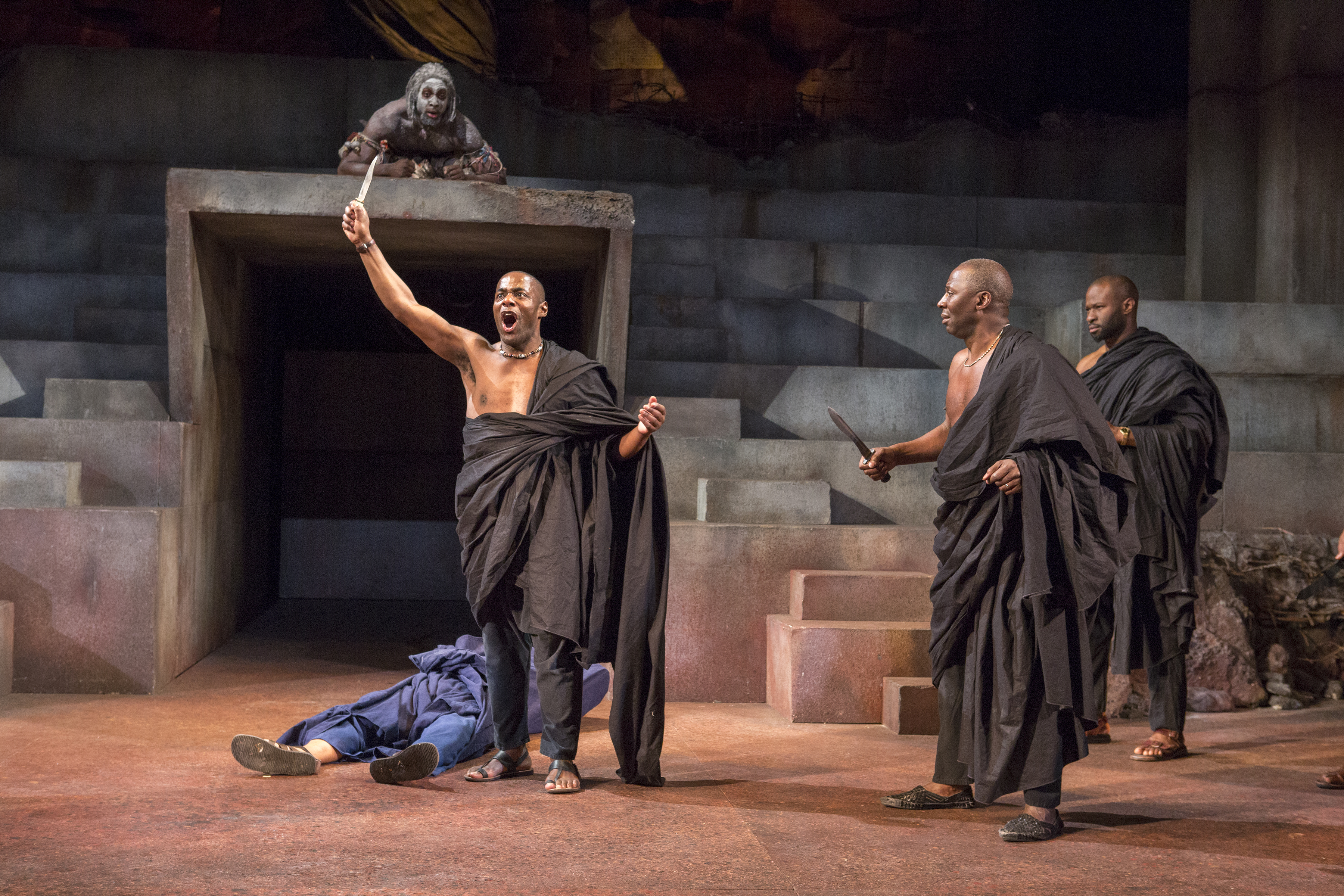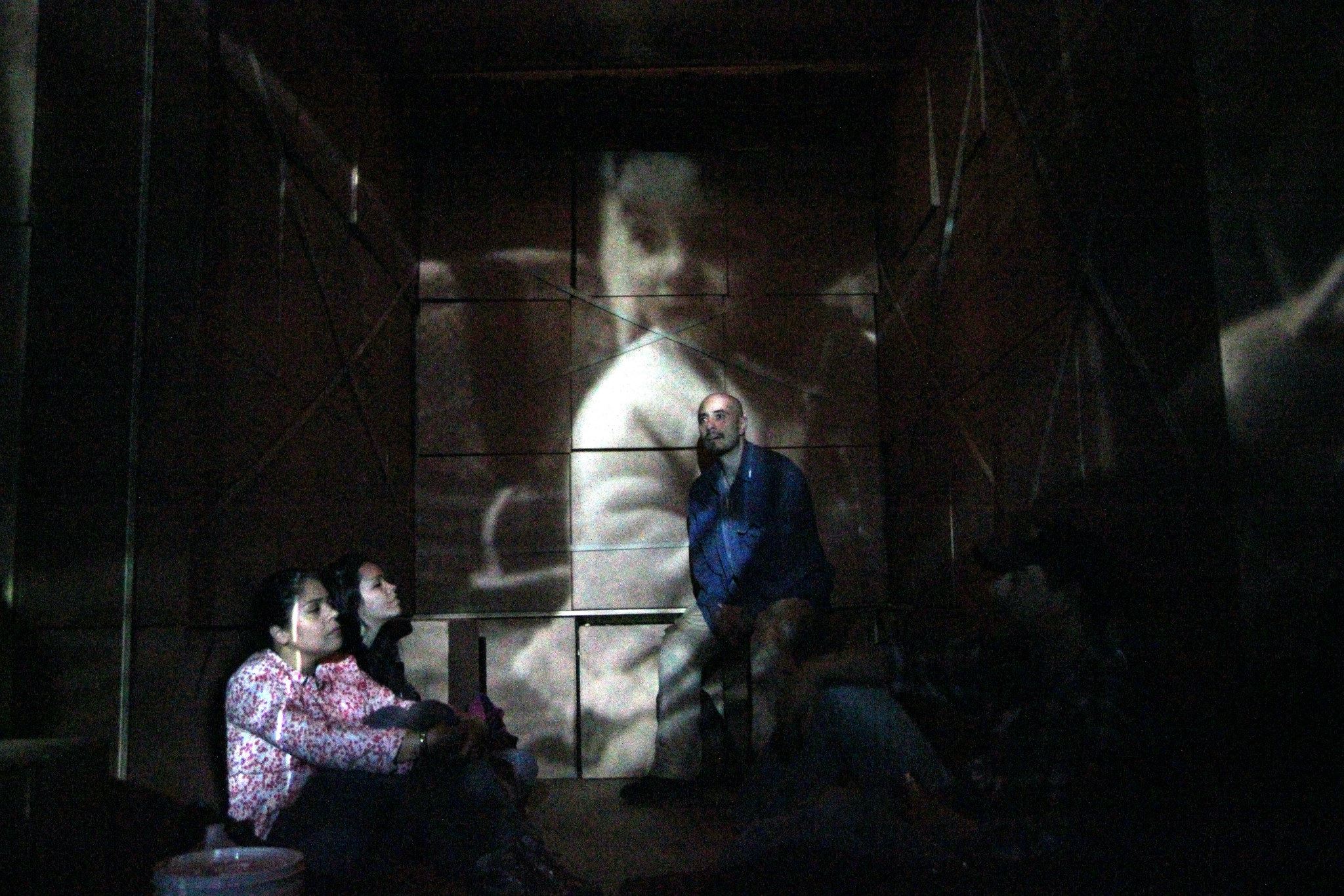
Poverty, destitution, and an overriding strangeness rule the day in Axis Company production of LAST MAN CLUB (photo by Dixie Sheridan)
Axis Company
One Sheridan Sq. between West Fourth & Washington Sts.
Thursday – Saturday through March 30, $20, 8:00
866-811-4111 www.axiscompany.org
Last October, the excellent Axis Company production of Last Man Club had to end its run early because of Hurricane Sandy. The show is now back, running Thursday through Sunday through March 30, giving people another chance to see Axis artistic director Randy Sharp’s unusual Grapes of Wrath meets The Road Warrior tale. In a depression-era middle America Dust Bowl that could double as a barren postapocalyptic landscape, a small family of ragged men and women tries to survive as sandstorms swirl around their deteriorating farm. Friends and kin took off with all the money, leaving the overly practical and far-too-trusting Major (David Crabb) in charge of the mumbling, OCD-riddled Pogord (Spencer Aste), who is waiting for the tank truck to show so that his dried-out sheets can be wetted down; the quirky, ultra-strange Wishful Hi (Lynn Mancinelli), who wears crazy goggles and sees ghosts; and would-be singer Saromybride (Britt Genelin), who wonders whether they should have all headed out to California with the others. As the worst dust storm in modern history approaches, two drifters arrive one at a time: first Middle Pints (George Demas), who has an idea he wants to present to the town’s local Last Man Club, then Henry Taper (Brian Barnhart), who says he’s a scientist on his way to the city to help figure out how to stop the terrible drought. “I can’t take it no more. I really can’t,” Pogord says. “It’s the end of the world,” Wishful Hi proclaims. Writer-director Sharp’s (Hospital) unpredictable dialogue and subtle plot shifts bring a compelling elegance to the proceedings while also making the play relevant to such twenty-first-century concerns as poverty, unemployment, climate change, the housing crisis, war, and a lack of faith in government. Karl Ruckdeschel’s costumes and the simple but effective set cast the production in browns and grays that emphasize the growing destitution, while solid acting all around gives the play an honesty despite the surreal craziness going on. Last Man Club might be set in the past and hint at the future, but it is, sadly, also firmly rooted in the here and now.
Anna Khaja takes on many roles in examining the life and death of Benazir Bhutto (photo by Hunter Canning)
Culture Project
45 Bleecker St. between Lafayette & Bowery
Friday – Monday through April 21, $25-$55
866-811-4111 www.cultureproject.org
In 2007, exiled two-time Pakistani prime minister Benazir Bhutto returned to her native country to run for a third term, as a member of the Pakistan People’s Party. The party had been founded by her father, former prime minister Zulfikar Ali Bhutto, who was hanged in Rawalpindi by the government under questionable circumstances in 1979. On December 27, 2007, during a political rally in Rawalpindi, Benazir Bhutto was assassinated, dead at the age of fifty-four. Half-Pakistani actress Anna Khaja examines the life, career, and impact the popular, controversial leader had in the compelling one-woman show Shadeed: The Dream and Death of Benazir Bhutto. Khaja (True Blood, Stuff Happens) plays eight characters who share their views on Bhutto on that fateful day in late December. Khaja begins by appearing as herself, a young woman trying to discover her identity in a very personal journey, for she is the daughter of a Pakistani man who walked out on his American family to perhaps become a terrorist. Over the course of eighty minutes, Khaja portrays Sara, a worshipful student; U.S. secretary of state Condoleezza Rice, who declares, “I have not sent you into a death trap, Miss Bhutto”; investigative journalist and confidante Daphne Barak; Quasim, a professor who was interrogated and tortured for his beliefs; Bhutto’s estranged niece and journalist Fatima; excited street vendor Shamsher; student revolutionary Afshan; and Bhutto herself. After each segment, Khaja changes costumes simply and effectively, behind a slatted wooden fence designed by Maureen Weiss while Pakistani music composed by Phillip Young and Colyn Emery plays and Steven Calcote projects related images onto a white sheet draped over the fence. A hit at the 2010 New York Fringe Festival, Shaheed: The Dream and Death of Benazir Bhutto, written by the multitalented Khaja and directed by Heather de Michele and being presented at the Culture Project’s Women Center Stage through April 1, offers a unique look — or, actually, several unique looks — at a horrific tragedy and its effect on a deeply troubled nation.
SLEEPING ROUGH
The Wild Project
195 East Third St.
April 3-27, $25-$35
866-811-4111 www.page73.org
Unhappy with specific actions taken by her country, a divorced mother takes off for London just as the financial crisis kicks into full gear, forcing her to face a new reality in the world premiere of Kara Manning’s Sleeping Rough.. The show, which is directed by Tony nominee Sam Buntrock (Sunday in the Park with George) and features Kellie Overbey, Quentin Mare, and Renata Friedman, is the latest from Page 73 Productions, which has previously staged such plays as Quiara Alegría Hudes’s Elliot, A Soldier’s Fugue, Dan LeFranc’s Sixty Miles to Silver Lake, and Heidi Schreck’s Creature.
TICKET GIVEAWAY: Sleeping Rough is scheduled to run April 3-27 at the Wild Project, and twi-ny has three pairs of tickets to give away for free. Just send your name, daytime phone number, and all-time-worst sleeping situation to contest@twi-ny.com by Friday, March 22, at 5:00 to be eligible. All entrants must be twenty-one years of age or older; three winners will be selected at random. All responses will be kept confidential.
Matt Friedman (Danny Burstein) pleads his case to Sally Talley (Sarah Paulson) in new production of TALLEY’S FOLLY (photo by Joan Marcus)
Roundabout at Laura Pels Theatre
Harold and Miriam Steinberg Center for Theatre
111 West 46th St. between Sixth & Seventh Aves.
Tuesday – Sunday through May 12, $91
212-719-1300 www.roundabouttheatre.org
Danny Burstein gives one of the best performances of the season in the first-ever New York revival of Lanford Wilson’s Pulitzer Prize–winning Talley’s Folly. Burstein (Company, Golden Boy) stars as Matt Friedman, a Jewish accountant from St. Louis who has come to Lebanon, Missouri (Wilson’s hometown), in 1944 to declare his love for southern belle Sally Talley (Sarah Paulson), with whom he had a brief flirtation the previous summer. As the show starts, Friedman bursts down the aisle and onto the stage, directly addressing the audience. “If everything goes well for me tonight,” he says in a Jewish accent, “this should be a waltz, one-two-three, one-two-three; a no-holds-barred romantic story, and since I’m not a romantic type, I’m going to need the whole valentine here to help me: the woods, the willows, the vines, the moonlight, the band — there’s a band that plays tonight, over in the park. The trees, the berries, the breeze, the sounds: water and crickets, frogs, dogs, the light, the bees, working all night.” The crowd instantly on his side — he even promises that it will all take place within a brisk ninety-seven minutes — Matt is soon joined by Sally, a nurse’s aide who is helping take care of wounded soldiers at a local hospital. More than a decade younger than Matt, Sally is not thrilled to see him, begging him to leave before her anti-Semitic Ozark family does something bad to him, but Matt is not about to take off without speaking his mind — and trying to convince Sally that she feels the same way he does, which clearly won’t be easy. “You do not have the perception God gave lettuce,” she tells him. “I did not answer but one letter and in that one short note I tried to say in no uncertain terms that I didn’t want you to write to me. You have sent me an almost daily chronicle of your life in your office. The most mundane details of your accounting life. Why did you come back here?”
Matt experiences a bump in the road while wooing Sally in Roundabout revival (photo by Joan Marcus)
As he continues to woo Sally despite her protestations, Matt makes full use of designer Jeff Cowie’s dilapidated Victorian boathouse set, which has a nostalgic charm to it while also representing the changing of the Old South and the new America that will arise out of World War II. Little by little, the repressed Sally begins to open up and the captivating waltz grows ever-more complex, one-two-three, one-two-three, as it heads to its beautiful conclusion, exactly ninety-seven minutes after it started. Director Michael Wilson (Gore Vidal’s The Best Man, Enchanted April) keeps things moving at an engaging pace, with just the right balance of humor, warmth, and conflict, bringing a vibrancy and freshness to the thirty-three-year-old play, the middle part of a trilogy that began with Talley & Son and concludes with Fifth of July. Paulson (American Horror Story, Collected Stories) is excellent as Burstein’s shiksa dance partner, standing appropriately stiff and tall in her yellow dress and blonde hair, the prim-and-proper polar opposite of the dark-suited, thickly bearded, no-holds-barred Burstein, the two claiming as their own roles originated by Trish Hawkins and Judd Hirsch. This Roundabout Theatre production, immersed in a sweet, contagious innocence, is a fitting tribute to Wilson, who passed away in 2011 at the age of seventy-four, leaving behind a legacy that also includes The Hot l Baltimore and Burn This. (Wilson’s 1975 play, The Mound Builders, is currently being revived at the Signature Theatre, where it has been extended through April 14.)
Mother (Edie Falco) and daughter (Phoebe Strole) have to reevaluate their relationship in THE MADRID (photo by Joan Marcus)
Manhattan Theatre Club
New York City Center Stage 1
131 West 55th St. between Sixth & Seventh Aves.
Extended through May 5, $95 www.themadridplay.com
It’s an intriguing proposition that many people probably consider at least once in their lives. In Liz Flahive’s The Madrid, Martha (Edie Falco) goes ahead and does it. One day, while teaching her kindergarten class, Martha simply gets up and walks out of her life, leaving her career and her family behind. Her gentle, loving husband, John (Tony nominee John Ellison Conlee), and their daughter, Sarah (Spring Awakening’s Phoebe Strole), are stunned and devastated by Martha’s disappearance, as are neighbors and best friends Becca (Heidi Schreck) and Danny (Darren Goldstein). However, Martha’s elderly mother, Rose (two-time Tony winner Frances Sternhagen), seems to take it a little more in stride. A recent college graduate who gets a job at Starbucks while contemplating her future, a confused Sarah is eventually contacted by her mother, who has moved into a ratty city apartment building called the Madrid; soon Sarah must decide whether she wants to have any kind of a relationship with her mother, who insists that Sarah tell no one, especially John, about where she is and what she is doing. Flahive and director Leigh Silverman (Chinglish, In the Wake), who previously teamed up on From Up Here, also for Manhattan Theatre Club, ask lots of questions but don’t necessarily provide the answers in the quirky, unpredictable 130-minute show that examines personal and familial identity and one’s place in the world. Martha never fully explains why she’s done what she’s done, and Falco plays her with an air of repressed mystery, like she’s not sure of the reasons either. Throughout the play, Flahive, a producer on Falco’s award-winning Showtime series Nurse Jackie, has John and Sarah prepare for a garage sale, trying to get rid of so many of the physical objects that remind them of Martha while also attempting to figure out how to deal with her desertion emotionally and psychologically. Perhaps unsurprisingly, it turns out that walking out on one’s life is not exactly a party, something Flahive handles in The Madrid with an at-times frustrating lack of clarity but also with sensitive care and humor. (Falco will be at the 92nd St. Y on April 7 for a Broadway Talks conversation and audience Q&A about the play and more with Jujamcyn Theaters president Jordan Roth.)
They don’t come much cooler and classier than Tony Lo Bianco. The longtime star of stage and screen has appeared in such films as the cult classic The Honeymoon Killers with Shirley Stoler, the Academy Award-winning The French Connection with Gene Hackman, and The Juror with Alec Baldwin and Demi Moore in addition to such Broadway shows as A View from the Bridge and The Goodbye People as well as off-Broadway productions of Waiting for Godot,The Threepenny Opera, and Yanks 3 Detroit 0 Top of the Seventh, which earned the Brooklyn native an Emmy. Since 1984, Lo Bianco has been portraying former congressman and three-term New York City mayor Fiorello La Guardia in an evolving series of shows that have included Fiorello! The Musical, Lo Bianco’s La Guardia, and Hizzoner! His latest one-man presentation, The Little Flower, runs March 11-29 at the Dicapo Opera Theatre. The show, which takes place in La Guardia’s office on his last day as mayor, recently made news when Republican mayoral candidate and Gristedes head John Catsimatidis bought up ten performances as a fundraiser; tickets are still available for March 22, 23, 27, 28, and 29. Lo Bianco, now seventy-six, spoke to us from his Central Park West home as he was preparing to leave for DC to perform The Little Flower to an invite-only crowd at the US Navy Memorial Theater on Pennsylvania Ave.
twi-ny: This is a busy time for you. How are you doing?
Tony Lo Bianco: I’m terrific. Today we’re leaving for Washington, and that’s really exciting. It’s like hitting the pinnacle, except if I had the president in front of me. [laughs]
twi-ny: You’ve performed variations of this play in New York and elsewhere. Is Washington a different kind of crowd, since it’s a more political-heavy audience?
Tony Lo Bianco: We’re gonna see, and I think you’re right. There’s going to be a lot of military there too. In New York, the people who are going to come and see La Guardia have a political background and interest as well; they’re not coming to some musical comedy that they believe is going to be “that kind of entertainment.” We’re going to talk about issues, and I’m very excited about that.
twi-ny: The show goes back to Hizzoner in 1984 and has gone through several incarnations since. How has The Little Flower changed from that original production?
Tony Lo Bianco: The original one we did in Albany in ’84 was more of a valentine to Fiorello. It was filmed by WNET, and we received five Daytime Emmys, including one for Mayor Koch, who narrated it. But it didn’t touch on what I’m touching on now. I’m addressing all the issues, and through its incarnations, I’ve changed it and tried to keep up with what La Guardia was doing and thinking at the time as a congressman and all the way past when he was mayor.
I use that mind, that Fiorello mind, and the fact that he was a fusion candidate – which is a key word in our politics today – a fusion candidate because the way we’re set up right now, we’re never going to get anything done. Nobody can agree on anything. The two parties are so far away from each other, we’ve really made a dividing line in our country. So the idea of bringing people together is to be a fusion candidate, which is what La Guardia was. He ran as a Republican because the Democrats at that time were just loaded with corruption; Tammany Hall was in power for 136 years when Fiorello finally ran against them in Congress and beat them after a second attempt. From that perspective, he was able to say things like – and if any candidate says this today, it’ll go a long way – “If I don’t live up to my campaign promises, I want you to throw me the hell out of office.”
twi-ny: You don’t hear that anymore.
Tony Lo Bianco: No, no, no, because it’s a load of “Scratch my back, I’ll scratch yours” and so on and so forth. You need a maverick, like he was, a real maverick, who is not beholden to anyone except the people. And the message has to get out to the people to bypass both parties.
twi-ny: The word bipartisanship has become a joke.
Tony Lo Bianco: Yeah, it’s just foolishness. But when you show people that you hire, as La Guardia did – he said, “I’ll hire people from both sides, even if they voted against me….” I think that kind of attitude – you know, they try to scratch the surface once in a while. Like this administration right now is putting up a fake Republican in Chuck Hagel. It’s like a joke. They did it back in Clinton’s time with William Cohen for Secretary of Defense. In the play, I address many issues that are plaguing us in every which way, whether it’s inflation, whether it’s unemployment, juvenile delinquency, all kinds of corruption in government.
twi-ny: All of which is still relevant today.
Tony Lo Bianco: That’s why I’ve redone the whole show and made it very relevant to almost everything that I say. It pertains to what our faults are today and how to fix them – not just bringing them up but bringing them up in a way that is undeniably the truth. Because, and I say this from experience, when the far left or the far right comes to see my show, they both believe I’m talking to them. And that’s wonderful. I mean, I’ve had that demonstration right in front of my eyes – the far left wanting to buy a show so they can promote their point of view, and the far right has done the same thing. So I must be doing something right.
twi-ny: It also says something about the mayors of New York who have served three terms – primarily La Guardia, Koch, Bloomberg, all of whom appealed to Republicans and Democrats, who ran on both sides of the ticket or switched affiliation. The Little Flower takes place on the last day of La Guardia’s third term. Are three terms too many?
Tony Lo Bianco: You know, it depends on what kind of a great job we need. We’re so desperate for congressmen or mayors who are just terrific that if they’re indispensable, then they should stay, because we have a lack of quality people to represent us, which is just awful. It’s just remarkable how hungry and starving we are for leaders. I do think that if we find a gem, the term should be extended. However, history has proven that that’s not to be the fact – especially when they’re crooked thieves [like Tammany Hall]. That is the biggest problem. How do you regulate that?
Look what they’re doing in other countries as well. I just spoke with someone from Italy yesterday; people are beside themselves, and it’s just handwriting on the wall for us. Europe is just handwriting on the wall for us, and if we don’t pay attention, we’re going to do the same kind of – we’re doing the same kind of thing. You can’t say we’re going to. We are in the process of doing the same kind of thing as Europe. And my biggest personal thing is history is our greatest teacher. To me, if you don’t follow history, you don’t understand history, you’re going to be an idiot. You’re going to be a fool. You’re going to make the same stupid mistakes.
We should be the smartest country in the world. We have all that magnificent history behind us. There’s thousands of years there of understanding what happens to governments, what happens to empires. It’s right in front of us. We’re not inventing the wheel. Tell me, how do we get sixteen trillion, five hundred billion dollars in debt? How does that happen? You think somebody just wakes up one day and says, “Oh my God, is that the figure?” That’s the way we seem to be behaving.
twi-ny: We’re fiddling while Rome burns.
Tony Lo Bianco: That’s right. Is that not the biggest issue? That is like a meteor going to crush us one of these days. The public is concentrating on making a buck just to put food in their mouths – they can’t be thinking about sixteen trillion, five hundred billion dollars, or that their children and grandchildren are going to pay for that.
twi-ny: Do you feel that if La Guardia ran today, based on the same platforms, we would elect him to fix things?
Tony Lo Bianco: I’m fighting like a son of a gun to do something like this and try to, for want of a better word, teach this kind of understanding of sacrifice and giving and helping and doing for the public. It’s in my genes to do that; I personally love doing that, and I picked this character to shove it out to the public. But I don’t know if this public is ready for this anymore because they’re so busy with what they’re doing. They just have to realize what I’m saying and realize the reality of what is happening to them and somehow be strong enough – I say “somehow” because they’ve been led this way to thinking, “Hey, I can only think about tomorrow. “Gimme gimme gimme. What are you gonna give me? What? Oh, good. I don’t have to work. How many weeks unemployment? Ninety-nine? Weeks? Oh, wow. I think I’ll take a part-time job while I’m receiving that money – that would mean much much more money than I ever earned.”
twi-ny: You’re sounding like a conservative Republican. Are you?
Tony Lo Bianco: No, I’m trying to talk common sense. Common sense and logic. Another thing La Guardia said as a congressman was about labels. He said, “I’ve been called a pacifist, a Communist, a Socialist, a radical, a Republican, a progressive, a Democrat, a conservative, a rebel, and a demagogue. That sounds like I’m a well-rounded fella, don’t ya think?” [laughs] That’s in my play. I cover anything that anybody could say or think, but the idea of that stuff I spouted is it might sound Republican, but it’s common sense, isn’t it? Someone tell me where I’ve gone wrong in saying what I just said.
twi-ny: Well, one of the things you did say was “well-rounded,” and “well-rounded” is something you are when playing La Guardia. Here’s Tony Lo Bianco, this elegant-looking, smooth-talking guy from The French Connection, The Seven-Ups, Blood Brothers, and you’re prancing around the stage in this fat suit, telling jokes, singing. That’s something different for you.
Tony Lo Bianco: You see, I love that. That’s what I do. I mean, I love to play other human beings. The roles that I’ve portrayed – there’s a whole gallery of different characters I’ve played, different humans, different tempos, different sizes and shapes. But yes, for the general public, who see me as you just described, which is pretty much the movies and stuff, it is a revelation. When you come and see the show, please, you must come and say hello to me and see the difference of this guy who is prancing around, as you say [laughs]. And I am prancing around and doing all those things.
twi-ny: You’ve also done several sports films. You were a Golden Gloves boxer, you played Rocky Marciano – do you still follow sports?
Tony Lo Bianco: Oh yeah, I’m a big fight fan. I’m a big baseball fan.
twi-ny: You did Yanks 3 Detroit 0 Top of the Seventh, which you won an Obie for.
Tony Lo Bianco: I loved that.
twi-ny: So I gather you’re a Yankees fan?
Tony Lo Bianco: I’m a Yankees fan, but actually I’m a New York fan. I want them both to win. My ideal, of course, is for the both of them to be in the World Series.
twi-ny: That’s a tough place to be.
Tony Lo Bianco: I’m a baseball fan. I like to watch excellence and achievement and great players who respect the game, respect themselves, respect the country. Whether they’re a sports hero, or any kind of hero, whether it’s an actor, whatever, they should really understand that they are a public figure and they should be an example to the children and everybody else in the world of how to behave. They must all be tremendously grateful for having the opportunity today in earning the kind of money that these athletes earn, which is rather enormous.
twi-ny: Regarding the steroids controversy, should Mike Piazza have been elected to the Hall of Fame?
Tony Lo Bianco: There is no proof, no evidence against Piazza. That kind of stigma in this country is terrible. Even Roger Clemens – Roger Clemens has been cleared. I just saw a thing in the newspaper that labeled him a disgrace. What disgrace? He was cleared, and anybody who’s cleared is cleared. And as far as Mike Piazza, he certainly should be in the Hall of Fame. But as far as those who have used drugs and steroids, no, they should not be in the Hall of Fame.
twi-ny: Boxing isn’t the cleanest of sports either.
Tony Lo Bianco: Back in the day there were definitely things going on, when the mob was involved. I don’t know what’s going on now. You never know. You got promoters promoting both fighters. Who the heck knows what’s going on? But some of the fights are pretty vicious, so it makes you wonder, “Can this fight possibly be fixed?” It doesn’t look like it.
twi-ny: You’re a Brooklyn boy.
Tony Lo Bianco: Yes.
twi-ny: What do you think of the new Brooklyn, which has spread out to Bushwick and Red Hook, and now you’ve got the Nets playing where Branch Rickey wanted to put the Dodgers?
Tony Lo Bianco: You know, one person’s progress is another person’s disaster, and I address that also in the play, because La Guardia had to build low-cost housing, and he had to take that land from somewhere. You know, I am so thrilled to have grown up having nothing. My father was a taxicab driver, so we understand where we came from – we never forget that – and I’m grateful for all that wonderful experience. I would call it “home education” – when I say “home education,” I mean because I had uncles, and aunts, and grew up in a big family, and the headquarters was my house in Brooklyn. Every Sunday, everybody would come over to see my mother and all her brothers, and that kind of life teaches you more than any school or college can teach you. I’m so grateful for that, and it’s given me my best quality, which is certainly not my academic understanding but my human understanding, of people and conditions, and maybe, in a funny way, that’s why I relate to La Guardia, and why I picked La Guardia, because he’s a man of the people, for the people.
Stanislaus (Patrick Fitzgerald) wants to offer Katie (Wrenn Schmidt) something different in Teresa Deevy revival at the Mint (photo by Richard Termine)
Mint Theater
311 West 43rd St. between Eighth & Ninth Aves.
Tuesday – Sunday through March 31, $55
866-811-4111 www.minttheater.org
The Mint Theater completes its rediscovery of Irish playwright Teresa “Tessa” Deevy (1894-1963) with the subtly eloquent Katie Roche. Led by producing artistic director Jonathan Bank, the Mint is dedicated to staging lost or forgotten works, and they’ve spent the last three years examining the career of Deevy, a heretofore little-known deaf playwright who had six productions mounted at Dublin’s Abbey Theatre between 1930 and 1936. Following well-received revivals of Wife to James Whelan in 2010 and Temporal Powers in 2011 and readings of six other works by Deevy, a well-regarded playwright who eventually ran afoul of artistic politics at the Abbey, the Mint is currently presenting a splendid version of Katie Roche, Deevy’s most popular play during her lifetime. Wrenn Schmidt, who also appeared in Temporal Powers, stars as the title character, a young woman in the service of Amelia Gregg (Margaret Daly) and her brother, Stanislaus (Irish Rep veteran Patrick Fitzgerald), taking care of their countryside cottage. Both siblings, who are much older than Katie, are unmarried, but the ever-respectable, always formal and proper Stanislaus soon reveals his desire to wed Katie, whose mother previously worked for the Greggs, while also trying to convince his sister that she should consider a potential union with big, bawdy Frank Lawlor (John O’Creagh).
Katie (Wrenn Schmidt) shares her dreams with Amelia (Margaret Daly) in KATIE ROCHE (photo by Richard Termine)
But Katie is caught in the middle of multiple worlds; while part of her is attracted to the wealthy domesticity offered by Stanislaus, she still wants to go to local dances, hang out with friends her own age, flirt madly with Michael Maguire (Jon Fletcher, who played Apollo Moran in Wife to James Whelan), and joke with his buddy, Jo Mahony (David Friedlander). In addition, Katie’s well-known illegitimacy — she does not know who her father is — jeopardizes her chances to marry into a respectable family. And finally, Katie has dreams of becoming a saint, which she shares with Rueben (Jamie Jackson), a religious traveler who regularly comes to the village to go door-to-door offering to hear confession and deliver repentance. Told in three acts of forty minutes each, Katie Roche unfolds with an elegant beauty as the often flighty Katie, played with engaging humor by Schmidt, considers her many choices. Fitzgerald is a fine complement to Schmidt, all tight pent-up tension, his white hair perfectly coiffed, his manner direct and straightforward. Directed by Bank on Vicki R. Davis’s lovely living-room set, the show displays Deevy’s skillful economy of words, which allows characters to develop as the plot reveals itself at a clever pace, delving into love, faith, and responsibility. Katie Roche is an utterly charming piece of theater by a playwright worthy of yet further investigation.