this week in theater

MANNA-HATTA

(photo by Dan Lane Williams)

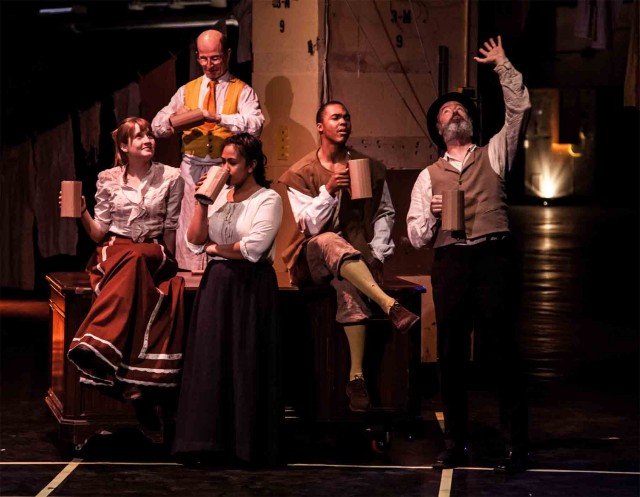
Charles Pfaff (Everett Quinton, at back) serves thirsty drinkers mugs of beer at the Vault in MANNA-HATTA (photo by Dan Lane Williams)

The James A. Farley Post Office
425 Eighth Ave. at 31st St.
Thursday – Sunday through June 23, $18, 7:00
www.peculiarworks.org

Now in its twentieth year, Obie-winning theater company Peculiar Works Project has taken on quite a task for its latest immersive, site-specific show, telling the long, complex history of New York City in Manna-Hatta. Written by Barry Rowell and directed by Rowell and Kathleen Amshoff, Manna-Hatta features twenty actors playing more than one hundred roles as the production moves through a series of rooms and hallways on the third and fourth floors of the historic James A. Farley Post Office. The audience is divided into four sections, led by either presidential candidate Shirley Chisholm (Cherrye J. Davis), poet Walt Whitman (Christopher Hurt), author-activist Jane Jacobs (Catherine Porter), or Lenape chief Easanques (Tina Chilip). Examining power and corruption, immigration and corruption, city planning and corruption, business and corruption, and culture and discrimination, the show’s goal is stated at the very beginning when one of four men simultaneously playing W. Parker Chase announces, “We love New York and want everybody, everywhere, to know what a truly wonder city New York really is.” The four Parker Chases appear as a quartet throughout the show, including a terrific turn as the “Four Peters (Well, Three and a Half),” as they perform a song-and-dance number about Peter Stuyvesant, Peter Minuit, Peter Schagen, and Peter Cooper; Eric C. Bailey also plays Boss Tweed, Bradley Wells plays Robert Moses, J. Kelly Salvadore plays Jimmy Walker, and Everett Quinton plays Charles Ignatious Pfaff, among other characters. Quinton, the former artistic director of Charles Ludlam’s Ridiculous Theatrical Company, is particularly effective, radiating an infectious humor and energy that helps drive the show even during its slow patches, of which there are too many. Clocking in at about three hours and fifteen minutes (with a free-beer-and-pretzels intermission), Manna-Hatta is very long, especially since the audience is standing most of the time, although it’s fascinating to wander through the abandoned spaces, where plaques still identify employees and their positions, as if the workers all disappeared one night, leaving behind a kind of ghost town. Rowell and Amshoff try to squeeze in too much of New York’s history, and it gets confusing why they emphasize certain moments while giving short shrift to others, but it’s a still a rousing triumph, a lighthearted and fun if exhausting trip through Gotham, with some of the highlights being the unique way the troupe portrays the development of Manhattan’s street grid, the building of the Brooklyn Bridge, and the Triangle Shirtwaist factory fire. Manna-Hatta continues Thursday–Sunday through June 23, with tickets only $18, but be prepared to do a lot of standing, walking, and stair climbing.
TEA FOR THREE: LADY BIRD, PAT, AND BETTY

(photo by Ron Marotta)

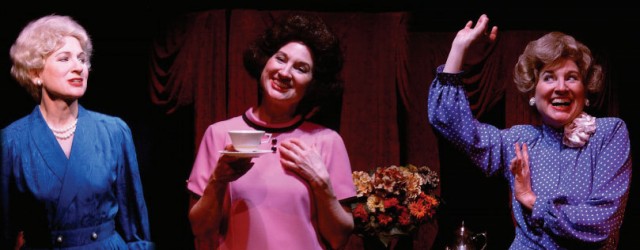
Elaine Bromka portrays a trio of back-to-back-to-back First Ladies in one-woman show (photos by Ron Marotta)

30th Street Theatre at Urban Stages
359 West 30th St. between Eighth & Ninth Aves.
Wednesday – Sunday through June 29, $25-$45
212-868-4444
www.teaforthree.com

Sitting down for tea is usually a rather pleasant experience, cordial and not too stressful. Such is the case at Elaine Bromka’s one-woman show, Tea for Three: Lady Bird, Pat & Betty. Running at the small, intimate Theatre at 30th St. at Urban Stages, the show is divided into three parts, as Bromka portrays Lady Bird Johnson in 1968, Pat Nixon in 1974, and Betty Ford in 1976, as each one is getting ready to leave the White House for the next First Lady. Bromka, who previously played eight First Ladies in Rich Little’s The Presidents show, wonderfully embodies the three women, capturing their unique diction and looking the part, wearing Bunny Mateosian and Patricia Carucci’s costumes and Robert E. McLaughlin’s wigs. In each section of the eighty-minute intermissionless production (there is a short break between segments), each First Lady has a silver tray of tea, discusses life with her husband, and prepares for life outside the White House, directly addressing the audience. Although the women touch upon some of the serious aspects of their husbands’ administrations, including the Vietnam War and Watergate, the play, cowritten by Bromka with Eric H. Weinberger (Class Mothers ’68, Wanda’s World) and directed by Byam Stevens, primarily opts for lighthearted moments that are gently humorous. Bromka incorporates Pat Nixon’s claim that being First Lady is “the hardest unpaid job in the world,” but that never quite comes across in this sugary sweet look at this succession of presidential wives who wanted to be considered more than just appendages of their spouses. Thus, Tea for Three makes for a pleasant experience, served with a few too many cubes and not enough lumps.

THE CAUCASIAN CHALK CIRCLE

(photo by Joan Marcus)

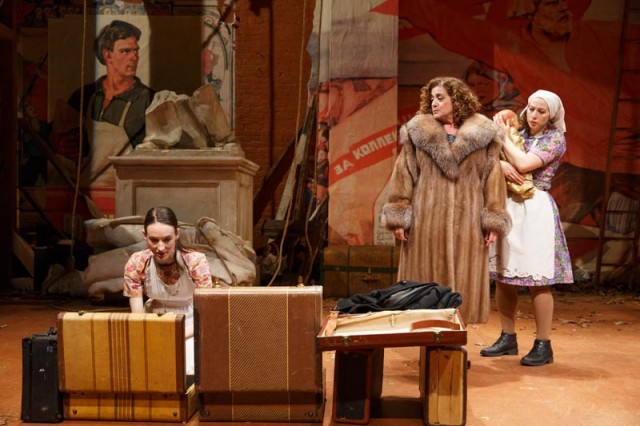
The fur-clad governor’s wife (Mary Testa) has more on her mind than her baby in Brecht revival (photo by Joan Marcus)

Classic Stage Company
136 East 13th St. between Third & Fourth Aves.
Tuesday – Sunday through June 23, $65
212-677-4210
www.classicstage.org

There’s a whole lot going on in Classic Stage Company’s inconsistent yet involving production of Bertolt Brecht’s The Caucasian Chalk Circle, including a brief prologue in Russian, a self-referential play-within-a-play, seven actors performing twenty-four roles, a convergence of multiple Russian/Soviet periods, an eerie big-headed doll/dummy used to portray a child, and even an audience sing-along. Not all of it works, and some of it causes confusion, but at its center is a story that is beautifully compelling. In the city of Nukha in Grusinia, the governor has been beheaded, and his wife (Queen of the Mist’s Mary Testa, who will be replaced by Lea Delaria beginning June 11) is more concerned with her furs than the revolution that is going on all around her, or even than her own newborn son, whom she thoughtlessly leaves behind as she is hustled to safety. A young maid, Grusha (Elizabeth A. Davis), rescues the infant, risking her own freedom as all hell breaks loose. Although she has accepted a proposal of marriage from soldier Simon Chachava (Alex Hurt), she is chased by a trio of Ironshirts led by a creepy corporal (Tom Riis Farrell) who is determined to reclaim the governor’s child in order to have the kid put to death. In the second act, Azdak (Christopher Lloyd), a wild and unpredictable menial clerk, unknowingly offers shelter to the Grand Duke (Jason Babinsky), then ends up being granted a judgeship and having to decide, ultimately, who the baby belongs to. Inspired by Li Xingdao’s Yuan dynasty masterpiece Circle of Chalk, Brecht’s play tackles such subjects as war, power, wealth, politics, and justice in the face of love.

(photo by Joan Marcus)

Azdak (Christopher Lloyd) finds himself in a new position in postrebellion Russia (photo by Joan Marcus)

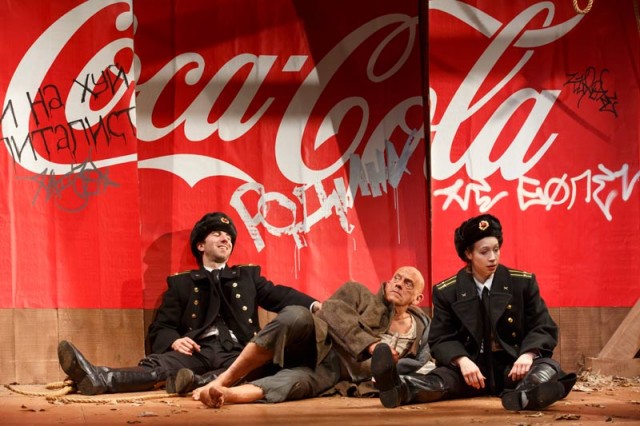
Adapting James and Tania Stern’s translation, with lyrics by W. H. Auden and original music by Duncan Sheik (Spring Awakening), director Brian Kulick incorporates unique creative flourishes into the production, including using old suitcases as multiple props, depicting rain by having actors squeeze wet sponges into buckets, staging a wedding/funeral with glowing candles and a mysterious song, and having characters tear down a statue of Lenin. But the play-within-a-play aspect grows tiresome, especially when the characters specifically mention Classic Stage Company (and when they speak in untranslated Russian), and the acting is hit-or-miss; Davis, who was nominated for a Tony for Once, is terrific as Grusha, wonderfully combining dedication and desperation with a touching vulnerability. Farrell severely overplays the Fat Prince and the Corporal, while Hurt underplays Simon. Lloyd spends the first act as the Singer, serving as narrator (but never actually singing), then is allowed to cut loose in the second act, which he does with great fervor and madness, melding his two iconic roles, Jim Ignatowski from Taxi and Doc Brown from the Back to the Future trilogy. Tony Straiges’s set design features chairs and rope hanging from the ceiling and red-and-white posters that equate Marx and Lenin with Coca-Cola a little too easily and obviously. But Brecht’s populist parable still manages to shine through, examining the state of the world as well as theater itself.

HOWL! FESTIVAL 2013

howl 2013

Tompkins Square Park
Ave. A to Ave. B between Seventh & Tenth Sts.
May 31 – June 2, free
www.howlfestival.com

“I saw the best minds of my generation destroyed by madness,” begins Allen Ginsberg’s Howl, which serves as the centerpiece for the somewhat annual Howl! Festival in and around Tompkins Square Park this weekend. The madness kicks off Friday at 4:30 with the Great Howl!, with Tyler Burba performing songs by Ginsberg, Bob Holman orchestrating a lineup of poets, and a group reading of Ginsberg’s masterpiece; among the participants are Hettie Jones, David Henderson, Jennifer Blowdryer, Lydia Lunch, Bob Rosenthal, Eliot Katz, Edwin Torres, and Nancy Mercado. On Saturday afternoon, there will be live performances on the Great Howl! Stage by Miami Rice, Anna Copacabana, Tall Pines, Ward White, Faith . . . , Richard Lloyd, and Vangeline Theater’s Mosaic. Meanwhile, the Beatification Stage will be holding a marathon poetry reading celebrating the tenth anniversary of the Poetry Project at St. Mark’s Church-in-the-Bowery, hosted by Todd Colby and including Jenny Zhang, Maggie Estep, Jennifer L. Knox, Mike Doughty, Carl Hancock Rux, CA Conrad, Bo DePena, Jason Nazary, and others. There will also be a children’s carnival, live painting on canvases surrounding the park, Riki Colon’s Men in Skirts presenting And I Still Rise, and the Allen Ginsberg Magnetic Field, consisting of installations, demonstrations, interactive projects, community nonprofit organizations, and more. On Sunday, Great Howl! Stage performers include Karen Marie, Bear 54, Diane Gentile, Andy Shernoff, Jack Skuller, and the Liza Colby Sound; dance will take over the Beatification Stage (along with Marguerite Van Cook’s Rockland series); and the Great Ladies of the Lower East Side will be honored in Low Life 7: Bowery Bombshells, paying tribute to Emma Goldman, Cookie Mueller, Mae West, Slugger Ann, Ellen Stewart, Patti Smith, and others.

FREE SUMMER THEATER 2013

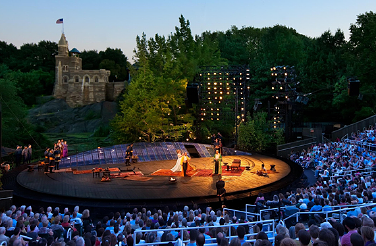
THE COMEDY OF ERRORS is first of two free Shakespeare in the Park presentations at the Delacorte this summer

THE COMEDY OF ERRORS is first of two free Shakespeare in the Park presentations at the Delacorte this summer

Tuesday, May 28
through
Sunday, June 30

Shakespeare in the Park: The Comedy of Errors, starring Jesse Tyler Ferguson, Jonathan Hadary, Hamish Linklater, Heidi Schreck, Skipp Sudduth, Jessica Wu, and others, directed by Daniel Sullivan, Delacorte Theater, Central Park, Tuesday – Sunday at 8:30

Thursday, May 30
through
Sunday, June 23

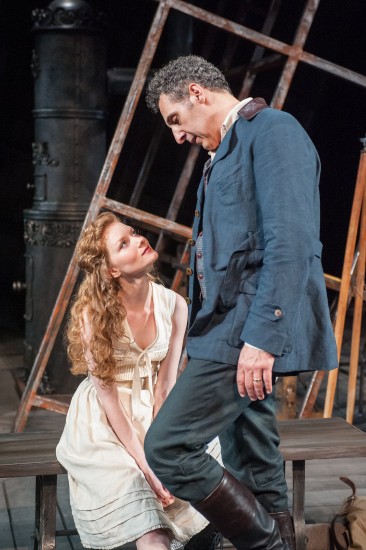
New York Classical Theatre: The Seagull by Anton Chekhov, translated by Jean-Claude van Itallie, directed by Stephen Burdman, Central Park, 103rd St. & Central Park West, Thursday – Sunday at 7:00

Monday, June 17
River to River Festival: Bad News!, staged reading directed by JoAnne Akalaitis, Poets House, 10 River Terrace, 6:30

Saturday, June 22
River to River Festival: Andrew Schneider, Tidal, curated by Laurie Anderson, East River Esplanade, Pier 15, 9:00

Tuesday, June 25
through
Sunday, June 30

New York Classical Theatre: The Seagull by Anton Chekhov, translated by Jean-Claude van Itallie, directed by Stephen Burdman, Prospect Park, Rustic Shelter by the Lake, 7:00

Thursday, June 27
through
Sunday, June 30

River to River Festival: Sekou Sundiata / Rhodessa Jones, blessing the boats: the remix, with Will Power, Carl Hancock Rux, and Mike Ladd, part of “Blink Your Eyes: Sekou Sundiata Revisited,” 3:00 or 8:00

Friday, June 28
through
Sunday, July 14

Shakespeare in Carroll Park: Julius Caesar, Smith Street Stage, bring your own seating, Carroll Park, 7:00

Sunday, June 30
River to River Festival: Isolde, LMCC Open Studios with New York City Players, written and directed by Richard Maxwell, starring Jim Fletcher, Brian Mendes, Victoria Vazquez, and Gary Wilmes, 1 Liberty Plaza, advance RSVP required, 3:00

Sunday, June 30
Tuesday, July 2
and
Wednesday, July 3

River to River Festival: You, My Mother: A Chamber Opera in Two Parts, by Two-Headed Calf & Yarn/Wire, directed by Brooke O’Harra, music by Brendan Connelly and Rick Burkhardt, text by Karinne Keithley-Syers and Kristen Kosmas, performed by Gelsey Bell, Beth Griffith, Laryssa Husiak, and Mike Mikos, Pier 17, South Street Seaport, advance RSVP required, 3:00 and/or 8:30

ONE from Piper Theatre Productions on Vimeo.

Friday, July 5, 12, 19
Saturday, July 6, 13, 20
and
Thursday, July 11, 18

Piper Theatre: Frankenstein, directed by John P. McEneny, with films by Jeremy Mather and original score by Lucas Syed, Old Stone House in Washington Park, 8:30

Saturday, July 6, 13, 20
and
Friday, July 12, 19

Piper Theatre: You’re a Good Man, Charlie Brown, directed by Mollie Lief Abramson, Old Stone House in Washington Park, 7:00

Tuesday, July 9
through
Sunday, August 4

New York Classical Theatre: The Tempest by William Shakespeare, directed by Sean Hagerty, Battery Park, Tuesday – Sunday, 7:00

Wednesday, July 10
through
Saturday, July 13

River to River Festival: This Great Country by 600 Highwaymen, directed by Abigail Browde & Michael Silverstone, advance RSVP required, Pier 17 Storefront, South Street Seaport, 8:00

Thursday, July 11
through
Saturday, July 27

Shakespeare in the Parking Lot: Cymbeline, municipal parking lot, corner of Ludlow & Broome Sts.

Saturday, July 13
River to River Festival: Open Studios with Andrew Ondrejcak based on Strindberg’s A Dream Play, Building 110, LMCC’s Arts Center at Governors Island, 2:00 – 6:00

Tuesday, July 23
through
Sunday, August 18

Shakespeare in the Park: Love’s Labour’s Lost: A New Musical, songs by Michael Friedman, book adapted by Alex Timbers, directed by Alex Timbers, Delacorte Theater, Central Park, Tuesday – Sunday at 8:30

Tuesday, July 30
through
Thursday, August 1

SummerStage “This is __ Hip-Hop”: King Kong by Alfred Preisser & Randy Weiner, directed by Alfred Preisser, Herbert Von King Park, 8:00

Thursday, August 1
through
Saturday, August 17

Shakespeare in the Parking Lot: Richard III, directed by Hamilton Clancy, municipal parking lot, corner of Ludlow & Broome Sts.

Friday, August 2
and
Saturday, August 3

SummerStage Theatre: Diablo Love by Mando Alvarado, directed by Alfred Preisser, with music direction and composition by Tomás Doncker, Herbert Von King Park, 8:00

Alfred Preisser and Randy Weiner’s KING KONG is part of SummerStage season

Alfred Preisser and Randy Weiner’s KING KONG is part of SummerStage season

Monday, August 5
SummerStage “This Is __ Hip-Hop”: King Kong by Alfred Preisser & Randy Weiner, directed by Alfred Preisser, Rumsey Playfield, Central Park, 8:00

Tuesday, August 6
Wednesday, August 7
and
Saturday, August 10

SummerStage “This Is __ Hip-Hop”: King Kong by Alfred Preisser & Randy Weiner, directed by Alfred Preisser, St. Mary’s Park, 8:00

Thursday, August 8
and
Friday, August 9

SummerStage Theatre: Diablo Love by Mando Alvarado, directed by Alfred Preisser, with music direction and composition by Tomás Doncker, St. Mary’s Park, 8:00

Tuesday, August 13
Wednesday, August 14
and
Saturday, August 17

SummerStage “This Is __ Hip-Hop”: King Kong by Alfred Preisser & Randy Weiner, directed by Alfred Preisser, Marcus Garvey Park, 8:00

Thursday, August 15
and
Friday, August 16

SummerStage Theatre: Diablo Love by Mando Alvarado, directed by Alfred Preisser, with music direction and composition by Tomás Doncker, Marcus Garvey Park, 8:00

Monday, August 19
SummerStage Theatre: Diablo Love by Mando Alvarado, directed by Alfred Preisser, with music direction and composition by Tomás Doncker, Rumsey Playfield, Central Park, 8:00

Tuesday, August 20
through
Thursday, August 22

SummerStage “This Is __ Hip-Hop”: King Kong by Alfred Preisser & Randy Weiner, directed by Alfred Preisser, Marcus Garvey Park, 8:00

Friday, August 23
and
Saturday, August 24

SummerStage Theatre: Diablo Love by Mando Alvarado, directed by Alfred Preisser, with music direction and composition by Tomás Doncker, East River Park, 8:00

THE MASTER BUILDER

(photo by Stephanie Berger)

Wrenn Schmidt and John Turturro try to build an unusual relationship in Andrei Belgrader’s new version of 1892 Ibsen play (photo by Stephanie Berger)

Brooklyn Academy of Music
BAM Harvey Theater
651 Fulton St. between Ashland & Rockwell Pl.
Through June 9, $25-$90
718-636-4100
www.bam.org

A stark coldness pervades Andrei Belgrader’s new version of Henrik Ibsen’s most autobiographical play, The Master Builder. Collaborating once again with John Turturro — the two previously worked together on a terrific production of Samuel Beckett’s Endgame at BAM in 2008 and on Anton Chekhov’s The Cherry Orchard at Classic Stage this past fall/winter, Belgrader uses David Edgar’s recent streamlined, modernized translation in telling the story of a star Norwegian architect who knows how to build buildings but can’t manage to keep his life from falling apart around him. Turturro plays the title character, Halvard Solness, a mean-spirited, philandering megalomaniac who is refusing to allow his dying mentor, Knut Brovik (Julian Gamble), the opportunity to see his architect son, Ragnar (Max Gordon Moore), succeed in any way before the father dies. Halvard also flirts terribly with his secretary, Kaja Fosli (Kelly Hutchinson), even though she is engaged to Ragnar. Meanwhile, Halvard’s wife, Aline (Katherine Borowitz, Turturro’s real-life wife), wanders through Santo Loquasto’s latticed-metal set like a ghost, never having recovered from a family tragedy. “I am the way I am. I can’t remake myself,” Halvard says at one point, but he does go through a change upon the arrival of Hilde Wangel (Wrenn Schmidt), a sexy fairy-tale-like nymph who claims that Halvard promised himself to her ten years earlier, when she was a mere thirteen. He is of course smitten with her, leading to yet more complications. But just as Halvard clearly differentiates between “a house, but not a home,” this Master Builder never climbs the heights it aspires to. Turturro is too blustery and Schmidt (Katie Roche, Boardwalk Empire) too chirpy (and chippy), while the production as a whole never quite develops a solid foundation, its structure too loose and disconnected, in need of some further construction.

NIKOLAI AND THE OTHERS

(photo by Paul Kolnik)

A group of Russian émigrés form an extended artistic family in Richard Nelson’s new play (photo by Paul Kolnik)

Lincoln Center Theater at the Mitzi E. Newhouse
150 West 65th St. between Broadway & Amsterdam Ave.
Tuesday – Saturday through June 16, $85
212-362-7600
www.lct.org

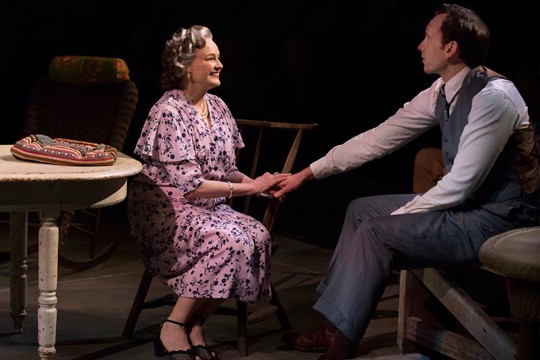
Over the last few years, Richard Nelson has been detailing the exploits of the Rhinebeck-based Apple family in such decidedly American, politically tinged works as That Hopey Changey Thing, Sweet and Sad, and Sorry. Nelson examines a very different kind of extended American family in the intelligent and engaging Nikolai and the Others, running at Lincoln Center’s Mitzi E. Newhouse Theater through June 16. It’s the spring of 1948, and a group of Russian immigrants has gathered at the Westport farmhouse of Vera and Igor Stravinsky (Blair Brown and John Glover) to honor elderly set designer Sergey Sudeikin (Alvin Epstein). Among the guests are choreographer George Balanchine (Michael Cerveris), actor Vladimir Sokoloff (John Procaccino) and his wife, Lisa (Betsy Aiden), Balanchine confidant and Stravinsky friend and translator Lucia Davidova (Haviland Morris), piano teacher Aleksi Karpov (Anthony Cochrane) and his fiancée, Natasha Nabokov (Kathryn Erbe), and composer Nikolai “Nicky” Nabokov (Stephen Kunken), Natasha’s first husband and a man who helps out his fellow Russian émigrés through secret connections. The men and women discuss life and love, art and politics while eating and drinking delicacies from the old country, proud of their heritage as well as having become American citizens. The evening’s centerpiece is to be the presentation of a pas de deux from Balanchine and Stravinsky’s upcoming ballet, Orpheus, performed by Balanchine’s wife, Maria Tallchief (Natalia Alonso), and Nicholas Magallanes (Michael Rosen), but the arrival of conductor Serge Koussevitsky (Dale Place) with U.S diplomat Charles Bohlen (Gareth Saxe) throws everything out of balance as suspicion and fear hover in the country air.

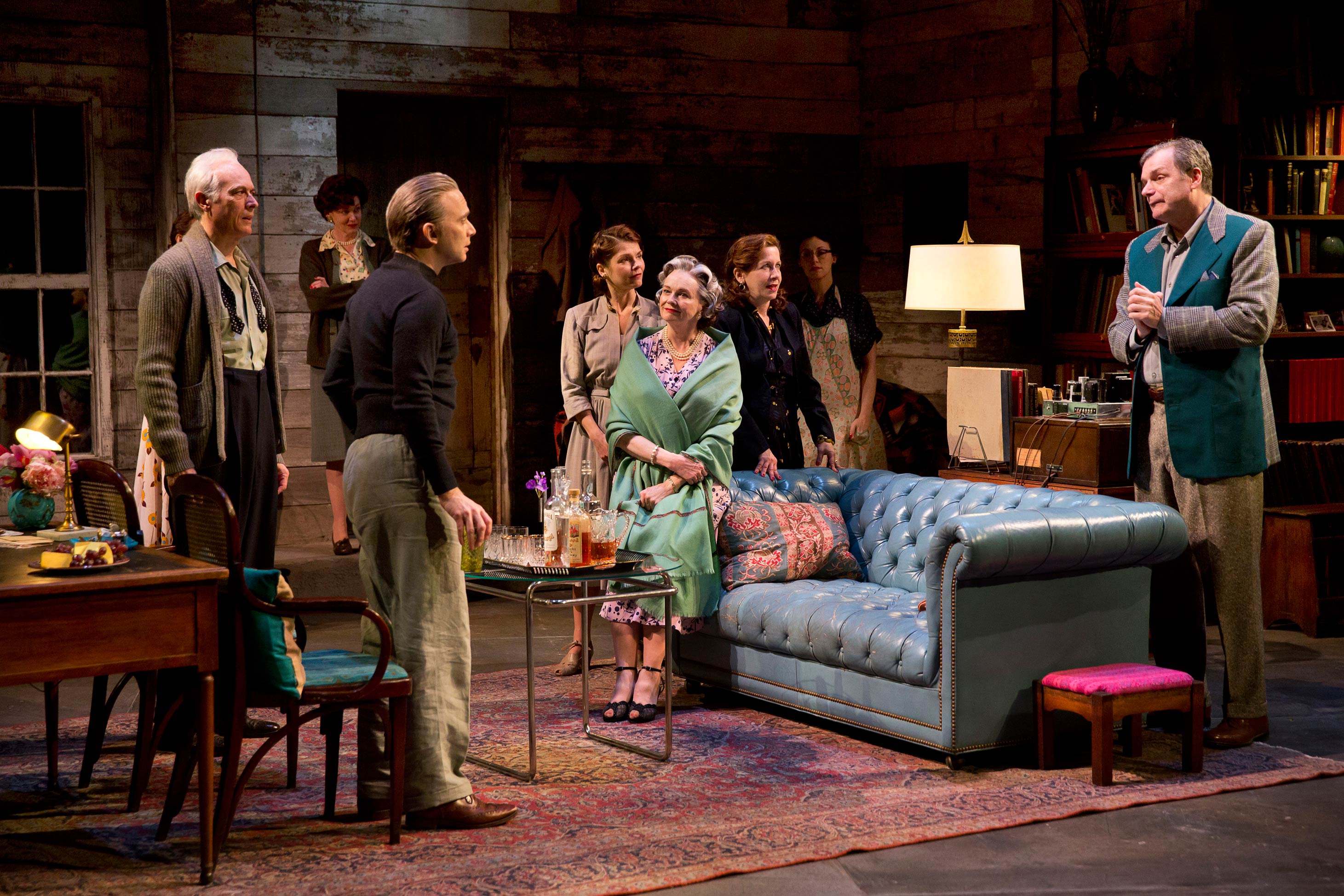
Vera Stravinsky (Blair Brown) and others reach out for help from Nikolai Nabokov (Stephen Kunken) during weekend in Westport (photo by Paul Kolnik)

Vera Strainsky (Blair Brown) and others reach out for help from Nikolai Nabokov (Stephen Kunken) during weekend in Westport (photo by Paul Kolnik)

Though featuring real characters and referencing many actual events, Nikolai and the Others is a fascinating creation of Nelson’s, an imaginary weekend that delves into the very nature of the creative process in a quickly changing world. (For example, Sudeikin died in 1946, two years before the play takes place.) But Nelson does an excellent job capturing the powerful emotions these Russian immigrants are experiencing as they attempt to continue their careers in America at the start of the Cold War, in search of personal and professional freedom that comes at a price. Nelson and director David Cromer (Tribes, When the Rain Stops Falling) have the characters speak unaccented English when they are conversing in their native Russian tongue, then in thickly accented English when they are talking in English itself, a conceit that is confusing at first but ultimately works very well. Glover, Brown, and Cerveris lead a strong cast that feels like they have formed a warm family of their own while inviting in the audience, which wraps around Marsha Ginsberg’s intimate set. The show takes on added meaning since it is in the midst of its world premiere at Lincoln Center, where Balanchine and Lincoln Kirstein (who is mentioned often but is never seen) ultimately moved the New York City Ballet after founding the troupe in 1948 and including Orpheus in its inaugural season.