this week in theater

DISGRACED

DISGRACED

A dinner party goes seriously wrong in Ayad Akhtar’s Pulitzer Prize-winning DISGRACED (photo by Joan Marcus)

Lyceum Theatre
149 West 45th St. between Sixth & Seventh Aves.
Tuesday – Sunday through February 15, $37.50 – $138
www.disgracedonbroadway.com

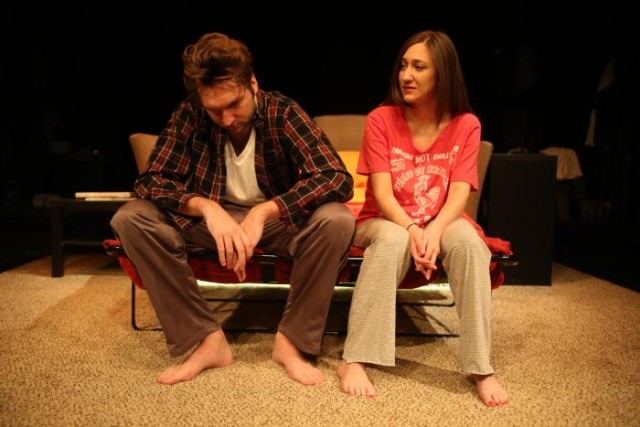
Ayad Akhtar’s searing Pulitzer Prize-winning Disgraced, which had its New York premiere in 2012 at Lincoln Center’s tiny 131-seat Claire Tow Theater, has made a terrifically successful transition to Broadway’s 950-seat Lyceum Theatre. Akhtar’s poignant and powerful drama about identity and racism feels right at home on the Great White Way, led by a strong cast, smart, energetic direction, and razor-sharp dialogue. Hari Dhillon stars as Amir Kapoor, a bold corporate lawyer who is hiding his Pakistani background to help him rise in his firm. His wife, Emily (Gretchen Mol), is a white painter using Islamic imagery in her work. Jewish curator Isaac (Josh Radnor) is considering including some of Emily’s canvases in an important upcoming show. Isaac is married to Jory (Karen Pittman), a black lawyer who works with Amir. Problems arise when Amir’s nephew, Pakistani-born Abe (Danny Ashok), who changed his name from Hussein in order to fit in better in America, asks his uncle to meet with his imam, who has been imprisoned for suspected ties to terrorism. At first, Amir resists becoming involved, but Emily helps convince him that it’s the right thing to do. Yet Amir’s attendance at a hearing for the imam is a serious mistake, setting in motion a cascade of events that culminates in a dinner party where all of the characters let loose on one another in a ricochet of revelations that surprises even themselves.

DISGRACED

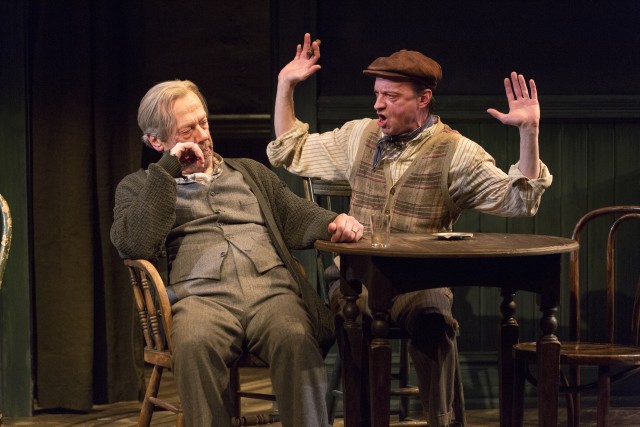
Abe (Danny Ashok) and his uncle Amir (Hari Dhillon) discuss heritage and assimilation in searing Broadway drama (photo by Joan Marcus)

As Disgraced opens, Emily is painting a portrait of Amir inspired by Velázquez’s portrait of Juan de Pareja, his slave of Moorish descent, immediately setting up the ethnocentric boundaries the play investigates. Dhillon, who starred in the West End production (the role was originated in Chicago by Usman Ally and in New York by The Daily Show’s Asif Maandvi), plays Amir with a fire building in his belly, ready to explode at any minute. Mol is warm and appealing as Emily, who might not really understand her deep-down motivations, serving as a kind of onstage stand-in for the liberal Caucasians who tend to populate Broadway theaters. Radnor (How I Met Your Mother) and Pittman (the only returning member from the LCT3 cast) do a splendid job playing a couple representing social factions that do not always get along very well, Jews and blacks. (Think Crown Heights, for example.) And in the middle of it all is Ashok as Abe/Hussein, debating the ultimate value of assimilation and its cost. John Lee Beatty’s Upper East Side apartment set is elegant and welcoming, even as the story turns angry, and Senior (Akhtar’s The Who & the What, 4000 Miles) keeps it all moving smoothly through a fast-paced eighty-five intermissionless minutes. Disgraced is one of those plays that hits you in the gut, forcing you to look inside yourself at your own biases and predispositions, and it’s not necessarily a pretty picture. The Staten Island-born Akhtar is clearly a writer to watch; he has also written a novel (American Dervish) and acted in several films, including one that he cowrote and was nominated for an Independent Spirit Award for Best Screenplay. His follow-up play, The Invisible Hand, begins previews November 19 at New York Theatre Workshop.

THÉÂTRE DE LA VILLE: SIX CHARACTERS IN SEARCH OF AN AUTHOR

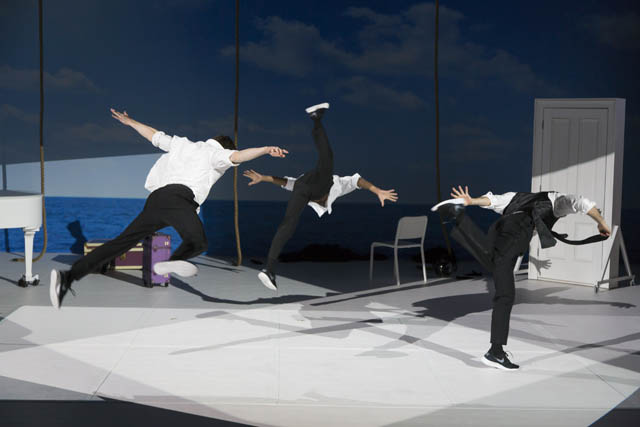
Théâtre de la Ville is back at BAM with an awe-inspiring production of Luigi Pirandello’s absurdist masterpiece (photo by Jean-Louis Fernandez)

Théâtre de la Ville is back at BAM with an awe-inspiring production of Luigi Pirandello’s absurdist masterpiece (photo by Richard Termine)

2014 NEXT WAVE FESTIVAL
Brooklyn Academy of Music
BAM Harvey Theater
651 Fulton St. between Ashland & Rockwell Pl.
October 29 – November 2, $20-$75
718-636-4100
www.bam.org
www.theatredelaville-paris.com

As audience members begin filing into the BAM Harvey to see Théâtre de la Ville’s awe-inspiring production of Luigi Pirandello’s absurdist classic Six Characters in Search of an Author, there is already a man onstage, suspended from above, painting a trompe-l’oeil blue sky backdrop; he is soon joined by a young woman who sits at a sewing machine, making costumes while quietly singing “O sole mio.” These two actions subtly announce that what we are about to see is artifice — what Pirandello called “the theater of the theater” — albeit multilayered artifice of the very highest order. For the next two hours, we are treated to a rapturous display of intensely clever stagecraft, filled with self-referential jokes about the theater, intellectual discussions of illusion vs. reality, and a search for nothing less than the very meaning of existence. A dictatorial director (Alain Libolt) is preparing his cast and crew to rehearse the second act of Pirandello’s The Rules of the Game when six mysterious people, all dressed in black, suddenly appear, claiming to be fictional characters abandoned by their author and now seeking a place where they can tell their story, which is the whole reason for their being. The director, the stage manager (Gérald Maillet), the actors (Charles-Roger Bour, Sandra Faure, Olivier Le Borgne, and Gaëlle Guillou), the carpenter (Pascal Vuillemot), and the assistant (Jauris Casanova) are at first dubious of the six strangers, but soon the father (Hugues Quester) convinces them to hear them out, so they delve into a soap-opera-like tale of faded love, mourning, incest, sibling rivalry, and horrific tragedy also involving the sexy stepdaughter (Valérie Dashwood), the grieving mother (Sarah Karbasnikoff), the estranged son (Stéphane Krähenbühl), the awkward teenager (Walter N’Guyen), and the adorable little girl (Sierra Blanco).

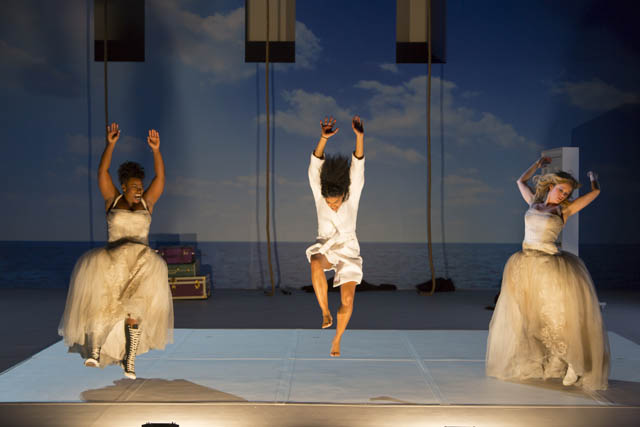
Glorious production seeks to life the veil on some of the many mysteries of the theater (photo by Richard Termine)

Glorious production seeks to lift the veil on some of the many mysteries of the theater (photo by Richard Termine)

No one onstage has a name, save for the surprise arrival of Madame Pace (Céline Carrère); everyone else represents a stock character determined to experience their individual purpose, their raison d’être, whether in the play, the play-within-a-play, or the play-within-a-play-within-a-play. There are no rules to this sly game directed by Théâtre de la Ville head Emmanuel Demarcy-Mota, who was last at BAM in October 2012 with another delightful absurdist classic, Eugène Ionesco’s Rhinocéros. This is his third time staging Six Characters in Search of an Author, and he clearly knows his way around this existential journey of life as theater, and theater as life, expertly translated and adapted by François Regnault. The cast is uniformly excellent, led by Libolt, Dashwood, and Quester, who won the Critics’ Award for Best Actor for Théâtre de la Ville’s original 2001 production. Throughout the play, which is itself, of course, set in a theater, various characters look out at the seats, which to them are empty but to the actors playing them are filled with onlookers, furthering the self-referential nature of the show and the relationships between actor and audience, creator and creation. The director even references the subtitles at one point, reminding everyone that this is, at its most basic, an Italian play put on by a French company in an American city. Every moment is pure genius, a palimpsest of metas that keep piling on in glorious ways, a celebration of just what the theater can do and be, from behind the scenes to the last row of the balcony.

NEXT WAVE FESTIVAL: SIX CHARACTERS IN SEARCH OF AN AUTHOR

(photo by Jean-Louis Fernandez)

Théâtre de la Ville production of Luigi Pirandello absurdist classic will search for the meaning of existence in Brooklyn (photo by Jean-Louis Fernandez)

Brooklyn Academy of Music
BAM Harvey Theater
651 Fulton St. between Ashland & Rockwell Pl.
October 29 – November 2, $20-$75
718-636-4100
www.bam.org
www.theatredelaville-paris.com

“Unfortunately, there always has to be a third, unavoidable element that intrudes between the dramatic author and his creation in the material being of the performance: the actor,” playwright, novelist, and poet Luigi Pirandello wrote in his 1908 essay “Illustrators, Actors, and Translators.” That tenet is central to one of his most famous works, 1921’s Six Characters in Search of an Author, which is being presented at the BAM Harvey Theater October 29 to November 2 by Théâtre de la Ville, Paris, last at BAM in October 2012 with another absurdist classic, Eugène Ionesco’s Rhinocéros, Described by the playwright, who was born in Agrigento, Italy, in 1867, as a comedy “without acts or scenes,” Six Characters questions the very nature of its own being as a dramatic work as a half dozen abandoned characters appear onstage in need of a new author to define their existence. Adapted and translated by François Regnault and directed by Théâtre de la Ville head Emmanuel Demarcy-Mota, with set and light design by Yves Collet, music by Jefferson Lembeye, and costumes by Corinne Baudelot, this production once again stars Hugues Quester, who won the Critics’ Award for Best Actor for his performance in the play back in 2001. In conjunction with the show, BAM is teaming up with the Onassis Cultural Center NY for the discussion “On Truth (and Lies) in Authorship,” with Demarcy-Mota and host Simon Critchley, being held on October 30 at 6:00 at BAM Fisher Hillman Studio ($15), as part of the Hellenic Humanities Program.

THE LAST SHIP

(photo by Joan Marcus)

A game cast is set adrift by a lackluster book in THE LAST SHIP (photo by Joan Marcus)

Neil Simon Theatre
250 West 52nd St. between Broadway & Eighth Ave.
Tuesday – Sunday through March 29, $55-$147 (daily $30 lottery)
877-250-2929
www.thelastship.com

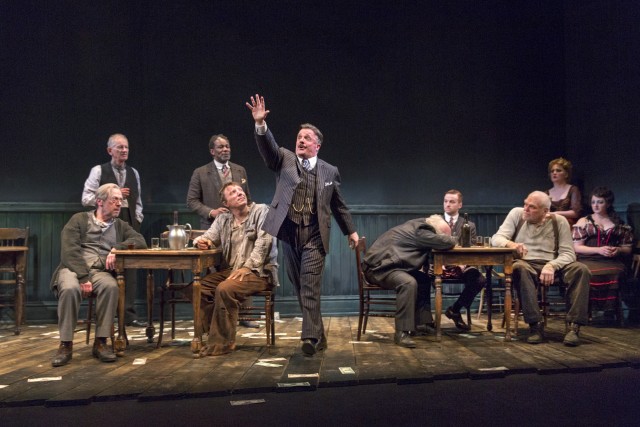
Watching The Last Ship, which opened last night at the Neil Simon Theatre, you’re likely to think you’ve seen this all before, as it rather precisely follows the pattern of 2013 Tony winner Kinky Boots: Both musicals feature music and lyrics by a pop star (Sting for The Last Ship, Cyndi Lauper for Kinky Boots), both are set in a British working-class community, and both involve a son debating whether he should follow in his father’s footsteps. And just as Boots was vastly overrated, the same is likely to happen with Ship. Based on Sting’s childhood experiences in the shipbuilding town of Wallsend in the northeast of England, The Last Ship focuses on Gideon Fletcher, first as a fifteen-year-old kid (Collin Kelly-Sordelet) wanting something more than his tough father (Jamie Jackson) has planned for him, then returning fifteen years later (now played by Michael Esper) for his dad’s funeral and trying to get back together with his old girlfriend, Meg (Dawn Cantwell, then Rachel Tucker). But the Wallsend he’s come back to is in the midst of a battle with corporate suit Freddy Newlands (Eric Anderson), whose company is taking over the docks and turning the shuttered shipyard into a scrap yard. With the help of former welder Arthur Milburn (Aaron Lazar), who is in love with Meg and is a surrogate father to her son, Tom (Kelly-Sordelet), Newlands tries to convince the unemployed shipbuilders to come work for him, but their leader, Jackie White (Jimmy Nail), wants no part of it. “You could die and hope for heaven / But you’d need to work your shift / And I’d expect ye’s all to back us to the hilt / And if St. Peter at his gate were to ask you why you’re late? / You’d tell him that you have to get a ship built,” he sings in “Shipyard,” in which all the men join in on the chorus, stamping their feet as they declare, “And the only life we’ve known is in the shipyard.” It’s the strongest song in the show, but it also emphasizes their refusal to face the facts that the world is changing while they’re not, adding to the many holes in the script.

(photo by Matthew Murphy)

A romantic triangle steers things out of control in musical based on Sting’s early life (photo by Matthew Murphy)

In the second act, the book, by Tony winner and Oscar nominee John Logan (Red, The Last Samurai) and Tony and Pulitzer Prize winner Brian Yorkey (Next to Normal), falls apart as Father James O’Brien (Fred Applegate), previously the comic relief, becomes the overly melodramatic sentimental inspiration, the love triangle between Meg, Gideon, and Arthur quickly turns stale and unbelievable, and the shipbuilders’ occupation of the yard is just plain ridiculous. Even the staging, by two-time Tony winner Joe Mantello (Take Me Out, Assassins) and choreographer Steven Hoggett (Once, The Glass Menagerie), can’t keep things afloat, as it also recalls Kinky Boots as the lads set out to build a ship for themselves. The cast is mostly excellent, particularly Tucker and Nail in their impressive Broadway debuts and another first-timer, Shawna M. Hamic, as Beatrice Dees, the owner of the Ship in the Hole pub, who offers “Mrs. Dees’ Rant” after intermission. While Sting’s score can be refreshing at times, steering clear of Broadway-fication, it can also be repetitive and preachy (“Life is a dance, a romance where ye take your chances / Just don’t be left on the shores of regretful glances”). As the two main narratives converge, the plot grows ever-more convoluted, getting lost in tired us-vs.-them themes that drain the show of any real depth, leaving The Last Ship bobbing on the surface, going nowhere.

THE CURIOUS INCIDENT OF THE DOG IN THE NIGHT-TIME

(photo by Joan Marcus)

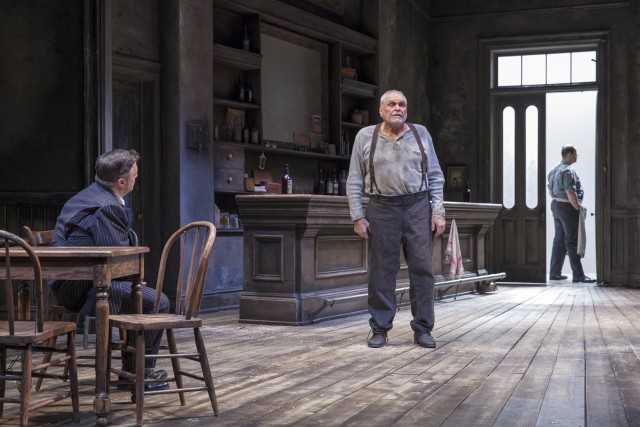
THE CURIOUS INCIDENT OF THE DOG IN THE NIGHT-TIME is lighting up the Ethel Barrymore Theatre (photo by Joan Marcus)

Ethel Barrymore Theatre
243 West 47th St. between Broadway & Eighth Ave.
Tuesday – Sunday (and some Mondays) through December 30, $27 – $225
www.curiousonbroadway.com
www.shubert.nyc

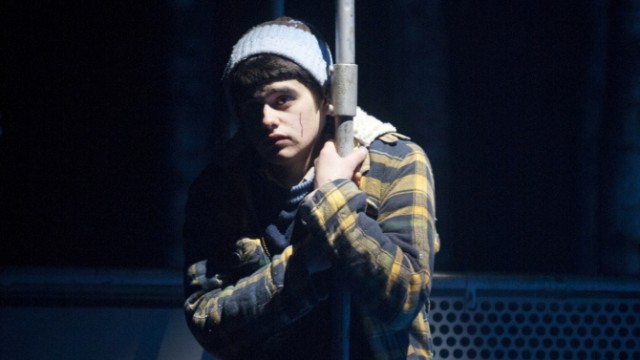
The National Theatre production of The Curious Incident of the Dog in the Night-time is an extraordinary multimedia journey through the mind of a fifteen-year-old boy with a kind of Asperger’s syndrome. Adapted with extraordinary care and insight by Simon Stephens (On the Shore of the Wide World, Punk Rock) from Mark Haddon’s award-winning novel and directed with flair by Marianne Elliott, the show takes place inside the created universe of truth-telling Christopher John Francis Boone (Alexander Sharp), an odd teen who is obsessed with prime numbers and mathematics, has a beloved pet rat named Toby, and does not like being touched. Upon discovering that the neighbor’s dog has been murdered, Christopher decides to play detective, interviewing people in the community to find the culprit. His father, Ed (Ian Barford), insists he stop sleuthing, as it will only lead to more trouble — Christopher has already been brought in by the cops, who considered him the chief suspect — but Christopher is determined to solve this mystery, as though it were a difficult but not impossible math equation. And when Christopher uncovers a shocking secret about his mother, Judy (Enid Graham), he sets out on another adventure, filled with dangers all its own.

(photo by Joan Marcus)

Christopher (Alexander Sharp) and his father (Ian Barford) bond in imaginative stage adaptation of Mark Haddon’s award-winning book (photo by Joan Marcus)

The Curious Incident of the Dog in the Night-time won seven Olivier Awards, including Best New Play, Best Director (Elliott), Best Actor (Luke Treadaway), and Best Supporting Actress (Nicola Walker), and it’s likely to win a bunch of prizes at next year’s Tonys as well. Elliott’s staging is captivating, the floor and three walls a grid on which Christopher draws emoticons, maps depict his travels, constellations appear, and video projections create a stunning escalator. Every technical element is worth praising: The sets and costumes are by Bunny Christie, lighting by Paule Constable, video by Finn Ross, choreography by Scott Graham and Steven Hoggett, music by Adrian Sutton, and sound by Ian Dickinson, combining to turn Haddon’s book into a treat for the senses. Twenty-five-year-old Sharp, a recent Juilliard graduate from London, is so immersed in his role that it is hard to believe he is acting, or that anyone else can play the part, but indeed, Luke Treadaway originated Christopher at the National Theatre, and Taylor Trensch gives Sharp a rest during matinees at the Ethel Barrymore Theatre. The cast members, several of whom play multiple roles, also includes Francesca Faridany as Siobhan, Christopher’s teacher and mentor who narrates brief passages from the book; Helen Carey as Mrs. Alexander, a gossipy neighbor who invites Alexander in for cookies; David Manis as Rev. Peters, who discusses God and heaven with the boy; and Mercedes Herrero and Richard Hollis as Mr. and Mrs. Shears, the owners of the dead dog. The repetitive, self-referential nods to the book as book are unnecessary, pulling the audience out of the immersive fantasy for a moment, and the postcurtain coda also takes the crowd out of the world of the play to allow the production to show off one more time, but otherwise The Curious Incident of the Dog in the Night-time is an absolute delight, a breathtaking, endlessly imaginative theatrical experience that is not to be missed. (As a bonus, some lucky ticketholders will find themselves in a Prime Number Seat, specially chosen by Christopher, which will win them a Curious button if the letters in their name add up to a prime number.)

JAMES DICKEY’S DELIVERANCE

(photo by Jason Woodruff)

Four friends are forced to reach deep inside themselves when trouble strikes in DELIVERANCE (photo by Jason Woodruff)

59E59 Theaters
59 East 59th St. between Madison & Park Aves.
Tuesday – Sunday through November 9, $25
www.59e59.org
www.godlighttheatrecompany.org

For twenty years, the Godlight Theatre Company has been specializing in stage adaptations of modern classic literature that has already been turned into well-known films. Among their previous works are One Flew Over the Cuckoo’s Nest, In the Heat of the Night, Slaughterhouse-Five, Fahrenheit 451, and The Third Man. They are now taking on James Dickey’s Deliverance, in a superb, stripped-down production making its world premiere at 59E59. In telling this harrowing story, playwright Sean Tyler and director Joe Tantalo have gone back to the source, Dickey’s 1970 novel, not John Boorman’s Oscar-nominated 1972 film, which starred Burt Reynolds, Jon Voight, Ned Beatty, and Ronny Cox as four friends whose Georgia canoe trip goes seriously wrong. So don’t expect to hear “Dueling Banjos” (Tantalo uses the Carter Family’s “Wildwood Flower,” from the book) or anyone squealing like a pig. But do expect to be chilled to the bone by this ever-insightful examination of what lurks in the pit of men’s souls.

(photo by Jason Woodruff)

Stark stage adaptation of James Dickey’s DELIVERANCE is told from the point of view of Ed Gentry (Nick Paglino) (photo by Jason Woodruff)

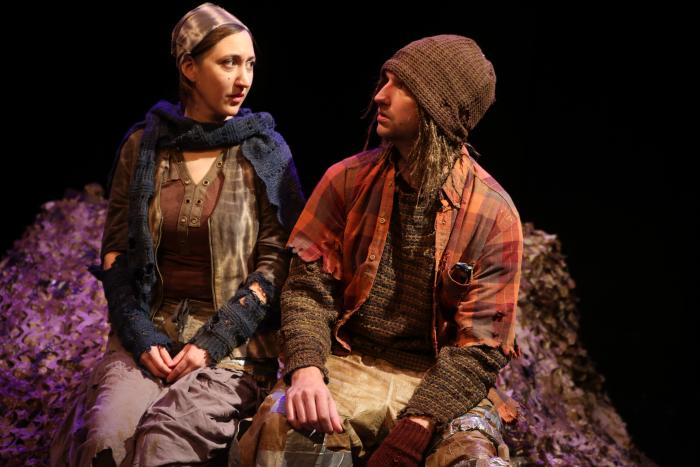
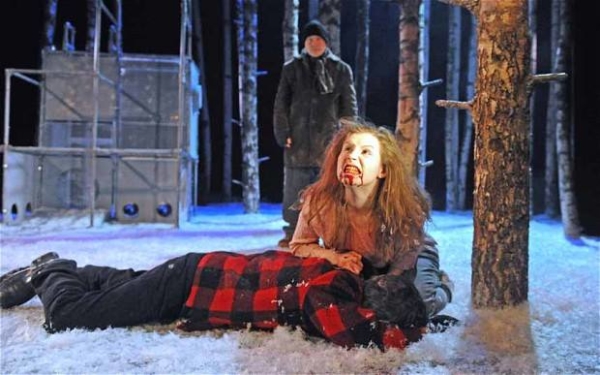
As Lewis Medlock (Gregory Konow), Ed Gentry (Nick Paglino), Bobby Trippe (Jarrod Zayas), and Drew Ballinger (Sean Tant) first set out on their country adventure, they have no idea what’s in store for them. When Griner (Eddie Dunn), a local mechanic, asks them why they’re planning on canoeing down the river, Lewis says, “Because it’s there,” to which Griner ominously replies, “It’s there, all right. But if you git in there and can’t git out, you’re goin’ to wish it wudn’t.” That prophecy comes true when they encounter two mountain men (Bryce Hodgson and Jason Bragg Stanley) who don’t take kindly to city folk, leading to tragedy that the four men might not be able to escape. Deliverance takes place on a shiny black twelve-foot-by-twelve-foot stage, with the audience sitting in two small rows on all four sides. Maruti Evans’s stark lighting and set design also includes dark walls (behind the audience) on which the characters’ reflections glow in the distance (below the biblical quote “The pride of thine heart hath deceived thee / thou that dwelleth in the clefts of the rock / whose habitation is high; that saith in his heart / Who shall bring me down to the ground?”). There are no props or projections, no water, no mountain imagery, no weapons — just the actors, who mimic drinking beer in a bar, paddling down the river, climbing over rocks, holding a rifle, and pulling back a bow. But it’s not gimmicky in the least; instead, it allows viewers to get immersed in the tale, using their imagination the way they would as if reading a book that comes alive in front of them. All of the actors are excellent, though the standout is Godlight regular Paglino, as the narrative unfolds from Ed’s perspective, especially during a long monologue during which he stares death in the face. At times you’ll think you are actually seeing the woods, the river, a deer, but it’s just your mind getting caught up in this thrilling, unique theatrical experience.

THE BELLE OF AMHERST

THE BELLE OF AMHERST

Joely Richardson stars as poet Emily Dickinson in off-Broadway revival of THE BELLE OF AMHERST

Westside Theatre
407 West 43rd St. between Ninth & Tenth Aves.
Tuesday – Sunday through January 25, $79
www.westsidetheatre.com

“Words are my life,” Joely Richardson declares as Emily Dickinson in the new revival of William Luce’s The Belle of Amherst that opened October 20 at the Westside Theatre. “I look at words as if they were entities, sacred beings.” In the one-woman show, Richardson (Nip/Tuck, Lady Chatterley’s Lover) stars as poet Emily Dickinson, a spinster-recluse who is sharing her life story with the audience. Now fifty-three, Dickinson, wearing a long white dress (designed by William Ivey Long), her auburn hair pulled back tight, whimsically discusses the importance of family (her sister Lavinia, known as Vinnie; her brother, Austin; her parents; and her aunt Libby), social graces, fame, solitude, nature, art, and romance, her monologue smoothly folding in her poetry along the way. Walking through Antje Ellermann’s bright, charming late-nineteenth-century drawing-room set, Dickinson is also bright and charming, though clearly a bit off-center, enthusiastically explaining that she is in full control of herself, even if the denizens of Amherst think she is crazy. “Oh, I do have fun with them. My menagerie,” she says. “I guess people in small towns must have their local characters. And for Amherst, that’s what I am. But do you know something? I enjoy the game. I’ve never said this to anyone before, but I’ll tell you. I do it on purpose. The white dress, the seclusion. It’s all deliberate.”

Emily Dickinson (Joely Richardson) proudly shares her life and poetry in THE BELLE OF AMHERST (photo by Carol Rosegg)

Emily Dickinson (Joely Richardson) proudly shares her life and poetry in THE BELLE OF AMHERST (photo by Carol Rosegg)

Over the course of one hundred minutes and two acts, Dickinson recites her poetry, very little of which was published during her lifetime, and reenacts short vignettes from her life, including attending a dance as a teenager, going to Mount Holyoke Female Seminary, receiving a gentleman caller, and seeing the Northern Lights, all while awaiting the arrival of her literary mentor, Thomas Wentworth Higginson. She excitedly digs through her treasure chest of poems, an ever-growing celebration of the written word that she is intensely proud of. Bravely fighting the sniffles and a few troubled line readings the night we went, Richardson is delightful as Dickinson, playing her with a wide-eyed sense of wonder and an inner freedom that often conflicts with the general perception of who Dickinson was. “In a way, the stories are true,” Dickinson says. “Oh, I believe in truth. But I think it can be slanted just a little.” And so it is with Luce’s (Lillian, Barrymore) extensively researched, skillful, though at times treacly, script. Richardson — the daughter of Vanessa Redgrave and Tony Richardson, granddaughter of Sir Michael Redgrave, and sister of the late Natasha Richardson — and director Steve Cosson (The Great Immensity; Mr. Burns, a Post-Electric Play) ably differentiate between the past and the present, as Richardson takes on a role that was made famous by Julie Harris, who won a Tony and a Grammy for her original 1976 performance. But Richardson stands tall, fully making it her own.