this week in theater

STICKS AND BONES

STICKS AND BONES

The all-American Nelson clan has to reevaluate their once-perfect life in David Rabe’s STICKS AND BONES (photo by Monique Carboni)

The Pershing Square Signature Center
The Romulus Linney Courtyard Theatre
480 West 42nd St. between Tenth & Eleventh Aves.
Tuesday – Sunday through December 14, $75-$95
212-244-7529
www.thenewgroup.org
www.signaturetheatre.org

In 1969, Michael J. Arlen wrote Living-Room War, a seminal book that examined how the Vietnam War was beamed into the homes of American families over the television. “I do know,” he surmised, “that the cumulative effect of all these three- and five-minute film clips . . . is bound to provide these millions of people with an excessively simple, emotional, and military-oriented view of what is, at best, a mighty unsimple situation.” Indeed, there was nothing simple about the Vietnam War, and there’s nothing simple about David Rabe’s 1971 play, Sticks and Bones, which is in the midst of an unsettling, unnerving, yet mesmerizing revival by the New Group in its new home at the Signature Center. Part of Rabe’s war quartet, which also includes The Basic Training of Pavlo Hummel, Streamers, and The Orphan, Sticks and Bones is set in the living room of that most American of families, the lily-white Nelsons from The Adventures of Ozzie and Harriet, who are living in an absurdist alternate reality, cut off from the rest of society, as neither their telephone nor, ironically enough, their rabbit-ear television works very well. Their only connection with the outside world comes in the form of their priest, Father Donald (a smooth and steady Richard Chamberlain), who regularly blesses Harriet (a delightfully madcap Holly Hunter) during his visits, and a hulking black army sergeant major (a commanding Morocco Omari) who delivers their son, David (a bold Ben Schnetzer), who lost his eyesight while fighting in Southeast Asia, back home to them, not quite what he used to be.

Father Donald (Richard Chamberlain) fends off David Nelson () in New Group revival of STICKS AND BONES (photo by Monique Carboni)

Father Donald (Richard Chamberlain) fends off David Nelson (Ben Schnetzer) in New Group revival of STICKS AND BONES (photo by Monique Carboni)

Gruff and direct, the sergeant major stays just a few minutes, as he has a convoy of other deliveries, returning more broken bodies and souls to confused parents and siblings. At first the blind David resists his homecoming, arguing that these people are not his family, but eventually everyone tries to make it work, with limited success. The fidgety, wholly uncomfortable Ozzie (a sensational Bill Pullman, his energy at times recalling Robin Williams’s) mutters about his past, a tightly wound Harriet bakes and cleans, confusedly trying to reach her wounded veteran son, and younger son Ricky (a very funny Raviv Ullman) drinks soda, eats fudge, and plays his ever-present guitar, willfully maintaining the fiction that nothing of consequence is going on around them while David hides out in his room with a vision of Zung (the mysterious Nadia Gan), the Vietnamese lover he left behind. Rabe, who served in Vietnam himself, and director Scott Elliott maintain a quirky, disconcerting tension throughout the play’s nearly three hours on Derek McLane’s wonderfully quaint 1960s sitcomlike living-room set, complete with swinging kitchen door and upstairs bedroom where we can see David, no longer a child, sleeping in a room meant for a boy. America had a whole lot of growing up to do during the Vietnam era, and Sticks and Bones depicts just how difficult the change was, rending the social fabric of a country still trying to get over the assassination of a beloved president. Pullman embodies all of that fear and desire, his every motion off-putting and unbalanced as he portrays a man terrified of seeing what’s right in front of him, his sometimes cosmic reflections serving as commentary on the history of twentieth-century American manhood. Hunter is a marvelous bundle of energy as Harriet, flitting about the house, flirting with the priest, and truly believing there are easy answers to every dilemma. Sticks and Bones debuted in 1971 at the Public Theater and won the 1972 Tony for Best Play in a Broadway production that starred David Selby, Tom Aldredge, Elizabeth Wilson, Cliff DeYoung, and Charles Siebert; it was also made into a television movie by Robert Downey Sr. in 1973. The New Group, which previously staged a 2005 revival of Rabe’s Hurlyburly and premiered his An Early History of Fire in 2012, gets to the heart of the matter with Sticks and Bones, even though it’s too long, it’s extremely exacting to watch, and it feels a bit out-of-date, as Americans now experience war, and treat returning soldiers, in very different ways. But it still makes for a gripping and unusual theatrical experience, that more powerful the night we saw it, on Veterans Day.

NEGATIVE IS POSITIVE

(photo by Magali Charron)

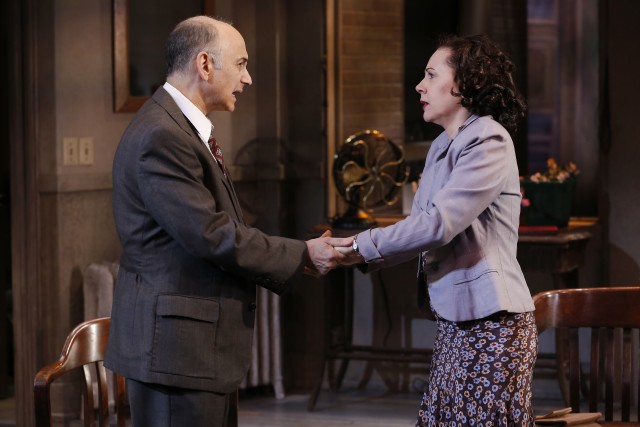
David (Joshua Zirger) and Simone (Karen Eilbacher) deal with a surprise medical diagnosis in Christy Smith-Sloman’s NEGATIVE IS POSITIVE (photo by Magali Charron)

Theater for the New City
155 First Ave. between Ninth & Tenth Sts.
Thursday – Sunday through November 30, $15
212-254-1109
www.negativeispositivetheplay.com
www.theaterforthenewcity.net

It’s rarely a good sign when you go to the theater and there are as many people in the audience as there are actors in the cast. It doesn’t help when the stage is surrounded by sheets of plastic that make it look like it is still under construction, not ready for the public yet. And then you have to sit through an opening scene that is so dreadful you’re looking for the emergency exits, wondering how you can sneak out without being noticed. (You can’t.) But then something happens, and you remember why you love going to the theater in the first place. In this case, it’s the entrance of Joshua Zirger, who commands his role with such a genuineness that you’re willing to forgive many of the shortcomings of Negative Is Positive, a new work by Christy Smith-Sloman, directed by Andreas Robertz, running at the Theater for the New City through November 30. The play is set in 2010, with Simone (Karen Eilbacher) getting diagnosed with HIV by a dentist (Fulton C. Hodges) using a rather questionable experimental procedure. Instead of seeking a second opinion — a serious flaw in the story — Simone rails against her husband, David (Zirger), accusing him of cheating and attacking him unmercifully, reevaluating their life together no matter how much he swears he’s innocent and that he loves her. When their best friends, Brianna (Vivienne Jurado) and George (David M. Farrington), arrive for dinner, Simone gets in an even fouler mood, with fireworks flying that get only more intense in the second act.

Negative Is Positive made headlines recently when former New York Rangers forward, Vogue intern, and model Sean Avery, who was originally supposed to play George, abruptly quit the show amid an argument over pizza. Smith-Sloman, who is also a journalist, and Robertz, the artistic director of OneHeart Productions, have, dare we say, turned a negative into a positive with Avery’s last-minute replacement, Farrington, who displays a natural ease in the role and clearly works well with others. Eilbacher is at her best when she unleashes several massive screams, but it’s Zirger who’s the one to watch here, even during the last moments of intermission, as his character examines his board of notes — David’s taken a year off from his sports job to write a screenplay — trying to decide what comes next. For Zirger, hopefully it’s bigger and better things onstage.

LOST LAKE

(photo by Joan Marcus)

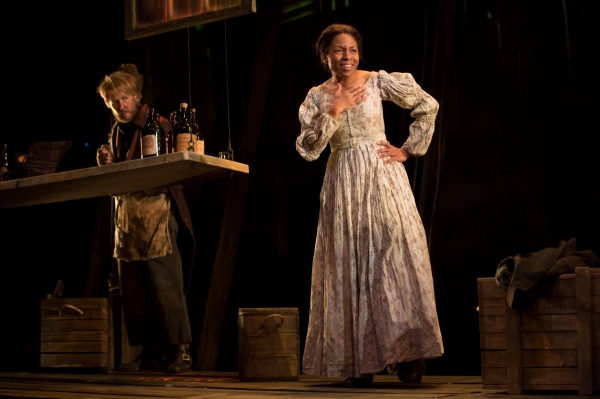
Veronica (Tracie Thoms) and Hogan (John Hawkes) are a pair of lost souls set adrift in new play by David Auburn (photo by Joan Marcus)

Manhattan Theatre Club
NY City Center Stage 1
131 West 55th St. between Sixth & Seventh Aves.
Tuesday – Saturday through December 21, $90
212-581-1212
www.lostlakemtc.com
www.nycitycenter.org

One of the best new plays of the fall season, David Auburn’s Lost Lake is a relatively simple yet compelling drama about two flawed souls trapped in worlds they can’t break out of. Veronica (Tracie Thoms) is a single mother looking to rent a cabin upstate for a week for her, her children, and one of their friends. Veronica goes up early to check out the cabin, which turns out to be as shoddy and ramshackle as its owner, Hogan (John Hawkes), a gaunt, grizzled, but well-meaning man who can’t seem to do anything right in his life. Both are repairers of a sort; Veronica is a nurse practitioner with aspirations to perhaps become a doctor, while Hogan purports to be a handyman who can fix just about anything, including the rotting swimming dock out on the lake behind the cabin. But neither can patch the gaping holes in their lives. As her supposed vacation progresses, Veronica gets caught up in Hogan’s family drama, as he lurks around the property, telling her about his problems with his ex-wife, his daughter, his brother, and, mostly, his despised sister-in-law, no matter how much Veronica just wants him to leave. But various events, both major and minor, keep bringing these two very different people together during a complicated period in which each is forced to take a long, hard look at the choices they’ve made while dealing with the hands they’ve been given.

Tony and Pulitzer Prize winner Auburn reteams with his Proof director, Daniel Sullivan, for this moving slice-of-life tale, which is highlighted by two superb performances. Thoms (Cold Case, Stick Fly) is careful and deliberate as Veronica, a troubled woman who does not like to let her wounds show. The Oscar-nominated Hawkes (Winter’s Bone, The Sessions) is riveting as Hogan, all herky-jerky and unpredictable as a man seemingly uncomfortable in his own skin. The back-and-forth banter between them is enhanced by the piercing yet vulnerable looks in their eyes, neither character happy with their lot in life but not sure how to turn things around. The script cleverly touches on such issues as race, the economic crisis, class, elitism, and gender roles while efficiently dismissing the one place you really don’t want it to go. J. Michael Griggs’s set is appropriately broken-down and dilapidated, echoing the protagonists’ inner demons. The ninety-minute Manhattan Theatre Club production follows the play’s debut earlier this year at the University of Illinois at Urbana-Champaign with Jake Weber and Opal Alladin as part of the Sullivan Project, a residency led by artistic director Daniel Sullivan, who has also helmed such shows as Rabbit Hole, Orphans, The Heidi Chronicles, and many Shakespeare in the Park presentations. Lost in the Lake is a fine fit for the intimate Stage I at City Center, where it is scheduled to run through December 21.

THE OLDEST BOY

THE OLDEST BOY

A lama (James Saito), a mother (Celia Keenan-Bolger), and a monk (Jon Norman Schneider) sip Tibetan butter tea in THE OLDEST BOY

Lincoln Center Theater at the Mitzi E. Newhouse
150 West 65th St. between Broadway & Amsterdam Ave.
Tuesday – Sunday through December 28, $87
212-362-7600
www.lct.org

Inspired by a true story told to her by her children’s Tibetan babysitter, playwright Sarah Ruhl explores motherhood, Buddhism, and monastic tradition in The Oldest Boy. Three-time Tony nominee Celia Keenan-Bolger (The Glass Menagerie, The 25th Annual Putnam County Spelling Bee) stars as a Cincinnati-born mother who is surprised when a monk (Jon Norman Schneider) and a lama (James Saito) arrive at her home (in an unnamed American city), claiming that her three-year-old son is the living reincarnation of the monk’s beloved teacher. Both she and her husband (James Yaegashi) — a Buddhist owner of a Tibetan restaurant who was born and raised in India, where the Dalai Lama and many Tibetans have lived in exile since the Chinese army crushed the 1959 Tibetan uprising — are honored that their child might be a tulku, or reincarnated Rinpoche. However, they face a dilemma, for the monk and the lama have come to take the boy to be enthroned in Dharamsala, where he will study in a monastery and become a Rinpoche himself, the teacher now being taught by his student in the endless circle of life. While the thought of giving up her son is shocking to the mother, the father is much more accepting of the situation, as it is part of his family’s culture.

THE OLDEST BOY

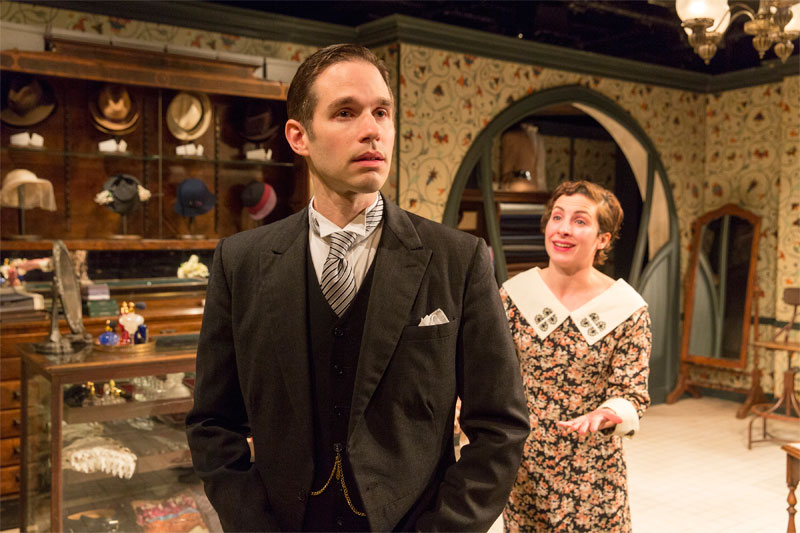
A mother has an impossible decision to make in Sarah Ruhl’s THE OLDEST BOY

The Oldest Boy is set on a round wooden floor that evokes a mandala. Two-time Pulitzer finalist Ruhl (The Clean House, In the Next Room, or the vibrator play) and director Rebecca Taichman (Ruhl’s Stage Kiss and Orlando) open up the back wall of the Mitzi Newhouse, where performers enact symbolic rituals that highlight Tibetan culture but detract from the central narrative, more David Henry Hwang than Sarah Ruhl. Keenan-Bolger and Schneider are both excellent, their difficult relationship wholly believable. The boy is portrayed by a wooden puppet operated by Takemi Kitamura, Nami Yamamoto, and Ernest Abuba, with Abuba providing the speaking voice. It’s a conceit that is odd and uncomfortable at first but ends up working rather well. Also influenced by such documentaries as Unmistaken Child and My Reincarnation, The Oldest Boy is a moving, if uneven, portrait of faith and family, of the value of belief and tradition in the modern world.

THE REAL THING

(photo by Joan Marcus)

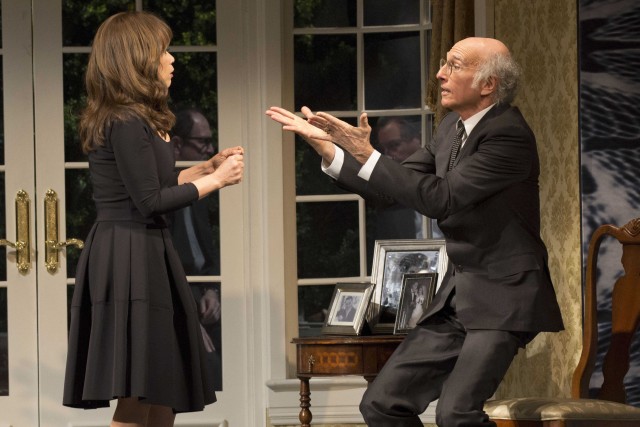
An all-star cast revive Tom Stoppard’s THE REAL THING on Broadway (photo by Joan Marcus)

American Airlines Theatre
227 West 42nd St. between Broadway & Eighth Ave.
Tuesday – Sunday through January 4, $67-$142
212-719-1300
www.roundabouttheatre.org

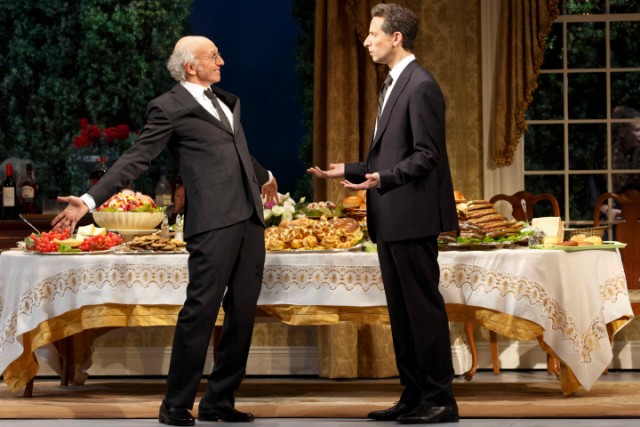
In 1984, Tom Stoppard’s The Real Thing won the Tony for Best Play, with stars Glenn Close, Jeremy Irons, and Christine Baranski taking home Antoinette Perry statues as well. In 2000, the story of love and infidelity was named Best Revival of a Play, with Jennifer Ehle and Stephen Dillane also honored for their roles. Lightning is unlikely to strike thrice in the latest Broadway revival of The Real Thing, a strangely cold and dispassionate version running at the American Airlines Theatre. In their Great White Way debuts, Ewan McGregor and Maggie Gyllenhaal never catch fire together, while Josh Hamilton and Cynthia Nixon don’t warm up either in this play about playwrights and actors. Henry (McGregor) is a successful scribe married to hoity actress Charlotte (Nixon), but he has the hots for another actress, the more earthbound Annie (Gyllenhaal), married to Max (Hamilton), who is suspicious of his wife’s possible infidelity. The tale alternates between real life and scenes from Henry’s plays with overlapping story lines and self-referential banter that sometimes makes it hard to differentiate between the two. In between scenes, members of the cast happily sing pop tunes out of character, as if they’re gathered around a campfire sharing wine and roasting marshmallows. But then it’s right back to Stoppard’s innately clever, refreshingly adult dialogue, which unfortunately falls flat under Sam Gold’s rather standard direction on David Zinn’s icy set. Madeline Weinstein adds some life as Debbie, Henry and Charlotte’s daughter — a role originated on Broadway by Nixon, who at the time was also appearing in David Rabe’s Tony-nominated Hurlyburly, dashing between the Ethel Barrymore Theatre and the Plymouth — but no sparks ignite as Annie’s costar, Billy (Ronan Raftery), and daft playwright Brodie (Alex Breaux) enter the fray. A well-known soda company once had a jingle that proclaimed, “There ain’t nothing like the real thing, baby”; in the case of this Broadway revival, that’s unfortunately not quite true.

ALL FOR ONE: FOURTH ANNIVERSARY

AllForOne_LOGO_onBlack_CMYK

Phebe’s Tavern & Grill
359 Bowery at East Fourth St.
Monday, November 11, free, 8:30
www.allforonetheater.org
www.phebesnyc.com

All for One, the nonprofit organization dedicated to “the art and craft of solo theater through education, performance, community, and advocacy,” is celebrating its fourth anniversary with a free party on November 11 at Phebe’s in the East Village. At the event, there will be appetizers and a cash bar, two-dollar raffle tickets to win two tickets to Sleep No More, 54 Below, the New York Neo-Futurists’ Too Much Light Makes the Baby Go Blind, Gazillion Bubble Show, and Metropolitan Playhouse, an announcement of next year’s programming, and the presentation of the 2015 All for One Pioneer Award to Cheryl King. Following the party, everyone is invited down the street to see a reading of founding artistic director Michael Wolk’s new musical at 64E4 Underground, GL9 (Ghostlight Nine), which is set in a haunted Broadway theater and features “book, music, lyrics, guitar playing, singing, and an attempt at acting” by Wolk, directed by Aaron Mark. The party is being held in conjunction with All for One’s SoloLab, which continues through November 16 with seven one-person solo shows in development, including Diana Oh’s {my lingerie play}: Installation 9/10, Katie Northlich’s Divine Chaos, Deb Margolin’s 8 Stops, Kim Morris’s We’re the Only Ones Left, and Antonia Lassar’s Post Traumatic Super Delightful.

THE OBJECT LESSON

(photo by Jeremy Abrahams)

Geoff Sobelle uses stuff to look back at his life in THE OBJECT LESSON (photo by Jeremy Abrahams)

2014 NEXT WAVE FESTIVAL
BAM Fisher, Fishman Space
321 Ashland Pl.
November 5-8, $20
718-636-4100
www.bam.org
www.geoffsobelle.com

Geoff Sobelle is a modern-day Buster Keaton in his one-man show The Object Lesson, which had its New York premiere at the BAM Fisher on Wednesday night and continues through Saturday. Once the doors to the intimate Fishman Space open, lucky ticket holders — the run is sold out, although there is a standby line — enter a room filled with hundreds and hundreds of cardboard boxes of all sizes, some scattered across the floor to be used as seats, others piled high to the ceiling. Many of the boxes are open, inviting people to peruse their contents. They contain the stuff of a lifetime, a hoarder’s fantasy, from footballs and photographs to stuffed animals and trophies, from Christmas decorations and clothing to papers and toys. There’s also a large card catalog with drawers and drawers of smaller items, many of which hold surprises that reveal a wry sense of humor. (Be sure to check out the Hamlet compartment.) Eventually, Sobelle enters the room and creates a central space consisting of a carpet, chair, side table, and lamps, magically pulling the items out of boxes while David Byrne’s “Glass, Concrete & Stone” plays on a turntable; “It is just a house, not a home,” the former Talking Head sings, differentiating between physical things and a more emotional concept. For the next seventy minutes or so, Sobelle rummages through boxes, interacts with the audience, has cleverly created telephone conversations, makes a salad like no one else ever has, and encounters memories that he can’t decide whether he wants to forget or remember, prompted by particular, tangible pieces of his past. He does all this in a mostly deadpan manner, with plenty of sly nods to the audience, who occasionally need to shift position when he builds his next set. (In addition to the “box seats” on the floor, a more standard row of theater chairs in the balcony accommodates those who might be otherwise uncomfortable, but the floor is clearly the place to be.) It all leads to a dazzling finale in which Sobelle, the co-artistic director of rainpan 43 and longtime member of Philadelphia’s Pig Iron Theatre Company, gathers everyone around him as he — well, you have to see it to believe it.

(photo by Jeremy Abrahams)

Each box Geoff Sobelle rummages through bring back memories, both fun and heartbreaking (photo by Jeremy Abrahams)

Every movement, every step, is wonderfully choreographed by Sobelle’s collaborators, director David Neumann, set designer Steven Dufala, lighting designer Christopher Kuhl, and sound designer Nick Kourtides, each contributing to the immersive illusion of it all. Winner of three major awards at the 2014 Edinburgh Fringe, The Object Lesson is inspired in part by the wit and wisdom of George Carlin, who said in his famous “A Place for My Stuff” routine, “That’s all you need in life, a little place for your stuff. That’s all your house is — a place to keep your stuff.” Sobelle has turned BAM’s Fishman Space into his own house, his own storage facility, like the end of Citizen Kane, with boxes and boxes of the stuff he has accumulated over the years. (Yes, many of the items are actually his.) Call it what you want — junk, trash, flotsam and jetsam, garbage, debris, waste, crap — but each one has a particular meaning for him, each one a root that ties him down, and it will dredge up memories of your own as well, especially when you return home and look at your own stuff, opening that box at the back of your closet that you haven’t looked inside for years.