this week in theater

FLOYDADA

(photo by Dan Lane Williams)

Sisters Dalia (Nomi Tichman) and Ada (Catherine Porter) reconnect in FLOYDADA (photo by Dan Lane Williams)

Peculiar Works Project
Merchants Square Building
40 Worth St. between Church St. & West Broadway
Wednesday – Saturday through April 11, $12-$18, 7:00
www.peculiarworks.org

When you think of the revolutionary art movement known as Dada, West Texas is not generally one of the first things that comes to mind. But in the early 1990s, playwright Barry Rowell was driving to Lubbock when he saw a sign for the small town of Floydada, Texas, and decided right then and there that he was going to write a play that involved Dadaism. The result is Floydada, a two-character show running through April 11 in a large, empty storefront in the Merchants Square Building on Worth St. The premise is a bit thin, as well as somewhat random — which, of course, is a key element of Dada. But you don’t have to know anything about Dada — the experimental movement, based on readymade objects and chance, that developed from a disgust with the death and destruction of WWI — to understand the play; after all, “Dada does not mean anything,” Tristan Tzara wrote in his 1918 manifesto. It’s March 1927, and Dalia (Nomi Tichman) is ill, so she has returned home to be with her sister, Ada (Catherine Porter), in the small town of Floydada. Dalia has spent the last several decades primarily in New York, Berlin, and Paris — France, not Texas — writing poetry, giving performances, and hanging out with the cultural elite, including the Baroness Elsa von Freytag-Loringhoven, a close friend with whom she continues to exchange letters. Elsa has also given Dalia one of her most famous sculptures, “Portrait of Marcel Duchamp,” an avant-garde work that mystifies Ada almost as much as her sister’s activities do. Over the course of ten months, the sisters reconnect, the city girl and the country girl learning from each other and even performing together, turning the family’s dry goods store into a cabaret where they sing and recite poetry for the close-knit local community.

(photo by Dan Lane Williams)

FLOYDADA features unusual characters in an unusual space (photo by Dan Lane Williams)

When Dalia first suggests that they perform, she tells Ada, “All we need is an empty space.” The same can be said for Peculiar Works Project, the Obie-winning company, cofounded by Porter, Rowell, and Ralph Lewis in 1993, that specializes in experimental productions in unusual spaces. In 2013, they presented Rowell’s Manna-Hatta in multiple rooms upstairs in the James A. Farley Post Office. Floydada takes place on the ground floor of the Merchants Square Building, which was built in 1928, right around the time in which the play is set. One side of the long, horizontal room, which boasts large pillars, a cement floor, and an open ceiling revealing pipes, wires, and insulation, has been filled with new Dada-inspired art by Carlo Adinolfi, Michelle Beshaw, Myrel Chernick, Norman Chernick-Zeitlin, Anna Kiraly, Ray Neufeld, and Francesco Vizzini. A makeshift box-office area features a urinal tip jar and a slideshow of Dada artists. The play itself unfolds in an open area with some furniture, as the two actors wander from living room to outside road to dry goods store, using sound to indicate their coming and going. Porter and Tichman portray Ada and Dalia with an oddball eccentricity that is reminiscent of the mother and daughter Bouvier Beales from Grey Gardens, though not nearly as off the wall. “People think you’re strange, you know,” Ada says, to which Dalia replies, “I am.” Director David Vining (Cracked, The Blue Puppies Cycle) makes creative use of the space, though a lot of the movement grows repetitive; at times you’ll just wish the characters just stayed put for a few moments instead of constantly getting up and down and moving back and forth on Casey McLain’s set. Yoonmi Lee adds fine piano and percussion, while Lianne Arnold’s projections and Leila Ghaznavi’s live manipulations (and sound effects) are colorful but confusing. The overall aesthetic has a sweetly innocent DIY charm, as well as plenty of strangeness, but it’s probably about twenty minutes too long, which, in its own way, is rather Dada itself. It’s also extremely cold in the space, with no heating, so be prepared to leave your coat and hat on if the weather remains so bitter. Floydada runs Thursdays, Fridays, and Saturdays through April 11; there will be a “Dada (Re)Creation” benefit on April 6 with dance, music, art, and poetry, and the April 9-11 shows will be followed by a DadaDialogue with Pratt professor Dr. Dorothea Dietrich and other panelists.

THE HEIDI CHRONICLES

(photo ©2014 Joan Marcus)

Elisabeth Moss stars as Heidi Holland in Broadway revival of Wendy Wasserstein’s Pulitzer Prize-winning play (photo © 2014 Joan Marcus)

Music Box Theatre
239 West 45th St. between Broadway & Eighth Aves.
Tuesday – Sunday through May 3, $40 – $139
www.theheidichroniclesonbroadway.com

“I wrote this play because I had this image of a woman standing up at a women’s meeting saying, ‘I’ve never been so unhappy in my life,’” Wendy Wasserstein told Time magazine in a 1989 interview about The Heidi Chronicles. “Talking to friends, I knew there was this feeling around, in me and in others, and I thought it should be expressed theatrically. But it wasn’t. The more angry it made me that these feelings weren’t being expressed, the more anger I put into that play.” Twenty-six years later, The Heidi Chronicles is being revived on Broadway for the first time, in a production directed by Tony winner Pam MacKinnon (A Delicate Balance, Who’s Afraid of Virginia Woolf?) that opened at the Music Box Theatre on March 19. But little of that anger is evident in what turns out to be a kind of tepid time-capsule experience that lacks energy and fervor; instead, it feels like an outdated story that is past its prime. Mad Men’s Elisabeth Moss stars as Heidi Holland, a smart woman who is considering having it all — both a career and a family — as she comes of age in the 1960s and ’70s and then has to reconfigure her hopes and dreams through the 1980s. In the first act, Wasserstein (The Sisters Rosensweig, An American Daughter) follows Heidi as she attends a high school dance in Chicago in 1965, meets the aggressive Scoop Rosenbaum (Jason Biggs) at a 1968 rally for Eugene McCarthy, goes to a women’s meeting in Ann Arbor in 1970, and protests the paucity of women artists in a 1974 exhibition at the Art Institute of Chicago as she searches for her purpose in life. In the second act, all of which takes place in New York in the 1980s, she goes to a baby shower, appears on a morning TV show, and has a confab at the Plaza as she tries to come to grips with the decisions she’s made as she approaches forty without a husband, children, or a real home base.

(photo © 2014 Joan Marcus)

Morning TV host April (Tracee Chimo) talks with Scoop (Jason Biggs) and Heidi (Elisabeth Moss) in THE HEIDI CHRONICLES (photo © 2014 Joan Marcus)

Each act begins with Heidi at a podium, delivering a lecture in 1989 on such overlooked women artists as Sofonisba Anguissola, Artemisia Gentileschi, Clara Peeters, and Lilly Martin Spencer. Those scenes show Heidi as a strong, intelligent, confident, and funny woman, more than comfortable in her own skin. However, in the flashbacks, she is lost and uncertain, most often an observer who doesn’t take action, allowing others — primarily but not exclusively men — to take control. Heidi is more of a humanist than a feminist, as is the play itself, but in 2015, with more opportunities than ever before for women — although there’s obviously still a long, long way to go — the conflicts Heidi faces don’t seem as dramatic as they might have been in 1989, and her diffidence or sometimes seeming paralysis denies the narrative some necessary conflict. We never quite understand why she is best friends with Susan (Ali Ahn), who is far more concerned with appearances than real depth; why she is drawn so much to the egocentric Scoop, even after he’s married; and what she truly gets out of her long friendship with Peter Patrone (Bryce Pinkham). All three supporting roles are played as caricatures who don’t seem to fit in with Heidi’s life. and the songs Wasserstein uses for each scene have become clichéd, from Aretha Franklin’s “Respect” and Jefferson Airplane’s “White Rabbit” to John Lennon’s “Imagine” and Janis Joplin’s “Take a Piece of My Heart,” all of which today are overkill, substituting for what we don’t see in Heidi. Like the character she portrays, Moss is at her best when delivering the illustrated lectures, relaxed and charming, someone you want to spend time with, but in the memory scenes, she is as understated and frustrating as Heidi. Rising star Tracee Chimo steals the show, playing four very different characters, Fran, Molly, Betsy, and April, making the most memorable statement of the evening when she declares, “Either you shave your legs or you don’t.” Heidi, and Moss, falls somewhere in the middle, and even if that’s the point, it doesn’t make for gripping theater. In 1989, The Heidi Chronicles earned Wasserstein the Pulitzer Prize, and she became the first solo woman to win a Tony for Best Play. But it feels very different all these years later.

A HAPPY END

(photo by Kim T. Sharp)

Iddo Netanyahu play looks at a family facing a crisis in Berlin during rise of the Nazis (photo by Kim T. Sharp)

June Havoc Theatre, Abingdon Theatre Company
Abingdon Theatre Arts Complex
312 West 36th St. between Eighth & Ninth Aves.
Through March 29, $65
www.ahappyend.net
www.abingdontheatre.org

In January, in the wake of the Charlie Hebdo terrorist attack in Paris, Israeli prime minister Benjamin Netanyahu declared, “This week, a special team of ministers will convene to advance steps to increase immigration from France and other countries in Europe that are suffering from terrible anti-Semitism.” His bold and controversial proclamation couldn’t help but remind one of the decisions European Jews had to make in the 1930s, faced with the rise of Adolf Hitler and the Third Reich. To stay or to go during that unhappy time is what Bibi’s younger brother, Iddo, author and part-time radiologist, explores in A Happy End, a compelling if unsubtle play making its New York premiere by the Abingdon Theatre Company. (Iddo and Bibi’s eldest brother, Yoni, was the only Israeli soldier killed in the 1976 raid on Entebbe.) Originally commissioned in Italy in 2008 for European Holocaust Memorial Day, the play takes place over four months in 1932-33 Berlin, as Hitler is amassing power, a situation dismissed by erudite physicist Mark Erdmann (Curzon Dobell). His wife, Leah (Carmit Levité), is having an affair with his lab colleague, Dieter Kraft (Joel Ripka), a non-Jew who recognizes the increasing level of anti-Semitism in the country and tries to convince his boss that he needs to leave Germany before it is too late. But Mark and Leah, who have a talented son, Hans (Phil Gillen), refuse to abandon the only home they’ve ever known. “They’re on the decline,” Mark says about the Nazis. “Politicians can’t dictate how we should live our lives,” Leah adds. But despite the play’s title, it’s doubtful things will work out well.

(photo by Kim T. Sharp)

Leah (Carmit Levité) and Mark Erdmann (Curzon Dobell) consider leaving their home behind in A HAPPY END (photo by Kim T. Sharp)

Numerous minor set changes help move the action more than Alex Dmitriev’s rather plain direction, as there is a lot of just sitting and standing around. Levité, a South African-Israeli actress, overplays Leah at first before eventually settling into the role of a glamorous woman who wants it all, a young lover in addition to a wise, successful husband (and fabulous clothes designed by Laura Crow). Dobell is rock-solid as an intellectual who is focused more on his work than the strong emotions swirling around him; when a waiter in a café turns on the radio to listen to a Hitler speech, Mark asks him to turn it off, as if that will make the potential next chancellor just go away. Lori Gardner adds doses of humor as Anna, Mark’s assistant, although repeated borrowings of his pen get tired. (Perhaps this is a reference to the pen being mightier than the sword, or, as a real stretch, even Jean-Marie Le Pen, the longtime leader of France’s right-wing National Front, but either way, it grows old quickly.) Ripka is earnest as the sincere Dieter, wanting the Erdmanns to be safe even though their leaving would impact him both personally and professionally. A Happy End is a thought-provoking work that handles its familiar subject matter with great care, a tale that will have you wondering what you would do in a similar situation. Sadly, there are many people around the world, especially in Europe right now, faced with that very real decision.

ON THE 20th CENTURY

(photo by Joan Marcus)

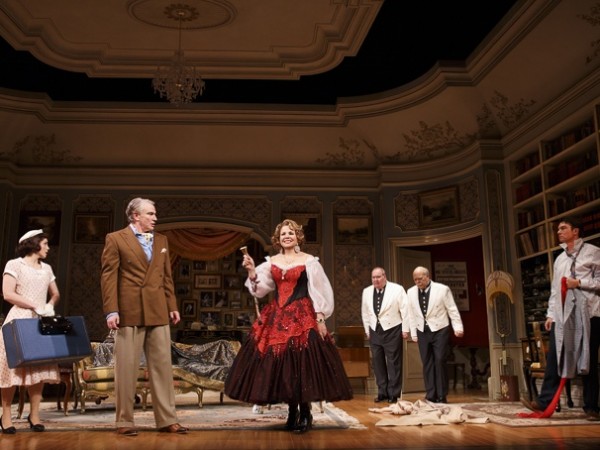
Oscar Jaffee (Peter Gallagher) is desperate for former flame Lily Garland (Kristin Chenoweth) to star in his next Broadway show (photo by Joan Marcus)

American Airlines Theatre
227 West 42nd St. between Broadway & Eighth Ave.
Tuesday – Sunday through January 4, $67-$142
212-719-1300
20thcenturyonbroadway.com
www.roundabouttheatre.org

“There’s something about a train that’s magic,” Richie Havens sang in a series of Amtrak commercials in the 1980s. There’s more than just a little magic in the first revival of Betty Comden, Adolph Green, and Cy Coleman’s 1978 screwball musical comedy, On the 20th Century, which has pulled into the American Airlines Theatre, brought back to glorious life by director Scott Ellis in this celebratory Roundabout production. It’s 1932, and suddenly bankrupt theatrical impresario Oscar Jaffee (Peter Gallagher), trying to recover from a series of failures, has boarded the glamorous Twentieth Century Limited with his musketeer henchmen, Oliver Webb (Mark Linn Baker) and Owen O’Malley (Michael McGrath), in order to convince his former leading lady, Lily Garland (Kristin Chenoweth), to put aside the Academy Award (aka the Oscar, of course) she’s just won and return to Broadway in his new show. But her new lover and frequent onscreen costar, Bruce Granit (Andy Karl), is jealous, and Lily herself is suspicious of the scheming Oscar, who discovered her when she was shlumpy Mildred Plotka and turned her into a star. Also on board the train is a little old lady, Mrs. Letitia Peabody Primrose (Mary Louise Wilson), a religious zealot secretly slapping up signs demanding that all of these heathens “Repent!” while also considering financing Oscar’s next show. As the train continues its overnight journey from Chicago to New York, Oscar grows more and more desperate, resulting in ever-wackier high jinks. “New York in sixteen hours / Anything can happen in those sixteen hours / On that might-y / Ride-the-night-ly / Miracle of engineering brains . . . / On the Twentieth Century / On the luxury liner of locomotive trains,” conductor Flanagan (Jim Walton) proclaims, and indeed, anything can and does occur.

(photo by Joan Marcus)

Lily Garland (Kristin Chenoweth) finds herself in a bit of a triangle between Bruce Granit (Andy Karl) and Oscar Jaffee (Peter Gallagher) in Roundabout revival (photo by Joan Marcus)

The show has a storied history, adapted from Ben Hecht and Charles MacArthur’s 1932 play, Twentieth Century (itself based on Charles Bruce Millholland’s unproduced Napoleon of Broadway) and Howard Hawks’s 1934 film, 20th Century, which starred John Barrymore as Oscar and Carole Lombard as Lily. (Various other versions and iterations have featured Fredric March, John Cullum, Rock Hudson, Orson Welles, José Ferrer, and Alec Baldwin as Oscar and Madeline Kahn, Judy Kaye, Anne Heche, Lily Palmer, Constance Bennett, Gloria Swanson, and Betty Grable as Lily.) Tony nominee Gallagher (Guys and Dolls, Long Day’s Journey into Night) has just the right amount of smarm and charm as Oscar, even if his singing voice is not quite virtuosic (although he is dealing with an illness that has forced him to miss several performances and delayed the official opening by a week), but Tony winner Chenoweth (Wicked, You’re a Good Man, Charlie Brown) more than makes up for that in a role that she fully inhabits, giving a rafters-rattling performance that will knock your socks off, as if this were the role she was born to play. (In fact, in 2000, Green told Chenoweth, “You know what part you’re born to play?” To which Comden replied, “Lily Garland.”) When Oscar says about Mildred, “It was there. The pixie . . . the eternal woman . . . the fire . . . the passion . . . and the singing voice of a lost child heard by its mother echoing from beyond a corner,” it could just as well be Gallagher talking about Chenoweth. It’s a spectacular display that actually includes fireworks.

The operetta-like score is not particularly memorable, overloaded with repetition and redundancy, but three-time Tony nominee David Rockwell’s Art Deco sets are, along with six-time Tony nominee Ellis’s (The Elephant Man, 1776) gleefully chaotic staging and Tony winner Warren Carlyle’s (After Midnight) glittering choreography. Tony winner McGrath (Nice Work If You Can Get It, Spamalot) and Linn-Baker (You Can’t Take It with You, Perfect Strangers) are a kind of Harpo and Chico to Gallagher’s Groucho, while Tony nominee Karl (Rocky, The Mystery of Edwin Drood) chews up the scenery as the narcissistic Granit. It all makes for one joyous journey, even when things get too silly, but the show’s self-deprecating humor, knowing nods and winks, and endless magic make you overlook its shortcomings (while reveling in the irony that the show that takes place on board a train is playing in a theater named for an airline and is produced by a company whose title can refer to a circular intersection cars drive around). Throughout the show, characters keep knocking on Oscar’s door, waving their scripts in his face. “It’s all about life on a train / I call it ‘Life on a Train,’ Flanagan sings, continuing, “I put it down just as it happened / Oh, the things I’ve seen!” I can happily say the same thing about On the 20th Century, itself: Oh, the things I’ve seen!

CHURCHILL

CHURCHILL

Ronald Keaton portrays Sir Winston Churchill in one-man show at New World Stages (photo by Jason Epperson)

New World Stages
340 West 50th St. between Eighth & Ninth Aves.
Wednesday – Monday through September 13, $67
churchilltheplay.com
newworldstages.com

In The Audience, now on Broadway at the Gerald Schoenfeld Theatre, Helen Mirren transforms into Queen Elizabeth II, making the crowd gasp as she seems to become Her Royal Highness right before our eyes. In Ronald Keaton’s one-man show, SoloChicago’s production of Churchill at New World Stages, Keaton never quite fully embodies the larger-than-life political figure — who is played in The Audience by Dakin Matthews — and the audience never forgets it is seeing a staged performance, but he still does hit all the right notes as he relates the life of one of the most important figures of the twentieth century. But whereas the text of The Audience is complete fiction, imagined by writer Peter Morgan, in Churchill Keaton, who both adapted and stars in the play, uses the writings and speeches of Sir Winston to give a clear and concise history of the man and his influence on world politics, focusing on the two world wars while including plenty of classic Churchill quips. It’s 1946, and Churchill has arrived in the United States to meet with President Dwight D. Eisenhower. Speaking directly to the audience, Churchill shares the details of critical moments in his life, beginning with his premature birth on November 30, 1874, the son of a British duke and an American woman: “So I am myself a kind of English-speaking union,” he says. “I came miraculously into the world with a certain amount of impatience and a good deal of energy.” Churchill discusses his schooling, his embarrassing lisp and stutter, his relationship with his loving mother and stiff-upper-lipped father (“You want to know how many conversations I had with my father over a lifetime? Maybe five.”), his marriage to Clementine Hozier (“In our first meeting at a social gathering, I took note of her personal grace and beauty. The second meeting convinced me that this was a woman of great character and intelligence, and I fell almost instantly.”), and his joining the military, which changed the course of his future, as he became a war hero, a bestselling author, and a savvy politician with an unrivaled talent for witty repartee and sharp comebacks. (“A female acquaintance of mine, one of those plutocrats who claimed to love the working man —indeed, they love to see him work — said to me, ‘Mr. Churchill, I care for neither your politics nor your mustache.’ I said, ‘Don’t distress yourself, dear lady, you’re not very likely to come in contact with either.’”)

CHURCHILL

“I must be very tough or very lucky. Or both,” Churchill (Ronald Keaton) declares in biographical play (photo by Jason Epperson)

The second act begins as England enters WWII on September 1, 1939, with Churchill becoming first lord of the admiralty (“‘Sir! You’re scuttling the traditions of the Royal Navy!’ ‘Admiral, have you ever considered what the traditions of the Royal Navy really are? I can tell you in three words: rum, sodomy, and the lash!’”) and, on May 10, 1940, prime minister for the first time. (“But at last, I had been given complete authority over the whole scene. I felt as if I were walking with destiny, and that all my past life had been preparation for this hour, this trial.”) Churchill speaks humbly yet proudly of his own vast accomplishments (“I’ve derived continued benefit from criticism in my life and never known any time when I was short of it.”) and fondly of his relationship with FDR. (“Meeting President Roosevelt was like opening your first bottle of champagne. And knowing him was like drinking it. He was the best friend England ever had.”) Director Kurt Johns has Keaton wander rather randomly across Jason Epperson’s somewhat cramped set, which includes an easel where the British Bulldog paints, two chairs, a desk, and a window on which Paul Deziel projects Churchill family photographs, the Union Jack, Churchill canvases, and other images. I attended the show with a Churchill aficionado, someone so enamored with the man that his daughter was even born on Winnie’s birthday, and he gave the show high marks for its historical accuracy and ability to encapsulate Churchill’s life and career in less than two hours (with intermission). I can’t be quite so generous with the staging itself, but Churchill, part of Churchill 2015, a celebration of the fiftieth anniversary of the eminent statesman’s death, is still a heartfelt look at an inspiring figure who changed the course of history. (On June 19, Keaton will be at the 92nd St. Y for the special talk “Behind the Scenes of Off-Broadway’s Churchill with Tricia McDermott.)

TICKET GIVEAWAY: CLINTON THE MUSICAL

clinton the musical

CLINTON THE MUSICAL
New World Stages
340 West 50 St. between Eighth & Ninth Aves.
Wednesday – Monday, March 25 – September 6 (opens April 9), $75–$95
www.clintonthemusical.com

There’ve been endless books, movies, documentaries, and SNL skits about William Jefferson Clinton and Hillary Rodham Clinton, so it’s about time there was a musical as well. But given the cast of characters, don’t expect Billary to be making this a campaign stop (if she’s running for president, of course). Paul and Michael Hodge have taken the story of an Arkansas hick and a Chicago-born suburbanite and turned it into Clinton the Musical, starring Tony nominee Kerry Butler as Hillary Clinton, Tom Galantich as WJ Clinton, Duke Lafoon as Billy Clinton, Emmy winner Judy Gold as Eleanor Roosevelt, John Treacy Egan as Newt Gingrich, Veronica Kuehn as Monica Lewinsky, and Kevin Zak as Kenneth Starr. A hit at the 2014 New York Musical Theatre Festival, Clinton the Musical has two actors portray the forty-second president of the United States, splitting the polarizing figure into separate parts, both of which ignite controversy, albeit in different ways. The show is directed and choreographed by Tony nominee Dan Knechtges (Tail! Spin!, Lysistrata Jones, Xanadu), with sets by Tony winner Beowulf Boritt and costumes by Tony nominee David Woolard, so it has quite a pedigree. To find out more, you can follow the show’s rehearsal breaks here.

TICKET GIVEAWAY: Clinton the Musical begins previews March 25 prior to an April 9 opening, and twi-ny has three pairs of tickets to give away for free. Just send your name, daytime phone number, and favorite show about politics to contest@twi-ny.com by Friday, March 27, at 3:00 to be eligible. All entrants must be twenty-one years of age or older; three winners will be selected at random.

SMALL MOUTH SOUNDS

(photo by Ben Arons)

Six characters seek enlightenment at a silent retreat in SMALL MOUTH SOUNDS (photo by Ben Arons)

Ars Nova
511 West 54th St. between Tenth & Eleventh Aves.
Monday – Saturday through April 11, $35, 7:00 or 8:00
212-352-3101
arsnovanyc.com

Silence turns out to indeed be golden in Bess Wohl’s charming, inventive Small Mouth Sounds, having its world premiere at Ars Nova. The hundred-minute play takes place at a silent meditation retreat, where six people have come seeking enlightenment, or at least a respite from the pain life has brought them. Jan (Erik Lochtefeld) is a doe-eyed middle-aged man with a soft, kind heart, carrying around with him a picture of a child. Rodney (Babak Tafti) is a yoga practitioner and meditator who knows all the right moves and poses. Alicia (Jessica Almasy) is a chaotic, emotional young woman, perpetually late and overly dramatic. Ned (Brad Heberlee) is a troubled, hapless soul who has experienced more than his fair share of suffering. And Joan (Marcia DeBonis) and Judy (Sakina Jaffrey) are a couple dealing with illness as their love is tested. The six people have come to an unnamed location — the show was inspired by a silent spiritual retreat Wohl attended at the Omega Institute in Rhinebeck — for five days of vegan eating, inward searching, and no talking, led by a teacher (Jojo Gonzalez) who turns out to have some problems of his own. “Think of this retreat as a vacation from your habits. Your routines. Yourself,” the unseen teacher says in a slow, choppy disembodied voice heard through a speaker. “It is the best kind. Of vacation. Because after this. You don’t ever have to go back. To who you were.” Over the course of the five days, they all find out a little more about who they are, and they don’t always like what they see.

(photo by Ben Arons)

Silent retreaters discover new ways to look at the world in superb Ars Nova production (photo by Ben Arons)

Set designer Laura Jellinek (The Nether) has transformed Ars Nova into a long, narrow space, with two rows of seats on either side of the stage. At one end are six chairs for the characters, who sit there when listening to the teacher, whose voice comes from the opposite end, echoing through the room. The center, horizontal area serves primarily as the retreaters’ sleeping quarters, with Ned paired with Rodney, Joan with Judy, and Alicia mistakenly situated with Jan, which doesn’t make her happy, although he is serenely unperturbed by it. Director Rachel Chavkin, who delighted audiences with the smash hit Natasha, Pierre & the Great Comet of 1812, which played at Ars Nova in 2012, keeps things much simpler this time around, showing that action speaks louder than words, incorporating silent-movie tropes and clever, recognizable gestures to reveal the characters’ traits, from their failings to their hopes and dreams, from needing a pencil to fighting off bears and mosquitoes. Video projections of nature by Andrew Schneider surround the upper panels of the room, placing everyone in the great outdoors, enhanced by Stowe Nelson’s terrific sound design, from the pitter-patter of rain to the teacher’s not-quite-godlike voice. Lighting designer Mike Inwood rarely lets it get too dark, so the audience is well aware of themselves, almost as if they are also on the retreat and observing such rules as silence and no eating, since any whisper or unwrapping of candy would be seen and heard by everyone. There might not be a lot of dialogue — although there is some, as numerous rules are broken by the students and the teacher — but Wohl (Pretty Filthy) has plenty to say about impermanence, communication, connection, intention, and interdependence as relationships unfold at a calm, dare we say meditative, pace. The title refers to those guttural sounds — grunts, moans, sighs, chuckles — we all make when words won’t suffice, or aren’t allowed. In Small Mouth Sounds, Wohl, Chavkin, and the splendid cast prove that silence can speak volumes.