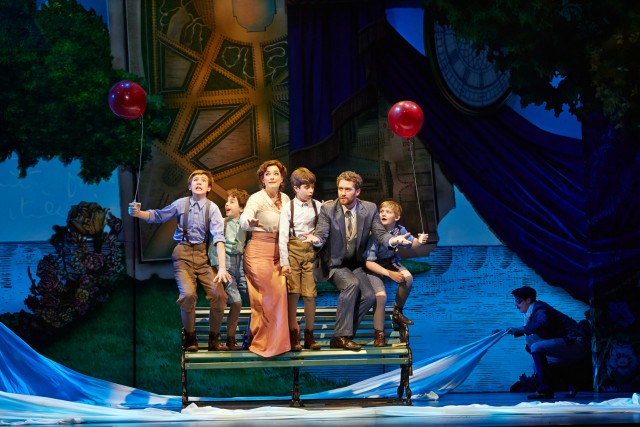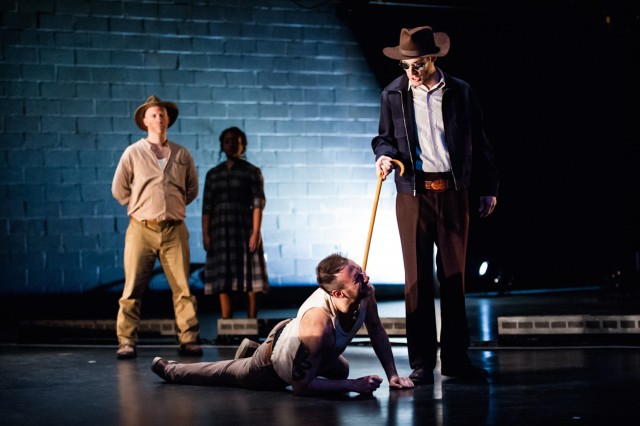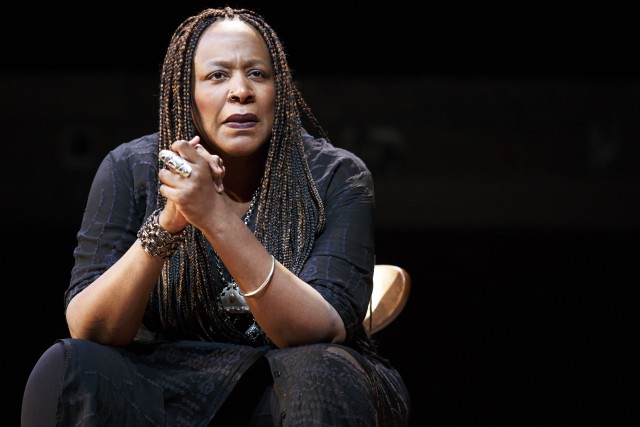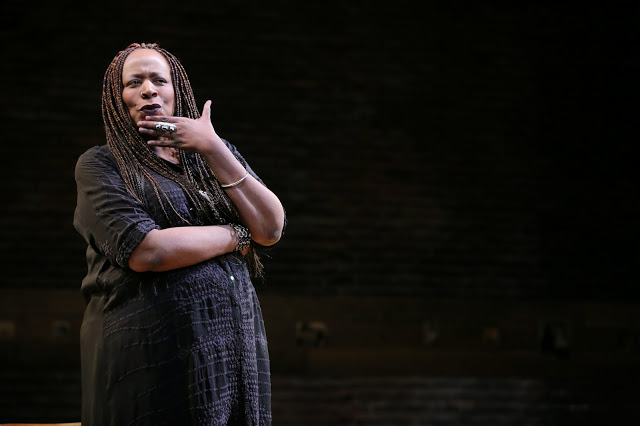
Jaclyn (Tonya Pinkins) and Ileen (Dianne Wiest) get involved in racism and office politics in RASHEEDA SPEAKING (photo by Monique Carboni)
The New Group at the Pershing Square Signature Center
The Romulus Linney Courtyard Theatre
480 West 42nd St. between between Ninth & Tenth Aves.
Tuesday – Sunday through March 22, $77-$97 www.thenewgroup.org www.signaturetheatre.org
The New Group’s twentieth anniversary season, and first at the sparkling Pershing Square Signature Center, continues with Joel Drake Johnson’s clever, if straightforward, pared-down examination of race and office politics, Rasheeda Speaking. The white Ileen (Dianne Wiest) and the black Jaclyn (Tonya Pinkins) work for the white Dr. Williams (Darren Goldstein), taking care of patients and handling the bills and forms. As the show opens, the surgeon is wheedling Ileen into reporting on Jaclyn, whom he clearly doesn’t like; he wants Ileen, whom he is promoting to office manager, to write down all of Jaclyn’s faults so he can ultimately replace her through human resources. “I don’t think she fits in,” Dr. Williams tells Ileen. “Her attitude is terrible. And she hates me.” After five days out sick, Jaclyn returns, complaining about toxins, the sorry state of her plants, and poisonous rays. She mistreats elderly white patient Rose Saunders (Patricia Conolly), accuses Ileen of being in love with their boss, doesn’t speak well of Mexicans, and claims Dr. Williams “doesn’t think white people should socialize with black people.” But just when it seems that Jaclyn is somewhat of a conspiracy theorist, both Dr. Williams and Ms. Saunders make comments that show that Jaclyn might not be that crazy after all.
Dr. Williams (Darren Goldstein) and Jaclyn (Tonya Pinkins) are not exactly the best of friends in New Group production (photo by Monique Carboni)
Played beautifully by Tony winner Pinkins (Jelly’s Last Jam; Caroline, or Change) and two-time Oscar winner Wiest (All My Sons, Bullets over Broadway), Jaclyn and Ileen are an engaging odd couple, bantering back and forth with aplomb, the former a ball of fire who speaks her mind, the latter a gentle soul who loves life and prefers to avoid confrontation. Pinkins commands the stage, stomping around Allen Moyer’s splendid doctor’s office set, while the rest of the cast treads far more lightly. Wiest might smile a lot as Ileen, but there’s something lurking right below the surface, and Goldstein (Bloody Bloody Andrew Jackson, The Affair) is appealing as the pastry-munching, suspicious surgeon who lets others do his dirty work. First-time director Cynthia Nixon keeps it all moving fluidly despite the office furniture clutter, giving appropriate space for Chicago playwright Johnson’s (Four Places, The Fall to Earth) razor-sharp dialogue. The narrative is too often overly direct and explicit, but the hundred-minute play does reveal the latent racism that is still so prevalent in today’s supposedly postracial society, letting us know that each and every one of us has plenty of work to do.
Claude (Jon Norman Schneider), Eleanor (Suzanne Bertish), and Dash (Devin Norik) try to make their dreams come true in Paris in Anton Dudley’s CITY OF
Peter Jay Sharp Theater
416 West 42nd St. between Ninth & Tenth Aves.
Daily through February 21, $10-$35 www.playwrightsrealm.org
Self-taught French artist and Customs agent Henri Rousseau never left Paris, but he often visited the city’s natural history museum, zoo, and botanical gardens, which influenced such famous paintings as his 1910 masterpiece, “The Dream,” in which a nude woman reclines on a sofa in the middle of a jungle. The painting serves as the jumping-off point of Anton Dudley’s second work for the Playwrights Realm, City of (following 2007’s Substitution, the Realm’s inaugural production). As the hundred-minute one-act opens, a young man named Claude (Jon Norman Schneider) is in MoMA, enraptured by “The Dream”; meanwhile, nearby, the tall, aristocratic Dash (Devin Norik), who turns out to be the wealthy owner of the work (now that his beloved mother has passed on), is enraptured by Claude. Soon the two are off to Paris, along with Cammie (Colby Minifie), who wants to sing on the stage of the Paris Opera House, and Eleanor (Suzanne Bertish), who is seeking out her dead father as she ventures into old age. Paris is represented by a pigeon with a sweet tooth (Cheryl Stern) and a gargoyle on the facade of the Cathedral of Notre-Dame (Steven Rattazzi, who also plays the ghost of Paul Verlaine and others). All of the main characters search for their dreams — or nightmares — as they make their way through a magical, haunted Paris. The play gets its name from how characters regularly are unable to finish descriptions of Paris, saying over and over again, “City of . . .” without filling in that last noun. Just as Claude, Dash, Cammie, and Eleanor can’t seem to quite put their finger on what makes Paris tick, Dudley and director Stephen Brackett (Buyer & Cellar) can’t seem to quite put their finger on what might make City of tick. Choppy dialogue has characters speaking on top of one another or sharing lines in unison as well as reading stage directions about themselves in the third person, confusing the action or reinforcing relationships to the point of overkill. Virtually everything is overstylized until it is understylized; the best scene in the play is Eleanor’s late soliloquy, passionately delivered by Royal Shakespeare Company veteran Bertish. Rousseau’s surreal painting can be interpreted many different ways by each viewer, deserving of extended attention; unfortunately, the same cannot be said for Dudley’s muddled theatrical homage.
It takes several minutes to get into the flow and rhythm of Nick Payne’s Constellations, a two-character play set in the quantum multiverse, in the “past, present, and future.” Beekeeper Roland (Jake Gyllenhaal) and cosmologist Marianne (Ruth Wilson) meet in a bar, have a brief chat, the lights go out, then they do it again, and again. But each time, something changes — the tone of their voice, the movement of their bodies, their positioning onstage, a word here and there. What at first seems like it might be just a tiresome theatrical exercise turns out to be a captivating, sophisticated exploration of the many roads a relationship (and storytelling itself) can take. Over the course of seventy minutes, there are more than fifty short scenes as Roland and Marianne go through repeated iterations of hooking up and not, discussing their careers, being faithful and unfaithful, and, ultimately, facing mortality square in the face. Once you fall under the spell of the drama’s intellectual conceit, a scene won’t even be over before you’re eagerly anticipating how the next one will be slightly different. Constellations is no mere Sliding Doors rehash in which the protagonists have two choices that will take their lives in alternate directions, nor is it as black and white as the Star Trek episode “The Enemy Within,” in which each character has a good and evil version; instead, it posits that there are parallel universes in which Roland and Marianne are interacting at the same time, each one similar but unique — and each one, ultimately, ending in death, something that never changes.
In writing Constellations, Payne — who previously tackled climate change in If There Is I Haven’t Found It Yet, in which Gyllenhaal made his New York theater debut — was inspired by the work of Columbia physics and mathematics professor Brian Greene, the superstring theorist and author of the highly influential book The Elegant Universe, giving an intriguing, well-researched scientific edge to the play. While Marianne’s job has her studying the origin of the universe, Roland is a rooftop beekeeper, caring for insects whose very existence might determine the future of the planet. In her Broadway debut, Wilson, whose star has risen dramatically in just a few short years — the thirty-three-year-old actress has won two Olivier Awards and had starring roles in such well-received television series as Luther and The Affair — is sensational as Marianne, combining an innate intelligence with just the right amount of vulnerability. And in his Broadway debut, the thirty-four-year-old Gyllenhaal — who is currently up for an Oscar for his performance in Nightcrawler and has starred in such other films as Zodiac, Brokeback Mountain, and Proof — is a worthy partner as he keeps his character beguilingly unpredictable under the sure hand of Michael Longhurst, who previously directed Gyllenhaal in the Roundabout production of If There Is I Haven’t Found It Yet and Wilson in Arthur Miller’s The Crucible, when the two were at the University of Nottingham together. The play, which originated in London with Rafe Spall (Life of Pi,Betrayal), who also originated the role Gyllenhaal played in If There Is, and Sally Hawkins (Happy-Go-Lucky, Blue Jasmine), features a fascinating set designed by Tom Scutt, with lighting by Lee Curran; the actors remain on a central rectangular platform that is surrounded on three sides and above by balloons that represent stars, with different orbs glowing on and off in each scene. Constellations is a challenging, intellectually stimulating and satisfying work, expertly written, directed, and acted, but even with all the thought-provoking science, when it comes right down to it, it’s really just a, er, universal love story, as boy meets girl, then boy meets girl, then boy meets girl….
Jameel (Zarif Kabier) and Haytham (playwright Laith Nakli) discuss troubles in Syria in SHESH YAK (photo by Sandra Coudert)
Rattlestick Playwrights Theater
224 Waverly Pl. between Eleventh & Perry Sts.
Wednesday – Monday through February 22, $30-$35
866-811-4111 www.rattlestick.org
At the beginning of Laith Nakli’s stagnant Shesh Yak, making its world premiere at the Rattlestick, thirtysomething Syrian American Jameel (Zarif Kabier) is much too happy that Haytham (Nakli), a scholarly older gentleman from his native country, has come to stay in his rather ratty New York City apartment for a few days in conjunction with Haytham’s arrival in town to participate in an important panel discussion. But it soon becomes apparent that Jameel has ulterior motives in welcoming Haytham into his home that go far beyond honoring him as a heroic figure fighting the power and publicly speaking his mind during Arab unrest. Set in pre-9/11 New York, Shesh Yak explores rebellion, repression, and retribution from a distinctly Syrian point of view, but it offers little that is new, instead relying on genre clichés, clumsy exposition, and familiar twists. The seventy-five-minute one-act most closely resembles Ariel Dorfman’s Death and the Maiden, but playwright Nakli (Aftermath, Food & Fadwa) and director Bruce McCarty (White Men with Afros, Running into Me) keep things far too straightforward and predictable right through to the ending. The title of the play comes from the name of a desirable dice roll in backgammon; unfortunately, the well-meaning but clunky and plodding Shesh Yak is about as exciting as watching two people play the traditional board game.
Who:Wang Jianwei What:“Spiral Ramp Library,” live performance held in conjunction with the closing of the exhibition “Wang Jianwei: Time Temple” Where: Solomon R. Guggenheim Museum, 1071 Fifth Ave. at 89th St., 212-423-3587 When: Thursday, February 12, $12, 8:00, and Friday, February 13, $15, 8:00 Why: “I always want to position my works, the exhibitions, and the audience’s relationship to the exhibitions as part of a process. The process includes changes that take place during different periods of time. For example, the production of works as time, the exhibition cycle as time, and the audience’s viewing experience in different locations as time,” Beijing-based artist Wang Jianwei says in a video about his Guggenheim exhibition, “Time Temple.” The exhibition consists of a room of painting and sculpture on view through February 16; the fifty-five-minute film The Morning Time Disappeared, inspired by Franz Kafka’s Metamorphosis, screening daily at 1:00; and the live multimedia performance event “Spiral Ramp Library,” taking place February 12-13 in the museum’s rotunda, incorporating sound, video, dance, theater, and improvisation, gathering ideas generated by the exhibition’s opening event, in which twenty speakers discussed ten topics, including maps, Jorge Luis Borges, climate, Frank Lloyd Wright, the universe, and the Guggenheim itself, in a way reimagining the building as Borges’s Tower of Babel in which every person is a book. (The February 13 performance will be followed by a Q&A with Wang.)
Writer Paul Rome and composer Roarke Menzies have collaborated on new audio fiction work (photo by Joshua Simpson)
COMPOSERS NOW FESTIVAL: PHILADELPHIA AND OTHER STORIES
Walkerspace
46 Walker St. between Church St. & Broadway
Wednesday – Saturday, February 11-21, 8:00 www.philadelphiaandotherstories.com
It’s a match made in Brooklyn. Writer Paul Rome and composer Roarke Menzies got to know each other at the Wyckoff Starr Coffee Shop in Bushwick, where Rome works as manager. Soon they were collaborating, working on audiocentric stage presentations that were written and performed by Rome, with an electronic score composed and played live by Menzies. They first worked together on the radio play And Once Again, followed by the audio epic The You Trilogy, a series of monologues about a fiction writer created for online streaming and download. For their next project, Calypso, Rome and Menzies took to the stage of the Bushwick Starr to investigate Homer and Virgil, young love and a tandem bicycle ride. They are now collaborating on Philadelphia and Other Stories, a collection of short pieces that is moving to Walkerspace in downtown Manhattan following a sold-out run at the Bushwick Starr. The work, which mythologizes memory, will be performed by Rome and Menzies, along with actress Katie Schottland and songs by Katie Mullins and David Kammerer. Rome, whose debut novel, We All Sleep in the Same Room, was longlisted for the 2014 PEN/Bingham Prize for debut fiction, and Menzies, who composes scores for such choreographers as Adam H. Weinert, Adam Barruch, and Jack Ferver, recently discussed their creative process, the City of Brotherly Love, and making the move from Brooklyn to the Big Apple as they prepared for the Manhattan debut of Philadelphia and Other Stories, part of the month-long Composers Now Festival.
twi-ny: How did the two of you meet?
Roarke Menzies: Paul and I were neighbors for a long time in Bushwick. He kept mentioning this “radio play” he was working on at the time. This was early 2010. We’d bump into each other pretty often at the coffee shop. One day he asked me to come over and listen to what he had. I was immediately into it. The writing was really strong and I just saw so much potential in developing this format. It had certain similarities to things I was familiar with from experimental theater and contemporary performance practices, but the way it zeroed in on the sound world, and more specifically the audio world — the microphonic voice, recorded sounds, everything mediated by loudspeaker and transistor — felt particularly vital and fresh. It was right up my alley.
Paul Rome: The only thing I’d ever heard of Roarke’s was a participatory improvisation at this salon my ex-girlfriend used to host in our living room. He passed out three or four Walkmen with these prerecorded textural patterns on them and people could manipulate the sounds by rewinding or fast-forwarding or changing the tape speed while he listened and did a vocal improvisation with effect pedals. It worked really beautifully.
twi-ny: What initially made you want to work together?
PR:I was really impressed by Roarke that first day he came over to listen to my radio play, And Once Again. He was really supportive and enthusiastic and seemed to intuitively get what I was trying to accomplish. He’s also technically capable in ways I’m not, so he was able to do things like mixing and rearranging my music, coaching my performance and really helping to turn a piece of text into a work for the stage. We became close friends during that project.
twi-ny: You’ve now worked together on four projects. How has the process of your collaboration evolved?
RM: When we first started working together, the projects were really Paul’s and I would play a supporting role, helping shape and realize the vision from behind the scenes. Calypso, a show we premiered in 2012, was really our first equal collaboration where we shared the stage, shared the bill, and had equal creative duties. Paul then asked me to work with him on substantive edits to his novel. So we’ve also developed a strong writer–editor relationship.
I think the best thing about our collaborative relationship is that there’s a unity of vision and an intense amount of trust. When you’re working on something new, you don’t necessarily know what that thing is yet, but there’s this vision in your imagination that you’re trying to pursue. Because we’ve worked so intensely on a number of projects, and because we’ve had so many fruitful conversations, there’s this shared vocabulary and a thorough thematic or dramaturgical language that we can refer to. In a collaboration like this, it’s really rare, I think, to be able to trust that when you each look at that vision in your heads, you’re both seeing the same thing.
PR: It’s true. We also argue a lot over the details. For me, that ability to argue and speak openly is the most important aspect of collaboration. We both want everything to be perfect and to adhere to a unified aesthetic and vision. We’re not above arguing over the angle of a chair onstage or the color of the text on the back of a promotional flyer for a few hours. Everything is important. If we fail, whatever that means, I still get to have the satisfaction of knowing that we didn’t fail out of laziness or succumbing to any preconceived notion of what our work ought to look like or sound like. The downside of collaborating with a friend is that it gets hard to talk about things other than our various projects. Roarke told me that for months after my novel came out, I talked about little else. I still feel bad about that.
twi-ny: You’ve previously presented your pieces, including Philadelphia and Other Stories, at the Bushwick Starr, but now you’re making the big move to Manhattan, performing the show at Walkerspace. How did that opportunity come about? Are you more excited or nervous about the Manhattan run?
RM: When we were mounting the premiere of Philadelphia at BWS, we really hit it off with Chip Rodgers, the production manager there. Chip also used to work at Soho Rep. and has been involved in a number of other important productions, including Ira Glass’s touring show with the choreographer Monica Bill Barnes. When the BWS run ended, Chip and I discussed the possibility of him coming on board as a producer for a potential remount of our show. Shortly after that, Chip came to us about this last-minute opportunity at Walkerspace.
With regard to the run in Manhattan, I’m mostly just thrilled to be performing this work again, and glad more people will get to see it. It’s in such a beautiful and well-equipped space, and a more substantial run, so we’ll really get to dig into the material.
PR: I agree; it’s gratifying to be able to extend this performance. I feel lucky. I can’t really separate my nervousness from my excitement. Both emotions are firing simultaneously right now. On a personal note, I’m looking forward to spending a few weeks in Manhattan. My life has become pretty Brooklyn-centric, but I spent two of my first years in New York living on Lafayette just south of Walker Street, and apparently my uncle lived next door to the theater in the ’80s, so it’s exciting to be downtown again. Manhattan, at least in memory, still possesses this incredible energy and stimulating confluence of different cultures and people.
twi-ny: You’re also collaborating with singer-songwriters Katie Mullins and David Kammerer. How did that come about?
PR: We were both big fans of their work prior to this production. I’ve seen each of them live on a number of occasions and have always been moved. Both have beautiful solo records. We wanted musicians who could accompany themselves and deliver stories in the same way that Roarke, Katie Schottland, and I do during the show. Their songs have a moody, introspective quality as well as a rhythmic pulse that conveys a traveling and Americana feeling to me, both of which are central themes in the show. Roarke shot each of them an email and they said yes. We found out later that Katie had been taking a break from music since wrapping promotion and touring for her last record. But after the performances at BWS, she’s started writing again. To help inspire something like that is really satisfying. It makes it all worth it.
twi-ny: Do you each have personal experience with Philadelphia? What made that city the centerpiece of this project?
RM: I first went to Philadelphia when I was in high school. Our choir did a minitour to DC, Philly, and Baltimore, performing in a few venues and churches, including the Washington National Cathedral. The only other time I’ve been was in 2013 when I composed a score for the choreographer Adam Barruch, who was making a piece on a Philadelphia-based contemporary ballet company called BalletX. So I’ve only ever spent a day or two there at a time. I guess it’s always felt like a place to visit, or a stop on a tour, the kind of place you pass through.
PR:Philadelphia was the first story we completed for this project and it has a lot of the themes embedded in it. Certain aspects of that narrative are autobiographical: I went to Philadelphia a few years ago on New Year’s to see an automaton I read about in the New York Times. Although it’s only momentarily alluded to in the story, Philadelphia has this incredible parade called Mummers on New Year’s Day, which I was completely unaware of. When I left New York in the morning, everyone I passed on the street looked depleted and sad, presumably hung over from New Year’s Eve, but the moment I arrived in Philly, which took less than two hours to get to, everyone appeared upbeat and cheerful. People were friendly and drinking on the street. It was a surreal experience. I felt inspired, and gradually the idea for writing a series of stories around traveling took shape. It seemed like an effective way to explore relationships and memories and time without it feeling forced.
Cities, generally, I think, especially ones you don’t know intimately, can possess a certain allure — just hearing the name “Philadelphia” or “Memphis” or “Grand Rapids,” etc. You know that if you went there you’d encounter this whole separate ecosystem of lives and habits and restaurants and relationships. Sometimes actually visiting these places can feel disconcertingly familiar or disappointingly mundane, yet something exotic and mysterious remains. There’s all this potential.
twi-ny: Your work has a kind of analog feel in the digital age. What attracted you to this kind of staging? Just the term “radio play” is very old-fashioned, very Beckett.
RM: The physical and visual staging, even the placing of the work on a stage, is meant to frame the audio/aural experience. We dress the room in spare furnishings and lamplights, but in a lot of ways the “setting” of the work is similar to some of Beckett’s works, in that it sort of takes place “in your head” (the character’s and/or the audience’s).
It’s funny you bring up Beckett. My dad is a theater director and acting coach in LA, and he’s also a huge Beckett fan. I only found out recently, last year maybe, that one of the experiences that got him really into theater, and Beckett in particular, was acting in a production of Krapp’s Last Tape back when he was twentysomething. I’m not terribly familiar with Beckett’s body of work, and I hadn’t heard of that one before. It turns out Krapp’s Last Tape is a one-person play in which a man sits at a desk with a reel-to-reel tape player (it was written in the ’50s) that he uses to play back and record various memories from his life. I was really struck not only by the similarities between the Beckett play and my work with Paul but also by the similarities between what my dad was doing in his twenties and what I’m now doing in mine.
PR: Creating work for the stage, translating the type of literature I’m drawn to into something performative, has never been motivated by a conscious desire to do something old-fashioned. This is my way of bringing storytelling to an audience in a format that I feel is conducive to close listening. Since I was a kid, close listening, whether it was a bedtime story from my dad or a record by Miles Davis, has remained incredibly important to me. I find it sustains me somehow in a way that’s both intellectually stimulating and cathartic. I can’t deny that there’s something particularly inspiring and charming to me about the radio play, the unadorned and ingenious methods used and the way it requires the audience to rely on her or his imagination. I don’t consider Philadelphia and Other Stories a radio play in the traditional sense, but it certainly draws from that tradition. I think there’s a lot of potential to marry the old and the new, analog and digital, in thoughtful and fluid directions.
RM: There’s been some writing and theorizing about the relatively recent dominance of “visual culture” over “aural culture.” I guess it’s pretty obvious when you look at the ubiquity of televisions or flatscreens, graphic user interfaces or, more recently, touch screens and mobile devices. But an “unforeseen” aspect of this visual overstimulation is that the auditory faculties seem to be underappreciated. People relate this to recent technological advances, but some argue that it started with the transition of power from oral to written word as the more dominant use of language. You can also consider architecture, the built environment, where thin walls create visual privacy but are next to useless with regard to aural privacy or noise pollution. I think part of the reason Philadelphia and Other Stories feels anachronistic is because it’s an audiocentric work. But I think that’s all the more appropriate, since it deals with memory and retrospection, with presence being out of time.
twi-ny: What’s next for the two of you?
RM: It’s a pretty busy season for me. Jack Ferver will be bringing Chambre, a new work of his that I soundtracked, to the American Dance Institute in DC on February 20-21. I’m finishing another commission for Adam Barruch for a piece he’s making on River North Dance Chicago. That’s premiering at the Auditorium Theatre in Chicago on March 28. Then I’m also finishing up some music for a feature that’ll premiere at the Tribeca Film Festival in April. (It hasn’t been announced yet, so I can’t name names.) From there, I’m hoping to focus on an audio work I’ve got planned.
PR: I’d really like to make some audio recordings with Roarke of our projects. I also want to collaborate again with the filmmaker Natalie Leite. A few years ago, she and I did a film short based on a short story of mine [The Game]. We’ve been discussing some ideas for a new feature. Somewhere inside me the elements of a second novel are brewing.
Fiasco Theater strips INTO THE WOODS down to its bare bones in delightful revival (photo by Joan Marcus)
Laura Pels Theatre
Harold and Miriam Steinberg Center for Theatre
111 West 46th St. between Sixth & Seventh Aves.
Tuesday – Sunday through April 12, $109
212-719-1300 www.roundabouttheatre.org www.fiascotheater.com
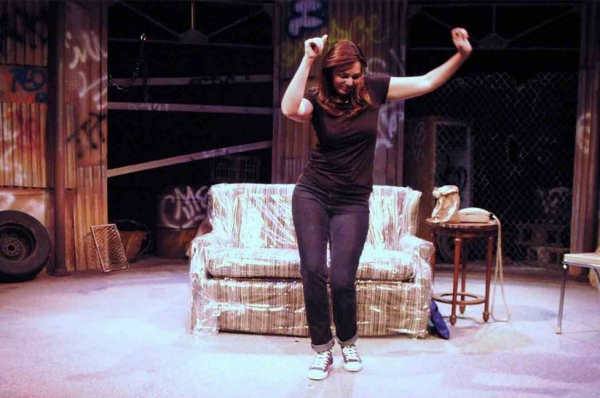
The Fiasco Theater shows that there is no such thing as too much Into the Woods in its utterly delightful, stripped-down version running at the Roundabout’s Laura Pels Theatre through April 12. In the summer of 2012, the Public Theater presented an all-star production (Amy Adams, Denis O’Hare, Donna Murphy, Jessie Mueller) as part of its Shakespeare in the Park season (redubbed Sondheim in the Park for the occasion), and Rob Marshall’s film, with a superstar cast (Meryl Streep, Johnny Depp, Emily Blunt, Chris Pine, et al.), is in theaters now and up for three Oscars. But the Manhattan-based Fiasco company, which was founded by a group of Brown graduates who “believe that it is only when artists are brave enough to risk a fiasco that the possibility exists of creating something special,” have indeed created something special, shining a new light on Stephen Sondheim and James Lapine’s fairy-tale mash-up, which earned ten Tony nominations back in 1988. There are no trees in this new version; instead, Derek McLane’s set consists of piano insides arranged along the sides and top of the stage, with thick, knotted crossed ropes in the back. Chandeliers hang over the actors and the audience as well. There is no orchestra; at the center of the stage, Matt Castle plays a movable piano, and through the course of the evening, other cast members add occasional guitar, French horn, trumpet, calliope, xylophone, bassoon, drums, miniature harp, cowbell, and triangle. All ten cast members are onstage through the whole show, several playing multiple roles; when they are not in the scene, they sit in the background, often looking as gleeful as the audience, taking joy in what is unfolding in front of them.
The Witch (Jennifer Mudge) uses help to scream at Rapunzel (Emily Young) in wonderful adaptation of Sondheim/Lapine favorite (photo by Joan Marcus)
The once-upon-a-time story is about a baker (Ben Steinfeld) and his wife (Jessie Austrian) who learn that they are childless because of a curse placed on his family by a vengeful witch (Jennifer Mudge). To end the curse and have a baby, they must head into the woods and come back with a cow as white as milk, a cape as red as blood, hair as yellow as corn, and a slipper as pure as gold. So off they go, encountering clueless Jack (Patrick Mulryan), who has been sent to market by his mother (Liz Hayes) to sell his beloved bovine (Andy Grotelueschen); Little Red Ridinghood (Emily Young), who is bringing a basket of goodies to her grandmother’s (Claire Karpen) house; Cinderella (Karpen), who wants to go to the prince’s (Noah Brody) festival but is slaving for her wicked stepmother (Hayes) and vicious stepsisters, Lucinda (Brody) and Florinda (Grotelueschen); Rapunzel (Young), who has been imprisoned in a tower by the witch; and a mysterious man (Paul L. Coffey) who knows more than he is letting on. While the first act ends happily, things don’t go nearly so well in the second act, as a giant invades the kingdom, leaving a path of death and destruction in its wake.
The revival, directed by Brody and Steinfeld, has a ball simplifying the diverse elements, using inventive, low-budget stagecraft to maximum effect. Brody and Grotelueschen, as Cinderella’s stepsisters, hold a curtain rod in front of them to show off their “dresses” for the festival, and as a pair of princes they gallop with little horse heads on sticks (which they hand to audience members when they come to a stop). At one point the baker’s wife sits down on the floor in the aisle and peruses a Playbill. And Rapunzel’s castle is actually a ladder that is moved about the stage — and which nearly every actor walks under, tempting fate. There are plenty of sly nods to the audience, knowing glances, and, primarily, big smiles throughout. Oh, and there’s Sondheim’s simply divine songs as well, from “Hello, Little Girl,” “Maybe They’re Magic,” and “Agony” to “Witch’s Lament,” “Any Moment,” and “Last Midnight,” all delivered with an intoxicating glee, with scrumptiously playful orchestrations by Castle and Frank Galgano. But Fiasco, which has previously tackled Twelfth Night, Measure for Measure, and Cymbeline and will be bringing The Two Gentleman of Verona in Washington, DC, this spring, never lose sight of the show’s central theme — that happily ever after comes with a heavy price. But there’s no need to get too serious, as this is one endlessly fun trip back into the woods.