this week in theater

FOREVER

(photo by Joan Marcus)

Dael Orlandersmith shares intimate details of her dysfunctional childhood in FOREVER (photo by Joan Marcus)

New York Theatre Workshop
79 East Fourth St. between Second & Third Aves.
Tuesday – Sunday through May 31, $75
nytw.org

Pulitzer Prize finalist Dael Orlandersmith returns to New York Theatre Workshop with the searing Forever, a harrowing, deeply intimate one-woman show about the severely dysfunctional relationship between a daughter and her alcoholic mother. In the semiautobiographical work, Orlandersmith (Yellowman, Monster, The Gimmick) spends a gripping eighty minutes discussing her artistic influences while looking back at damaging scenes from her past as she walks through Pere Lachaise Cemetery in Paris, paying tribute to Jim Morrison, Edith Piaf, Richard Wright, and other writers and musicians who helped her survive a brutal childhood in Harlem. “All of us have come / All of us who are seeking / have come to be with these people here in Pere Lachaise — who beyond our parents helped us give birth to ourselves,” she says. Statuesque and elegant in a long black dress, her braided hair falling over her shoulders and reaching toward her hips, she recalls a broken friendship with a local tomboy, being beaten by her mother over math homework, and how she felt when her mother tells her she is “fat / hateful / disgusting.” She shares her physical and psychological pain with the audience, making direct, lingering eye contact that is both soothing and uncomfortable. “I can’t believe I still can feel her slap. She’s been gone / dead / over twenty years but I can still see / feel / hear her laughing,” she says. Orlandersmith tells the story with a lyrical, poetic rhythm that is captivating and unique. She describes her Caesarian birth thusly: “October 29, 1959 / I was torn from blood/guts/water / Spanked into consciousness / Spanked into living.” Later she adds, “A scar I made a long time ago coming through you / I stare at it / Wondering how I could have been born from it / How I could have been born from you.”

(photo by Joan Marcus)

Dael Orlandersmith’s tale of her relationship with her mother is both harrowing and uplifting (photo by Joan Marcus)

About midway through Forever, which is calmly directed by Neel Keller, with excellent lighting by Mary Louise Geiger and sound by Adam Phalen, Orlandersmith relates a long, agonizing episode from her childhood in nerve-racking detail, one of the most powerful and frightening things you’re ever likely to experience from a show; it’s difficult to watch, but you won’t be able to avert your eyes from hers, finalizing an unbreakable bond between performer and audience that will stay with you long after you leave the theater. Ultimately, she tries to find closure as she revisits her mother’s death. Forever is both heartbreaking and uplifting, a shocking, poetic exploration of family, memory, and the ties that bind; it was particularly poignant the night we saw it, on the eve of Mother’s Day. Before and after the show, people are invited to write their own tributes to those they’ve lost on notecards they can tape to the long, narrow bulletin boards lining the side walls, and following the show, attendees can walk around Takeshi Kata’s central staging area and check out dozens of Orlandersmith’s family photographs on similar boards around the set. The notecards and photographs are a brilliant touch, a physical evocation of how the past embraces and surrounds both the audience and the performer’s emotional experience, providing yet more intimacy and reminding you of your own relationships. (The May 20 show will be followed by a discussion with photographers James and Karla Murray and NYU adjunct professor Cynthia Copeland, moderated by Alexander Santiago-Jirau, who will also lead a Shop Talk after the May 27 show.)

THEATRE FOR ONE: I’M NOT THE STRANGER YOU THINK I AM

Christine Jones’s mobile Theatre for One will present short plays by major playwrights in three locations May 18 - June 6 (photo by twi-ny/mdr)

Christine Jones’s mobile Theatre for One will present short plays by major playwrights in three locations May 18 – June 6 (photo by twi-ny/mdr)

Winter Garden at Brookfield Place, Zuccotti Park, Grace Building
May 18 – June 6, free, 12 noon – 7:00 pm
www.artsbrookfield.com
www.theatreforone.com

Theater can be an intimate experience, and it doesn’t get much more intimate than Christine Jones’s Theatre for One, which is exactly that: performances by one actor for one audience member at a time, inside a mobile four-by-eight-foot theater. TFO will feature new five-minute works by award-winning playwrights Craig Lucas (Prelude to a Kiss), Will Eno (The Realistic Joneses), Lynn Nottage (Ruined), José Rivera (Marisol), Thomas Bradshaw (Intimacy), Zayd Dohrn (Sick), and Emily Schwend (Take Me Back). The mobile theater is a collaboration between the architecture firm LO-TEK and the Tony-nominated Jones, who has designed the sets for such shows as Spring Awakening, American Idiot, and Coraline and is the director of the current immersive hit Queen of the Night. The short plays, which together are being called I’m Not the Stranger You Think I Am, will be performed by six actors and are directed by Jones, Rivera, Jenny Koons, and Brian Mertes; the mobile theater will be at the Winter Garden at Brookfield Place May 18-24; Zuccotti Park May 27-31; and the Grace Building June 2-6. Admission is first come, first served, and free, with each person able to see one of the plays, between 12 noon and 7:00 pm.

A QUEEN FOR A DAY

(photo by Russ Rowland)

Brothers Pasquale (Vincent Pastore) and Nino (David Proval) are set against each other in mob drama (photo by Russ Rowland)

Theatre at St. Clement’s
423 West 46th St. between Ninth & Tenth Aves.
Thursday – Tuesday through July 26, $49-$99
aqueenforadayplay.com

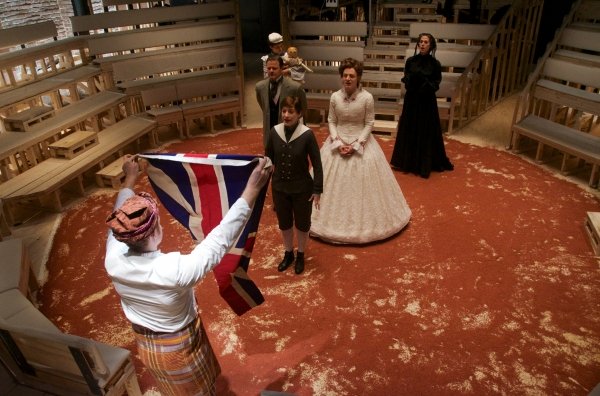
I have to admit that I’m a little hesitant to share my true thoughts about the new mob drama, A Queen for a Day, for fear of, well, unpleasant reprisals like being whacked, as the cast includes three Sopranos veterans. In the play, which was written by lawyer and film and theater producer Michael Ricigliano Jr. (Lily of the Feast) and directed by John Gould Rubin (Hedda Gabler, The Predators’ Ball), there’s a whole lot of unnecessary shouting, the dialogue is choppy, the plot is overcooked, the acting is inconsistent, and the direction is leaden. That said, the audience, highlighted by some loud cheerleading by a well-known Italian American actor, loved it, rising to their feet in unison at the end. Maybe they know what’s good for them. As part of a massive organized crime sweep, made man Giovanni “Nino” Cinquimani (David “Richie Aprile” Proval) and his Jewish lawyer, Sanford Weiss (David Deblinger), are in a Jersey warehouse, secretly meeting with Patricia Cole (Portia), a Fed who is offering Nino a proffer agreement, an arrangement known as “Queen for a Day,” in which he spills his guts on the spot, and the government decides whether the information is valuable enough to grant him immunity and witness protection in exchange for further testimony — or sends him back out on the streets to take his chances. “You see, Nino, if I put you on the stand, it’s warts and all,” Patricia tells him, “and I won’t have any surprises. I’m not naive, so if you hold back from me, we’re done! You understand! No immunity, no plea deals, and you get to roll the dice with the rest of your goombahs. It’s now or never.” But Nino’s caught in quite a pickle, as the man she wants him to give up is his younger brother, mob boss Pasquale Cinquimani (Vincent “Big Pussy” Pastore). The title of the play not only pertains to the proffer agreement but also to the popular mid-twentieth-century television game show in which people shared their woes with America, hoping to win prizes, as well as slyly referencing a ridiculous plot twist. (A second, major turn of events works very well, but it’s one of the only things that does.) Over the course of ninety minutes, the characters discuss respect across two kinds of family — from mothers, fathers, brothers, and lovers to capos, made men, and rats — but the two parts never come together in a satisfying way, resulting in a rather abrupt and confusing conclusion. There, I said it. I spilled my guts. I hope I’m not outfitted soon with a pair of concrete shoes.

THE PAINTED ROCKS AT REVOLVER CREEK

(photo by Joan Marcus)

Leon Addison Brown and Caleb McLaughlin star in what might be Athol Fugard’s final play (photo by Joan Marcus)

The Pershing Square Signature Center
The Romulus Linney Courtyard Theatre
480 West 42nd St. between Tenth & Eleventh Aves.
Tuesday – Sunday through June 7, $25-$65
212-244-7529
www.signaturetheatre.org

In 2011, South African writer-director Athol Fugard won a Tony Award for lifetime achievement the day after his seventy-ninth birthday, but that hasn’t slowed down the now-eighty-three-year-old man responsible for such important plays as Sizwe Bansi Is Dead and “Master Harold” . . . and the Boys. The next year he was the Signature Theatre’s playwright-in-residence, presenting stirring revivals of Blood Knot and My Children! My Africa! as well as the New York debut of The Train Driver. He is now back at the Signature with the world premiere of The Painted Rocks at Revolver Creek, a potent tale of apartheid and its effects on three people that distills right to the core the policy of racial segregation that dominated South Africa for nearly fifty years, and its legacy today. Inspired by real-life outsider artist Nukain Mabusa, who painted flowers on rocks in a stone garden in Revolver Creek for more than a decade, the play takes place in 1981, as an elderly farm laborer (Leon Addison Brown) and his young helper (Caleb McLaughlin) prepare to paint the Big One, an enormous rock on a hill on land owned by Elmarie Kleynhans (Bianca Amato) and her husband, an Afrikaner couple who employ the man, called Tata (“father”) by the boy, known as Bokkie (“small buck”), and Outa (“old father”) by Elmarie, who uses the generic, derisive Afrikaaner terms for them rather than their names. Bokkie is eager for Tata to paint the Big One, but Outa is hesitant. “He is bigger than me. And I know that he is my last one . . . so I am frightened,” Tata says of the inanimate object. “But he is only a rock,” Bokkie explains. “I have got no more flowers in me, Bokkie,” Tata replies. However, soon Bokkie and Tata are painting the rock together, the old man sharing the story of his hard life, passing it on for future generations. “What do you see standing here? Old Man? Just another old kaffer?” he says to the rock, asserting himself for maybe the first time ever. “No, Big One, I am not old man. I am not kaffer. I am MAN.” When the religious Elmarie arrives, she doesn’t understand what Outa has painted and wants him to replace it with something much prettier. “Next Sunday, why don’t you wipe that all away and make it a big flower, your biggest flower . . . to thank the Lord for all his blessings,” she says. The old man is faced with a choice, a decision that will have great impact not only on himself but on his young friend as well.

(photo by Joan Marcus)

Jonathan Sejake (Sahr Ngaujah) and Elmarie Kleynhans (Bianca Amato) argue over the new South Africa in THE PAINTED ROCKS AT REVOLVER CREEK (photo by Joan Marcus)

In the second act, it’s twenty-two years later, and the boy, now a grown teacher (Sahr Ngaujah), returns to Revolver Creek, in a South Africa that has ended apartheid and has a new constitution giving equal rights to blacks. He is met by Elmarie, who does not recognize him at first, holding a gun on him until he explains who he is and tells her why he is there. “So what gives you the right to come here and paint that rock without permission? Let me remind you, this is private property, Bokkie,” she says. “Nobody calls me that anymore, Mrs. Kleynhans. My real name is Jonathan Sejake,” he responds with pride and determination. He also explains that Tata/Outa had a name as well, Nukain Mabusa. Jonathan and Elmarie then engage in a heated verbal battle over the current state of the nation, the way things used to be, and what the future promises, arguing about land ownership, violence, and personal identity. As in the first act, Fugard, who also directed the production, includes long, sharply written monologues that both expand on the characters and serve as a microcosm for the arguments that have plagued South Africa since even before apartheid officially began in 1948. The absorbing dialogue is expertly performed by the outstanding cast, who lend nuance and believability to roles that could have been clichéd and predictable. Christopher H. Barreca’s set features an array of rocks covered in fading painted flowers, centered by the Big One, which embodies the seemingly impenetrable gap that exists between blacks and Afrikaners. Just as Tata and Bokkie gave eyes to the rock, Fugard invites the audience to see the vast intricacies of apartheid rule. He imbues The Painted Rocks at Revolver Creek with a captivating sensitivity, avoiding becoming overly treacly or didactic as the well-drawn, multidimensional characters make their cases. And although the play is specifically about South Africa, it also relates to the racial tensions that have gripped America in Baltimore, Ferguson, and elsewhere. The play is part of the Signature’s Legacy Program, and Fugard has stated that it might be his “farewell to the stage.” If that is indeed true, he has left behind quite a legacy himself, concluding with one of his most softly intelligent, illuminating works.

FIASCO THEATER’S THE TWO GENTLEMEN OF VERONA

(photo by Gerry Goodstein)

Fiasco Theater’s affectionate production of THE TWO GENTLEMEN OF VERONA has been extended at Theatre for a New Audience’s Polonsky Shakespeare Center (photo by Gerry Goodstein)

Theatre for a New Audience, Polonsky Shakespeare Center
262 Ashland Pl. between Lafayette Ave. & Fulton St.
Tuesday – Sunday through June 7, $20-$100
866-811-4111
www.tfana.org
www.fiascotheater.com

The Fiasco Theater continues its mission “to offer dynamic, joyful, actor-driven productions of classic and new plays” with a dynamic, joyful, actor-driven production of what is believed to be Shakespeare’s first play, The Two Gentlemen of Verona. The New York City–based company of Brown graduates, which has previously staged Twelfth Night, Cymbeline, Measure for Measure, and this past season’s utterly delightful, Drama Desk–nominated Into the Woods, has stripped down Shakespeare’s early comedy of letters and loyalty, mistaken identity and misplaced love, many elements of which would be explored more deeply in his future works, to its bare essentials. “Upon delving into it we quickly discovered that Two Gents is not merely a ‘shallow story,’ like those that Valentine mocks in the first scene, but a human and layered play that reveals questions and ideas of surprising depth,” a directors note in the program explains. While that might be a bit of a stretch, Fiasco does reveal Two Gents to be a fun-filled frolic through romantic folly. As the play opens, Valentine (Zachary Fine) is telling his compatriot Proteus (Noah Brody) that he is leaving Verona to court a fair lady. “To Milan let me hear from thee by letters / Of thy success in love, and what news else / Betideth here in absence of thy friend. / And I likewise will visit thee with mine,” Valentine declares. Proteus wishes him well, but because of a mix-up with Valentine’s servant, Speed (Paul L. Coffey), Proteus soon turns away from his true love, Julia (codirector Jessie Austrian), and decides instead to woo Valentine’s intended, Sylvia (Emily Young). But Sylvia’s father, the Duke of Milan (Andy Grotelueschen), favors her wealthy suitor Thurio (Coffey), setting off a three-way fight for her hand. “Sir, if you spend word for word with me, I shall make your wit bankrupt,” Thurio says, to which Valentine retorts, “I know it well, sir. You have an exchequer of words and, I think, no other treasure.” But as Speed has previously told Valentine, “Love is blind,” leading to a frantic conclusion.

(photo by Gerry Goodstein)

Lucetta (Emily Young) and Julia (Jessie Austrian) dream about love in early Shakespeare comedy (photo by Gerry Goodstein)

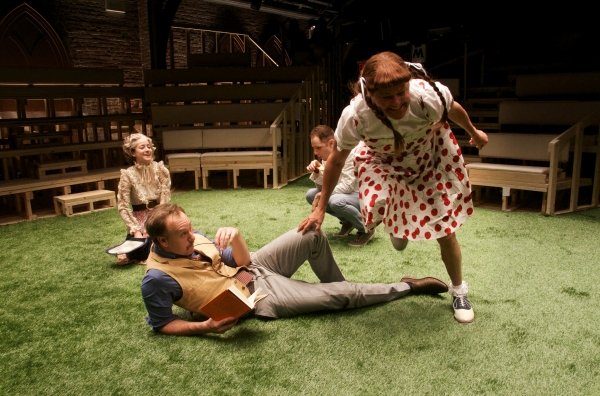
Set designer Derek McLane (Into the Woods, The Heiress) has covered the ceiling, walls, and backdrop with hundreds of crumpled-up handwritten letters; the stage at the Polonsky Shakespeare Center also features two white columns that serve as trees, in addition to benches on either side where the actors sit when not involved in the action (and seem to enjoy everything onstage as much as the crowd does). Regular Fiasco costume designer Whitney Locher has dressed the performers in springtime pastels,1950s-prepster style, the men sporting color-coded saddle-shoe bucks, the women in lacy cap-sleeves. Codirectors Austrian and Ben Steinfeld have the cast speak Shakespeare’s lines in contemporary rhythm, not iambic pentameter, giving it a more intimate feel and quickening the pace. The company is uniformly excellent — a particular treat is Launce’s (Grotelueschen) two monologues with his dog, Crab, played with great humor by Fine wearing a fake nose — singing a few songs and, before the first act and during intermission, mingling with the audience, giving out smiles and hugs. As is Fiasco’s style, the whole production is filled with an intoxicating affection, which works extremely well with one of Shakespeare’s lesser, though plenty charming, comedies. (The May 16 matinee will be followed by a free TFANA Talk with Re-Dressing the Canon: Essays on Theater and Gender author Alisa Solomon and members of the company. And after the May 17 matinee, food historian Francine Segan will host “Shakespeare Primavera,” a Talk & Taste inspired by Shakespeare’s Italian plays, catered by Danny Meyer’s Union Square Events; tickets are $45, or $35 if you attended the show or have a season package.)

AN AMERICAN IN PARIS

(photo © 2015 Matthew Murphy)

AN AMERICAN IN PARIS smells sweet in Broadway premiere (photo by Angela Sterling)

Palace Theatre
1564 Broadway at 47th St.
Tuesday – Sunday through November 22, $57-$147
www.anamericaninparisbroadway.com

Tony nominee and Pulitzer Prize finalist Craig Lucas and Royal Ballet artistic associate Christopher Wheeldon don’t merely translate Vincente Minnelli’s 1951 Oscar-winning film, An American in Paris, to the stage, they transform it. This first-ever theatrical production of the Gershwin musical is set in Paris at the end of WWII, as former GI Jerry Mulligan (New York City Ballet principal dancer Robert Fairchild) decides to stay in France and explore his art — as well as Lise Dassin (Royal Ballet dancer Leanne Cope), a shy young woman who works in a parfumerie but dreams of becoming a ballerina. Jerry soon finds a friend in Adam Hochberg (Brandon Uranowitz), a sarcastic composer and pianist who is training Henri Baurel (Max von Essen) for a cabaret act, a secret Henri keeps from his stern German parents (Veanne Cox and Scott Willis). Meanwhile, wealthy arts patron Milo Davenport (Jill Paice) has taken Jerry under her wing, introducing him to high society — and perhaps into her boudoir. But Jerry has fallen head-over-heels for Lise, who has some secrets of her own — and is also being wooed at the same time by Adam and Henri.

Ballet dancers Robert Fairchild and Leanne Cope dazzle in their Broadway debuts (photo © 2015 Matthew Murphy)

Ballet dancers Robert Fairchild and Leanne Cope dazzle in their Broadway debuts (photo by Marie-Noëlle Robert)

Lucas (Prelude to a Kiss, The Light in the Piazza) has cleverly expanded on Alan Jay Lerner’s original screenplay, not only making Lise a ballerina but adding references to Nazism and anti-Semitism, while Wheeldon (Alice’s Adventures in Wonderland, The Winter’s Tale) does a spectacular job bringing ballet to Broadway, creating scintillating ballet numbers that are fresh and vibrant. The score, with music by George Gershwin and lyrics by Ira, features such memorable treats as “I Got Rhythm,” “’S Wonderful,” “But Not for Me,” “The Man I Love,” and “They Can’t Take That Away from Me,” in addition to the instrumentals “Concerto in F” and “Second Prelude,” all adapted and arranged beautifully by Rob Fisher. Two of the film’s highlights, the dreamlike “American in Paris” sequence and “I’ll Build a Stairway to Paradise,” get the deluxe treatment, showing off Natasha Katz’s lighting and Bob Crowley’s gorgeous costumes and dazzling sets, which were inspired by Mondrian and the moving mirrors from the film. Fairchild and Cope are excellent in their Broadway debuts, dancing, singing, and acting with equal aplomb. And Lucas even leaves in Lerner’s Oscar Levant joke. Sure, “Fidgety Feet” is frivolous and the discussions of artistic integrity unnecessary, but everything else about An American in Paris on Broadway is, well, magnifique.

SOMETHING ROTTEN!

Thomas Nostradamus (Brad Oscar) predicts a musical future for Nick Bottom in SOMETHING ROTTEN! (photo © 2015 Joan Marcus)

Thomas Nostradamus (Brad Oscar) predicts a musical future for Nick Bottom (Brian d’Arcy James) in SOMETHING ROTTEN! (photo © 2015 Joan Marcus)

St. James Theatre
246 West 44th St. between Broadway & Eighth Aves.
Tuesday – Sunday through January 3, $37 – $177
rottenbroadway.com

Nearly five hundred years after William Shakespeare’s death, the author is still challenging modern dramatists around the world for theater space while influencing story lines and inspiring alternate takes on his thirty-six works. In their first stage production, brothers Karey and Wayne Kirkpatrick anachronistically take audiences back to the Renaissance in Something Rotten!, a rousing musical farce that pays tribute to the Bard and Broadway by playfully skewering both. Two-time Tony nominee Brian d’Arcy James stars as Nick Bottom, who runs a local theater troupe with his brother, Nigel (John Cariani), that can’t escape Shakespeare’s (Christian Borle) shadow. Desperate to beat the Bard at his own game — and determined to show his feminist wife, Bea (Heidi Blickenstaff), that he can be the family’s main breadwinner — Nick takes advice from a vagrant soothsayer named Thomas Nostradamus (Brad Oscar), leading him to attempt the first-ever full-fledged musical, Omelette. But Nigel wants to write something more meaningful than a show about breakfast, while also becoming interested in Portia (Kate Reinders), the chaste daughter of Puritan leader Brother Jeremiah (Brooks Ashmanskas). Meanwhile, Shakespeare prances about like a rock star, prepared to take on all comers to his literary throne, ready, willing, and able to do whatever it takes to preserve his lofty status. “Yo! — He’s the bomb, the soul of the age / The wiz of the Elizabethan stage,” the crowd sings about Shakespeare in the opening number, “Welcome to the Renaissance,” continuing, “He’s incredible, unforgettable / He’s just so freakin’ awesome!”

Shakespeare (Christian Borle) rocks out to his adoring fans in the park in SOMETHING ROTTEN! (Christian Borle)

Shakespeare (Christian Borle) rocks out to his adoring fans in the park in SOMETHING ROTTEN! (photo © 2015 Joan Marcus)

Karey, who cowrote the book with British novelist and script writer John O’Farrell (the two previously collaborated on the hit animated film Chicken Run), and Wayne, with whom Karey cowrote the music and lyrics, fill Something Rotten! with an endless array of references to Shakespeare and the Great White Way, from direct quotes, character names, and Gregg Barnes’s (Follies, The Drowsy Chaperone) costumes to Scott Pask’s (The Book of Mormon, The Coast of Utopia) high-school-like painted-cardboard sets and director Casey Nicholaw’s (The Book of Mormon, Spamalot) choreography. Part of the fun of Something Rotten! is trying to recognize all the references (be on the lookout for homages to Jesus Christ Superstar, Chicago, A Chorus Line, The Lion King, Hair, The Book of Mormon, The Producers, Gypsy, and countless others), which also saves you from not getting too caught up in the silly plot twists and several of the numbers that are precisely what is being made fun of. “Who talks like this?” Nick asks, referring to Shakespeare’s use of Olde English and iambic pentameter. “Nigel, why can’t we just write like we speak?” Among the most effective production numbers are “God, I Hate Shakespeare,” led by Nick and Nigel (Nick: “That little turd, he / has no sense about the audience / He makes them feel so dumb / The bastard doesn’t care / that my poor ass is getting numb”) and Nick and Nostradamus’s “A Musical” (Nick: “Well, that is the stupidest thing that I have ever heard / You’re doing a play, got something to say / so you sing it? It’s absurd / Who on earth is going to sit there / while an actor breaks into song / What possible thought can the audience think / other than this is horribly — wrong?”), while “Right Hand Man” is standard fluff, and “Will Power” and “Hard to Be the Bard” are overplayed and repetitive. But it’s all still great fun, with particularly fine turns by d’Arcy James (Shrek the Musical, Sweet Smell of Success), the Kristen Chenoweth-like Reinders (Wicked, Into the Woods), and Ashmanskas (Bullets over Broadway, Present Laughter), but Oscar (The Producers, Spamalot) steals the show as the clairvoyant bum who sums up what a musical is quite succinctly: “It appears to be a play where the dialogue stops and the plot is conveyed through song.” And in this case, it’s a celebration of the art form that will leave you giddy with delight, whether you are a lover or hater of Shakespeare — and Broadway musicals.