this week in theater

ANT HAMPTON: THE EXTRA PEOPLE

THE EXTRA PEOPLE

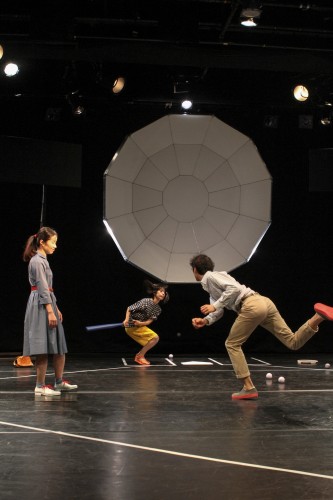
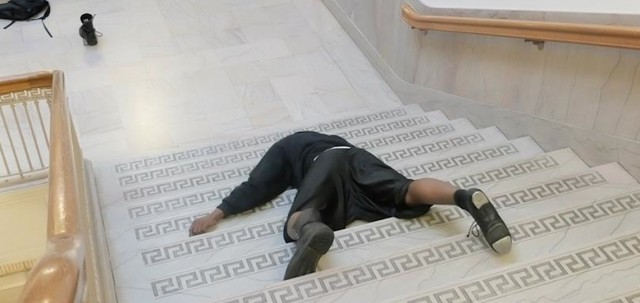
The audience takes center stage in Ant Hampton’s THE EXTRA PEOPLE

CROSSING THE LINE
French Institute Alliance Française
Florence Gould Hall, 55 East 59th St. between Madison & Park Aves.
Friday, September 25, and Saturday, September 26, $25
Festival continues through October 4
212-355-6160
www.fiaf.org
www.anthampton.com

Swiss-born British multidisciplinary artist Ant Hampton specializes in creating hard-to-categorize immersive performance installations that take place outside of the usual dynamic between performer and audience, making the latter an active participant in the production. Since 2007, Hampton has been presenting his Autoteatro series, works in which audience members and unrehearsed guest performers are given instructions and act out the pieces themselves. For Etiquette, two people sat across from each other in a public space and followed what they were told to do via headphones. For Hello for Dummies, pairs of strangers were sent to sit and interact on outdoor benches. Hampton’s latest work is The Extra People, premiering at FIAF’s Crossing the Line festival. The site-specific piece will take place in Florence Gould Hall, with fifteen audience members onstage and another fifteen sitting in seats. Each person will have a flashlight, a neon vest, and headphones, which will instruct them what to do and where to go. Hampton’s website advises to “avoid eye contact” and explains that “the overall picture is out of your reach: too big, beyond your comprehension, or simply not your job to know. . . . In a challenge to the assumption (often taken for granted) that collectivity is what you find in the theater, the building here reflects society rather differently, with its audience situated as atomized individuals adrift or even asleep among both seating and stage, plugged into their own audio streams, patiently awaiting their call, and eventually acting upon it.” Some of the slots are already sold out, so act fast if you want to have a rather unusual experience in a theatrical setting.

CROSSING THE LINE: CHAMBRE

(photo by Julieta Cervantes)

Jack Ferver reimagines Jean Genet’s THE MAIDS in performance installation at the New Museum (photo by Julieta Cervantes)

New Museum Theater
235 Bowery at Prince St.
Installation: September 23 – October 4
Performances: September 24-25, October 1-2, 7:00, and September 26-27, October 3-4, 3:00, $15
www.fiaf.org
www.jackferver.org

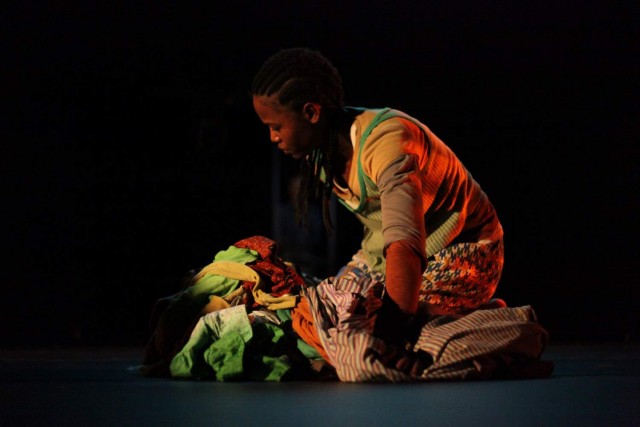
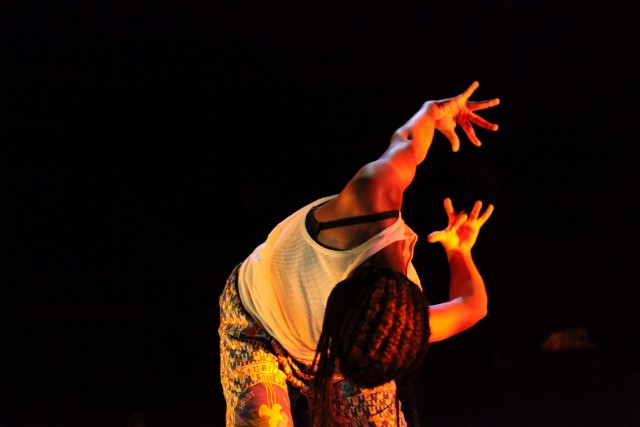
No one tells a story quite like Jack Ferver. In such deeply personal psychodramas as Rumble Ghost, Night Light Bright Light, and Two Alike, the Wisconsin-born, New York-based performer shares intimate, cathartic memories brought to life through a loving pop-culture lens. Melding dance, spoken word, electronic sound scores, and visual art, Ferver explores suicide, abused queer youth, rape, and other serious topics while incorporating references to Tennessee Williams, Poltergeist, Fred Herko, Cleopatra, Madonna, and the 1985 cult film Return to Oz. In Chambre, which runs September 24 to October 4 at the New Museum as part of FIAF’s Crossing the Line festival, Ferver turns to Jean Genet’s The Maids, the 1947 play inspired by a pair of real-life sisters, Christine and Léa Papin, who committed a horrific crime in France in 1933. For the project, which includes eight live performances, Ferver is working with several of his longtime collaborators; the music is composed by Roarke Menzies, the costumes are designed by Reid Bartelme, the art installation (which is on view during museum hours throughout the show’s run) is by Marc Swanson, and Ferver will be joined onstage by Michelle Mola and Jacob Slominski.

Jack Ferver and Marc Swanson will present CHAMBRE as part of FIAFs annual Crossing the Line festival (photo by Julieta Cervantes)

Jack Ferver and longtime collaborators will present CHAMBRE as part of FIAF’s annual Crossing the Line festival (photo by Julieta Cervantes)

“While I’ve been mulling over the material for Chambre for years, we started our first residency at Baryshnikov [Arts Center] two years ago this month. It’s been exciting, to say the least, for me to see how much it has changed,” Ferver told twi-ny about the evolution of the show. “This iteration of Chambre at the New Museum is very different from our premiere at Bard [last year]. The context of the museum obviously has factored into it. Marc and I also originally envisioned it for the white cube. The space is more intimate than where we have performed it so far. Marc’s installation becomes a room in a room, and it is changing the performance, creating a more nuanced, vulnerable, and frightening experience for me. Michelle, Jacob, and I have already started rehearsing in the space. The script and choreography are changing as the psyche of the piece changes in the space of the New Museum.” Menzies added, “The evolution of the score for this work was interesting. I wrote maybe three separate scores before arriving at the final version. A lot of the first music cues I created really capitalized on the notion that this is a murder story. Originally, the main theme had this very suspenseful beat and dark, brooding piano melodies — very campy, and very much in the language of Friday the 13th or Halloween, which has one of the great horror scores in cinema. But I think I ended up scrapping all of those references in lieu of much more raw, uncomfortable, barely recognizable sounds that I created by manipulating and contorting recordings of my voice. As we got to the core of the work, it became clear that the real source of the horror in this piece isn’t the murder but the horror of being embodied, the horror of having to live in this cruel, terrible world. All we really have to escape that horror are the endless games we play.” Sounds like classic Jack Ferver to us, so we can’t wait to catch this highly anticipated New York City premiere.

HAMLET IN BED

(photo by Tristan Fuge)

Michael Laurence and Annette O’Toole play actors rehearsing HAMLET at the Rattlestick (photo by Tristan Fuge)

Rattlestick Playwrights Theater
224 Waverly Pl. between Eleventh & Perry Sts.
Wednesday – Monday through October 25, $35
866-811-4111
www.rattlestick.org

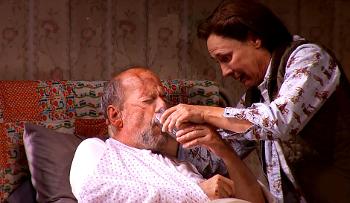
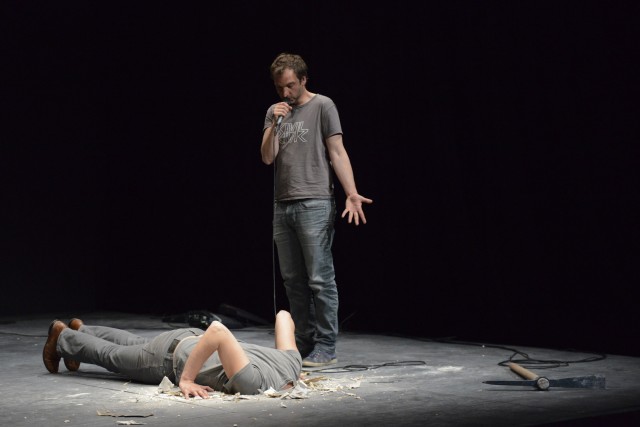
For several decades, people have been adding the phrase “in bed” at the end of fortune-cookie predictions to come up with playful sexual innuendos. But writer and actor Michael Laurence takes it a lot deeper by adding the two words to what he considers the greatest work in the English language. At the beginning of Hamlet in Bed, making its world premiere at the Rattlestick, Laurence stands in the middle of a spare stage, talking into a microphone like a confessional stand-up comic. “Here’s the plot; let’s get that out of the way. OK, not the plot, but the premise: An actor and an actress perform a play. (It’s a play within a play.) The actor and the actress may or may not be mother and son, and they may or may not know it. You know the play, the play is Shakespeare’s Hamlet. Yes, that mother and son.” Laurence gives himself three plum roles: his (apparently) real self, an actor who has written Hamlet in Bed; a fictionalized version of himself, an unemployed actor who thinks he might have found his birth mother; and the great Dane of literary legend. Obsessed with Hamlet — he arrives onstage holding a skull as if it’s Linus’s blanket, like he cannot exist without it — Laurence tells a story in flashback of how he purchased a nearly forty-year-old diary of Anna May Miller (Annette O’Toole), an actress who was playing Ophelia in a New York City production of Hamlet. She discusses getting pregnant by the man playing Hamlet and giving the baby up for adoption, and giving up acting as well. Laurence thinks that child might be him, so he tracks down the woman, now a lonely barfly living in a seedy rent-controlled apartment, and pretends that he’s staging a unique version of Hamlet — taking place mostly in bed — and wants her to audition for the role of Gertrude. He believes that if they play a fictional mother and son, he can determine if he really is her child. As they delve into rehearsal, Laurence keeps dropping hints about their possible relationship while the sexual tension between them grows, adding possible incest to the already complicated, multilayered mix.

Annette OToole is mesmerizing as woman trying to escape her past in HAMLET IN BED (photo by Tristan Fuge)

Annette O’Toole is mesmerizing as a woman trying to escape her past in HAMLET IN BED (photo by Tristan Fuge)

Hamlet in Bed is overly self-aggrandizing, self-conscious, self-referential, and self-satisfied — yet it’s also compelling and gripping for most of its ninety minutes. Laurence (The Few, Krapp, 39) and O’Toole (Cat People, Smile) take turns at microphones giving long, intimate soliloquies about their failed lives (he talks about not being able to fix the flusher on his toilet; she details yet another late-night pickup), but it’s their scenes together that are fired by an intense chemistry. Rachel Hauck’s set consists of a couple of microphones, a ratty mattress, and a scrim on which Dave Tennent projects occasional words and images that give the proceedings a noir feel. Directed by Lisa Peterson (An Iliad, Shipwrecked), the play is often too stagnant, but Laurence and O’Toole are a pleasure to watch, he appropriately edgy and nervous, she much harder to decipher, at times seeming to turn into her nineteen-year-old self. “I have this thing,” Laurence says at the start. “I think I am Hamlet and Hamlet is me. . . . Most of all, I want to do that scene with Hamlet’s mother, the queen.” By writing and starring in Hamlet in Bed, he allows himself to do just that; but fortunately, what could have come off like a vanity project is much more. After all, as Hamlet and Laurence both say, “The play’s the thing.”

THEATER & CINEMA: VENUS IN FUR

VENUS IN FUR

The relationship between actor and director becomes an intense psychosexual battle in Roman Polanski’s VENUS IN FUR

CINÉSALON: VENUS IN FUR (LA VÉNUS À LA FOURRURE) (Roman Polanski, 2013)
French Institute Alliance Française, Florence Gould Hall
55 East 59th St. between Madison & Park Aves.
Tuesday, September 22, $14, 4:00 & 7:30 (later screening with David Ives Q&A)
212-355-6100
www.fiaf.org
www.ifcfilms.com

For his third stage adaptation in ten years, following 1994’s Death and the Maiden and 2011’s Carnage, Roman Polanski created a marvelous, multilayered examination of the intricate nature of storytelling, consumed with aspects of doubling. David Ives’s Tony-nominated play, Venus in Fur, is about a cynical theater director, Thomas Novachek, who is auditioning actresses for the lead in his next production, a theatrical version of Leopold von Sacher-Masoch’s psychosexual novella Venus in Furs (which led to the term “sado-masochism”), itself a man’s retelling of his enslavement by a woman. In the film, as he is packing up and about to head home, Thomas (Matthieu Amalric) is interrupted by Vanda (Emmanuelle Seigner), a tall blond who at first appears ditzy and unprepared, practically begging him to let her audition even though she isn’t on the casting sheet, then slowly taking charge as she reveals an intimate knowledge not only of his script but of stagecraft as well. An at-first flummoxed Thomas becomes more and more intrigued as Vanda performs the role of Wanda von Dunayev and he reads the part of Severin von Kushemski, their actor-director relationship intertwining with that of the characters’ dangerous and erotic attraction.

Roman Polanski directs wife Emmanuelle Seigner in thrilling stage adaptation of Tony-winning play

Roman Polanski directs wife Emmanuelle Seigner in thrilling stage adaptation of Tony-nominated play

Ives’s English-language play, which earned Nina Arianda a Tony for Best Actress, was set in an office, but Polanski, who cowrote the screenplay with Ives, has moved this French version to an old theater (the Théâtre Récamier in Paris, rebuilt by designer Jean Rabasse) where a musical production of John Ford’s Stagecoach has recently taken place, with some of the props still onstage, including a rather phallic (and prickly) cactus. Polanski has masterfully used the machinations of cinema to expand on the play while also remaining true to its single setting. One of the world’s finest actors, Amalric, who looks more than a little like a younger Polanski, is spectacular as the pretentious Thomas, his expression-filled eyes and herky-jerky motion defining the evolution of his character’s fascination with Vanda, while Seigner, who is Polanski’s wife, is a dynamo of breathless erotic power and energy, seamlessly weaving in and out of different aspects of Vanda. Venus in Fur was shot in chronological order with one camera by cinematographer Paweł Edelman, who photographed Polanski’s previous five feature films, making it feel like the viewer is onstage, experiencing the events in real time. Alexandre Desplat’s complex, gorgeous score is a character unto itself, beginning with the outdoor establishing shot of the theater. The film also contains elements that recall such previous Polanski works as The Tenant, Bitter Moon, Tess, and The Fearless Vampire Killers, placing it firmly within his impressive canon. Polanski was handed Ives’s script at Cannes in 2012, and this screen version was then shown at Cannes for the 2013 festival, a whirlwind production that is echoed in Seigner’s performance. Venus in Fur kicks off the CinéSalon series “Theater & Cinema” on September 22, with Ives on hand for a Q&A moderated by Nicholas Elliott following the 7:30 screening. The Tuesday festival continues through October 27 with such other stage-related dramas as Jacques Rivette’s Va Savoir, Olivier Assayas’s Clouds of Sils Maria, Arnaud Desplechin’s Esther Kahn, Abdellatif Kechiche’s Games of Love and Chance, and François Truffaut’s The Last Metro. But FIAF is only getting started with Amalric, who will be the subject of a six-week retrospective in November and December; he’ll be in Florence Gould Hall for a Q&A with costar Stéphanie Cléau following the 7:30 screening of The Blue Room on November 3, then will perform in writer-director Cléau’s stage production of Le Moral des Ménages with Anne-Laure Tondu at FIAF on November 4-5.

ISOLDE

(photo by Gerry Goodstein)

Massimo (Gary Wilmes), Patrick (Jim Fletcher), and Isolde (Tory Vazquez) discuss function and beauty, love and memory in splendidly constructed Richard Maxwell play (photo by Gerry Goodstein)

Theatre for a New Audience, Polonsky Shakespeare Center
262 Ashland Pl. between Lafayette Ave. & Fulton St.
Tuesday – Sunday through September 27, $55-$100
866-811-4111
www.tfana.org

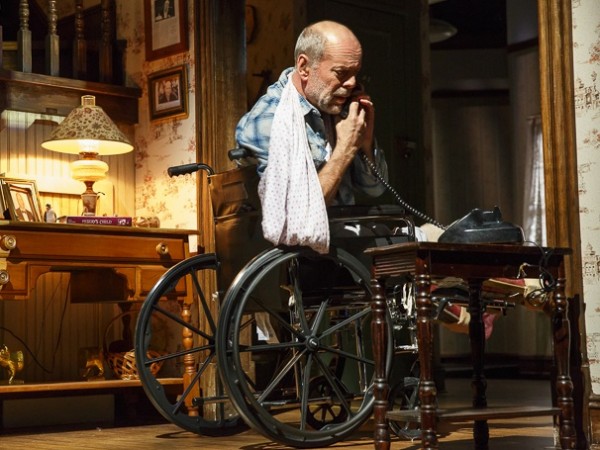
Writer-director Richard Maxwell uses the construction of a Jungian dream house as a sharp metaphor for the building of a play in his latest experimental work, Isolde. Hyperrealism, surrealism, psychobabble, inside jokes, and the occasional cliché combine to form a grounded though existential narrative that has a lot to say about life, love, and the theater. As the play begins, Isolde (Tory Vazquez), a popular actress, is running lines with her husband, Patrick (Jim Fletcher), a successful contractor. She is rehearsing for a role in a play based on the legend of Tristan and Isolde, but she gets frustrated when she keeps losing her place. “Should we start from the top?” Patrick says? “No, no! I can get it,” she replies. “OK. . . . Um. Isolde. To get the line . . . Did you ever just try saying what you feel?” Patrick asks. He’s worried about her mental health, but she’s concerned about a lot more than that. “It’s getting worse!” she declares. Her career might be in jeopardy, but she is energized by Massimo (Gary Wilmes), the “artist architect” she has hired to design their latest vacation house. Massimo’s method involves getting to know his clients very well before deciding what to build, which in this case includes growing a little too close to Isolde. They discuss function and beauty, home and memory, while Patrick, a practical realist, becomes more and more concerned that Massimo, a poetic fantasist, isn’t really doing anything, so he brings in his friend Uncle Jerry (Brian Mendes), a gruff construction worker, for his opinion. Massimo and Uncle Jerry lock horns almost instantly, their differing styles at odds. As the three men watch football and bicker among themselves, Isolde gets right to the point. “Imagine knowing something is missing and not knowing what that is. That dresser, that doorway. That tree, that face. That thought. The panic of it not being there,” she tells Massimo with Shakespearean grace. “Wait till you see it gone and the terror of one day not even knowing that it’s gone — how do you mourn that which you cannot recall? You’re only left with the ghost of some longing, a deadened sensation of the void. How subtle is the gift of memory? How precious?”

(photo by Gerry Goodstein)

Massimo (Gary Wilmes) and Patrick (Jim Fletcher) both have their hands full in ISOLDE (photo by Gerry Goodstein)

Isolde takes place on Sacha Van Riel’s somewhat spare set, with exposed, movable plywood walls and a far-off image of the lake they are building near, as if the play’s setting is as unfinished as Massimo’s design. There are numerous bits of dialogue that refer to the making of theater as much as the construction of a house. “Where is the flow? Should you have two stories?” Massimo asks. “This is my cue?” Patrick says, adding, “Can we see a budget?” Maxwell also takes a wry stab at how he perhaps has been perceived as an avant-garde theater director, as Massimo explains: “People often get the wrong impression about me. They think I’m this laid back guy and I am but that doesn’t mean I don’t know what I’m doing. The truth is some of my ideas are not always embraced. And I’ll be the first to tell you I come across as arrogant, but I see my peers bumble through the orthodoxy of architecture and I want to be impressed with their work but I’m not impressed.” Fletcher (House of Dance, And That’s How the Rent Gets Paid), Vazquez (People without History, Wrestling Ladies), and Wilmes (Chinglish, Straight White Men) are joys to watch, so at ease with one another; veterans of Maxwell’s New York City Players company, they also portrayed characters immersed in a love triangle in Gatz, Elevator Repair Service’s eight-hour adaptation of Fitzgerald’s The Great Gatsby. To further the various meta surrounding the multilayered show, Maxwell is married to Vazquez and went to high school with Wilmes. As with nearly all of Maxwell’s productions (Neutral Hero, House, The Evening), the terrific actors — including Mendes, who offers a refreshing honesty and bluntness as Uncle Jerry — recite their often abstruse, disconnected dialogue plainly and directly, without overt emotion, almost robotic at times, although their performances are filled with passion. Artists of many disciplines are often compared to architects, and, of course, vice versa; in the eighty-five-minute Isolde, at Theatre for a New Audience’s Polonsky Shakespeare Center in Fort Greene through September 27, Maxwell lifts the concept to a whole new level, or should we say story. “Function is beauty; it takes us out of the past, answers the future,” Isolde says to Massimo early on. “Don’t erect a monument just to hold on to something.” In Maxwell’s world, function is indeed beauty, and he builds works that are much more than mere monuments.

AUTUMN MOON FESTIVAL AND MORE

autumn moon festival

A CELEBRATION OF ASIAN CULTURE
Snug Harbor Cultural Center & Botanical Garden
1000 Richmond Terrace, Staten Island
Saturday, September 19, $8-$10, 12 noon – 4:00 pm
718-425-3504
snug-harbor.org

On September 19, Staten Island’s beautiful Snug Harbor Cultural Center & Botanical Garden will be hosting its sixteenth annual Autumn Moon Festival, an afternoon of special programs celebrating the Asian harvest. Taking place in the Chinese Scholar’s Garden, the festival will include an arts and crafts family workshop, a performance of Rabbit Days and Dumplings by Elena Moon Park and Friends, traditional music and dance, Asian-inspired food, martial arts and Tai Chi demonstrations, calligraphy lessons, and more. In addition, on Saturday and Sunday, Snug Harbor is holding a party for the grand opening of the Staten Island Museum, with games, live music, crafts, science, food, and more; admission for that is free. And finally, on Saturday at 2:00 and 8:00 and Sunday at 2:00, the Harbor Lights Theater Company will be presenting Rent in the Music Hall ($35-$45); the production continues through October 4.

EMPIRE TRAVEL AGENCY

It all starts out innocent enough in EMPIRE TRAVEL AGENCY — or does it? (photo by Mitch Dean)

It all starts out innocent enough in EMPIRE TRAVEL AGENCY — or does it? (photo by Mitch Dean)

Financial District, Lower Manhattan
Through September 26, free
www.empiretravelagency.com

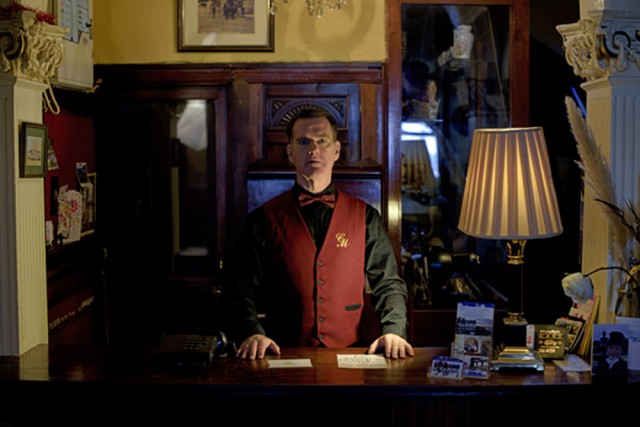
To say too much about Woodshed Collective’s marvelously inventive Empire Travel Agency would ruin the endless surprises that make this wholly immersive production the most engaging trip of the season. Yet it is difficult not to want to share at least some of the chills and thrills that occur over the course of two and a half intense and involving hours. Six nights a week at thirty-minute intervals, four lucky individuals in four separate groups go on a wild journey through the dark passageways of Lower Manhattan, caught up in the middle of a dangerous battle over a mysterious substance. It all begins with a call at a pay phone — yes, a few of them still work — and then you are led from narrow streets through public plazas, private galleries, cars, the subway, and more. Be prepared to do plenty of walking, and climbing up and down a lot of stairs, as you get serenaded by the Avant Guardsmen, play a few games of Ordo, and meet a series of shady characters, beginning with Dr. Hans Bidity, who welcomes you to the Hidden City Excursion and proudly announces, “The only alliance I feel is to the truth. And secret societies.” From there — well, again, we’ve already said too much. (But just who is Rhonda Cadwallader?)

(photo by Mitch Dean)

A downtown art space is one of the many unusual locations audience members will visit in immersive, participatory show (photo by Mitch Dean)

Empire Travel Agency is no mere gimmicky shtick. It works because, first and foremost, Jason Gray Platt’s (There Was No Time Before the War, Agnosiophobia) script is well laid out and compelling, tackling with intelligence and wry humor such topics as Manhattan real estate, the New York City art market, government conspiracies, and constant surveillance. “Yeah, the animals are cooped up in this little cage, but can you be free in a confined space?” Frank asks. “I say, sure, we’re all livin’ inside some kinda boundary — city, country, planet, whatever, and you can decorate your little dollhouse however you like. Can you be free when you are under observation? No you cannot.” Woodshed artistic director Teddy Bergman (Twelve Ophelias, The Tenant) keeps it all moving at an exciting pace while still allowing for a few breathers as the uniformly excellent large cast (featuring particularly fine performances by Rosalie Lowe, Roger Lirtsman, Nicole Golden, and Phillip Taratula) guides you through some very cool small spaces designed by Gabriel Hainer Evansohn. You really have to let go if you want to enjoy the proceedings to the fullest; you will be touched and jostled, you’ll have to be extremely trusting of strangers, and you’ll be expected to improvise with the actors so you can dig deeper into the intriguing, if wacky, story. Oh, and did we say it’s all free? You will be asked for a five-dollar donation for an early imbibement that also serves as a souvenir, although you won’t need a physical object to help you remember this delirious production that takes adventurous, immersive, participatory theater to a whole new level.