this week in theater

FOOL FOR LOVE

(photo © 2015 Joan Marcus)

Eddie (Sam Rockwell) and May (Nina Arianda) are lovers with quite a past in FOOL FOR LOVE (photo © 2015 Joan Marcus)

Manhattan Theatre Club at the Samuel J. Friedman Theatre
261 West 47th St. between Broadway & Eighth Aves.
Tuesday – Sunday through December 13, $75-$150
foolforlovebroadway.com
www.manhattantheatreclub.com

In the published script for Fool for Love, Sam Shepard explains, “This play is to be performed relentlessly, without a break.” And as with many of Shepard’s plays, it is indeed relentless. In a seedy motel room on the edge of the Mojave Desert, Eddie (Sam Rockwell), a former rodeo cowboy, reclines in a shaky chair against the back wall, while May (Nina Arianda), a tall blonde, is hunched statue-like on the end of the bed, her face covered by her long hair, looking toward the ground. At the front of the stage near the corner, an older man (Gordon Joseph Weiss) sits back in a sturdy chair, hands grasping the armrests like the slick hipster from the Maxell commercials. The Old Man and May remain stock-still as Eddie begins talking and makes his way over to May, showing a slight limp. “I’m not goin’ anywhere. See? I’m right here. I’m not gone,” he tells her, and she eventually reaches out and grabs his leg, holding on for dear life. That sequence sets the stage for this seventy-five-minute one-act play about two people who both attract and repel each other, for reasons that become more clear with a surprise revelation about halfway through. May and Eddie have known each other since high school, and they have been on-and-off lovers ever since. “You’re just guilty. Gutless and guilty,” she says shortly before promising to kill both Eddie and the Countess, a woman he might be seeing. “I’m gonna torture her first, though. Not you. I’m just gonna let you have it. Probably in the midst of a kiss. Right when you think everything’s been healed up. Right in the moment when you’re sure you’ve got me buffaloed. That’s when you’ll die.” The ever-confident Eddie is sure that May will ultimately choose to come away with him, despite May’s claims that she has started a new life, dating a normal man, Martin (Tom Pelphrey). Every once in a while, the Old Man chimes in briefly, like a Greek chorus all by himself. “I wanna show you somethin’. Somethin’ real, okay? Somethin’ actual,” he says to Eddie, referring to a nonexistent picture on the wall. A moment later, after the Old Man has settled back in his chair, once again soundless and immobile, May tells Eddie how much she can’t stand him. “No matter how much I’d like not to hate you, I hate you even more. It grows. I can’t even see you now. All I can see is a picture of you. You and her.” We only see what we want to see, remember what we want to remember, mixing fiction and reality in our memories, much like theater itself. For Eddie and May, there’s one thing they can never forget. “You know we’re connected, May,” Eddie says. “We’ll always be connected. That was decided a long time ago.” To Shepard, destiny is a bitch.

(photo © 2015 Joan Marcus)

The Old Man (Gordon Joseph Weiss) is a Greek chorus unto himself in Broadway debut of Sam Shepard’s Pulitzer-nominated FOOL FOR LOVE (photo © 2015 Joan Marcus)

Nominated for a Pulitzer Prize, Fool for Love is part of the series of plays, including the Family Trilogy, that Shepard wrote between 1978 and 1985, consisting of Curse of the Starving Class, Pulitzer winner Buried Child, Pulitzer nominee True West, and A Lie of the Mind. Partly inspired by his relationship with Jessica Lange, Fool for Love is a treat for actors; previous versions have featured such Eddie-May pairings as Ed Harris and Kathy Baker, Ian Charleson and Julie Walters, Martin Henderson and Juliette Lewis, Bruce Willis and Denise Simone, and, in the 1985 Robert Altman film, Shepard and Kim Basinger (with Harry Dean Stanton as the Old Man and Randy Quaid as Martin). The original 1983 production was directed by Shepard, who includes extremely specific stage cues in his script. For the play’s Broadway debut, Daniel Aukin (Bad Jews, 4,000 Miles) takes the reins. Tony winner Arianda (Venus in Fur, Born Yesterday) and Rockwell (A Behanding in Spokane, Moon) have a fiery energy together, but their back-and-forth rapport gets repetitive, and you can feel the hands of Shepard (and Aukin) manipulating your emotions too much, especially when Rockwell puts his lasso to interesting use, bringing a little S&M into the proceedings. The story bounces between the physical and the metaphysical, occasionally getting caught within both at the same time. Pelphrey (Guiding Light, As the World Turns) plays Martin with just the right amount of cluelessness, and Weiss is terrifically perverse as the Old Man; while the rest of the action is going on, you can’t help but cast glances over at him sitting in the darkness. Shepard is a man’s man, and Fool for Love is very much a masculine tale; May might get in her digs, but Eddie is really calling the shots as he cleans his rifle and swigs tequila straight from the bottle. Love ain’t easy, and destiny is a bitch, Shepard is telling us. Damn straight.

THE GIN GAME

(photo by Joan Marcus)

James Earl Jones and Cicely Tyson reunite onstage in lovely Broadway revival of THE GIN GAME (photo by Joan Marcus)

Golden Theatre
252 West 45th St. between Broadway & Eighth Ave.
Tuesday – Sunday through January 10, $57 – $141
thegingamebroadway.com

Life is like a game of cards in D. L. Coburn’s Pulitzer Prize-winning The Gin Game, back at its original Broadway home, the Golden Theatre, in a lovely revival starring James Earl Jones and Cicely Tyson. But it’s also a whole lot more complicated than that. Weller Martin (Jones) and Fonsia Dorsey (Tyson) have both recently moved into a nursing home to live out their final years. “Is there something wrong with you — if you don’t mind my asking,” Fonsia says. “Oh my, I should say so,” Weller replies. “I have one of the most advanced cases of old age in the history of medical science. The mortality rate’s incredible.” Over numerous games of gin on the ramshackle back porch, Weller, who fancies himself a card sharp, and Fonsia, who claims to not have played in a long time, slowly and carefully reveal details about their lives and their families, none of whom come to visit them. They are two old, lonely people brought together by circumstance; as they play gin, the other residents are inside, taking advantage of more of what the nursing home has to offer. “I don’t understand all this ‘entertainment,’” Weller says. “I’m talking about this constant need to entertain us. Sometimes I get the idea that they feel like if they don’t have a choir up there, or if they don’t have a goddamn magician up there doing tricks or something, then we’re all going to drop dead right in front of their eyes. En masse.” Weller is a big, blustery man whose cynicism and deep-seated anger seep into his card playing, especially when he continues losing games to the God-fearing, slim, and demure Fonsia, who doesn’t take kindly to his language. “You know, I never heard my father say a curse word in his life,” she explains, to which Weller responds, “Obviously you never played gin with him.”

(photo by Joan Marcus)

Weller Martin (James Earl Jones) and Fonsia Dorsey (Cicely Tyson) play cards as a metaphor for life in THE GIN GAME (photo by Joan Marcus)

Coburn’s first play, The Gin Game sums up the whole of two people’s lives in clever, if at times sentimental and overly metaphorical, ways, while avoiding any easy, pat answers. At one point, Weller is not willing to accept that Fonsia’s success is just beginner’s luck. “I didn’t realize there was that much strategy to it,” she says. “There most certainly is. Anyone who tells you that gin is nothing but luck doesn’t know what the game is all about,” he says, referring to life as well. Riccardo Hernandez’s set is littered with broken-down sinks and refrigerators, old walkers and wheelchairs, but Weller and Fonsia are not ready for the garbage heap quite yet. Director Leonard Foglia (On Golden Pond, Master Class) sure-handedly makes a play that is mostly made up of games of cards mesmerizing and exciting, letting his stars do their stuff. (To see the cheat sheet Coburn created so the performers can keep track of the games, go here.) The two actors, who first worked together on Broadway nearly fifty years ago, in Roscoe Lee Browne’s 1966 show A Hand Is on the Gate, are sensational. The eighty-four-year-old Jones (You Can’t Take It with You, Gore Vidal’s The Best Man), who has won two Tonys, three Emmys, a Grammy, and a lifetime achievement Oscar, adds a complex sadness to Weller’s pomposity, his deep, mellifluous voice raising and lowering like a choreographed dance, while the ninety-year-old Tyson (The Trip to Bountiful, Sounder), who has won a Tony and three Emmys along with an Oscar nomination, is utterly charming and delightful as Fonsia, who turns out to be much stronger than she first appears. Both characters, despite their age, do some growing up during the course of the two-hour play, which has been previously performed by such pairs as Hume Cronyn and Jessica Tandy, E. G. Marshall and Maureen Stapleton, and Charles Durning and Julie Harris and won Tonys in 1977 for Best Play and in 1997 for Best Revival. (There is also a 2003 television adaptation starring Dick Van Dyke and Mary Tyler Moore.) The night I saw the show, both Jones and Tyson each had a moment when they accidentally dropped something. As they bent down to pick the items up, you could feel a tension build in the audience, wondering whether the actors would be able to do so without a problem. We should have had no such fears; it appears that there’s almost nothing this dynamic duo can’t accomplish.

SPRING AWAKENING

(photo © 2015 Joan Marcus)

Revival of SPRING AWAKENING combines deaf and hearing actors in ingenious ways (photo © 2015 Joan Marcus)

Brooks Atkinson Theatre
256 West 47th St. between Broadway & Eighth Ave.
Tuesday – Sunday through January 24, $49-$149
877-250-2929
www.springawakeningthemusical.com
www.deafwest.org

America would be in much better shape if every member of Congress went to see Deaf West Theatre’s thrilling revival of Duncan Sheik and Steven Sater’s Spring Awakening. The musical, which won eight Tony Awards in its initial 2006 Broadway run, deals with homosexuality, guns, teen pregnancy, child abuse, suicide, premarital sex, disabilities, masturbation, education, religion, the arts, and more. At its heart, it’s a story about the eternal generation gap, focusing on the miscommunication between adults and children, which is as critical today as it was in 1891, when German author Frank Wedekind wrote the original play on which it’s based. But this time around, director Michael Arden and choreographer Spencer Liff have made the mediocre songs and Shakespeare-does-YA story secondary to a spectacular staging that will take your breath away over and over again. Arden has paired each deaf member of the cast with a hearing actor to speak or sing their lines; both performers use sign language as well, their bodies moving in a very different, very beautiful kind of dance. Sometimes the dual performers are on opposite sides of the stage, and sometimes they follow each other around, as if linked together by an invisible chain. Lines that are not vocalized or signed are projected onto a blackboard or the back wall; cues for the deaf actors consist of physical touches from their hearing doppelganger, musical vibrations, multicolored lighting, offstage closed-captioned monitors, and the use of props, such as the opening of a letter. It all works as seamlessly as in the most heavily choreographed musical, so much so you’re likely to not even realize there’s not much actual dancing in the show, which is somewhat different from Deaf West’s previous Broadway production, 2003’s Big River.

(photo © 2015 Joan Marcus)

Melchior Gabor (Austin P. McKenzie) finds himself in the midst of big trouble in SPRING AWAKENING revival (photo © 2015 Joan Marcus)

The show takes place in 1891 Germany, a time when deaf people were discriminated against and sign language was banned in classrooms. Sandra Mae Frank stars as Wendla Bergmann, an adolescent girl who asks her mother, Frau Bergmann (Camryn Manheim), how babies are made. Frau Bergmann’s fear of telling her daughter the truth sets everything in motion, as parents and teachers battle their children and students, the lack of communication between the young and old serving as the major theme of the play. The bright and charming Melchior Gabor (Austin P. McKenzie) challenges his teacher, Herr Sonnenstich (Patrick Page), over the concept of “critical commentary on textual conjecture,” Moritz Stiefel (Daniel D. Durant) has sexual dreams he doesn’t understand, the geeky Georg (Alex Wyse) has the hots for his piano teacher, and the girls don’t want what happened to the bruised and battered Ilse (Krysta Rodriguez) to happen to Martha (Treshelle Edmond) and cause her to run away too. “When I have children, I’ll let them be free. And they’ll grow strong and tall,” Anna — portrayed by Ali Stroker, the first wheelchair-bound actor to ever play a part on Broadway, even more impressive because it’s a role that doesn’t call for it — says, to which Thea (Amelia Hensley) responds, “Free? But how will we know what to do if our parents don’t tell us?” Only Frau Gabor (Marlee Matlin), Melchior’s mother, is willing to give the kids the freedom to grow. “Surely, you boys are now of an age to decide for yourselves what is good for you and what is not,” she tells her son and Moritz. But Melchior makes their dire situation clear when leading everyone in the showstopper, “Totally Fucked,” declaring, “There’s a moment you know you’re fucked / Not an inch more room to self-destruct.”

The set is like an industrial warehouse, with several metal staircases leading to a second level where the adults often look down on the children, watching them in shame and embarrassment. The impeccable casting features Emmy winner Manheim, who studied sign language in college and used the skill on The Practice; Oscar winner Matlin (Children of a Lesser God), the grand dame of deaf actors, in her Broadway debut; and Page (Casa Valentina, Cyrano de Bergerac), whose deep, booming voice echoes throughout the Brooks Atkinson Theatre, reminding everyone of the power, and bombastic nature, of vocalized speech. As the show opens, Frank, a short brunette, looks into a glassless mirror; on the other side is Katie Boeck, a tall blonde with a guitar, who will follow Frank around for the rest of the show as they portray Wendla as a team, Boeck supplying the voice of the character while also playing music. Their relationship is a beauty to behold, as if every one of us, whether we’re deaf or hearing, has two parts that form our own whole. In a later scene, a deaf actor’s voice partner becomes more than just a talking, singing shadow, making for an unforgettable, magical moment that is what live theater is all about. Wedekind’s stories work amazingly well with music; in addition to Spring Awakening, German composer Alban Berg turned his Lulu plays, Earth Spirit and Pandora’s Box, into the opera Lulu, which is being performed at the Met in November and December in a new production directed by South African multimedia artist William Kentridge. So now, how do we get Congress to see Spring Awakening?

BAM NEXT WAVE FESTIVAL: HELEN LAWRENCE

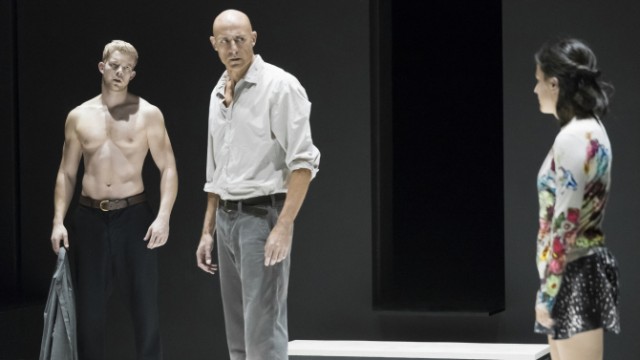
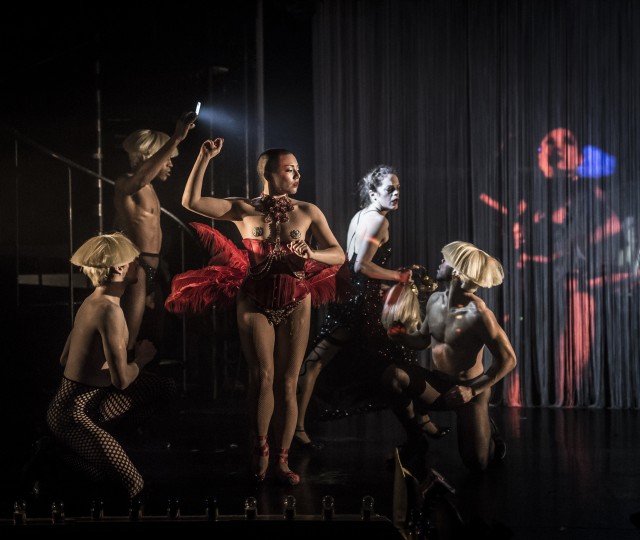
(photo by David Cooper)

HELEN LAWRENCE tells an old-fashioned postwar noir tale using cutting-edge technology (photo by David Cooper)

BAM Howard Gilman Opera House
30 Lafayette Ave. between Ashland Pl. & St. Felix St.
October 14-17, $24-$95, 7:30
718-636-4100
www.bam.org

Photographer and film and video installation artist Stan Douglas and screenwriter Chris Haddock have teamed up for the multimedia theatrical presentation Helen Lawrence, running October 14-17 at BAM’s Howard Gilman Opera House as part of the 2015 Next Wave Festival. Douglas, who won a 2012 ICP Infinity Award for career achievement, and Haddock, the writer and creator of such Canadian television series as Da Vinci’s Inquest and Intelligence, set the post-WWII noir tale in Vancouver, where Douglas was born and is based. He directs a cast of twelve, including Lisa Ryder as the title character, Nicholas Lea as Percy Walker, Crystal Balint as Mary Jackson, and Greg Ellwand as Inspector Leonard Perkins, who interact with green screens, live camera projections, and 3-D computer imagery to give the proceedings a fantastical, surreal element. The set is by Kevin McAllister, with costumes by Nancy Bryant, lighting by Robert Sondergaard, sound by John Gzowski (who plays guitar on the recorded soundtrack), cinematography by Brian Johnson, and video programming by Peter Courtemanche.

TICKET GIVEAWAY: THE HONEYCOMB TRILOGY

THE HONEYCOMB TRILOGY
The Gym at Judson
243 Thompson St. at Washington Square South
October 13 – November 14, $25 for each of three parts
www.gideonth.com
www.judson.org

You can binge-watch a TV series, so why not a play? Mac Rogers’s (Viral, Asymmetric) sci-fi epic, the Honeycomb Trilogy, is back in New York for a return engagement, promising that “it’ll be about 20% more awesome than last time.” The original unfolded in three installments over six months in 2012, but now you can follow the Cooke family battle alien invasion and try to save the human race over the course of a week, or in one day, at the Gym at Judson. Advance Man, which won a New York Innovative Theatre Award for Outstanding Premiere Production, is being performed by itself October 13, 23, and 29 and November 3 and 13, Blast Radius on October 15, 20, and 30 and November 5 and 10, and Sovereign October 16, 22, and 27 and November 6 and 12. But on Saturdays and Sundays during the run, you can catch all three plays back-to-back-to back, at 2:00, 5:00, and 8:30.

TICKET GIVEAWAY: The Honeycomb Trilogy is running October 13 through November 14 at the Gym at Judson, and twi-ny has one pair of tickets to give away for all three shows to one lucky person. Just send your name, phone number, and favorite sci-fi binge-watching experience to contest@twi-ny.com by Wednesday, October 15, at 3:00 to be eligible. All entrants must be twenty-one years of age or older; one winner will be selected at random.

WILLIAM KENTRIDGE IN NEW YORK

William Kentridge invades New York this fall with an opera at the Met, a performance at BAM, and a number of discussions and lectures (photo courtesy the Metropolitan Opera)

William Kentridge invades New York this fall with an opera at the Met, a multimedia performance at BAM, and a number of discussions and lectures (photo courtesy the Metropolitan Opera)

When William Kentridge comes to town, he really comes to town. Back in 2010, the South African multidisciplinary artist was all over New York City, with the smashing “Five Themes” retrospective at MoMA, his production of Shostakovich’s The Nose at the Metropolitan Opera, a unique artist book at Dieu Donné, a screening of some of his animated films accompanied by live music at the World Financial Center, and a performance of his one-man show “I am not me, the horse is not mine” at MoMA. He’s back in the city this fall, with a host of wide-ranging events, exhibits, and performances all over town. On October 12 (free, 7:00), he’ll be giving a lecture, “The Sentimental Machine,” at the New York Studio School of Drawing, Painting & Sculpture. On October 13 ($30, 6:30), he’ll be at the Metropolitan Museum of Art, in conversation with printer Andrew Hoyem in the Grace Rainey Rogers Auditorium discussing the limited-edition letterpress book The Lulu Plays, delving into the nature of human imagination and time. On October 14 (free, 5:00), Kentridge will deliver the Belknap Lecture at Princeton, “O Sentimental Machine,” about his Trotsky-inspired multimedia installation.

From October 22 to 25 ($30-$100), Kentridge teams up with longtime collaborator Philip Miller for the audiovisual chamber opera Refuse the Hour at the BAM Harvey, a wildly inventive lecture-performance with dance, music, projections, and more, a companion piece to his wildly inventive “The Refusal of Time” 2013 installation at the Metropolitan Museum of Art. In conjunction with Refuse the Hour, Kentridge will be at BAM Rose Cinemas on October 24 ($15, 5:00) for a discussion with physicist and Refuse the Hour collaborator Peter Galison, moderated by Dennis Overbye. From November 2 to December 31 (free), the Marian Goodman Gallery will be showing works by Kentridge in the third-floor project room. From November 4 to 8 ($10-$40), The Lulu Plays will be on view at the IFPDA Print Fair at the Park Avenue Armory. And from November 5 through December 3 ($27-$335), there will be eight performances of Kentridge’s four-hour-plus version of Alban Berg’s Lulu at the Met, featuring Marlis Petersen in the title role, Susan Graham as Geschwitz, Paul Groves as the painter and the African prince, and Johan Reuter as Dr. Schön and Jack the Ripper, conducted by Lothar Koenigs. We’re exhausted just reading about all the sixty-year-old Kentridge has planned; we can’t even begin to imagine doing it all, but we’re going to see as many of these events as we can, and we urge you to do the same.

THE NEW MORALITY

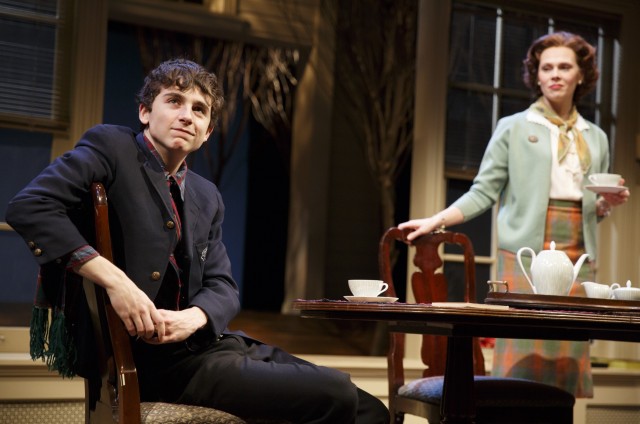
(photo by Richard Termine)

Betty Jones (Brenda Meaney) has a bone to pick with her husband (Michael Frederic) in Mint revival of Harold Chapin’s THE NEW MORALITY (photo by Richard Termine)

Mint Theater
311 West 43rd St. between Eighth & Ninth Aves.
Tuesday – Sunday through October 25, $55-$65 (all seats $43 for the final week; $100 for last show, followed by a farewell party)
866-811-4111
www.minttheater.org

The Mint does the theater world another great service by reviving Harold Chapin’s deliciously delightful comedy of manners, The New Morality. In honor of the centennial of Chapin’s death — the Brooklyn-born British playwright and actor was killed in action in WWI in September 1915 at the age of twenty-nine, before this play was ever produced — Mint artistic director Jonathan Bank has finally brought it to New York for its first theatrical run; it previously played only a handful of matinees way back in 1921. The three-act, nearly two-hour show takes place in 1911 on a houseboat on the Thames, where local socialite Betty Jones (a devilishly vampy Brenda Meaney) has just laced into neighbor Muriel Wister with a loud string of unwomanly insults on a day so hot that the morning milk is going sour almost immediately. Her friend Alice Meynell (Clemmie Evans), a prim, proper, demure young woman, arrives for tea only to find Betty still in bed, bemoaning her outburst. “Did you or did you not hear me call that woman a —,” Betty begins to ask, cut off by Alice responding, “Well, she is . . . ,” to which Betty declares, “I know she is! But you can’t go calling people dog-show names on the deck of their own houseboat in a voice loud enough to be heard across the river.” Betty’s husband, the stodgy Colonel Ivor Jones (Michael Frederic), then comes in, demanding that his wife apologize to Muriel, but she insists she will do nothing of the sort. “Don’t you think it would be politic? I do,” Jones says, to which Betty replies, “A man always thinks the most politic thing he can do is to humiliate his wife.” It turns out that Betty verbally attacked her neighbor because Muriel more than tolerates Ivor’s infatuation with her; he follows her around like a puppy dog in full view of the rest of the community, wholly embarrassing his wife. After Alice departs, Betty and Ivor are visited by Muriel’s husband, E. Wallace Wister (Ned Noyes), a milquetoast stick in the mud who demands that Betty answer for her actions, but again she refuses to acquiesce. Soon Betty’s suave brother, lawyer Geoffrey Belasis (Christian Campbell), enters the fray as the discussions grow more and more heated in wildly funny ways, assessing not only the specific situation but the state of British high society and women’s place in it.

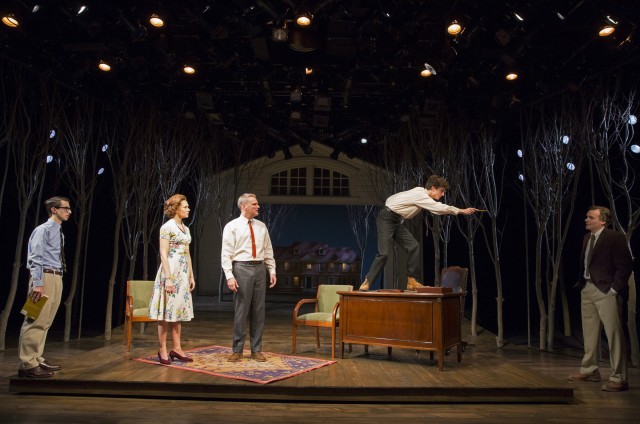
(photo by Richard Termine)

Playwright Harold Chapin examines love, marriage, and British society in stinging comedy (photo by Richard Termine)

As with so many Mint productions, the set, designed by Steven C. Kemp, is utterly charming; the first act takes place in Betty’s lovely chintz-covered bedroom, while the second and third acts are held on the spacious deck of their houseboat, with projections of the Thames and the shore on the back and sides of the stage. (Be sure to stick around during the first intermission to watch the magical change.) Meaney (Indian Ink, Venus in Fur) is superb as Betty, a clever, forward-thinking woman with a yearning sexuality and a fab wardrobe courtesy of costume designer Carisa Kelly. Chapin joins Shaw and Wilde in their investigations of the “New Woman” of the early twentieth century, breaking with Victorian ideas of propriety and forging a new identity in public and private spheres. Like them, he delivers his sociological thoughts via wickedly sharp dialogue skewering the British upper class, ably performed by a cast that also includes Kelly McCready as the Joneses’ curious maid, Lesceline, and Douglas Rees as their stout man-servant, Wooten. When Chapin died, the British theatrical press mourned his loss; St. John Ervine wrote in the Guardian, “It must be true that the taste for comedy, which is an educated taste, has very nearly disappeared from London. But it will, no doubt, come back again; and when it does this play will have its day.” The New Morality is finally having its day in New York City at the Mint, and one can only hope that more of Chapin’s works are on the horizon. Unfortunately, that won’t be happening in the Mint’s home of twenty years, 311 West Forty-Third St., where the company has become the latest victim of the real estate market. The Mint will continue — Bank has a full slate of plays lined for 2016 — but the location is up in the air as of now.