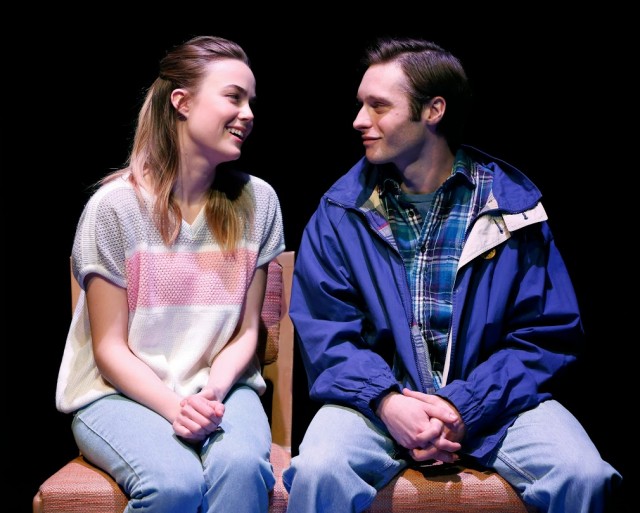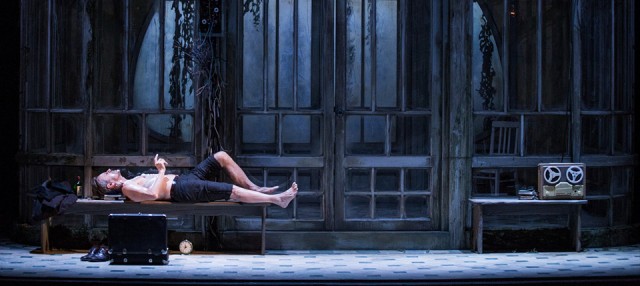
Who: Dylan Baker, Eric Bogosian, David Cale, Michael Chernus, Richard Kind, Anson Mount, Billy Crudup, Gaby Hoffmann, Danny Mastrogiorgio, Craig “muMs” Grant, Marin Ireland, Matthew Maher, and Jennifer Tilly
What: Eric Bogosian’s 100 Monologues
Where: The Players, 16 Gramercy Park South
When: Monday, November 16, and Tuesday, November 17, $122-$222, 7:30
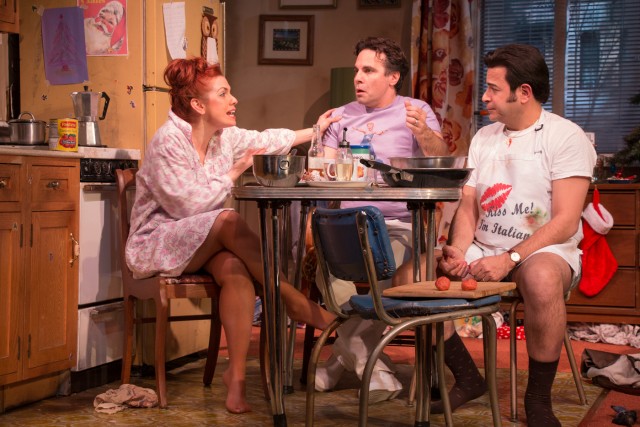
Why: In his 2014 book, 100 (Monologues), Eric Bogosian writes, “I did not set out to write monologues, but the more involved with the form I got, the more interesting it became to me. I liked the energy and excitement of speaking directly to an audience. I liked arranging the portraits of characters to create a larger whole. I liked the difficulty of writing and performing such complex stuff.” On November 16 & 17, a prestigious group of actors will join Bogosian at the Players to perform many of his monologues, in a two-night benefit supporting PS122’s “Give Performance Space” campaign, raising funds as the ultracool downtown institution prepares for the grand reopening of its renovated space at First Ave. and Ninth St. next summer. Among those performing hand-selected monologues are Dylan Baker, Jennifer Tilly, Billy Crudup, Gaby Hoffmann, Richard Kind, Anson Mount, Marin Ireland, and Bogosian, directed by longtime Bogosian collaborator Jo Bonney.
this week in theater
WUNDERBAUM: LOOKING FOR PAUL

Wunderbaum makes its New York debut with work examining controversial public art project by Paul McCarthy (photo by Steven A. Gunther)
New York Live Arts
Bessie Schönberg Theater
219 West 19th St. between Seventh & Eighth Aves.
November 11-14, $15-$35, 7:30
212-691-6500
www.newyorklivearts.org
thenewforest.nl
In 2001, controversial Utah-born, California-based artist Paul McCarthy was commissioned by Rotterdam to make a public sculpture for Shouwburgplein, or Theater Square. However, the city ultimately rejected McCarthy’s work, a giant Santa Claus holding a rather phallic pine tree that soon became known as “Kabouter Buttplug,” or “Buttplug Gnome.” The sculpture was moved several times before finally parading into its new home in the Eendrachtsplein. The eco-conscious Dutch-Flemish collective Wunderbaum examines the controversy, and public art in general, in the multimedia Looking for Paul, which is having its New York premiere November 11-14 at New York Live Arts. In the piece, bookstore owner Inez van Dam has no appreciation for “Kabouter Buttplug,” so she decides to do something about it, going out to Los Angeles to confront McCarthy, who is rather familiar with confrontation. Looking for Paul features actors and creators Walter Bart, Inez van Dam, Matijs Jansen, Maartje Remmers, Marleen Scholten, and guest Daniel Frankl, with design by Maarten van Otterdijk.
CHANG(E)

Soomi Kim and Suzi Takahashi’s CHANG(E) examines the performance artist and political activist Kathy Change’s bizarre end
HERE
145 Sixth Ave. at Dominick St.
November 4-22, $18
212-647-0202
here.org
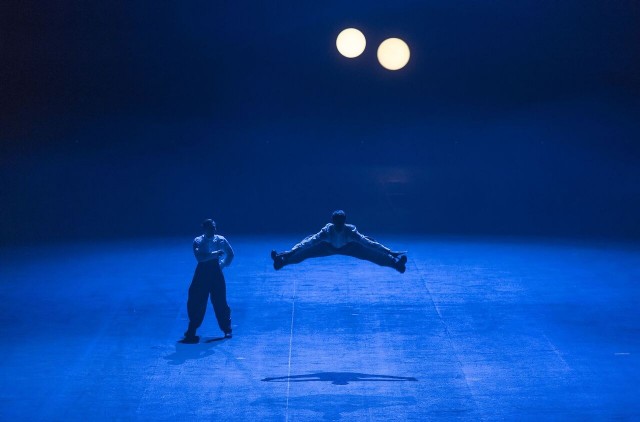
Korean-born, New York-based movement artist Soomi Kim and director Suzi Takahashi complete their trilogy of multidisciplinary works about underrecognized Asian American figures with Chang(e), running November 4-22 at HERE, where it was previously part of the CultureMart festival. Dictee: bells fall a peal to sky explored the stories of such women as Joan of Arc and Yu Guan Soon, while Lee/gendary deconstructed martial arts icon Bruce Lee. In Chang(e), which was developed through the HERE Artist Residency Program, Kim and Takahashi examine what led Ohio-born performance artist and activist Kathleen Chang, also known as Kathy Change, to kill herself in a public act of self-immolation on the Penn campus in 1996. The multimedia docudrama, which combines dance, text, video, and live music, is performed by Kim, Ben Skalski, Kiyoko Kashiwagi, David Perez-Ribada, Criena House, Adriana Spencer, and Zeke Stewart, with music by Adam Rogers, set design by Bryce Cutler, video by Kevan Loney, lighting by Lucrecia Briceno, costumes by Machine Dazzle, and choreography by Alexandra Belle. To prepare for the HERE shows, Kim and Loney went to Philadelphia to visit some of the places where Kathy Change lived and performed and shoot video for the project. In putting the work together, Kim and Takahashi explain, “We discovered that Kathy was a passionate, marginalized woman, battling her own cultural and psychological demons, who aspired to save the world through political transformation. After two years of struggling to reconstruct these stories and fragments into a play, we realized that we were no closer to learning any absolute truths about Kathy. Instead, our show marks the canvas with a few brushstrokes to allow just enough form to emerge so the audience may fill in the details of Kathy’s life with their imaginations. By showing fragments, impressions, and fictions in response to her legacy, we seek to uncover a universal meaning to her life that is inspired by Kathy, but not the truth of her.” (You can find out more about Kathy’s life and legacy here.)
FIGHT OR FLIGHT (LE MORAL DES MÉNAGES)

Mathieu Amalric makes his U.S. stage debut at FIAF this week in FIGHT OR FLIGHT (photo © Marc Domage)
French Institute Alliance Française, Florence Gould Hall
55 East 59th St. between Madison & Park Aves.
Wednesday, November 4, and Thursday, November 5, $50, 7:30
212-355-6100
www.fiaf.org
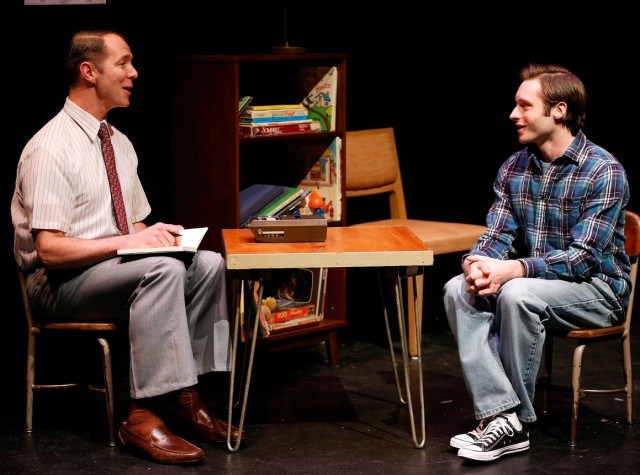
Acclaimed actor and director Mathieu Amalric has been rather busy in New York City, celebrating his fiftieth birthday with appearances at a pair of film festivals being held in his honor, “Mathieu Amalric: Renaissance Man,” at Anthology Film Archives and the French Institute Alliance Française. But most exciting, on November 4 and 5 he’ll be making his U.S. theatrical debut at FIAF, starring opposite Anne-Laure Tondu in the sixty-minute drama Fight or Flight (Le Moral des ménages). The play, about a forty-year-old musician facing a midlife crisis, is based on the 2002 novel by award-winning Parisian writer Eric Reinhardt and is adapted and directed by Stéphanie Cléau, Amalric’s wife, who was also his costar in his latest directorial effort, The Blue Room. (Amalric and Cléau will participate in a Q&A following the 7:30 screening of the film at FIAF on November 3.) Amalric is an extraordinarily sensitive actor, as seen in such films as Julian Schnabel’s The Diving Bell and the Butterfly, Olivier Assayas’s Late August, Early September, and Arnaud Desplechin’s Kings & Queen, while also displaying a mischievous sense of humor, as exemplified in the French version of Wes Anderson’s The Fantastic Mr. Fox, so this stage production should be a real treat.
GRAHAM GREENE’S TRAVELS WITH MY AUNT

Thomas Jay Ryan, Daniel Jenkins, Rory Kulz, and Jay Russell all play Henry in Keen revival of TRAVELS WITH MY AUNT
The Clurman Theatre at Theatre Row
410 West 42nd St. between Ninth & Tenth Aves.
Tuesday – Sunday through November 14, $62.50
www.keencompany.org
“Never presume yours is a better morality,” Aunt Augusta says in Keen Company’s playful, imaginative, and frugally produced revival of Travels with My Aunt, adapted by Giles Havergal from Graham Greene’s hippie-era story about colonialism, drugs, free love, family, and, in its own way, flower power. Greene called the novel “the only book I have written for the fun of it,” and that is exactly how director Jonathan Silverstein approaches the two-act comedy of manners in which four actors take on some two dozen roles, ambitiously trading off some of the same parts, even within the same scene. It’s an inventive and, at times, confusing conceit that is introduced at the very start, when four men (Thomas Jay Ryan, Daniel Jenkins, Rory Kulz, and Jay Russell), identically dressed in black suits, white shirts, vests, ties, and bowlers, appear onstage. Three of them are sitting down, trading off lines from retired banker Henry Pulling’s first-person narration. “Everyone thought me lucky but I found it difficult to occupy my time,” Henry explains. “I had never married. I had always lived quietly, and, apart from my interest in dahlias, I had no hobby. For those reasons I found myself agreeably excited by my mother’s funeral.” At the funeral, he sees his aunt Augusta (Ryan) for the first time in more than fifty years. She surprises him with a family secret about his birth, and soon the two of them are traveling around the world, being interrogated by the police, meeting oddball characters, and getting caught up in international intrigue. Through it all, Henry (primarily portrayed by Russell) remains steadfast and droll, a boring sort who doesn’t quite understand the depth of what he has become involved in, but it’s too late to turn back now.

Thomas Jay Ryan and Jay Russell are looking for answers in low-budget adaptation of Graham Greene comic novel
Steven Kemp’s spare set is centered by what the cast and crew call “The Monster,” a movable rectangular block that contains windows and a door on one side and a gated entryway on the other. The blue-curtained backdrop eventually rises to reveal yet more fun, along with a few costume changes courtesy of Jennifer Paar. The actors are simply extraordinary, led by the always excellent Ryan (In the Matter of J. Robert Oppenheimer, In the Next Room), who divides his time between Henry and Aunt Augusta, and Russell (End of the Rainbow, The Play What I Wrote), who plays Henry as well as the young woman Tooley, her maybe-CIA father O’Toole (who is studying the lengths of his urination), Miss Keene, and Frau General Schmidt, among others. Jenkins (Big, Big River) is Henry, Mr. Visconti, Colonel Hakim, Detective Sgt. Sparrow, et al., but his main role is the now politically incorrect Wordsworth, Aunt Augusta’s immigrant lover who speaks in a stereotyped tongue. “Why, man, you not offended at Wordsworth?” he asks at one point. It’s hard not to be at least somewhat offended by this Greene character, a product of British imperialism and the British imperialist mind. Late cast addition Kulz (The Old Masters, Empire Travel Agency), in his off-Broadway debut, plays many of the more minor roles, such as a guard, a hotel receptionist, and a Turkish policeman. It’s all jolly good lighthearted fun that never takes itself too seriously, even as it deals with some important topics. “Perhaps a sense of morality is the sad compensation we learn to enjoy, like a remission for good conduct. In the vision there is no morality,” Henry says to Wordsworth. Travels with My Aunt, which was also made into a very different Oscar-winning film by George Cukor (with Maggie Smith as Aunt Augusta, Alec McCowen as Henry, and Louis Gossett Jr. as Wordsworth) offers a sly, sweet-natured look at morality in this lovely little Keen revival.
THE QUARE LAND

Hugh Pugh (Peter Maloney) tries to teach Rob McNulty (Rufus Collins) a lesson in drab revival (photo © Carol Rosegg)
Irish Repertory Theatre
DR2 Theatre
103 East 15th St. between Irving Pl. & Park Ave.
Tuesday – Sunday through November 15, $70
212-727-2737
www.irishrep.org
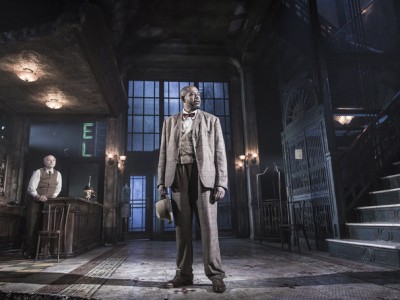
Something magical happens during the Irish Rep’s revival of John McManus’s The Quare Land. Unfortunately, it’s not the play itself but a bit of mysterious stagecraft. Star Peter Maloney spends the entire show in a cast-iron bathtub — and the bubbles never go away during the ninety minutes. I don’t know which brand of bubbles he uses, but I can’t get the bubbles in my bath to stay afloat for more than a handful of minutes. Otherwise, The Quare Land is a rather ordinary work that offers no new takes on a familiar story. Maloney plays the silly-named Hugh Pugh, an old farmer living in a ramshackle house on the Irish countryside in County Cavan. (The wonderful set is by Charlie Corcoran.) Pugh is relaxing in the tub with his rubber ducky, listening to Bobby Darin on his ancient phonograph, enjoying beer he retrieves via a complex pulley system that brings him bottles from inside a filthy toilet, when the well-dressed Rob McNulty (Rufus Collins) shows up unannounced and walks into the bathroom. McNulty is a real-estate developer who wants to purchase land from Pugh that he didn’t even know he owned, in order to turn a nine-hole golf course into an eighteen-holer to attract professional events. McNulty assumes the sale is a slam dunk, but he can barely get a word in edgewise as Pugh shares stories from his life nonstop, cannily dodging McNulty’s best efforts. The play, directed by Ciaran O’Reilly, starts out well enough, but as it continues, it grows more and more annoying, the plot turning into a stale retread of such films as The Field and Local Hero, except neither character here turns out to be very likable. The play is billed as a “Cantankerous Comedy,” and cantankerous it is, but not in the intended way. Maloney (Outside Mullingar) and Collins (The Royal Family) give fine performances, but the sour script ultimately lets them down. Now, about those bubbles….
THÉRÈSE RAQUIN

Thérèse (Keira Knightley) dreams of something more while her doltish cousin, Camille (Gabriel Ebert), sits with her by the river (photo by Joan Marcus)
Studio 54
254 West 54th St. between Seventh & Eighth Aves.
Tuesday – Sunday through January 3, $47-$137
212-719-1300
www.roundabouttheatre.org
There’s fire and ice in Helen Edmundson’s new adaptation of Émile Zola’s 1867 serial novel and 1873 play, Thérèse Raquin, which opened last night at Studio 54. On the edge between gothic melodrama and nineteenth-century realism, Zola tells a familiar story, evoking Poe, Dostoevsky, Dreiser, Shakespeare, and Balzac as well as such films as Roman Polanski’s Knife in the Water, René Clément’s Purple Noon, and Billy Wilder’s Double Indemnity. (Zola’s novel has also been turned into numerous films, miniseries, musicals, an opera, and other stage productions, in various languages.) In 1868 France, poor orphan Thérèse Raquin (Keira Knightley) has spent years like Cinderella, taken in by her aunt, Madame Raquin (Judith Light), and her cousin, Camille (Gabriel Ebert), after her North African mother died and her French sailor father disappeared at sea. More a maid than a member of the family, Thérèse aches for something more. She sits by the river, watching the water flow and the swans fly by, but where she sees freedom, Camille, a pathetically weak and spoiled momma’s boy, sees nothing but “the same water as yesterday.” Madame Raquin and Camille don’t even allow Thérèse to open the windows, whether in their small village or after they move to Paris, where Camille seeks success in the modern city, away from the ancestral countryside. Thérèse lives a trapped life wherever they are, especially after she is forced to marry the sniggering Camille, but from the moment she meets the virile, handsome, artistic Laurent (Matt Ryan), she sees a way out. In fact, when he first enters the Raquin home, she is staring out the window; it is as if he has entered straight out of her daydreams. Thérèse and Laurent soon begin a passionate sexual affair. “My God. You were born for this,” Laurent proclaims with wonder during their initial tryst. “We will live between these sheets, within this room, behind this door,” Thérèse declares. “We will live.” But Camille stands in their way, and they are soon planning the perfect murder.

Matt Ryan, Judith Light, Keira Knightley, and Gabriel Ebert star in Roundabout adaptation of Émile Zola novel (photo by Joan Marcus)
Commissioned for Roundabout’s fiftieth anniversary season, Thérèse Raquin is a bleak but compelling melodrama. Beowulf Boritt’s sets, which include a side-by-side dining room/bedroom, a riverfront with real water, a small artist’s garret that dangles from above, and an abstract painted backdrop, are as dark and dank as Jane Greenwood’s period costumes, which favor black, brown, and gray. Royal Shakespeare Company veteran Ryan (Constantine, Small Change) and two-time Oscar nominee Knightley (Pride and Prejudice, The Imitation Game) have electric chemistry; in her Broadway debut, Knightley transforms from a mousy, silent wallflower into a libidinous woman who is almost afraid of her sudden, deep desires, often acting primarily with her mesmerizing eyes. Tony winner Ebert (Matilda the Musical, 4,000 Miles) has fun playing the fanciful dullard Camille, while two-time Tony winner Light (Other Desert Cities, The Assembled Parties) shows once more that she is one of Broadway’s most dependable actors as the somewhat clueless mother who elegantly devolves throughout the play. Rounding out the cast is Jeff Still as Monsieur Grivet, an efficiency expert who makes sure the dinner table is always in its exact proper place, David Patrick Kelly as retired superintendent Michaud, who can still sniff out trouble, and Mary Wiseman as Suzanne, Michaud’s buxom niece, who is as flighty as Thérèse is at first gloomy. Edmundson’s (The Heresy of Love, The Clearing) script jumps around too much and doesn’t fully explore the various subplots and minor characters, especially regarding a brutal local murder, and Evan Cabnet’s (A Kid Like Jake, The Performers) direction is, like Monsieur Grivet, efficient, if not inspiring. But Ryan and Knightley make quite the ravenous couple, sending the audience through a roller coaster of emotions as they seek true happiness — or at least sexual fulfillment — at any tawdry cost. “In Thérèse Raquin my aim has been to study temperaments and not characters,” Zola wrote in the preface to the second edition of his novel. “That is the whole point of the book. I have chosen people completely dominated by their nerves and blood, without free will, drawn into each action of their lives by the inexorable laws of their physical nature. Thérèse and Laurent are human animals, nothing more.” Knightley and Ryan embody that human-animal nature with fervor to spare in this gripping production.