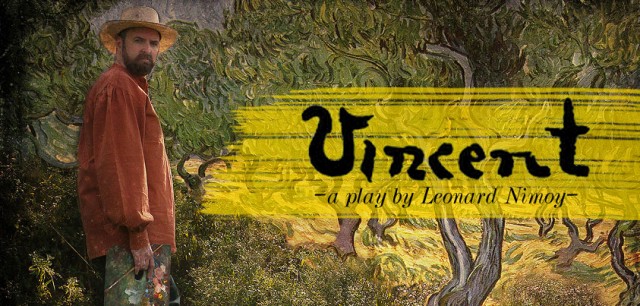
LEONARD NIMOY’S VINCENT
Theatre at St. Clement’s
423 West 46th St. between Ninth & Tenth Aves.
Wednesday – Sunday through June 5, $59-$89 starrynighttheater.com/vincent
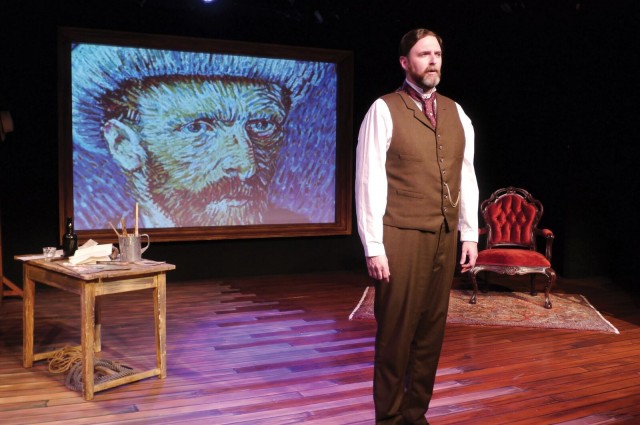
Leonard Nimoy lived long and prospered before passing away last February at the age of eighty-three, leaving behind a legacy that includes two children, two marriages of more than twenty years, major roles on and off Broadway (Equus, Fiddler on the Roof, One Flew over the Cuckoo’s Nest), and this little television and movie franchise known as Star Trek. But one of his most important personal projects was a one-man show called Vincent, which he adapted from Phillip Stephens’s Van Gogh and toured in beginning in 1981. In the play, Vincent’s younger brother, Theo, talks about life with his older sibling, an artist whose talent and innovation was only recognized after his death. The thoroughly researched text is based on hundreds of letters between the brothers; Nimoy also traveled to Arles, Saint-Rémy, and Auvers while preparing the show. The play is now being revived by the Starry Night Theatre Co. starting April 1 at the Theatre at St. Clement’s. Company artistic director James Briggs plays Theo, with Dr. Brant Pope directing. “Last week when we buried my brother, there was so much I wanted to say, I couldn’t do it,” Theo says at the start. “You see, I simply couldn’t speak. I didn’t express myself. It’s been a burden on my soul . . . what I wanted to say and I couldn’t . . . what I needed to say, what you need to hear. So I thank you for this second opportunity.”
James Briggs stars as Theo van Gogh in revival of Leonard Nimoy’s VINCENT, coming to the Theatre at St. Clement’s
TICKET GIVEAWAY: Vincent begins previews April 1 and opens April 7 at Theatre at St. Clement’s, and twi-ny has three pairs of tickets to give away for free. Just send your name, daytime phone number, and favorite van Gogh painting to contest@twi-ny.com by Wednesday, March 30, at 3:00 to be eligible. All entrants must be twenty-one years of age or older; three winners will be selected at random.
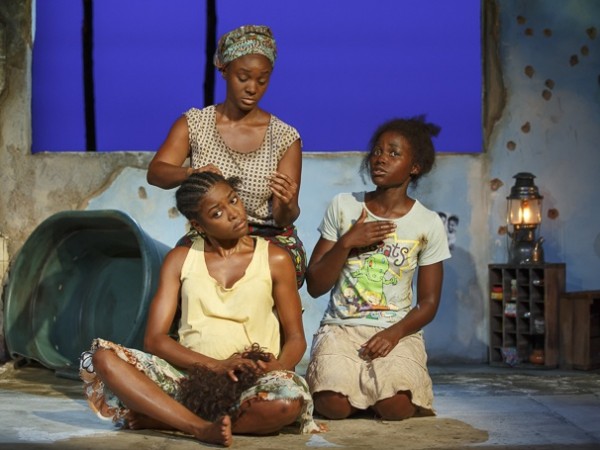
Danai Gurira’s ECLIPSED follows a group of women just trying to survive during Liberia’s second civil war (photo by Joan Marcus)
Golden Theatre
252 West 45th St. between Broadway & Eighth Ave.
Tuesday – Sunday through June 19, $45-$149 eclipsedbroadway.com
When Academy Award winner Lupita Nyong’o was invited to star in a play at the Public by artistic director Oskar Eustis, she immediately chose Danai Gurira’s Eclipsed, and it’s easy to see why. Eclipsed is a searing look at five women trying to find ways to survive during the second Liberian civil war, a memorably written, directed, and acted story filled with surprising dark humor among horrific abuse and violence. The play was initially staged by Woolly Mammoth and then at Yale Rep in 2009, where Nyong’o served as an understudy and never got the opportunity to go on. It was such a success at the Public last fall that it has since transferred to Broadway, where it’s running at the Golden Theatre through June 19. Set in 2003, the play explores the terrifying situation of five women, three of whom live together in a ramshackle cement hut riddled with bullet holes and are sex slaves to a local commanding officer. They are known merely as wife Number One (Saycon Sengbloh), who has been there the longest and manages the household; pregnant wife Number Three (Pascale Armand), who likes to complain and is rather scattershot; and the new girl, wife Number Four (Nyong’o), who is determined to hold on to her identity despite what is happening to her and the others. When Number Four asks Number One about her age and Number One doesn’t seem to care, Number Four says, “Don’t you want to know? I don’ know, I just tink we should know who we are, whot year we got, where we come from. Dis war not forever.” Number One responds, “Dat whot it feel like,” to which Number Four replies, “Ya, but it not. I want to keep doing tings. I fifteen years, I know dat. I want to do sometin’ wit’ myself, be a doctor or member of Parliament or sometin’.”
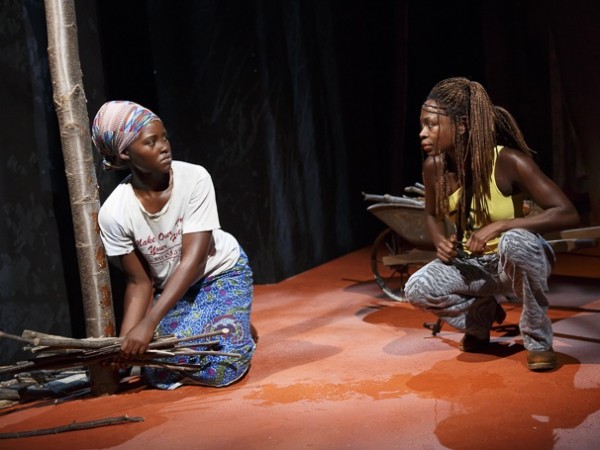
Despite such dreams, their value as objects rather than humans is made clear; every so often, they suddenly line up in a row as the unseen CO walks by and chooses which one he wants to have sex with. When they return, they go straight to a basin, grab a washcloth, and clean themselves. Soon Number Two (Zainab Jah) returns, a revolutionary carrying a rifle and bringing rice, which Number One refuses. Number Two, who has joined the Liberians United for Reconciliation and Democracy (LURD) against corrupt President Charles Taylor, wants to recruit Number Four, but Number Four is too immersed in a book she is reading out loud, about a U.S. leader named Bill Clinton. “A white man?” Number One asks. “Ya, he white. He from America,” Number Four answers. “You sho he white? Dere lots of Liberians in America. Maybe he American from Liberia or Liberian from America,” Number Three adds. “No, I tink he American from America,” Number Four, who wears Rugrats and Tweety Bird T-shirts, says. Later, Number Three claims, “He see me, he gon’ forget dat white wife. She betta not let him come ’ere.” In her fantasy of release, she’s still a concubine, only to a white U.S. president rather than a Liberian warlord, perhaps a sly dig at the “liberation” of first-world women. The whole conversation about Bill and Hillary Clinton and Monica Lewinsky is much-needed comic relief as things heat up and Rita (Akosua Busia), a peace worker dressed in white like an angel, comes to the compound to meet with the CO and try to help end the civil war.
Lupita Nyong’o considers joining the fighting at the behest of Zainab Jah (photo by Joan Marcus)
Eclipsed is the second of four plays about Africa and African Americans written by Gurira, a Zimbabwean American who plays zombie killer Michonne on The Walking Dead; she won an Obie for 2005’s In the Continuum, was nominated for an L.A. Drama Critics Circle Award for 2012’s The Convert, and Familiar has been extended at Playwrights Horizon. In her return to the stage — and her Broadway debut — following her Oscar-winning performance in 12 Years a Slave, Mexican Kenyan Nyong’o is mesmerizing as a young woman bright beyond her years, prepared to do whatever it takes to maintain her identity and, ultimately, regain her freedom without sacrificing her humanity, something that the brutal, fierce Number Two no longer worries about. “We gon’ restore Liberia to its rightful people,” Number Two tells Number Four. “You understand, de enemy, de enemy is no longer human being. Okay?” Reprising their roles from the Yale Rep production, Jah (Ruined, The Convert), who was born in England and partly raised in Sierra Leone, fully inhabits her role as the freedom warrior, inspired by real women who took up arms to fight against Taylor’s rule, while Armand (The Trip to Bountiful, An Octoroon), who was born in Brooklyn and whose parents are from Haiti, is charming as a woman who never quite learned how to take care of herself. Sengbloh (Marley, Hurt Village), who is of Liberian heritage, is bold yet tender-hearted as the strong-willed but perhaps misguided ersatz leader of the sex slaves, and Ghanaian Busia (Mule Bone, The Talented Tenth) lends a touching vulnerability to the peace worker who has a personal agenda in her mission. Together they form a kind of alternate family of parents and children attempting to deal with an impossible situation, their performances ringing true with realistic and rhythmic movement and dialogue, beautifully directed by South Africa native Tommy (Ruined, The Good Negro), who has been with the show from the start. The set and costumes by Clint Ramos and music and sound design by Broken Chord add to the mood, which is fraught with danger yet resilient with hope, giving balance to this extraordinary story by and about women and power. Coincidentally, the Playbill front cover features a close-up of Nyong’o’s very serious face, while the back cover shows her bursting with happiness in an elegant advertisement for a high-end makeup company, providing quite a contrast that is, in some ways, metaphorically echoed in this very special production.
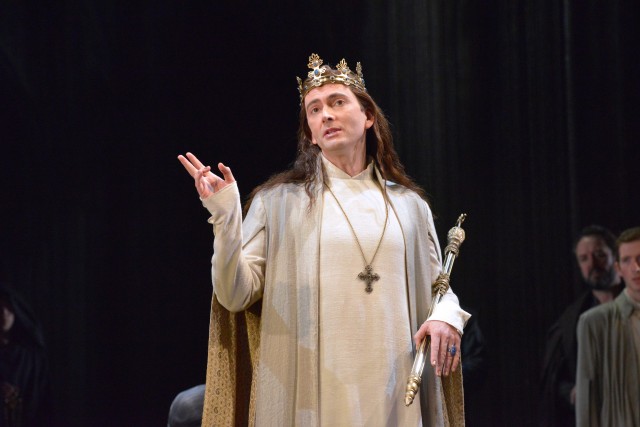
David Tennant stars as Richard II in Royal Shakespeare Company production coming to BAM (photo by Keith Pattison)
Brooklyn Academy of Music
BAM Harvey Theater
651 Fulton St.
March 24 – May 1, $30-$200
718-636-4100 www.bam.org
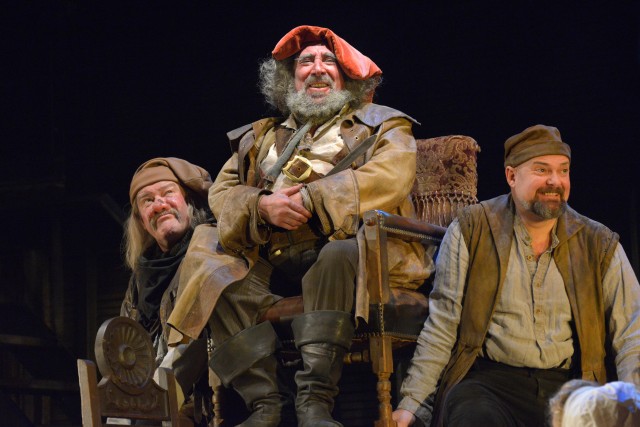
In a letter to his mistress, Lady Emma Hamilton, in 1800, Admiral Horatio Nelson wrote, “My greatest happiness is to serve my gracious King and Country, and I am envious only of glory; for if it be a sin to covet glory, I am the most offending soul alive.” BAM references that famous quote in its glorious program “King and Country: Shakespeare’s Great Cycle of Kings,” and it would be a sin not to covet it. In honor of the quadricentennial of the passing of William Shakespeare, who died in 1616 at the age of fifty-two, BAM has teamed up with the Royal Shakespeare Company and the Ohio State University to present the Henriad, four Shakespeare plays in repertory at the BAM Harvey over the course of thirty-nine days, concentrating on Kings Henry IV and V. All four works are directed by RSC artistic director Gregory Doran, with sets by Stephen Brimson Lewis, lighting by Tim Mitchell, music by Paul English, sound by Martin Slavin, movement by Michael Ashcroft, and fights by Terry King. David Tennant (Doctor Who, Broadchurch, Jessica Jones), who played the title character in Doran’s 2008 staging of Hamlet with Patrick Stewart as his father, has the lead role in Richard II, with Julian Glover as John of Gaunt, Leigh Quinn as the queen, Oliver Ford Davies as the duke of York, Sarah Parks as the duchess of York, and Jasper Britton as John of Gaunt’s son, later to become Henry IV. Britton continues his role in Henry IV, Part I, and Henry IV, Part II, with Alex Hassell as Prince Hal, Martin Bassindale as Peto and Prince John, Antony Sher (Doran’s longtime partner) as Sir John Falstaff, Parks as Mistress Quickly, and Sam Marks as Ned Poins. And Hassell then takes the throne in Henry V, with Jim Hooper as the archbishop of Canterbury, Simon Thorp as King Charles VI of France, Jane Lapotaire as Queen Isobel, Quinn as lady-in-waiting Alice, and Marks as the French constable.
HENRY IV, PART I is one of four RSC plays running at BAM through May 1 (photo by Keith Pattison)
“The Henriad plays are a contemplation of power and leadership — how they are acquired, maintained, and lost,” BAM publicist Christian Barclay writes in a program essay. “A host of historical and fictional characters — both high- and lowborn — revolve around the monarchs in shifting alliances. . . . The Henriad is a study of the difficult personal and ethical choices that accompany political life.” In conjunction with the plays, the Mark Morris Dance Center is hosting the master class “Embodying Shakespeare” on April 5 with Owen Horsley, Hassell, and Quinn ($25, 2:00), Doran will be in conversation with Shakespeare scholar James Shapiro on April 7 at BAMcafé ($20, 6:00), Neil Kutner, Ryan Gastelum, and Ben Tyreman will participate in the seminar “Behind the Scenes: King and Country” at BAM Fisher on April 20 ($35, 5:00), astronomer Summer Ash will lead guided tours of the sky with telescopes in “A Look at the Stars: Shakespeare and the Cosmos” April 15-17 on the BAM Fisher rooftop terrace (free, 8:30 or 9:30), and the exhibition “King and Country: Treasures from the Folger,” consisting of rare paper artifacts from the Folger Shakespeare Library in Washington, DC, will be on view at the Harvey during the run of the performances. Tickets for the shows and the special events are going quickly, so act now if you want to catch any or all of what should be a glorious Shakespeare spectacle to covet.
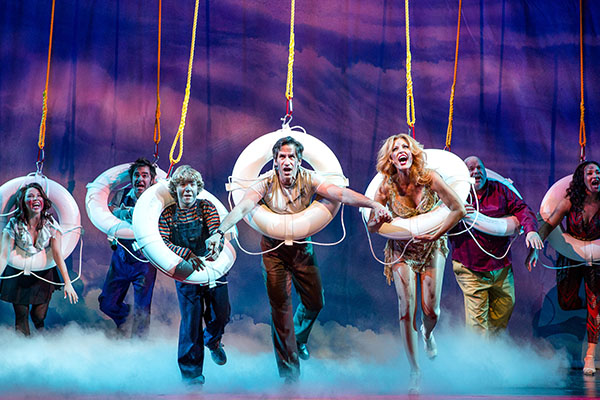
The audience and the cast have a swinging good time in DISASTER! (Jeremy Daniel Photography)
Nederlander Theatre
208 West 41st St. between Seventh & Eighth Aves.
Tuesday – Sunday through July 3, $65-$179
877-250-2929 www.disastermusical.com
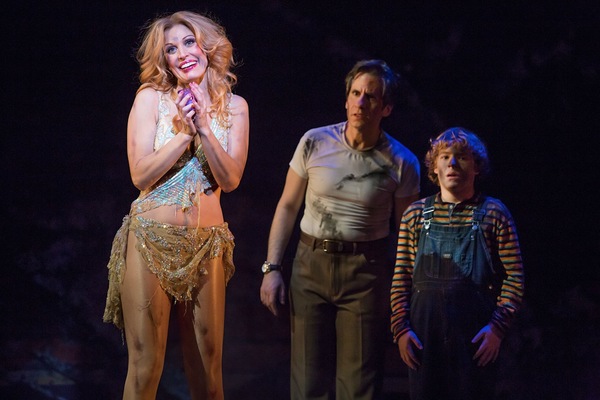
There has been many a disaster on Broadway; Disaster! is definitely not one of them. The delightful musical comedy, which began life as a one-night charity benefit in 2011 and then had off-Broadway runs at the Triad Theater in 2012 and St. Luke’s in 2013-14, has made a simply fabulous transition to the Great White Way, where it runs through July 3 at the Nederlander Theatre. The show has kept growing since initially conceived by Seth Rudetsky and Drew Geraci, with bigger and bigger stars and significant changes to the script and music; the Broadway version is by cowriter, music supervisor, song arranger, and costar Rudetsky and his best friend, cowriter and director Jack Plotnick, a longtime character actor in film and television. It’s 1979, and Tony Delvecchio (Roger Bart channeling Jack Black) is celebrating the opening of Barracuda, his floating casino and discotheque moored in New York Harbor. A chintzy showman and businessman, Tony has cut just about every corner possible, worrying journalist Marianne (Kerry Butler) and Professor Ted Schneider (Rudetsky), who is concerned that the ship could not survive a natural disaster, which is likely to occur shortly. Among those on deck are Sister Mary Downy (Jennifer Simard), who is protesting against the casino and its debauchery; Shirley (Faith Prince) and Maury (Kevin Chamberlin), an older couple with a fierce love of life; Levora (Lacretta Nicole), a down-on-her-luck former disco diva who goes everywhere with her beloved dog in her handbag; Chad (Adam Pascal), whom Marianne left at the altar and his now working as a waiter on the ship, and his goofy buddy, Scott (Max Crumm); and elegant but not-too-bright lounge singer Jackie (Rachel York) and her young twins, Ben and Lisa (both played in hilarious fashion by Baylee Littrell). The show pays tribute to the great, and not-so-great, disaster movies of the 1970s, ingeniously coupled with beloved, and not-so-beloved, pop songs from that era.
Jackie (Rachel York) prays for a morning after as Ted (Rudetsky) and Ben (Baylee Littrell) look on (Jeremy Daniel Photography)
The main target is The Poseidon Adventure, but there are also references galore to the Airport films, The Towering Inferno, Earthquake, Rollercoaster, Tidal Wave, Piranha, and even Airplane! Simard’s nun character, speaking in a killer deadpan voice, is pulled directly from Jim Abrahams and David and Jerry Zucker’s classic 1980 spoof, while Prince excels in her homage to Shelley Winters in Poseidon. Meanwhile, the melodrama involving Marianne and Chad feels like a terrifically nerdy subplot from The Love Boat. The score features more than three dozen period favorites, delivered with extremely firm tongues-in-cheek, including Mary MacGregor’s “Torn Between Two Lovers,” Helen Reddy’s “I Am Woman,” Queen’s “You’re My Best Friend,” England Dan and John Ford Coley’s “I’d Really Love to See You Tonight,” Orleans’s “Still the One,” Carly Simon’s “Mockingbird,” and Donna Summer’s “Hot Stuff,” many of which become riotous set pieces, especially as things start looking more and more bleak and Tobin Obst’s (Newsies, Jekyll & Hyde) set begins falling apart with deliciously low-budget panache. The cast, superbly dressed by William Ivey Long (Chicago, On the Twentieth Century), does an amazing job keeping a straight face while the audience explodes in pure glee over each new reference or song snippet, which Rudetsky and Plotnick nail again and again. Littrell, the son of former Backstreet Boy Brian Littrell, nearly steals the show playing the twin siblings, going back and forth between Ben and Lisa in side-splitting, nearly impossible ways. The fun choreography is by JoAnn M. Hunter (School of Rock, Broadway Bound), who has a blast with the fab soundtrack. No mere jukebox musical, Disaster! is hot stuff indeed, a love letter to a simpler time and place; about the only thing missing is Sensurround.
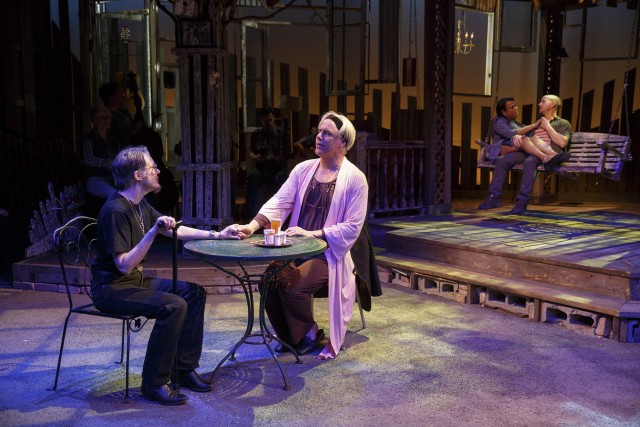
Couples Robert (Annette O’Toole) and Lola (Jeff McCarthy) and Carly (Aneesh Sheth) and Jackson (Jeffrey Kuhn) deal with LGBTQ issues in SOUTHERN COMFORT (photo by Carol Rosegg)
Anspacher Theater at the Public Theater
425 Lafayette St.
Through March 27, $40-$65
212-967-7555 www.publictheater.org
At intermission of Southern Comfort, I was standing just outside the Anspacher Theater at the Public, next to a group of older men and women who were debating whether to go back inside for the second act. “Tell me, why are we seeing this again?” one gentleman asked. “We’re seeing this because it’s important,” one of the women answered. “It’s important for us to see and understand people who are different.” The man looked over at me with a shrug, and I couldn’t help but shrug back. I went back inside for the rest of the show; some of the people in that group opted to go home instead, which was not a bad decision. Southern Comfort is a sappy, treacly adaptation of Kate Davis’s award-winning 2001 documentary about ailing transgender Robert Eads and his close circle of friends, which he calls his “chosen family.” Ten years in the making, the musical, which was conceived by Robert DuSold and Thomas Caruso, with book and lyrics by Dan Collins and music by Julianne Wick Davis (who previously collaborated on Trevor and When We met), follows a dying Eads (Annette O’Toole) as he continues his monthly picnics at his wooded home in Georgia with transgender Jackson (Jeffrey Kuhn), who is considering getting a phalloplasty to physically complete his transition; Carly (Aneesh Sheth), Jackson’s new transgender girlfriend; burly transgender Sam (Donnie Cianciotto) and his girlfriend, Melanie (Robin Skye); and Robert’s new lover, transvestite Lola Cola (Jeff McCarthy), a man’s man who is nervously just starting to adjust to his preferred lifestyle. They are all considering whether to attend the annual Southern Comfort convention in Atlanta, a gathering place for the LGBTQ community, where they can be themselves without any of the usual consequences. (Southern Comfort is a real conference and symposium that recently relocated to Fort Lauderdale after twenty-four years in Atlanta; the convention boasts more than eighteen thousand attendees over its history and bills itself as “the largest gathering of the transgender community in the world.”)
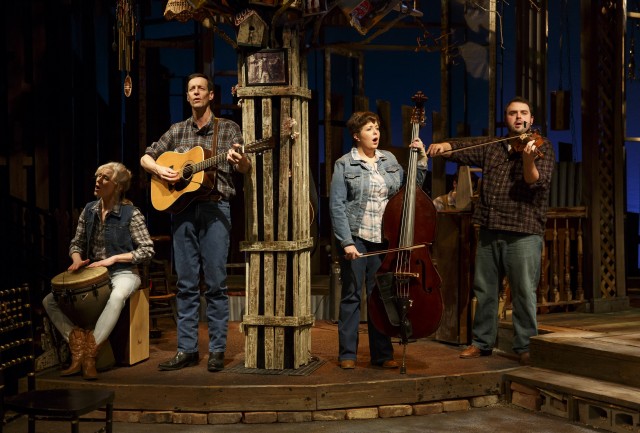
Folk band plays music and gets involved in the narrative in rustic musical (photo by Carol Rosegg)
But while the documentary is a warm and intimate examination of Eads and his friends and family, the musical merely celebrates its own existence, with only the most tangential and, dare we say, dull and ordinary moments of conflict and drama. Will Melanie bring Sam to her company holiday party? Will Robert’s parents finally accept who he has become? (This relationship was changed from the film.) Will Lola go to the convention and join the greater LGBTQ community? While these are all valid questions, their treatment in Southern Comfort does not make for exciting or compelling theater; instead, they come off more like plot points in a Lifetime movie. Even the titles of the songs are rather plain and obvious (as are the lyrics): “Grace,” “Women,” “Bless My Heart,” “Walk the Walk,” “Chosen Family,” “Home.” James J. Fenton’s set is rustic and inviting, including a swing and a tree festooned with photos and other memorabilia from the characters’ lives. Around the tree, the band plays folksy music, and some of the musicians occasionally narrate brief bits or play small roles; the crack band consists of Lizzie Hagstedt on bass, Joel Waggoner on violin and piano, Morgan Morse on piano and guitar, Elizabeth Ward Land on piano and percussion, and musical director David M. Lutken on harmonica and various stringed instruments. The acting is solid if unspectacular, led by an unrecognizable O’Toole (Hamlet in Bed, Cat People) and a bold McCarthy (Urinetown, Side Show). Perhaps Southern Comfort would have been more effective ten or fifteen years ago, closer to the time when the film came out and made such an impact. Or maybe part of the problem is that the show is essentially preaching to the converted at the Public Theater, where the audience has no issues with who the characters are and what they want to do with their lives. Of course, horrible, unjust, and unfair treatment of the LGBTQ community continues around the world, and those stories need to be told; unfortunately, Southern Comfort is not the musical to do it.
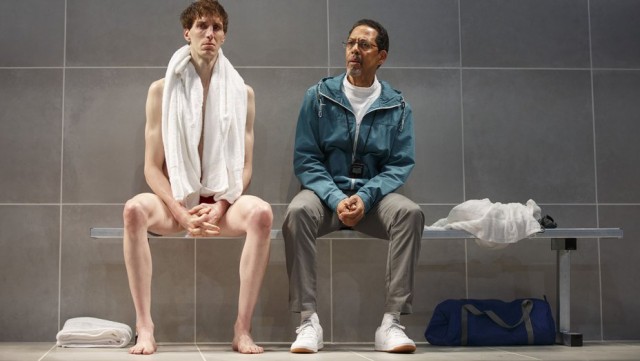
Ray (Alex Breaux) and his coach (Peter Jay Fernandez) discuss strategy in RED SPEEDO (photo by Joan Marcus)
New York Theatre Workshop
79 East Fourth St. between Second & Third Aves.
Tuesday – Sunday through April 3, $69 www.nytw.org
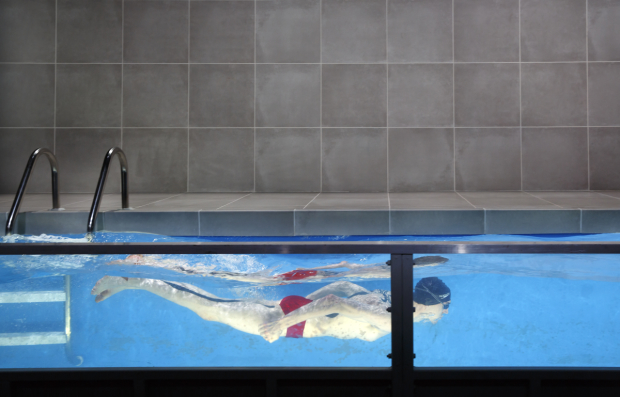
Upon entering the theater at NYTW to see Lucas Hnath’s Red Speedo, you are met with the familiar smell of chlorine; at the foot of the stage is a horizontal tank filled with water, the glow from its soft, calming waves glistening on the back wall of Riccardo Hernandez’s spare but comfy locker-room set. Over the speaker system, the soft, calming waves of Roy Orbison’s glorious voice, singing his posthumous 1989 hit single, “You Got It,” repeat on a loop (that might leave you not wanting to ever hear the song again, no matter how much you think you love it). Soon Peter (Lucas Caleb Rooney), a bearded lawyer, is threatening a swimming coach (Peter Jay Fernandez) that if he doesn’t flush the cooler-full of performance-enhancing drugs he found in his refrigerator — which swimmer Ray (Alex Breaux), Peter’s younger brother, says belongs to one of his teammates, Tad — Peter will take Ray to another swim club, even with the Olympic trials scheduled for the next day. Tall and impossibly sinewy and wearing nothing but a red Speedo, Ray, who is expected to compete for a medal in the Olympics, is standing between the two men as they talk at each other in an almost Mamet-like barrage of unfinished thoughts and sentences. “It is my responsibility to inform the officials, the powers that be, that one of my swimmers has been taking performance-enhancing drugs,” the coach says. “It’s an ethical responsibility.” But Peter, a middling lawyer who sees representing Ray as his way to financial success, starting with an endorsement deal with Speedo, threatens, “Yes, you should do what you need to do. I’m just trying to remind you of what you need.” When Ray informs Peter whom the drugs really belong to, it sets in motion a series of confrontations in which ethics and morality face off against fame and fortune and everyone, including Ray’s former girlfriend, Lydia (Zoë Winters), has to make life-changing decisions that affect more than just themselves.
Ray (Alex Breaux) does what he does best in RED SPEEDO at New York Theatre Workshop (photo by Joan Marcus)
Red Speedo plays out like an individual medley race; its pacing and story aligns with the competition in which the swimmer goes from the butterfly to the backstroke to the breaststroke to freestyle. The start of each new act is signaled by the same kind of air-horn blast that kicks off races — while also making sure the audience has not dozed off. The action might take place in the world of sports, but the story, at its core, is about addiction. People can be addicted to winning just as they are addicted to drugs, alcohol, sex, gambling, porn, and even shopping. The day I saw the show, there was an added buzz in the theater, as news was breaking that tennis champion Maria Sharapova had admitted to using PEDs and was facing a major ban, making the show’s central topic even more relevant. It’s almost impossible to take your eyes off of Breaux (The Real Thing, Bushwick), who’s onstage virtually the entire show, always in his absurdly tight red Speedo, displaying a stupendously large black serpent tattoo running down his back and leg; he injects amiability and even a little sympathy into a not-very-bright character who seems harmless enough but is imbued with a raging selfishness. Breaux, who played football at Harvard and is a Juilliard graduate, works well with Rooney (Love and Information, The Orphans’ Home Cycle), who lends older brother Peter a worried desperation, as if Ray’s potential success is his only way out of his mundane, average existence.
Breaux does not have that same connection with Winters (Love and Information, 4000 Miles); there is no, er, chemistry between the two — who both appeared in the 1994 Shakespeare in the Park production of Much Ado About Nothing — and it is hard to believe that the street-smart Lydia, who used to deal in elicit pharmaceuticals, could really fall in love with the dimwitted athlete who might be a wiz underwater but is a rather dull tool on firm ground. Fernandez (All the Way, Father Comes Home from the Wars) is effective as the conflicted coach who is determined to do the right thing but is caught up in something that is new for him. Hnath (The Christians, A Public Reading of an Unproduced Screenplay About the Death of Walt Disney) and director Lileana Blain-Cruz (Hollow Roots, A Guide to Kinship and Maybe Magic) leave some gaping plot holes, primarily never satisfactorily addressing how the guilty swimmer has not gotten caught despite being tested regularly, and they sometimes settle for the lowest common denominator instead of challenging the audience more. Perhaps Red Speedo, which has plenty of merit, would have been better if it were built with more, shorter races rather than with several longer ones, with a more concrete focus instead of trying to rush too many elements into an already overlong eighty minutes. And then, when it’s all done, Orbison comes back, promising, “Anything you want, you got it. / Anything you need, you got it. / Anything at all, you got it. / Baby!”
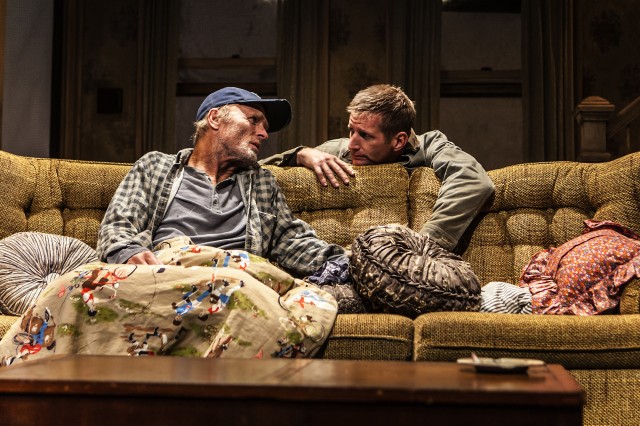
Dodge (Ed Harris) and Tilden (Paul Sparks) have a complicated father-son relationship in New Group revival of Sam Shepard’s BURIED CHILD (photo by Monique Carboni)
The New Group at the Pershing Square Signature Center
The Alice Griffin Jewel Box Theatre
480 West 42nd St. between between Ninth & Tenth Aves.
Tuesday – Sunday through April 3, $30-$115 www.thenewgroup.org
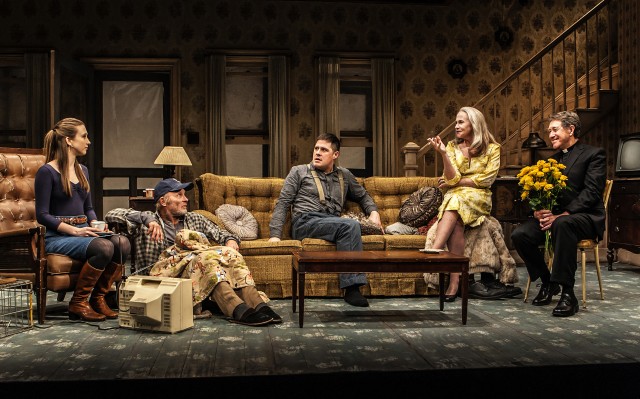
At a talkback following a recent performance of the New Group’s powerful, involving revival of Sam Shepard’s Buried Child at the Pershing Square Signature Center, actor Paul Sparks, who plays Tilden, said, “This is a play you learn about as you do it,” and several of the other actors nodded in agreement. Shepard won the 1979 Pulitzer Prize for Drama for this deep-rooted exploration of the decline of the American dream, but he has not stopped tinkering with it, and he has never explicated its many intricacies, not even to the actors themselves. In the preface to the 2006 revised edition of the play, Shepard explained that he made major changes for the 1995 Steppenwolf production because “enough time had elapsed for me to clearly see the holes in the play. . . . Finally, the language began to settle in and take hold. There were fewer gaps between the actors, the characters, and the words.” Shepard has revisited the play — which was nominated for five Tony Awards for that Steppenwolf version, including nods for director Gary Sinise, actors Lois Smith and James Gammon, and Best Play — once again for this latest edition, helmed by New Group founding artistic director Scott Elliott. Shepard didn’t make any huge alterations this time around, but he has done some nipping and tucking here and there. Perhaps the most critical change is that the play, which has always had three acts and two intermissions, is now being performed in a smooth-flowing 110 minutes without break; in addition, Ed Harris, who plays dying alcoholic patriarch Dodge, is already onstage as the audience enters the cozy Alice Griffin Jewel Box Theatre, spending upwards of a half hour drinking, dozing, and staring off into space as he sits uncomfortably on a ratty couch, an old baseball cap on his head. It’s a superbly effective introduction to Buried Child, a complex play about a dysfunctional family nonpareil, each member more wounded, physically and/or psychologically, than the next. Although their problems are primarily tied to a long-buried secret that has shattered them, it doesn’t appear that they had much happiness prior to that either. Dodge has given up on life, eking through a sickly, shriveled existence, trying to forget who he once was and what might have been. His wife, Halie (Amy Madigan), is in perpetual mourning for their dead son, Ansel, perhaps the family’s only hope at bettering its lot. Halie henpecks Dodge when she’s not out gallivanting around with Father Dewis (Larry Pine) and lording it over her husband. Meanwhile, son Bradley (Rich Sommer) stumbles on the periphery, a bear of a man who lost one of his legs in a chainsaw accident, and another son, Tilden, has returned after being thrown out of New Mexico for unspecified reasons. Tilden, an empty shell of a man, seems more ghost than human, making very little sense in those rare moments he speaks.
Family secrets threaten to implode a disillusioned clan in BURIED CHILD (photo by Monique Carboni)
Tilden keeps showing up with vegetables he has dug up in the backyard, even though Dodge and Halie insist that nothing has been planted in their dilapidated Illinois farm in decades. If things weren’t already crazy enough, Tilden’s college-age son, Vince (Nat Wolff), suddenly shows up with his girlfriend, Shelly (Taissa Farmiga), after disappearing for six years, and at first neither Dodge nor Tilden recognizes him, which makes Shelly want to leave. Vince is determined to become part of a family again, however, no matter how difficult and challenging that may be. But this is Shepard, so a happy ending may not exactly be on the horizon. It rains throughout much of the play, and occasional drops of water trickle down from the ceiling into a metal pail near the front of the stage, like a metronome interacting with the dialogue, or like a countdown clock ticking its way toward impending doom. Shepard injects lots of dark humor into the work, emphasizing the surreal nature of what is going on, even though the family is surrounded by a heavy shroud of death. As the play opens, Halie is unseen for several minutes as she screams down at Dodge from upstairs. “What’re you watching? You shouldn’t be watching anything that’ll get you excited!” she calls out, to which he responds, “Nothing gets me excited.” Dodge soon refers to himself as “the corpse” and “an invisible man,” claiming, “I don’t enjoy anything!” But he gets a little kick out of Shelly, who is not afraid to speak her mind. “It’s like a Norman Rockwell cover or something,” she says when she first enters, making fun of the house. “I thought it was going to be turkey dinners and apple pie and all that kinda stuff,” she adds once she’s sure that is not quite the case. (The wonderfully run-down living-room set is by Derek McLane.) Mysteries pervade, questions go unanswered, and subplots fade away even as revelations are made, all anchored by a mesmerizing performance by Oscar nominee Harris (Pollock, Wrecks), a Shepard veteran who won an Obie in 1984 for his portrayal of Eddie in the original off-Broadway production of Shepard’s Fool for Love and a 1995 Lucille Lortel Award for playing Carter in Shepard’s Simpatico. The decision to have Harris onstage from the time the doors open — and he never leaves — immediately bonds the audience to Dodge, as if he’s one of us, a bystander watching all the absurdity and chaos exploding around him. (It also gets rid of the dreaded entrance applause.) In fact, although he occasionally watches television, no glow or noise ever emanates from the TV, as if the actual show is what the rest of the characters are doing, which he is watching just as we are. Harris’s real-life wife, Oscar nominee Madigan (Twice in a Lifetime, Shepard’s A Lie of the Mind) — the couple costarred in the New Group’s production of Beth Henley’s underappreciated The Jacksonian in 2013 — is beautifully shrill as the nasty, deeply wounded Halie, playing her like a classic Tennessee Williams femme fatale. (Madigan played Stella opposite Alec Baldwin’s Stanley in Gregory Mosher’s 1992 revival of A Streetcar Named Desire.)
Sommer (The Unavoidable Disappearance of Tom Durnin,Harvey) provides fear and danger as Bradley, the ever-dependable Pine (Casa Valentina, A Public Reading of an Unpublished Screenplay About the Death of Walt Disney) is effectively neutral as the priest, and Sparks (Boardwalk Empire, The Killer) creates a zombielike Tilden exuding a dread that you can practically cut with a knife. Both Farmiga (American Horror Story, The Bling Ring) and Wolff (Heartbeat to Baghdad, The Fault in Our Stars) appear to have shown up from the current day (except for Wolff’s porn stache), although the play takes place at an inexact time during 1970s and there are no specific cultural references. (And for those of you keeping score at home, Pee Wee Reese never played for the Chicago White Sox, but he did hit three home runs for the Brooklyn Dodgers against the Chicago Cubs in Wrigley Field.) Farmiga, in her stage debut, is a little too chipper as the perky Shelly, but Wolff is strong as a young man desperate to reconnect with his family, regardless of what they have become. Themes of disillusionment, ennui, aging, love, lies, and loss permeate Buried Child, a tense, bitterly funny, heartbreaking tragedy that has been reimagined for this must-see revival that feels right at home at the Signature, imbued with freshness and vitality by Elliott (Mercury Fur, Hurlyburly); Shepard was the playwright-in-residence in 1996-97 for the Signature Theatre (but not at this location) and more recently was part of the company’s legacy program, and his large-scale portrait is on the wall alongside that of so many other Signature Theatre playwrights (such as August Wilson, Edward Albee, Tony Kushner, and Paula Vogel). Buried Child is a production of the New Group, not the Signature, but it’s an extremely satisfying sort of homecoming nonetheless, particularly for a show about home.