this week in theater

PROTOTYPE

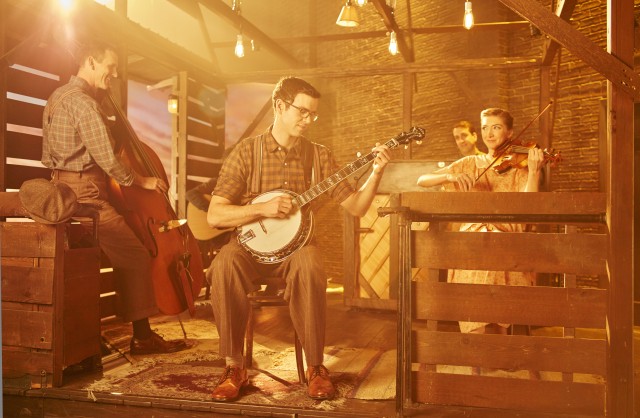
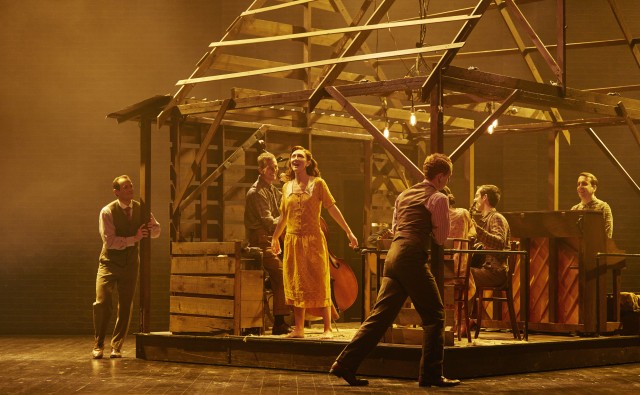
Enda Walsh’s first opera, THE LAST HOTEL, is part of fourth annual Prototype festival (photo by Hugh O’Conor)

Enda Walsh’s first opera, THE LAST HOTEL, is part of fourth annual Prototype festival (photo by Hugh O’Conor)

Multiple venues
January 6-17, $25 unless otherwise noted
www.prototypefestival.org

The fourth annual Prototype, consisting of pioneering, cutting-edge opera-theater and music-theater works by classical and postclassical composers, takes place January 6-17, consisting of seven presentations at multiple venues. The world premiere of composer Du Yun and librettist Royce Vavrek’s Angel’s Bone, about two angels returning to earth, features Abigail Fischer, Kyle Pfortmiller, Jennifer Charles, Kyle Bielfield, the Choir of Trinity Wall Street, and NOVUS NY and runs January 6, 9, 10, 12, 13, and 15-17 at 3-Legged Dog Art & Technology Center on Greenwich St. Vavrek also wrote the libretto for composer David T. Little’s Dog Days, making its New York City premiere January 9-11 ($25-$81) at NYU’s Skirball Center; the work is based on the short story by Judy Budnitz. Greek tragedy meets the Vietnam War in composer Heidi Rodewald and librettist Donna Di Novelli’s The Good Swimmer, a first-look presentation running at HERE January 7-17. Irish playwright and screenwriter Enda Walsh (Lazarus, Once, Hunger) wrote the libretto and directs composer Donnacha Dennehy’s The Last Hotel at St. Ann’s Warehouse January 8, 9, 10, 12, and 15-17 ($51-$61). Brooklyn-based five-piece Bombay Rickey brings its cinematic sound to HERE January 8-9 and 15-16 with a sixty-minute opera-cabaret work directed by Kristin Marting. Gregory Frateur and Nicolas Rombouts’s multimedia song cycle Sága makes its American premiere January 9-10 at National Sawdust. And on January 17, FIAF will host a one-time only concert reading of Jorge Sosa and Laura Sosa Pedroza’s La Reina, featuring mezzo-soprano Audrey Babcock, Laura Claycomb, and Christopher Burchett and conducted by David Allan Miller; it will be followed by a discussion moderated by Lawrence Edelson.

UNDER THE RADAR FESTIVAL

(photo by Laura Fouqueré)

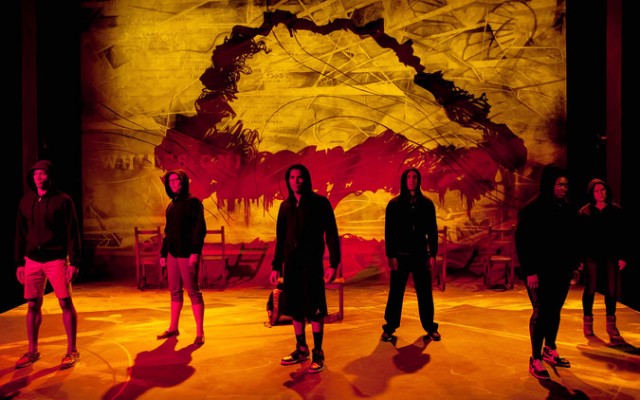
Dorothée Munyaneza and Compagnie Kadidi’s SAMEDI DÉTENTE is part of Public Theater’s annual Under the Radar Festival (photo by Laura Fouqueré)

The Public Theater unless otherwise noted
425 Lafayette St. by Astor Pl.
January 6-17, $25 unless otherwise noted
212-967-7555
www.undertheradarfestival.com

The Public Theater’s 2016 Under the Radar Festival features eighteen innovative music, dance, and theater hybrids from around the globe, taking place primarily at the Public’s many stages. The fun begins with the French duo of Halory Goerger and Antoine Defoort and Germinal (January 6-9, the Public’s Newman Theater), who use the magic of theater to build the world from scratch. Lars Jan and Early Morning Opera combine a 1950s typewriter with kinetic light sculptures in The Institute of Memory (TIMe) (January 8-17, the Public’s Martinson Hall), as Jan delves into his father’s past as a Cold War operative. Director Andrew Scoville, composer Joe Drymala, technologist Dave Tennent, and writer Jaclyn Backhaus team up for the live podcast People Doing Math Live! (January 8 & 17, the Public’s Shiva Theater), complete with audience participation. Canadian duo Liz Paul and Bahia Watson’s two-woman show pomme is french for apple returns to Joe’s Pub on January 10 & 17, exploring womanhood in unique ways. DarkMatter, the trans South Asian spoken-word duo of Alok Vaid-Menon and Janani Balasubramanian, will perform the concert #ItGetsBitter at Joe’s Pub on January 12 & 14. Individual tickets for Martha Redbone’s new Bone Hill (January 13-16, Joe’s Pub), a collaboration with Aaron Whitby and Roberta Uno, are sold out, but you can still catch the show as part of a UTR Pack (five shows for $100). Nikki Appino and Saori Tsukuda’s Club Diamond (January 13 & 17, Shiva) combines silent film, live music, and Japanese techniques to explore the concept of truth in thirty-five minutes. Dorothée Munyaneza, who was born in Rwanda and currently lives in France, brings her Compagnie Kadidi to the Public’s LuEsther Hall for Samedi détente (January 14-17), looking back at the 1994 genocide, joined by Ivorian dancer Nadia Beugré and French musician Alain Mahé. Japan’s Toshiki Okada, who was previously at UTR in 2011 with Hot Pepper, Air Conditioner, and the Farewell Speech and in 2013 with the Pig Iron Theatre Company for Zero Cost House, will be back at Japan Society with God Bless Baseball (January 14-17, $35), which examines America’s pastime in Korea and Japan.

(photo by Nadya Kwandibens)

Canadian Inuit throat singer Tanya Tagaq takes a unique look at NANOOK OF THE NORTH at Under the Radar Festival (photo by Nadya Kwandibens)

Canadian Inuit throat singer Tanya Tagaq will perform live to Robert J. Flaherty’s 19922 silent film, Nanook of the North, January 15-17 at the Newman, reclaiming her heritage, joined by percussionist Jean Martin and violinist Jesse Zubot. The 2016 Under the Radar Festival also includes 600 Highwaymen’s Employee of the Year (January 7-17, Martinson Hall), Royal Osiris Karaoke Ensemble’s The Art of Luv (Part I): Elliot (January 8-17, the Public’s Anspacher Theater), Sister Sylvester’s They Are Gone But Here Must I Remain (January 9 & 16, Shiva), I Am a Boys Choir’s demonstrating the imaginary body or how i became an ice princess (January 10 & 16, Shiva), Ahamefule J. Oluo’s Now I’m Fine (January 12-17, Newman), Guillermo Calderón’s Escuela (January 13-17, LuEsther Hall), Wildcat!’s I Do Mind Dying — Danse Précarité (January 14 & 17, Shiva), and Dane Terry’s Bird in the House (January 15-16, Shiva). In addition, numerous performances will be followed by Q&As with members of the creative teams, and there will be two free round-table discussions at the Public, “Assembly Required: New Media, New Dramaturgies” with Jan, André M. Zachery, and others on January 16 at noon and “Destroyer of Worlds” with Janani Balasubramanian, Abigail Browde, Calderón, Michael Silverstone, and Vaid-Menon on January 17 at noon.

COIL 2016

(photo by Jorge Lizalde)

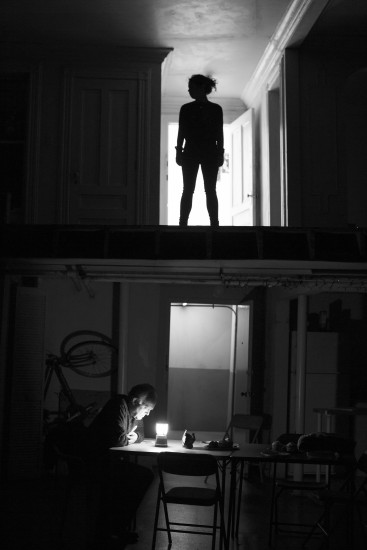
Ranters Theatre’s SONG kicks off COIL 2016 festival (photo by Jorge Lizalde)

Multiple venues
January 5-17, $20 unless otherwise noted
www.ps122.org

Every January, New York City is home to a handful of performance festivals that feature cutting-edge and experimental theater, dance, music, and installation art. PS122’s home at 150 First Ave. is scheduled to reopen this summer following a major renovation, but in the meantime you can experience its innovative programming at COIL 2016, taking place at various venues in Brooklyn, Queens, and Manhattan. “COIL 2016 attacks the very concept of boundaries and of limits. The boundaries between ideologies, life and death, the contemporary and historic, human and machine, light and darkness, audience and performer,” PS122 artistic director Vallejo Gantner explains on the event website. “Limitations of time, identity, age, and geography disappear. The work we will see this year deals with evolutionary transformation — personal, social, and artistic.” COIL begins on January 5 with Ranters Theatre’s Song (January 5-8), a sixty-minute immersive sound and visual installation at the New Ohio Theatre in which the audience can sit or lie down on the floor. Composer and vocalist Samita Sinha collaborates with Red Baarat percussionist Sunny Jain, guitarist and sound designer Greg Mcmurray, lighting designer Devin Cameron, visual artist Dani Leventhal, and director Ain Gordon on bewilderment and other queer lions (January 6-10, Invisible Dog Art Center), an intimate investigation of ritual and mythology through music, text, and image. Choreographer Jillian Peña’s Panopticon (January 9-17, Abrons Arts Center), a copresentation with American Realness, uses reflections to give a kaleidoscopic effect to a duet by Alexandra Albrecht and Andrew Champlin.

At the Baryshnikov Arts Center, Australians Helen Herbertson and Ben Cobham team up for Morphia Series (January 12-16), an eighteen-minute phantasmal environment for twelve audience members at a time. Annie Dorsen, whose Magical with Anne Juren was a highlight of COIL 2013, is back with Yesterday Tomorrow (January 13-16, La MaMa), in which Hai-Ting Chinn, Jeffrey Gavett, and Natalie Raybould go on a multimedia musical journey from the Beatles’ “Yesterday” to Annie’s “Tomorrow.” Asia Society will be hosting Xi Ban and Po Huang Club’s one-night only Shanghai / New York: Future Histories 2 (January 13, free with RSVP, 7:00 & 9:30), which melds Peking Opera with southern blues. The festival also includes niv Acosta’s Discotropic (January 6-10, Westbeth Artists Community), Frank Boyd’s The Holler Sessions (January 6-17, Paradise Factory), Kaneza Schaal’s Go Forth (January 7-12, Westbeth), David Neumann’s I Understand Everything Better (January 10-16, the Chocolate Factory), Ranters Theatre’s Intimacy (January 11-16, New Ohio Theatre), Chris Thorpe and Rachel Chavkin’s Confirmation (January 13-17, Invisible Dog), Jonathan Capdevielle’s Adishatz / Adieu (January 15-17, Abrons Arts Center), and Michael Kliën’s Excavation Site: Martha Graham U.S.A. (January 15, Martha Graham Studios, 3:00 – 7:00).

TAKE CARE

Brittane Rowe, Ashton Muñiz, Rachel Lin, and the rest of the Bats perform with the audience in TAKE CARE at the Flea Theater (photo by Bjorn Bolinder)

Brittane Rowe, Ashton Muñiz, Rachel Lin, and the rest of the Bats perform with the audience in TAKE CARE at the Flea Theater (photo by Bjorn Bolinder)

The Flea Theater
41 White St. between Broadway & Church St.
Thursday – Sunday through January 25, $15-$35
866-811-4111
www.theflea.org

If edgy participatory theater is your thing, especially with a distinctly controversial political bent, then Take Care is the show for you. The world premiere by the Bats, the Flea Theater’s resident company of young actors, is an immersive production that essentially begins the moment you enter the building on White St. in TriBeCa. You will be led downstairs to the basement one at a time by a Bat to a folding chair, where you decide how much you want to participate – featured participants will be given solo responsibilities, group participants will always be accompanied by at least one other participant, and voyeurs will mostly stay in the background. For nearly fifty minutes, the Bats use the central motif of hurricane destruction to explore climate change and racism in contemporary America, interacting with audience members who might shout a racist slur, get doused by a hose, or share a personal story. Each participant receives a unique series of precisely timed instructions, and everyone has enough time to prepare for their involvement. (Several monitors around the room display a running clock, in addition to various related videos.) “Everything you do tonight is perfect and absolutely right,” Rebeca Rad assures the crowd near the start. “If you mess up, it’s right. If you’re late, it’s right. If you laugh or cry or sit down early, it’s the absolutely right thing to do.”

Written by Elastic City’s Todd Shalom and Niegel Smith and directed by Smith, the Flea’s new artistic director, Take Care is a vibrant, thought-provoking, and fun show, even if the links between hurricanes, global warming, segregation, civil rights, and individual identity are often quite a stretch. The eager, energetic cast, which consists of Tommy “Tsunami” Bernardi, Maki Borden, Rachel Lin, Ashton Muñiz, Derek Christopher Murphy, Rad Pereira, Brittane Rowe, Isabella Sazak, Ryan Stinnett, and Catherine Woodard, does an excellent job of keeping things moving (along with choreographer and understudy Ethan Hardy) and making sure the participants are kept busy, even though audience members might at times find themselves outside their comfort zones, which of course is part of the point. I asked to be a featured participant, and I ended up with a scary responsibility that had me agonizing for forty minutes and fifty seconds (it was scheduled for 40:50), as it sets in motion events that result in a rather potent open discussion. No matter which participant level you choose, Take Care will have you looking deep inside, facing some harsh realities about yourself as well as where America is as a country today. Smith calls the show “a perfect storm to expose the ways we take care of and neglect one another,” and it is indeed very much about both the individual and the collective and how we consider our fellow human beings. Each performance is significantly different, as it changes depending on the audience. It also has a major effect on the Bats themselves; the night we went, one of the actors broke down in tears at the conclusion, moved by the power of what had just happened. It’s not for everyone, but adventurous theatergoers should not hesitate to become part of what is going on in the Flea’s basement Thursday through Sunday nights through January 25.

COLIN QUINN: THE NEW YORK STORY

(photo by Mike Lavoie)

Colin Quinn explores the history and development of the New York character in one-man show (photo by Mike Lavoie)

Cherry Lane Mainstage Theatre
38 Commerce St.
Tuesday – Sunday through January 31, $25-$96
212-989-2020
www.colinquinnthenewyorkstory.com
www.cherrylanetheatre.org

Colin Quinn likes to tackle big subjects. In 2010, the actor and comedian took Broadway audiences on a journey through the history of the world in Long Story Short. In 2013 at the Barrow Street Theatre, the gruff Brooklyn-born comic explored American history in Unconstitutional. In his latest seventy-five-minute one-man show, The New York Story, based on what he claims will be his only book, The Coloring Book: A Comedian Solves Race Relations in America, Quinn examines the development (and death) of the New York persona. “Our tourist attraction is the people. Nobody else had people like this,” he says near the start of the show. “Smoking cursing rude sarcastic pushy loud fast-talking outspoken. It’s not a pleasant personality but it was entertaining and honest.” Slowly ambling across Sara C. Walsh’s old-time set, which features a classic New York City stoop, a laundry line of drying clothing, stacks of wooden crates, and small flags from many nations, Quinn discusses the Indians, the Dutch, the British, the Germans, the Irish, the Jews, the Italians, the Puerto Ricans, and the blacks, not afraid to be politically incorrect as he details what each ethnicity, religion, and race contributed to New York City. He’s no stranger to edgy material: He hosted the politically oriented comic talk show Tough Crowd, was formerly the anchor of “Weekend Update” on Saturday Night Live, has a recurring role on Girls, and played Amy Schumer’s father in Trainwreck. He can be wickedly funny about each group while respecting their individual heritages, but he’s also clearly upset about where we are today, seemingly drained of our uniqueness as New Yorkers. “First of all: positivity, inclusion, non-judgmentalism, those are all great qualities to have,” he points out. “But not in New York. This city was supposed to be the sanctuary city for the judgmental, the obnoxious, the non-positive. That’s the thing. And somewhere along the way we decided to appropriate the rest of the country’s positivity.”

The show, which begins with Odyssey’s “Native New Yorker” and concludes with Ace Frehley’s “Back in the New York Groove,” is directed by Jerry Seinfeld, who also helmed Long Story Short. It includes projections of city monuments and subway signs that are sometimes hard to make out, and Quinn often seems to be trying too hard to hit his mark instead of being more natural. But his verbal delivery is superb, speaking to the audience like he’s sharing a beer with us instead of lecturing like a professor, rambling through broken sentences as he uses his gruff Brooklyn Irish accent to expound on the state of the city he, and we, love. “The immigrants are the only ones who are still authentic,” Quinn explains. Amid all the laughs, the truth hurts. Tickets for the show are allocated geographically, from $56 for the Coney Island and Red Hook seats in the rear to, getting ever closer to the stage, $76 for Hell’s Kitchen and $96 for Washington Heights and Yonkers.

THESE PAPER BULLETS!

(photo by Ahron R. Foster)

THESE PAPER BULLETS! mixes Shakespeare with the Fab Four at the Atlantic (photo by Ahron R. Foster)

Atlantic Theater Company
Linda Gross Theater
336 West 20th St. between Eighth & Ninth Aves.
Tuesday – Sunday through January 10, $75
866-811-4111
atlantictheater.org

These Paper Bullets!, Rolin Jones’s Yale Rep transport of Shakespeare’s Much Ado About Nothing to swinging 1964 London, looks and sounds great. Jessica Ford’s Mary Quant-inspired Mod costumes feature polka dots, brightly colored miniskirts, and fashionable boots and shoes, while Billie Joe Armstrong’s Beatlesque songs offer a fun twist on the Fab Four’s musical style. Unfortunately, the rest of this overly silly frenetic farce is dreadfully unfunny, a Monty Python-like sketch that in this case goes on for a long, drab two hours. The Quartos — Ben (Justin Kirk), Claude (Bryan Fenkart), Balth (Lucas Papaelias), and Pedro (James Barry) — are England’s hottest band, making women swoon wherever they go. Claude has fallen for Twiggy-esque model Higgy (Ariana Venturi), the daughter of hotel owner Leo Messina (Stephen DeRosa), while Ben and fashion designer Bea (Nicole Parker) develop a kind of love-hate relationship. Everything threatens to come crumbling down when fired drummer Don Best (Adam O’Byrne), Pete’s brother, decides to exact revenge on the Quartos and their manager, Anton (Christopher Geary), with the help of reporter Boris (Andrew Musselman). Meanwhile, Scotland Yard is suspicious of the Quartos and their success, so Mr. Berry (Greg Stuhr) sends Mr. Cake (Tony Manna) and Mr. Urges (Brad Heberlee) undercover to find out what the band is really up to. The shenanigans are annoyingly detailed throughout by TV journalist Paulina Noble (Liz Wisan), including a ridiculous appearance by the queen (Geary). These Paper Bullets! is supposed to be a madcap romp melding Shakespearean iambic pentameter with the sheer glee of Richard Lester’s Beatles films, but it falls flat again and again, despite a game cast. Jackson Gay, who will be directing Much Ado About Nothing this spring at Cal Shakes, can’t make heads or tails of Jones’s nonsensical script (the two previously collaborated on The Intelligent Design of Jenny Chow and The Jammer, both at the Atlantic), getting a total of two chuckles out of me as the Bard and Beatles references zoom by at a groaning pace. In a nice touch, the Quartos perform such songs as “Give It All to You” and “Love Won’t Wait” on a rotating stage in the shape of a vinyl record; Green Day’s Armstrong, whose American Idiot ran on Broadway five years ago, knows his Mop Tops, but most of the rest of These Paper Bullets! shoots nothing but blanks, desperately in need of some real help.

LAZARUS

(photo by Jan Versweyveld)

Michael C. Hall reprises David Bowie role from THE MAN WHO FELL TO EARTH in LAZARUS at NYTW (photo by Jan Versweyveld)

New York Theatre Workshop
79 East Fourth St. between Second & Third Aves.
Tuesday – Sunday through January 19, $129; Wednesday, January 20 benefit, $1,004 – $2,504
www.nytw.org

David Bowie’s resurrection after a long public absence continues with Lazarus, an intriguing, at times captivating, and often confusing musical drama at New York Theatre Workshop though January 20. A little over a decade ago, in June 2004, the iconoclastic British artist suffered a heart attack onstage and underwent emergency surgery. He stayed out of the limelight after that, making only rare appearances and not releasing a new record until 2013, The Next Day, declaring on the title track, “Here I am / Not quite dying / My body left to rot in a hollow tree / Its branches throwing shadows / On the gallows for me / And the next day / And the next / And another day.” But evidently with a renewed lust for life, Bowie has been very busy over the last few years, and he takes a fascinating look at his personal and professional past, present, and future in Lazarus, a multimedia collaboration with playwright Enda Walsh (Once, The Walworth Farce) and heavily in-demand director-of-the-moment Ivo van Hove (Scenes from a Marriage, A View from the Bridge). The show picks up some forty years after the end of The Man Who Fell to Earth, the 1976 Nicolas Roeg film in which Bowie portrayed Thomas Jerome Newton, an alien who comes to Earth to collect water to save his planet. As the audience enters the theater, Newton (Michael C. Hall) is lying flat on the stage, as if dead. He eventually rises, met by his old friend Michael (Charlie Pollock) and his new assistant, Elly (Cristin Milioti). Newton is now a retired, reclusive, wealthy former businessman who stays at home drinking gin and eating Lucky Charms and Twinkies, watching a large television screen that broadcasts things going on in his head as he agonizes over his loneliness, his wife and daughter long gone from his life. “Don’t you remember the person you were? Your life outside,” Michael asks. “That was before,” Newton answers. “And it’s all gone?” Michael says. “Of course it’s gone,” Newton responds shortly before singing “Lazarus,” one of four new songs Bowie has written for the show. “Look up here, I’m in heaven / I’ve got scars that can’t be seen / I’ve got drama, can’t be stolen / Everybody knows me now / Look up here, man, I’m in danger / I’ve got nothing left to lose,” Hall sings in a strong Bowie accent. The music is performed live by a band in a glassed-in booth across the back of the stage, behind Jan Versweyveld’s apartment set, which features a refrigerator at the right (next to a record player on the floor with a pile of Bowie LPs), a bed at the left, and a large screen at the center. Newton is soon visited by a young girl (Sophia Anne Caruso) who he knows is a figment of his imagination, there to help him find purpose in his life, as well as hers. “You’re not dying, are you?” she asks. “A little bit every day. I’m a dying man who can’t die,” he says. “That’s a joke, right?” she replies. “Yes, not being able to die is a joke. A fucking terrible joke,” he states. Newton’s life is further complicated by three teenage girls (Krystina Alabado, Krista Pioppi, and Brynn Williams) who form a kind of Greek chorus, the mysterious Valentine (Michael Esper), Elly’s jealous husband, Zach (Bobby Moreno), and a couple madly in love, Maemi (Lynn Craig) and Ben (Nicholas Christopher).

(photo by Jan Versweyveld)

Ivo van Hove’s LAZARUS uses David Bowie songs to explore love and loneliness (photo by Jan Versweyveld)

Lazarus was inspired by Walter Tevis’s 1963 science-fiction novel, The Man Who Fell to Earth, in which Newton is described thusly: “He was human; but not, properly, a man. Also, man-like, he was susceptible to love, to fear, to intense physical pain and to self-pity.” Hall (Hedwig and the Angry Inch, Cabaret) embodies the character with a tender simplicity despite the craziness that Newton is experiencing. As the girl, Caruso again shows intelligence and instincts well beyond her fourteen years, as she did earlier in 2015 in Jennifer Haley’s The Nether. The music, consisting of new arrangements of Bowie classics and deep cuts, from 1970’s The Man Who Sold the World, 1971’s Hunky Dory, 1980’s Scary Monsters, and The Next Day, in addition to the four new songs, is a treat for Bowie fans, especially the Japanese and English “It’s No Game (Part 1),” Pollock’s “The Man Who Sold the World,” Hall’s “Where Are We Now?” and “Killing a Little Time,” and Caruso’s “Life on Mars.” In a soft, gentle version of “Changes,” Tony nominee Milioti (Once) sings “Turn and face the strange,” and strangeness is just what keeps this production from soaring into the stratosphere. Too much of Lazarus, which is about love and loss and making connections, is head-scratchingly opaque, particularly the use of the video monitor; Tal Yarden’s projections are occasionally poetic and visually striking but much more often bewildering, muddying the narrative with perplexing shots that could be memories, long-gone dreams and desires, or — well, by the time Alan Cumming appears onscreen, you can forget about trying to figure out what’s going on. But if you instead concentrate on Hall’s thrilling performance, the central relationship between Newton and the girl, and the outstanding musical numbers, Lazarus will lift you up, making you thankful that Bowie has returned to Earth to share his unique, and plenty strange, world view with us mere mortals again.