this week in theater

SHAKESPEARE IN THE PARK: TROILUS AND CRESSIDA

(photo by Joan Marcus)

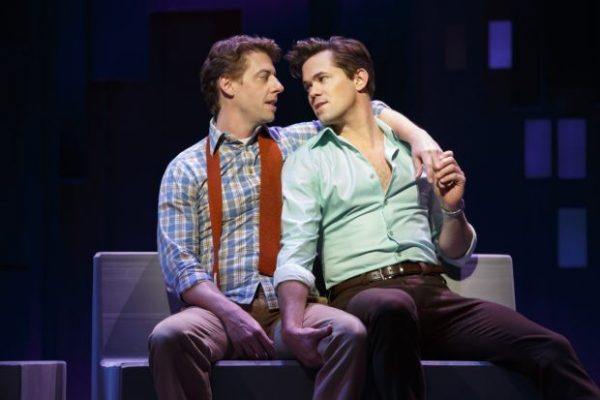
Pandarus (John Glover) brings together Troilus (Andrew Burnap) and Cressida (Ismenia Mendes) in new Shakespeare in the Park production (photo by Joan Marcus)

Central Park
Delacorte Theater
Through August 14, free, 8:00
publictheater.org

For the third time in the fifty-six-year history of Shakespeare in the Park, the Public Theater is taking on the seldom-performed, less-than-popular Troilus and Cressida at the Delacorte. One of William Shakespeare’s so-called problem plays, the work has fairly obvious issues, including convoluted story lines, subplots that never get resolved or have bleak conclusions, and a narrative that uneasily shifts between comedy, tragedy, history, and romance. In 1965, Public Theater founder Joseph Papp directed a production starring Richard Jordan as Troilus, Flora Elkins as Cressida, and James Earl Jones as Ajax, and thirty years later Mark Wing-Davey helmed a version with Neal Huff as Troilus, Stephen Spinella as Pandarus and Calchas, Elizabeth Marvel as Cressida, Catherine Kellner as Cassandra, and Tim Blake Nelson as Thersites. Shakespeare director extraordinaire Daniel Sullivan is firmly in charge of this latest adaptation, set in modern times, complete with contemporary military weapons and clothing, pounding music by Dan Moses Schreier, and blazing strobe lights by Robert Wierzel. David Zinn’s stark red set features a movable wall of doors in the back, small caged rooms at either side, and detritus composed of old chairs and other items at front stage left and right. (Zinn also designed the cool costumes.) The great John Glover begins and ends the play as Pandarus, the hobbled uncle of the lovely Cressida (Ismenia Mendes), daughter of Trojan priest Calchas (Miguel Perez), who has defected to the Greeks. Pandarus serves as a kind of matchmaker for his niece, who is coveted by Troilus (Andrew Burnap), son of Priam (Perez), king of Troy. (Yes, the word “pander” came from the character Pandarus.) Troilus and Cressida seal their true love with a night of passion, but the next day she discovers that she is to be sent to the Greeks, and back to her traitorous father, in exchange for a Trojan captive, Antenor (Sanjit De Silva). At the Greek camp she is wooed by Diomedes (Zach Appelman) while trying to remain faithful to her beloved Troilus. Meanwhile, after seven years of the Trojan War, both sides seek one-on-one combat, with first dimwitted warrior Ajax (Alex Breaux) and then hunky fighter Achilles (Louis Cancelmi), who has a thing for the effeminate Patroclus (Tom Pecinka), taking on one of Troilus’s brothers, the brave and true Hector (Bill Heck). Watching over it all are the leaders of the Greeks, general Agamemnon (John Douglas Thompson), elderly mentor Nestor (Edward James Hyland), the cuckolded Menelaus, Agamemenon’s brother (Forrest Malloy), and sly, clever adviser Ulysses (Corey Stoll). Lust, jealousy, pride, and power drive the mishmash story to its violent finale.

(photo by Joan Marcus)

Ulysses (Corey Stoll) tries to explain things to the none-too-bright Ajax (Alex Breaux) in TROILUS AND CRESSIDA at the Delacorte (photo by Joan Marcus)

Inspired by Chaucer’s poem “Troilus and Criseyde” and Homer’s The Iliad, Shakespeare’s play, which scholars believe was a late, unpaginated addition to the first folio, is all over the place, unable to find a central focus. But six-time Tony nominee (and one-time winner) Sullivan (The Merchant of Venice, Proof) manages to keep a precarious balance among the kitchen-sink events while also making it relevant to today’s ongoing wars in the Middle East, helped by fine performances by Burnap, who just graduated from the Yale School of Drama; Mendes (The Wayside Motor Inn, Family Furniture), who plays Cressida with a tentative, nuanced charm; Breaux (Red Speedo, Much Ado About Nothing), who brings a humorous doofiness to Ajax; Max Casella (The Lion King, Timon of Athens), who relishes his role as Thersites, the nasty fool, who declares, “The common curse of mankind, folly and ignorance”; Heck (The Merchant of Venice, Night Is a Room) as the honorable warrior Hector; and most especially Delacorte veteran, five-time Emmy nominee, and Tony winner Glover (Much Ado About Nothing, Love! Valour! Compassion!) as Pandarus, who immediately has the audience eating out of the palms of his very able hands. Troilus and Cressida might not be one of Shakespeare’s best works, but Sullivan and his excellent cast have turned it into a very welcome and entertaining production, despite its many flaws.

THE MUSHROOM CURE

Adam Strauss shares his quest for magic mushrooms to beat his OCD in one-man show (photo by Dixie Sheridan)

Adam Strauss shares his quest for magic mushrooms to cure his OCD in one-man show (photo by Dixie Sheridan)

Cherry Lane Studio Theatre
38 Commerce St.
Tuesday – Sunday through August 13, $19-$26
212-989-2020
themushroomcure.com
www.cherrylanetheatre.org

A hit at the 2014 Fringe Festivals in Edinburgh and New York, Adam Strauss’s cute and charming one-man show about his real-life battle with OCD, The Mushroom Cure, has been extended at the Cherry Lane Studio, in a streamlined, finished version, pared down to a swift eighty-five minutes from its original nearly two-hour length. In the play, Strauss shares the intimate details of his struggle with obsessive compulsive disorder, but he explains that he is not a hand washer, a stove checker, a counter, or any of the more well known types of OCD sufferers. Instead, Strauss has trouble making decisions, whether selecting an MP3 player, figuring out which shirt to wear, or choosing which side of the street to walk down. “Pick the right one pick the right one pick the right one pick the right one!” he says with both frustration and determination. “Go! Go! Go! No! No! No! Go no go no go no go!” He’s tried yoga, meditation, multiple medications, psychotherapy, CBT, and other treatments, but none of them have worked. He then becomes intrigued by a Journal of Clinical Psychiatry report about a study that has shown that in some cases a single does of psychedelic mushrooms can actually cure a person’s OCD. So he sets out on a mission to get his hands on the magic fungi and rid himself of this dread mental illness. In the meantime, Strauss, who is haunted by the breakup with his previous girlfriend, Annie, becomes interested in a Kansas tourist named Grace who is in the city for a psychology conference. But the more they are drawn to each other, the more his OCD threatens to get in the way.

the mushroom cure

Written by Strauss, a Brooklyn-based stand-up comic, and directed by Jonathan Libman (The Bench, Shall I Fetch the Apparatus?), The Mushroom Cure is an intimate portrait of mental illness, romance, and dick slapping. Strauss, who walks around the nearly empty stage, occasionally sitting in a chair and taking a drink of water from several glasses on a small table, does such an excellent job of relating the character of Grace that afterward you might forget that this was a one-man show, with no actress playing her. Strauss (The Uncertainty Principle) also plays his drug dealer, Slo, as well as his goofball psychiatrist, who calls him “Guy.” Strauss sometimes moves too quickly between self-effacement and self-approval, and the lighting can get a little confusing, particularly when it goes completely off and the audience wonders whether to clap or not. But most of all The Mushroom Cure will delight you and have you laughing at the ridiculousness of it all while also making you think about your own possible OCD, or that of a loved one. “Some of you didn’t think you had OCD when you walked in here, but now you’re like, wait, did this show give me OCD?” It might also have you seeking out magic mushrooms. All profits from the Cherry Lane run will go to the Multidisciplinary Association for Psychedelic Studies, which conducted the study that set Strauss off on his quest, which he generously shares with the rest of us.

THE SEEING PLACE THEATER: GETTING OUT / RHINOCEROS

The Seeing Place Theater is presenting RHINOCEROS, above, with Marsha Normans GETTING OUT at the Lynn Redgrave Theater

The Seeing Place Theater is presenting Eugène Ionesco’s RHINOCEROS, above, in repertory with Marsha Norman’s GETTING OUT at the Lynn Redgrave Theater

The Seeing Place @ the Lynn Redgrave Theater
45 Bleecker St. at Lafayette St.
Through August 7, $15
www.seeingplacetheater.com

The actor-driven Seeing Place Theater, whose name is the English translation of the Greek word theatron, continues its presentation of two very different works through this weekend as part of its “But Who Am I, Really” season. The company’s seventh season consists of Pulitzer Prize winner Marsha Norman’s Louisville-set debut play, 1978’s Getting Out, and Romanian-French absurdist Eugène Ionesco’s 1959 classic, Rhinoceros. The former follows a Kentucky woman trying to put her life back together after being released from prison, while the latter deals with a French villager recovering from a hangover as rhinos start stampeding all around him. Getting Out is directed by TSP founding managing director Erin Cronican, who also stars as Arlene, while Rhinoceros is directed by TSP founding artistic director Brandon Walker, who plays Berenger. “The more we’ve explored these plays as a pair the more we’ve noticed the profound amount of conformity society demands of us in order to keep us ‘civilized,’” Walker explained in a statement. “In both plays our central protagonist is faced with a fateful opportunity to step into a new reality, but who really makes this choice — the individual or society?” TSP has previously staged productions of such works as Macbeth, Hamlet, Othello, Martin McDonagh’s The Pillowman, Johnna Adams’s Gidion’s Knot, Lee Blessing’s Two Rooms, and Harold Pinter’s The Lover.

QUIETLY

QUIETLY

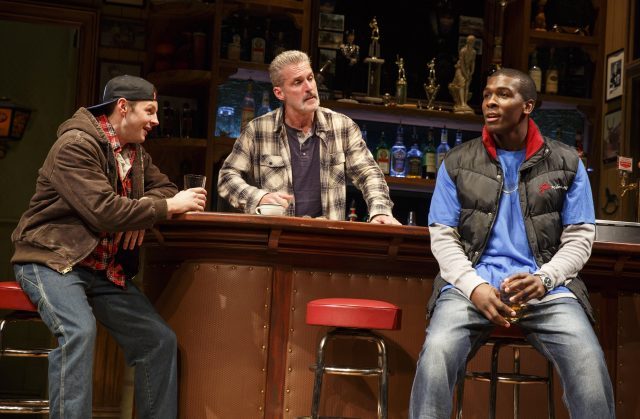
Ian (Declan Conlon), Robert (Robert Zawadzki), and Jimmy (Patrick O’Kane) do more than just watch the match in Owen McCafferty’s QUIETLY

Irish Repertory Theatre
132 West 22nd St. between Sixth & Seventh Aves.
Tuesday – Sunday through September 11, $50 – $70
212-727-2737
www.irishrep.org

Owen McCafferty’s searing, sharp-edged, fictional Quietly might be set in a Belfast pub in 2009, but its theme is so frighteningly universal that it could be describing real events in any part of the world today. Polish émigré and barman Robert (Robert Zawadzki) is watching a World Cup qualifier between Poland and Northern Ireland when everyday regular Jimmy (Patrick O’Kane) comes in for a few pints. A bitter, angry man with a massive chip on his shoulder, Jimmy claims not to care about the game, or the news about a pub that was smashed up by some Poles. He warns Robert that there is likely to be a different kind of trouble when a man he is waiting for arrives. “But it’s nothin for you to worry about,” Jimmy says. Robert: “No trouble — can’t afford for trouble — I get the blame.” Jimmy: All a meant was just in case there was a bit a shoutin — don’t panic.” Robert: “A bit of shouting.” Jimmy: “Yes, a bit a shoutin — nothin for you to get involved in — ya understan — stay out of it — nothin to do with you.” Robert: “A bit of shouting — everyone shouts here — it’s the national sport.” Jimmy: “We all need to be heard at the same time.” The soft-spoken Robert is in Northern Ireland trying to make a new life for himself but is stuck in the same rut. “I didn’t come over here to be a barman — Belfast isn’t barman mecca — not the fucking capital of the barman world — I came over to work and ended up a barman because I was one before,” he tells Jimmy, who is lost in his own drama. The situation explodes almost immediately when Ian (Declan Conlon) enters the pub. Although both Ian and Jimmy are fifty-two and well aware of each other’s existence, they have never met before, despite their involvement in an event thirty-six years earlier that profoundly altered both their lives. “I’m here because we’re the same age,” Ian says. “You’re not my fuckin age — my age has to do with the life I’ve led — you haven’t led my life,” Jimmy responds, to which Ian adds, “I led a life — my life.” As the facts slowly start coming out on what happened on that fateful day of July 3, 1974, the tension builds to a shattering conclusion.

The award-winning Abbey Theatre production, being staged at the Irish Rep in association with the Public Theater, is a sizzling drama zeroing in on how politics, religion, status, and birthplace can tear people apart, leading to senseless violence no matter what side you’re on. It’s also very much about forgiveness, specifically referencing the controversial truth and reconciliation process. Conlon (The House, Terminus) is rock solid as Ian, carefully balancing pride and regret, and Zawadzki (The Shoemakers, Who Is That Bloodied Man?) is calm as Robert, who is caught in the middle. But Quietly belongs to the Belfast-born O’Kane (The House, As the Beast Sleeps), who won several UK best actor awards for his compelling performance. O’Kane commands the stage, whether sitting with crossed arms on a barstool, drinking a pint of Harp, or confronting Ian face-to-face. (Catherine Fay’s set is based on a real pub that McCafferty used to live near and which was blown up by the Ulster Volunteer Force.) You can almost see the heat rising from O’Kane’s bald pate. It’s a memorable performance in a gripping play, tautly directed by Lyric Theatre executive producer Jimmy Fay (The Risen People, Here Comes the Night). And it ends with a final reminder that, in this increasingly polemic, xenophobic world, anyone could be next.

TICKET ALERT: BAM 2016 NEXT WAVE FESTIVAL

Mikhail Baryshnikov channels Nijinsky in Robert Wilsons LETTER TO A MAN (photo by Lucie Jansch)

Mikhail Baryshnikov channels Nijinsky in Robert Wilson’s LETTER TO A MAN (photo by Lucie Jansch)

Who: Performers and/or creators Mikhail Baryshnikov, Isabelle Huppert, Ivo van Hove, Robert Wilson, Peter Brook, John Jasperse, Godspeed You! Black Emperor, Alarm Will Sound, Howard Fishman, David Lang, Jonah Bokaer, Daniel Arsham, TR Warszawa, Cheek by Jowl, the Magnetic Fields, So Percussion, Wordless Music Orchestra, Shen Wei Dance Arts, Kyle Abraham / Abraham.In.Motion, Faye Driscoll, Mark Morris Dance Group, and many more
What: Annual fall interdisciplinary performance festival
Where: BAM Harvey Theater (651 Fulton St.), BAM Howard Gilman Opera House (30 Lafayette Ave.), BAM Fisher (321 Ashland Pl.)
When: September 7 – December 3
Why: Tickets for BAM’s 2016 Next Wave Festival have just gone on sale to the general public, but you better hurry if you want to see some of the hottest shows of what is always a great collection of innovative dance, music, film, theater, and hard-to-describe hybrid presentations from around the world. This year there are more than five dozen events, including performances, talks, and master classes. We don’t know about you, but we’ll be practically living at BAM this fall. Below are five of our don’t miss favorites.

Isabelle Huppert stars as a modern-day mythical queen in PHAEDRA(S) (photo by Pascal Victor/ArtComArt)

Isabelle Huppert stars as a modern-day mythical queen in PHAEDRA(S) (photo by Pascal Victor/ArtComArt)

PHAEDRA(S)
BAM Harvey Theater
September 13-18, $30-$95
Isabelle Huppert is back at BAM, following her stunning turns in Sarah Kane’s 4.48 Psychosis in 2005 and Robert Wilson’s Quartett in 2009. This time she stars as the mythological queen in Phaedra(s), in which director Krzysztof Warlikowski and Odéon-Théâtre de l’Europe incorporate texts by Kane, Wajdi Mouawad, and J. M. Coetzee to tell the three-and-a-half-hour story of love and tragedy. On September 18, BAM will host the related panel discussion “Phaedra Interpreted” at Borough Hall as part of the Brooklyn Book Festival.

REMAINS
BAM Harvey Theater
September 21-24, $20-$45
John Jasperse, who presented the exhilarating Canyon at BAM in 2011, now looks back at his thirty-year career as well as toward the future in Remains, featuring dancers Maggie Cloud, Marc Crousillat, Burr Johnson, Heather Lang, Stuart Singer, and Claire Westby and music by John King. On September 22 at 2:00 ($30), Jasperse will teach a master class for intermediate to professional dancers at the Mark Morris Dance Center, and on September 23 at 6:00 ($25) he will participate in a talk with Tere O’Connor at BAM Fisher.

LETTER TO A MAN
BAM Harvey Theater
October 15-30, $35-$120
BAM regular Robert Wilson reteams with Mikhail Baryshnikov in this multimedia staging of the diaries of Vaslav Nijinsky; the two collaborated at BAM in 2014 with The Old Woman. Baryshnikov recently paid tribute to his friend Joseph Brodsky in Brodsky/Baryshnikov, while Wilson has presented such aural and visual spectacles at BAM as Quartett, The Black Rider, and Woyzeck. On October 24 at 7:00 at NYU’s Center for Ballet and the Arts, “Inside Nijinsky’s Diaries” will consist of an actor reading from the diaries, followed by a discussion (free with advance RSVP).

Ivo van Hove merges multiple Shakespeare plays into KINGS OF WAR (photo by Jan Versweyveld)

Ivo van Hove merges multiple Shakespeare plays into KINGS OF WAR (photo by Jan Versweyveld)

KINGS OF WAR
BAM Howard Gilman Opera House
November 3-6, $24-$130
In-demand director Ivo van Hove and Toneelgroep Amsterdam return to BAM for a four-and-a-half-hour adaptation of Shakespeare’s Henry V, Henry VI Parts I, II & III, and Richard III. Van Hove has previously staged such works as Angels in America, Cries and Whispers, and Antigone (with Juliette Binoche) at BAM, in addition to the double shot of A View from the Bridge and The Crucible on Broadway.

THANK YOU FOR COMING: PLAY
BAM Fisher
Judith and Alan Fishman Space
November 16-19, $25
Choreographer Faye Driscoll follows up Thank You for Coming: Attendance with this new work, which we got a sneak peek at this past weekend on Governors Island. Driscoll’s presentations (There is so much mad in me, 837 Venice Blvd.) are always involving and unpredictable, and this piece is no exception. Driscoll will also be teaching a master class on November 18 at 2:00 ($30) for performers at all levels.

PRIVACY

Daniel Radcliffe and Reg Rogers in PRIVACY (photo by Joan Marcus)

A closed-down writer (Daniel Radcliffe) has trouble opening up to a psychiatrist (Reg Rogers) in PRIVACY at the Public (photo by Joan Marcus)

Newman Theater, the Public Theater
425 Lafayette St. at Astor P.
Tuesday through Sunday through August 14, $100
212-539-8500
www.publictheater.org

Tickets to James Graham and Josie Rourke’s Privacy come with a unique set of terms and conditions, advising “Privacy is a unique theatrical production that involves interactive moments with the audience, designed to explore how public many details of our lives have become. In order to better explore these issues, information that you provide when purchasing ticket(s) to the production of Privacy at the Public Theater will be used to inform some moments during your performance.” As far as “involving” theater goes, this coproduction with London’s Donmar Warehouse takes it to the next level, especially when, right before the show begins, the prerecorded voice of Public Theater artistic director Oskar Eustis asks audience members to leave their phone on, and then an address is given where they can send photos and texts to. Daniel Radcliffe stars as the Writer, a young man obsessing over his recent breakup with his boyfriend, who accused him of being too closed off. He is too scared to open up and share his innermost thoughts even with a psychiatrist (Reg Rogers), who guides him into situations in which he mentally faces his divorced parents (Rachel Dratch and Michael Countryman) and meets experts on information technology, cybersecurity, surveillance, social media, and personal privacy in the age of the iPhone. Among those he speaks with are Harvard professor Jill Lepore, journalists Ewen MacAskill and James Bamford, OKCupid cofounder Christian Rudder, MIT professor Sherry Turkle, former Facebook marketing director Randi Zuckerberg, FBI director James Comey, and U.S. senator Ron Wyden. These experts and family who enter the Writer’s mind are played by De’Adre Aziza, Raffi Barsoumian, an excellent Countryman, a terrific Dratch, and an outstanding Rogers and are identified by a projection of their faces and credentials on a large rear wall; all of their words are based on original interviews conducted by Graham and Rourke. As the Writer considers sharing more of his life with the psychiatrist as well as online, the audience is asked numerous times to text information or photos that are processed by onstage researcher Harry Davies and, within minutes, are incorporated into the show in clever ways. It’s almost like magic, but instead of pulling a rabbit out of a hat, Davies reveals surprisingly easy-to-access details about audience members. It’s both funny and frightening, but to say much more would give away too many of the show’s “tricks,” including a video appearance by a very special guest near the end.

Daniel Radcliffe and Reg Rogers in PRIVACY (photo by Joan Marcus)

Privacy concerns, with the onstage actors as well as audience members, are at the heart of James Graham and Josie Rourke’s participatory show (photo by Joan Marcus)

The casting of Radcliffe (The Cripple of Inishmaan, Equus) to play the shy, reserved Writer works on two major levels; first, he is excellent in the role, his unwillingness to talk about himself and his hesitant body movements beautifully capturing his character’s fears. In addition, Radcliffe became such an international star from the Harry Potter movies that he probably enjoys very little privacy in real life. He is particularly effective in a scene that may or may not be mostly improvised. When he is not the main subject of attention in the show, it drags significantly, but fortunately that is never for too long. Lucy Osborne’s uncomplicated set design allows Duncan McLean’s creative projections to often steal the audience’s attention, especially when — well, you’ll have to find that our for yourself, but don’t be surprised if you discover something rather personal about various people seated around you. Meanwhile, you won’t learn much about the cast in the Playbill, as numerous words and sentences have been redacted. And if you’re wondering who is providing the voiceovers, it’s British actors Simon Russell Beale and Harriet Walter. The first half of the show, which focuses on the Writer, is much stronger than the second half, which occasionally gets lost in the marvels of technology and the implications of sharing private information online. Also, if you already closely follow the ongoing controversies about government surveillance, drones, hacked email servers, smartphone protections, social media and online shopping algorithms, and other such privacy concerns, you might not learn much that is new. But writer Graham (This House, Finding Neverland) and director Rourke (Les Liaisons Dangereuses, City of Angels), who have also collaborated on The Vote at the Donmar Warehouse, maintain just enough drama to keep all of the data from overwhelming the story. (Radcliffe will be taking part in a TimesTalk with director Daniel Ragussis at the TimesCenter on August 8 at 7:00, discussing their upcoming film, Imperium; tickets are available here.)

EUDORA WELTY — MISSISSIPPI STORIES

Jenny Odle Madden and Alice Rainey Berry bring Eudora Welty and one of her most beloved stories to life in MISSISSIPPI STORIES (Fowler Photography)

Jenny Odle Madden and Alice Rainey Berry bring Eudora Welty and one of her most beloved tales to life in MISSISSIPPI STORIES (Fowler Photography)

The Studio Theatre at Theatre Row
410 West 42nd St. between Ninth & Tenth Aves.
Thursday – Sunday through August 7, $35
www.summonersensemble.org
www.theatrerow.org

Summoners Ensemble Theatre and Memphis-based Voices of the South pay tribute to Pulitzer Prize-winning southern writer Eudora Welty in Eudora Welty — Mississippi Stories, a pair of minimalist one-acts, adapted and directed by Gloria Baxter and starring Jenny Odle Madden and Alice Rainey Berry, running at the small gray box Studio Theatre at Theatre Row through August 7. The show begins with a delightful interpretation of one of Welty’s most beloved short stories, “Why I Live at the P.O.” Published in the 1941 collection A Curtain of Green, the tale is narrated by Sister (Berry) as her family (all played by Madden) gathers for a July 4 celebration. Sister’s younger sibling, Stella-Rondo, spends the day turning everyone against Sister in shameful ways. “Stella-Rondo is exactly twelve months to the day younger than I am and for that reason she’s spoiled,” Sister explains. “She’s always had anything in the world she wanted and then she’d throw it away. Papa-Daddy gave her this gorgeous Add-a-Pearl necklace when she was eight years old and she threw it away playing baseball when she was nine, with only two pearls.” Stella-Rondo has left her husband, Mr. Whitaker, and returned home with a two-year-old daughter whom she insists is adopted despite the child’s highly suspicious resemblance to both Stella-Rondo and the absent Mr. Whitaker. As the women’s long-simmering rivalry heats up, Sister’s standing in the family grows more and more dire. Berry is spectacular as Sister, delivering Welty’s slyly uproarious words with the poetry and grace they deserve, the lines just flowing off her tongue as she walks around the three chairs that form all the scenery on the stark stage and maintains nearly continual direct eye contact with the audience, making sure no one misses a single instant. Fluidly shifting among multiple eccentric characters, Madden overplays her roles with exaggerated gestures and cartoony facial movements, but Berry manages to bring it all back home every time.

In the second act, Berry and Madden both portray Welty in “Listening,” the first chapter from Welty’s 1984 memoir, One Writer’s Beginnings. The chairs are removed and replaced by a trunk and a long spread of fabric on the floor, which occasionally come into play as Welty recounts scenes from her childhood that put her on her career path. (Madden:) “In our house on North Congress Street in Jackson, Mississippi, where I was born, the oldest of three children, in 1909,” (Berry:) “we grew up to the striking of clocks.” (Madden:) “There was a mission-style oak grandfather clock standing in the hall,” (Berry:) “which sent its gong-like strokes through the living room, dining room, kitchen, and pantry, and up the sounding board of the stairwell. Through the night, it could find its way into our ears; sometimes, even on the sleeping porch, midnight could wake us up.” Welty remembers discovering the moon and sun and stars, listening to her mother tell stories to her friends, and hearing such expressions as “Well, I declare,” “You don’t say so,” and “Surely not.” Madden then adds, “Years later, beginning with my story ‘Why I Live at the P.O.,’ I wrote reasonably often in the form of a monologue that takes possession of the speaker,” to which Berry finishes, “How much more gets told besides!” The second work lacks the drama of the first, but it still tantalizes with Welty’s glorious language and observations about time. Once again Berry is excellent, displaying a natural acting ability that helps distract from Madden’s grander tendencies, which are calmer here than in “Why I Live at the P.O.” The theater world is often overloaded with Shakespeare, Williams, Albee, Shepard, Miller, etc.; Eudora Welty — Mississippi Stories offers a splendid literary alternative. (Note: Ten percent of all ticket sales goes to the Mississippi Center for Justice, which seeks is dedicated to advancing racial and economic justice.)