this week in theater

THE ENCOUNTER

(photo © Joan Marcus 2016)

Simon McBurney leads audiences deep into the Amazon in THE ENCOUNTER (photo © Joan Marcus 2016)

Golden Theatre
252 West 45th St. between Broadway & Eighth Ave.
Tuesday – Sunday through January 8, $49 – $132
theencounterbroadway.com

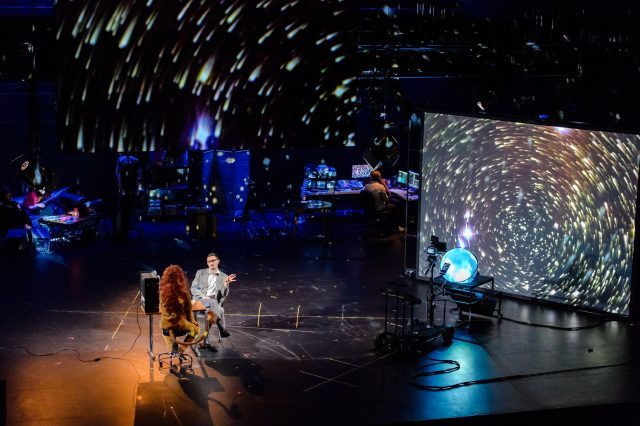
Innovative British theater director and actor Simon McBurney spent nearly twenty years trying to figure out how best to adapt the story of photojournalist Loren McIntyre’s adventures in the Amazon for the stage; what he ultimately came up with is absolutely genius. In the solo show The Encounter, playing at the Golden Theatre through January 8, McBurney uses the art of storytelling itself to dramatize McIntyre’s treacherous 1969 solo trip into Amazon’s Javari Valley, where he made contact with the indigenous Mayoruna tribe. Without any physical evidence, including photographs or notebooks, McIntyre shared his tale with Romanian-American writer Petru Popescu, whose book about the journey, Amazon Beaming, came out in 1991. And McBurney, whose 1999 production of Mnemonic by his Complicite company is considered a landmark in contemporary experimental theater, also uses the barest of evidence in The Encounter, which explores time, consciousness, memory, acculturation, and humanity’s connection with nature in spectacular ways. As the audience takes their seats, McBurney is wandering around the stage, which is littered with water bottles, a box of VHS tape, a desk with several microphones and a laptop, and a central figure — an Easter Island–like binaural head that turns out to be a speaker. McBurney addresses the crowd directly, toying with the notion of whether the show has actually started yet. “My children will always be able to look back over all of these photographs and videos and see their entire lives. But of course it’s not their life, it’s a story,” McBurney says about his smartphone. “So I’m worried about them mistaking it for reality, like we all mistake stories for reality. So I feel really responsible, because as I’m capturing moments on this [phone], I’m essentially deciding what story I’m going to tell them about their past . . . and about the world. But it’s not a reality. It’s a story. Stories are how we understand life. . . . You might say that stories are what have allowed the human race to thrive.”

(photo © Robbie Jack)

Simon McBurney uses innovative technology to tell a fascinating story in one-man Broadway show (photo © Robbie Jack)

McBurney, who has appeared in such films as The Golden Compass, Tinker Tailor Soldier Spy, and Mission Impossible — Rogue Nation and has adapted such other literary works as Haruki Murakami’s The Elephant Vanishes, Bruno Schulz’s The Street of Crocodiles, and John Berger’s To the Wedding, tells his story through headphones that each audience member must wear, with different sound effects and dialogue coming out of the right and left earpieces. There are also sounds that reverberate through the theater, outside of the headphones, that immerse the audience into this created world, from doors slamming shut to random muttering voices. He calls it a “technological trick,” but it’s actually a shrewd artistic device that is no mere gimmick. McBurney plays multiple roles by using microphones that change the pitch, tone, and even accent of his voice while combining live text with prerecorded snippets; among the real-life characters he portrays are McIntyre, McIntyre’s pilot, and Popescu heard alongside dialogue from such psychiatrists, scientists, and other experts as Iain McGilchrist, Steven Rose, Marcus du Sautoy, George Marshall, and Rebecca Spooner, who lend authenticity to the proceedings. Meanwhile, McIntyre claims to communicate with members of the Mayoruna, including Beam, Barnacle, Tuti, and Red Cheeks, via some kind of telepathy that echoes McBurney’s use of the headphones for the audience. Meanwhile, he is sharing the story with his seven-year-old daughter, Noma. “Dadda, who are you talking to?” she asks early on. “I’m not talking to anybody, sweetie,” he replies. “Yes, you are!” she demands. “No, I’m not. Well, I am in a way,” he answers. “But there’s nobody there!” she claims. “That’s true, there’s nobody there,” he agrees. Of course, McBurney is talking about the show itself; the only person there is him, yet, as time goes on, we feel as if we are deep in the Amazon rainforest, meeting all of these characters, trudging through the muck, and seeing the monkeys that threaten McIntyre.

For both McIntyre and McBurney, the concept of time is a critical element, photographer and performer each trying to capture and share a moment in time. “What lay behind this frenzy, Loren thought, was fear. Fear of the future. Fear of losing the past,” McBurney relates. “So unlike these people, he thought. They never think of the future, they don’t hoard or store up belongings. Time for them was an invisible companion, something comfortable and unseen like the air. For us, the civilizados, time was a possession. An increasingly more efficient machine.” Time for the Mayoruna is changeable, while the West’s obsession with time is limiting and controlling. As McBurney writes in a new foreword to Popescu’s book, “Our adamantine vision of time as an arrow, moving in a pitiless irreversible horizontal motion towards oblivion, is called into doubt. Could it be that this version of time is a fiction, a story that only exists in our common imagination? Our idea of distance, crucially the distance between one person and another, is also challenged. The notion of a ‘separate self,’ so precious to our contemporary notion of identity, is undermined to the point that it becomes, for McIntyre, utterly illusory. One self, one so-called individual consciousness, he discovers, is not necessarily separated from another by language, time, or distance. We are possibly interconnected in ways to which we are, mostly, blind in the modern world — a world in which, paradoxically, we are more connected by technology that at any time in history.”

Simon McBurney makes remarkable use of unusual props in THE ENCOUNTER (photo by Joan Marcus)

Simon McBurney makes remarkable use of unusual props in THE ENCOUNTER (photo by Joan Marcus)

The play, which runs approximately one hundred minutes without intermission, is also very much about contact, from McIntyre meeting the Mayoruna to how each audience member experiences it individually, a solitary yet communal experience. “There were so many things here in their elemental state, why not thought, too?” McBurney asks in the show. “Why not the simplest form of human contact — mind to mind. No, for goodness sake. But then something had been ratified, because he had been given this most beautiful gift.” We have also been given a most beautiful gift, The Encounter, which is essentially transmitted mind to mind in a mesmerizing tour de force by McBurney; also deserving of major kudos are set designer Michael Levine, sound designers Gareth Fry and Pete Malkin, lighting designer Paul Anderson, and projection designer Will Duke, who all participate in this amazing feat. At the end of the show, I fully believed that I had traveled through the Amazon with McBurney and McIntyre, had seen the Mayoruna, had felt the heat and fought off the mosquitoes, had experienced the fear and loneliness McIntyre had experienced, even though it was essentially all just McBurney getting inside my head and manipulating, and freeing, my mind. “To accept that our ability to hear, to listen to each other, is perhaps essential for our collective survival,” McBurney also writes in his foreword to Amazon Beaming. “These thoughts are urgent because, in order to survive, we need to acknowledge that there is another way of seeing the world and our place in it.” That could not be more true, today more than ever.

TERMS OF ENDEARMENT

(photo by Carol Rosegg)

Molly Ringwald and Hannah Dunne play mother and daughter in U.S. premiere of TERMS OF ENDEARMENT (photo by Carol Rosegg)

59E59 Theaters
59 East 59th St. between Park & Madison Aves.
Tuesday – Sunday through December 11, $70
212-279-4200
www.59e59.org

My beloved fourth-grade teacher, Miss Schimmenti, taught us to never use the word “nice,” emphasizing that it was a meaningless adjective and urging us to always look for a better, more specific modifier when trying to describe something. Meanwhile, I have virtually banned myself from using the word “perfect,” since it has become ubiquitous and vastly misused, as very few things are absolutely perfect. Thus, I am struggling to find the right words to describe the U.S. premiere of Dan Gordon’s Terms of Endearment, which I found to be, well, perfectly nice. First produced in 2007, the show is based on both the 1975 novel by Pulitzer Prize winner Larry McMurtry and the screenplay by James L. Brooks, who also directed the Oscar-winning 1983 film, which won five Academy Awards and was nominated for another six. The movie features memorable performances by Shirley MacLaine as Aurora Greenway, a widowed mother who is unhappy with certain choices made by her daughter, Emma, played by Debra Winger. Emma is preparing to marry Flap Houston, played by Jeff Daniels; meanwhile, Jack Nicholson nearly steals the film as Garrett Breedlove, a boozing, womanizing astronaut who lives next door to Aurora, who is outraged by his unsavory behavior. The original 2007 theatrer production was a vehicle for Dallas stalwart Linda Gray, who starred as Aurora on a UK tour that was supposed to come to the States but never did. But Terms of Endearment is at last making its U.S. debut, running at 59E59 through December 11, with Gray now serving as one of the presenters. Molly Ringwald (Cabaret, Enchanted April) has taken over the role of Aurora, and she does a perfectly nice job, as does Hannah Dunne (Mozart in the Jungle) as Emma, Denver Milord as Flap, Jessica DiGiovanni (Of Good Stock) as Patsy and others, and Jeb Brown (Beautiful: The Carole King Musical) as the wild and crazy Garrett.

Aurora Greenway (Molly Ringwald) keeps in touch with her daughter via phone in TERMS OF ENDEARMENT (photo by Carol Rosegg)

Aurora Greenway (Molly Ringwald) keeps in touch with her daughter via phone in TERMS OF ENDEARMENT (photo by Carol Rosegg)

Aurora has been putting down Emma her whole life, and she’s getting even worse as her daughter’s wedding approaches. “Emma, you are not special enough to overcome a bad marriage,” she says. Six months later, she says, “I never fool myself, Emma. I’m always brutally honest with myself. I never try to whitewash the fact that you married badly.” Actually, there’s just about nothing that Emma can do to please her mother, who complains about her daughter’s weight, her clothing, her bank account, her hair, her husband, her living conditions, etc. But that doesn’t stop the good daughter from loving her mother and talking to her over the phone every day. Playwright and screenwriter Gordon (Irena’s Vow, Murder in the First) doesn’t really add anything new to the story, merely condensing the book and the film, hitting the tale’s high points but losing any edge and flow. It all turns choppy as Emma and Flap have a few kids, Flap might be cheating on her, and Emma becomes seriously ill. The scene in which Aurora and Garrett meet with Dr. Maise (John C. Vennema) feels like it’s from a different play. Michael McDonald’s middle America costumes look perfectly nice on Ringwald (MacLaine’s wardrobe in the film was to die for), but David L. Arsenault’s set, constructed around invisible boundaries that separate Aurora’s living room, Emma’s bed (through the years), Emma and Flap’s couch and kitchen, and Garrett’s front door, gets confusing, forcing the audience too often to have to figure out how the geometry works as characters go from one place to another. Troupes such as the Godlight Theatre Company (Deliverance, In the Heat of the Night) and Ivo van Hove’s Toneelgroep Amsterdam (Scenes from a Marriage, Cries and Whispers) adapt novels and/or the movies they’ve been turned into by using creative staging techniques that are unique and inventive, but Gordon and director Michael Parva merely rehash this familiar story without any real panache. You could say that it’s all perfectly nice. Or, as Emma tells her mother early on, “Well, what is the point?!” (Oh, and sorry, Miss Schimmenti.)

LES LIAISONS DANGEREUSES

(photo © Joan Marcus 2016)

La Marquise de Merteuil (Janet McTeer) and Le Vicomte de Valmont (Liev Schreiber) use seduction as a weapon in Broadway revival of Christopher Hampton’s LES LIAISONS DANGEREUSES (photo © Joan Marcus 2016)

Booth Theatre
222 West 45th St. between Broadway & Eighth Ave.
Tuesday – Sunday through January 22, $40- $159
liaisonsbroadway.com

Tony winners Janet McTeer and Liev Schreiber take a somewhat unexpectedly playful tack in Josie Rourke’s Donmar Warehouse production of Christopher Hampton’s 1985 devilishly wicked Olivier Award winner, Les Liaisons Dangereuses, running at the Booth Theatre through January 22. In early 1780s Paris, former lovers La Marquise de Merteuil (McTeer) and Le Vicomte de Valmont (Schreiber) spend their days and nights calculating who they can sleep with, turning the art of seduction into a malicious game in which they manipulate and humiliate friends, enemies, strangers, and acquaintances primarily for the mere sport, although they occasionally have other goals. “Love and revenge: two of your favourites,” Merteuil tells Valmont. When Merteuil expresses her dissatisfaction with Valmont’s decision to attempt to bed the married, eminently proper Madame de Tourvel (Birgitte Hjort Sørensen) instead of the virginal fifteen-year-old Cécile Volanges (Elena Kampouris), daughter of Madame de Volanges (Ora Jones), who has spread talk of his bad-boy reputation, he explains, “I can’t agree with your theory about pleasure. You see, I have no intention of breaking down [Madame de Tourvel’s] prejudices. I want her to believe in God and virtue and the sanctity of marriage, and still not be able to stop herself. I want passion, in other words. Not the kind we’re used to, which is as cold as it’s superficial. I don’t get much pleasure out of that anymore. No. I want the excitement of watching her betray everything that’s most important to her. Surely you understand that. I thought ‘betrayal’ was your favourite word.” Accusing him of developing real feelings for Madame de Tourvel, Merteuil claims, “Love is something you use, not something you fall into, like quicksand, don’t you remember? It’s like medicine; you use it as a lubricant to nature.” Other sexual innuendos include such phrases as “I know Belleroche was pretty limp,” “I want you to help me stiffen his resolve,” “The position in which I find myself,” “Nothing firm,” and “I’m sure she’ll soon be back in the saddle.” Determined to bed Madame de Tourvel, Valmont heads out to the summer cottage of his elderly aunt, Madame de Rosemonde (Mary Beth Peil), where Madame de Tourvel is staying while her husband is off at war. In the meantime, Merteuil decides to go after young Cécile’s love, Le Chevalier Danceny (Raffi Barsoumian), as her next sexual toy.

(photo © Joan Marcus 2016)

The married Madame de Tourvel (Birgitte Hjort Sørensen) does not want to give in to the Le Vicomte de Valmont’s (Liev Schreiber) wicked charms in LES LIAISONS DANGEREUSES (photo © Joan Marcus 2016)

Based on Pierre Choderlos de Laclos’s 1782 epistolary novel about sexual manipulation, humiliation, and seduction in pre-revolutionary France, Les Liaisons Dangereuses has been adapted into numerous stage and screen versions as well as radio dramas, ballets, and operas; among the duos who have portrayed Merteuil and Valmont (or their equivalents) onstage and -screen are Lindsay Duncan and Alan Rickman, Jeanne Moreau and Gérard Philipe, Glenn Close and John Malkovich, Sarah Michelle Gellar and Ryan Phillippe, Catherine Deneuve and Rupert Everett, Duncan and Ciarán Hinds, and Annette Bening and Colin Firth. McTeer (Mary Stuart, A Doll’s House) and Schreiber (A View from the Bridge, Glengarry Glen Ross) are not quite electrifying in their roles, sometimes seeming more like brother and sister — if siblinghood makes one think of Cersei and Jaime Lannister from Game of Thrones. Valmont’s seduction of Cécile turns ugly fast, and his wooing of Madame de Tourvel has echoes of Richard III, but without the explicit evil. Tom Scutt’s costumes are rich and elegant but his set, a dilapidated living room with paintings (some wrapped partially with plastic, which would not be invented for another 125 years) lying on the floor against the walls, is rather mystifying; perhaps it represents the coming fall of the aristocracy in France, or maybe it is meant to evoke Merteuil’s and Valmont’s damaged states of mind. But Mark Henderson’s lighting is splendid, from circles of candles to chandeliers lowered from above. Rourke (Privacy, The Machine) has delivered a pleasurable period drama, if one that is not quite as illicitly rousing and arousing as it could have been.

TREASURED NOH PLAYS FROM THE DESK OF W. B. YEATS

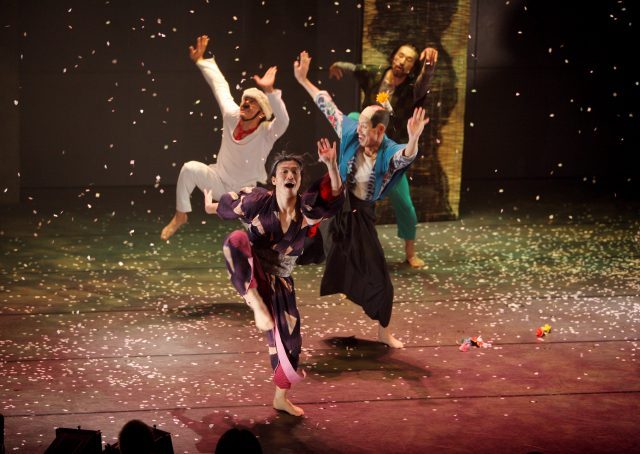
Living National Treasure Tomoeda Akiyo and Kita Noh Theater Company will be at Japan Society to perform works that inspired W. B. Yeats (photo © Seiichiro Tsuji)

Living National Treasure Tomoeda Akiyo and Kita Noh Theater Company will be at Japan Society to perform noh works that inspired W. B. Yeats (photo © Seiichiro Tsuji)

TRADITIONAL THEATER
Japan Society
333 East 47th St. at First Ave.
Saturday, November 19, $40, 7:30, and Sunday, November 20, $60, 5:00
212-715-1258
www.japansociety.org

In 1913, Ezra Pound introduced W. B. Yeats to the Japanese noh drama, and by 1916, Pound published English translations of fifteen noh plays and Yeats had written At the Hawk’s Well, which was directly inspired by the Japanese form. In honor of the centennial of that literary moment, Japan Society will be hosting two noh programs performed by the Kita Noh Theater Company, led by Tomoeda Akiyo, who was named a Japanese Living National Treasure in 2008. The first program, on November 19, consists of highlights from Nishikigi, Kumasaka, Tamura, Shojo, and Kagekiyo, presented in such styles as maibayashi, shimai, and subayashi, which differ in use of masks, costumes, chants, and music. Williams College music professor Dr. W. Anthony Sheppard will also give a talk about noh’s influence on Yeats. In addition, the related exhibition, “Simon Starling: At Twilight (After W. B. Yeats’s Noh Reincarnation),” a multimedia installation in which Turner Prize winner Starling reinterprets Yeats’s At the Hawk’s Well for the modern era, will stay open until 7:15; the performance will be followed by a Meet-the-Artists reception. On November 20 at 5:00, the second program will feature full versions of Kayoi Komachi and Shojo-midare, from Yeats’s collection, preceded at 4:00 by a lecture by Princeton University professor Dr. Tom Hare. (There will also be an “Image-in-Focus Series: Tomoeda Akiyo” gallery talk at 2:00.) Tickets for both events are sold out, but there will be a waitlist at the box office beginning one hour before showtime.

THE DEATH OF THE LAST BLACK MAN IN THE WHOLE ENTIRE WORLD AKA THE NEGRO BOOK OF THE DEAD

Who gived birth tuh this. I wonder,” Black Man with Watermelon (Daniel J. Watts) says in searing Suzan-Lori Parks play at the Signature (photo © 2016 Joan Marcus)

“Who gived birth tuh this. I wonder,” Black Man with Watermelon (Daniel J. Watts) says in searing Suzan-Lori Parks play at the Signature (photo © 2016 Joan Marcus)

The Pershing Square Signature Center
The Alice Griffin Jewel Box Theatre
480 West 42nd St. between Tenth & Eleventh Aves.
Tuesday – Sunday through December 18, $30 through December 4, $35-$65 after
212-244-7529
www.signaturetheatre.org

As the audience enters the Alice Griffin Jewel Box Theatre to see the Signature revival of Suzan-Lori Parks’s The Death of the Last Black Man in the Whole Entire World AKA the Negro Book of the Dead, a man in overalls is onstage, sitting in a chair, his bare feet on the gravel, arms dangling at his side, his head, face covered by a hat, slumped over, as if dead. Behind him is a long, diagonal tree branch and an electric chair on a cantilevered porch. Most of the people who filter in take a quick look at the stage before continuing ongoing conversations, paging through the Playbill, or checking their cell phones. Meanwhile, the dead man just sits there, mostly unnoticed, the lengthy title of the play projected in large block letters on the back wall. It’s an apt metaphor for the show itself, first presented in 1990 at BACA Downtown in Brooklyn and now extremely relevant again amid the Black Lives Matter movement and the shooting of so many unarmed black men, women, and children by police. The searing eighty-minute production begins with an overture in which nine spirit characters, each representing a different African American archetype/stereotype, slowly enter Riccardo Hernandez’s set, carrying a watermelon with them. During the overture, they introduce themselves by speaking their signature lines, which also serve as their names: Lots of Grease and Lots of Pork (Jamar Williams), Queen-Then-Pharaoh Hatshepsut (Amelia Workman), And Bigger and Bigger and Bigger (Reynaldo Piniella), Prunes and Prisms (Mirirai Sithole), Ham (Patrena Murray), Voice on Thuh Tee V (William DeMeritt), Old Man River Jordan (Julian Rozzell), Yes and Greens Black-Eyed Peas Cornbread (Nike Kadri), and Before Columbus (David Ryan Smith). Then Black Woman with Fried Drumstick (Roslyn Ruff) sits in the rocking chair next to the dead man, Black Man with Watermelon (Daniel J. Watts), and says, “Yesterday today next summer tomorrow just uh moment uhgoh in 1317 dieded thuh last black man in thuh whole entire world. Uh! Oh. Dont be uhlarmed. Do not be afeared. It was painless. Uh painless passin. . . . Why dieded he huh? Where he gonna go now that he done dieded? Where he gonna go tuh wash his hands?” Moving around Riccardo Hernandez’s set in highly stylized motion choreographed by Raja Feather Kelly and in representative costumes by Montana Blanco, the characters talk in a poetic and rhythmic language about the world being flat, the “saint mines,” the civil rights movement, dragons, and freedom over the course of four acts called panels — “Thuh Holy Ghost,” “First Chorus,” “Thuh Lonesome 3Some,” and “Second Chorus” — that unfold in a nonlinear and repetitive manner. “The black man bursts into flames. The black man bursts into blames. Whose fault is it?” asks Black Man with Watermelon, who dies over and over again. “Figuring out the truth put them in their place and they scurried out to put us in ours,” Before Columbus says.

(photo © 2016 Joan Marcus)

THE DEATH OF THE LAST BLACK MAN IN THE WHOLE ENTIRE WORLD . . . features a cast of familiar black archetypes (photo © 2016 Joan Marcus)

Pulitzer Prize winner Parks (Topdog/Underdog, Father Comes Home from the Wars [Parts 1, 2 & 3]) sets the play “here,” in “the present,” and it’s frightening how that could fit from the discovery of America to today and beyond, particularly given the current state of the country, so mired in systemic racism. When Black Man with Watermelon says, again and again, “Cant breathe,” and gasps, it is impossible not to think of Eric Garner, but those lines were written more than twenty-five years ago. Director Lileana Blain-Cruz (War, Red Speedo) maintains a mesmerizing rhythmic flow to the abstract narrative, which was inspired by the Stations of the Cross and free jazz. The cast is outstanding, portraying stock characters who are far more complex than mere stereotypes and reach deep into black history. For example, And Bigger and Bigger and Bigger is an expansion of Bigger Thomas from Richard Wright’s Native Son, Queen-Then-Pharaoh Hatshepsut is based on the second Egyptian female pharaoh, and Ham is a conglomeration of the son of Noah and the old minstrel song “Hambone, Hambone, Have You Heard?” Front and center are Watts (Hamilton, The Color Purple) and August Wilson veteran Ruff (Fences, Familiar), who embody the desperation blacks have suffered for centuries. Yes and Greens Black-Eyed Peas Cornbread demands, “You should write it down because if you dont write it down then they will come along and tell the future that we did not exist. You should write it down and you should hide it under a rock. You should write down the past and you should write down the present and in what in the future you should write it down.” And that’s precisely what Parks has done although, unfortunately, it appears to be a story with no end. (Blanco will discuss her costume design before the November 16 performance, the shows on November 17, 22, and 29 will be followed by a talkback with members of the cast and creative team, and there will be a cocktail hour before the December 1 show. Parks’s Signature residency continues in April 2017 with Venus followed by The Red Letter Plays: In the Blood and Fucking A in the 2017-18 season.)

BEN HECHT AND CHARLES MacARTHUR’S THE FRONT PAGE

(photo by Julieta Cervantes)

Journalist Hildy Johnson (John Slattery) and editor Walter Burns (Nathan Lane) go after a big story in revival of THE FRONT PAGE (photo by Julieta Cervantes)

Broadhurst Theatre
235 West 44th St. between Broadway & Eighth Ave.
Tuesday – Sunday through January 29, $67-$167
thefrontpagebroadway.com

Since its stage debut eighty-eight years ago, Ben Hecht and Charles MacArthur’s The Front Page has been celebrated for its witty, rapid-fire dialogue and madcap pace, but the latest Broadway revival, running at the Broadhurst Theatre, doesn’t quite merit front-page headlines. In the press room in the Chicago Criminal Courts Building, a group of cynical, jaded newspaper reporters are awaiting the execution of Earl Williams
(John Magaro), who was convicted of killing a police officer. As men do, they sit around the dank room, playing cards, insulting one another, making sexist and racist jokes, and downing burgers in between filing reports. The motley cast of characters includes hard-boiled know-it-all Murphy (Christopher McDonald), the constantly complaining Endicott (Lewis J. Stadlen), the banjo-playing Kruger (Clarke Thorell), and the poetic germophobe Bensinger (Jefferson Mays), along with McCue (Dylan Baker), Schwartz (David Pittu) and Wilson (Joey Slotnick). In addition to the hanging, it’s also the last day on the job for star journalist Hildy Johnson (John Slattery), who is leaving for New York City to marry his fiancée, Peggy Grant (Halley Feiffer). But when Williams suddenly escapes, Hildy can’t stop himself from pursuing the story, especially when Williams essentially ends up in his lap and his longtime editor, Walter Burns (Nathan Lane), preys on his journalistic sensibilities. (The Oscar-winning duo of Hecht and MacArthur, who also collaborated on Wuthering Heights and Twentieth Century, know what of they write; they were both former Chicago journalists.)

(photo by Julieta Cervantes)

Sheriff Hartman (John Goodman) finds himself in the middle of a mess in madcap revival of classic play (photo by Julieta Cervantes)

Told in three acts with two intermissions, the 165-minute production, directed by estimable three-time Tony winner Jack O’Brien (who has previously directed Lane in the riotous ensemble comedy It’s Only a Play and the much more serious The Nance), never hits its stride; it needs to move like the rat-a-tat-tat of the machine-gun fire heard as Williams heads out on the lam, but instead it seems a little too cocksure as it waits for Lane to make his grand appearance more than halfway through. Lane does inject a much-needed shot of life into the proceedings, although he plays Burns with familiar Lane-ian smarm and vigor. The play, which takes place in Douglas W. Schmidt’s appropriately dim and dusty surroundings, also features Holland Taylor as Mrs. Grant, Hildy’s future mother-in-law; Sherie Rene Scott as Mollie Malloy, a close friend of Williams’s; Dann Florek as the opportunistic mayor, who is up for reelection; Danny Mastrogiorgio as Diamond Louie, Burns’s underground operative; John Goodman as the bumbling Sheriff Hartman; Patricia Conolly as cleaning woman Jennie; and Micah Stock as goofy cop Woodenshoes Eichhorn. Although it’s virtually impossible to steal any show away from Lane, particularly when he’s in full-throated, scenery-chewing form, eighty-five-year-old Tony and Emmy winner Robert Morse does just that in his small but pivotal role as Mr. Pincus, who has a special delivery for the mayor. Morse’s Mad Men castmate, Slattery, does not fare as well as Hildy, a terrific actor who seems out of place here. The chemistry between Hildy and Burns is the key to the play; over the years, the dynamic duo has been portrayed on Broadway by Lee Tracy and Osgood Perkins in 1948, Bert Convy and Robert Ryan in 1969, and Richard Thomas and John Lithgow in 1986 and on film by Pat O’Brien and Adolphe Menjou in 1931, Rosalind Russell and Cary Grant in His Girl Friday in 1940, and Jack Lemmon and Walter Matthau in 1974. It’s as if Slattery and Lane, and O’Brien and the rest of the cast, were relying on the show’s vaunted history, but in these days of the electronic 24/7 news cycle and political correctness, The Front Page — which includes racist language that has been toned down but not eliminated — feels more outdated than ever as opposed to a thrilling look at the way things used to be. It has its share of very funny and insightful moments, but it doesn’t hold up to the promise its headlines blast out.

VIETGONE

(photo by Carol Rosegg)

Quang (Raymond Lee) and Nhan (Jon Hoche) take readers on a wild ride in Qui Nguyen’s VIETGONE (photo by Carol Rosegg)

Manhattan Theatre Club
New York City Center Stage 1
131 West 55th St. between Sixth & Seventh Aves.
Tuesday – Sunday through December 4, $90
212-581-1212
vietgoneplay.com
www.nycitycenter.org

In such works as She Kills Monsters, Six Rounds of Vengeance, Alice in Slasherland, Aliens versus Cheerleaders, and Living Dead in Denmark, Arizona-born Vietnamese American playwright and screenwriter Qui Nguyen brings a fresh perspective to the stage, incorporating martial arts, horror, and irreverent humor within a comic-book sensibility. (He’s also a writer for Marvel Studios and founder of the New York-based Vampire Cowboys troupe.) He gets more serious, but no less wild, in his latest drama, Vietgone, a semiautobiographical look at the Vietnam War inspired by his family’s real experiences. “All characters appearing in this work are fictitious. Any resemblance to real persons, living or dead, is purely coincidental,” the playwright (Paco Tolson) announces to the audience at the very beginning. “That especially goes for any person or persons who could be related to the playwright. Specifically his parents. Who this play is absolutely not about. Seriously, if any of you peeps repeat or retweet anything you’ve seen to my folks tonight, you’re assholes.” Nguyen and director May Adrales then tell the story of “a completely made-up man named Quang” (Raymond Lee), a former South Vietnamese soldier who is living in a refugee camp at the Fort Chaffee military base in Arkansas. A married man with two children he has not seen in several years, Quang is trying to get out of America and go back to Vietnam to be with them. “In Saigon / City in Vietnam / Shot up by the Viet Cong / They stole my peep’s freedom / so I’m coming to kill them / Call me their arch villain / Can’t stop me I’m willin’ / to die for this vision / Of a Vietnam that’s free / from those evil VC,” he raps. “You can’t stop me / I’m like a pissed off Bruce Lee / With a hi-ya, a kick, and a kung fu grip / We’ll come out swinging / We don’t give no shits.”

The cast of Qui Nguyen’s VIETGONE struts its stuff in Manhattan Theatre Club production at City Center (photo by Carol Rosegg)

The cast of Qui Nguyen’s VIETGONE struts its stuff in Manhattan Theatre Club production at City Center (photo by Carol Rosegg)

Quang is heading to California on a motorcycle with his friend Nhan (Jon Hoche), where they’ll catch a flight home. The time shifts between April and July 1975, as Quang and Nhan get out during the fall of Saigon and Quang develops a sexual relationship at Fort Chaffee with the cold and carefree Tong (Jennifer Ikeda), despite the protests of her grandmother, Huong (Samantha Quan). But through it all, Quang just wants to reunite with his family. “We don’t belong here. We belong there,” he tells Nhan. “There, we’re heroes. We’re sons. We’re men. There, we count for something. Here, however, we ain’t shit.” On their travels, they encounter a hippie dude (Tolson), a flower girl (Quan), and a redneck biker (Tolson); meanwhile, flashbacks reveal the tough decisions Tong had to make when she chose to leave Vietnam for America. “The communists are going to be rolling into our streets any day now with the mind to make dead all of us who aren’t waving red flags and you’re going to stick around to get riddled with bullets?” she says to her brother, who won’t leave his girlfriend. “I’m not going to let you die here. I can’t. I can’t. That would destroy me. It would absolutely destroy me.” Quang and Tong might be sleeping together in America, but they are both after something they may not be able to find again.

Quang (Raymond Lee) and Tong (Jennifer Ikeda) have something to celebrate while Tong’s unhappy grandmother (Samantha Quan) looks on (photo by Carol Rosegg)

Quang (Raymond Lee) and Tong (Jennifer Ikeda) have something to celebrate while Tong’s unhappy grandmother (Samantha Quan) looks on (photo by Carol Rosegg)

A production of Manhattan Theatre Club in association with South Coast Repertory, where the play debuted, Vietgone turns genre clichés inside out while toying with stereotypes, including who speaks with what accent. Passionately directed by Adrales with a frenetic warmth, the hip-hop immigrant tale — with a sweet nod to Hamilton — is colorful and energetic, taking place on Tim Mackabee’s impressive set, featuring a giant billboard, a horizon backdrop, and tiny telephone poles that represent the American road, creatively lit by Justin Townsend. Jared Mezzocchi’s projections, including graphic-novel-like drawings, set the time and the tone; the scene in which Quang and Nhan race for the helicopter to escape Saigon is absolutely breathtaking. Lee (tokyo fish story, Four Clowns) and Ikeda (Love and Information, Marie Antoinette) have a strong chemistry, while Vampire Cowboys artistic associate Hoche (Soul Samurai, The Inexplicable Redemption of Agent G), Quan (Masha No Home, An Infinite Ache), and longtime Nguyen collaborator Tolson (Fight Girl Battle World, Men of Steel) have a ball in multiple roles. The play is not as polished as it could be; several moments could be tightened up, and its clever but unusual storytelling techniques are not for everyone, obviously, as a chunk of older people left at intermission. But they should have stuck it out, as the rest of us did, who were caught up in this compelling love story about home that is both funny and moving, historical and contemporary, given the current debate over immigrants and refugees from around the world.