this week in theater

TICKET ALERT: KPOP

kpop

A.R.T./New York Theatres
502 West 53rd St.
Monday – Saturday, September 5 – October 7, general admission $45 (select dates $25-$35), premium $75
212-352-3101
arsnovanyc.com/kpop

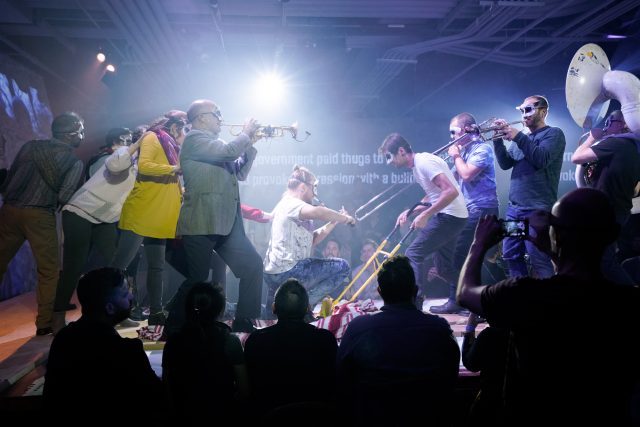
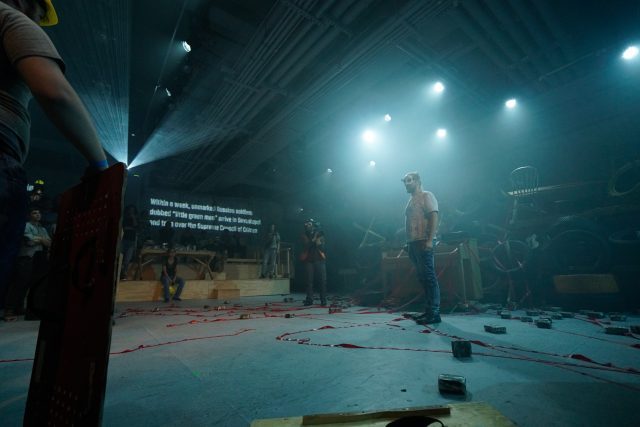
Tickets are going extremely fast for Ars Nova’s latest production, KPOP, a collaboration with Ma-Yi Theater and Woodshed Collective running at A.R.T./New York Theatres from September 5 to October 7, with opening night set for September 22. The immersive show takes audiences behind-the-scenes at a K-pop music factory and will involve standing, walking, climbing stairs, and dancing as a cast of eighteen leads audiences throughout the space. It was conceived by Woodshed Collective (Empire Travel Agency, The Tenant) and Jason Kim; Kim wrote the book, with music and lyrics by Helen Park and Max Vernon, choreography by Bessie winner Jennifer Weber, and direction by Teddy Bergman. Ars Nova has previously presented such inventive, immersive works as Small Mouth Sounds, Eager to Lose, The Lapsburgh Layover, and a little thing called Natasha, Pierre, and the Great Comet of 1812. So this is no time to dawdle if you want to catch what promises to be another unique, unpredictable experience.

MICHAEL MOORE: THE TERMS OF MY SURRENDER

(photo by Joan Marcus)

Michael Moore makes his Broadway debut in The Terms of My Surrender (photo by Joan Marcus)

Belasco Theatre
111 West 44th St. between Sixth & Seventh Aves.
Tuesday – Saturday through October 22, $29 – $149
www.michaelmooreonbroadway.com

“How the fuck did this happen?” Michael Moore asks at the beginning of his Broadway debut, The Terms of My Surrender, which opened last night at the Belasco Theatre for a three-month run. He makes it clear that he’s talking about the election of Donald J. Trump, not his one-man show on the Great White Way. For nearly two hours, the filmmaker, activist, and mensch, dressed in his usual schmatas including ever-present baseball cap, mixes pivotal moments from his life with ideas about how the left can come together and retake control of the White House and Congress. When he’s talking about President Trump, usually standing at a microphone at the front center of the stage, a giant American flag behind him, he does not quite have the fanatical fury or commanding presence of George C. Scott as General George S. Patton that setup evokes but instead comes off as a comic pundit preaching to the choir on MSNBC. But when he sits down at a desk or in a comfy reading chair and shares personal stories about how one person — himself, in several cases — can indeed make a difference, the his performance is riveting. Moore relates how he got involved in an Elks Club controversy; how he and a friend went to Germany to protest Ronald Reagan’s visit to a Nazi cemetery in Bitburg; how the governor of Michigan is involved in the poisoning of thousands of children with lead-laced drinking water in Moore’s impoverished hometown of Flint; and how one librarian from Englewood affected the publication of his 2001 book Stupid White Men. (That librarian, Ann Sparanese, was in the audience on opening night and received a standing ovation. Also on hand for the opening-night celebration were Harry Belafonte, Anna Deavere Smith, Dan Rather, Christie Brinkley, Brian Stokes Mitchell, Marlo Thomas, Jonathan Alter, Nia Vardalos, Al Sharpton, Rosanna Scotto, and Tony Bennett.)

Michael Moore settles in for his Broadway debut, The Terms of My Surrender (photo by Joan Marcus)

Michael Moore will consider ways to win back Congress and the White House during three-month run at the Belasco Theatre (photo by Joan Marcus)

A set piece about carry-on items banned by the TSA is hit-or-miss, and a game show pitting the dumbest Canadian in the audience against the smartest American is silly and goes on too long, serving as a way for Moore to spout yet more statistics at us. An informal tête-à-tête with a surprise guest — on opening night it was Gloria Steinem and previously has featured Bryan Cranston, Rep. Maxine Waters, Morgan Spurlock, and Judah Friedlander — can become self-indulgent, a crafty way to turn the spotlight away from Moore temporarily, but that’s easier said than done, as Moore can’t help being the center of attention, whether on a Broadway stage, on television (TV Nation, The Awful Truth), or in such films as Roger & Me, Bowling for Columbine, Fahrenheit 9/11, and Michael Moore in Trumpland. His shocking tale of receiving death threats and assassination attempts brings the show to a screeching halt when he decides to test the FCC by calling a public figure and making the same death threats he got from Glenn Beck. Moore most certainly is not in Trumpland at the Belasco, where the predominantly liberal audience claps often in support of the Flint native’s views on the president and politics. Tony-winning director Michael Mayer (Hedwig and the Angry Inch, Spring Awakening) has his hands full with the show, which jumps around from scene to scene and bit to bit, including a fair amount of ad-libbing, as Moore updates his comments with the latest news to keep things fresh. Tony-winning designer David Rockwell’s (She Loves Me, Kinky Boots) set features a desk and chairs that slide on- and offstage and a large American flag backdrop onto which Andrew Lazarow projects photographs, clips of Trump, headlines, and other images. There’s also an empty presidential box waiting for Trump, complete with “little opera gloves,” but don’t expect Trump or Vice President and Broadway superfan Mike Pence to take those seats anytime soon. The show is uneven, but when Moore, an often amiable yet fiery fellow who drives the right insane, gets away from the rhetoric and focuses on his heartfelt conviction that one person really can initiate change — and insists that now is most definitely not the time to give up — The Terms of My Surrender is right on target, reminding us all that if Moore can do it, there’s no reason we can’t either.

CORKSCREW THEATER FESTIVAL

corkscrew theater festival

Paradise Factory
64 East Fourth St. between Second & Third Sts.
August 7 – September 3, readings free, shows $24
347-954-9125
corkscrewfestival.org

On August 20, FringeNYC will hold a fundraising variety show in which they will reveal the future of the popular summer theater festival, which will not be taking place this year. Stepping into the void is the debut of the Corkscrew Theater Festival, presented by the Brewing Dept. and Fortress Productions at Paradise Factory in the East Village. The festival consists of five world-premiere productions and five readings running August 7 through September 3 by early-career artists, most of whom identify as female; the readings are free and the shows are $24. “The plays featured in the inaugural Corkscrew Theater Festival center on the need to be seen. By the institution that won’t listen to you, by the sibling whose struggles affect both of you, or by the boyfriend who just doesn’t understand that you’re turning into a werewolf,” artistic director Thomas Kapusta said in a statement. “We’re proud to give these new artists and their stories – some joyful, some tragic, and some hilarious – the chance to be seen and heard in quality productions performed in repertory this summer.”

The plays, which tackle such subjects as mental illness, queer love triangles, millennial privilege, and, yes, werewolves, consists of Kaela Mei-Shing Garvin’s High School Coven, directed by Felicia Lobo; Robert Zander Norman’s All of My Blood, directed by Taylor Haven Holt; Nora Sørena Casey’s False Stars, directed by Jenny Reed; Lilla Goettler and Katie Hathaway’s Ex Habitus, directed by Lilla Goettler; and Morgaine Gooding-Silverwood’s Cradle Two Grave, directed by Gooding-Silverwood and choreographed by Raquel Chavez. The readings, about such topics as an interracial couple in a gentrifying neighborhood, amateur porn, nuclear holocaust, and an island of giant rabbits, comprise Uzunma Udeh’s A Day in the Life: A Performance Piece of Performance Pieces, directed by Udeh and Ann-Kathryne Mills; Ayo Edebiri and Nick Parker’s Mad Cool, directed by Diane Chen; the musical Hot Cross Buns, with book and lyrics by Julia Izumi and music and lyrics by Grace Oberhofer, directed by Logan Reed; Laura Winters’s Gonzo, directed by Noam Shapiro; and Ryan Bernsten’s The New Order, directed by Kristin Skye Hoffmann.

SHAKESPEARE IN THE PARK: A MIDSUMMER NIGHT’S DREAM

(photo by Joan Marcus)

Annaleigh Ashford steals the show as Helena in Shakespeare in the Park presentation of A Midsummer Night’s Dream (photo by Joan Marcus)

Central Park
Delacorte Theater
Tuesday-Sunday through August 13, free, 8:00
shakespeareinthepark.org

Since 2013, Public Works founder and resident director Lear deBessonet has presented special short-run summer productions of classic works at the Delacorte Theater consisting of professional and nonprofessional actors, with casts of more than two hundred men, women, and children, from community organizations from all five boroughs in addition to theater veterans. The Public Theater initiative has included musical adaptations of The Tempest, The Winter’s Tale, Twelfth Night, and The Odyssey. DeBessonet also directed Bertolt Brecht’s Good Person of Szechwan indoors at the Public’s Martinson Hall. But now the thirty-something Baton Rouge native and longtime Brooklynite is moving to one of the Public Theatre’s largest and best-loved programs, making her Shakespeare in the Park directorial debut. She’s helming the Bard’s A Midsummer Night’s Dream, which would appear to be a terrific vehicle for her sensibilities but which turns out to be a mixed bag, though still fun. The romantic comedy is one of Shakespeare’s most delightful and well-structured plays, with four intersecting plots dealing with the notion of love in all its forms. Theseus, the Duke of Athens (Bhavesh Patel), is preparing to wed Hippolyta, queen of the Amazon (De’Adre Aziza). Hermia (Shalita Grant) is in love with Lysander (Kyle Beltran), but her father, Egeus (David Manis), insists that she marry Demetrius (Alex Hernandez) or face severe punishment. Helena (Annaleigh Ashford) is madly in love with Demetrius, who has no interest in her. Meanwhile, an acting troupe of artisans known as the Mechanicals — carpenter Peter Quince (Robert Joy), weaver Nick Bottom (Danny Burstein), bellows mender Francis Flute (Jeff Hiller), tinker Snout (Patrena Murray), joiner Snug (Austin Durant), and tailor Robin Starveling (Joe Tapper) — have come to Athens to put on a production of Ovid’s Pyramus and Thisbe, about a pair of Babylonian lovers, a wall, and a lion, but professionalism is not their forte. And deep in the forest are the Fairies, including King Oberon (Richard Poe) and Queen Titania (Phylicia Rashad), who are battling over a changeling boy (Benjamin Ye), along with Robin Goodfellow, better known as Puck (Kristine Nielsen), Peaseblossom (Vinie Burrows), Cobweb (Manis), and Mustardseed (Warren Wyss). Magical elixirs, mistaken identity, and animal transformation ensue. “The course of true love never did run smooth,” Lysander tells Hermia. And Puck declares, “Lord, what fools these mortals be!”

(photo by Joan Marcus)

Titania (Phylicia Rashad) finds a strange bedfellow in Nick Bottom (Danny Burstein) in Bard show at the Delacorte (photo by Joan Marcus)

A Midsummer Night’s Dream practically demands to be performed outside, and the Delacorte is a splendid home for it. Tony winner David Rockwell’s (She Loves Me) fairy-tale set features three lush green trees, a movable stone wall entranceway, a tree house where the band plays, and a playground slide amid the clouds, stars, flying insects, and backstage raccoons. The fab costumes, including a glamorous shout-out to Beyoncé, are by Tony winner Clint Ramos (Eclipsed). Tony winner Ashford (Kinky Boots, You Can’t Take It with You) steals the show as Helena, once again displaying her spectacular aptitude for physical comedy; her line deliveries, facial expressions, and wacky movements make the production worthwhile all on their own. Six-time Tony nominee Burstein (Fiddler on the Roof, Cabaret) has a ball as Bottom, who is turned into a donkey, although the play-within-a-play drags on a bit too long. Casting senior citizens as the fairies, dressed in white night clothing, is cute at first but eventually slows things down, and not even the always outstanding Nielsen can turn it around. And there’s usually sexual tension surrounding the changeling, but deBessonet has made him a young boy searching for a home. Marcelle Davies-Lashley belts out some hot New Orleans–tinged R&B as a fairy singer in a glitzy gown, but her appearances are disruptive to the narrative, taking the audience out of Shakespeare’s fantasy world. (The band consists of music director Jon Spurney on keyboards and guitar, Jeremy Chatzky on bass, Christian Cassan on drums and percussion, Andrew Gutauskas on reeds, Freddy Hall on guitar, and Matt Owens on trumpet and flugabone.) Despite the production’s disjointedness, there is nary a better way to spend a night outdoors in New York City, especially for free. As Puck relates, “If we shadows have offended, / Think but this, and all is mended, / That you have but slumbered here / While these visions did appear.”

NAPOLI, BROOKLYN

(photo by Joan Marcus)

Three sisters (Lilli Kay, Elise Kibler, and Jordyn DiNatale face unexpected tragedy in Napoli, Brooklyn (photo by Joan Marcus)

Laura Pels Theatre
Harold and Miriam Steinberg Center for Theatre
111 West 46th St. between Sixth & Seventh Aves.
Tuesday – Sunday through September 3, $99
212-719-1300
www.roundabouttheatre.org

Right before intermission in Meghan Kennedy’s Napoli, Brooklyn, director Gordon Edelstein stages a spectacular, shocking event, made all the more surprising because it’s based on a little-remembered occurrence that took place in Park Slope in 1960. What came before intermission is not nearly as exciting, and what comes after might not be as fascinating as it could have been, but the event itself and its revolutionary effect on the characters’ approach to life makes it worth a trip to the downstairs Laura Pels Theatre at the Roundabout, where the show is running through September 3. The Muscolino family is led by the emotionally and physically abusive Nic (Michael Rispoli) and his worried and frightened wife, Luda (Alyssa Bresnahan), who cuts up onions to induce the tears she can’t let flow: “Why does He not let me cry? He knows I need to,” she says about God as she chops away. One of their daughters, twenty-year-old Vita (Elise Kibler), has been sent to live in a convent. Another, sixteen-year-old Francesca (Jordyn DiNatale), wants to run away with her girlfriend, Connie Duffy (Juliet Brett). And the third, twenty-six-year-old Tina (Lilli Kay), works hard in a tile factory. “What’s it like, bein’ loved?” Tina asks one of her coworkers, Celia Williams (Shirine Babb). Meanwhile, Connie’s father, Albert (Erik Lochtefeld), can’t help but flirt with Luda whenever she comes into his butcher shop. As everyone except Nic considers some kind of change in their life, a tragedy befalls the neighborhood that has each person rethinking their future.

(photo by Joan Marcus)

The Feast of the Seven Fishes turns into a brawl in new Meghan Kennedy play (photo by Joan Marcus)

Napoli, Brooklyn is, for the most part, a fairly standard family drama, with not enough twists and turns aside from the major one at the end of the first act. The relationship between Francesca and Connie doesn’t feel real, and Nic is too much of a caricature. Kennedy, whose Too Much, Too Much, Too Many ran at the Roundabout Underground in 2013, doesn’t give quite enough depth to the characters as they explore their lives and debate the existence of God in the second act when they come together for the Feast of the Seven Fishes. Long Wharf artistic director Edelstein (Satchmo at the Waldorf, My Name Is Asher Lev) makes good use of Eugene Lee’s functional set, in which nearly all the locations are always onstage. But the first-set closer is a doozy, so you’re likely to forgive the syrupy, message-laden narrative and leave the theater wanting to find out more about that real-life devastating catastrophe in Brooklyn that, before this play, wasn’t even a historical footnote to the vast majority of us.

AMERIKE — THE GOLDEN LAND

(photo © Victor Nechay)

National Yiddish Theatre Folksbiene explores the Jewish immigration experience in Amerike — the Golden Land (photo © Victor Nechay)

Museum of Jewish Heritage — A Living Memorial to the Holocaust
Edmond J. Safra Plaza, 36 Battery Pl.
Tuesday-Wednesday and Thursday-Sunday through August 6, $35-$60
866-811-4111
nytf.org
mjhnyc.org

The National Yiddish Theatre Folksbiene has followed up its wonderful, ebullient hit, The Golden Bride, with Amerike — the Golden Land, a rather more clichéd historical pageant, a series of episodic set pieces about the American dream. The show began life as a special program honoring the eighty-fifth anniversary of the Jewish Daily Forward in 1982 and has gone through numerous iterations since then. The latest version, extended at NYTF’s new home at the Museum of Jewish Heritage through August 20, follows half a dozen emigrants from Eastern Europe who arrive in America expecting streets paved with riches. But the reality of making a new life on the Lower East Side is far more difficult for Oppenheimer (Glenn Seven Allen), Sadie (Alexandra Frohlinger), Joe (Daniel Kahn), Fannie (Dani Marcus), Gussie (Stephanie Lynne Mason), and Izzie (David Perlman). (The talented ensemble also includes Maya Jacobson, Alexander Kosmowski, Raquel Nobile, Isabel Nesti, Grant Richards, and Bobby Underwood.) Written by Moishe Rosenfeld and his cousin, NYTF artistic director Zalmen Mlotek, and directed by Bryna Wasserman, who helmed The Golden Bride and such other NYTF productions as The Dybbuk and Lies My Father Told Me, Amerike features a treasure trove of Yiddish songs performed by an outstanding band, with Katsumi Ferguson on violin, Jordan Hirsch on trumpet, Dmitry Ishenko on bass, Daniel Linden on trombone, Mlotek and Andrew Wheeler on piano, Sean Perham on percussion, and Dmitri Zisl Slepovitch on reeds. The story is told in eleven sections, from “Arrival,” “The New City,” and “Shabbos” to “Work,” “Citizenship,” and “The Depression,” with such numbers as “O Kumt Ir Farvoglte” (Oh Come You Who Are Displaced”), “Brother, Can You Spare a Dime?,” and “Vi Nemt Men Parnuse?” (“How Do I Make a Living?”), by Joseph Rumshinsky, Arnold Perlmutter and Herman Wohl, Solomon Shmulewitz, and other composers.

Despite its innate exuberance, the narrative is laden with overly familiar vignettes about immigrants first seeing the Statue of Liberty, having their names changed on Ellis Island, battling poverty, and trying to assimilate. It often feels more like a history lesson, teaching us about things we already know, like the Triangle Shirtwaist Factory fire, although it is imbued with a relevance to what is happening today as President Trump continues to push his immigration and refugee restrictions. Amerike — the Golden Land does have some beautiful and heart-wrenching moments, including the story of a widower whose young children are not allowed to enter America with him and two immigrants who are fearful of falling in love. Izzy Fields’s costume design and Jason Lee Courson’s set and projections capture the feeling of late-nineteenth-century / early-twentieth-century New York City, and Merete Muenter’s choreography melds well with the music. The songs are mostly performed in Yiddish with English and Russian surtitles, although, curiously, there are a few English-language numbers that feel out of place. The cast, only one member of which knew Yiddish prior to rehearsals, is solid, and the musicians, who get the crowd dancing after the curtain call, are outstanding. But the lack of originality in the story — there’s even a multilingual version of Emma Lazarus’s “The New Colossus” — dampens a lot of this terrific company’s freshness. (Be sure to arrive forty-five minutes early to get a free Yiddish lesson.)

1984

(photo by Julieta Cervantes)

Citizens of Oceania prepare for the Two Minutes Hate (photo by Julieta Cervantes)

Hudson Theatre
139-141 West 44th St. between Sixth & Seventh Aves.
Tuesday – Sunday through October 8, $35 – $274
www.thehudsonbroadway.com

Among the myriad virtues of George Orwell’s final novel, the 1949 groundbreaking, language-redefining 1984, is its continued relevance to changing times, as every generation finds its prescience remarkable. “It’s a vision of the future no matter when it’s being read,” Martin (Carl Hendrick Louis), an antiques dealer, tells protagonist Winston Smith (Tom Sturridge) in Robert Icke and Duncan Macmillan’s confounding stage version, running at the Hudson Theatre through October 8. Martin was talking about both Winston’s secret diary and the masterful source material, Orwell’s clear-eyed view of a bleak future ruled by unseen totalitarian entities who keep the populace under constant suppression and surveillance. Later in the scene, Martin explains to Winston, “Every age sees itself reflected.” Neither of these lines is in the original text, but they get to the heart of this inconsistent theatrical adaptation. Orwell warned us that all this was coming, and now we’re virtually there, pun intended. It’s no coincidence that the book keeps appearing on the bestseller list as President Donald Trump and his associates speak out about “alternative facts” and “fake news” and cabinet members are confirmed to head departments responsible for policy they seem to be against. Icke and Macmillan have interlaced a confusing framing story that takes place well past 2050, inspired by the book’s appendix, looking back at how Winston attempted to navigate a world drowning in Newspeak, where Big Brother proclaims, “War Is Peace,” “Freedom Is Slavery,” and “Ignorance Is Strength” and such words as “doublethink,” “thoughtcrime,” “telescreen,” and “unperson” have entered the lexicon. Romantic love is illegal, but Winston and Julia, who both work at the Ministry of Truth, where Winston erases people and events from history, decide to take a risk, finding themselves in each other’s arms while also plotting to bring down the party. But it’s not going to be easy, as they soon discover.

(photo by Julieta Cervantes)

O’Brien (Reed Birney) explains the way things are to Winston (Tom Sturridge) and Julia (Olivia Wilde) (photo by Julieta Cervantes)

The 101-minute intermissionless play features some very strong moments, particularly whenever party leader and possible Brotherhood agent O’Brien (Reed Birney) is onstage. The scenes change with a shocking blast of noise and blinding white lights, courtesy of sound designer Tom Gibbons and lighting designer Natasha Chivers, which is frighteningly effective. Later, the torture scenes are so graphic that the theater bars anyone under fourteen. (Originally there was no age limit, but too many families were exiting early with their scared youngsters in tow.) Playing off the concept of the telescreen watching people’s every movement, Icke (Oresteia, Mr. Burns, a post-electric playEvery Brilliant Thing, City of Glass) rely too much on live projections by video designer Tim Reid; at one point the audience is watching the screens at the top of Chloe Lamford’s set for an extended period of time as no live action takes place onstage but instead is being streamed from offstage. In addition, the fourth wall is broken twice, but it’s more of an off-putting device than it is an effective warning that this could happen to us if we’re not careful. “Words matter. Facts matter. The truth matters,” Winston says as the play references Trump and his fight with the media. There’s not much passion between Wilde, in her Broadway debut, and Tony nominee Sturridge (Orphans, Punk Rock), while Tony winner Birney (The Humans, Circle Mirror Transformation) brings just the right calm demeanor to O’Brien. The cast also features Michael Potts as Charrington, Nick Mills as Syme, Wayne Duvall as Parsons, and Cara Seymour as Mrs. Parsons, and the disappearance/erasure of one of the secondary characters is handled quite cleverly. But the narrative jumps around too much between the past, the present, and the future and strays too often from the central plot, creating confusion and annoyance. The story’s overall message — which Orwell arrived at in part as a response to the rise of Stalinism while also predicting the German Stasi — gets buried in too much stylistic stagecraft. However, its relevance is still terrifyingly apparent: Big Brother is indeed watching us, and we don’t seem to mind anymore what they see.