this week in theater

IF ONLY . . .

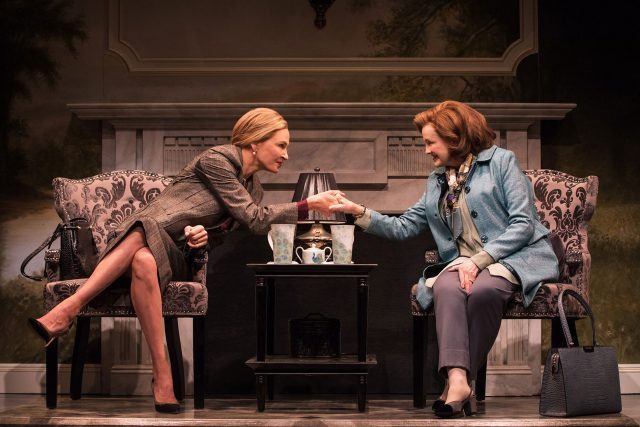
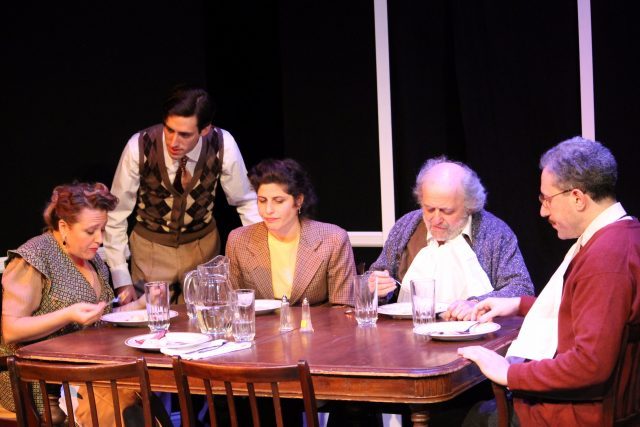
If Only at the Cherry Lane (photo by Carol Rosegg)

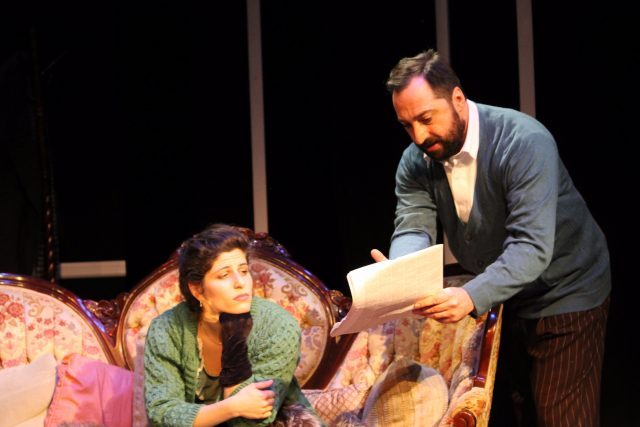
Ann Astorcott (Melissa Gilbert) and Samuel Johnson (Mark Kenneth Smaltz) rehash old times in If Only… at the Cherry Lane (photo by Carol Rosegg)

Cherry Lane Studio Theatre
38 Commerce St.
Wednesday – Sunday through September 17, $55
212-989-2020
www.cherrylanetheatre.org

Last year, the american vicarious theater company, led by artistic director Christopher McElroen, presented the world premiere of Thomas Klingenstein’s Douglass, about nineteenth-century abolitionist and social reformer Frederick Douglass. The same team is now back with If Only…, which opened yesterday at the Cherry Lane Studio Theatre. McElroen and Klingenstein are an unusual pair; the former is cofounder of the Classical Theatre of Harlem, while the latter is a conservative philanthropist and financial advisor who believes there is “too much emphasis on ethnic and racial difference and too little on our common national identity.” They both attempt to bridge that divide in If Only…, a relatively vanilla tale of the reunion of schoolteacher and former slave Samuel Johnson (Mark Kenneth Smaltz) and prominent society wife Mrs. Ann Astorcott (Melissa Gilbert), who had been brought together by Abraham Lincoln and haven’t seen each other since the assassinated president’s funeral. It’s now the winter of 1901, and Ann lives in a New York City Victorian brownstone with her businessman husband, Henry (Richmond Hoxie), and a young orphan, Sophie (Korinne Tetlow), who has not spoken since a tragic occurrence. Henry is out at a meeting of the monument committee — a rather timely responsibility, given the current controversy over historical statuary — so Ann and Samuel, who has arrived from Chicago to attend another funeral, are by themselves, where they exchange niceties, skirting around the central issue of their deep affection for each other, which, under different circumstances, could have led to a more serious, involved relationship. “Mr. Lincoln did not abide convention,” Samuel tells her. “Did you know that he did not hunt. Everyone hunted in the West, but not Mr. Lincoln. Nor did he drink, smoke, or swear. He did not like to fight, to farm, and he did not despise Indians. The soldiers liked his unconventional ways.” Ann responds, “The older I get, the more I understand the need for convention. One needs deep ruts to keep them from going off course.” He replies, “You once defied convention,” to which she answers, “If you say so.” The play is structured around the concept of convention, whether these two people, who clearly still are in love, will throw caution to the wind and let free their true feelings.

in If Only at the Cherry Lane (photo by Carol Rosegg)

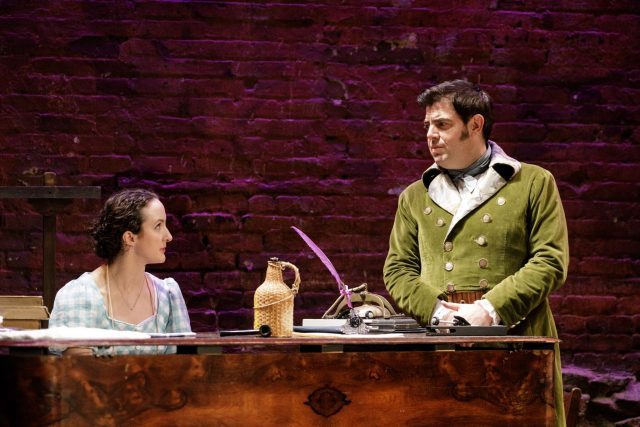
Ann (Melissa Gilbert) reads to Sophie (Korinne Tetlow) in new Thomas Klingenstein play at the Cherry Lane (photo by Carol Rosegg)

If Only… takes place in the Astorcotts’ cozy, old-fashioned parlor, designed by William Boles. Gilbert (The Miracle Worker, Little House on the Prairie) is prim and proper as Ann, who is like a butterfly in her husband’s collection, pinned back, not allowed by society to burst out and show her true colors. Law and Order veteran Smaltz (American Son, It Can’t Happen Here) plays Samuel with a cool demeanor; he understands the complicated situation but won’t take action unless Ann breaks out of her cold posturing. There’s not much to McElroen’s direction; the characters switch chairs or move a table, just to give them something physical to do. Klingenstein tries to make various comparisons to the current state of race relations in the United States (as well as an anachronistic reference to a glass ceiling), but they mostly fall flat in the face of the obvious, especially since what happened in Charlottesville. If Only… turns out to be more of a writing exercise than a fully fledged play, an overly trite story that exploits Lincoln’s beliefs and accomplishments, wondering why we all still can’t just get along.

BAM NEXT WAVE FESTIVAL 2017

(photo by Bo Lahola)

Tanztheater Wuppertal/Pina Bausch’s Café Müller returns to BAM for Next Wave Festival (photo by Bo Lahola)

BAM Harvey Theater, 651 Fulton St.
BAM Howard Gilman Opera House, 30 Lafayette Ave.
BAM Fisher, 321 Ashland Pl.
September 14 – December 16
718-636-4100
www.bam.org

As usual, we are considering moving in to the Brooklyn Academy of Music for three months after the announcement of the lineup for the thirty-fifth BAM Next Wave Festival, running September 14 through December 16 at the Harvey, the Howard Gilman Opera House, and the Fisher. “This year’s Next Wave showcases artists from Switzerland to Senegal in creative dialogue with historic events, personal histories, and the present moment,” longtime BAM executive producer Joe Melillo said in a statement. The roster includes old favorites and up-and-comers from around the world, with several surprises. Dance enthusiasts will be particularly impressed with the schedule, which begins September 14-24 with a superb double bill of Tanztheater Wuppertal/Pina Bausch’s Café Müller and The Rite of Spring, which were part of the first Bausch program at BAM back in June 1984. For The Principles of Uncertainty (September 27-30), Maira Kalman teams up with John Heginbotham, Dance Heginbotham, and the Knights to bring her online graphic diary to life. New York Live Arts artistic director and cofounder Bill T. Jones returns to BAM with the Bill T. Jones/Arnie Zane Company and composer Nick Hallett for A Letter to My Nephew (October 3-7), about his nephew, Lance T. Briggs, who battled illness and addiction. Senegalese artist Germaine Acogny takes center stage for the emotional solo piece Mon élue noire (My Black Chosen One): Sacre #2 (October 4-7), choreographed specifically for her by Olivier Dubois of Ballet du Nord, set to music by Stravinsky. Also on the movement bill are Joshua Beamish/MOVETHECOMPANY’s Saudade, Cynthia Oliver’s Virago-Man Dem, ODC/Dance, Brenda Way, and KT Nelson’s boulders and bones, David Dorfman Dance’s Aroundtown, Hofesh Shechter Company’s Grand Finale, Xavier Cha’s Buffer, Big Dance Theater’s 17c, and Tesseract, a multimedia collaboration between Charles Atlas, Rashaun Mitchell, and Silas Riener.

(photo by Arno Declair)

Schaubühne Berlin presents the U.S. premiere of its unique take on Richard III at BAM Next Wave Festival (photo by Arno Declair)

The festival also boasts impressive theater productions, kicking off October 11-14 with Schaubühne Berlin’s tantalizing version of Shakespeare’s Richard III, translated and adapted by Marius von Mayenburg, directed by Thomas Ostermeier, and starring Lars Eidinger. Théâtre de la Ville, Paris is back November 2-4 with Albert Camus’s State of Siege, directed by Emmanuel Demarcy-Mota. Tony-winning Belgian director Ivo van Hove takes on Ayn Rand in Toneelgroep Amsterdam’s four-hour The Fountainhead November 28 to December 2. Rachel Dickstein and Ripe Time bring Naomi Iizuka’s adaptation of Haruki Murakami’s Sleep to the Fisher November 20 to December 2. Fresh off her Broadway stint in Marvin’s Room, Lili Taylor stars in Farmhouse/Whorehouse: An Artist Lecture by Suzanne Bocanegra, directed by Lee Sunday Evans (December 12-16). Geoff Sobelle, who went solo at BAM for The Object Lesson, is joined by an ensemble of designers and dancers for Home (December 6-10). And be on the lookout for Manfred Karge, Alexandra Wood, and Wales Millennium Centre’s Man to Man, Thaddeus Phillips and Steven Dufala’s A Billion Nights on Earth, the Cameri Theatre of Tel-Aviv’s adaptation of Etgar Keret’s Suddenly, directed by Zvi Sahar and PuppetCinema, Manual Cinema’s Mementos Mori, Marc Bamuthi Joseph/The Living Word Project’s /peh-LO-tah/, and James Thierrée and Compagnie du Hanneton’s La grenouille avait raison (The Toad Knew).

Music aficionados have plenty to choose from, with Olivier Py Sings Les Premiere Adieux de Miss Knife, Kronos Quartet, Rinde Eckert, and Vân-Ánh Võ’s My Lai, Bang on a Can All-Stars, Michael Gordon, David Lang, Julia Wolfe, and Michael Counts’s Road Trip, Gabriel Kahane’s Book of Travelers, Rithy Panh, Him Sophy, Trent Walker, Jonathan Berger, and Harriet Scott’s Bangsokol: A Requiem for Cambodia, Wordless Music Orchestra and Chorus’s two-part John Cale: The Velvet Underground & Nico, and the New York premiere of American Repertory Theater’s Crossing, an opera inspired by Walt Whitman’s “Crossing Brooklyn Ferry,” composed, written, and conducted by Matthew Aucoin and directed by Diane Paulus. The season is supplemented with several postperformance talks and master classes.

CROSSING THE LINE FESTIVAL 2017

Annie Dorsen Crossing the Line

Annie Dorsen turns FIAF auditorium into planetarium for Crossing the Line Festival

French Institute Alliance Française and other locations
Florence Gould Hall, 55 East 59th St. between Madison & Park Aves.
FIAF Gallery, 22 East 60th St. between Madison & Park Aves.
September 6 – October 15, free – $60
212-355-6160
crossingthelinefestival.org
www.fiaf.org

FIAF’s annual Crossing the Line Festival enters its second decade with the eleventh edition of its always exciting multidisciplinary lineup featuring unique and eclectic works from around the world. This year’s focus is on Congolese choreographer and CTL veteran Faustin Linyekula, who will be presenting the world premiere of the site-specific Banataba at the Metropolitan Museum of Art (9/9, 9/10, 9/12, $65), the U.S. premiere of In Search of Dinozord with Studios Kabako at the NYU Skirball Center (9/22, 9/23, $40), and the world premiere of Festival of Dreams at Roberto Clemente Plaza on 9/23 and Weeksville Heritage Center on 9/24 (free, 3:00). The festival begins September 6-7 with Ryoji Ikeda’s supercodex (live set) at the Met ($45-$60), a follow-up to his dazzling Superposition from 2014. In #PUNK, taking place 9/14-15 in FIAF’s Tinker Auditorium ($30), Zimbabwe-born, New York–based Nora Chipaumire channels the musical rage of Patti Smith; the 9/14 show will be followed by a Q&A with Chipaumire and Linyekula, moderated by Ralph Lemon. Performance festival regular Annie Dorsen (Magical, Yesterday Tomorrow) takes a new narrative approach to the internet in The Great Outdoors, 9/21-23 in FIAF’s Florence Gould Hall ($35). Alessandro Sciarroni continues his “Will you still love me tomorrow?” trilogy with the New York premiere of UNTITLED_I will be there when you die at La MaMa 9/28-30 ($25, 8:00).

Moroccan dancer-choreographer Bouchra Ouizguen’s Corbeaux (Crows) is a site-specific living sculpture that will move throughout the Brooklyn Museum’s Beaux-Arts Court 9/30 and 10/1 (free with museum admission). Drag fave Dickie Beau conjures Marilyn Monroe and Judy Garland in Blackouts 10/5-8 at Abrons Arts Center ($30). Adelheid Roosen and Nazmiye Oral transform FIAF’s Le Skyroom into an intimate living room in No Longer without You 10/12-15 ($25), in which traditional Muslim immigrant Havva Oral and her Westernized daughter, Nazmiye, discuss faith, sexuality, identity, and more. In addition, Alain Willaume’s immersive exhibition, “VULNERABLE,” will be on view 9/15 to 10/28 in the FIAF Gallery (free), and Sophie Calle’s Voir la mer, set by the Black Sea in Istanbul, will be projected on Times Square billboards every night in October at 11:57 as part of the monthly Midnight Moment program.

THE TERMS OF MY SURRENDER: REVISITED

The Donald hovers over Michael Moore in The Terms of My Surrender (photo by Joan Marcus)

The Donald hovers over Michael Moore in The Terms of My Surrender (photo by Joan Marcus)

Belasco Theatre
111 West 44th St. between Sixth & Seventh Aves.
Tuesday – Saturday through October 22, $29 – $149
www.michaelmooreonbroadway.com

I attended the star-studded August 10 opening of Michael Moore’s Broadway debut, the mostly one-man show The Terms of My Surrender, in which the Flint native rails against Donald Trump and shares stories about how one person can make a difference. In my review the next day, I noted that there was a handful of important flaws; other critics were somewhat less generous (amid some raves). With all that is going on in the world, overwhelming us on a constant basis, I decided to revisit the Belasco Theatre the next week to see if Moore and director Michael Mayer had made any important changes and how Moore might incorporate the violent white nationalist march in Charlottesville, Virginia.

The show turned out to be much better the second time around. Moore was more comfortable (though not when it comes to dancing), several cringeworthy lines and a dreadful bit were cut, and no special guest arrived for the interview segment. Trump’s words relating to Charlottesville were projected across the stripes on the American flag that hovers behind Moore, and the proceedings had a more agreeable narrative flow. Moore did note at one moment that he went ahead with a line his producers wanted him to get rid of, and he made a point of explaining that he would not have done the show unless the producers agreed that all balcony seats would sell for $29, something he did not say on opening night, so perhaps the show has indeed undergone some necessary and successful nipping and tucking. Whatever the case, The Terms of My Surrender improved greatly upon repeat viewing, even if Moore is still preaching to the converted. However, I’m unlikely to go back a third time; as with presidents, two “terms” are enough.

MARVIN’S ROOM

(photo by Joan Marcus)

Sisters Lee (Janeane Garofalo) and Bessie (Lily Taylor) reunite after eighteen years in Marvin’s Room (photo by Joan Marcus)

American Airlines Theatre
227 West 42nd St. between Broadway & Eighth Ave.
Through August 27, $47-$127
212-719-1300
www.roundabouttheatre.org

Scott McPherson’s 1990 play, Marvin’s Room, is finally making its Broadway debut, in a touching and funny Roundabout production directed gracefully by Anne Kaufman. The work, which focuses on the complex relationship between two sisters, ran in New York at Playwrights Horizon and the Minetta Lane Theater in 1992-93, winning two Drama Desk Awards (including Outstanding Play) and an Obie, and was then turned into a film in 1996 with an Oscar-nominated Diane Keaton, Meryl Streep, Leonardo DiCaprio, and Gwen Verdon. For its Great White Way bow, it has enlisted a pair of fab actresses to portray the sisters. Lily Taylor stars as Bessie, a forty-year-old woman who has been caring for her ailing father, Marvin (Carman Lacivita), and her partially incapacitated aunt, Ruth (Celia Weston), in their Florida home for decades. “Dad’s dying but he’s been dying for about twenty years. He’s doing it real slow so I don’t miss anything,” Bessie tells Dr. Wally (Triney Sandoval), who is filling in for her regular physician. “And Dr. Serat has worked a miracle with Ruth,” she adds. “She’s had constant pain from her back since she was born, and now the doctor had her get an electronic anesthetizer; you know, they put the wires right into the brain and when she has a bad pain she just turns her dial. It really is a miracle. . . . If she uses it in the kitchen our automatic garage door goes up. But that’s a small price to pay, don’t you think?” The scene’s elements of vaudeville slapstick prepare the audience for Bessie’s discovery that she is sick as well. Her sister, Lee (Janeane Garofalo), arrives from Ohio to offer assistance, along with her two boys, Charlie (Luca Padovan) and the older, deeply troubled Hank (Jack DiFalco). It’s not exactly the most heartwarming of family reunions as everyone tries to decide how far they’re willing to go to help.

(photo by Joan Marcus)

Ruth (Celia Weston) and Bessie (Lily Taylor) have their hands full in Broadway debut of 1990 Scott McPherson play (photo by Joan Marcus)

Garofalo (Russian Transport, The Truth about Cats and Dogs), in her Broadway debut, and Emmy winner Taylor (Aunt Dan & Lemon, Six Feet Under) get the sibling thing just right; they even look somewhat similar, and more so as the play continues. Taylor plays Bessie with a soft vulnerability beneath her hard shell, while Garofalo is excellent at keeping Lee’s motives just under the surface. Whenever they are together, Marvin can be seen in silhouette lying down in the bedroom, a constant reminder of what drove the sisters apart. Tony nominee Weston (True West, The Last Night of Ballyhoo) provides comic relief as the slow-moving, God-fearing Ruth, who refers to a bowel movement as a “stinky.” The set by Laura Jellinek (The Nether, The Wolves) easily slides from kitchen to doctor’s office to hospital room to retirement home while Obie winner Kauffman (Marjorie Prime, Belleville) moves the story at a calm pace despite the occasional fireworks. The play was inspired by childhood memories as well as a different play McPherson was writing, about an AIDS clinic. McPherson later cared for his partner, a cartoonist and activist who died of AIDS in February 1992 at the age of thirty-three; McPherson, who also wrote Scraped, passed away from AIDS complications later that year, at the same age. Marvin’s Room is a tragicomic story that boldly addresses the question of what happens when a caregiver needs a caregiver as well as a bittersweet reminder of the weight of family responsibility and heartbreaking loss.

PIPELINE

(photo by Jeremy Daniel)

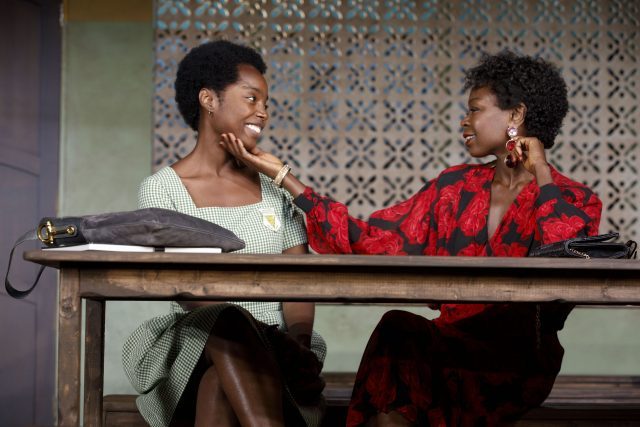
Nya (Karen Pittman) desperately tries to protect her son, Omari (Namir Smallwood), in Dominique Morisseau’s riveting Pipeline (photo by Jeremy Daniel)

Lincoln Center Theater at the Mitzi E. Newhouse
150 West 65th St. between Broadway & Amsterdam Ave.
Tuesday – Sunday through August 27, $87
212-362-7600
www.lct.org

Pipeline is an up-to-the-minute, honest, and hard-hitting look at race, class, and the education system in the United States from Detroit native Dominique Morisseau. Continuing at the Mitzi E. Newhouse through August 27, the intensely intelligent, powerful play was created by Morrisseau shortly after completing her award-winning Detroit Projects trilogy (Detroit ’67, Paradise Blue, Skeleton Crew) and before she begins her Residency Five at the Signature Theatre in April 2018 with a revival of Paradise Blue. In this new work, Morisseau brilliantly introduces Nya (Karen Pittman), a divorced public-school teacher in an unidentified city facing a family crisis, as she leaves a complicated, heart-rending phone message for her ex-husband, Xavier (Morocco Omari), explaining in fractured sentences that their son, Omari (Namir Smallwood), is facing explusion from school. However, she decides to delete the message, replacing it with a blunt “Calling to talk to you about our son. Give me a call back when you get this. Thanks. Bye.” In the span of just a few minutes, Morisseau has set the stage beautifully, establishing character, plot, and mood. Omari is a dour teenager who has attacked one of his teachers during a discussion about Richard Wright’s Native Son, an incident that was captured on video and is about to go viral. Omari’s girlfriend, Jasmine (Heather Velazquez), is a whirling dervish of opinions who’s never afraid to say what she is thinking. Meanwhile, Nya’s fellow teacher, the bitter, old-fashioned Laurie (Tasha Lawrence), has returned to school after getting involved in a serious fight between two students. “A good old ass whipping can teach a lot,” she says. The teachers are sometimes joined by Dun (Jaime Lincoln Smith), a flirtatious school security guard who promises Nya and Laurie that he’ll do whatever he can to prevent further clashes with students. But when Omari runs off, Nya becomes desperate to find him before his future comes crashing down. It’s all summed up by Jasmine, who tells Nya, “Sometimes somebody mess with you on the wrong day. . . . It’s like THEY don’t know it’s your last straw. But they ain’t seen how many times you been sucked of everything you got. They go pickin’ at you like lint, and be lookin’ surprised when you knock ’em flat the hell out.”

(photo by Jeremy Daniel)

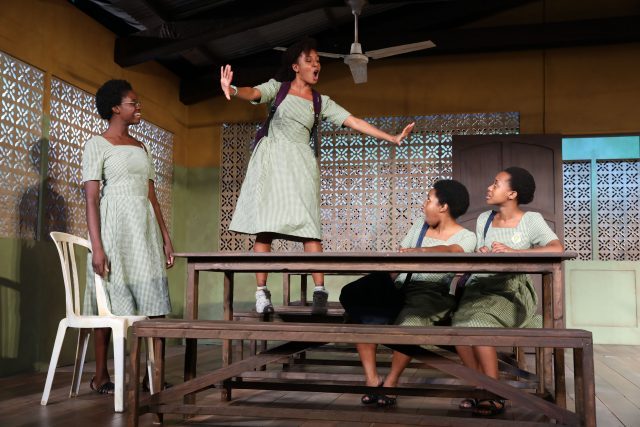
Jasmine (Heather Velazquez) and Omari (Namir Smallwood) face a troubling situation in poetic Lincoln Center production (photo by Jeremy Daniel)

Nya occasionally addresses the audience directly, as if they are in class themselves, but Morisseau, a former teacher whose mother was a public school teacher, and Obie-winning director Lileana Blain-Cruz (War, The Death of the Last Black Man in the Whole Entire World) never allow the play to become overly preachy or pedantic. (There’s even a program insert, “Playwright’s Rules of Engagement,” which notes, “This can be church for some of us, and testifying is allowed.”) The set, by Matt Saunders, swiftly changes from office to lunchroom to dorm room to classroom to hospital waiting room, with occasional scenes taking place in what Morisseau, who is also a writer and executive story editor for the Showtime series Shameless, calls “undefined space.” Omari’s fight with his teacher is representative in many ways of the confrontations between police and black and brown men and the need for personal space, and it’s all sensitively portrayed by an exceptionally strong cast and exceptional writing. “It’s a gamble, Jasmine,” Nya says. “All the time. You send your young man out into the world everyday, or away for a weekend. A semester. A school year. But you don’t know . . . You have no idea if they’re safe. You have no idea if one day someone will try to expire them because they are too young. Or too Black. Or too threatening. Or too loud. Or too uninformed. Or too angry. Or too quiet. Or too everyday. Or too cool. Or too uncomposed. Or too mysterious. Or just too TOO. You don’t know, Jasmine.” The relationships between the characters are fully believable as Morisseau steers clear of genre clichés in making the many issues Pipeline raises a microcosm of what is happening in twenty-first-century America. And at the center of it all is Gwendolyn Brooks’s 1960 poem “We Real Cool,” which is projected onto a blackboard and adorns the cover of Lincoln Center Theater Review: “We real cool. We / Left school. We / Lurk late. We / Strike straight. We / Sing sin. We / Thin gin. We / Jazz June. We / Die soon.” Pipeline is a poetic indictment of institutionalized societal constraints, a lesson we all need to learn.

A PARALLELOGRAM

(photo by Joan Marcus)

Bruce Norris’s A Parallelogram explores time travel and potential tragedy (photo by Joan Marcus)

2econd Stage Theatre
Tony Kiser Theatre
305 West 43rd St. between Eighth & Ninth Aves.
Through August 20, $37-$109
2st.com

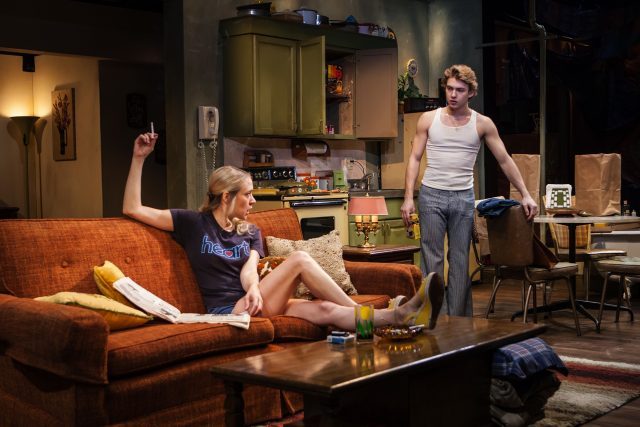
2econd Stage follows up its poignant New York premiere of Pulitzer Prize winner Tracey Letts’s 2003 Man from Nebraska with the superb New York premiere of Pulitzer Prize winner Bruce Norris’s 2010 A Parallelogram, continuing at the Tony Kiser Theatre through August 20. “If you knew in advance exactly what was going to happen in your life, and how everything was going to turn out, and if you knew you couldn’t do anything to change it, would you still want to go on with your life?” thirty-five-year-old Bee (Celia Keenan-Bolger) asks her boyfriend, the married fortysomething Jay (Stephen Kunken), adding, “What if it turned out to be for the best if we’d never even existed?” It’s a classic science-fiction trope, handled with unique flair by Norris, director Michael Greif, and a strong cast of four. Celia Keenan-Bolger stars as the conflicted Bee, a Rite Aid regional manager who is apparently being visited by her future self, an older woman (Anita Gillette), identified in the program as Bee 2, who sits on a chair in the front corner of her bedroom, smoking and sardonically dropping hints about what is in store for Bee’s life. Invisible to the rather self-involved Jay, who moved in with Bee after leaving his wife and two children, Bee 2 nevertheless manages to set off quite a battle between the two lovebirds. The virile young JJ (Juan Castano) mows the lawn outside, but he’ll be inside soon, while Bee 2 plays with some kind of high-tech remote that can shift time backward and forward, the stage going dark and lights flashing to signify the movement of time. (The lighting designer is Kenneth Posner.) But the more Bee gets involved with Bee 2, the more Jay grows concerned about her mental health, and the more the audience is drawn into a parallelogram of ideas and questions about chronology, sanity, narrative, and theater itself.

Bee 2 (Anita Gillette) speaks directly with the audience in 2econd Stage production (photo by Joan Marcus)

Bee 2 (Anita Gillette) speaks directly with the audience in 2econd Stage production (photo by Joan Marcus)

Norris (Clybourne Park, Domesticated) and Greif (Dear Evan Hansen, Rent) include lots of little clues as to whether Bee is actually in contact with Bee 2 or is imagining it all and is in the midst of a breakdown, from Bee’s proclivity for playing Solitaire on the bed to the placement of a clock and a TV and Jay’s insistence that he can not only smell the smoke but see it, pointing out the drifting trails that evoke the lines that Bee 2 explains circle the planet and meet themselves, resulting in slightly different realities converging. Bee even tells Bee 2 that people can’t smell light or time, as if they just have to have faith, just like the audience must have faith in the magic of theater. The idea of doubling also relates to the two men, who are not accidentally named Jay and JJ and who play key roles in various aspects of Bee’s life. Three-time Tony nominee Keenan-Bolger (The Glass Menagerie, The 25th Annual Putnam County Spelling Bee) is delightful as Bee (previously portrayed by Kate Arrington in Chicago and Marin Ireland in L.A.), a kind of surrogate for the audience as we contemplate whether she is delusional or not; of course, it helps that Tony nominee Gillette (Chapter Two, Moonstruck), who clearly relishes her role, often addresses us directly, but she is a highly unreliable narrator. Tony nominee Kunken (Enron, Frost/Nixon) is terrific as the easy-to-despise Jay, while Castano (Jesus Hopped the ‘A’ Train, Transfer) holds his own as the bilingual JJ. Obie winner Rachel Hauck’s set quickly rotates from ground-floor apartment to hospital room (where Bee 3 makes a subtle Three Stooges reference), with both spaces resembling each other, another instance of doubling, as is the existence of theater in general, something that presumes to re-create real life onstage. A Parallelogram asks some key questions while not offering any concrete answers. There’s a minor slip-up here and there and not every detail holds up to concerted investigation, but we could always grab hold of that remote and try to fix a few holes — but would it really change anything?