this week in theater

KINGS

(photo by Joan Marcus)

Gillian Jacobs, Aya Cash, and Zach Grenier star in Kings at the Public Theater (photo by Joan Marcus)

The Public Theater, LuEsther Hall
425 Lafayette St. by Astor Pl.
Tuesday – Sunday through April 1, $75 – $150
212-967-7555
www.publictheater.org

In the spring of 2016, playwright Sarah Burgess and director Thomas Kail teamed up at the Public Theater on Dry Powder, Burgess’s first professionally produced work, managing to make a story about leverage buyouts and dividend recaps tense and involving. Unfortunately, lightning doesn’t strike twice in their Public follow-up, Kings, a surprisingly dry tale of Washington lobbyists. Eisa Davis stars as Rep. Sydney Millsap, a Dallas single mother and former oil and gas company accountant elected to Congress without any political experience. She is quickly set upon by a pair of vulturous thirtysomething lobbyists, Lauren (Aya Cash) and Kate (Gillian Jacobs), both of whom believe they are more important to the system than Millsap is. Kate is pushing absurd legislation for podiatrists, while Lauren, who is married to the chair of the SEC, is hyping a tax-code bill on carried interest (snooze). Neither is very happy to receive short shrift from Millsap. “Good luck getting reelected if you’re going to insult every lobbyist you come into contact with,” Kate tells her. “Maybe you should change careers,” Lauren suggests to Millsap. When Millsap’s party, led by the powerful Sen. McDowell (Zach Grenier), is unhappy with her vote on the tax bill, the senator himself, who has eyes on the White House, offers Millsap a lucrative deal if she decides not to run again, but instead she makes a decision that is nearly as absurd as the legislation the podiatrists want.

(photo by Joan Marcus)

Rep. Sydney Millsap (Eisa Davis) gets some political advice from Sen. McDowell (Zach Grenier) in new Sarah Burgess play (photo by Joan Marcus)

Kings is a slow-moving retread of Dry Powder, mixed with a little Mr. Smith Goes to Washington, lending nothing new on the critical issue of lobbyists and campaign financing. Even Kail’s (Hamilton, Tiny Beautiful Things) direction mimics that of his previous collaboration with Burgess, with furniture being rearranged into chairs and tables and colored lights flashing with loud music in between scenes. For no apparent reason, the audience sits on two sides of Anna Louizos’s set, facing each other, with the action taking place in the middle. Similarly, when Millsap meets other characters at her favorite restaurant, Chili’s, their table revolves. Grenier (Talk Radio, Describe the Night) is rock-solid as McDowell, a proud man who long ago decided to play the game in order to gain power, and Davis (Passing Strange, Julius Caesar) is fresh and exciting as Millsap, a woman who believes she can really make a difference (and she looks sharp in Paul Tazewell’s costumes), but Cash (You’re the Worst, The Other Place) and Jacobs (Don’t Think Twice, Community) are annoying as the lobbyists; their characters are not supposed to be likable, and their shrill performances ensure that. The American electoral system is in chaos, and lobbyists have a lot to do with that, but Kings fails to get at the heart of the situation, offering only clichéd platitudes, like a politician’s empty campaign promises.

MEREDITH MONK AND VOCAL ENSEMBLE: CELLULAR SONGS

(photo by Julieta Cervantes)

Meredith Monk & Vocal Ensemble will present world premiere of Celluar Songs at the BAM Harvey this week (photo by Julieta Cervantes)

Brooklyn Academy of Music
BAM Harvey Theater
651 Fulton St.
March 14-18, $25-$55
718-636-4100
www.bam.org
www.meredithmonk.org

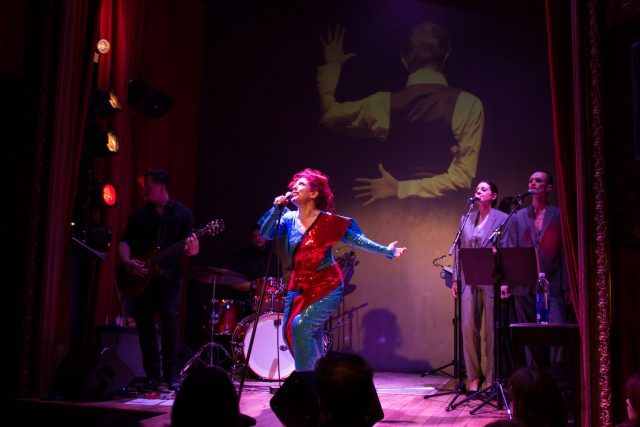
Eclectic New York City multidiscplinary artist Meredith Monk will unveil her latest work this week at BAM, presenting the world premiere of Cellular Songs at the Harvey March 14-18. The multimedia performance comprises voice, movement, light, site-specific video installation, instrumental music, and film; Monk, who made her BAM debut in 1976 with Quarry and was last at the Brooklyn institution in 2014 with On Behalf of Nature, will be joined by four members of her Vocal Ensemble, Ellen Fisher, Katie Geissinger, Allison Sniffin, and Jo Stewart in her Monk debut. The seventy-five-minute piece, which examines humanity’s interdependence with nature in a tech-driven world, features costumes and scenography by Yoshio Yabara, lighting by Joe Levasseur, sound design by Eli Walker, and video design by Kate Freer. Cellular Songs follows On Behalf of Nature, which Monk calls “a meditation on what we’re in danger of losing”; the new work is inspired by the Pulitzer Prize-winning book The Emperor of All Maladies: A Biography of Cancer by Siddartha Mukherjee. Speaking about the new work at Jim Hodges’s Queenslab last June, Monk, equating human cells to musical cells, says, “I started thinking that I was going deeper into On Behalf of Nature, going way inside the body but also from microcosm all the way to the universe to macrocosm, so it’s really that contrast and also between organic forms and the individual human beings and those realms.” You can get a sneak peek at Monk & Vocal Ensemble rehearsing Cellular Songs at Abrons Arts Center here.

AXIS COMPANY: HIGH NOON

High Noon

Will Barnon (Brian Barnhart) is waiting on a train in reimagined theatrical version of High Noon (photo by by Pavel Antonov)

Axis Company
One Sheridan Sq. between West Fourth & Washington Sts.
Thursday – Saturday through March 24, $10-$30, 8:00
866-811-4111
www.axiscompany.org

Axis artistic director and founder Randy Sharp transforms a classic American Western into an existential purgatory in the world premiere of High Noon, continuing at Axis’s Sheridan Square theater through March 24. This is a stripped-down High Noon, utilizing elements from both Fred Zinnemann’s 1952 Oscar-winning film and John Cunningham’s 1947 short story for Collier’s, “The Tin Star.” The sixty-five-minute drama takes place on Chad Yarborough’s sparse, all-white stage, with a horizontal saloon bar, a slightly raised platform in one corner, and white fencing along the walls; even the permanent stanchions are painted white. That brightness is more than offset by Karl Ruckdeschel’s costumes, nearly all of which are black; it not only references good and evil but also High Noon itself, which Zinnemann decided to shoot in black-and-white instead of color for aesthetic rather than financial reasons. In an unidentified small town, the marshal, Will Barnon (Brian Barnhart), has just married his sweetheart, a Quaker named Alice (Katie Rose Summerfield), and turned in his badge. Meanwhile, Guy Jordan, a man Will sent away for murder, has unexpectedly been released from prison and is believed to be coming back on the noon train to take his revenge on all those who’d done him wrong, primarily Will. Guy’s brother, Check (Nicholas McGovern), is already in town and looking for trouble. Will and Alice are preparing to start a new life together, minding her family’s store far away, but Will suddenly decides that he must stay and face Guy. “I’ll never know what’s behind me,” he tells Alice. “I’ve got to stay. That’s the whole thing. That’s the whole thing.” (The dialogue features a lot of purposeful repetition.)

While Henry (Phil Gillen), who runs the local hotel, can’t wait to see Will get his comeuppance, Judge Mettrick (Spencer Aste) is packing his things and thinks Will ought to do the same, as does Will’s deputy, Senator (Jon McCormick), who wants to become the marshal. Caught in between is Helen Rivera (Britt Genelin), who went from being Guy’s lover to Will’s and then Senator’s — and she does not want to be around when Guy arrives. Will might have cleaned up the town, but nearly all his supposed friends, including Senator, Helen, Mettrick, Baker (George Demas), Sam (Andrew Dawson), and stationmaster Oliver (Brian Parks), are turning their back on him, preferring that he leave immediately; their community might have been more dangerous when Guy ran things, but there was also much more business and cash flowing in. Through it all, Will is stalwart, refusing to sacrifice his principles, even if he has to face Guy Jordan and his gang alone.

Helen Rivera (Britt Genelin) has had enough and wants to get out of town in Axis Company’s High Noon (photo by by Pavel Antonov)

Helen Rivera (Britt Genelin) has had enough and wants to get out of town in Axis Company’s High Noon (photo by by Pavel Antonov)

Samuel Beckett’s Waiting for Godot meets Clint Eastwood’s High Plains Drifter in Sharp’s involving staging. All of the actors are onstage through the entire production as if trapped; their words move the tale from the hotel and the depot to the court and the prairie. In writing the High Noon screenplay, Carl Foreman was influenced by the House Un-American Activities Committee investigation into communism in Hollywood; Cooper had refused to name names when he was summoned before the committee in 1947, and Foreman was later blacklisted. Sharp steers clear of that angle, instead situating High Noon in a kind of way station where there are no genuine heroes and everyone has to face their sins, both individually and as a community. The stationmaster is like St. Peter, waving his white flag as if surrendering to the murderous Supreme Being on board the coming train. “My God, it is the end of the world. Holy Jesus,” he says. A few moments later, Mettrick repeats, “By God. This is the end of the world.” Barnhart portrays the icy Will as more of an everyman than a hero, talking in old-fashioned Americana. “Alice, I’m going to try and be the best man you think I am. I’ll do my best,” he tells his new bride. Wearing his badge like a halo, Will tries to put together a posse of apostles, but no one is going to join him on what they consider a suicide mission; he is even spurned by his wife and Helen, his Mary Magdalene, as his execution awaits. High Noon is famous for, among other things, the building tension leading to the action-packed finale, but Sharp chooses another path there as well, providing a surprising, subtle twist. The key to Sharp’s (Last Man Club, Dead End) cunning plot lies in the words of Helen. Early on, she says, “Things’ll go straight back to before. They’ll be the same. The same way. The same story.” Later, she adds, “I want a different ending.” She doesn’t quite get what she desires in this uncompromising morality tale about mid-twentieth-century America — and today.

JERRY SPRINGER — THE OPERA

(photo by Monique Carboni)

Jerry Springer (Terence Mann) encourages guests to share their guilty secrets in Jerry Springer — The Opera at the Signature (photo by Monique Carboni)

The New Group at the Pershing Square Signature Center
The Romulus Linney Courtyard Theatre
480 West 42nd St. between between Ninth & Tenth Aves.
Tuesday – Sunday through April 1, $95 – $135
www.thenewgroup.org

Since 1982, journalist, actor, politician, author, and recording artist Jerry Springer has hosted his confrontational, eponymously titled syndicated talk show, in which friends, lovers, and family members go at it on national television, with the rowdy studio audience cheering on the verbal and even physical battles, chanting the familiar refrain of “Jerry! Jerry! Jerry!” This week the program’s themes are “Little People, Big Problems,” “Cheating Like a Boss,” “Catfish & Release,” “Spiteful Sex,” and “Bromance Break-Ups.” Richard Thomas (book, music, lyrics) and Stewart Lee (book, additional lyrics) have transformed this most American phenomenon into the wildly funny and fabulously foul-mouthed musical Jerry Springer — The Opera, which has been extended at the Pershing Square Signature Center through April 1. The idea started with Thomas’s one-man show, How to Write an Opera about Jerry Springer, in 2001 and has gone through numerous iterations since then. The New Group production is choreographed with plenty of humor by Chris Bailey (Newsies, Cyrano de Bergerac) and directed with flair by Tony winner John Rando (Urinetown, On the Town) on Tony winner Derek McLane’s (33 Variations, Anything Goes) intimate set, with the audience sitting in only a handful of rows on three sides. The two-and-a-half-hour show begins with an “Overtly-Ture,” which references a lap-dancing preoperative transsexual, a lesbian dwarf, and a mom who used to be a dad, followed by “Audience Very Plainsong,” in which an audience chorus calls a man some pretty foul names that cannot be repeated here but had me in stitches.

During some preparatory shtick by annoying warm-up man Jonathan Wierus (Tony nominee Will Swenson) in which the audience declares its desire for “open crotch sighting, pimps in bad suits, mothers who are prostitutes, and cocaine abusers with no noses,” Jerry (three-time Tony and Emmy nominee Terence Mann) takes the stage and announces that today’s theme is “guilty secrets,” and he proceeds to parade up a series of men and women who reveal some fascinating proclivities to their significant others, leading to some riotous song-and-dance numbers while enjoying their “Jerry Springer Moment.” The audience chorus regularly chimes in with such poetic gems as “Dirty whore, dirty whore, filthy dirty manky skanky slut whore, manky, skanky slut whore” and “Vomit / Vomit / Puke my guts out / Secretly kinda hot.” There are some hysterical fake commercials for weight loss, insurance, and Jesus, although one does descend into really unfunny bad taste. Through it all, Jerry eggs everyone on by offering such gentle encouragements as “So, Baby Jane — what is it you want to say to Andrea?” Meanwhile, the dedicated Steve (Billy Hepfinger) provides security for Jerry and the guests, but when things go awry with Wierus, a shot is fired, and the second half of the show moves to purgatory, where Jerry has to prove to Satan (Swenson) that he should not go to hell.

(photo by Monique Carboni)

Jerry (Terence Mann) must prove to Satan (Will Swenson) that he shouldn’t be sent to hell in outrageously funny New Group production (photo by Monique Carboni)

The first half of Jerry Springer — The Opera is everything it should be and more: rude and crude, wild and wacky, and even, dare I say, poignant. It also fits in well with what’s happening on social media these days, except online it’s anonymous people screaming, shouting, and shaming in the ether. Mann (Beauty and the Beast Les Misérables), who will be replaced by Matt McGrath beginning March 13, is a steady, calming presence as Springer, walking up and down the aisles holding his microphone and his cards, engaging with the audience, and standing back while Steve tries to break up fights. The diverse cast, all of whom play multiple roles except for Mann and Hepfinger, has a blast, with Jennifer Allen as Irene, Florrie Bagel as Peaches, Sean Patrick Doyle as Tremont, Luke Grooms as Dwight, Nathaniel Hackmann as Chucky, Justin Keyes as Montel, Beth Kirkpatrick as Zandra, Elizabeth Loyacono as Andrea, a scene-stealing Tiffany Mann as Shawntel, and Jill Paice as Baby Jane, each character sharing his or her deliciously decadent secret, wearing superbly awful outfits courtesy of costume designer Sarah Laux. The purgatory section of the show lags far behind what came before; it’s repetitive and not nearly as much fun as the previous two acts, the songs not as appealing, the new characters too silly and, well, over the top even in Jerry Springer world. In addition, Valkyrie (Kim Steele), a dark, winged creature who serves as Jerry’s conscience, appears only once, never to be seen again, as if Thomas (Anna Nicole, Tourettes Diva) and Lee (Made in Dagenham, What Would Judas Do?) just forgot about her. But at the heart of the musical is its fondness for Jerry the human being, who feels he’s just a good guy helping people express themselves. “Everybody has the right to a voice. Everybody has a story which should be told,” he says. “No matter what your background, no matter what you’ve done, you deserve your voice. Say what you like about me and the show — I give a platform to the marginalized and dispossessed.” And in the end, isn’t that all that matters? Oh, what also matters is that Jerry Springer — The Opera features what must be the longest “Fuck you” in the history of live theater.

JOHN KELLY: TIME NO LINE

Performance artist John Kelly uses dance, music, drawing, film, photography, and more in Time No Line (photo by Theo Cote)

Performance artist John Kelly uses dance, music, drawing, film, photography, and more in Time No Line (photo by Theo Cote)

Ellen Stewart Theatre, La MaMa Experimental Theatre Club
66 East Fourth St.
Thursday – Sunday through March 11, $21-$26
212-475-7710
lamama.org
johnkellyperformance.org

John Kelly’s latest performance piece, the autobiographical, multimedia, multidisciplinary Time No Line, not only looks back at his long, varied, and highly influential career but also honors those he’s lost along the way; his breakout era of work coincided with the AIDS epidemic, and any artistic biography today must reckon with that immense tragedy. “There are so few of my generation left to tell their stories,” Kelly reads from his journals, which he’s been keeping since 1976. So Kelly shares his own story, citing his heroes, including Egon Schiele, Maria Callas, and Gustav Mahler, while referencing such other downtown fixtures as Karen Finley, David Wojnarowicz, Nan Goldin, Charles Atlas, Ethyl Eichelberger, Tere O’Connor, the Cockettes, John Fleck, Joey Arias, and others. The New Jersey native relates episodes of his life through interpretive dance, video projections, visual text, drawing, photographs, songs, and reading from his journal at a small desk. Pages from his journal in neatly arranged rows cover a screen in back. The narrative goes back and forth through the years; “the past is not linear,” he reads. “In retrospect, it’s a patchwork of emotional triggers — how hard has it been to go back into these journals. I see my missteps — and I see my experience, whether I like it or not.” Fortunately, we get to see his experience as well, and there is a lot to like. Kelly traces his career from the ballet and the opera to creating the drag character Dagmar Onassis, the fictional daughter of Callas and Aristotle Onassis, transforming himself into Joni Mitchell, and dealing with the AIDS crisis as it swept through New York City. Third-person text projected on the screen explains, “He sees the possibility of performing ‘in drag’ as a way to be socially annoying (this is 1979) and to process a lot of youthful rage.”

John Kelly looks back at his life and art in autobiographical one-man show (photo by Theo Cote)

John Kelly looks back at his life and art in autobiographical one-man show (photo by Theo Cote)

Bullied as a child, Kelly found solace onstage, but he ultimately opted for alternative venues, such as the Pyramid Club, the Kitchen, DTW, and La MaMa. Cultural touchstones play a central part in his work; his previous shows include Diary of a Somnambulist, about Lady Macbeth and Cesare from The Cabinet of Dr. Caligari, the Obie-winning Love of a Poet, an adaptation of Robert Schumann’s Dichterliebe song cycle, The Escape Artist, based on the life of Caravaggio, and Pass the Blutwurst, Bitte, in which he portrays Schiele. He steps to the side when changing costumes as more text, family photos, and archival footage is shown on the screen; there are also two higher screens where ghostly images occasionally appear. He steps to a center microphone and sings relevant songs by Mitchell, Henry Purcell, and Charles Aznavour. He snakes along the floor and makes chalk drawings that recall Keith Haring’s style and Leonardo da Vinci’s Vitruvian Man. The pacing can be uneven, Kelly is sometimes a little too casual, and he occasionally teeters on the edge of self-indulgence, but when he gets back in the groove, he displays why he has been such a beloved figure for decades. He often talks about mirrors and self-portraits; he calls the former “the stand-in for eventual public scrutiny” and “a tool for establishing a sense of self.” Of course, Time No Line is really a complex, nonlinear self-portrait, a visual diary of the making of a man in which Kelly holds up a mirror and allows us to see the tragedy and comedy that has resulted in his unique brand of art.

In conjunction with Time No Line, which continues at La MaMa through March 11, Kelly’s Sideways into the Shadows exhibition is being held at Howl! Happening: An Arturo Vega Project at 6 East First St. through March 25, featuring hand-rendered transcriptions of journal entries and a memorial wall of portraits. “From this vantage point, it was a challenging time,” Kelly says as a survivor of the AIDS generation. “It’s still hard to get my head around it. This exhibition and Time No Line are my way to process the entire range of how my personal experiences and the arc of my artistic career intertwined into a coherent whole during a time that was both exhilarating and tragic.”

BROOKLYN MUSEUM FIRST SATURDAY: WOMEN’S HISTORY MONTH

Judy Chicago Designing the Entry Banner for The Dinner Party, 1978 (courtesy of Through the Flower Archive)

“Judy Chicago Designing the Entry Banner for ‘The Dinner Party,’” 1978 (courtesy of Through the Flower Archive)

Brooklyn Museum
200 Eastern Parkway at Washington St.
Saturday, March 3, free, 5:00 – 11:00
212-864-5400
www.brooklynmuseum.org

The Brooklyn Museum honors Women’s History Month with its free March First Saturday program, featuring live performances by Leikeli47, DJ Sabine Blaizin (Oyasound) with live percussion by Courtnee Roze, MICHIYAYA Dance (with Anya Clarke and Mitsuko Verdery leading a jam session), and Brown Girls Burlesque, presenting “Act Like a Lady! Strippin’ Fo’ the Culture,” with Hoodoo Hussy, Elektra Taste, Dakota Mayhem, Skye Siren, and Dirty Honey Shake dancers, hosted by Ravenessa; a book launch of Beverly Bond’s Black Girls Rock! Owning Our Magic. Rocking Our Truth. with Bond, Michaela Angela Davis, and Eunique Jones Gibson; pop-up gallery talks by teen apprentices in the “American Art” galleries; a community talk with representatives from THINK!Chinatown; Cave Canem Foundation poetry with zakia henderson-brown, Marwa Helal, and Aracelis Girmay; a hands-on art workshop inspired by Judy Chicago’s banners; a curator tour of “Roots of ‘The Dinner Party’: History in the Making” led by Carmen Hermo; and a Feminist Book Club discussion of Janet Mock’s Surpassing Certainty: What My Twenties Taught Me, with Glory Edim of Well-Read Black Girl. In addition, the galleries will be open late so you can check out “One Basquiat,” “Roots of ‘The Dinner Party’: History in the Making,” “Arts of Korea,” “Infinite Blue,” “Ahmed Mater: Mecca Journeys,” “Rodin at the Brooklyn Museum: The Body in Bronze,” “A Woman’s Afterlife: Gender Transformation in Ancient Egypt,” and more.

THE AMATEURS

(photo by Carol Rosegg)

A ragtag troupe tries to survive the plague while putting on a play about Noah’s ark in The Amateurs (photo by Carol Rosegg)

Vineyard Theatre
Gertrude and Irving Dimson Theatre
108 East 15th St. between Union Square East & Irving Pl.
Tuesday – Sunday through March 29, $79-$100
www.vineyardtheatre.org

During the first half of Jordan Harrison’s new play, The Amateurs, which opened tonight at the Vineyard, I found myself wondering just what it was I was watching. Basically, it was about a troupe of amateur actors in fourteenth-century Europe putting on a most amateurish production of Noah’s Flood. Led by Larking (Thomas Jay Ryan), who plays God, the company wants to impress their benefactor, the Duke, so much that he will make them his official troupe and allow them to live in his castle, safe from the Black Death that is sweeping across the land and has already taken one of their own, Henry (Greg Keller). “We’re actors,” Larking declares. “They bury us outside the city walls — and that’s if they like us. So we’ve got to be the best they’ve ever seen, if we want to live.” But alas, they are terrible. So is the first act of The Amateurs a farce? A parable? A historical treatise? Is it purposefully scattershot, or is it a bunch of amateurs making a play about a bunch of amateurs? Just when I was looking for Marshall McLuhan to explain it all to me (see Annie Hall), the narrative comes to a halt and Michael Cyril Creighton, who portrays simple-minded but lovable scenic designer Gregory, steps forward in contemporary dress and identifies himself as the playwright.

steals the show twice at the Vineyard (photo by Carol Rosegg)

Michael Cyril Creighton plays several key parts in The Amateurs at the Vineyard (photo by Carol Rosegg)

“Hi. Hello there,” Creighton says, addressing the audience directly. “The Vineyard Theatre thought it might be a good idea if I talked to you for a little while about, well, Why. It seems that a few ticket holders have been, um, voting with their feet, I guess you would say? And I suggested we could just lock all the doors maybe, or like lightly shame people as they’re trying to leave, but they said No. No, they said. We are all adults and it would be better if you could maybe just contextualize things a little.” And contextualize things he does, delivering a fifteen-minute monologue that goes deep into what might or might not be Pulitzer finalist Harrison’s creative process and personal past, from grammar school to the AIDS epidemic, from Bible study to art history lesson, ingeniously relating the inspiration behind the play, bringing its own drama and tension. At one point, Gregory is joined by Quincy Tyler Bernstine, who plays Hollis in the show-within-the-show; she just about tears the roof off the place with her soliloquy, sharing her feminist views comparing Noah’s unnamed wife to Bob Cratchit’s spouse, Emily, in Charles Dickens’s A Christmas Carol.

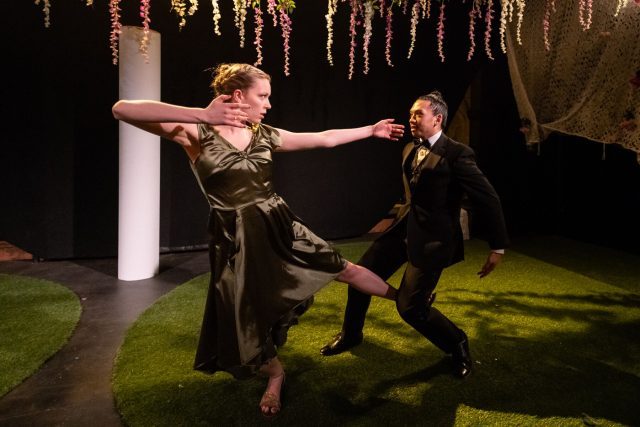
And then the magic of theater took complete hold of me. The play travels back to fourteenth-century Europe, where Hollis, Larking, Rona (Jennifer Kim), the Physic (Keller), and Brom (Kyle Beltran) again portray the Seven Deadly Sins, rehearse their terrible show, and meet the Duke’s stalwart major-domo (Beltran). However, whereas in the first act things were bumpy and odd, now every action, every piece of dialogue makes sense. We get the references, we laugh at inside jokes, we applaud the feminist angle, we even care more about the pageant players themselves, as well as the characters they play. We marvel at Harrison’s (Marjorie Prime, Maple and Vine) creative process, we get a kick out of Tony winner David Zinn’s (The Humans, Fun Home) set, which consists of a grassy field, a hill, and a ramshackle cart that serves as the troupe’s mobile stage, and we chuckle knowingly at Raphael Mishler’s strange, Scream-like masks. We appreciate Obie winner Oliver Butler’s (The Light Years, The Open House) tongue-in-cheek direction, guiding us through two time periods and the fourth wall. And we owe it all to Creighton/Harrison, for reminding us of the power of theater, where it comes from, and what it can do for us, especially in dark times.