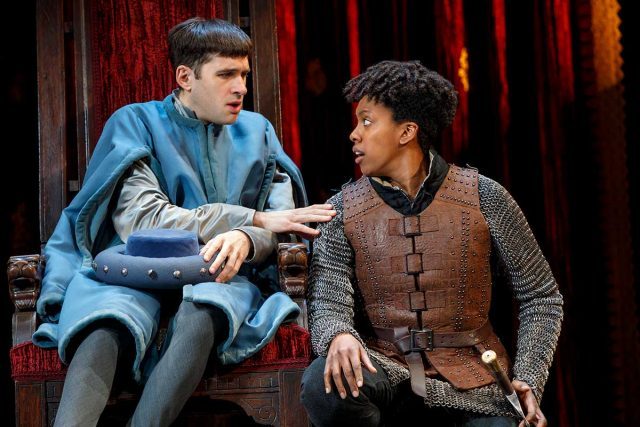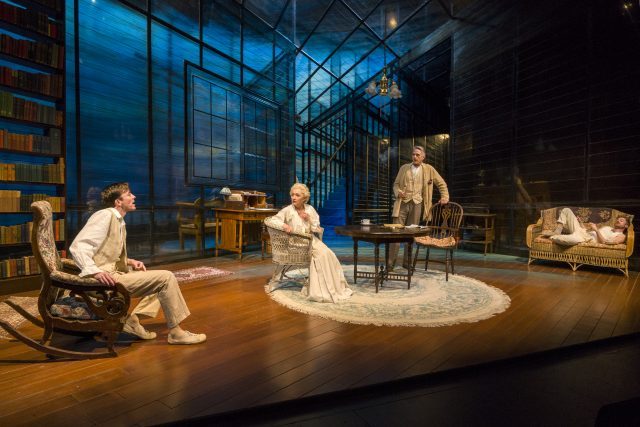
this week in theater

THE AMATEURS

(photo by Carol Rosegg)

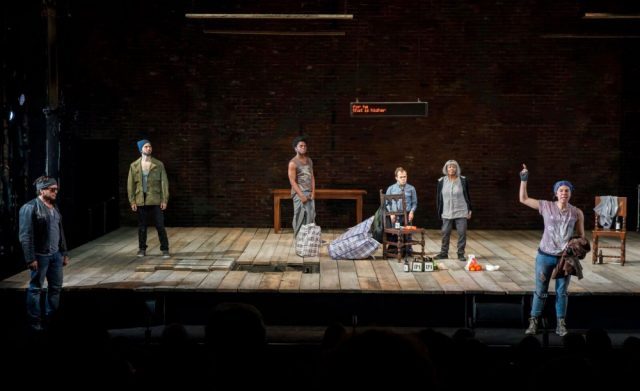
A ragtag troupe tries to survive the plague while putting on a play about Noah’s ark in The Amateurs (photo by Carol Rosegg)

Vineyard Theatre
Gertrude and Irving Dimson Theatre
108 East 15th St. between Union Square East & Irving Pl.
Tuesday – Sunday through March 29, $79-$100
www.vineyardtheatre.org

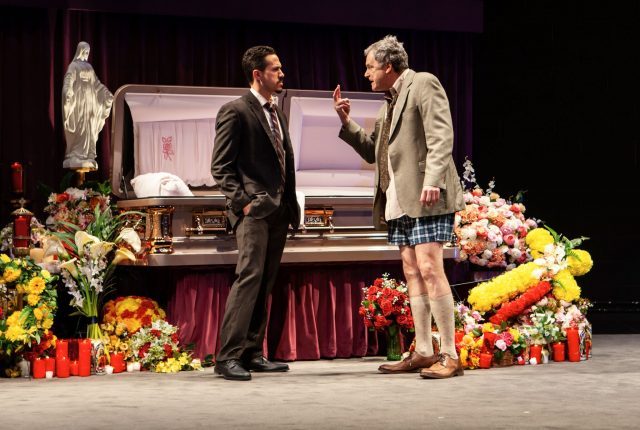
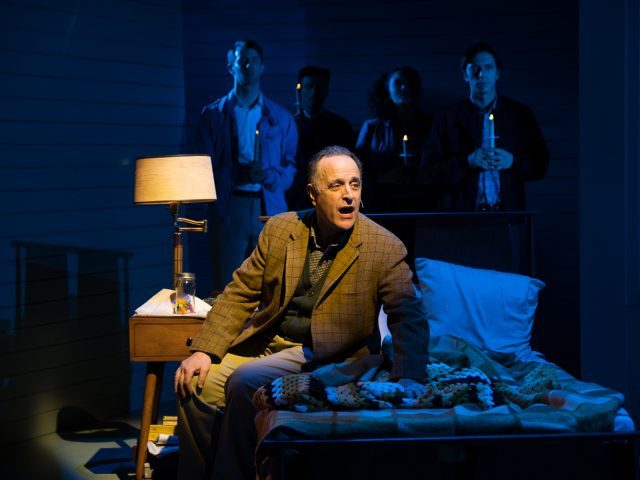
During the first half of Jordan Harrison’s new play, The Amateurs, which opened tonight at the Vineyard, I found myself wondering just what it was I was watching. Basically, it was about a troupe of amateur actors in fourteenth-century Europe putting on a most amateurish production of Noah’s Flood. Led by Larking (Thomas Jay Ryan), who plays God, the company wants to impress their benefactor, the Duke, so much that he will make them his official troupe and allow them to live in his castle, safe from the Black Death that is sweeping across the land and has already taken one of their own, Henry (Greg Keller). “We’re actors,” Larking declares. “They bury us outside the city walls — and that’s if they like us. So we’ve got to be the best they’ve ever seen, if we want to live.” But alas, they are terrible. So is the first act of The Amateurs a farce? A parable? A historical treatise? Is it purposefully scattershot, or is it a bunch of amateurs making a play about a bunch of amateurs? Just when I was looking for Marshall McLuhan to explain it all to me (see Annie Hall), the narrative comes to a halt and Michael Cyril Creighton, who portrays simple-minded but lovable scenic designer Gregory, steps forward in contemporary dress and identifies himself as the playwright.

steals the show twice at the Vineyard (photo by Carol Rosegg)

Michael Cyril Creighton plays several key parts in The Amateurs at the Vineyard (photo by Carol Rosegg)

“Hi. Hello there,” Creighton says, addressing the audience directly. “The Vineyard Theatre thought it might be a good idea if I talked to you for a little while about, well, Why. It seems that a few ticket holders have been, um, voting with their feet, I guess you would say? And I suggested we could just lock all the doors maybe, or like lightly shame people as they’re trying to leave, but they said No. No, they said. We are all adults and it would be better if you could maybe just contextualize things a little.” And contextualize things he does, delivering a fifteen-minute monologue that goes deep into what might or might not be Pulitzer finalist Harrison’s creative process and personal past, from grammar school to the AIDS epidemic, from Bible study to art history lesson, ingeniously relating the inspiration behind the play, bringing its own drama and tension. At one point, Gregory is joined by Quincy Tyler Bernstine, who plays Hollis in the show-within-the-show; she just about tears the roof off the place with her soliloquy, sharing her feminist views comparing Noah’s unnamed wife to Bob Cratchit’s spouse, Emily, in Charles Dickens’s A Christmas Carol.

And then the magic of theater took complete hold of me. The play travels back to fourteenth-century Europe, where Hollis, Larking, Rona (Jennifer Kim), the Physic (Keller), and Brom (Kyle Beltran) again portray the Seven Deadly Sins, rehearse their terrible show, and meet the Duke’s stalwart major-domo (Beltran). However, whereas in the first act things were bumpy and odd, now every action, every piece of dialogue makes sense. We get the references, we laugh at inside jokes, we applaud the feminist angle, we even care more about the pageant players themselves, as well as the characters they play. We marvel at Harrison’s (Marjorie Prime, Maple and Vine) creative process, we get a kick out of Tony winner David Zinn’s (The Humans, Fun Home) set, which consists of a grassy field, a hill, and a ramshackle cart that serves as the troupe’s mobile stage, and we chuckle knowingly at Raphael Mishler’s strange, Scream-like masks. We appreciate Obie winner Oliver Butler’s (The Light Years, The Open House) tongue-in-cheek direction, guiding us through two time periods and the fourth wall. And we owe it all to Creighton/Harrison, for reminding us of the power of theater, where it comes from, and what it can do for us, especially in dark times.

HANGMEN

(photo by Ahron R. Foster)

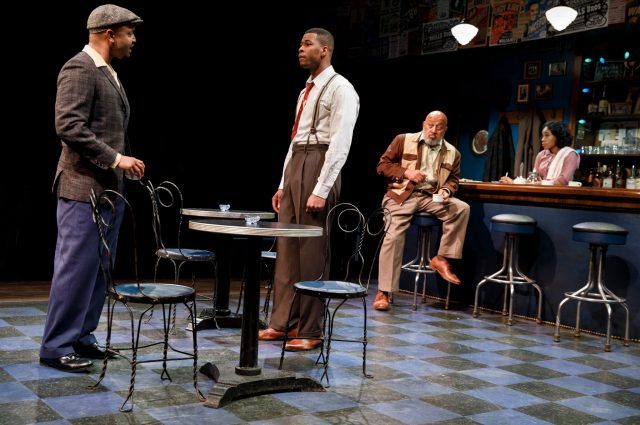
Martin McDonagh’s Hangmen is set primarily in a Lancashire pub run by a government executioner (photo by Ahron R. Foster)

Atlantic Theater Company
Linda Gross Theater
336 West 20th St. between Eighth & Ninth Aves.
Tuesday – Sunday through March 25, $90-$110
866-811-4111
atlantictheater.org

British-Irish writer and filmmaker Martin McDonagh further establishes himself as one of the finest storytellers in all the land with the exquisitely rendered, Olivier Award–winning Hangmen, which has just been very deservedly extended through March 25 at the Atlantic. McDonagh is already riding high with Three Billboards outside Ebbing, Missouri, which he wrote, produced, and directed and has been nominated for seven Academy Awards; the film is a razor-sharp investigation of one mother’s determination to find out who raped and killed her daughter in a small town that wants to move on from the tragedy. Hangmen begins in 1963, when master executioner Harry Wade (Mark Addy) and his somewhat hapless assistant, Syd Armfield (Reece Shearsmith), are preparing to hang convicted child rapist and murderer Hennessy (Gilles Geary), who is fighting to stay alive. “You’re hanging an innocent man! I never even met the girl! I’ve never even been to Norfolk!” Hennessy insists. “That’s all just the whys and wherefores. That’s nowt to do with me,” the burly Harry explains shortly before pulling the lever and hanging Hennessy. “Now where’s our bloody breakfast? I, for one, am fucking starved,” Harry says after Hennessy is officially declared dead. To Harry, hanging is his job, and he is simply going to carry out the orders of the government to the best of his ability.

(photo by Ahron R. Foster)

Harry Wade (Mark Addy) and his wife, Alice (Sally Rogers), worry about their daughter in gripping play at the Atlantic (photo by Ahron R. Foster)

Two years later, Harry is at the pub he runs with his wife, Alice (Sally Rogers). Also there are four regulars, the daft Bill (Richard Hollis), the old and deaf Arthur (John Horton), Charlie (Billy Carter), who repeats everything for Arthur, and Fry (David Lansbury), a policeman who looks the other way whenever necessary. Capital punishment, including hanging, has just been outlawed in Britain, and young reporter Clegg (Owen Campbell) is trying to get a quote from Harry, who refuses to talk — until Clegg brings up Albert Pierrepoint (Maxwell Caulfield), the most famous of Britain’s executioners and Harry’s archnemesis and former boss. They are soon joined by the mysterious Peter Mooney (Johnny Flynn), a suspicious character who appears to have an ulterior motive. After Mooney violates pub protocol, Alice says to Harry, “Don’t mind him, love. He just don’t know the ropes, does he?” to which Harry responds, “There’s ropes and there’s ropes, though, int there?,” one of several rope jokes McDonagh uses. Mooney turns more menacing as he seeks to rent a room above the pub and takes an interest in Alice and Harry’s extremely shy fifteen-year-old daughter, Shirley (Gaby French), setting up a thoroughly unpredictable, wickedly funny second act.

Hangmen is loosely inspired by the exploits of the real-life Harry Allen, an English hangman who at first assisted Pierrepoint (the subject of the excellent 2005 biopic Pierrepoint — The Last Hangman) and later, as chief executioner, hanged a man named James Hanratty who professed his innocence to the very end. The Royal Court production is expertly directed by Matthew Dunster (The Lightning Child, Mogadishu), who never allows the play to pause for a breath; none of the actors are ever just standing around, waiting, even as the action takes place elsewhere. Anna Fleischle’s set marvelously morphs twice, including a gripping scene between Mooney and Armfield in a café. Addy (Game of Thrones, The Full Monty) is utterly charming as the boisterous and blustery Harry, a bigger-than-life figure who has no regrets, except for declining an invitation to hang convicted Nazis. In his relatively brief appearance, Caulfield (Grease 2, Class Enemy) is a hoot as Pierrepoint, a serious man who brings down the house. But the success of the narrative depends on Mooney, played with devilish charm by Flynn (Richard III / Twelfth Night, Jerusalem); the questions surrounding who Mooney is, what he wants, and what he might have done are central not only to the play but to the overall debate over the effectiveness of the death penalty as justice and deterrent. And through it all, the real star is McDonagh, whose skill at writing dialogue and putting well-drawn, unique characters in emotionally and psychologically (and physically) challenging situations is unparalleled. McDonagh’s plays have won three Olivier Awards (The Lieutenant of Inishmore, The Pillowman, and Hangmen), earned two other Best Play nominations (The Beauty Queen of Leenane, A Skull in Connemara), and garnered four Best Play Tony nods; meanwhile, he was nominated for an Oscar for Best Original Screenplay for his 2008 thriller, In Bruges. The man can just plain write. Hangmen is a sizzling black comedy, one of the best plays of the season. It’s not going to hang around forever — although a Broadway transfer would be most welcome — so book your tickets now.

RELEVANCE

(photo by Joan Marcus)

Dr. Kelly Taylor (Molly Camp) moderates a discussion with Dr. Theresa Hanneck (Jayne Houdyshell) and Msemaji Ukweli (Pascale Armand) in Relevance (photo by Joan Marcus)

MCC Theater at the Lucille Lortel Theatre
121 Christopher St. between Bleecker & Hudson Sts.
Tuesday – Sunday through March 11, $49-$99
212-352-3101
www.mcctheater.org

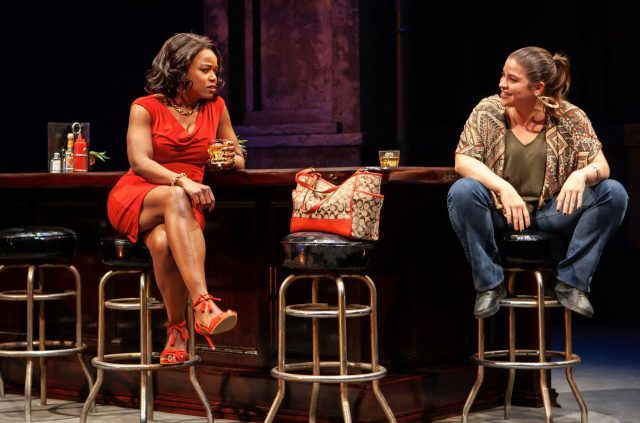
“What you hear underneath it is hate. It’s pure, unadulterated hate,” Dr. Theresa Hanneck (Tony winner Jayne Houdyshell) says at the beginning of JC Lee’s electrifying Relevance, which opened this afternoon at the Lucille Lortel Theatre. The timely and topical MCC world premiere takes place at the fictional American Conference for Letters and Culture, where Theresa, a white woman in her late fifties, is being honored with the Alcott lifetime achievement award for her influential career as an outspoken feminist writer and teacher. As the play opens, she is on a panel with up-and-coming writer and activist Msemaji Ukweli (Tony nominee Pascale Armand), a twentysomething African American woman who quickly reveals that she is not afraid to take down her idols to prove a point. The talk is being moderated by vice committee chair Dr. Kelly Taylor (Molly Camp), a white woman in her thirties who desperately wants to avoid controversy, especially involving race, gender, and age. After Theresa brings up the concept of privilege, Msemaji fires back, and the two women go for each other’s throat as Kelly tries to calm things down.

(photo by Joan Marcus)

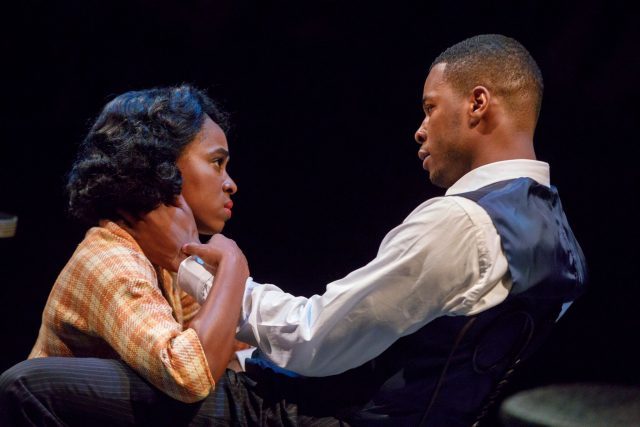
David (Richard Masur) and Theresa (Jayne Houdyshell) have a lot to talk about in MCC world premiere at the Lucille Lortel (photo by Joan Marcus)

Theresa is livid about how she was treated by Msemaji; her longtime agent and former lover, David (Emmy nominee Richard Masur), thinks she should let it go, but Theresa is dead-set on revenge, belittling her new rival. “You pick a topic people are afraid to confront, you feign bravery with a cursory glimpse, and everyone showers you with accolades for showing them a touchstone they already knew was there,” she says, convinced that Msemaji is a phony. Meanwhile, Msemaji is not going to back off just because of Theresa’s history. “Her work is a clarion call from the past, a touchstone for my generation as we move the conversation forward, unmarked by the same scars that are tokens of her survival,” Msemaji explains. The ever-widening generation gap is also evident in social media; whereas Msemaji spreads her message on Twitter and on such sites as Jezebel, Theresa has never tweeted and doesn’t even know how to scroll on her smartphone. “Twitter is hardly Vidal versus Buckley,” a defiant Theresa says. “It’s people climbing on top of one another to see what the kids at the cool table are talking about. Who can ‘out woke’ who. It’s as much a debate as a Fox & Friends panel.” But when she digs up some dirt on Msemaji, Theresa becomes digitally literate on the spot while she decides how far she is willing to go to protect her legacy and not be shoved aside.

(photo by Joan Marcus)

Msemaji Ukweli (Pascale Armand) knows just what she wants in Relevance (photo by Joan Marcus)

Relevance is gripping theater, focusing on many of the key hot-button issues that have led to rising hatred on the streets, in the government, and, of course, across social media. Lee (Luce, Looking) and director Liesl Tommy (Eclipsed, The Good Negro) zero in on the bickering that exists among liberals with views not that different from each other but who find themselves at odds regarding their methods. Houdyshell (The Humans, A Dolls House, Part 2), one of the leading ladies of New York theater, is a force of nature as Theresa, a strong, determined woman who is not about to yield her place as a major figure in the women’s rights movement. Armand (Eclipsed, The Trip to Bountiful) is tough as nails as Msemaji, a bold, future-thinking woman who knows it’s her time to shine. Camp (The Heiress, Close Up Space) strikes just the right note as Kelly, whose conflict-avoidant perkiness covers a steely ambition to excel in a position long dominated by men. And Masur (Transparent, One Day at a Time) is subtle and gentle as David, a seemingly reasonable man who has his own personal agenda.

Tony winner Clint Ramos’s (Eclipsed, Sunday in the Park with George) revolving set goes from conference stage to hotel bar to bedroom, with such songs as Joan Armatrading’s “Drop the Pilot” — which includes the line “Don’t use your army to fight a losing battle” — accompanying the changes. However, Jeanette Oi-Suk Yew’s projections, mostly depicting what is happening “live” on social media, can be overwhelming and distracting. Relevance unfolds like a classic courtroom drama, with Theresa and Msemaji evoking Clarence Darrow and William Jennings Bryan going at it back and forth, each one making salient, hard-hitting points, taking on hypocrisy while also serving their own substantial egos. Lee and Tommy do a superb job navigating the deeply intellectual and philosophical arguments being made, which easily could turn to the pedantic and pretentious but instead are thought-provoking and eye-opening. In a world fraught with oversensitivity and political correctness, Relevance also stands as a cogent reminder of what could possibly be accomplished if some people could just come together and fight on the same side — and the tremendous cost incurred when they don’t.

A WALK WITH MR. HEIFETZ

(photo by James Leynse)

Mariella Haubs plays the violin as Yehuda Sharett (Yuval Boim) and Jascha Heifetz (Adam Green) talk about music in world premiere play (photo by James Leynse)

Cherry Lane Mainstage Theatre
38 Commerce St.
Wednesday/Thursday, Saturday/Sunday through March 4, $72-$102
212-989-2020
primarystages.org
www.cherrylanetheatre.org

In April 1926, Lithuania-born Russian violin virtuoso Jascha Heifetz gave a fundraising concert in a stone quarry by Ein Harod kibbutz in Mandatory Palestine, the future State of Israel. Afterward, it is believed that the Jewish musician took a stroll with composer and kibbutznik Yehuda Sharett, brother of Moshe Sharett, who would become the second prime minister of Israel nearly thirty years later. In A Walk with Mr. Heifetz, a Primary Stages world premiere continuing at the Cherry Lane through March 4, former Gramophone editor and Time magazine journalist James Inverne imagines what took place while the twenty-five-year-old Heifetz (Adam Green) and Yehuda (Yuval Boim) wandered around the quarry area. In the first act, the two men talk about music, Zionism, ego, walking, and responsibility as Itzhak Perlman protégée Mariella Haubs plays the violin in the background. In the second act of the hundred-minute play, Wilson Chin’s set turns from the quarry to Yehuda’s cluttered apartment in 1945, as he’s visited by his brother, Moshe (Erik Lochtefeld), who has taken on a critical role in the burgeoning government. They talk about music, Zionism, ego, coffee, and responsibility, Moshe somewhat hopeful about the future as he name-drops such Jewish leaders as Chaim Weizmann and David Ben-Gurion, Yehuda despondent as he can’t get over a family tragedy that upended his life.

(photo by James Leynse)

Brothers Moshe (Erik Lochtefeld) and Yehuda (Yuval Boim) Sharett discuss music and the future of Israel in A Walk with Mr. Heifetz (photo by James Leynse)

It’s a very talky, didactic play, each act involving two characters arguing over theoretical propositions in dry, matter-of-fact ways, more of a debate than a piece of theater, dueling essays on the formation of the State of Israel. There’s little palpable tension and no conflict; it’s just an excuse for first-time playwright Inverne to share his views — which can be intriguing — but he and director Andrew Leynse have left out any hint of drama. Boim (Two Thousand Years) speaks in a thick Israeli accent, Green (Venus) in a heavy Russian one, and Lochtefeld (Small Mouth Sounds) in a British lilt, to help differentiate among the three men, even though none of the accents are based on how they actually spoke. Haubs, however, speaks beautifully with her violin; unfortunately, there is not nearly enough of the Juilliard graduate, particularly in the second act. Eventually, by the time they get to “The Hatikva,” what would become the Israeli national anthem and which means “The Hope” in English, all hope has been lost.

POLLOCK

Pollock

Jim Fletcher and Birgit Huppuch star in US premiere of Pollock at Abrons Arts Center (photo by Laurent Schneegans)

Abrons Arts Center, Underground Theater
466 Grand St. at Pitt St.
February 22-25, $20
212-352-3101
www.abronsartscenter.org

Abrons Arts Center and the Cultural Services of the French Embassy in New York have joined forces for the US premiere of Compagnie l’heliotrope’s Pollock, a riveting show about the tempestuous relationship between Abstract Expressionists Jackson Pollock and Lee Krasner, who met in 1942, married in 1945, and stayed together, through good and bad — primarily Pollock’s alcoholism and infidelities — until his death in a car crash in 1956. Written by Fabrice Melquiot and directed by Paul Desveaux as part of a trilogy about American artists that also includes works about Janis Joplin and Diane Arbus, Pollock unfurls like one of Pollock’s paintings, nonlinear, experimental, and abstract, forming an intense and entertaining whole. Pollock (Jim Fletcher) and Krasner (Birgit Huppuch) tramp barefoot across Desveaux’s set, which features a pair of transparent plastic canvases, a small kitchen area, and microphones at either side, where Pollock and Krasner share some of their tale. The stage is a metaphor for Pollock’s thoughts; “Jackson Pollock drags on his cigarette and now he’ll go / into / into the bar that functions as his head / Jackson Pollock’s head is a bar not a head all I serve in my bar is pure genius no ice it rips out your tonsils plucks off your uvula,” the Wyoming-born Pollock says. Brooklyn native Krasner adds, “That’s what genius is /
 Pollock 
/ It’s on your face like a mark of shame you’d like to hide but it’s got you in its grip /
 It won’t let go will never let go drink all you like Pollock you’ll never escape it 
/ It’s how you’re made it’s there it’s /
 It’s on your face on every one of your paintings poor love my poor love and because your face lets you see where to put your feet like the paintings help you stand up straight
 / You keep your beautiful face for all to see and tuck your crutches under your arm / Then your genius explodes 
/ You don’t wanna fall flat on your face.”

Pollock

Pollock depicts the tempestuous relationship between Jackson Pollock and Lee Krasner (photo by Laurent Schneegans)

The couple cuddle and argue, smoke cigarettes, drink from bottles, interview each other, dance, paint, and name-drop such friends and colleagues as Hans Hoffmann, Tony Smith, Pablo Picasso, Andre Derain, Pierre Matisse, Piet Mondrian, and Alexander Calder. They speak in poetic rhythms — the English translation is by Kenneth Casler and Myriam Heard — as they relate various aspects of their relationship, including events after Pollock’s death in a one-car accident that might have been a suicide; Pollock’s mistress at the time, Ruth Kligman, was in the car too but survived. “Painting / And killing myself / I don’t do anything else,” Pollock says. A moment later, Krasner examines a Pollock painting using mathematics and fractal density. “You’re exactly what I wasn’t expecting this evening,” he says. It’s not exactly what the audience was expecting either, but Pollock is an insightful and entertaining exploration of love and the creative process. Fletcher (Isolde, The Evening), a longtime member of Richard Maxwell’s New York City Players and who most recently played Lemmy Caution in Why Why Always at Abrons, Shaun Irons and Lauren Petty’s multimedia adaptation of Jean-Luc Godard’s Alphaville, inhabits Pollock’s mind, body, and spirit, giving an expert performance that is complemented by Huppuch’s (Men on Boats, Telephone) bold, beautiful portrayal of Krasner, just as Pollock was complemented by Krasner. Many of the scenes and much of the dialogue were inspired by real episodes, as Melquiot and Desveaux drip, scratch, and splatter the elements together to come up with an impressive theatrical canvas.

PERFORMANCE SPACE NEW YORK EAST VILLAGE SERIES: AVANT-GARDE-ARAMA

Performance Space New York is reborn in the East Village

Performance Space New York is reborn in the East Village

Performance Space New York
150 First Ave. at East Ninth St.
Sunday, February 18, free, 6:00 pm – 1:00 am
212-352-3101
performancespacenewyork.org

After a major renovation, one of downtown’s best and most diverse venues is back, as Performance Space New York, formerly known as PS122, celebrates its return with a free event on Sunday night, “Avant-Garde-Arama.” Kicking off the East Village Series, the festivities will feature live performances from six to nine on several stages by a vast array of creators, including Adrienne Truscott, Erin Markey, Hamm, Holly Hughes, John Kelly, John Zorn, La Bruja of Nuyorican Poets Cafe, Penny Arcade, Pharmakon, Reggie Watts, and Sister Jean Ra Horror, among many others. At nine, a dance party takes over, with JD Samson, Justin Strauss, and more. The evening’s hosts are the Factress (Lucy Sexton), Carmelita Tropicana, and Ikechukwu Ufomadu. On its website, the venue declares, “Performance Space New York was born in the East Village in 1980 as Performance Space 122 when a group of local artists occupied the empty building that had been home to Public School 122 and started making performance work as a passionate rejection of corporate mainstream culture. Today, almost forty years later, Performance Space New York is faced with a radically transformed neighborhood unaffordable for young artists and a national political climate that feeds off social inequity more than ever. Moving back into our newly renovated spaces, the inaugural East Village Series asks what kind of art organization we need to become in light of this ever-more-exclusionary social and political context.” The East Village Series continues through June with such presentations as “Focus on Kathy Acker,” “Women’s History Museum,” Diamanda Galás and Davide Pepe’s Schrei 27, a world premiere by Sarah Michelson, Tiona Nekkia McClodden’s CLUB, Penny Arcade’s Bitch! Dyke! Faghag! Whore!, and Chris Cochrane, Dennis Cooper, and Ishmael Houston-Jones’s Them.

JIMMY TITANIC

(photo by Carol Rosegg)

Colin Hamell portrays more than twenty characters in one-man show at the Irish Rep (photo by Carol Rosegg)

Irish Repertory Theatre
W. Scott McLucas Studio Theatre
132 West 22nd St. between Sixth & Seventh Aves.
Tuesday – Sunday February 18, $50
212-727-2737
irishrep.org

Playwright Bernard McMullan takes audiences from the fiery furnaces of hell to the heavens above in the seventy-five-minute one-man show Jimmy Titanic, cruising along at the Irish Rep through February 18. The play was first performed in 2012 in tribute to the centennial of both the birth and death of the RMS Titanic, which sank on April 14-15, 1912, after hitting an iceberg on its maiden voyage. The show is now back with its stalwart captain, Colin Hamell, who has been with it since the beginning, steering it around the world. Hamell serves as narrator/guide as well as playing every character, including Jimmy Boylan, who works on board with his best friend, Tommy Mackey, who helped build the luxury liner at the Harland and Wolff shipyard in Belfast and knows all there is to know about the Titanic. Hamell portrays more than twenty characters in all, from Jimmy and Tommy and other crew members to numerous fictional passengers, the editor of the New York Times, the mayor of Belfast, the real-life John Jacob Astor, Jacques Futrelle, and Senate committee chairman William Alden Smith, and the angel Gabriel, St. Peter, and God. The play works best when Jimmy is on board the “ship of dreams,” relating stories about how it was built, sharing details about its overall impressiveness, and assisting people trying to survive as it begins sinking. Those scenes are chock-full of surprising facts as Hamell floats across Michael Gottlieb’s tight set, a series of riveted metal panels representing the inside of the bottom of the ship, where the men toil in mind-numbing heat. Gottlieb also designed the effective lighting, which changes colors as the tale continues with director Carmel O’Reilly (McMullan’s Return of the Winemaker) at the helm.

(photo by Carol Rosegg)

Colin Hamell teaches how to shovel coal in Bernard McMullan’s Jimmy Titanic (photo by Carol Rosegg)

The scenes on board the ship are genuinely gripping as Hamell reveals how passengers of different backgrounds, from class to ethnicity to gender, faced peril. Whenever McMullan steers the story back up to heaven, the energy is drained as Hamell portrays Gabriel as a cunning thief, Peter as a selfish lapdog, and God as a gangster. The scenes in the newsroom, the US Senate, and the Belfast mayor’s office offer a look into how the media, politics, and economics dealt with the disaster, but the show drags a bit until it shifts back to the commotion rising on the ship. To those not familiar with many of the facts, it is shocking to learn that there were far more passengers traveling in second and third class than in first, and how there were travelers from more than thirty nations, many seeking a new life in America. “Titanic was primarily an emigrant ship,” Jimmy says, while also talking about the large crew: “Two hundred and forty men worked below in the stokeholds. Only a quarter of them survived. Of the eighty lads working that night on the eight to midnight shift, just twelve made it out.” Jimmy is also proud to point out how most everyone reacted in the midst of the crisis. “The prospect of what lay ahead that night brought out instincts you never knew you had. People were trying to do the right thing. Saving themselves and their loved ones,” he explains. Despite its drawbacks, Jimmy Titanic offers a unique and compelling view of one of the worst tragedies of the twentieth century, focusing on the men behind the scenes.