this week in theater

THE METROMANIACS

(photo by Carol Rosegg)

David Ives’s The Metromaniacs is a nonstop laugh fest (photo by Carol Rosegg)

Red Bull Theater
The Duke on 42nd St.
229 West 42nd St. between Seventh & Eighth Aves.
Tuesday – Sunday through May 26, $75-$95 ($45 with code MANIAC3)
www.redbulltheater.com
dukeon42.org

It’s easy to go crazy for The Metromaniacs, David Ives’s gleeful romp set during the poetry craze in 1738 France. Ives’s third collaboration with director Michael Kahn, in which they present long-lost French comedies (following Corneille’s The Liar in 2010 and Regnard’s The Heir Apparent in 2011), The Metromaniacs is a “transladaptation” of Alexis Piron’s scandalous 1738 La Métromanie (“The Poetry Craze”), based on a real-life incident in which Voltaire declared his love for a French poetess who turned out to be a man using a woman’s name in order to get published. (Although La Métromanie was performed at the Comédie Française, Piron never got into the Académie Française because he had also written “Ode to the Penis.”) The two-act, 105-minute Red Bull production, which opened Sunday night at the Duke on 42nd St., is entirely in delectable rhyming verse, and Ives never misses a chance for a devilishly clever quatrain or couplet. The story takes place in the elegant home of Francalou (Adam LeFevre), a wealthy wannabe poet whose work is looked down upon. To send up the establishment, he has been publishing ridiculous pastorals under the female pseudonym Meriadec de Peaudoncqville. Francalou is throwing a small party for his virginal daughter, Lucille (Amelia Pedlow), who is returning home from university; the shindig will include a play written for the occasion by Francalou, called The Metromaniacs, set in the parlor, which has been turned into a silly sylvan forest with fake trees and rocks. (The fab set is by James Noone.) Francalou has cast the saucy maid, Lisette (Dina Thomas), as his daughter. “Of course, I only wrote it for a laugh. / But here and there’s a joke, a paragraph, / A rhyme or two I might not call un-juicy. / What a choice welcome-home gift for my Lucy!” he declares. The guests at the party are Damis (Christian Conn), a young poet, using the pseudonym Cosmo de Cosmos, who is determined to meet and wed Meriadec de Peaudoncqville; Mondor (Adam Green), Damis’s valet, who has the hots for Lisette, thinking she is Lucille; Dorante (Noah Averbach-Katz), a dullard who is seeking Lucille’s hand but knows that will be difficult, given that his father is immersed in a legal battle with Francalou; and Baliveau (Peter Kybart), Damis’s uncle and a judge who wrongly believes that his nephew is away at law school, which he is paying for. Over the course of one wild night, lust, love, literature, and the law are thoroughly mocked through cases of mistaken identity and purposeful deception that grow more hysterical by the minute.

(photo by Carol Rosegg)

Lucille (Amelia Pedlow) and Lisette (Dina Thomas) discuss love and literature in The Metromaniacs (photo by Carol Rosegg)

The Metromaniacs is chock-full of bawdy humor, physical slapstick, playful anachronisms, asides to the audience, splendid costumes by Murell Horton, awesome wigs by Dori Beau Seigneur, inside jokes, and spectacular rhyming verse. Early on, Lisette says of Lucille, “I’d be amazed if she were ever wived, / Locked in her room reading since she arrived. / See, she’s a metromaniac. That’s her curse.” Dorante asks, “Crazy for subways?” Lisette responds, “No, crazy for verse. / An inflammation of the mental bursa. / Where verse becomes your vice — and vice-a-versa.” Occasionally a character will pause ever so slightly, giving the audience the opportunity to guess what rhyme might be next, something that gets a little harder with such words as “dramaturgy,” “chartreuse,” “Brittany,” “distich,” and, over and over, “incognito.” The seven-person cast might be having even more fun than the audience. At one point the night I saw it, a prop misfired, and Conn and Averbach-Katz couldn’t control themselves, trying their best to hold back laughter as they quickly ad-libbed and the audience erupted. Perdlow is establishing herself as one of the leading period comedians in New York, having previously cracked wise in Red Bull’s ’Tis Pity She’s a Whore and Kate Hamill’s Pride and Prejudice. Thomas (Tribes, Clever Little Lies) is a hoot as Lucille, Lefevre (Awake and Sing, The Diary of Anne Frank) is goofily charming as Francalou, Conn (The School for Scandal, Venus in Fur) is cool and confident as Damis, and Green (The Witch of Edmonton) lends just the right amount of manly slime to Mondor. Tony nominee Kahn (Show Boat, Cat on a Hot Tin Roof) refuses to allow a dull moment in this nonstop laugh fest, which also can be rather self-referential. Here’s a gem from Damis about Francalou, but it could just as well be about Tony winner Ives (Venus in Fur, All in the Timing): “Oh, he’s a lovely man, don’t get me wrong. / Generous and open, sunshine all day long. / But then in middle age he gets this itch / And now he writes the most appalling kitsch. Oh, sure, he’ll say he wrote it ‘for a laugh’ — / Then make you sit through every lumbering gaffe. / Tonight we’re putting on his so-called ‘play’ . . . ? / But wait. I see him coming. Run away!” Of course, don’t run away; run to the Duke to catch this high-falutin’ comic extravaganza, which continues through May 26.

MISS YOU LIKE HELL

(photo by Joan Marcus)

Olivia (Gizel Jiménez) and Beatriz (Daphne Rubin-Vega) head out on the road in Miss You Like Hell (photo by Joan Marcus)

The Public Theater, Newman Theater
425 Lafayette St. by Astor Pl.
Tuesday – Sunday through May 13, $90
212-967-7555
www.publictheater.org

Pulitzer Prize winner Quiara Alegría Hudes tackles immigration, marijuana reform, same-sex marriage, suicide, teen sex, the blogosphere, and more in the overstuffed, underwhelming road-trip musical Miss You Like Hell, which has been extended at the Public’s Newman Theater through May 13. Daphne Rubin-Vega stars as Beatriz, a Mexican immigrant living in California who, facing a critical immigration hearing, suddenly shows up to see her sixteen-year-old daughter, Olivia (Gizel Jiménez), who lives in Philadelphia with her father. Mother and daughter have not communicated for four years; they are so estranged that Olivia calls her Beatriz, not Mom. “I miss you like hell; my bones hurt, Olivia, because you’re not at my side,” Beatriz pleads to her daughter, who at first wants nothing to do with her. Beatriz ask Olivia to drive cross-country with her to the West Coast, but Olivia is dubious of her mother’s motives. “This is weird, Beatriz,” she says. “Come after school. We’ll grab slices and get caught up.” Her mother wants more, explaining how she reads Olivia’s anonymous, very personal blog — in which she claims her mother is dead — and is concerned for her, desperate for the two of them to hit the road together. “I’m a motherless girl / I survive on my own / It’s who I am / right down to the bone,” Olivia sings. “She’s my negative space / She’s my hole in the world / The echoing empty of a motherless girl.” Olivia eventually jumps into her mother’s truck and off they go on a journey that, just as Olivia expected, is a lot more than just a mother-daughter re-bonding experience.

(photo by Joan Marcus)

Miss You Like Hell features an ensemble cast at the Public Theater (photo by Joan Marcus)

Jiménez (Party People, Unseamly) sings her heart out as Olivia, while two-time Tony nominee Rubin-Vega (Rent, Anna in the Tropics) is more reserved and laid back as Beatriz. The other eight members of the cast sit on green chairs in the back and occasionally come onstage to change the props and play minor roles. Riccardo Hernandez’s stage features two rows of audience members seating on either side; in between is a blue floor populated by depictions of white doves, which also fly up the walls. Most of the sets consist of tables and chairs, with a revolving center that director Lear deBessonet (Venus, A Midsummer Night’s Dream) doesn’t quite know what to do with, although Danny Mefford’s (Fun Home, Bloody Bloody Andrew Jackson) choreography has a certain charm to it. In her theatrical debut, singer-songwriter Erin McKeown’s pop score, though not particularly memorable, has a sweet innocence, and the lyrics, by McKeown and Hudes (Water by the Spoonful, In the Heights), are, for the most part, fine (best verse, sung by Beatriz: “Be with me, ancestors / Be with me, witchy witches / I call upon the feminine divine / Yo, back me up, bitches”). But Hudes’s book is disappointing. When the story strays from the relationship between mother and daughter, the play stalls; the subplots are unnecessary diversions that take away from the main narrative. David Patrick Kelly and Michael Mulheren are terrific as Higgins and Mo, a couple of gay biker dudes who are getting married in every state they can, but Hudes gives them far too much time onstage. Olivia’s desire to go to Yellowstone to meet one of the fans of her blog, Pearl (Latoya Edwards), feels forced. And the less said about the tamale episode with Manuel (Danny Bolero) the better. (In addition, Marinda Anderson plays Beatriz’s lawyer, Marcus Paul James is a police officer, and Shawna M. Hamic is a legal clerk.) Miss You Like Hell is certainly timely and can be poignant, particularly as the country debates immigration and the president wants to build a wall between the United States and Mexico, but this road trip takes too many detours before reaching its unexpected destination.

DRESS OF FIRE

(photo by John Dallas Phelps)

Cheers battle jeers in new play about the Trojan War (photo by John Dallas Phelps)

13th Street Theatre
50 West Thirteenth St. between Fifth & Sixth Aves.
April 25-29, $20-$40
dressoffire.com
www.13thstreetrep.org

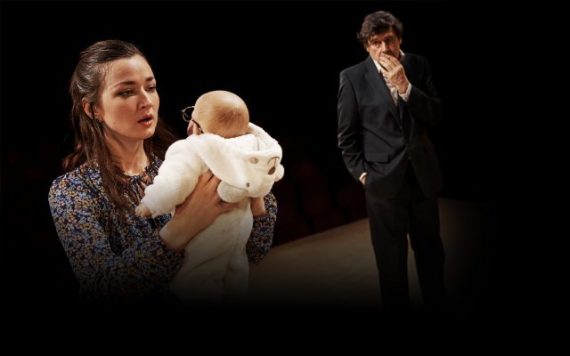
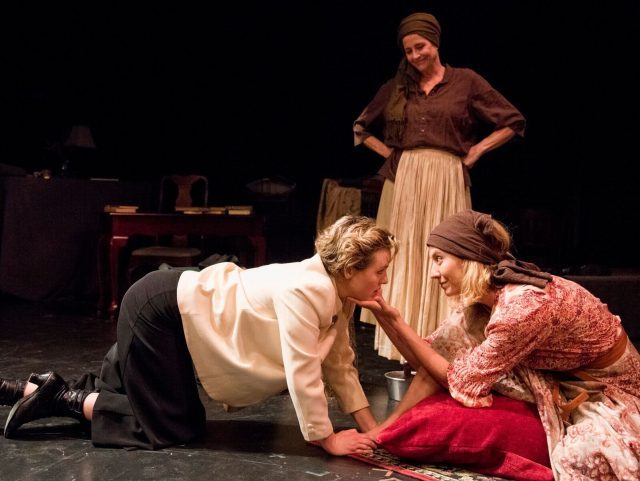
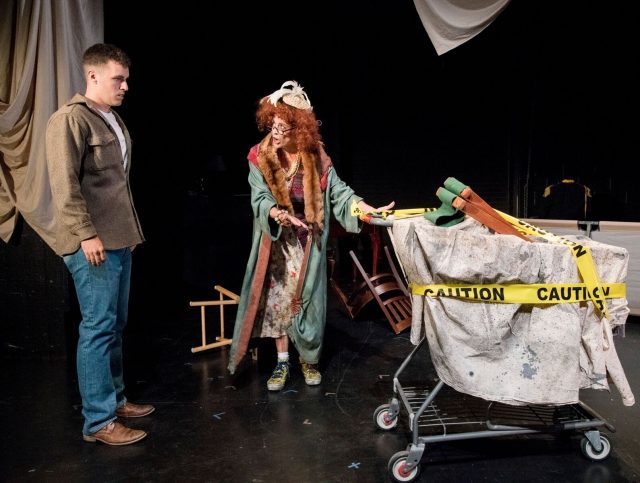
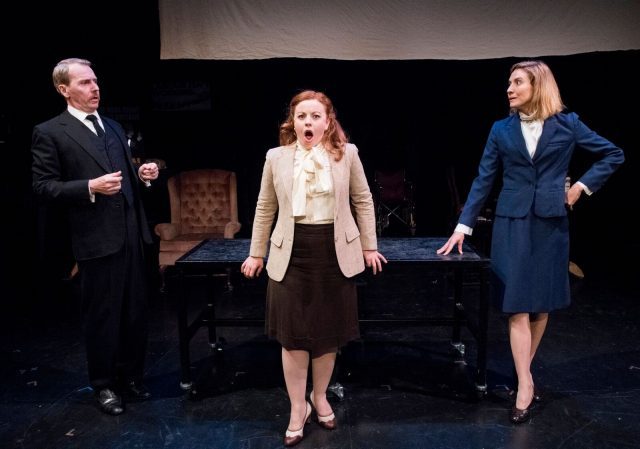
What, if anything, does an audience owe the actors in a play, especially in a work that might not quite be of the quality they expected? Once upon a time, eggs and rotten tomatoes were thrown by audience members who were none too pleased with what was happening onstage. Walking out is always an option, although it is more couth to at least wait for intermission. At a matinee of Dress of Fire, a new play written by Nina Kethevan and directed by Ioan Ardelean about the Trojan War that opened tonight at the 13th Street Theatre, two women sitting in front of me started laughing and could not stop through most of the first act, wondering out loud at times if the work was supposed to be funny. Late in the first act, during an expository soliloquy (of which there are many), one of the men sitting in a row close to the stage leaned over and asked the man next to him how he ever found this place, at which point the actress turned and addressed her next lines — loud, admonitory words — directly to them; the second man responded with a loud “Oy vey.” The play does have a bevy of head-scratching flaws, including very odd wardrobe choices: The men have pants on underneath their period costumes, and nearly all the characters wear contemporary footwear. The indefatigable Austin Pendleton’s name is printed large and above the title on the posters and ads, but Pendleton, a longtime favorite of mine, has a rather minor role, as King Priam, and he was not in his best form at the matinee I saw. Not everyone came back after intermission of the hundred-minute play, but most did, and there were even a few cheers during the curtain call. In today’s theater, there is just no room for blatant rudeness. “Is there no respect of place, persons, nor time in you?” Malvolio asks Sir Toby Belch in Twelfth Night. No respect indeed. And leave the eggs and tomatoes at home.

MLIMA’S TALE

(photo by Joan Marcus)

Sahr Ngaujah is extraordinary as an endangered elephant in Mlima’s Tale (photo by Joan Marcus)

Martinson Hall, the Public Theater
425 Lafayette St. at Astor Pl.
Tuesday through Sunday through June 3, $85-$150
212-539-8500
www.publictheater.org

In 2015, a Minnesota dentist became an international pariah when he shot and killed a beloved thirteen-year-old lion named Cecil in Zimbabwe’s Hwange National Park, purely for sport and a photo op. In the 2017 documentary Trophy, Shaul Schwarz and Christina Clusiau went deep inside the big business of trophy hunting, focusing on the industry surrounding the hunting of the Big Five: buffalo, leopards, elephants, lions, and rhinos. In Mlima’s Tale, which was just extended through June 3 at the Public’s Martinson Hall, two-time Pulitzer Prize winner Lynn Nottage follows the money after a treasured elephant is killed for his magnificent tusks in a national park in Kenya. Nottage, who traveled to Democratic Republic of Congo for Ruined to tell the harrowing story of rape and sexual abuse there, and went to Reading, Pennsylvania, to look at a factory town in trouble in Sweat (which began in Martinson Hall before transferring to Broadway), now takes theatergoers to the African savannah, where the mighty Mlima is facing death. The mammal is sensationally portrayed by the tall, powerfully built Sahr Ngaujah, who displays an impressive, chiseled chest and a deep, dark stare, his movements a kind of contemporary dance.

As the play opens, Mlima is on a spare stage, a full moon projected behind him. His speech is accompanied by elephant sounds in the background. “You must listen with your entire body, feel how the earth shifts when there’s the slightest disruption, because how you listen can mean the difference between life and death. It’s the truth of the savannah, something we all learn at a very young age,” he says, remembering what his grandmother taught him, echoing words spoken by many African and black American parents and grandparents to their children and grandchildren. Two hunters, the impatient Rahman (Ito Aghayere) and the older, wiser Geedi (Jojo Gonzalez), approach the fatally wounded Mlima, waiting for him to die so they can cut off his tusks. Geedi believes the proud animal should be treated with the respect he deserves, while Rahman recalls a Maasai legend, saying, “If you not give elephant proper burial, he’ll haunt you forever.” Just before dying, Mlima calls out to his brother, “Let reason rule your anger, and don’t come to mourn me! Run! Run!” Geedi then removes the unseen tusks and brings them to police chief Githinji (Kevin Mambo), setting in motion a La Ronde-like narrative structure in which one character from each scene continues into the next (with two exceptions) as the tusks, now represented by Ngaujah with white streaks across his face and body, are illegally transported by a series of corrupt men, each one taking his cut. Along the way, the spirit of Mlima is alive in the tusks, leaving a white mark of complicity and shame on everyone involved.

(photo by Joan Marcus)

Sahr Ngaujah stands tall as Mlima as Kevin Mambo, Ito Aghayere, and Jojo Gonzalez portray characters debating the fate of the elephant’s tusks (photo by Joan Marcus)

Nottage (By the Way, Meet Vera Stark; Intimate Apparel) was inspired to write Mlima’s Tale after a conversation she had with Oscar-winning director Kathryn Bigelow, an animal-rights activist who directed and produced the three-minute 2014 documentary Last Days, about the human and financial cost of the illegal ivory trade and its ties to terrorism. Aghayere (Familiar, Three Days to See), Gonzalez (F**king A, Small Mouth Sounds), and Mambo (The Color Purple, Fela!) play multiple roles, from warden and ship captain to ivory dealer and artist, often changing costumes (by Jennifer Moeller) in less than a minute. Director Jo Bonney (Father Comes Home from the Wars; By the Way, Meet Vera Stark) uses inventive staging for the quick transitions, as a large rectangular board moves horizontally across the front of the stage like a cinematic wipe as such basic props as chairs and tables are changed on Riccardo Hernandez’s set. Each new scene begins with a projected quote, including “Even the night has ears,” “No matter how full the river, it still wants to grow,” and “A single stick might smoke, but it will not burn.” Composer and music director Justin Hicks stands on the floor, next to the stage, effectively mixing music and natural sounds to maintain the stark atmosphere. (The sound design is by Darron L West.)

Tony and Olivier nominee Ngaujah (The Painted Rocks at Revolver Creek, Fela!) is spectacular as Mlima, his accusing eyes penetrating through the other characters as well as the audience, implicating all of us, his breathtaking movement seeking to regain power that might never return. (The choreography is by Chris Walker.) When he stands high on a table and is examined by prospective tusk buyers, it is like he is an African slave being sold at auction. But Nottage and Bonney don’t overplay that connection, instead focusing attention on the plight of the elephants, whose population has dropped from 1.3 million to 400,000 over the last several decades. “There are more elephants being killed than are being born, which means that in less than twenty years they may well be extinct,” a white Kenyan says in the play. Coincidentally, around the corner from the Public Theater, in Astor Plaza, is Gillie & Marc’s “The Last Three,” a bronze sculpture depicting three northern white rhinos, one atop the other, symbolizing the potential extinction of the species because of the rhino horn trade; sadly, right after the work was installed, one of the three remaining rhinos died. Mlima’s Tale is a gorgeously rendered, heartbreaking reminder of humanity’s place in the world, how greed and consumption trample over the natural environment and how every choice we make, as individuals and as a society, has an impact on the future of the planet, which is far too heavy with white markings everywhere.

KING LEAR

(photo by Richard Termine)

Kent (Antony Byrne) is at the ready as Lear (Sir Antony Sher) enters in Royal Shakespeare production at BAM (photo by Richard Termine)

Brooklyn Academy of Music
BAM Harvey Theater
651 Fulton St.
April 7-29, $35-$125, 7:30 (plus weekend matinees)
718-636-4100
www.bam.org

Sir Antony Sher bids adieu to Shakespeare in a dark version of the already dark King Lear, continuing at BAM’s Harvey Theater through April 27. The Royal Shakespeare Company production takes place in a dank, dreary, dismal world reminiscent of Akira Kurosawa’s The Lower Depths, where poverty and disillusionment reign. As the audience enters the theater, robed and hooded figures slowly walk onstage from the wings and sit on a vinyl tarp covering the ground, which is strewn with black gravel, while hellish mist floats in. After several minutes, they leave and a door in the back wall opens; Lear, wearing an enormous, brutal, bearlike fur coat, makes his entrance, sitting on his throne atop a large box with transparent sides. The members of the court are all dressed in black, some with gold adornments, except for one woman, who we soon learn is Cordelia (Mimi Ndiweni). Prepared to divide his kingdom into thirds, Lear listens as first Goneril (Nia Gwynne), who is married to the Duke of Albany (Clarence Smith), then Regan (Kelly Williams), wed to the Duke of Cornwall (James Clyde), profess their undying love for their father, and each is rewarded with their share of the kingdom. But when Cordelia, the youngest daughter, tells Lear she loves him as a child should love a parent, refusing to damn him with faint praise, he disinherits her. Lear’s trusted friend and adviser, the Earl of Kent (Antony Byrne), questions the king’s decision, so he is exiled. Afterward, another of Lear’s advisers, the Earl of Gloucester (David Troughton), is tricked by his illegitimate son, Edmund (Paapa Essiedu), into believing that his older son, Edgar (Oliver Johnstone), has plotted against him, leading Edgar to run away and disguise himself as Poor Tom, a crazy wanderer. Things don’t go well from there for anyone in the play, which was inspired by Raphael Holinshed’s Chronicles of England, Scotland, and Ireland and Sir Philip Sidney’s Countess of Pembroke’s Arcadia.

The Brooklyn Academy of Music has been presenting Lear for more than 150 years, with a wide range of actors portraying the king, from Ernesto Rossi and Edwin Booth to Frank Langella and Sir Derek Jacobi. “It’s all Ian McKellen’s fault,” Sher writes at the beginning of his latest book, Year of the King: The Lear Diaries; McKellen played Lear at BAM in 2007. Directed by RSC artistic director Gregory Doran, Sher’s longtime partner, this Lear is more subtle than most, if that word can be used at all to describe the Bard’s monumental tragedy. The sixty-eight-year-old Sher plays Lear as a sad, gentle, at times spoiled child who is already in decline before completely unraveling. With great understatement he towers over everyone in the storm scene, high atop the box, video of a rushing waterfall raging behind him, but he has already lost it all. Byrne is a fine, forceful Kent, boasting a shaved head with a warriorlike tattoo; he’s determined to bring the king back to reality, but he knows it’s too late. Troughton is magnificent as Gloucester, a pathetic figure on his way to certain doom, his hair so disheveled you want to go onstage and hug him (and comb his dreary locks). Johnstone’s Edgar is heartbreaking as well, a kind of sprite who has been beaten down by a cruel world he can’t understand. And Graham Turner is a memorable Fool, a tall, strong clown whose mind and body break down over time.

(photo by Richard Termine)

Kent (Antony Byrne) attends to a failing Lear (Sir Antony Sher) as the Fool (Graham Turner) looks on (photo by Richard Termine)

Niki Turner’s set is mostly spare, with various objects, from small trees to chairs and tables to large circles on poles representing the sun and the moon, carried by the cast. The large box is a curious addition that might not completely work — perhaps it’s a metaphor for peering inside the minds of the characters, particularly Lear’s, or else is a sign of being trapped — but it is eerily effective in the blinding scene, blood spurting and splashing onto the transparent sides. Doran focuses on the act of seeing throughout the play, giving prominence to lines about sight and eyes. “What, art mad? A man may see how this world goes with no eyes,” Lear tells Gloucester. “’Tis the times’ plague, when madmen lead the blind,” the Fool says to the old man (Edward James Walters). Tim Mitchell’s lighting, Jonathan Ruddick’s sound design, and Ilona Sekacz’s music, performed by musicians on balconies on the right and left of the stage, combine for a threatening atmosphere; the goings-on grow so somber that a surprising amount of the audience did not return after intermission for the second act, although I’d like to think that was more because those patrons were not prepared for nearly three and a half hours of gloom and doom. But this is Lear, after all, in this case featuring one of the world’s greatest Shakespearean actors taking his final Bard bow. It might be more of a whisper than a scream, but it is majestic and monumental nonetheless.

FEEDING THE DRAGON

(photo by James Leynse)

Sharon Washington shares her childhood tale of living inside the New York Public Library in Feeding the Dragon (photo by James Leynse)

Cherry Lane Mainstage Theatre
38 Commerce St.
Tuesday – Sunday through April 27, $72
212-989-2020
www.feedingthedragontheplay.com
primarystages.org

Amid all the high-profile theatrical extravaganzas that are trying to capture Tony buzz this spring, a small gem opened last month, a must-see, particularly for the literary-minded. From 1969, when she was ten, until 1973, Sharon Washington lived on the fifth floor of the St. Agnes Branch of the New York Public Library on the Upper West Side with her mother, Connie, a native New Yorker; her father, George, the Charleston-born library custodian; Connie’s mother, Gramma Ma; and their dog, Brownie. Washington, an actress who has appeared in such films as Die Hard with a Vengeance and Michael Clayton, such series as The Looming Tower and Law & Order: Special Victims Unit, and such plays as While I Yet Live and The Scottsboro Boys, is now sharing her poignant story in Feeding the Dragon, a Primary Stages production continuing at the Cherry Lane through April 27. Washington is a warm, eminently likable storyteller, moving across Tony Ferrieri’s welcoming set with grace, ease, and humor. The two-level stage features five glass windows in the back, with multiple rectangular panels of different colors, a wooden table and chair and desk lamp at the center, and several rows of library books and card catalog drawers, in addition to one pile of books piled high on the lower level, next to a stool. For eighty minutes, Washington keeps the audience riveted as she relates her engrossing tale, which for viewers of a certain age provides a similar thrill to E. L. Konigsburg’s From the Mixed-up Files of Mrs. Basil E. Frankweiler, the classic children’s novel about a brother and sister who essentially live at the Metropolitan Museum of Art.

(photo by James Leynse)

Actress Sharon Washington stars in one-woman show about her childhood at the Cherry Lane (photo by James Leynse)

During the day, Sharon would go to school, but when she got home and the library was closed, she voraciously read through the endless stacks of books, absorbing as much as she possibly could. She had free rein, except for the basement, where the furnace was. Her mother told her not to go down there because it was dangerous, but Sharon didn’t listen. “To me the furnace room was an enchanted cave where I could watch Daddy feed the Dragon,” she says, describing how the furnace looked like a monster to her. “I loved watching Daddy work. He was like a knight from my Blue Fairy book — St. George and the Dragon.” Sharon talks about the owners of the store next door, Mr. Sam and Miss Sophie; wonders how her parents got a baby grand piano into the apartment; discusses getting into Dalton; reenacts scenes from books with her best friend, Esther; and searches for Brownie when the dog escapes the apartment and runs into the library. When she discovers something about her father that her parents kept from her, she is sent to Queens for a few weeks to stay with Connie’s siblings, Aunt Sis and Uncle Gene, then goes on a road trip with her father to visit, for the first time, his family in Charleston, experiencing aspects of the real world that she couldn’t find in books, including Jim Crow. Sharon seamlessly flows from character to character, each with a distinct voice, while also reading passages from books by W. E. B. Du Bois, Langston Hughes, Zora Neale Hurston, and James Baldwin. But life there was far from idyllic for the Washingtons. “Let me tell you something, baby. Folks say all the time it must be so nice to live rent-free. Shoot . . . this ain’t free,” says her father, who had to shovel coal into the furnace to keep it constantly burning. “I work hard. Seven days a week. Don’t bother me . . . worth it to keep a roof over my family’s head. I ain’t scared of no hard work. That ain’t nothing new to me.” Director Maria Mileaf never allows the show to become stagnant; in addition to Sharon’s movement — and mad dancing skillz — lighting designer Ann Wrightson keeps the colors on the back windows changing, and sound designer Lindsay Jones adds offstage music and subtle audio effects. Sharon was inspired to tell her fairy-tale story — yes, she begins by saying, “Once upon a time, there was a little girl who lived in a library” — when journalist Jim Dwyer wrote a 2009 article about the family in the New York Times.. Of course, no one else could tell it as the girl who lived it. So forget those big-budget blockbusters and instead hurry down to the Cherry Lane before this library closes.

MEAN GIRLS

(© 2018 Joan Marcus)

Cady Heron (Erika Henningsen) meets the Plastics (Ashley Park, Taylor Louderman, and Kate Rockwell) in Mean Girls (photo © 2018 Joan Marcus)

August Wilson Theatre
245 West 52nd St. between Broadway & Eighth Ave.
Tuesday – Sunday through July 7, $99 – $199
meangirlsonbroadway.com

Last year the August Wilson Theatre was home to Groundhog Day, an outstanding, underappreciated musical based on Harold Ramis’s 1993 hit comedy. It’s nearly déjà vu all over again as the theater is now the residence of another outstanding musical version of a beloved film, Mean Girls; however, with tickets currently available through March 2019, it may be there a whole lot longer than Groundhog Day was. And like its predecessor, Mean Girls gets just about everything right; the only thing clearly missing are cheese fries at the concession stand. Mark Waters’s 2004 film about a new girl experiencing all the awful trials and tribulations of high school was written by Tina Fey, who also wrote the book of the musical, doing a superb job of reimagining and updating the story for the Broadway stage, at least until the disappointingly sappy ending. The show opens with outcasts Damian Hubbard (Grey Henson) and Janis Sarkisian (Barrett Wilbert Weed) warning the audience about what they are going to see. “It’s a cautionary tale / of fear and lust and pride, / based on actual events / where people died,” the proudly gay Damian sings. Offbeat artist Janis adds, “No one died. / But how far would you go / to be popular and hot? / Would you resist temptation?” After growing up in Kenya with her crunchy archaeologist parents and a vast array of animal friends, Cady Heron (Erika Henningsen) is thrilled to go back to the States for high school with other teenagers — but she quickly learns that it’s survival of the fittest, not all that less brutal than the animal kingdom, as packs are formed, turf is defended, and prey is attacked. When Cady is asked to sit with the Plastics — the cool-chick clique run by the vain and nasty Regina George (Taylor Louderman), with her loyal sidekick Gretchen Wieners (Ashley Park) and the not-too-bright sexpot Karen Smith (Kate Rockwell) — Damian and Janis try to convince her not to. “Regina George is not cool! She’s a scum-sucking fart-mouth life ruiner!” Janis declares, then asks Cady to spy on the Plastics for them. Cady doesn’t want to be a mole, but she’s so desperate to be accepted at school that she decides to go along with it. And the more she learns about the Plastics, the more she learns about herself, and life, and not always liking what she discovers.

(© 2018 Joan Marcus)

Damian Hubbard (Grey Henson) and Janis Sarkisian (Barrett Wilbert Weed) offer advice to Cady (Erika Henningsen) in musical version of hit movie (photo © 2018 Joan Marcus)

Mean Girls is a bittersweet, raucous tale of fitting in, whether child or adult. “Where do you belong?” Damian sings early on. “We all get a box / That’s where we go / It’s stifling / But at least you know / So, where do you belong?” The lyrics, by Tony nominee Nell Benjamin (Legally Blonde, The Explorers Club), don’t fit in a box either, nor does the music, by Emmy winner Jeff Richmond (Fey’s husband), ranging from rock to rap. (The orchestrations are by John Clancy.) Fey brings the classic tale of the new girl into the present, incorporating environmentalism and cyber bullying as well as a modern-day feminist angle, with her trademark fresh but sharp sense of humor. Henningsen (Les Misérables, Dear World) is delightful as Cady, the role famously played by Lindsay Lohan in the film, making it her own. Louderman (Kinky Boots, Bring It On), plays the devilish Regina to the hilt, with outrageously funny support from Park as Gretchen, who brings down the house with “What’s Wrong with Me?,” trying to find her own identity, and Rockwell (Bring It On, Rock of Ages) as Karen, who gives a nice twist to the dumb blonde stereotype. Tony nominee Kerry Butler (Xanadu, Disaster!) does triple duty as Cady’s mom, calculus teacher Ms. Norbury (played by Fey in the film), and Regina’s ultrachic mother, who gets to utter, “We haven’t had new meat in our little lady taco in so long!” Weed (Lysistrata Jones, Cabaret) and Henson (The Book of Mormon) make a great team as Janis and Damian, guiding Cady, and the audience, through the horrors of high school; the two characters would fit right in if there were a remake of The Breakfast Club. The all-around strong cast also includes Kyle Selig as Aaron Samuels, Regina’s ex-boyfriend who takes a liking to Cady; Cheech Manohar as Kevin Gnapoor, Mathlete extroardinaire; and Rick Younger as Mr. Duvall, the beleaguered principal.

(© 2018 Joan Marcus)

Director and choreographer Casey Nicholaw brings Mean Girls into contemporary America at the August Wilson Theatre (photo © 2018 Joan Marcus)

Fey leaves in most of the key quotes from the film without merely rehashing the movie. Tony-winning director and choreographer Casey Nicholaw (The Book of Mormon, Aladdin) maintains a frenetic pace with near-constant movement as background characters don’t just stand still and two-time Tony winner Scott Pask’s (The Book of Mormon, The Pillowman) fab set keeps changing, from schoolrooms to bedrooms, bathrooms to locker rooms. The video design, by Tony winner Finn Ross and Adam Young, wonderfully captures the tumult and gestalt of the modern-day teenager, as updated references ring true and secrets and shaming are shared on social media. “It’s just . . . sometimes I feel like an iPhone without a case,” Gretchen explains. “Like, I know I’m worth a lot, and I have a lot of good functions, but at any time I could just shatter.” But there are also plenty of truths that have not changed over the years, regardless of technological advances or changing sociopolitical standards and mores. “I just wish we could all get along like we used to in elementary school,” a teary girl says. “I wish that I could bake a cake made out of rainbows and smiles, and we could all eat it and be happy.” (Good luck with that.) Oh, and, of course, watch out for that bus, and if you’re going on a Wednesday, be sure to wear pink.