this week in theater

FREE SUMMER EVENTS JUNE 24 – JULY 1

Roger Guenver Smith

Roger Guenveur Smith will perform Frederick Douglass Now at BRIC Celebrate Brooklyn! Festival on June 28

The free summer arts & culture season is under way, with dance, theater, music, art, film, and other special outdoor programs all across the city. Every week we will be recommending a handful of events. Keep watching twi-ny for more detailed highlights as well.

Sunday, June 24
Porch Stomp, with more than seventy bands on sixteen stages, Nolan Park, Governors Island, 12 noon – 5:00 pm

Monday, June 25
Movie Nights in Bryant Park: The Philadelphia Story (George Cukor, 1940), Bryant Park, lawn opens at 5:00, film begins at sunset

Tuesday, June 26
Washington Square Music Festival, with Kuumba Frank Lacy Sextet and vocalist, Washington Square Park, 8:00

The Metropolitan Summer Recital Series comes to Jackie Robinson Park on June 28

The Metropolitan Summer Recital Series comes to Jackie Robinson Park on June 27

Wednesday, June 27
SummerStage: The Metropolitan Summer Recital Series, with Gerard Schneider, Gabriella Reyes de Ramírez, and Adrian Timpau performing arias and duets, Jackie Robinson Park, 7:00

Thursday, June 28
Live at the Archway: Grupo Rebolu, with DJ Dan Edinberg and live art experience by Catherine Haggarty, Water St. between Anchorage Pl. & Adams St., DUMBO, 6:00

Friday, June 29
BRIC Celebrate Brooklyn! Festival: Branford Marsalis / Roger Guenveur Smith: Frederick Douglass Now, Prospect Park Bandshell, 7:30

Sunday, July 1
Shell-ebrate Oysters, Hudson River Park, Pier 25, registration recommended, 4:00

TEENAGE DICK

(photo by Carol Rosegg)

Richard Gloucester (Gregg Mozgala) thinks he has all the answers in Teenage Dick at the Public (photo by Carol Rosegg)

The Shiva Theater at the Public Theater
425 Lafayette St.
Tuesday – Sunday through July 29, $55
212-539-8500
publictheater.org
ma-yitheatre.org

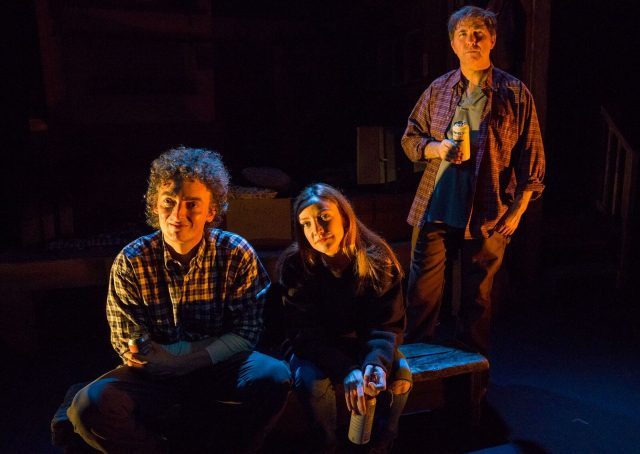
I can only imagine the elevator pitch for Mike Lew’s latest play, which opened last night at the Public’s Shiva Theater. “It’s Richard III in high school, about a student with cerebral palsy who will do just about anything to become senior class president. Oh, and it’s called Teenage Dick.” The terrifically titled play, a workshop production of which ran at the Shiva in 2016, reimagines Shakespeare’s tragedy through the lens of such hit films as Clueless, Mean Girls, Election, and even Carrie while sprinkling in elements and quotes from other Shakespeare plays. It’s a bumpy ride that bites off more than it can chew, trying to be too much instead of maintaining its focus while making important points about the disabled. “Now that the winter formal gives way to glorious spring fling we find our rocks for brains hero Eddie — the quarterback — sleeping through his job as junior class president,” Roseland High School class secretary Richard Gloucester says at the start of the play. Richard is splendidly portrayed by Gregg Mozgala, whose cerebral palsy substitutes here for Richard’s physical deformities. Mozgala, a Drama Desk nominee, commissioned the work for the Apothetae, a company founded by Mozgala (who serves as artistic director) that concentrates on the “disabled experience.” Richard’s competition for the presidency is dunderheaded quarterback and prom king Eddie (Alex Breaux) and Bible-thumping overachiever Clarissa (Sasha Diamond); Richard’s primary supporter and only friend is Barbara “Buck” Buckingham (Shannon DeVido, who has spinal muscular atrophy and uses a wheelchair), who is getting tired of Richard’s breaking out into Bard-speak. “Soft you now, she approaches,” Richard says, to which Buck barks back, “Who talks like that?” Richard decides that the best way to achieve his ascendancy is through prom queen Anne Margaret (Tiffany Villarin), Eddie’s former girlfriend who harbors a secret that could ruin them both; she’s also a dancer, so his limited mobility comes to the fore. Overseeing it all is English teacher Elizabeth York (Marinda Anderson), who has assigned the class to read Machiavelli’s The Prince, which has become a kind of primer for Richard, who has studied Machiavelli’s four pathways to power: fortune, virtue, civil election, and, preferably, wickedness. As the voting for class officers approaches, Richard uses devious methods as he seeks his ultimate goal.

(photo by Carol Rosegg)

Richard Gloucester (Gregg Mozgala) woos prom queen Anne Margaret (Tiffany Villarin) in Mike Lew play (photo by Carol Rosegg)

A coproduction with Ma-Yi Theater Company, the hundred-minute Teenage Dick tackles such issues as bullying, government policy, war, and, of course, the treatment of the disabled. Tony-nominated director Moritz von Stuelpnagel (Present Laughter, Hand to God) can’t quite get rid of all the choppiness in Lew’s (Bike America, Tiger Style!) script, which caroms too quickly between realism and abstraction while deciding how close it will or won’t stick to Shakespeare’s general plot. It works best when it stays on point, echoing Richard’s dispatching of Clarence and Edward and wooing of Queen Margaret, and doesn’t preach, which it ultimately does. Lew and von Stuelpnagel are not sure just what to do with Elizabeth, whose character and purpose feel ill-defined. Wilson Chin’s set ranges from a high school hallway with lockers and a trophy case to a teen girl’s bedroom and a dance studio, and DeVido (The Healing, Difficult People) has a blast motoring through it. Mozgala (Cost of Living, Light Shining in Buckinghamshire) makes a fine Richard, particularly as the play explores whether one can rise above their station and whether it is better to be loved or feared, which is especially relevant in high school in twenty-first-century America. “Given a choice, it is best to be feared,” he says. “For man is ungrateful, fickle, and greedy, and thusly being loved is a bond they may break. Whereas being feared is sustained by a dread of punishment that won’t ever fail you.” Unfortunately, the play doesn’t quite live up to its awesome title, which works both as a riff on the name of the Shakespeare play it’s inspired by and because it features a protagonist who is, well, kind of a dick.

TWI-NY TALK: JOE WISSLER / ALL MY SONS

All My Sons

George Deever (David Winning) and Joe Keller (Joe Wissler) face some hard truths in All My Sons at Bernie Wohl Center (photo by Susan Case/Halina Malinowski)

Bernie Wohl Center @ Goddard Riverside Community Center
647 Columbus Ave. between Ninety-First & Ninety-Second Sts.
June 20-24, $20
www.outoftheboxtheatre.com

Joe Wissler loves acting; it’s in his bones. You can see it when he’s onstage performing or when he’s discussing his career, which has included appearing in shows at the Mint, the Fringe, the Actors Studio, the Producers Club, and Where Eagles Dare and such indie films as Powder Strike, Empire, and Street Revenge. The Manhattan-born, Brooklyn-raised character actor is quite a character himself, a tough guy with a heart of gold. Wissler is starring this week in the lead role of Joe Keller in the Out of the Box Theatre production of Arthur Miller’s All My Sons, an Actors’ Equity showcase running June 20-24 at the Bernie Wohl Center at the Goddard Riverside Community Center. The play is directed by Justin Bennett, with a cast also featuring J. D. Brookshire, Matthew Dunivan, Marie Lenzi, Susan McBrien, Patrick McGuiness, Nirvaan Pal, Anna Marie Sell, Jennifer Wingerter, and David Winning.

“As a director, it is an immense pleasure to work with an actor like Joe,” Bennett said. “He is constantly striving to find the depth of a complex character that many actors consider to be a dream role. He is always willing to try different ways to do something. Fortunately, the rest of the cast works in a similar way in order to produce a fantastic quality of acting in one of the masterpieces of American theater.” Founding Out of the Box board member and coproducer (with Halina Malinowski) Susan Case added, “We’re delighted to welcome Joe Wissler to the Out of the Box family. Justin cast Joe to play the lead role of Joe Keller after wading through several hundred resumes and auditioning numerous actors. Joe brings great warmth and honesty to his compelling portrayal of this beleaguered character.” After finishing tech rehearsal, Wissler filled us in on his latest show and more.

twi-ny: We last spoke with you four years ago, when you were in Baby GirL at the Fringe in 2014. How’ve you been since then?

Joe Wissler: The years certainly do fly by. In those years both my children have gotten married, Joe to Kaylyn and Nicole to Sam. In addition, Kaylyn is expecting our first grandchild in July. I have spent a good amount of that time writing. The first project, 20 to Life, is about a police officer who is all set to retire, only to find that his new girlfriend is pregnant, forcing him to stay on the job. Production is set to begin in the fall of 2018.

All My Sons

Chris Keller (Matthew Dunivan) and his father, Joe (Joe Wissler), have tense moments in Out of the Box revival of Arthur Miller classic (photo by Susan Case/Halina Malinowski)

twi-ny: You’re starring as Joe Keller in All My Sons at the Bernie Wohl Center at the Goddard Riverside Community Center. How did that come about?

JW: I saw a listing on Actors Access and submitted. I went in to the audition with one simple strategy: Tell the story from the heart, not the head. It seems to have worked. I am now part of a cast that I consider to be the some of the finest actors I have ever had the pleasure to share a stage with. Our director, Justin Bennett, has guided us on the journey with the precision of Magellan. I am so thankful to Out of the Box for producing this masterpiece and for being the most professional, amazing people that they are.

twi-ny: Joe Keller has previously been portrayed onstage by such actors as Ed Begley, Richard Kiley, John Lithgow, and David Suchet and on film by Edward G. Robinson and James Whitmore. Aside from the original 1947 version, of course, have you seen any of the other adaptations?

JW: I have not seen a stage production of this play before. Which is fine by me. It allowed me to create the character from the ground up. Which is sometimes very difficult to do if you have seen an amazing production. Watching a master actor such as the ones you have listed would leave an impression that would be hard to erase. This Joe Keller is all Joe Wissler’s.

twi-ny: What approach are you taking for such a classic role? What do you think is the key to the part?

JW: I am approaching this classic with the respect it deserves. It is truly one of the finest plays ever written. To win this part is one of the greatest honors I have received professionally. I am letting my emotions guide me through the text as a conductor would rely on his sheet music. Every line has such an emotional explosion behind it. The key to this play is Joe’s love for his son. I believe nothing is more important to Joe. And that’s why I love playing this role. I have the same love for Joe and Nicole.

all my sons

twi-ny: Keller has to deal with something from his past that haunts him. Is there any one thing that you regret from your past that you wouldn’t mind sharing with us?

JW: “Regrets, I’ve had a few, but then again, too few to mention.” Thanks for giving me the chance to say that. My biggest regret is not spending even more time with my mother over the years. She passed away suddenly at the young age of sixty-five and it wasn’t until she wasn’t there anymore that I realized how much I still depended on her. It was her guidance that brought me to acting. And that gave me the heart to love as deeply as I do. Anything good that can be said about me is because of her. I dedicate this performance to her.

twi-ny: Have you done any other Miller plays? Do you have a favorite?

JW: This is my first Miller play. I hope to get cast in many more. I do have a favorite. Actually two, A View from the Bridge and of course All My Sons.

twi-ny: Did Joe and Nicole treat you well on Father’s Day?

JW: To look in their eyes and see them smiling is all I need. The gifts were nice too.

FRUIT TRILOGY

(photo by Maria Baranova)

Liz Mikel and Kiersey Clemons play items on a shelf in Eve Ensler’s Pomegranate (photo by Maria Baranova)

Lucille Lortel Theatre
121 Christopher St. between Bleecker & Hudson Sts.
Tuesday – Sunday through June 23, $65-$85
212-352-3101
abingdontheatre.org/fruit-trilogy

Activist and writer Eve Ensler follows up her powerful, intimate one-woman show, In the Body of the World, with the New York premiere of Fruit Trilogy, three short experimental pieces that are still in need of some ripening. The Abingdon Theatre Company production, running at the Lucille Lortel through June 23 — coincidentally, Ensler was just given a lifetime achievement honor at last month’s Lucille Lortel Awards — explores major themes from throughout Ensler’s oeuvre, investigating female oppression and empowerment and the body itself, beginning with her 1986 international hit, The Vagina Monologues. Fruit Trilogy opens with the Beckett-like Pomegranate, in which Item 1 (Liz Mikel) and Item 2 (Kiersey Clemons) portray a pair of women on a shelf in a warehouse, only their heads visible in small black boxes. On display for men to purchase and do with what they want, they discuss their situation: “Women? We are items that they want to buy,” Item 1 says. “We are women more willing to be vile receptacles than we are willing to be dead,” Item 2 explains. Discussing hope, Item 1 declares, “My body will not live without possibility.” Item 2 sarcastically replies, “You have a body?”

(photo by Maria Baranova)

Kiersey Clemons is a young sex slave trapped in a cage in Eve Ensler’s Avocado (photo by Maria Baranova)

In Avocado, Clemons plays a sex slave slithering across a raised narrow platform in a container that serves as a cage, though the bars are unseen. She prowls about like a wild animal, speaking directly to the audience. At one point, she says, “Do you see them? Such naughty angels, jokester angels, protecting me, protecting all the girls who lost their bodies.” She goes into graphic detail about her victimization, brutalization, and enslavement, her story lightened only by an unexpected connection in one encounter, with a deaf, nonverbal boy who treats her more like a person, than a prostitute. The woman has sold herself one last time for passage in the container to a place called Asylum, the kind of freedom offered by City of Joy, a securely walled and guarded safe space cofounded by Ensler in Bukavu in the Eastern Democratic Republic of Congo where survivors of rape and sexual violence come to get their life back, learning to reclaim their bodies and their minds.

(photo by Maria Baranova)

Liz Mikel treats herself special in Coconut, the conclusion of Fruit Trilogy (photo by Maria Baranova)

And in Coconut, Mikel invites the audience into her bathroom, lit by candles, where she luxuriously and ceremonially rubs coconut oil onto her right foot, taking control of her body in ways that the characters in the previous two tales could not. “Like everything else, this body only existed in relationship to the person who was touching it, as a thing that might be touched,” she says. Now that person is her, rejecting all the ways she previously didn’t “measure up” to others, being a large black woman judged by her size, gender, and race. “We’re engaged in a transformative process of emollient change,” she says as she rubs the pain of memory and shame out of her body. When she disrobes, she takes pride in her naked body, daring the audience to look at her, to experience her, to join her in a happier world. Clemons (Dope, The Only Boy Living in New York) and Mikel (Lysistrata Jones, Friday Night Lights) are engaging, fearless performers, but director Mark Rosenblatt (The Country, Animal Wisdom) can’t get a firm enough grasp of the material or of Mark Wendland’s (Significant Other, Next to Normal) dark, low-budget sets, which are indeed somewhat confusing. Although it takes on some tough, serious topics, the trilogy is too long at eighty minutes, with too much repetition in the overly clever dialogue that continues well after the point has been made. It feels like Fruit Trilogy is still at the workshop stage, requiring additional care and nurturing before being picked and served to the public. Several of the remaining performances will be followed by talkbacks with Ensler (The Good Body, Emotional Creature) and special guests, focusing on not only the play itself but Ensler’s work with V-Day, “a global activist movement to end violence against women and girls” that she cofounded in 1998.

SHAKESPEARE IN THE PARK: OTHELLO

(photo by Joan Marcus)

Iago (Corey Stoll) has a point to make with Othello (Chukwudi Iwuji) in Othello at the Delacorte (photo by Joan Marcus)

Central Park
Delacorte Theater
Tuesday-Sunday through June 24, free, 8:00
shakespeareinthepark.org

While filming Richard Eyre’s 2018 BBC television adaptation of King Lear, Chukwudi Iwuji, who was playing the king of France, was told by Sir Anthony Hopkins, who was starring in the title role, “You must be ready for your Othello now.” Iwuji proves he is more than ready in Ruben Santiago-Hudson’s gripping, emotional production that opened last night at the Delacorte in Central Park as part of the Public Theater’s annual Shakespeare in the Park presentation. Born and raised in Nigeria, later educated in Ethiopia and England, and now living in New York City, Iwuji, a Royal Shakespeare Company associate artist, has built up quite a resume at the Public, portraying the narrator and Enobarbus in Anthony and Cleopatra at the Anspacher in 2014, as Edgar in King Lear at the Delacorte that same year with John Lithgow as the monarch, taking the lead in Hamlet in the Public Theater’s Mobile Unit abbreviated 2016 version, and being nominated for awards as slave John Blanke in Bruce Norris’s The Low Road at the Anspacher earlier this year. (He also played the duke of Buckingham in Richard III at BAM in 2012.) In a role previously played at the Delacorte by James Earl Jones in 1964 and Raul Julia in 1979 and 1991, Iwuji might be shorter in stature and more naturally handsome than most actors who portray Othello, but he commands the role from the very moment he appears onstage, displaying a regal charm and joie de vivre even as he is instantly hustled by his devious ensign, Iago, played here by the tall, thin, bald Corey Stoll with a sarcastic and cynical sense of humor that is often laugh-out-loud funny.

(photo by Joan Marcus)

Desdemona (Heather Lind) and Emilia (Alison Wright) help the women take charge in Othello in Central Park (photo by Joan Marcus)

Tony-winning actor and director Santiago-Hudson (Jitney, Paradise Blue) keeps the focus on romance, particularly the deep, passionate love between Othello and Desdemona (Heather Lind), who have just gotten married against the wishes of her father, senator Brabantio (Miguel Perez), contrasting sharply with the much colder relationship between Iago and his wife, Emilia (Alison Wright). A Venetian military hero fighting the Turks, Othello has complete trust in Iago, who is out to destroy him, using and abusing his right-hand man, Roderigo (Motell Foster), in the process. Iago’s plan involves driving Othello into a jealous rage by convincing him that Desdemona is being unfaithful with Othello’s loyal lieutenant, Cassio (Babak Tafti), whose girlfriend, Bianca (Flor De Liz Perez), is no mere prostitute. In Santiago-Hudson’s vision, Desdemona, Bianca, and Emilia are strong female characters who are quick to stand up for themselves. Wright brings the house down in a late, fiery speech that gets to the heart of the truth. The excellent ensemble also includes Peter Jay Fernandez as the duke of Venice, Andrew Hovelson as Lodovico, Thomas Schall as Montano, and Peter Van Wagner as Gratiano, the cast moving through Rachel Hauck’s relatively basic but effective set, two walls with gothic archways, with a small tower on either side. Toni-Leslie James’s period costumes have a punk edge, consisting of lots of black leather and cool accessories on the men and lush gowns on the women.

(photo by Joan Marcus)

Othello (Chukwudi Iwuji) holds on tight to Desdemona (Heather Lind) as Emilia (Alison Wright) looks on in Rubin Santiago-Hudson’s stirring period version of classic Shakespeare play (photo by Joan Marcus)

“Rude am I in my speech / And little blessed with the soft phrase of peace,” Othello says early on, but in actuality Iwuji speaks Shakespeare’s words with such poetic beauty and skill that it evokes the sound of the birds singing in the trees as night falls. Iwuji and Lind (The Merchant of Venice, Incognito) are electric together; at one point Othello lifts his arm out to her and it is magical. Meanwhile Stoll (Intimate Apparel, Plenty), in his third consecutive year doing Shakespeare in the Park (following Troilus and Cressida and Julius Caesar), and Emmy nominee Wright (The Americans, Sneaky Pete) are also a dynamic pair as their characters’ marriage heads toward a giant abyss of lies. Of course, even with the concentration on romance and the emergent power of the women, as well as the undercurrent of racism that is always simmering, the success of the play ultimately relies on the chemistry between the actors playing Othello and Iago, who have previously been portrayed by such mixed-race pairs as David Oyelowo and Daniel Craig, Chiwetel Ejiofor and Ewan McGregor, Laurence Fishburne and Kenneth Branagh, Paul Robeson and José Ferrer, Jones and Christopher Plummer, and Julia and Christopher Walken. “O grace! O heaven forgive me! / O monstrous world! Take note, take note, O world: / To be direct and honest is not safe,” the conniving Iago says. “Nay, stay. Thou shouldst be honest,” the too-easily-convinced Othello replies. Iwuji and Stoll have now become part of the canon, and they well earn their place in this stirring, elegant production.

IVANOV

EVGENY MIRONOV and CHULPAN KHAMATOVA in Ivanov

Evgeny Mironov and Chulpan Khamatova star in State Theatre of Nations’ Ivanov at City Center (photo by Sergei Petrov)

New York City Center
130 West 56th St. between Sixth & Seventh Aves.
June 14-17, $45-$155
212-581-1212
cherryorchardfestival.org
www.nycitycenter.org

Originally commissioned as a comedy, Anton Chekhov’s first produced full-length play, the four-act Ivanov, was quickly revised and turned into something significantly more serious after its initial presentation. Indeed, the State Theatre of Nations adaptation currently running at New York City Center as part of the Cherry Orchard Festival is darkly comic, with its moody, depressed, seemingly apathetic protagonist as its antihero. Award-winning star of stage, film, and television in his native Russia, Evgeny Mironov is the title character, Ivanov Nikolai, a government administrator in his thirties whose life is falling apart, but he’s not exactly facing his many hardships head-on. His wife, Anna (Chulpan Khamatova) — the former Sarah Abramson, who was disinherited by her wealthy Jewish family when she married Nikolai — is dying. Her doctor, Lvov (Dmitriy Serduk), insists that Nikolai take her abroad to rest, but he claims he can’t afford it and instead goes out every night to get away from her. “She is upset by your treatment of her,” the doctor tells Nikolai. “I will speak frankly: Your conduct is killing her.”

(photo by Sergei Petrov)

Dr. Lvov (Dmitriy Serduk) is desperate to help the seriously ill Anna (Chulpan Khamatova) in early Chekhov play (photo by Sergei Petrov)

Nikolai attends a raucous party at the home of Pavel Lebedev (Igor Gordin) and his wife, Zinaida (Natalya Pavlenkova), to whom he owes money and whose daughter, the twenty-year-old Sasha (Elizaveta Boyarskaya), takes a romantic interest in him. Meanwhile his uncle, Matvey Shabelskiy (Victor Verzhbitsky), is a count and a wastrel who believes he can get back on his feet by marrying the rich widow Marfa Babakina (Marianna Schults). And a distant relative of Nikolai’s, freeloader Mikhail Borkin (Alexander Novin), regularly comes up with bombastic ideas to make money, including one hysterical plan involving dogs and rabies. “Nikolai, my dear friend, you’re always moody,” Mikhail says. “You’re a fine, intelligent man, but you lack nerve, a certain drive.” But Nikolai knows that there is something wrong with him. “I am terribly guilty, but my thoughts are muddled, and I’m unable to understand myself or other people,” he says. “I myself don’t understand what’s happening to me.” Things come to a head when Anna and the doctor catch him kissing Sasha, leading to yet more tragedy.

(photo by Sergei Petrov)

A birthday party leads to a critical plot twist in Timofey Kulyabin’s production of Anton Chekhov’s Ivanov (photo by Sergei Petrov)

Director Timofey Kulyabin’s (Macbeth, Kill) sleek, nearly-three-hour production is splendidly paced, a psychodrama focusing on character. Oleg Golovko’s sets change from small rooms in Nikolai and Anna’s home to Nikolai’s crowded, claustrophobic office before opening out to the Lebedev home and a wedding hall. The scenery is pushed upstage and back by stagehands with the curtain still up so the audience can witness it. (Golovko also designed the costumes.) The cast is uniformly excellent, led by company artistic director Mironov’s (Robert Lepage’s Hamlet / Collage, Robert Wilson’s Pushkin’s Fairy Tales) poignant portrayal of a deeply troubled man who has lost control of his life and does not know if he wants it back. “In my opinion, this psychosis of mine, with all its attributes, can make one only laugh,” he says. Khamatova, who starred in Shushkin’s Stories with Mironov at City Center in 2016, is strong as Anna, a role that could easily devolve into maudlin melodrama, and Gordin (A Gentle Creature, The Lady with the Dog) excels as the conflicted Pavel, who is not so sure that he is in favor of Nikolai’s relationship with his daughter. “There’ll be a scandal; the whole town will talk,” he says to Sasha, “But it’s better to endure a scandal than to ruin your life.”

Seeing this Russian presentation of Ivanov — considered a lesser Chekhov play but an important stepping-stone for the future writer of The Cherry Orchard, Three Sisters, Uncle Vanya, and The Seagull — at New York City Center is also a fascinating cultural experience. The crowd on opening night consisted primarily of Russians, many of whom chatted during the show, got up and down incessantly to change seats and use the facilities, smoked a remarkable amount of cigarettes outside at intermission, and let their cell phones go off constantly during the performance, without fear or embarrassment. They also gave entrance applause to several of the actors, who are mostly unknown in America, and laughed and nodded in agreement on a different beat than non-Russian speakers did, and not only when the English surtitles either were slightly out of sync or off completely for a few lines. But none of that took away from what is a compelling production of a work that feels fresh and alive today, asking penetrating questions that we all face, at one time or another.

RIVER TO RIVER FESTIVAL 2018

(photo by Victoria Sendra)

Catherine Galasso’s Of Granite and Glass at Winter Garden is part of LMCC River to River Festival (photo by Victoria Sendra)

Multiple downtown locations
June 15-24, free (some events require advance RSVP)
lmcc.net

The seventeenth annual River to River Festival gets under way today, kicking off ten days of free multidisciplinary programs in downtown Manhattan, sponsored by the Lower Manhattan Cultural Council. R2R specializes in presenting hard-to-categorize works in unusual locations, and this year is no different. “The River to River Festival transforms the landscape of Lower Manhattan and works with artists and communities to explore lesser known pasts, presents, and futures of our neighborhoods,” curator Danielle King said in a statement. Among the highlights are silent :: partner, a dance piece about memory and exclusion by enrico d. wey in Federal Hall; MasterVoices’ Naamah’s Ark, an oratorio in Rockefeller Park about Noah’s Ark, preceded by a family-friendly art workshop; Cori Olinghouse’s Grandma, about which Olinghouse says, “While looping through the practice of hoarding, discarding, coveting, and display, I excavate a particular formation of white southern middle classness that is built up in my memories”; and the LES Citizens Parade, consisting of a processional and performances by senior citizens in Seward Park. Below is the full schedule.

Friday, June 15
through
Sunday, June 17

Catherine Galasso: Of Granite and Glass, part of Of Iron and Diamonds, based on Boccaccio’s Decameron, with performers Doug LeCours, Jordan D. Lloyd, Ambika Raina, and Mei Yamanaka and music by Dave Cerf, Winter Garden, Brookfield Place, 230 Vesey St. 6/15-16 at 7:00, 6/17 at 6:00

enrico d. wey: silent :: partner, Federal Hall, advance RSVP required, 8:00

Friday, June 15
through
Sunday, June 24

Elia Alba: The Supper Club, art installation, NYC DOT Art Display Cases on Water St. between Wall St. & Maiden Ln. and Gouverneur Ln. between Water & Front Sts.

Friday, June 16
and
Saturday, June 17

Cori Olinghouse: Grandma, performance installation created and directed by Cori Olinghouse, performed by Martita Abril and Cori Olinghouse, with visual design by Dean Moss and Cori Olinghouse, LMCC Studios at 125 Maiden Ln., 6/16 at 1:00 & 5:00, 6/17 at 1:00

Sunday, June 17
MasterVoices: Naamah’s Ark, oratorio composed by Marisa Michelson, with libretto by Royce Vavrek, performed by MasterVoices with Victoria Clark as Naamah and Sachal Vasandani as Merman, conducted by Ted Sperling, Rockefeller Park, 7:00 (preceded by art workshop 1:00 – 5:00)

(photo by Chloé Mossessian for FIAF)

It’s Showtime NYC! will make a statement on the steps of Federal Hall for R2R Festival (photo by Chloé Mossessian for FIAF)

Monday, June 18
through
Friday, June 22

It’s Showtime NYC!, site-responsive intervention by street dance company, directed by choreographer Marguerite Hemmings, steps of Federal Hall at Broad & Wall Sts. across from New York Stock Exchange, 4:00

Tuesday, June 19
Night at the Museums, free entry to African Burial Ground National Monument, China Institute, Federal Hall National Memorial, Fraunces Tavern Museum, Museum of Jewish Heritage — A Living Memorial to the Holocaust, National Archives at New York City, National Museum of the American Indian — Smithsonian Institution, National September 11 Memorial & Museum, 9/11 Tribute Museum, NYC Municipal Archives, Poets House, the Skyscraper Museum, South Street Seaport Museum, and more, 4:00 – 8:00

Thursday, June 21
Tribeca Art + Culture Night, with fine art galleries, art nonprofits, artists studios & residencies, university galleries, design galleries, museums, creative & crafts spaces, and public parks open late, some with special performances and talks, 6:00 – 9:00

Performance parade will feature senior citizens along the waterfront (photo courtesy of Laura Nova)

Performance parade will feature senior citizens along the waterfront (photo courtesy of Laura Nova)

Friday, June 22, 5:30
and
Sunday, June 24, 4:00

Naomi Goldberg Haas & Laura Nova: LES Citizens Parade, activist processional and performances by senior citizens cocreated by choreographer and Dances for a Variable Population artistic director Naomi Goldberg Haas and visual artist Laura Nova, Seward Park

Saturday, June 23
Engaging LES: Daytime Movement Workshops, movement-based activities including cardio, dance & sweat, Latin, jazz, hip-hop, lindy hop, jazz funk at 10:30 am, Tai Chi workshop at noon, boxing/self-defense at 1:30, and Movement for Life workshop at 3:00, East River Esplanade at Rutgers Slip under the FDR Dr.