this week in theater

MAKE BELIEVE

(photo by Joan Marcus)

The Conlee kids are forced to fend for themselves in Bess Wohl’s Make Believe (photo by Joan Marcus)

2econd Stage Theater
Tony Kiser Theater
305 West 43rd St. between Eighth & Ninth Aves.
Tuesday – Sunday through September 22, $30-$89
2st.com/shows

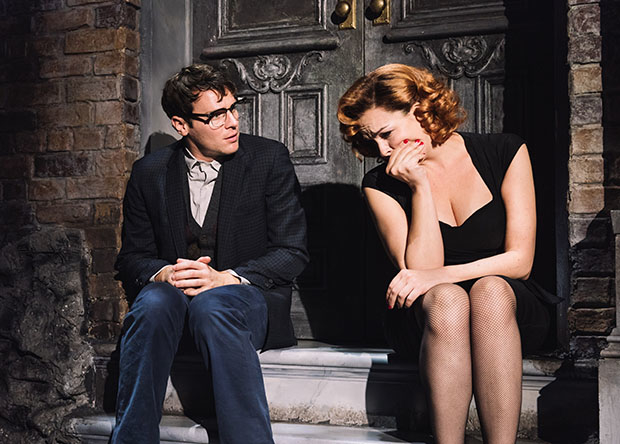
Bad things tend to happen in fictional stories involving attics. Think V. C. Andrews’s Flowers in the Attic, Yoji Sakate’s The Attic, Alfred Hitchcock’s The Birds, and Dan Curtis’s Burnt Offerings. If the brain is like a house with many rooms, the attic is where psychological fear resides (very different from the more otherworldly horrors that await in basements; ghosts live in attics, while demons hide down below). Such is the case with Bess Wohl’s poignant Make Believe, which has been extended at 2econd Stage’s Tony Kiser Theater through September 22. The Harvard and Yale grad further establishes herself as one of our smartest, most perceptive playwrights with the eighty-five-minute drama, even if there’s nothing particularly exceptional about the premise: Four young siblings become troubled adults because of severe parental neglect. But it’s Wohl’s skill in writing insightful dialogue and creating strong characters in convincing situations that makes the show a worthy successor to such previous works as American Hero, Small Mouth Sounds, and Continuity. So it’s no surprise that her next play, Grand Horizons, will make its New York debut on Broadway at the Hayes Theater in December.

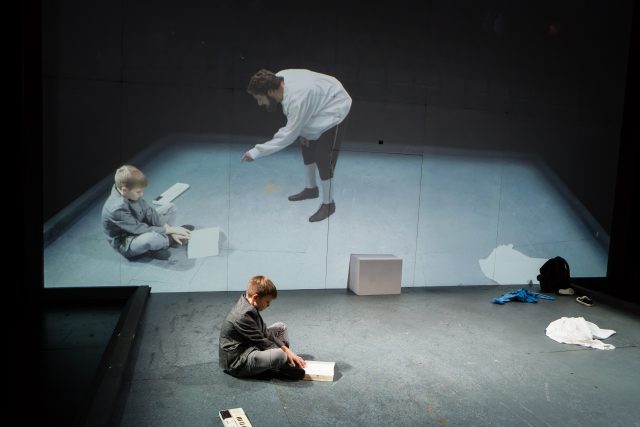
Make Believe begins in 1980, as twelve-year-old Chris (Ryan Foust), ten-year-old Kate (Maren Heary), seven-year-old Addie (Casey Hilton), and five-year-old Carl (Harrison Fox) are playing in their attic, pretending to be “one big happy family,” Kate says, more wish fulfillment than reality. The attic, designed by David Zinn, is decked out with a large tent, tables and chairs, and large windows facing the street. Their father is on a business trip, and their mother has seemingly disappeared. At first the kids act like it’s no big deal, but as day turns into night and then day again, they start worrying about their survival, deciding to fend for themselves without ratting out their parents.

(photo by Joan Marcus)

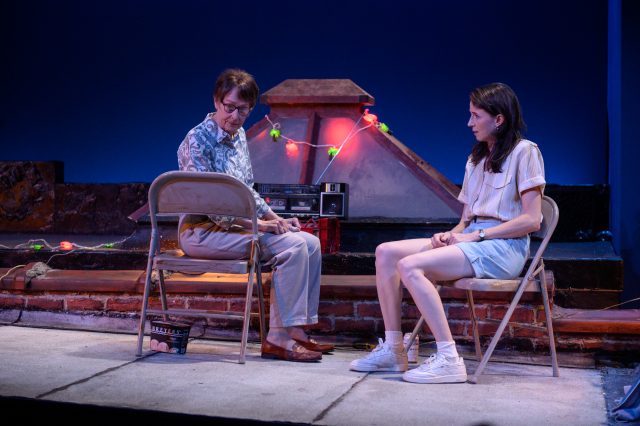
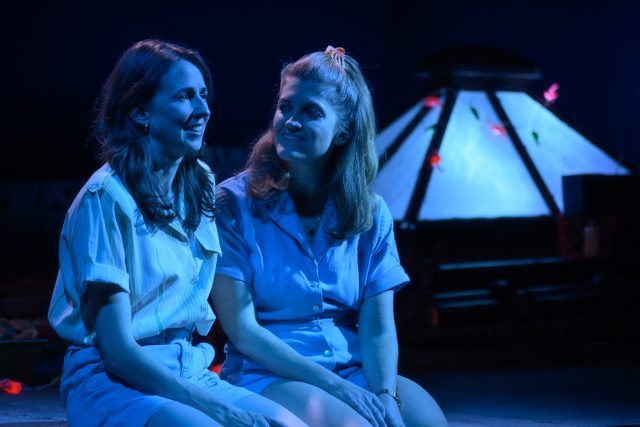
The grown-up Conlees face a traumatic moment in their past in Bess Wohl play (photo by Joan Marcus)

As the show opens, Addie is playing with her Cabbage Patch Kid while her siblings hover in the background, dressed as ghosts in white sheets with eye holes cut out. It’s more ominous than sweet; something is going to happen that will haunt them for the rest of their lives. When they sit down for a pretend dinner with Kate as the mom, Chris as the dad, and Carl as the dog, they mimic their parents’ unhappiness and their own reticence about getting older and becoming adults. “Remember: Don’t ever have children,” Kate advises her siblings. Later, Addie says, “Grown-ups aren’t real anyway. They’re only monsters with masks on.” Just when you think that the whole show will be with the children only, the adults (Kim Fischer, Susannah Flood, Brad Heberlee, Samantha Mathis) enter the picture, and it’s not a pretty one. It’s thirty years later, and they’re back in the attic, revealing the scars their childhood imprinted on them.

The four young actors in Make Believe are exceptional; I could have watched them all night, each one doing a superb job handling complex material. Director Michael Greif (Dear Evan Hansen, Rent) provides a smooth transition to the present, the kids now adults picking up the pieces of their haunted past. The themes of how parents can mess up their children’s future and how hard it is for kids to get over bad memories are common ones, but Wohl maneuvers through it with breathtaking finesse and a quick wit. “Grow up. Grow up, you idiots,” the young Kate says, to which Addie responds, “A wolf is coming.” In Make Believe, the wolf is at the door of the attic, then and now, ready to attack.

LITTLE GEM

(photo by Carol Rosegg)

Kay (Marsha Mason) brings up some very private details in Little Gem at the Irish Rep (photo by Carol Rosegg)

Irish Repertory Theatre, Francis J. Greenburger Mainstage
132 West 22nd St. between Sixth & Seventh Aves.
Through September 8, $50-$70
212-727-2737
irishrep.org

Three generations of women in a North Dublin family share their foibles and exert their fortitude in successive monologues in Marc Atkinson Borrull’s engaging if not quite sparkling revival of Elaine Murphy’s Little Gem, running at the Irish Rep through September 8. First seen in the US at the Flea in 2010, the hundred-minute play begins with eighteen-year-old Amber (Lauren O’Leary), who enters a doctor’s office waiting room (the antiseptic set is by Meredith Ries) and talks about a night of partying at a high school ball with her best friend, Jo, involving drugs and alcohol, dancing, and her maybe-boyfriend, Paul. “Jo and me just did a line in the toilets. Feeling nice. The music is thumping in my chest. Unce, unce, unce. Like this fuzzy feeling, know exactly where I am but when I close my eyes I could be anywhere,” she says dreamily.

When she is done, her mother, Lorraine (Brenda Meaney), comes in and, while Amber watches her, discusses a strange occurrence at the store where she works that ends up with her having to speak with human resources. The “HR bird” asks her about her ill father. “She reaches across the desk and touches my hand. Don’t remember the last time someone touched me, hugged me, or even bleedin’ nudged me,” Lorraine admits to the audience.

And then Kay (Marsha Mason), Amber’s grandmother and Lorraine’s mother, walks in and, while the other two look at her, describes her vaginal itch and her ill husband, Gem, who she loves but calls a “cantankerous oul’ fuck.” She says, “I’m the wrong side of sixty, not dead. I haven’t had sex in well over a year and it’s killing me.” So off she goes to Ann Summers to purchase her very first vibrator.

(photo by Carol Rosegg)

Grandmother Kay (Marsha Mason), granddaughter Amber (Lauren O’Leary), and mother Lorraine (Brenda Meaney) share their fears and desires in Irish Rep revival (photo by Carol Rosegg)

Sex, significant others, loneliness, and the pains of life and death are the key themes as the trio of women continue alternating monologues. Amber becomes pregnant. Lorraine, who is divorced from Ray, goes on her first date ever with a man she met at a salsa dance class. And Kay tries to use her vibrator while worrying about Gem’s health. They meander across the stage, occasionally sitting down, as they open up about intimate details of their innermost fears and desires; while the youngest, Amber, has no filter, Lorraine is ready to burst out of her sheltered existence and Kay is a bit surprised by how brutally honest she is.

Everything about Murphy’s (Ribbons, Shush) first play is solid, from Borrull’s (Beginning, Outlying Islands) effective direction to the performances by four-time Oscar nominee Mason (The Goodbye Girl, Fire and Air), Meaney (Indian Ink, Incognito), and, in her off-Broadway debut, O’Leary (The Awkward Years), but Little Gem never quite grabs you as it should, falling just short of reaching the next level it aims for. Like life itself, it can be disappointing, but there are enough genuine moments to recommend it, even if it doesn’t glitter.

NYC BROADWAY WEEK SUMMER 2019

(photo by Matthew Murphy)

Ain’t Too Proud – The Life and Times of the Temptations is one of twenty-four shows participating in Broadway Week (photo by Matthew Murphy)

BROADWAY WEEK: 2-for-1 Tickets
September 3-16, buy one ticket, get one free
www.nycgo.com/broadwayweek

Tickets are on sale for the end-of-summer edition of Broadway Week, which runs September 3-16 and offers theater lovers a chance to get two-for-one tickets in advance to see new and long-running productions on the Great White Way. Two dozen shows are participating, but one is already sold out — The Lion King — so you need to act fast. You can still grab seats, either half-price or a $30 upgrade, for Ain’t Too Proud – The Life and Times of the Temptations, Aladdin, Beautiful: The Carole King Musical, Beetlejuice, Betrayal, The Book of Mormon, Chicago, Come from Away, Dear Evan Hansen, Derren Brown: Secret, Frozen, The Great Society, Harry Potter and the Cursed Child, The Height of the Storm, Mean Girls, Oklahoma!, The Phantom of the Opera, Sea Wall / A Life, Slave Play, The Sound Inside, Tootsie, Waitress, and Wicked.

EUREKA DAY

(photo by Robert Altman)

A woke executive committee at a California private school tries to reach a consensus in Eureka Day (photo by Robert Altman)

Walkerspace
46 Walker St. between Broadway & Church St.
Wednesday – Sunday, through September 21, $25-$40
www.coltcoeur.org

Political correctness, inclusivity, neurodiversity, sensitivity, and conflict avoidance run amok in Colt Coeur’s East Coast premiere of Jonathan Spector’s uproarious satire, Eureka Day, which opened last night at Walkerspace. When an unvaccinated student at a supposedly woke California private school, Eureka Day, contracts mumps and the county health department issues a quarantine order, the executive committee, which strives to treat all children, students, and parents with equal respect and considers every opinion valid, suddenly faces a crisis that makes it question its most basic value systems. The white Don (Thomas Jay Ryan), Eli (Brian Wiles), and Suzanne (Tina Benko), the black Carina (Elizabeth Carter), and the Asian Meiko (K.K. Moggie) meet in the elementary school library; the cluttered room (designed by John McDermott) features three tall bookshelves, divided into Fiction, Nonfiction, and Social Justice, as if the third one is neither fiction nor nonfiction, fake nor real. The alphabet circling the room consists of such words as “co-op” for C, “democracy” for D, “trans” for T, and “union” for U.

The committee, which makes decisions only by consensus — heated arguments are not their thing, because offensive language or behavior of any kind will not be tolerated — agrees to hold a live community activated conversation over social media, an online town hall about the health situation. Despite Don’s peaceful intentions, it erupts into a frenzy of personal attacks between those parents in favor of vaccinations and those against — a larger number than anyone anticipated — but even the phrasing causes problems. “‘Anti-vaxxer’ is not really a term I’m comfortable with. It’s actually something said out of IGNORANCE,” one mother posts, while a father writes, “TRUE FACTS: Moonlanding wasn’t faked / 9/11 wasn’t an inside job / Global Warming is real / Vaccines Don’t Cause Autism.” The committee shuts it down when it devolves into curses and vicious name-calling, but the controversy soon blossoms among the five of them when it is learned that Suzanne and Meiko refuse to vaccinate their children, while Eli and Carina have immunized theirs. Don, the head of the school, doesn’t have the same skin in the game, as he is childless.

(photo by Robert Altman)

A live community activated conversation over social media looks at a community health crisis in Jonathan Spector’s black comedy (photo by Robert Altman)

Don, Suzanne, Eli, and Meiko are determined not to offend anyone, in any way, ever — even the scones they eat are carefully sourced and served — but Carina, the newest member of the committee, is not afraid to state her case for fact-based science over undereducated opinion, which does not make Suzanne happy. And it only gets worse when race, religion, and class enter the fray, rearing their ugly heads in the hallowed halls of Eureka Day.

Adroitly directed with subtle, dry humor by Adrienne Campbell-Holt (Downstairs, Joan), Eureka Day is a shrewd, cunning laceration of would-be social justice warriors, conspiracy theories, identity politics, and the education system. The characters are well drawn and fully believable, portrayed by a terrific cast led by Benko (Top Girls, Nantucket Sleigh Ride), who matter-of-factly contorts her body in funny ways throughout, and Ryan (The Nap, Dance Nation) as the soft and tender though oblivious Don, looking ever-so-gentle and caring in his shorts and mandals (without socks) as he attempts to steer clear of confrontation. The story has a little extra oomph here in New York City, where a measles outbreak in Brooklyn has spread fear and misinformation, especially on the internet. It’s Pollyanna-ish to think, in this day and age, that everyone gets a say, that every opinion bears equal weight despite the evidence. As it becomes clear in Eureka Day, in an environment in which everyone wins, there eventually has to be losers. But it’s not always who you might think.

BAT OUT OF HELL: THE MUSICAL

(Little Fang Photo)

Strat (Andrew Polec) and Raven (Christina Bennington) take off like bats out of hell in Jim Steinman musical (Little Fang Photo)

New York City Center
130 West 56th St. between Sixth & Seventh Aves.
Tuesday – Sunday through September 8, $49-$249
212-581-1212
batoutofhellmusical.com
www.nycitycenter.org

When I took my seat at Jim Steinman’s Bat Out of Hell at City Center last week, there was already a buzz of excitement in the air just before the lights went down, like before a rock concert. Everything hushed for a moment and then exploded: Meat Loaf had entered the building. Mr. Marvin Lee Aday, better known by his beefy appellation, had come to see the show for the first time in New York City. BOOH is an extravaganza based on the three albums he made with Steinman, 1977’s Bat Out of Hell, 1993’s Bat Out of Hell II: Back into Hell, and 2006’s Bat Out of Hell III: The Monster Is Loose. His entrance recalled Gene Wilder’s initial appearance in Willy Wonka and the Chocolate Factory as the seventy-one-year-old Meat Loaf, who has multiple health issues, moved very slowly, relying on a cane to walk. Fans congregated around him for selfies anyway, but eventually darkness came and the show went on. It was more fun watching Meat Loaf himself taking his seat; you can throw just about anything you want into a meatloaf and still end up with a satisfying dish, but you can’t do that with a fully fledged musical that’s charging up to $225 a ticket.

(Little Fang Photo)

Falco (Bradley Dean) and Sloane (Lena Hall) search for paradise by the dashboard light in Bat Out of Hell (Little Fang Photo)

Bat Out of Hell: The Musical is fifty years in the making, beginning with Steinman’s Brecht-inspired Baal in 1968 and his Peter Pan-influenced Neverland in 1977. This final version debuted in February 2017 at the Manchester Opera House and has been touring the world; it continues at City Center through September 8, but I can’t recommend you get tickets as soon as possible because the show is an absolute mess, nay, a nearly complete disaster, starting with the opening piece, “Love and Death and an American Guitar,” a two-character narration that just might be the worst first few minutes of a major musical I have ever seen. For the next two and a half hours, things occasionally got better — there are even a few dazzling highlights — as Steinman and director Jay Scheib evoke such wide-ranging shows and movies as Grease, The Warriors, Romeo & Juliet, Mad Max, Jesus Christ Superstar, Hair, Godspell, and Peter Pan, all of which are far superior to this head-scratchingly bizarre weirdness that is all revved up with no place to go.

The story takes place in 2030 in a postapocalyptic Manhattan, now known as Obsidian, that has been drifting out at sea after an unnamed “cataclysmic event.” The city is run with an iron fist by Falco (Bradley Dean), whose wife, Sloane (Tony winner Lena Hall), is bored and drinks too much; their daughter, Raven (Christina Bennington), wants to break out of her sheltered, pampered existence as she turns eighteen. For no apparent reason, she falls in love with Strat (Andrew Polec), the ersatz leader of a group of homeless kids known as the Lost, living under the ruins of the American Museum of Natural History, by an abandoned tunnel and skeevy bar called the Deep End. (Much of that information comes from perusing the actual script; the details are nowhere to be found onstage.) The headstrong Falco is ready to do everything in his power to keep Strat and Raven apart, including using the military force of his armed units. The cataclysm has frozen the disenchanted youths in time; the Lost are all eighteen years old, condemned never to grow into adulthood. “To be forever eighteen and irresponsible? It’d be fucking great,” Sloane tells Raven. Except maybe not.

(Little Fang Photo)

The Lost fight the power, battling Falco, in City Center show (Little Fang Photo)

Among the other members of the Lost are Strat’s right-hand man, Jagwire (Tyrick Wiltez Jones), who has the hots for the bold Zahara (Danielle Steers); the trio of Ledoux (Billy Lewis Jr.), Valkyrie (Jessica Jaunich), and Kwaidan (Kayla Cyphers), who occasionally find themselves front and center; and Tink (Avionce Hoyles), a fairy-like character (think Tinker Bell) who also is in love with Strat and who resents being frozen several years before he turned eighteen, so everyone treats him like a little kid. The dilapidated set, by costume designer Jon Bausor, features a slanted glass high-rise where Falco, Sloane, and Raven live; we can often see inside Raven’s window as she writes in a notebook or fights with her parents. Those scenes are usually accompanied by a videographer who films what is happening, which is annoyingly and confusingly live-streamed on a far wall. (The video design is by the usually inventive and dependable Finn Ross.)

The music, for the most part, is fine; musical director Ryan Cantwell and orchestrator Steve Sidwell don’t futz around too much with the original arrangements, and the pit band, comprising three keyboardists, two guitarists, a bassist, a drummer, and a percussionist, does justice to such songs as “Two Out of Three Ain’t Bad” (sung beautifully by Jones and Steers), “Heaven Can Wait,” the poignant ensemble piece “Objects in the Rear View Mirror May Appear Closer Than They Are,” “You Took the Words Right Out of My Mouth (Hot Summer Night),” “I’d Do Anything for Love (But I Won’t Do That),” and “Bat Out of Hell,” but Xena Gusthart’s choreography is baffling when it isn’t downright, er, batty. If you do choose to see the show, don’t miss the inexplicable movements of what appears to be a group of pansexual Oompa Loompas during a wild version of “Paradise by the Dashboard Light,” manically performed in flashback by Dean and Hall. And if you’re wondering how Air Supply’s “Making Love Out of Nothing at All” ended up here, it’s because Steinman wrote it for Meat Loaf, who turned it down for financial reasons.

(Little Fang Photo)

Bat Out of Hell: The Musical explodes with bizarre moments (Little Fang Photo)

While there are some fine ingredients — Bennington, Hall, Jones, and Steers are standouts — the result is significantly less than savory. Fortunately, the night I went, Meat Loaf eventually stored away his cane and joined the cast for an encore of “You Took the Words Right Out of My Mouth (Hot Summer Night)”; he might not be in top form, but he is a force of nature, one of the most charismatic, magnetic characters ever to grab a mic, and it was a thrill to see him onstage again, even after the cataclysmic disaster that preceded him, leaving us with an ultracool dessert to finish off an otherwise dreadfully disappointing meal.

FIDDLER: A MIRACLE OF MIRACLES

Fiddler

Fiddler on the Roof lyricist Sheldon Harnick plays the violin in new documentary about history of the show

FIDDLER: A MIRACLE OF MIRACLES (Max Lewkowicz, 2019)
Quad Cinema, 34 West 13th St. between Fifth & Sixth Aves., 212-255-2243
The Landmark at 57 West, 657 West 57th St. at Twelfth Ave.
Opens Friday, August 23
thefiddlerfilm.com

I’ve always felt a deep connection to Fiddler on the Roof, one of the most popular and critically successful musicals in history. I was awed by the movie when I was a kid, listened over and over to the original Broadway cast recording (on cassette!), and have enjoyed several stage productions, including one at a Long Island synagogue when I was a teen, one in Yiddish, and two on the Great White Way. I always assumed that it was because of my Eastern European Jewish roots; my grandparents on one side and great grandparents on the other escaped from pogroms in shtetls not unlike Anatevka, the small, tight-knit community in Ukraine where the show takes place. But as the new documentary Fiddler: A Miracle of Miracles reveals, the story is far more universal. “What is that that makes it speak in so many languages, and everybody thinks it’s about them,” Joel Grey, director of the smash Yiddish version running at Stage 42, says in the film. Theater critic Charles Isherwood points out, “Fiddler is really not just about violence that is visited on a single person but violence that is visited on an entire culture. Really it’s about what we now call ethnic cleansing, in the end, and these forces are still very much alive in the world. Bigotry, oppression, sometimes disguised as mere conservatism, it’s eerily and perhaps sadly relevant today.”

Fiddler

Producer Hal Prince explains the legacy of Fiddler in A Miracles of Miracles

In the documentary, director Max Lewkowicz (Underfire: The Untold Story of Pfc. Tony Vaccaro), whose mother is a Holocaust survivor, explores the creation of the Broadway musical, which was based on the Tevye the milkman stories by Sholem Aleichem and features a score by Jerry Bock, lyrics by Sheldon Harnick, book by Joseph Stein, and direction and choreography by Jerome Robbins, as well as examining its lasting international influence. He shifts between 1905, the time when the show is set; 1964, when it opened on Broadway; and today, where a production can be seen somewhere around the globe every day. He has amassed a treasure trove of archival footage, including old television appearances, a recording of Aleichem narrating one of his tales, a scene from the 1939 Yiddish drama Tevya, original Marc Chagall-inspired set designs by Boris Aronson, and the tape of music that Bock would send to Harnick so he could write the words (instead of working together at the piano).

He combines old interviews, photos, and clips of Bock, Stein, Robbins, and Tevye originator Zero Mostel with new interviews with Harnick (who plays a violin on a New York City roof), the late producer Harold Prince, violinist Itzhak Perlman, Fiddler fans Stephen Sondheim and Lin-Manuel Miranda, and numerous actors and directors affiliated with the show: Austin Pendleton and Joanna Merlin from the original 1964 cast, Topol and Norman Jewison (who is not Jewish) from the 1971 Oscar-winning film, Harvey Fierstein from the 2005-6 iteration, Danny Burstein, Jessica Hecht, Bartlett Sher, Adam Kantor, and Michael C. Bernardi — whose father, Herschel, portrayed Tevye on Broadway in 1964 and 1981 — from the 2016 version, and the current Yiddish Tevye, Steven Skybell. Authors Jan Lisa Huttner and Alisa Solomon put the story in sociopolitical context by relating it to the civil rights and women’s movements of the 1960s and ’70s.

Lewkowicz and editor Joseph Borruso also interweave footage from Fiddler productions in the Netherlands, Japan, Canada, Thailand, England, Brooklyn Middle School 447, and other locations, emphasizing again the universality of the story, particularly in light of today’s refugee crisis, the rise of anti-Semitism and racism, images of immigrant children being ripped out of their parents’ arms, and the cultural need to hold on to tradition and personal connection in the age of social media and the internet. “In moments of great upheaval, Fiddler is always going to seem relevant because the world is changing faster than we can understand,” Miranda, whose In the Heights was partially inspired by Fiddler, explains. “And that’s what the show’s about, and it’s intensely accessible because we are going through times of great change and great upheaval.” And, of course, there’s the music itself, as the film delves into such classic songs as “Matchmaker, Matchmaker,” “Sunrise, Sunset,” “Sabbath Prayer,” “Tradition,” “To Life,” “If I Were a Rich Man,” and “Do You Love Me?” Perhaps the best thing about Fiddler: A Miracle of Miracles, which opens today at the Quad and the Landmark at 57 West, is that it has given me an even greater appreciation of the musical’s endless wonders, which I didn’t think possible. I’ve also learned that it’s not just mine, but I guess I can share it with everyone else.

QUEEN OF HEARTS

(photo by Mark Shelby Perry)

Alice (LEXXE) is led down the rabbit hole in latest baroque burlesque production from Company XIV (photo by Mark Shelby Perry)

Theatre XIV
383 Troutman St., Bushwick
Thursday – Sunday through November 2, $85 – $435 (VIP Champagne couch for two)
companyxiv.com

Company XIV heats up an already scorching summer with the smokin’ hot Queen of Hearts, continuing at the wildly talented troupe’s new home in Bushwick through November 2. This time company founder Austin McCormick, who previously helmed baroque burlesque adaptations of such fairy tales as Cinderella and Snow White, turns his attention to Lewis Carroll’s Alice’s Adventures in Wonderland in a sexy, immersive production most definitely not suitable for children. The Troutman St. space has been transformed into a posh cabaret with a chandelier tree, an old-fashioned bar, and flashy decorations. Attendees sit in comfy chairs or couches for two, as company members make their way through the crowd, bantering with the audience.

(photo by Mark Shelby Perry)

The Caterpillar blossoms into a Butterfly (Lilin Lace) in raunchy take on Lewis Carroll classic (photo by Mark Shelby Perry)

All Carroll’s characters are here, just not as you’ve ever seen them before, gussied up in spectacularly raunchy, revealing costumes by Zane Pihlstrom, who also designed the set, and with fab makeup by Sarah Cimino: the alluring Alice (LEXXE), the body-rocking White Rabbit (Michael Cunio), the Caterpillar/Butterfly (Lilin Lace), the dashing Mad Hatter (Marcy Richardson), Tweedledee & Tweedledum (Nicholas Katen and Ross Katen), the Dormouse (Nolan McKew), the juggling Flamingo (Jacoby Pruitt), two Cheshire Cats (Jourdan Epstein and Ryan Redmond), and, of course, the Queen of Hearts (Storm Marrero). The cast also features Ashley Dragon on cyr wheel doing “Eat Me,” Làszlò Major on the pole proclaiming, “Drink Me,” and Ian Spring, Sam Urdang, and rehearsal director Allison Schuster rounding out the ensemble.

(photo by twi-ny/mdr)

Nolan McKew and Marcy Richardson dazzle with acrobatic performance above the crowd in Queen of Hearts (photo by twi-ny/mdr)

Conceived, directed, and choreographed with endless flair by McCormick, Queen of Hearts has a glorious, dark, decadent look hearkening to both Weimar cabaret and Aubrey Beardsley–style graphics. The show boasts more than thirty songs, some sung live by the characters, others recordings by familiar artists. LEXXE taunts us with the original “Blue,” Richardson tantalizes with Tears for Fears’ “Mad World,” Cunio belts out Tom Waits’s “Yesterday Is Here,” and Marrero shakes the building to its foundations with several treats, along with classics by Tom Jones, Perry Como, Dean Martin, Frank Sinatra, Rossini, and Tchaikovsky (and Natalia Kills, the Weeknd, Rihanna, Beyoncé, and, of course, Jefferson Airplane). The acrobatics are awesome, particularly a duet by McKew and Richardson, and Jeannette Yew’s lighting is sultry. There is a sly humor throughout, from magic mushrooms and can-can playing cards to a great use of the back curtain and, well, a bunch of male phalluses. The two-and-a-half-hour extravaganza has two intermissions, so you can get more drinks and snacks at the bar or remain in your seats and watch some bonus entertainment. You’re also encouraged to stick around after for further beverages and a chance to mingle with the cast.