this week in theater

THE TALMUD

The Talmud

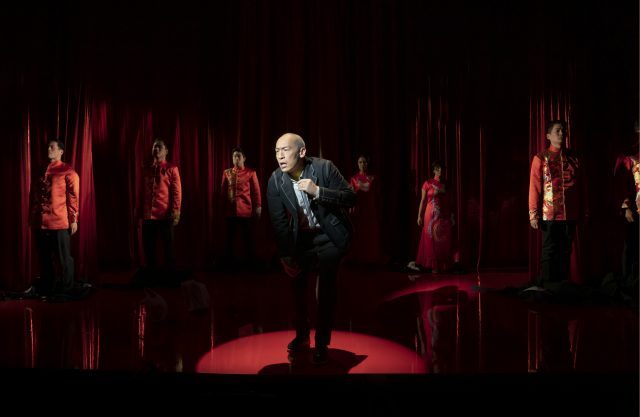
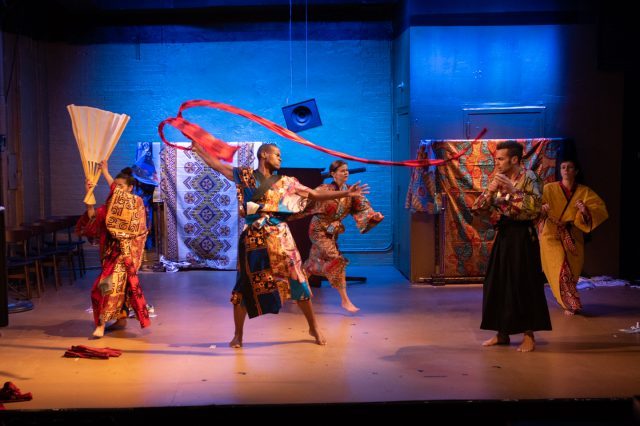
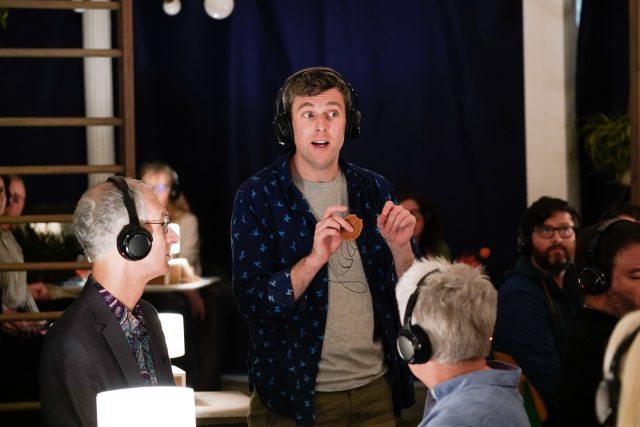
Meta-Phys. Ed. multimedia production brings together the Talmud and Kung Fu movies (photo by Jenny Sharp)

The Doxsee @ Target Margin Theater
232 52nd St. between Second & Third Aves., Sunset Park
Through September 28, $20-$25
866-811-4111
www.targetmargin.org/talmud

In his 2012 book A Kosher Christmas: ’Tis the Season to Be Jewish, Rabbi Joshua Eli Plaut discusses, among other things, American Jewish families’ penchant for eating Chinese food every December 25 and San Francisco’s annual Kung Pao Kosher Comedy show, taking place December 24-26 this year, providing “Jewish comedy on Christmas in a Chinese restaurant.” Experimental theater director Jesse Freedman, who cofounded Meta-Phys. Ed. in 2011 with Rabbi Bronwen Mullin, has found another connection between Jewish and Chinese culture, turning it into a new multimedia show, The Talmud, which opened last night at the Doxsee @ Target Margin Theater in Sunset Park.

“The Talmud is a very exciting and important Jewish text and is incredibly difficult to understand,” he explains in a statement. “I was watching a Kung Fu movie and thought, ‘This Kung Fu movie reminds me of the Talmud.’ I started to learn more Talmud and thought, ‘This reminds me of Kung Fu movies.’ I started to watch and learn more about Chinese martial arts cinema, my appreciation for them deepened, and the world of the Talmud, which had previously been opaque to me, started to make sense.” As a Jew and a Kung Fu movie fan, I fully understand where Freedman is coming from. The Talmud, consisting of the Mishnah and the Gemara, is a dense text that examines Jewish law and customs, requiring years of study to grasp its labyrinthine breadth. However, not even years of study will help you figure out what is happening in most Kung Fu movies, whether they are in Chinese or English. Trying to figure out the plot in films that have been dubbed into English rather than subtitled is especially confusing and entertaining, worthy of its own Mishnah investigation. Freedman’s complex production fits right in with those themes.

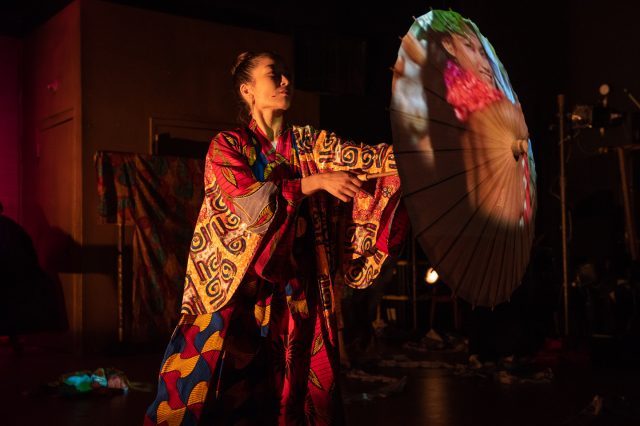
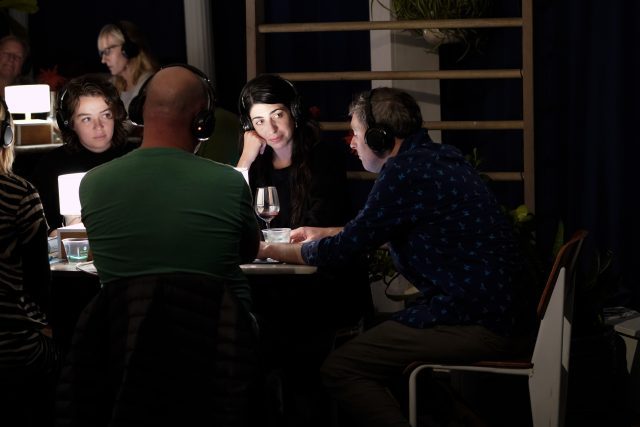
The Talmud (photo by Jenny Sharp)

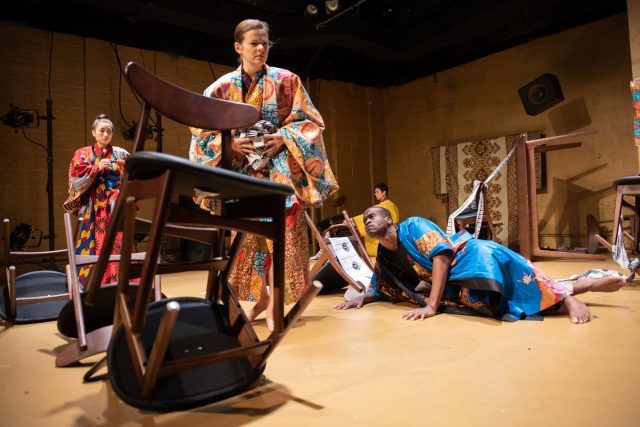
The Talmud continues at the Doxsee @ Target Margin Theater in Sunset Park through September 28 (photo by Jenny Sharp)

Continuing through September 28, The Talmud is set on a chessboard floor with several long, narrow, translucent curtains, reminiscent of Chinese scroll paintings, onto which Hebrew words from the Talmud are projected, as well as live streams of the action occurring onstage, courtesy of an iPhone basically strapped to the stomach of actress Lucie Allouche. (The senic design is by Kyu Shin, with projections by Lacey Erb and costumes by Karen Boyer.) Allouche, Abrielle Kuo, Eli M. Schoenfeld, and Jae Woo detail stories from one chapter of the Talmud, including the complex law of Sicarii, the case of mistaken identity involving enemies Kamtza and bar Kamtza and Nero, and the battle between zealots and sages over peace with the Romans. These pieces are dense with meaning that is difficult to follow within the play’s narrative; as you are still evaluating what you have just seen, the next tale proceeds, jumbling together in your mind. The show is punctuated by choreographed Kung Fu movement among the four actors, occasionally enhanced with swooshing sound effects; the score is by Avi Amon, with lovely music performed onstage by Lu Liu on pipa. The Talmud is a well-crafted production, with good performances and intriguing staging, but, like reading the Talmud and watching Kung Fu movies, you’ll be left scratching your head, not quite fully sated.

CROSSING THE LINE FESTIVAL: OPENING NIGHT

Crossing the Line Festival opens with Isabelle Adjani in Opening Night

FIAF’s Crossing the Line Festival opens with Isabelle Adjani in Opening Night (photo © Simon Gosselin)

French Institute Alliance Française, Florence Gould Hall
55 East 59th St. between Madison & Park Aves.
September 12-14
Festival continues through October 12
212-355-6160
crossingthelinefestival.org/2019

After the audience has settled in at FIAF’s Florence Gould Hall for Cyril Teste’s multimedia adaptation of John Cassavetes’s 1977 film Opening Night, there appears to be confusion on the stage, as a man in headphones converses in French with an unseen tech crew, their words not translated on the supertitles screen. It’s a disorienting moment, especially if you don’t understand French, and a terrific introduction to one of the themes of the play, the pull between fact and fiction, fantasy and reality inherent in theater and cinema. The man in the headphones is the play-within-a-play’s director, Manny (Morgan Lloyd Sicard), who is helming a melodrama featuring famous actress Myrtle Gordon (five-time César winner Isabelle Adjani) and her stoic costar, Maurice (Frédéric Pierrot); in the original film, itself based on a play by John Cromwell, Gena Rowlands was Myrtle, her real-life husband, Cassavetes, was Maurice, and one of their closest friends, Ben Gazzara, was Manny, their personal relationships further blurring the lines of reality.

With opening night a day away, Myrtle is having trouble with her lines and her physical presence, particularly in a scene that involves Maurice slapping her. She’s becoming emotionally unhinged, having a nervous breakdown, spurred by the earlier accidental death of a seventeen-year-old fan seeking an autograph and Myrtle’s inability — or overt unwillingness — to relate to her character, who is all too much like her, as if she is unable to face her own fate. Throughout the play’s eighty-five minutes, there is an additional figure onstage, cameraman Nicolas Doremus, who follows the characters as they move about Ramy Fischler’s elegant living-room set, which features a couch, a table, knickknacks on shelves, a visible backstage area with Agnès b.’s costumes, and, at the very center, a large screen where Doremus’s footage streams live, offering viewers a different angle on what’s happening. At one point, Doremus zooms in close on Manny and Myrtle, who might be about to kiss, the cameraman completing a kind of love triangle between life and artifice; at another, Doremus films other characters behind stage sharing their concerns as Myrtle is alone on the couch, drinking away her pain. Everyone is dressed in dark colors, mostly black, signaling potential doom.

star in

Morgan Lloyd Sicard, Isabelle Adjani, and Frédéric Pierrot star in Cyril Teste’s multimedia adaptation of John Cassavetes’s Opening Night at FIAF

Teste (Patio, Nobody) based his script on Cassavetes’s screenplay more than the final film itself, although he did use the director’s longtime friend and cinematographer, Al Ruban, who shot Opening Night, as a consultant. Teste encourages improvisation and changes stage directions every night, ensuring that each performance is unique in a way a film can never be yet still capturing the essence of the movie. “While Cassavetes’s other great films are models of immediacy — gut-level attempts to devise a cinematic syntax that accounts for and responds to the quantum flux of moment-to-moment experience — the doubly framed and multiply mirrored Opening Night operates at a remove,” Dennis Lim notes in his Criterion essay, which is appropriately titled “The Play’s the Thing.” He continues, “The filmmaker’s habitual insistence on the inseparability of actor and character (and of art and life) reverberates here within the haunted corridors of a backstage melodrama.” Adjani (The Story of Adele H, Queen Margot) is ravishing in her New York theatrical debut, her regal stage demeanor working hand-in-hand with her total command of the screen; we get to see both facets of her immense talent at the same time, which is both a treat and disconcerting; non-French speakers will lose a little as they avert their eyes to the supertitles while also deciding whether to look at the activity onstage, backstage, or onscreen. Sicard is superb as the director, and Pierrot is hardy as the skeptical Maurice, but Doremus stands out by not standing out even as he is right in the middle of the action. Opening Night opens FIAF’s monthlong Crossing the Line Festival and is supplemented by “Magnetic Gaze: Isabelle Adjani on Screen,” consisting of ten of her films shown on Tuesdays through October 29.

CROSSING THE LINE FESTIVAL 2019

Crossing the Line Festival opens with Isabelle Adjani in Opening Night

Crossing the Line Festival opens with Isabelle Adjani in Opening Night (photo © Simon Gosselin)

Crossing the Line Festival
French Institute Alliance Française and other venues
September 12 – October 12
212-355-6160
crossingthelinefestival.org

FIAF’s thirteenth annual Crossing the Line Festival, one of the city’s best multidisciplinary events, opens appropriately enough with the US premiere of French director Cyril Teste’s Opening Night, a multimedia adaptation of John Cassavetes’s 1977 film. The seventy-five-minute presentation, running September 12-14, stars the legendary Isabelle Adjani, along with Morgan Lloyd Sicard and Frédéric Pierrot; the actors will receive new stage directions at each performance, so anything can happen. (In conjunction with Opening Night, FIAF will be hosting the CinéSalon series “Magnetic Gaze: Isabelle Adjani on Screen,” consisting of ten films starring Adjani, including The Story of Adele H, Queen Margot, and Possession, on Tuesdays through October 29.) Also on September 12, Paris-born, New York–based visual artist Pierre Huyghe will unveil his free video installation The Host and the Cloud, a two-hour film exploring the nature of human ritual, set in a former ethnographic museum; the 2009-10 film will be shown on a loop in the FIAF Gallery Monday to Saturday through the end of the festival, October 12. Another major highlight of CTL 2019 is the US premiere of Peter Brook and Marie-Hélène Estienne’s Why? Running September 21 through October 6 at Theatre for a New Audience’s Polonsky Shakespeare Center in Brooklyn, the seventy-five-minute show delves into the very existence of theater itself. The festival also features dance, music, and other live performances by an impressive range of creators; below is the full schedule. Numerous shows will be followed by Q&As with the writers, directors, and/or performers.

Thursday, September 12
through
Saturday, September 14

Opening Night, directed by Cyril Teste, starring Isabelle Adjani, Morgan Lloyd Sicard, and Frédéric Pierrot, FIAF Florence Gould Hall, $45-$55, 7:30

Thursday, September 12
through
Saturday, October 12

The Host and the Cloud, directed by Pierre Huyghe, FIAF Gallery, free

Friday, September 13
through
Sunday, September 15

Manmade Earth, by 600 HIGHWAYMEN, the Invisible Dog Art Center, $15 suggested donation

Tuesday, September 17
and
Wednesday, September 18

The Disorder of Discourse, Fanny de Chaillé’s restaging of a lecture by Michel Foucault, with Guillaume Bailliart, the Cooper Union for the Advancement of Science and Art, free with RSVP, 8:00

Saturday, September 21
through
Sunday, October 6

Why?, by Peter Brook and Marie-Hélène Estienne, Polonsky Shakespeare Center, Theatre for a New Audience, $90-$115

© Louise Quignon

Radio Live makes its New York premiere at Crossing the Line Festival (photo © Louise Quignon)

Wednesday, September 25
Isadora Duncan, by Jérôme Bel, CTL commission, with Catherine Gallant, FIAF Florence Gould Hall, $35, 7:30

Thursday, September 26
through
Saturday, September 28

Somewhere at the Beginning, created and performed by Mikaël Serre, choreographed by Germaine Acogny, set to music by Fabrice Bouillon, La MaMa, $25, 7:00

Wednesday, October 2
Radio Live, with Aurélie Charon, Caroline Gillet, and Amélie Bonnin, based on narratives by young change makers from around the world, FIAF Florence Gould Hall, $15-$35

Thursday, October 3
through
Sunday, October 6

Look Who’s Coming to Dinner, world premiere choreographed by Stefanie Batten Bland, with music by Paul Damien Hogan, inspired by 1967 Stanley Kramer film, La MaMa, $21-$26

Friday, October 4
and
Saturday, October 5

The Sun Too Close to the Earth, world premiere by Rhys Chatham for nine-piece ensemble, inspired by climate change, along with Le Possédé bass flute solo and On, Suzanne featuring harpist Zeena Parkins and drummer Jonathan Kane, ISSUE Project Room, $25, 8:00

Thursday, October 10
When Birds Refused to Fly, conceived, directed, and choreographed by Olivier Tarpaga, featuring Salamata Kobré, Jean Robert Kiki Koudogbo, Stéphane Michael Nana, and Abdoul Aziz Zoundi, with music by Super Volta and others, FIAF Florence Gould Hall, $15-$35, 7:30

Friday, October 11
and
Saturday, October 12

Дyми Moï — Dumy Moyi, solo performance by François Chaignaud, the Invisible Dog Art Center, free with RSVP

SARAH JONES: SELL/BUY/DATE

(photo © Joan Marcus 2016)

Sarah Jones plays multiple characters in futuristic one-woman show about commercial sex trade (photo © Joan Marcus 2016)

New York Live Arts
219 West 19th St. between Seventh & Eighth Aves.
September 12-15 & 18-21, $15-$50, 7:30
212-924-0077
newyorklivearts.org
www.sarahjonesonline.com

Following its 2016 Manhattan Theater Club presentation, Sarah Jones’s Sell/Buy/Date is back in the city for an encore engagement at New York Live Arts. Below is an update of twi-ny’s original review, with relevant information added.

In 2006, British playwright and actress Sarah Jones won a Special Tony Award (and an earlier Obie) for her one-woman show Bridge and Tunnel, in which she played multiple characters, shining a light on New York City’s immigrant population. It took a decade, but she returned three years ago with her follow-up, another one-woman multiple-identity tour de force, Sell/Buy/Date, which revives some characters from her previous works while adding new ones; the production is now back by popular demand, running at New York Live Arts September 12-15 and 18-21. It’s late-twenty-first-century America, and Dr. Serene Campbell is teaching a class on the sex business, leading her students through a series of BERT modules, bio-empathetic resonant technology that dates back to 2017. Using this imaginary technology like oral histories, she tells her students, “We will be experiencing different bodies, different ages, what were then called ‘races’ or ‘ethnic groups,’ as you’ll remember from Unit One, and along the gender continuum, we’ll be encountering males as well as females — it was quite binary at that time. Remember, these are Personal History modules — the focus today is on feeling each person’s experience, so, before we begin, how many people have your emotional shunts engaged?”

She then proceeds to embody seventeen characters interviewed throughout the decades about the commercial sex trade, examining the reaction in the recent past to prostitution, pornography, and exotic dancing. “Chronologically advanced” Jewish bubbe Lorraine L. talks about trying to enhance her sexual relationship with her husband by searching for porn on the internet. Post–Valley Girl Bella, named after feminist activist Bella Abzug, is a “sex work studies major, minoring in social media with a concentration on notable YouTube memes” who cohosts “the biweekly pole-dancing party . . . called ‘Don’t Get All Pole-emical.” Jamaican No Fakin’ is a Caribbean prostitute at a sex workers rally who is carrying an unseen sign that says “No Justice, No Piece.” She defends what she does, noting, “You find me somebody who don’t hate some part of their job. There’s a lotta things I hate about doing this, but the money is not one of them.” And New York Domini-Rican Nereida angrily declares, “It just makes me so sick that we are all supposed to care about the same human rights, at least, that’s why we’re all here for this Feminist Plenary, but I mean, if one more of these so called ‘sex work advocates’ calls me anti-sex, I swear to god. I’m gonna be, like, first of all, I love sex. Sex is amazing. But what you are having is not sex.

Dr. Campbell also calls up interviews of members of the male species as she walks around Dane Laffrey’s futuristic set, a spare, antiseptic classroom with a podium, a file cabinet, a floor sparsely outlined with lights, and a projection screen at the back. “Yes, of course men were having sex as well, but you’ll remember from the reading, what were male sluts called?” she asks the class. “Very good, they were called ‘men.’” Among the male characters in the show are frat boy and Grand Theft Auto fan Andrew “AV” Vanderbeek, Russian raunchpreneur Sergei Ledinov, Los Angeles pimp Cookie Chris (“Even with what I was doing, you know, exploiting women and whatnot, I had a rep for being real sweet about it”), and Native American comedian Gary (“I’m usually most popular on college campuses, whenever they wanna do their Diversity Day or Hey, We’re Not All White week”). But as much as the treatment of women and sex workers needs to change, not all change turns out to be progress.

Sarah Jones explores the history of the (photo © Joan Marcus 2016)

Sarah Jones explores a controversial aspect of human sexuality in Sell/Buy/Date (photo © Joan Marcus 2016)

Jones (The Foundation, Surface Transit), who was born in Baltimore and raised in Boston, DC, and Queens in a multiracial family, has created a fascinating future devoid of organized religion, bachelor parties, unpaid internships, personal security guards, violent video games, a livable New Jersey, and mobile phones, where people can travel freely between countries and there is no discrimination of any kind. “They did not believe one has an automatic right to live equally,” Dr. Campbell says about people from the past. It’s a potent point, especially given the vitriol present in this year’s lurid presidential election campaign. In researching Sell/Buy/Date, Jones met with sex workers around the world, visiting Sweden, Germany, Korea, India, Las Vegas, France, Ireland, Scotland, the Netherlands, and the Dominican Republican, helping her create believable men and women who share a wide range of thoughts about commercial sex. She smartly captures the humanity in the industry, even if it is a bit lighthearted at times for such a serious topic, while Drama Desk–nominated director Carolyn Cantor (Fly by Night, Indian Summer) ably uses sound (by Bray Poor) and light (by Eric Southern) to smoothly transition between time periods. However, a subplot involving Dr. Campbell’s mother’s identity as a “survivor” feels like a forced tribute to those who have paved the way for gender equality. Jones, who once declared, “The revolution will not happen between these thighs” (the late Gil Scott-Heron was a family friend), gives a superb performance, instantly taking control of the audience; she has a natural confidence as a teacher that is intoxicating. Sell/Buy/Date offers a lively and timely look at a controversial subject that has continued to raise eyebrows throughout the centuries.

BAD NEWS! I was there…

(photo by Ian Douglas)

Eight messengers descend to deliver tragic tales in JoAnne Akalaitis’s BAD NEWS! I was there . . . (photo by Ian Douglas)

NYU Skirball Center for the Performing Arts
566 La Guardia Pl. at at Washington Square South
September 6-8, $40
212-992-8484
nyuskirball.org

The good news is that five-time Obie winner JoAnne Akalaitis’s BAD NEWS! I was there . . . is a salient, pertinent, and entertaining work. The bad news is that it’s all too true. Initially workshopped five years ago at Poet’s House and debuting at the Guthrie last year, BAD NEWS! is a clarion call that relates Greek tragedy to what is happening around the world today. The ninety-minute show takes audiences, divided into four groups, through numerous spaces in NYU’s Skirball Center, where it continues through September 8; in each location, two messengers in yellow safety vests with flashlights in the pocket over their heart deliver tales of disaster, murder, catastrophe, suicide, violence, butchery, incest, and war as a young child (Jah-Sire Burnside, Devin Coleman, Donovan Coleman, and Riley Velazquez) sits nearby, reading superhero comic books. The audience is separated from the performers by yellow caution tape, a constant reminder of impending doom. “In death there is nothing but death,” the cast says in unison.

(photo by Ian Douglas)

JoAnne Akalaitis’s BAD NEWS! I was there . . . takes audiences all around the NYU Skirball Center (photo by Ian Douglas)

The dialogue and songs (the music is by Bruce Odland), presented in English, Greek, Latin, French, and German, have been adapted from classical literature by Sophocles, Euripedes, Lucius Annaeus Seneca, Jean Racine, and Aeschylus, translated by Anne Carson, Bertolt Brecht, Ezra Pound, W. B. Yeats, Ted Hughes, Caryl Churchill, and others. Eight seminal tragic figures are represented: Medea (Katie Lee Hill), Thyestes (Jenny Ikeda), the Bacchae (Rocco Sisto), Phèdre (Kelley Curran), Oedipus (Howard Overshown), Antigone (Henry Jenkinson), Orestes (Jasai Chase Owens), and Hecuba (Rachel Christopher). Guides (Ahsan Ali, Maya Carte, ESJAE, Josh Fulton, ALEXA GRÆ, Chloé Worthington, Isabella Peterson, Milo Longenecker, and Aigner Mizzelle) carry lights as they lead the groups through narrow hallways, up and down stairs, and into various rooms; they also serve as a Greek chorus, singing in unison in the background. Along the way, white sheets with the title of the show written in what looks like blood hover. Curiously, there are not enough chairs to seat everyone at each stop, so if you can stand, let the elderly, infirm, or pregnant sit down.

(photo by Ian Douglas)

Immersive production at Skirball Center warns of impending doom (photo by Ian Douglas)

As you watch one section, you can clearly hear snippets from at least one other part (the first four scenes run concurrently and can be seen in any order), creating a cacophony of bad news, as if you’re being overwhelmed by social media and television reports. (Julie Archer designed the sets and costumes, with lighting by Jennifer Tipton and sound by Odland.) It all culminates in a grand finale that brings all four groups together, making one last stand. Created and directed by Akalaitis, the cofounder of Mabou Mines and former head of the New York Shakespeare Festival, BAD NEWS! is about bearing witness, in the past and the present; it asks us to pay attention to what is going on across the globe and to speak up when we see danger. “I was there and I will tell you everything” is the play’s constant refrain. (For example, when no Holocaust survivors are left on earth, what happens to their stories, especially with so many conspiracy theorists claiming it’s a hoax, and so many people on the internet believing them?) The show is accompanied by a multimedia lobby installation on Greek tragedy, supplemented with articles on the refugee crisis, Donald Trump, neo-Nazis, and other current events, and the audience is asked to write down their own personal bad news on a sheet of paper. After the performance, you’re encouraged to have a free drink, talk about what you just experienced, and read aloud one of the anonymous pieces of bad news. “I speak the truth. All evils are revealed,” one character says early on. The actors are not just delivering tragic news from ancient tales; they’re warning us about today, and tomorrow. And that’s a good thing, if only more people would listen.

BETRAYAL

(photo by Marc Brenner)

Jerry (Charlie Cox), Emma (Zawe Ashton), and Robert (Tom Hiddleston) are caught up in a circular love triangle in Betrayal (photo by Marc Brenner)

Bernard B. Jacobs Theatre
242 West 45th St. between Broadway & Eighth Ave.
Tuesday – Sunday through December 8, $25 – $189
betrayalonbroadway.com

Jamie Lloyd’s minimalist reimagining of Harold Pinter’s Betrayal, which opened tonight at the Jacobs, is not just a great revival; it’s a wholly new, brilliant work of art that is so fresh and alive that I feel like I’ve never seen the play before, although I have twice. Inspired by Pinter’s real-life affair with Joan Bakewell, Betrayal goes backward in time as it details a circuitous love triangle involving gallery owner Emma (Zawe Ashton), her husband, book publisher Robert (Tom Hiddleston), and his best friend, literary agent Jerry (Charlie Cox). The story begins in 1977, as Jerry and Emma meet two years after their long affair ended, and concludes in 1968, when they first became attracted to each other. It’s like a mystery where you know who the killer and victim are but now have to find out what led to that outcome. Except in Betrayal there are no victims; all three protagonists are complicit in the lies and deceit that are deconstructed over the course of ninety tense minutes. (Perhaps the only victim is Jerry’s unseen wife, Judith.)

The suspense starts at the rise of the curtain, which reveals Soutra Gilmour’s stark set, featuring three chairs and the three characters standing in front of a long, L-shaped marble wall. Jerry and Emma each grab a chair and move to the tip of the stage, where they sit down and share intimate details of their relationship. It’s uncomfortable in an exciting yet unsettling way, getting right in the face of the audience; meanwhile, Robert stands in the back, as if a ghost listening in, the cuckold all alone. Throughout the play, as it travels in reverse chronology, the three characters are onstage nearly the entire time, moving the chairs around as they go from a bar to a restaurant to a furnished room, from England to Italy. In most of the scenes, two of them are speaking while the other hovers cryptically, although all three appear together a few times, amplifying the dynamic among them. They wear the same clothes through most of the play — Gilmour designed the costumes as well — as if they are trapped by time. The set also includes two rotating sections, slowly spinning the characters in circles, mimicking their relationships, especially at one dazzling moment when one circle goes clockwise, the other counterclockwise, leaving the audience awed and nearly dizzy. Jon Clark’s lighting amplifies the suspense, creating eerie shadows as the wall moves up and back.

(photo by Marc Brenner)

Emma (Zawe Ashton) considers her predicament in Pinter revival (photo by Marc Brenner)

All three characters lie, emitting falsehoods that are so intertwined with who they are that it’s impossible to take anything they say at face value. Their memories are untrustworthy too; for example, Jerry keeps forgetting whose kitchen he was in when he threw Charlotte, Emma and Robert’s daughter, up in the air, a seemingly insignificant fact that he just can’t get right, if we are to believe Emma. Lloyd (Assassins, Pinter’s The Caretaker) makes the most of Pinter’s trademark pauses and silences, incorporating specialized movement and incidental sound and music by Ben and Max Ringham; he even slyly includes a snippet of Susan Boyle’s haunting version of Depeche Mode’s “Enjoy the Silence.”

The three leads are phenomenal in a play that has always been a big-name vehicle. Raul Julia, Blythe Danner, and Roy Scheider teamed up in the Broadway debut in 1980, Liev Schreiber, Juliette Binoche, and John Slattery joined together for the 2000 revival, and Daniel Craig, Rachel Weisz, and Rafe Spall starred in Mike Nichols’s 2013 iteration; the 1983 film boasted Jeremy Irons, Patricia Hodge, and Ben Kingsley. The tall, lithe, classically trained Hiddleston (The Avengers, Othello) is elegant and graceful as Robert, a potent counterpart to Cox’s (Daredevil, Incognito) more earthy and straightforward Jerry; their longtime bromance adds an extra dimension to their individual relationships with Emma, who is stunningly portrayed by novelist, playwright, film director, and actress Ashton (Velvet Buzzsaw, Gone Too Far!); it is easy to see why both men fall in love with her. Emma is smart, beautiful, and ambitious, enticingly barefoot throughout, a woman who knows what she wants and is not afraid to go after it, but she doesn’t necessarily fully contemplate the potential consequences of her decisions. Eddie Arnold is humorous as the waiter in an Italian restaurant, but this Betrayal is not a dark tale in need of comic relief. I had never thought of it as a comedy, but it is surprisingly laugh-out-loud funny, particularly in Hiddleston’s often satirical delivery.

(photo by Marc Brenner)

Zawe Ashton, Charlie Cox, and Tom Hiddleston excel in Jamie Lloyd revival of Betrayal at the Jacobs (photo by Marc Brenner)

Theater is different from books and movies in that you can see plays multiple times in unique adaptations, each making their own mark on the story, for good or bad. You can read a book or see a film more than once, but it doesn’t change, although you do. With Betrayal, Lloyd has breathed new, vital life into Pinter’s nearly forty-year-old Olivier Award winner. In the opening scene, Emma tells Jerry, “It’s nice, sometimes, to think back. Isn’t it?” He replies, “Absolutely.” It’s also more than nice to think forward. Don’t miss this opportunity to see this profound, organic interpretation that captures the heart and soul of Pinter’s bold original.

NYU SKIRBALL FALL 2019 SEASON

Skirball

Joanne Akalaitis’s site-specific Bad News! I Was There . . . leads small audiences through the Skirball Center

NYU Skirball Center for the Performing Arts
566 La Guardia Pl.
September 6 – December 9
212-992-8484
nyuskirball.org

NYU Skirball’s mission is to “present work that inspires yet frustrates, confirms yet confounds, entertains yet upends.” They are staying true to their goals with an extremely impressive and daring fall season of music, theater, dance, literature, and talks. The season gets under way September 6-8 ($40) with the New York City premiere of former New York Shakespeare Festival head and five-time Obie winner Joanne Akalaitis’s Bad News! I Was There . . . , a site-specific performance in English, Greek, French, and German that takes four groups through the lobby, dressing room, and backstage area of the theater, mixing in sung and spoken excerpts from classic Greek tragedy. “‘I was there’ is a refrain heard every day on the news, often followed by ‘How can this happen? What’s wrong here? What should we do?’” Akailitis says about the show.

Philippe Quesne’s The Moles, set in a world without humans and words, consists of four presentation September 12-14: “Parade of the Moles,” a free tour of Greenwich Village on Thursday at 2:00; “Night of the Moles” on Friday and Saturday night ($30, 7:30), taking place in a burrow; and the family-friendly “Afternoon of the Moles” on Saturday afternoon ($20, 7:30), as the Moles form a punk band. If you missed Sam Mendes’s brilliant production of The Lehman Trilogy at the Park Avenue Armory, you can catch one of two “National Theatre Live” screenings at the Skirball on September 15 ($25, 2:00 & 7:00) On September 16, “NYU Writes: A Celebration of Writers and Writing at NYU” brings together Jeffrey Eugenides, Jonathan Safran Foer, Terrance Hayes, Yusef Komunyakaa, Nick Laird, Sharon Olds, and Zadie Smith, hosted by Deborah Landau (free with advance RSVP, 7:00).

(photo by Andrew Lieberman)

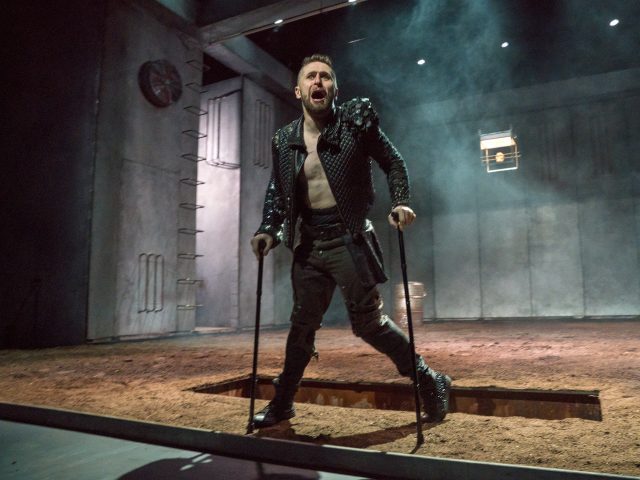
Daniel Fish reimagines Don DeLillo’s White Noise in multimedia production (photo by Andrew Lieberman)

Tony nominee Daniel Fish follows up his controversial reimagining of Oklahoma! with White Noise, a seventy-minute multimedia show “freely inspired” by Don DeLillo’s 1985 National Book Award-winning novel. Zoe Coombs Marr, Ursula Martinez, and Adrienne Truscott take on critics in Wild Bore September 27-28 ($35-$45, 7:30). And that just takes us through September; below are some of the highlights from October to December:

Sunday, October 6
National Theatre Live: Fleabag, $25, 7:00

Friday, October 11
and
Saturday, October 12

John Kelly: Underneath the Skin, $35-$45, 7:30

John Kelly channels Samuel Steward in show at Skirball

John Kelly channels Samuel Steward in show at Skirball

Friday, October 18
and
Saturday, October 19

ICE: George Lewis’s Soundlines — A Dreaming Track, $35-$45, 7:30

Friday, October 25
and
Saturday, October 26

Mette Ingvartsen: to come (extended), US premiere, $35-$45, 7:30

Friday, November 8
and
Saturday, November 9

Big Dance Theater: The Road Awaits Us, Ballet, Cage Shuffle: Redux, $35-$45, 7:30

Friday, December 7
and
Saturday, December 8

The Builders Association: Elements of Oz, $20-$25, 7:30