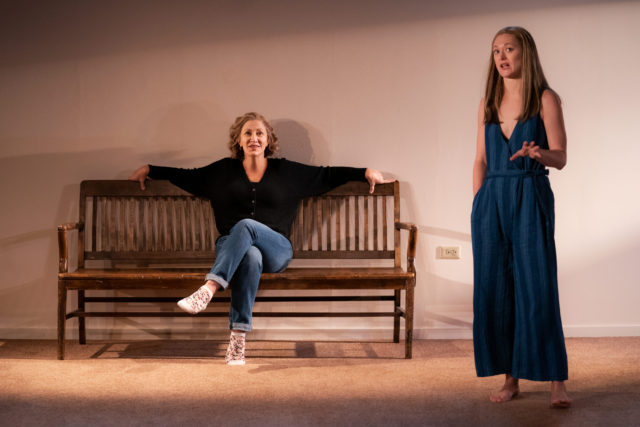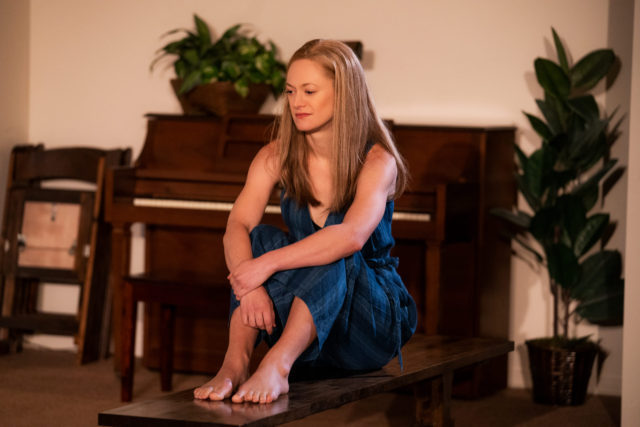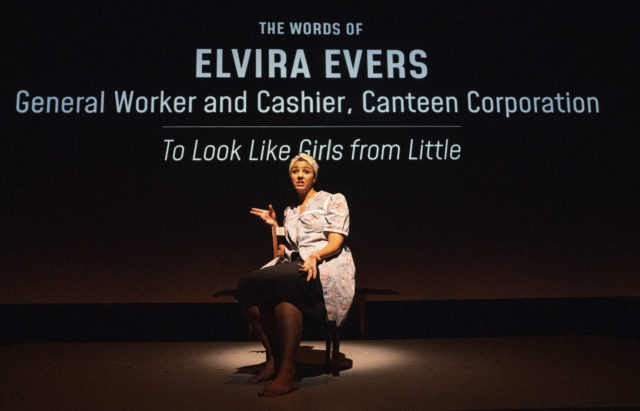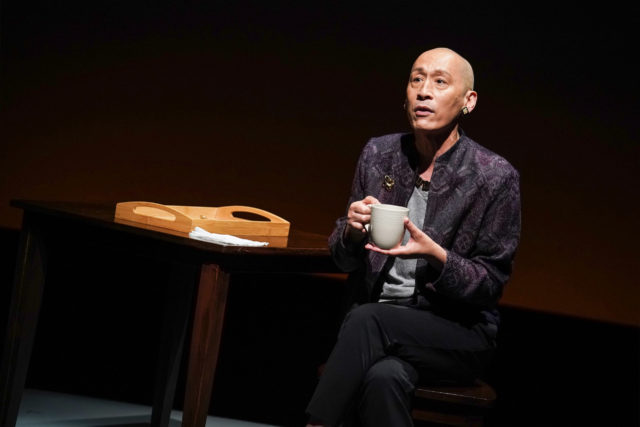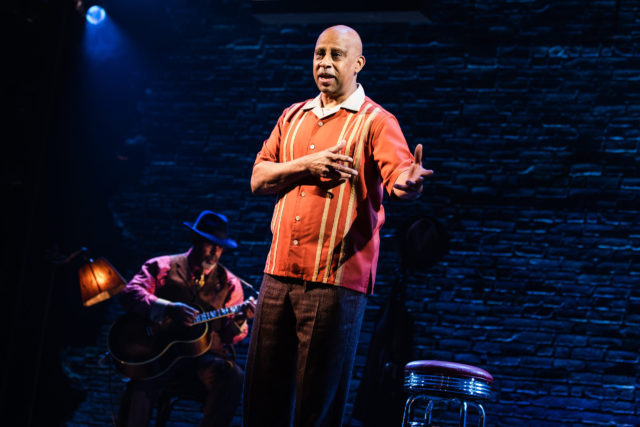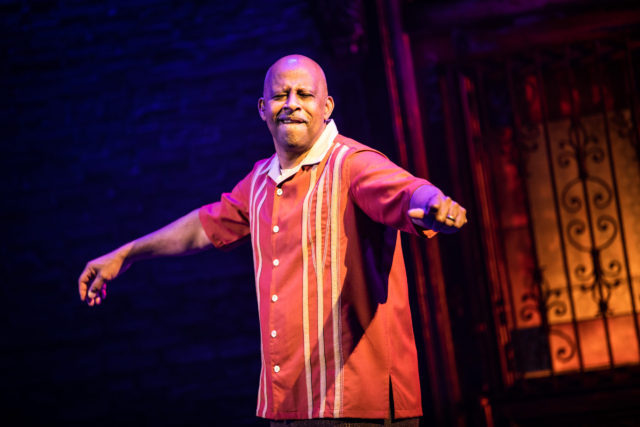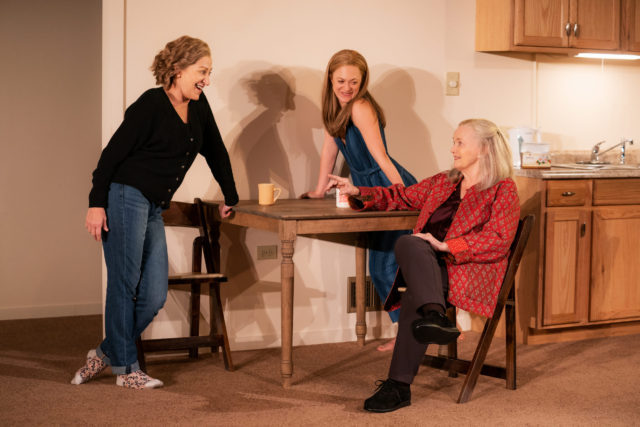
Casey Howes performs in immersive Endure in Central Park (photo by Richard Termine)
ENDURE
Southern end of Central Park
Through August 8, $59.99 runwomanshow.com
In his 2008 memoir, What I Talk About When I Talk About Running, award-winning Japanese novelist Haruki Murakami writes, “This is a book in which I’ve gathered my thoughts about what running has meant to me as a person. Just a book in which I ponder various things and think out loud. . . . One thing I noticed was that writing honestly about running and writing honestly about myself are nearly the same thing.”
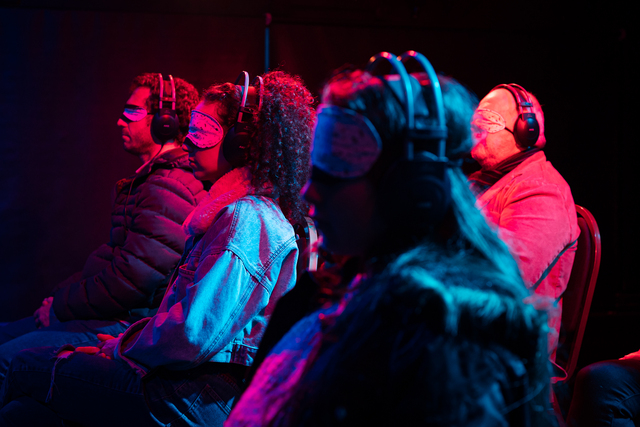
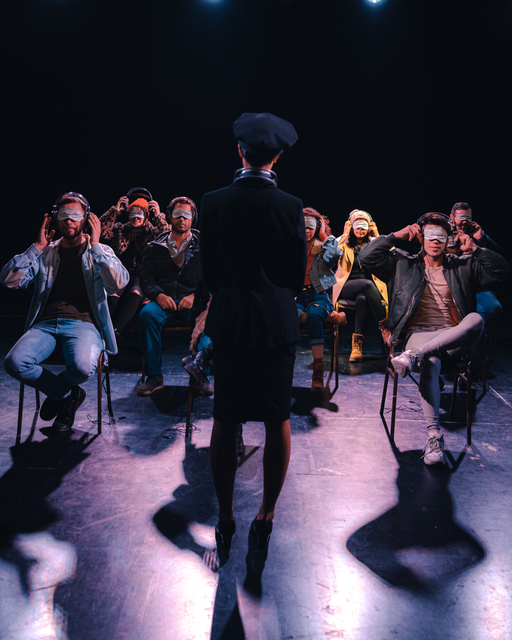
Canadian marathoner, Ironman finisher, and mother Melanie Jones takes a similar approach in Endure: Run Woman Show, an outdoor, on-the-move immersive event continuing in Central Park through August 8. A limited audience of no more than fifteen follows Mary Cavett or Casey Howes through the park while listening on earbuds to Jones talk about running her first marathon, sharing thoughts about the race and life. “You keep going, keep living, keep searching, keep risking, keep pressing out at the edges of yourself because, sure, you could stop or walk or stand on the sidelines, but there’s something beautiful in passing the end of who you think you are. See, there’s so much more beyond,” she narrates. She discusses what it feels like at the starting line, dealing with skeptics at a cocktail party, how math and endorphins can be overwhelming, and striving for her top-secret goal time.
Created and written by Jones (Joyride,In You. [And You?]) and directed by Suchan Vodoor, Endure: Run Woman Show is based on real-life stories from Jones and other runners, delving into what they think about and what they personally experience as they make their way through parks, streets, and tracks, running for both their mental and physical health. Covering approximately three miles in about seventy-five minutes — the audience is not expected to run alongside the performer, who will always remain in view, making stops on bridges and lawns, trees and lampposts — the piece, featuring a musical soundtrack by Swedish composer Christine Owman, is particularly relevant during the “2020” Summer Olympics in Tokyo, where participants are facing Covid-19 in addition to the regular tests of their abilities against the finest athletes in the world, and doing so without crowds cheering them on this time.
“When I discovered running, I realized that the stronger I got on the outside, the stronger I felt on the inside,” Jones said in a statement. “Long-distance running, at its best, is a spiritual experience: uplifting, clarifying, transformative. A runner feels connected to their environment, their best self, even humanity. My hope is that Endure gives audiences a sense of that tranquillity and peace.” And that’s something we all could use a whole lot of right about now.
Who:Black Box PAC What:Free Shakespeare in Bergen County Where:Overpeck Park Amphitheater When: Weekends July 23 – August 29, free, 8:00 Why: New York City has Shakespeare in the Parking Lot’s Two Noble Kinsmen,NY Classical’s King Lear with a happy ending, the Classical Theatre of Harlem’s Seize the King, and the Public Theater’s Shakespeare in the Park presentation of Merry Wives of Windsor. But you can also catch free Bard in New Jersey, where the Black Box Performing Arts Center’s summer season begins this weekend with modern productions of Hamlet and As You Like It, continuing Thursday to Sunday through August 29 at the Overpeck Park Amphitheater in Bergen County. In addition, Black Box PAC will be hosting free “Play On!” concerts Sundays in August at the amphitheater at 4:00, including performances by Divinity & the FAM Band, Melissa Cherie, Esti Mellul, Ginny Lackey & the Hi-Fi Band, Dan Sheehan’s Rising Seas, and Andy Krikun & Jeff Doctorow. There will also be script-in-hand readings of Macbeth and The Taming of the Shrew at the Englewood Public Library on Wednesdays at 8:00 from July 28 to September 1. Admission to all events is free, with no advance RSVP necessary. As Duke Orsino declares in Twelfth Night, “If music be the food of love, play on!”
Myra Caellaigh (Florence Scagliarini), Kate O’Sullivan (Phoebe Mar Halkowich), and Siobhan Murchadha (Irina Kaplan) tend to the deceased in The Wake of Dorcas Kelly (photo by Nick Thomas)
THE WAKE OF DORCAS KELLY
The Players Theatre
115 MacDougal St.
Thursday-Sunday through July 25, $42 www.spitnvigor.com
New York–based nonprofit theater company spit&vigor continues its exploration of the past in The Wake of Dorcas Kelly, which opened July 16 at the Players Theatre and continues through July 25.
Inspired by a true story that has expanded its legend with apocryphal elements over time, the ninety-minute show takes place in the Maiden Tower brothel in Dublin in January 1761, where the hanged and charred body of former madam Dorcas Kelly lies covered on a table. Ladies of the evening Siobhan Murchadha (Irina Kaplan), Kate O’Sullivan (Phoebe Mar Halkowich), and Myra Caellaigh (set and sound designer Florence Scagliarini) are watching over their dear departed friend and former boss, who was brutally executed for the murder of a shoemaker in the street. “She didn’t shoot just any man,” pub owner and regular Maiden customer Tom Doherty (Nicholas Thomas) explains. “It was the scoundrel John Dowling, who left our poor Kate with child and no support. Which is a thing I’d never do, for all my vices.”
As they share memories of Dorcas, a riot is under way right outside, the noise spilling into the room. Former sailor William O’Brien (Eamon Murphy) has been hired by Kate to protect the brothel during the public melee, but he keeps coming in for more drink while insisting he will remain true to his wife, Grace (Duoer Jia). “I suppose he’s burning through some of his debts with hard labor,” Siobhan says. “That boy wouldn’t know hard labor if it spanked him in the arse,” Myra replies. “Well, this hard labor has spanked him in the arse once or twice,” Siobhan jokes.
Soon Tom and William are dragging doped-up Father Jack Dancy (troupe executive producer Adam Belvo) in through the back window. The visiting Belfast priest is completely out of it; the men tie him up so he won’t be able escape before praying for Dorcas. Meanwhile, former prostitute Fannie Prufrock (Kyra Jackson) has gone legit but can’t seem to stay away from the brothel. “Went and run off with some shipmate and now she thinks she’s the queen of England,” Myra says. “Have some tenderness, Myra. She only comes back round here because she’s tired of married life. Imagine getting stuck with the same prick night after night,” Siobhan adds. “You want to be married, then, Myra? I’ll make an honest woman of you,” Tom offers, but Myra is having none of that. When a surprise guest (Peter Oliver) is discovered, the plot takes a dark turn without losing its macabre, ribald sense of humor.
Founded in 2015, spit&vigor excels at mining the history of drama, literature, and art for raw material: Among its previous productions, NEC SPE / NEC METU tells the story of Baroque painters Caravaggio and Artemisia Gentileschi, Mary’s Little Monster imagines how Mary Wollstonecraft Shelley’s Frankenstein came to be, The Brutes goes behind the scenes of an 1864 benefit performance of Julius Caesar by the Booth brothers (staged by spit&vigor at the Players club, which was started by Edwin Booth), and the livestreamed Luna Eclipse traveled back to the fourteenth century as the cast proceeded throughout the West Park Presbyterian Church on Eighty-Sixth St.
The Wake of Dorcas Kelly offers plenty of booze, blasphemy, and butchery (photo by Nick Thomas)
Written and directed by company artistic director Sara Fellini (In Vestments, Hazard a Little Death) with plenty of spit and vigor, The Wake of Dorcas Kelly opens with all nine actors onstage, singing a rousing version of “The Tempest” by the Real MacKenzies: “We are all born free but forever live in chains / And we battle through existence on and on / We’ll take whatever comes to be while keeping hopeful melody / And we’ll cruise through the darkness until the warmth of dawn.” The drinking song gets the audience ready for a rollicking evening on Scagliarini’s cramped, dusty, but homey set with unmatched chairs, Baroque wallpaper, a back staircase, and candles, cups, glasses, and bottles everywhere. (The often eerie lighting is by Chelsie McPhilimy, with period costumes and props by Claire Daly.)
Sex, drugs, and rock and roll, along with booze, blasphemy, and butchery — what’s not to love? Deserving of a longer engagement, The Wake of Dorcas Kelly is a spirited night out at the theater — live and in person — performed by a strong cast that will only get better as the show continues. It’s so much fun spending time with these well-drawn, engaging characters and talented actors that it’s sad when the play is over and the lights go down; it’s easy to see why everyone likes stopping by and staying for a drink or two, and maybe a little more, even with dead bodies lying around.
Melissa Joyner stars as a mother willing to do just about anything to get her daughter a better education in Lines in the Dust
LINES IN THE DUST
New Normal Rep
Available on demand through August 8, $25 www.newnormalrep.org
In his 1963 inaugural address upon being sworn in as governor of Alabama, Democrat George Wallace declared, “In the name of the greatest people that have ever trod this earth, I draw a line in the dust and toss the gauntlet before the feet of tyranny, and I say, segregation now, segregation tomorrow, and segregation forever.”
Actress and playwright Nikkole Salter uses part of that quote for the title of her potent three-character work about racism, residential districting, and school residency fraud, Lines in the Dust, streaming through August 8 in a potent virtual version from New Normal Rep. The 110-minute play feels like it was written yesterday, but it actually debuted at Luna Stage in New Jersey in 2014. In a short video about the world premiere, Salter explained, “I think we’re at a critical moment of national reflection,” referring specifically to the sixtieth anniversary of the Brown v. Board of Education ruling that declared school segregation unconstitutional. She continues, “This play becomes poignant now because we find ourselves as segregated, if not more segregated in certain places, than we were in 1954 when we look at our education system.” Among the many difficult lessons we’ve learned since March 2020 is that America still has a major segregation problem in education, among other institutions, amid another critical moment of national reflection.
The play begins in the spring of 2009 at an open house in Millburn, New Jersey, where Dr. Beverly Long (Lisa Rosetta Strum), the married mother of a teenage son, and Denitra Morgan (Melissa Joyner), the single mother of a teenage daughter, are talking about the local district. “If you want a good school, you have to pay property taxes or private school tuition, pick your poison. I say, at least with the former, you get some equity,” Beverly explains. “Gotta pay if you wanna play,” Denitra replies. Beverly: “At least we can. Imagine if we were stuck in other, worser — if we couldn’t afford to pay —” Denitra: “Yeah.” Beverly: “I don’t know what those parents do. ‘Hope’ it works out? Pray?” Denitra: “Beg, borrow, lie; they’ll cheat their way into . . .” Beverly: “Of course they do. Wouldn’t you?” Denitra: “Yeah, I guess I would.” Beverly: “I definitely would. What parent wouldn’t?”
Lisa Rosetta Strum, Melissa Joyner, and Jeffrey Bean star in New Normal Rep’s potent virtual production of Nikkole Salter’s Lines in the Dust
A year and a half later, Beverly is the interim principal at a prestigious public high school in Essex County, where Denitra is illegally sending her daughter, Noelle, since they can’t afford to live in that district. In her office, Dr. Long meets with Michael DiMaggio (Jeffrey Bean), a private investigator hired by the board to weed out these illegal students, seeking to expel them and make their family pay restitution. A thirty-five-year veteran of the Millburn Police Department, DiMaggio doesn’t exactly hide his racism and anti-Semitism, determined to rid the school of these unwelcome elements, using dog-whistle phrases that he insists are not biased, claiming merely to be following the law. While Dr. Long is uncomfortable with his language, methods, and personal beliefs, she also wants to keep her job, so she attempts to find that line in the dust, especially when DiMaggio starts going after Denitra and Noelle.
Preparing a slide presentation for the board, DiMaggio gives Dr. Long an advance run-through. “Now, you’ve got a good thing goin’ here in Millburn,” he states. “And I tell ya, they’re gonna come and try and take it.
It’s easier to take than to build your own. I ask you, are you gonna take this opportunity to do everything you can to fight to keep Millburn? Or are you going to let it go to a bunch of people who don’t even live here? The choice is yours.” It is clear who that “bunch of people” are, but the interim principal is worried about criticizing the PI, concerned about her position at the school and conscious of her responsibility to the Black community.
She tells DiMaggio, “We all should be concerned about the future of our schools. But what I don’t think we should feel is afraid. And right now, those pictures, they make me feel like you want me to be afraid —” “No —,” DiMaggio begins, but Dr. Long cuts him off. “Afraid in a very specific way. The images are very —” DiMaggio: “I’m not trying to scare anybody.” Dr. Long: “They’re very biased.” DiMaggio: “You think I’m biased?” No, I didn’t say you — I think the pictures you chose, and how you present them, create a very biased look —” DiMaggio: “These are real pictures.” Dr. Long: “I’m sure, but the way you present them —” DiMaggio: “What way? In a slide show?” Dr. Long: “No. Back to back and in juxtaposition to — it makes it seem as if the thing they should be afraid of is the ghetto.” DiMaggio: “Yeah.” Dr. Long: “Yeah?” DiMaggio: “Aren’t you afraid of that?” Dr. Long: “Excuse me?” The battle comes to a head as DiMaggio starts following Noelle and the official presentation approaches.
Lines in the Dust was directed over Zoom by Awoye Timpo (The Loophole), with multimedia green-screen design by Afsoon Pajoufar, taking us from the open house to Dr. Long’s office to Denitra’s home, with costumes by Qween Jean, sound by Stan Mathabane, and original music by Alphonso Horne. The cast is outstanding, led by Joyner’s (Maids Door, Mrs. America) heart-wrenching turn as Denitra, a woman willing to go to extreme lengths to get her daughter a quality education that can make a difference in her future. You can feel her desperation even though watching her performance on a computer. Strum (Pipeline, the solo project She Gon’ Learn) portrays Beverly’s painful dilemma with poise and self-assurance, while Bean (The Thanksgiving Play,About Alice) brings an understated refinement to DiMaggio, a white man who represents so much of what is wrong with the current system.
Salter — an award-winning playwright and actress who wrote Here We Are and starred in Lydia R. Diamond’s Whitely Negotiations for the extraordinary two-way “Here We Are” solo theater project held online during the pandemic lockdown — was partly inspired by the career of onetime Newark resident, NAACP lawyer, and federal judge Robert L. Carter, which included work on such cases as Sweatt v. Painter, in which Heman Marion Sweatt sued the University of Texas Law School in 1950 because he was rejected for being Black, and Brown v. Board of Education. The play gets to the emotional core of such legal precedents, focusing on the human element. It all feels particularly pertinent in 2021 in regard to ongoing arguments across the US about teaching critical race theory in schools and the battle over voting rights. Somewhere up there, Wallace is smirking down on all of us.
Who:Brian Stokes Mitchell, Vanessa Williams, Daniel J. Watts, Marc Shaiman, Bernadette Peters, Kristin Chenoweth, David Hyde Pierce, more What: Ticket giveaway for Crossovers Live! with Brian Stokes Mitchell Where:Stellar When: Premiering monthly July 26 – December 20, $15-$100 per show, six-show bundle $49-$500; use code BBS10 to save $10 on any six-show bundle through July 21 (benefiting the Actors Fund) Why: Brian Stokes Mitchell was already a Broadway and television star when he reached a new stratosphere of fame for his nightly renditions of “The Impossible Dream” early in the 2020 pandemic lockdown in New York City. Delivered from the window of his Upper West Side apartment after the 7:00 pm clap for health-care workers, Stokes’s performances were part of his vocal retraining after a serious bout with Covid-19. He sang one of the hit songs from Man of La Mancha, a show that earned him a 2003 Tony nomination for Best Actor in a Musical, an award he had won in 2000 for Kiss Me Kate. The Seattle-born Mitchell, who has appeared in such other Broadway musicals as Jelly’s Last Jam, Kiss of the Spider Woman, and Ragtime and such TV series as Mr. Robot, Glee, and Trapper John, M.D. (in addition to a ton of voiceovers on animated programs), is now hosting his own online talk show, Crossovers Live!, which will stream live monthly July through December and be available on demand for a limited time.
In a promotional video, Mitchell — who has also been nominated for a Grammy, formed Black Theatre United in June 2020 with Audra McDonald, LaChanze, Billy Porter, Anna Deavere Smith, and others, and received the key to the city for his extensive work during the coronavirus crisis as chairman of the board of the Actors Fund — asks, “Do you like movies? TV shows? Miniseries? How about theater? Do you like theater? Like, really like theater? Do you like any medium that actors, composers, singers, writers, dancers could be on? We asked Vanessa Williams, Marc Shaiman, Bernadette Peters, Kristin Chenoweth, David Hyde Pierce, and more to talk about crossing over from stage to screen. And they all accepted because they love audiences, and audiences love them, and we all just love each other. You get it.” The show premieres July 26 with Williams (Soul Food, Kiss of the Spider Woman) and Daniel J. Watts (Tina: The Tina Turner Musical, The Last O.G.), followed August 30 with composer Shaiman (Hairspray, Mary Poppins Returns), September 27 with Peters (Annie Get Your Gun, The Jerk), October 25 with Chenoweth (Wicked, Glee), November 22 with Hyde Pierce (Spamalot, Fraser), and December 20 with a Holiday Finale. A minimum of ten percent of the net proceeds will benefit the Actors Fund.
TICKET GIVEAWAY: Tickets for Crossovers Live! with Brian Stokes Mitchell are $15 each, $25 for the show and access to the VIP chat room, and $100 for the Super VIP Livestream, which adds in signed merchandise. The six-show bundle is $49/$99/$500.
However, twi-ny is giving away two standard six-show bundles ($49) and one VIP bundle ($99) for free. In order to be eligible, you must like Crossovers Live! on Facebook and Instagram and, in addition, send your name, phone number, and favorite play, television show, or movie with Brian Stokes Mitchell in it to contest@twi-ny.com by Thursday, July 22, at 3:00 pm. All entrants must be twenty-one years of age or older; three winners will be selected at random. As Mitchell sings, “And the world will be better for this / Oh, that one man, scorned and covered with scars / Still strong with his last ounce of courage / To reach the unreachable, the unreachable / The unreachable star.”
“I hate my life,” Marcus (Kamal Angelo Bolden) says early on in the virtual one-man show Ride Share, a psychological thriller streaming from Chicago’s Writers Theatre through July 25.
Marcus believed he was on the right road, doing everything correctly. The thirty-three-year-old Black man had just married a lovely woman, Joselyn, at an $85,000 wedding and returned from their honeymoon in Aruba imagining only brightness in his future. He gets called in to work, expecting to be made partner after having put in twelve dedicated, difficult years. Instead, Craig, a white Yale grad who married the boss’s niece, informs Marcus that he is being laid off. “He tells me that I should . . . count this as a blessing, this leaves your path wide open for a great adventure ahead of you. Oh, and by the way, there’s a box waiting for [you] at the front desk.”
Devastated and desperate for money, Marcus becomes a driver for every ride-share company he can find. He shuttles passengers around Chicago in his white Kia from four to ten every morning and again from seven at night till past midnight, jeopardizing his relationship not only with his new wife but with his sanity. Standing atop his car, he details his preoccupation with his rating, like a day trader or a compulsive gambler:
“From the start, ratings have been the bane of my existence. In three months, I’ve earned the ranking of a platinum-level driver. I’ve driven 647 trips with a rating of 4.9, with 629 five-star reviews, 10 four-stars, 4 three-stars, 3 two-stars, and 1 one-star review. I watch these ratings like a hawk. It’s gotten so bad that now I tell people I’m gonna give them five stars in hopes that they do the same. I check these ratings after every ride. I check them again before I go to bed; my wife thinks that I’m obsessed with these ratings. She says, ‘You pay more attention to your ratings than you do to me.” I say, ‘Well, you’re not gonna downgrade me from platinum to blue. She laughed and then she said, ‘You better be careful because your ratings aren’t the only things that could turn blue.’ I love her so much. She’s my everything.”
He spends his down time trying to create better opportunities, learning Spanish by listening to Latin music and hanging out with the other drivers at the airport. “All of us waiting. Waiting for just one ride. Waiting to control our own destinies, waiting on the America dream, waiting.” As his disdain for his passengers grows, particularly for snarky businesspeople and young white women, so does information about a new disease, Covid-19. Then fate steps in when Craig enters his vehicle and Marcus admits to himself that he always has an additional passenger sitting next to him, which he calls his dark rider. “No one can see him but me, our eyes lock, ten generations of rage staring back at me, his mouth gaping wide, uttering nothing but yet I hear his whispers,” he says. Suddenly the road ahead is filled with sin and temptation.
Written by Reginald Edmund and directed by Simeilia Hodge-Dallaway, the cofounders of the activist Black Lives, Black Words International Project, Ride Share, part of BLBW’s Plays for the People series, is a tense and uneasy journey into the mind of a man who has been rejected by a society that refuses to see him for who he is as an individual, as a unique human being. When seen at all, he is judged by the color of his skin and the type of car he drives, representations of systemic racism and income inequality. Bolden (Jitney, Detroit ’67) effectively captures the angst and fear that so many Black men and other people of color have felt so acutely over the last sixteen months (not to mention the decades before), during a pandemic that has led to isolation and economic hardship, as well as a reckoning for racial injustice.
At times, cinematographer Tannie Xin Tang brings the camera right up to Marcus’s mouth, making palpable the years of anguish and torment, ready to emerge and explode at any moment. Edited by Lesley Kubistal, with music and sound by CHXLL Sounds and scenic design by Alexandra Regazzoni, the eighty-minute hybrid work is informed by an ever-threatening claustrophobia that envelops the viewer, sitting at home, where not everyone is always as safe as they think they are. Marcus often is shown looking into his rearview mirror, watching out for what is chasing him, while the road ahead becomes continually darker. The ride can get bumpy, but the ultimate destination is as startling as it is, unfortunately, all too believable.
Who:L.A. Theatre Works What: All-star audio play based on Agatha Christie novel Where:LATW online When: Available starting July 1, $20 (nine-play season $150) Why: In the 1990s, L.A. Theatre Works focused its attention on audio plays, “producing world classics, modern masterpieces, contemporary, and original works that speak to the issues of our times.” Audio plays have flourished during the pandemic lockdown, with excellent productions from the Public Theater, Keen Company, and Gideon Media, among many others. So the time is right for LATW’s digital 2020-21 nine-play season, which has included audio versions of The Thanksgiving Play by Larissa FastHorse, Life on Paper by Kenneth Lin, Extinction by Hannie Rayson, Bump by Chiara Atik, A Weekend with Pablo Picasso by Herbert Sigüenza, For Us All by Jeanne Sakata, No-No Boy by Ken Narasaki, and A Good Day at Auschwitz by Stephen Tobolowsky.
Alfred Molina and Simon Helberg star in LATW audio adaptation of The Murder on the Links (photos by Matt Petit and Derek Hutchison)
The final work is Kate McAll’s audio theater adaptation of The Murder on the Links, based on Agatha Christie’s 1923 novel, which featured John Moffat as Belgian detective Hercule Poirot in a 1990 BBC Radio 4 version and David Suchet as the intrepid detective in a 1996 episode of Agatha Christie’s Poirot for British television. Here Alfred Molina stars as Poirot, with Simon Helberg as Poirot’s bestie, Capt. Arthur Hastings. The two men travel to France to meet with Paul Renauld, only to find out he has been murdered — and their quest soon leads to another body. The cast also features Adhir Kalyan as Jack Renaud, Joanne Whalley as Madame Daubreuil, Kevin Daniels as Detective Giraud, Edita Brychta as Madame Renauld and Françoise, Anna Lyse Erikson as Leonie, Darren Richardson as a sergeant, a doctor, and others, Jocelyn Towne as Cinderella and Marthe Daubreuil, and Matthew Wolf as Monsieur Hautet; the download includes access to a digital video of a table read. Recorded in West Hollywood in April 2021, The Murder on the Links is directed and produced by Erikson, with original music by John Biddle, editing by Charles Carroll, and foley sound by Jeff Gardner. Each LATW play can be downloaded for $20; all nine are available for $150 and come with such bonuses as a video conversation with LATW founding members Ed Asner, Richard Dreyfuss, Hector Elizondo, Stacy Keach, Marsha Mason, and JoBeth Williams.