this week in theater

ALMA BAYA

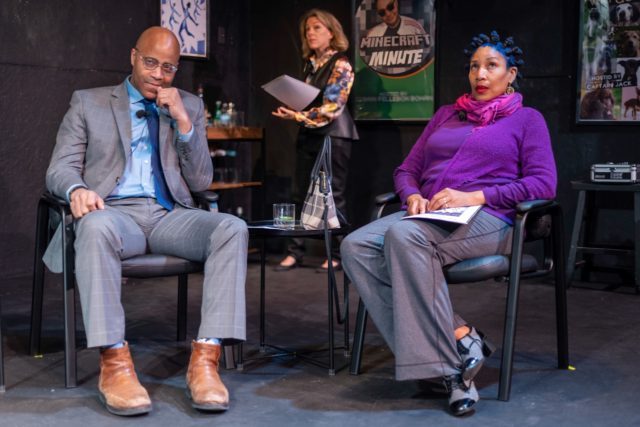
Edward Einhorn’s Alma Baya can be seen in person or online (photo by Arthur Cornelius)

ALMA BAYA
A.R.T./New York, Jeffrey and Paula Gural Theatre
502 West Fifty-Third St. at Tenth Ave.
August 13-28, $25 in person ($15 until August 25 with code UTC61); available on demand through September 19, $25
www.untitledtheater.com

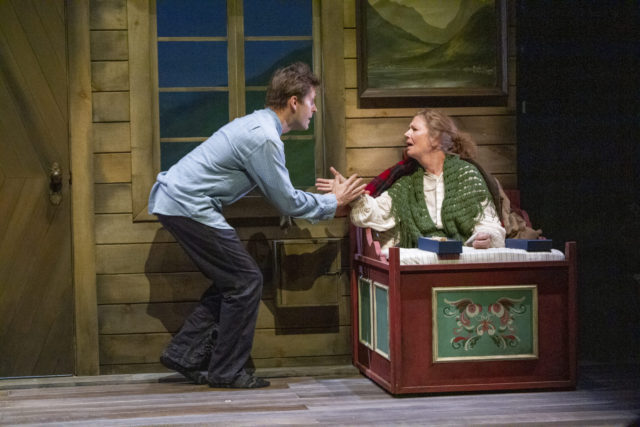
Writer-director Edward Einhorn’s Alma Baya is a claustrophobic, vastly entertaining sci-fi parable for this moment in time, an absurdist look at what comes next. The play can be seen in person through August 28 at A.R.T./New York’s Jeffrey and Paula Gural Theatre, or two recordings can be accessed online; the August 14 and 15 performances, featuring different casts, were livestreamed for on-demand viewing. I saw the show with Ann Marie Yoo as Alma, Sheleah Harris as Baya, and Rivera Reese as a mysterious stranger; the second cast consists of Maggie Cino, Nina Man, and JaneAnne Halter.

In a not-too-distant future in an undefined part of the universe, the stern, ultraserious Alma and the wide-eyed, innocent Baya are living in a self-contained, highly sterile white pod, following instructions word-for-word as laid out in a series of white books. Alma is the alpha woman, in charge, while Baya is her obedient, willing assistant.

Like pushing the button at the underground swan site in the TV series Lost, Alma and Baya must twist and turn various handles and wheels when alarm bells sound, even though they don’t know what any of it means. Their controlled existence becomes threatened when a shadowy figure appears outside the pod and they debate whether to let it in. “It’s terrible. It’s helpless. Waiting. It thinks it’s being rescued,” Baya argues. “Don’t you dare,” Alma shoots back. “It’s either it or us. . . . If it gets in, it will kill us.”

Alma ultimately relents and they open the airlock, inviting in an unnamed naked, feral woman with a protective suit who needs food and water and promises she’s not dangerous. Alma insists she is a threat, but Baya wants to help her. The stranger also says she can help maintain their crops in return for being able to stay with them; Alma and Baya had thought the crops were dead — they have no working suit and haven’t been outside in months — and so are intrigued by the prospect of more sustenance. However, as the stranger tells stories about how her pod was so different from this one and begins questioning the many rules and the very purpose of it all, Alma grows more suspicious of her intentions, calling her a liar who is cleverly plotting against them. “I’m too hungry to be clever,” the stranger says. “That’s too bad. I thought you were too clever to be hungry,” Alma responds.

Two casts alternate in futuristic parable Alma and Baya

All the while, Alma and Baya expect the eventual arrival of the original Alma and Baya, as predicted in the books, evoking the New Testament and the return of Jesus as well as Vladimir and Estragon in Samuel Beckett’s Waiting for Godot. “When?” the stranger asks. “Someday,” Baya answers. Alma explains, “That’s why we’re here. That’s the reason that we’re here. All of us. Even you.” A moment later, the stranger asks, “How do you know whether they’ll come or not?” Alma: “Why else are you here?” The stranger: “I don’t know if there is a reason.” Ultimately, they all might be right, or they all might be wrong.

Staged by Untitled Theater Company No. 61 — which playwright, novelist, filmmaker, and podcaster Einhorn (The Marriage of Alice B. Toklas by Gertrude Stein, The Iron Heel) cofounded with his brother, David, who died of cancer during rehearsals — the seventy-five-minute Alma Baya adeptly tackles such topics as faith and religion, the refugee crisis, Covid-19, and others without ever mentioning them by name. The stranger could represent a manifestation of Jesus or the devil or a political refugee desperate for asylum; she even is a gardener, a profession that employs myriad people from other countries. There is also the much clearer comparison to the pods we all formed during the height of the coronavirus crisis, allowing only our live-in partner/families into our homes, afraid that anyone else could introduce Covid and kill us.

The fun, DIY set is by Mike Mroch, with flashy lighting by Federico Restrepo, effective sound by Mark Bruckner, and costumes by Ramona Ponce. The cast performs its job well, with Reese standing out as the stranger, a juicier role that keeps the audience guessing whether she’s good or bad. It’s an escapist play about how we are all trapped by something, including by ourselves, and that blind trust and faith are not always the best way out.

WALDEN

TheaterWorks Hartford adaptation of Amy Berryman’s Walden is set on edge of woods (photo by Christopher Capozziello)

WALDEN
TheaterWorks Hartford
RiverFront Recapture, 100 Meadow Road, Windsor, $95-$150
Livestream at Dunkin’ Donuts Stadium, Downtown Hartford, $15
Available on demand through August 29, $25
twhartford.org

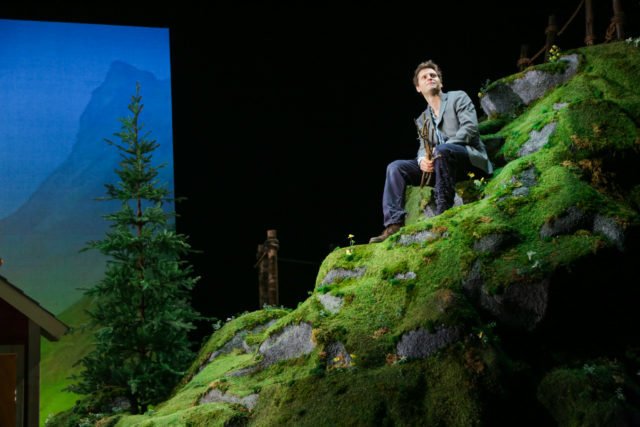
One of the best new plays of the last eighteen months, Amy Berryman’s superb Walden is a cogent and timely exploration of loss, loneliness, and reconnection in an indeterminate near-future. Berryman started writing the play five years ago, concentrating on the devastating effects of climate change, and it debuted onstage at the Harold Pinter Theatre on London’s West End in May. It has now been ingeniously reimagined by TheaterWorks Hartford, taking place in a specially built wood-and-glass cabin on the edge of the woods by the Connecticut River at a location known as Riverfront Recapture in Windsor. The very small house has a sustainable vegetable garden on one side, a hammock on the other, and a cozy outdoor front porch.

There are three unique ways of experiencing the hundred-minute show: You can watch it in person, wearing masks, in socially distanced chairs on the grass, listening on headphones; see it with other people streaming at Dunkin’ Donuts Stadium in downtown Hartford, home of the minor league baseball team the Yard Goats; or check it out online, where it is available on demand. Do choose one, because Walden is an absolute must-see.

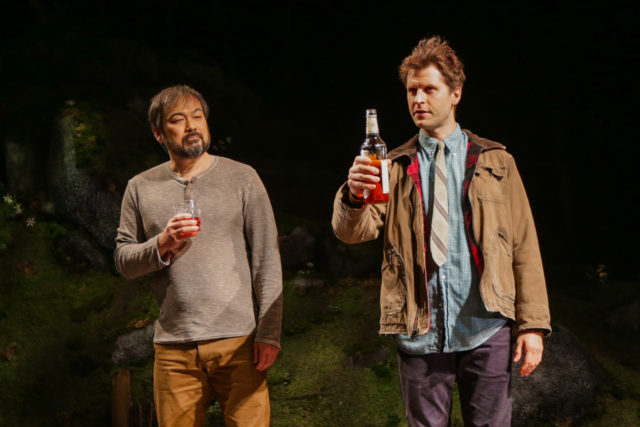
Bryan (Gabriel Brown) and Stella (Diana Oh) are living together in this wilderness; he is a staunch EA (Earth Advocate), a radical movement that believes the government must exhaust all possibilities of saving the planet before considering establishing habitats on the moon or Mars. Stella is a former prominent NASA architect who is adapting to her more private life with Bryan; they have a solar car, a flush toilet, and electricity, and Stella follows the news on a portable device, but Bryan refuses to use any kind of screen, living a Henry David Thoreau–like existence. Recently engaged, they each suffered different kinds of losses a year ago and are still dealing with the effects.

Cassie (Jeena Yi), Bryan (Gabriel Brown), and Stella (Diana Oh) spend time in the garden in Walden (photo by Christopher Capozziello)

After spending the last twelve months on the moon, where she miraculously made something grow out of the ground, Stella’s twin sister, Cassie (Jeena Yi), is coming for a visit. Their fathers were astronauts who also taught them about Walden, often quoting Thoreau. They remember him repeating to them, from the Solitude chapter, “This whole earth which we inhabit is but a point in space. How far apart, think you, are the two most distant inhabitants of yonder star, the breadth of whose distance cannot be measured by our instruments. Why should I feel lonely? Is not our planet in the Milky Way?”

Over the course of an evening, Bryan, Stella, and Cassie drink wine, share secrets, argue over technology, and debate not only the future of the blue marble but their own individual destinies as they contemplate where they belong in the universe. “It’s too late to turn things around!” Cassie declares. She’s right in more ways than one.

TheaterWorks Hartford’s first outdoor production in its thirty-five-year history, Walden is a seductive and charming play, no matter which side of the climate crisis discussion you are on. The isolation the characters feel, whether living in the woods or on the moon, is even more palpable in this time of Covid. When Cassie first arrives, she has a mask on. “You know, you don’t have to wear that,” Bryan says. “I wasn’t sure,” Cassie responds. “Within a hundred miles the air is totally safe. You don’t need a mask,” Bryan assures her. That’s something we would all like to hear.

The future of the planet is hotly debated in powerful new play (photo by Christopher Capozziello)

Walden is beautifully directed by Mei Ann Teo (SKiNFoLK: An American Show, Where We Belong) with a relaxed, easygoing pace that befits its lovely surroundings. I watched it online, where the cameras take you inside the house, into the garden, and onto the grass, where you can see some members of the masked audience sitting in front of you, making you feel part of set designer You-Shin Chen’s stunningly real and inviting environment. Jeanette Oi-Suk-Yew’s lighting evolves organically as darkness falls, while Hao Bai’s sound design immerses you in the action.

Berryman, a playwright, filmmaker, and actor who has written such shows as The New Galileos and The Whole of You and appeared in such works as Jessica Dickey’s The Convent and Greg Kotis’s Lunchtime at the Brick — her coronavirus microplay Pigeons for Eden Theater Company’s “Bathroom Plays” Zoom trilogy earned star LeeAnne Hutchison twi-ny’s Best Actor in a Short Play award during the pandemic lockdown — has given us an extraordinary treat in these difficult times, a splendidly constructed, wholly believable tale about where we are as a species today, and where we might be tomorrow.

Oh ({my lingerie play}, The Infinite Love Party), Yi (Judgment Day, Network), and Brown (Bobbie Clearly, Joe Turner’s Come and Gone) form a terrific trio, their well-drawn characters expressing serious contemporary concerns without becoming preachy or didactic. When it’s over, you’ll feel exhilarated by the return of live theater — and sincerely worried for the future of humanity.

ON BROADWAY

Sir Ian McKellen waxes poetic about Broadway in Oren Jacoby’s documentary

ON BROADWAY (Oren Jacoby, 2019)
Quad Cinema
34 West 13th St. between Fifth & Sixth Aves.
Opens Friday, August 20
quadcinema.com

As Broadway prepares to reopen in a big way in September following a year and a half of a pandemic lockdown that shuttered all forty-one theaters, Oren Jacoby’s documentary arrives like a love letter to the recent past, present, and future of the Great White Way (so named for its lights and illuminated marquees). “Without the theater, New York somehow would not be itself,” Sir Ian McKellen says near the beginning of On Broadway, which opens August 20 at the Quad and will have a special rooftop screening September 1 outside at the Marlene Meyerson JCC. “Live theater can change your life,” he adds near the end. Both lines appear to apply to how the city is coming back to life even as the Covid-19 Delta variant keeps spreading, but the film is nearly two years old, having made its New York City debut in November 2019 at DOC NYC.

On Broadway is a bit all over the place as it traces the history of Broadway from the near-bankrupt doldrums of 1969-72 to its rebirth in the 1980s and 1990s as a commercial force while also following Richard Bean’s UK import The Nap as it prepares to open September 27 at MTC’s Samuel J. Friedlander Theatre. I was a big fan of The Nap, calling it “a jolly good time . . . a tense and very funny crime thriller” in my review. Jacoby speaks with Bean, director Daniel Sullivan, and star Alexandra Billings, the transgender actor playing transgender character Waxy Bush. The behind-the-scenes look at the play, which was taking a big risk, lacking any big names and set in the world of professional snooker, is the best part of the film and it deserved more time instead of focusing on how such innovators as Stephen Sondheim, Bob Fosse, Andrew Lloyd Webber, Mike Nichols, and Michael Bennett helped turn around Broadway’s misfortunes with such popular shows as Pippin, Chicago, A Chorus Line, Annie, Evita, Cats, Amadeus, and Nicholas Nickleby, ultimately leading to Rent, Angels in America, and Hamilton. But Broadway still found room for August Wilson’s ten-play Pittsburgh Cycle.

The film explores how spectacle, celebrity, and extravaganza began ruling the day, at the expense of new American plays. “This could be a business,” Disney head Michael Eisner remembers thinking; his company bought a theater and produced such hits as Beauty and the Beast and The Lion King, which attracted families paying exorbitant ticket prices and going home with plenty of merch. Jacoby speaks with Sidney Baumgarten and Rebecca Robertson, who were involved in transforming Times Square from a haven for addicts, hookers, and porn shops to a place where parents could bring their kids to see a show. “We’re like Las Vegas now,” Tony-winning director Jack O’Brien laments.

Among the many other theater people sharing their love of Broadway — as well as their concerns — are John Lithgow, George C. Wolfe, Alec Baldwin, Helen Mirren, Tommy Tune, Hal Prince, Cameron Mackintosh, James Corden, Nicholas Hytner, David Henry Hwang, Oskar Eustis, and Hugh Jackman. “In the theater, you have to be present. You have to be present as an artist, and you have to be present as an audience member, for the experience to really happen,” Emmy, Tony, and Obie winner Christine Baranski says, evoking what it feels like as we wait for Broadway to reopen this fall. “And when you see a great performance, it is a spiritual experience.”

Jacoby, whose previous works include Shadowman, Master Thief: Art of the Heist, and My Italian Secret: The Forgotten Heroes, will be at the Quad for Q&As at the 7:00 screenings on August 20 and 21. But it’s Sardi’s maître d’ Gianni Felidi who gets to the heart of it all. “This is what Broadway’s about,” he says. “Great theater is a mirror to the human condition, to us, to people, and how we’re really all the same despite our differences, our perceived differences; be it if we’re from a different race, a different gender, a different sexual orientation, we’re really all the same. And that’s what theater shows us.”

SHAKESPEARE IN THE PARK: MERRY WIVES

An exuberant cast welcomes Shakespeare in the Park back to the Delacorte in Merry Wives (photo by Joan Marcus)

MERRY WIVES
Central Park, Delacorte Theater
Monday – Saturday through September 18, free, 8:00
shakespeareinthepark.org

Shakespeare in the Park returns to the Delacorte after a canceled 2020 Covid summer season with the Public Theater’s exuberant but overbaked Merry Wives, continuing through September 18. Adapted by actress and playwright Jocelyn Bioh, who has appeared in such shows as An Octoroon and The Red Letter Plays: In the Blood and written such works as School Girls; or, the African Mean Girls Play and Nollywood Dreams, the play is thoroughly updated but often feels like a mash-up of such sitcoms as What’s Happening!! and The Jeffersons with such reality programs as The Bachelorette and Real Housewives.

The evening begins with Farai Malianga in a Brooklyn Nets Kyrie Irving jersey pounding on his djembe and eliciting an engaging call-and-response with the audience. It’s a wonderful start, reminiscent of how the late Baba Chuck Davis would kick off BAM’s annual DanceAfrica series. The seating is less thrilling but important, divided into sections full of vaccinated people who may choose not to mask — most don’t — and two emptier sections of unvaccinated people who must be masked and socially distanced.

Merry Wives is set in modern-day South Harlem, with a cast of characters from Ghana, Liberia, Nigeria, and Senegal, portrayed exclusively by actors of color. In 2019, Kenny Leon directed a fabulous all-Black version of Much Ado About Nothing, but lightning doesn’t strike twice.

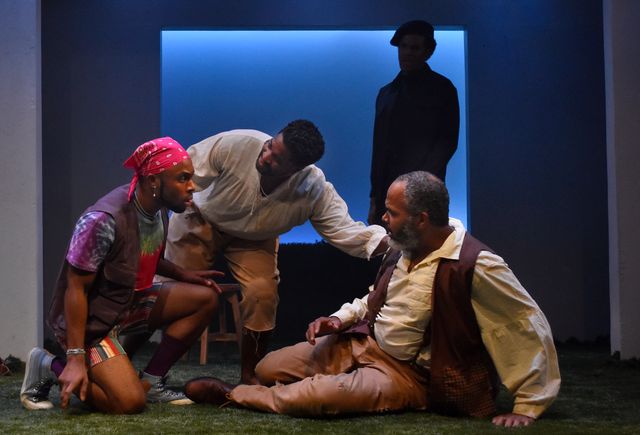
Madams Ford (Susan Kelechi Watson) and Page (Pascale Armand) join forces in contemporary update of Merry Wives (photo by Joan Marcus)

There’s a reason why The Merry Wives of Windsor is so rarely presented; it’s only been performed at the Delacorte twice before, in 1974 (with George Hearn, Marilyn Sokol, Barnard Hughes, Cynthia Harris, Michael Tucker, and Danny DeVito) and 1994 (with Margaret Whitton, David Alan Grier, Andrea Martin, Brian Murray, and Tonya Pinkins). It’s not one of the Bard’s better plays, a Medieval farce that tears down one of his most beloved creations, Sir John Falstaff, far too mean-spiritedly. And too many of the devices and subplots — mistaken identity, the exchange of letters, secret romance — feel like hastily written retreads here.

Falstaff (Jacob Ming-Trent) is a Biggie Smalls–loving wannabe playa out to conquer laundromat owner Madam Nkechi Ford (Susan Kelechi Watson) and socialite Madam Ekua Page (Pascale Armand), making cuckolds of their husbands, the distinguished Mister Nduka Ford (Gbenga Akinnagbe) and the generous Mister Kwame Page (Kyle Scatliffe).

“Nah man, I’m serious,” the sweats-wearing Falstaff tells Pistol (Joshua Echebiri), one of his minions. Madam Page “did so course over my exteriors with such a greedy intention that the appetite of her eye did seem to scorch me up like a burning-glass. She bears the purse too; she is from a region in Ghana, all gold and bounty. I will be cheaters to them both, and they shall be sugar mamas to me; we’re gonna have the Ghanaian and the Nigerian jollof rice! Go bear this letter to Madam Page — and this one to Madam Ford. And then, my friend, I will thrive! . . . I mean . . . We will thrive.”

Misters Kwame Page (Kyle Scatliffe) and Nduka Ford (Gbenga Akinnagbe) try to avoid being cuckolded in Bard farce in Central Park (photo by Joan Marcus)

At the same time, the Pages’ daughter, Anne (Abena), is considered the most eligible bachelorette in Harlem and is being wooed by the well-established Doctor Caius (David Ryan Smith), the shy, nervous Slender (Echebiri), and Anne’s true love, Fenton (MaYaa Boateng), whom no one approves of. Manipulating various elements are the caring Pastor Evans (Phillip James Brannon) and the busybody Mama Quickly (Angela Grovey). Madams Ford and Page get wind of Falstaff’s deceit and team up to confound him, while a jealous Mister Ford disguises himself as a Rastaman named Brook to try to uncover Falstaff’s plan to bed his wife. “Please, off with him!” Sir John tells Brook about Ford. “I will stare him out of his wits, I will awe him with my club; I shall hang like Lebron James over the cuckold’s horns.” It all concludes with a series of matches that are as playful as they are convenient and contemporary.

Beowulf Boritt’s set is fabulous, consisting of the facades of a health clinic, a laundromat, and a hair braiding salon, which open up to reveal various interiors. Dede Ayite’s gorgeous costumes honor traditional African designs with bold colors and patterns. But director Saheem Ali (Fireflies, Fires in the Mirror), the Public’s associate artistic director who helmed audio productions of Romeo y Julieta, Richard II, and Anne Washburn’s Shipwreck: A History Play About 2017 during the pandemic lockdown, can’t get a grip on the story, instead getting lost in silly, repetitive slapstick that overwhelms the narrative. The laughs come inconsistently, settling for trivial humor over sustained comedy. This Merry Wives is a crowd pleaser the way familiar but routine sitcoms and reality shows are; light and frothy, none too demanding, but once they’re done, you’re on to the next program.

HANDS UP: 7 PLAYWRIGHTS, 7 TESTAMENTS

Who: The National Black Theatre (NBT)
What: American radio play premiere
Where: NBT Vimeo
When: August 16-23, $10 for forty-eight-hour on-demand viewing
Why: In 2015, the New Black Fest premiered the specially commissioned presentation Hands Up: 7 Playwrights, 7 Testaments, a collection of seven monologues, between ten and fifteen minutes each, in response to the police killing of Michael Brown in Ferguson, Missouri, as well as other such murders. From August 16 to 23, the National Black Theatre (NBT) will be streaming the US radio play debut of Hands Up, featuring Kamal Bolden, Nuri Hazzard, Isaiah Johnson, Crystal Lucas-Perry, Eden Marryshow, Warner J. Miller, and J. D. Mollison, helmed by NBT executive artistic director Jonathan McCrory, with sound and music by Kathy Ruvuna and illustrations by Jaimee Todd.

The seven autobiographical monologues, which explore the Black experience in America, consist of Superiority Fantasy by Nathan James, Holes in My Identity by Nathan Yungerberg, They Shootin! Or I Ain’t Neva Scared by Idris Goodwin, Dead of Night . . . The Execution of . . . by Nambi E. Kelley, Abortion by NSangou Njikam, Walking Next to Michael Brown by Eric Micha Holmes, and How I Feel by Dennis A. Allen II. “There is a need for a reform!” McCrory declared in a statement. “There is a new government-sanctioned genocide happening to Black folxs by the police. And unless we change how they serve and protect, we will continue to have these testimonies housed in Hands Up resonate as present pulse narratives that articulate the terror that is running rampant within our communities.” Access to a forty-eight-hour on-demand stream is $10.

I AM YOUR MASSEUSE (six short digressions)

Who: The Bridge Production Group
What: I Am Your Masseuse (six short digressions) by John Patrick Shanley
Where: Brooklyn Navy Yard
When: August 18 and 22, $15, 8:00
Why: As we emerge from the pandemic lockdown, theater companies are finding unique locations to stage works in front of a live audience. The nonprofit Bridge Production Group, which is “committed to dismantling and rebuilding an audience’s expectations of theatrical storytelling, [seeking] to disrupt traditional conventions and assumptions about how stories are told,” has turned to the historic Brooklyn Navy Yard, where it is currently in residency. On August 18 and 22 at 8:00, the company will premiere I Am Your Masseuse (six short digressions) by Pulitzer Prize and Oscar winner John Patrick Shanley, a New York City native whose previous works include Doubt, Moonstruck, and Wild Mountain Thyme. The new show, directed by Claire Edmonds (Red Light Winter, Where the Lovelight Gleams), features Marcus Naylor, Crawford M. Collins, Carlo Alban, and Christina Toth. Tickets are only $15, with all proceeds going to the Actors Fund. Performed for two nights only, the plays are “designed to aid the digestion and further erode our attention span.” The Bridge Production Group is also presenting Jeff Bowen and Hunter Bell’s musical [title of show] with Keri Rene Fuller, Josh Daniel, Jennifer Apple, and Max Hunter at the Navy Yard August 13-21.

NOT A MOMENT, BUT A MOVEMENT: THE DUAT

Gregg Daniel plays a man facing judgment day in world premiere of The Duat

THE DUAT
Center Theatre Group
Available on demand through August 12, $10
www.centertheatregroup.org

Gregg Daniel is electric as a man caught between heaven and hell, defending the choices he made in his life, in the world premiere of Roger Q. Mason’s one-man show, The Duat, streaming from Center Theatre Group through August 12. Daniel plays Cornelius “Neil” Johnson, a Black man who, when we first see him, is blindfolded and barefoot. “If I’m in hell, I want to know. I want to see the fire before it takes me down,” he calls out, dancing as if the floor is burning hot. He’s actually in the Duat, the Egyptian underworld where the god Anubis weighs the hearts of the dead to determine where they will spend the afterlife.

Over the course of forty-five minutes, Johnson shares his story, starting with his birth in Texas in 1948 and the tragic death of his father, a railroad porter, four years later. Johnson visits his grandmama, attends a liberal integrated elementary school, excels at UCLA, and becomes a driver for a wealthy white woman. Daniel seamlessly switches between characters, from his angry mother to his brash father to his sensible, soft-spoken grandmother, performing brief, urgent interpretive dance movements at the end of each scene (choreographed by Michael Tomlin III). He is haunted by his father’s fate, dying “a colored death,” and is determined to have his own, unique identity. “I am somebody,” he says in different ways throughout the play, as if Johnson is trying to convince himself that he matters, that he will be seen. But trouble brews when he recounts his time with the US organization, a rival to the Black Panthers, as Johnson does something that he regrets.

Presented in association with the Fire This Time Festival and Watts Village Theater Company, The Duat is part of the third episode of the “Not a Moment, But a Movement” series; the first episode was introduced by Vanessa Williams and featured Angelica Chéri’s one-person play Crowndation; I Will Not Lie to David, while the second episode explored “Black Nourishment” with spoken word artists. The Duat is preceded by a conversation with Watts co-artistic director Bruce A. Lemon Jr. and LA-based visual artist Floyd Strickland and is introduced by Wayne Brady.

The Duat unfolds in the tradition of such solo-show geniuses as Anna Deavere Smith, Dael Orlandersmith, and Charlayne Woodard, as Daniel (Insecure, Urban Nightmares) portrays multiple characters detailing the Black experience in America. He doesn’t change costumes but alters his tone of voice as the narrative sometimes repeats itself from different points of view. Director Taibi Magar (Is God Is, Blue Ridge) zooms in for closeups of Daniel’s face and feet, then pulls back to reveal percussionist David Leach playing several instruments in the background, the spotlight behind him casting him in silhouette. (The effective lighting is by Brandon Baruch, with sound design and original music by David Gonzalez.) Mason (The White Dress, Onion Creek) pulls no punches as Johnson looks back at his life, warts and all, trying to understand who he is and what awaits him.