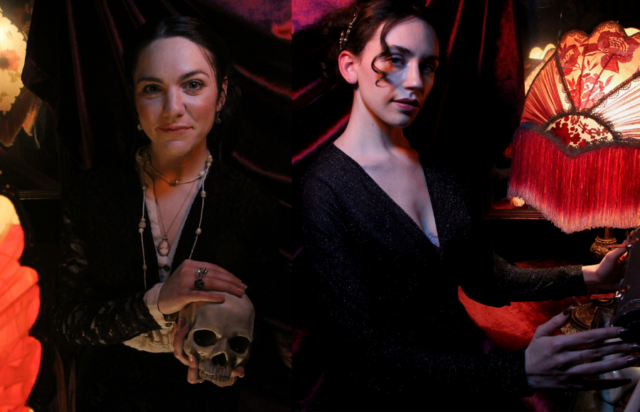
Works by Vivian J. O. Barnes, Danny Tejera, and Susan Xu are part of Second Stage’s Judith Champion New Voices Reading Series
Who:Second Stage Theater What:Staged readings of new plays Where: Tony Kiser Theater, 305 West 43rd St. between Eighth & Ninth Aves. When: January 18, 24, 31, free with RSVP, 6:30 Why: Second Stage Theater’s 2022 Judith Champion New Voices Reading Series is set to take place January 18, 24, and 31, featuring professionally produced staged readings of three works by emerging artists. “We’re thrilled to be presenting the second year of our New Voices series — and to do so in person at the Tony Kiser Theater,” Second Stage president and artistic director Carole Rothman said in a statement. “Supporting early career writers is central to Second Stage’s mission, and I can’t wait for the Second Stage audience to be the first to experience these great plays by Danny, Vivian and Susan.”
First up is Danny Tejera’s Toros on January 18, about three twentysomethings and a dog hanging out in a garage in Madrid, directed by David Mendizábal, followed on January 24 by Vivian J. O. Barnes’s The Sensational Sea Mink-ettes, about a dance team preparing for homecoming, directed by Cristina Angeles, and concluding on January 31 with Susan Xu’s Yellow Dream$, a dark comedy about diversity, directed by May Adrales. “Support what is most important to you,” series underwriter Judith Champion added in a statement, “and one thing that is important to me is to nurture new playwriting talent so that theater flourishes for future generations.”
spit&vigor’s Ectoplasm opens January 13 at the Players Theatre (photo by Nick Thomas)
ECTOPLASM The Players Theatre
115 MacDougal St. between West Third & Bleecker Sts.
Wednesday – Sunday, January 13 – February 6, $52-$99 www.spitnvigor.com
Sara Fellini is proud of being old school, but that doesn’t mean she’s old-fashioned. The actress, playwright, director, and amateur historian started the New York City–based spit&vigor theater company in 2015 with executive producer Adam Belvo, “dedicated to makeshift, skin-of-your-teeth, ad hoc theater — bringing modern voices and perspectives to the wild, chaotic, irreverent, burlesque roots of theater.”
The company has performed such works as Casey Wimpee’s The Brutes, about the three Booth brothers staging Shakespeare’s Julius Caesar, at the Players Club, which was founded by Edwin Booth; Fellini’s NEC SPE / NEC METU, in which Fellini portrayed seventeenth-century painter Artemisia Gentileschi and Belvo played Caravaggio, at the Center at West Park; Fellini’s The Wake of Dorcas Kelly, a period piece about the death of a real-life Dublin madam in 1762 and the riot that followed; and Thomas Kee’s Mary’s Little Monster, about Lord Byron, Percy Bysshe Shelley, and Mary Shelley. During the pandemic, they created the site-specific Luna Eclipse, which was livestreamed using one camera from the Center at West Park.
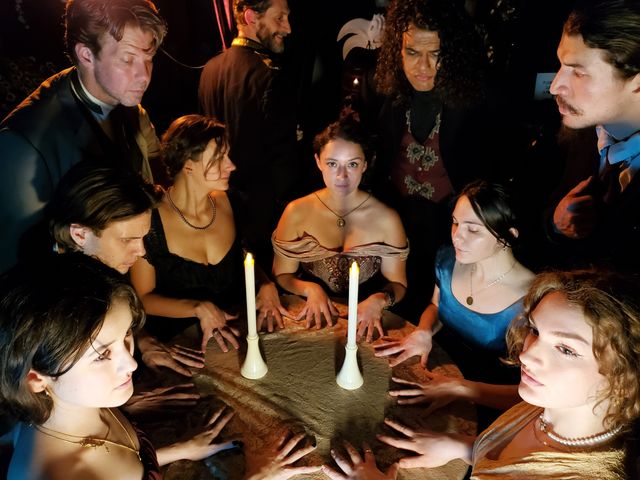
Next up for spit&vigor is Ectoplasm, running January 13 through February 6 at the Players. (The opening was delayed more than a week because of Covid.) Written and directed by Fellini, the phantasmagoric show is set in 1912 around a séance involving a famous magician, a spiritual medium, a madame, and an uninvited guest. The title refers to the eerie white substance, supposedly spiritual energy, that would emerge from the mouths of psychics as they contacted the deceased.
Below Fellini discusses her fascination with history, creating theater during the coronavirus crisis, taking risks, and more.
twi-ny: What was your initial reaction to the March 2020 pandemic lockdown?
sara fellini: Initially, I just absolutely could not fathom it. I just didn’t believe we’d go into lockdown. My reference point at that time was SARS, so I thought the panic would die down and we would continue on as we were. spit&vigor had two productions coming up at that time — as a small company, we can’t always control where or when we produce because we have to go where residencies are offered, so through no lack of desire on our part we hadn’t actually produced anything for a while and we had spent the better part of the year prepping for the productions at the New Ohio, and then our off-Broadway debut in March and May of 2020, respectively.
I could not imagine a world in which shows would be canceled. Before Covid, I’d never even heard of a rehearsal being canceled, and now two shows of ours were dropped in a matter of months. My entire worldview was changed.
twi-ny: The company is very much about site-specific, immersive productions. What were you working on at the time that couldn’t proceed?
sf: At the New Ohio, we were working on an “embedded” version of The Wake of Dorcas Kelly. We use the term embedded to mean that the audience is kind of sitting inside the brothel, like flies on the wall, watching the production. The actors don’t see or interact with the audience, but they’re very up-close and personal. So we were going to re-create the brothel inside of the New Ohio.
Then, at the Players Theatre, which is a proscenium, we were expanding our vision to create a diorama-esque version of another “embedded” play we’ve produced several times in the past, Mary’s Little Monster by Thomas Kee. We’ve produced that play before at the Mudlark Public Theatre, a one-room puppet theater in New Orleans owned by the genius Pandora Gastelum, and at Torn Page, the historic home of Rip Torn and Geraldine Page.
The Players is a great space to do very intimate-feeling shows even though it’s a larger theater, because it’s very long, and you kind of get sucked into the stage. The stage becomes your entire vision when you sit facing forward. So we were planning on doing a very intimate production of a very intimate and sultry play, with a lot of sex, drugs, and rock-and-roll . . . which now with Covid restrictions is an absolute NO for a while. Even if we staged it quite safely, I don’t think audiences are ready to see that kind of closeness onstage for a while.
twi-ny: Was Luna Eclipse already in process as an in-person show?
sf: No, I wrote Luna Eclipse as a response to the pandemic. I’ve always wanted to write a walk-through play (in person), and the pandemic gave me an opportunity to stretch that muscle. Luna Eclipse was a series of monologues exploring inherited mental illness (and the different historic perceptions of mental illness — are you a mystic visionary, or a failure to society?) through one family’s history, going all the way back to Roman times.
So I wrote the monologues, and we staged it at the Center at West Park as part of their incredible residency program. We did a lot of work to film the production, and livestream it, as a walk-through experience — like you were walking through the tunnel of time and encountering the different experiences of all of these ghosts. We essentially created a one-shot film in the vein of Russian Ark and 1917, except we did it live, as theater artists are wont to do.
Ectoplasm centers around a séance involving a famous magician (photo by Claire Daly)
twi-ny: Did you watch a lot of online theater during the lockdown?
sf: Um, no. I didn’t watch a lot of online theater. I hate to admit that, but I really dislike online theater. It’s so safe. And it completely misses the mark of what theater is supposed to be. I understand the impulse people have to stay safe physically, but online theater seems safe emotionally and I can’t really abide that. But you’re also talking to a person who doesn’t really like movies, either, so I’m already biased. We did Luna Eclipse, and we also did some live Zoom readings of classic TV shows for fun, but I am glad to be back in a theater and I wouldn’t ever really do online theater again in a serious way.
twi-ny: There have been a slew of recent works about Mary Wollstonecraft Shelley and Frankenstein, including s&v’s Mary’s Little Monster. What do you think it is about her that has stimulated such interest in the past few years?
sf: In my historical research, I’ve noticed there are cycles of time where people suddenly become interested in women creators. The story of a young woman in competition with titans of literature Lord Byron and Percy Bysshe Shelley is irresistible, especially when you factor in their libertine sexual practices.
I think Mary Shelley herself interests people today for a few reasons: because she was the daughter of the legendary feminist Mary Wollstonecraft, which shows a writing dynasty we rarely see through the mother’s line. She seems to have been sexually liberated in a way that we think we understand today, and she seems uniquely forgotten because her (male) creation is so ubiquitous while her name is not as well known. I think that’s a little bit of a false impression because fewer people could tell you that John Polidori rewrote the vampyre legend for popular Western culture, and, off the top of my head, I have no idea who created the mummy legend.
[Ed. note: Jane Louden’s novel The Mummy! A Tale of the Twenty-Second Century was published in 1827, while Bram Stoker’s The Jewel of Seven Stars, about an archaeologist trying to revive a mummy, came out in 1903, six years after Dracula.]
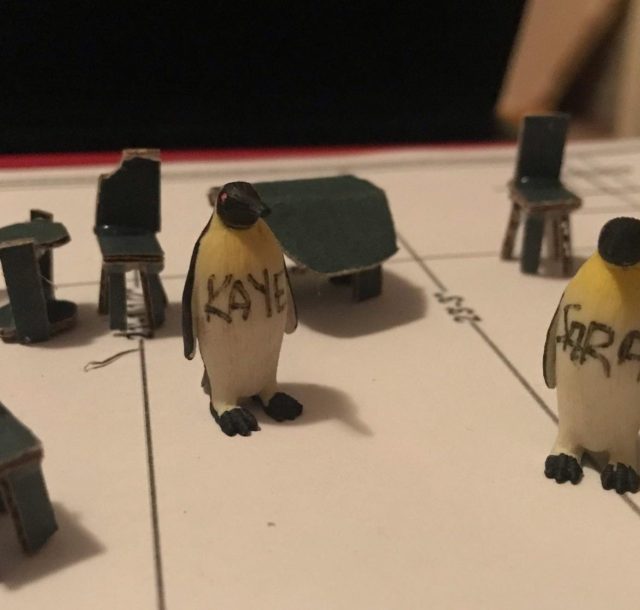
Writer-director Sara Fellini used models during rehearsals for Ectoplasm (photo courtesy spit&vigor theatre company)
twi-ny: You returned to in-person shows first with Dorcas Kelly, then Hit Your Mark / Die Beautiful. What was that transition like?
sf: It was incredible to be back in a theater, with people. I wouldn’t ever go back. The first few rehearsals were very emotional.
twi-ny: How has the omicron variant, which is spreading throughout New York City (I now have it too), impacted the rehearsal process for Ectoplasm?
sf: I’m so sorry to hear that, I hope you recover quickly!
We have had to be extremely creative with rehearsals. Around the holidays, we moved rehearsals to Zoom to restrict exposure, which was torture. I created a replica set out of cardboard and used little rubber penguins as actors to go over staging, which was a nightmare. But I’m glad we did it because two of our cast members actually contracted omicron and had to continue to Zoom into rehearsals as they quarantined, even while the rest of us met in person.
Beyond that, we are testing frequently, hiring swings, which we’ve never really done before, and just doing our best and working hard, both to create a beautiful production and to keep everyone safe.
twi-ny: You also have a bent for historical re-creations, with plays involving such real-life figures as Shelley, the Booth family, Caravaggio and Gentileschi, Kelly, and now Houdini. Were you always into history?
sf: Yes, I’ve always been into history. I have trouble relating to the modern world. Ever since we started spending most of our time online, people have become irritable and impatient, turning the slightest friction or conflict into all-out war, zero to sixty, and it is so frustrating to me.
So, while a lot of the ideas and prejudices of the past are nonsense and based in ignorance and inexperience, I do think there’s a lot to be learned from people who spent all of their time noticing, negotiating, and navigating other human beings. We need that human interaction as much as we need food or water — and it’s becoming harder and harder to find it, because even when you’re in the same room as someone, after the Covid pandemic (and the pandemic of computers), people turn their faces away or fidget and squirm when they’re in the presence of other humans, myself included.
I want to rediscover our shared humanity, and I think one way to do so is turning back the clocks and finding the root source. If we combine the social aspect of the past with modern perspectives on gender, race, sexual orientation, we could have an incredibly rad world to live in.
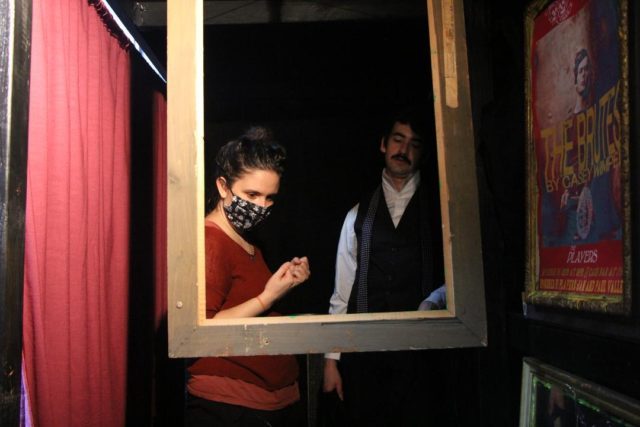
Sara Fellini checks out part of the set for new work at Players Theatre (photo courtesy spit&vigor theatre company)
twi-ny: What other historical figures might play a part in future s&v productions?
sf: I’m developing a play at the moment about the women pirates Anne Bonny and Mary Read, which is turning into a real romp.
twi-ny: You are a writer, director, costume designer, and actor. How do you juggle the four disciplines? When you are writing something, do you know immediately whether you will direct and/or star in it?
sf: I write plays for our company, so I generally have a good idea of who I want to be in it, what I want them to be wearing (from our costume stock), and how I would like the play to look. I think more writers should write like this, in a practical way — it’s very Shakespearean, or old Victorian theater.
A lot of theater productions seem a lot like film sets, with bloated production personnel and everybody in niche roles. We prefer to have an intimate team working together to create something personal. It’s riskier, because it means you take on a lot of the responsibility when something goes wrong and you can’t hide in your niche, but I think art is supposed to be risky, and I hope we don’t lose that mentality after all this time.
Who: Works by and/or featuring Moko Fukuyama, Joshua William Gelb, Gabrielle Hamilton, Jace, Elmore James, Jamal Josef, Katie Rose McLaughlin, Sara Mearns, Zaire Michel, Zalman Mlotek, Alicia Hall Moran, Patrick Page, Barbara Pollack, Seth David Radwell, Jamar Roberts, Tracy Sallows, Xavier F. Salomon, Janae Snyder-Stewart, Mfoniso Udofia, Anne Verhallen What:This Week in New York twentieth anniversary celebration Where:This Week in New York YouTube When: Original air date: Saturday, May 22, free with RSVP, 7:00 (now available on demand) Why: In April 2001, I found myself suddenly jobless when a relatively new Silicon Alley company that had made big promises took an unexpected hit. I took my meager two weeks’ severance pay and spent fourteen days wandering through New York City, going to museums, film festivals, parks, and tourist attractions. I compiled my experiences into an email I sent to about fifty friends, rating each of the things I had done. My sister’s husband enthusiastically demanded that I keep doing this, and This Week in New York was born.
Affectionately known as twi-ny (twhy-nee), it became a website in 2005 and soon was being read by tens of thousands of people around the globe. I covered a vast array of events – some fifteen thousand over the years – that required people to leave their homes and apartments and take advantage of everything the greatest city in the world had to offer. From the very start, I ventured into nooks and crannies to find the real New York, not just frequenting well-known venues but seeking out the weird and wild, the unusual and the strange.
For my tenth anniversary, we packed Fontana’s, a now-defunct club on the Lower East Side, and had live music, book readings, and a comics presentation. I had been considering something bigger for twenty when the pandemic lockdown hit and lasted longer than we all thought possible.
At first, I didn’t know what twi-ny’s future would be, with nowhere for anyone to go. But the arts community reacted quickly, as incredible dance, music, art, theater, opera, film, and hybrid offerings began appearing on numerous platforms; the innovation and ingenuity blew me away. The winners of twi-ny’s Pandemic Awards give you a good idea of the wide range of things I covered; you can check out part one here and part two here. (Part III is now up as well.)
I devoured everything I could, from experimental dance-theater in a closet and interactive shows over the phone and through the mail to all-star Zoom reunion readings and an immersive, multisensory play that arrived at my door in a box. Many of them dealt with the fear, isolation, and loneliness that have been so pervasive during the Covid-19 crisis while also celebrating hope, beauty, and resilience. I’ve watched, reviewed, and previewed more than a thousand events created since March 2020, viewing them from the same computer where I work at my full-time job in children’s publishing.
Just as companies are deciding the future hybrid nature of employment, the arts community is wrestling with in-person and online presentations. As the lockdown ends and performance venues open their doors, some online productions will go away, but others are likely to continue, benefiting from a reach that now goes beyond their local area and stretches across the continents.
On May 22 at 7:00, “twi-ny at twenty,” produced and edited by Michael D. Drucker of Delusions International and coproduced by Ellen Scordato, twi-ny’s business manager and muse, honors some of the best events of the past fourteen months, including dance, theater, opera, art, music, and literature, all of which can be enjoyed for free from the friendly confines of your couch. There is no registration fee, and the party will be available online for several weeks. You can find more information here.
Please let me know what you think in the live chat, which I will be hosting throughout the premiere, and be sure to say hello to other twi-ny fans and share your own favorite virtual shows.
Thanks for coming along on this unpredictable twenty-year adventure; I can’t wait to see you all online and, soon, in real life. Here’s to the next twenty!
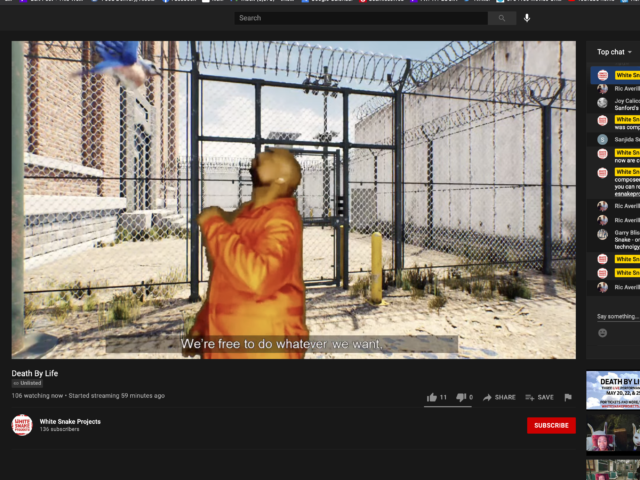
White Snake Projects’ Death by Life: A Digital Opera in One Act redefined what live online opera could be
On July 4, 2020, I published Part I of the twi-ny Pandemic Awards, hoping that it would be the first of hopefully only two such postings celebrating the amazing innovation and creativity in dance, film, theater, food, opera, art, literature, music, and other forms of entertainment made online since March 2020.
As the pandemic lockdown proceeded, I followed that up with Part II on January 1, 2021. And now, a year later, comes the third — and final — edition of twi-ny’s Pandemic Awards, honoring the best, and most unusual, online presentations of 2021. To see some of the video highlights from March 2020 through last May, check out the “twi-ny at twenty” anniversary gala here.
Even as the omicron variant tears through New York City and the world, entertainment venues are back open, and more people are visiting museums, theaters, sports venues, and other forms of indoor and outdoor entertainment. Meanwhile, there is still much happening exclusively online. This Week in New York will continue to track virtual and hybrid productions of all kinds from across the globe, in addition to live performances happening in the five boroughs, so keep following this space for the best, and the worst, in live and recorded in-person and virtual events.
Happy 2022 to all — may you and your friends, family, and loved ones stay safe and healthy!
BEST FUTURISTIC PLAY
Edward Einhorn’s Alma Baya, Untitled Theater Company No. 61, A.R.T./New York. Edward Einhorn delves into isolation and living in pods in this in-person/online show about what might happen next.
BEST IMMERSIVE HISTORICAL DRAMA
Arlekin Players Theatre, Witness. Igor Golyak uses Arlekin’s Zero Gravity Lab to place viewers aboard the MS St. Louis in this interactive exploration of antisemitism.
BEST SHORT PLAY SERIES BY ONE PLAYWRIGHT
Steppenwolf Now, “Three Short Plays by Tracy Letts”:Night Safari, The Old Country, The Stretch. Steppenwolf did exemplary online work during the pandemic lockdown, including this triple crown of short one-acts by Tracy Letts, featuring Rainn Wilson, Letts, and William Petersen and Mike Nussbaum voicing puppets in a diner.
BEST GIFT ACCOMPANYING AN ONLINE PLAY
Third Rail Projects, Return the Moon. Immersive site-specific theater experts Third Rail Projects sent viewers a package including an exquisite little cut-paper diorama in conjunction with its interactive virtual show.
BEST FILMED OUTDOOR PLAY
Amy Berryman’s Walden, TheaterWorks Hartford. Twin sisters and an Earth Advocate argue over the future of the planet in Amy Berryman’s superb play about loss, loneliness, and reconnection, filmed in front of a socially distanced live audience in the woods by the Connecticut River.
BEST ZOOM PLAY TAKING PLACE ON ZOOM
Jake Shore’s Adjust the Procedure, Spin Cycle and JCS Theater Company. Zoom fatigue had not quite settled in yet when Jake Shore’s play about a university facing a crisis over the course of several Zoom meetings was released.
BEST USE OF LIVE CHAT IN A PLAY
Arlekin Players Theatre, chekhovOS /an experimental game/. The audience gets to vote on which Chekhov play Arlekin will perform, then argue in the chat about anything they want, including the quality of the production itself, with administrators encouraging all responses.
BEST ACTOR
Jason Alexander, Rob Ulin’s Judgment Day, Barrington Stage Company; Wendy Wasserstein’s The Sisters Rosensweig, Spotlight on Plays. Jason Alexander was a riot in two virtual readings, as a greedy lawyer whose life is changed by a near-death experience in Judgment Day, which had an encore streaming in July, and as Mervyn Kant in Sisters, playing to his home camera with effusive glee.
Kathleen Chalfant elegantly performs Joan Didion’s The Year of Magical Thinking for Keen Company benefit
BEST ACTRESS
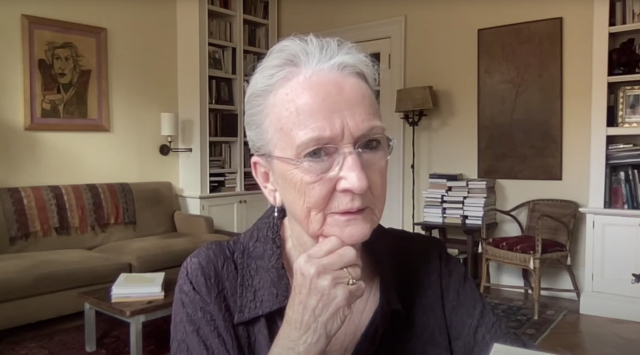
Kathleen Chalfant, Joan Didion’s The Year of Magical Thinking, Keen Company; Karen Malpede’s Blue Valiant, Theatre Three Collaborative. Theater treasure Kathleen Chalfant read directly from the published book of Joan Didion’s poignant memoir with an exquisite elegance, performed from her home, lending it a mesmerizing intimacy. She went outside for Blue Valiant, a play about a horse and a mother’s relationship with her daughter that was written by Karen Malpede specifically for Chalfant, who was lovely acting alongside George Bartenieff as pianist Arthur Rosen gave life to the horse in an unusual way.
BEST ACTRESS IN A FILMED PLAY ON A STAGE
Charlayne Woodard, The Garden, Baltimore Center Stage. Charlayne Woodard, who presented a stellar online version of her one-woman show Neat for MTC, returned to the stage for her two-character play The Garden, in which she and Caroline Stefanie Clay starred as a daughter and a mother trying to reconnect after a series of tragic events.
BEST SUPPORTING ACTRESS IN A VIRTUAL PLAY
Elizabeth Heflin, Michael Gotch’s Tiny House, Westport Country Playhouse. Elizabeth Heflin was wonderful as a cynical mother visiting her daughter and her environmental-nut husband in the mountains on the Fourth of July, as fireworks fly.
BEST PLAYWRIGHT FINALLY GETTING HER DUE
Adrienne Kennedy, “The Work of Adrienne Kennedy: Inspiration & Influence,” Round House Theatre / McCarter Theatre Center. If you didn’t know much about hugely influential playwright Adrienne Kennedy, Round House Theatre and McCarter Theatre Center changed that with excellent virtual productions of He Brought Her Heart Back in a Box, Sleep Deprivation Chamber, Ohio State Murders, and Etta and Ella on the Upper West Side, along with a series of online discussions celebrating the now-ninety-year-old experimental legend.
BEST NONTHEATRICAL INDOOR LOCATION FOR A PLAY
Sharon Karmazin’s home, George Street Playhouse. George Street board member Sharon Karmazin generously turned over her house to the New Jersey company for excellent virtual filmed productions of Theresa Rebeck’s Bad Dates and Becky Mode’s Fully Committed, allowing each one-person show to shine.
BEST OLD-FASHIONED RADIO PLAY
Lucille Fletcher’s 1943 Sorry, Wrong Number, Keen Company. Keen Company made it feel like you were listening to the radio in 1943 with its audio production of while Lucille Fletcher’s Sorry, Wrong Number, in which Marsha Mason thinks she has overheard a murder plot and desperately wants to stop the potential killing.
BEST ILLUSTRATED SHORT PLAY
Rajiv Joseph’s Red Folder, Steppenwolf Now. Carrie Coon narrates Rajiv Joseph’s devilishly clever and insightful short Red Folder, a kind of graphic novel come to life about being different.
BEST PLAY FILMED WITH AN AUDIENCE
Ryan J. Haddad’s Hi, Are You Single?, Woolly Mammoth Theatre Company. Ryan J. Haddad’s autobiographical one-man show was recorded in front of a small, socially distanced audience of crew members at Woolly Mammoth; the moment when he is joined onstage by a man wearing a mask was as alarming as it was invigorating.
BEST PLAY ABOUT PARANOIA X the Experience. Aaron Salazar and Jason Veasey’s interactive online show casts the viewer as a trainee for the mysterious conglomerate known as WE, which appears to disdain individuality in favor of a faceless collective, touching a nerve as vaccines started promising an eventual return to normalcy.
BEST SCIENTIFIC PLAY
Jake Broder’s UnRavelled. This virtual collaboration between the Global Brain Health Institute and Trinity College Dublin told the true story of a doctor who started channeling composer Maurice Ravel through extraordinary paintings that had her husband worried about her mental stability; the play was accompanied by a discussion featuring the doctor who treated her.
BEST USE OF SOCIAL MEDIA IN A PLAY
The Javaad Alipoor Company’s Rich Kids: A History of Shopping Malls in Tehran. Javaad Alipoor and Peyvand Sadeghian used Instagram Live to relate the true story of a 2015 fatal car accident in Tehran, going backward in time to explore government corruption, unchecked capitalism, climate change, and the impact social media has on the younger generation.
BEST SOCIAL DISTANCING IN A PLAY
Mike Bartlett’s Cock, Studio Theatre; Kelli Goff’s The Glorious World of Crowns, Kinks and Curls, Baltimore Center Stage. As companies started filming theatrical productions back on their stages, without an audience, they still kept the actors apart from one another, which was done intuitively in Mike Bartlett’s Cock and Kelli Goff’s The Glorious World of Crowns, Kinks and Curls, both of which are structured to involve touch and physical closeness.
STRANGEST ONLINE PLAY Sloppy Bonnie: A Roadkill Musical (for the Modern Chick!), No Puppet Co., OZ Arts. Leah Lowe, Krista Knight, and Barry Brinegar add goofy cartoonish animation to the online version of this full-tilt campy musical about a road trip that leaves dead bodies in its wake, filmed live in front of a Nashville audience that can’t know what fun we are having watching it at home.
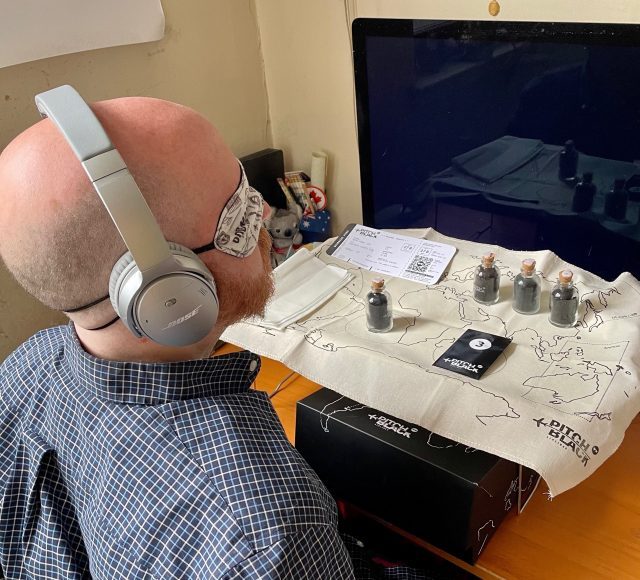
Odd Man Out offers a theatrical journey in a box to be experienced at home (photo by twi-ny/ees)
BEST AT-HOME INTERACTIVE EXPERIENCE
Martín Bondone’s Odd Man Out, Teatro Ciego and theatreC. Writer Martín Bondone and codirectors Carlos Armesto and Facundo Bogarín’s immersive memory play arrives at your home in a box containing elements for four of the senses as you listen on headphones while blindfolded, following the story of a blind musician returning to Argentina.
BEST COMEDY FILMED ON A STAGE
Terrence McNally’s It’s Only a Play, George Street Playhouse. After presenting two excellent online solo shows, Bad Dates and Fully Committed, filmed in a board member’s home, George Street Playhouse returned to its New Jersey stage for a stellar rendition of Terrence McNally’s hysterical comedy about theater that had me laughing out lout time and time again.
BEST SURPRISE ENDING OF A VIRTUAL PLAY
Christopher Chen’s Communion, American Conservatory Theater (A.C.T.). It would be unfair to reveal what Stacy Ross tells us at the conclusion of Christopher Chen’s online, interactive Zoom show, which comes complete with breakout rooms and is skillfully directed by Tony winner Pam MacKinnon.
BEST REVIVAL SERIES
MTC’s Curtain Call, The Niceties,Three Days of Rain,The Past Is the Past,Neat. Manhattan Theatre Club looked back in presenting virtual versions of past productions, in most cases reuniting the original casts, including the late Lisa Banes and Jordan Boatman in Eleanor Burgess’s The Niceties, about an allegation of racism at a prestigious university, as well as Patricia Clarkson, John Slattery, and Bradley Whitford in Richard Greenberg’s family mystery Three Days of Rain and Charlayne Woodard re-creating her one-woman autobiographical show Neat.
BEST MUSICAL FILMED ON A STAGE
Heather Christian’s Animal Wisdom, Woolly Mammoth and San Francisco’s American Conservatory Theater. Heather Christian reimagined her 2017 show, Animal Wisdom, for online viewing, recording it with her band onstage at DC’s Woolly Mammoth, incorporating aspects of the pandemic while Christian faces ghosts from her past.
BEST SITE-SPECIFIC INDOOR FILMED MUSICAL
Jason Robert Brown’s The Last Five Years, Out of the Box Theatrics, Holmdel Theatre Company, and Blair Russell. Jason Michael Webb’s adaptation of Jason Robert Brown’s 2001 two-character sung-through musical about the end and beginning and end of a relationship follows Nasia Thomas and Nicholas Edwards through a cramped New York City apartment as concepts of time and space are obliterated.
BEST REIMAGINING OF A ONE-WOMAN PLAY
Studio Theatre, Dael Orlandersmith’s Until the Flood. Studio Theatre associate artistic director Reginald L. Douglas reimagines Dael Orlandersmith’s gripping one-woman show about the police killing of Michael Brown as a piece for three Black women actors of different ages, who portray multiple characters as they move about the empty DC theater.
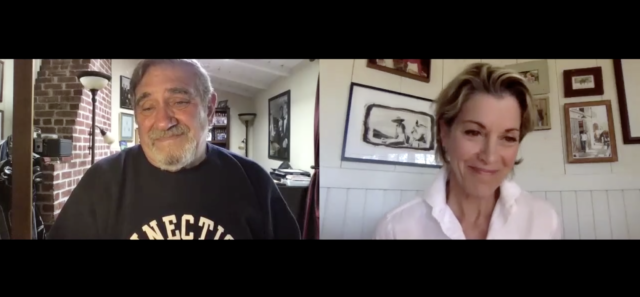
Dan Lauria and Wendie Malick are warm and welcoming in Sitting and Talking
BEST TWO-CHARACTER ZOOM PLAY ABOUT CONNECTING
Lia Romeo’s Sitting and Talking, Miles Square Theatre. Dan Lauria and Wendie Malick are delightful as two older single people attempting to connect through online dating, trying to dig themselves out of the loneliness they are both experiencing, and not just because of the pandemic.
BEST SOLO SHAKESPEARE PLAY
Patrick Page, All the Devils Are Here: How Shakespeare Invented the Villain, Shakespeare Theatre Company. Patrick Page gives a master class in Shakespeare, focusing on his many villains in this triumphant one-person show filmed onstage at STC.
BEST PODCAST PLAYS
Wallace Shawn’s Grasses of a Thousand Colors and The Designated Mourner, Gideon Media. The original casts of these two prescient plays by Wallace Shawn reunited for outstanding audio versions, with Julie Hagerty, Jennifer Tilly, Emily Cass McDonnell, Deborah Eisenberg, and Larry Pine joining Shawn.
BEST ONLINE FILM FESTIVAL DOC NYC 2021. The twelfth annual DOC NYC festival went hybrid, presenting more than two hundred films online and in theaters that look at where we are as a society today, in the midst of a pandemic that has killed more than five million people around the world, including several important films about Covid-19 and how we have responded to it.
BEST INTERACTIVE FILM Republique, the Interactive Movie. Created by director Simon Bouisson and writer Olivier Demangel, Republique puts the viewer in control of the action, choosing which of several unfolding scenes to watch during a terrorist attack in the Paris Metro.
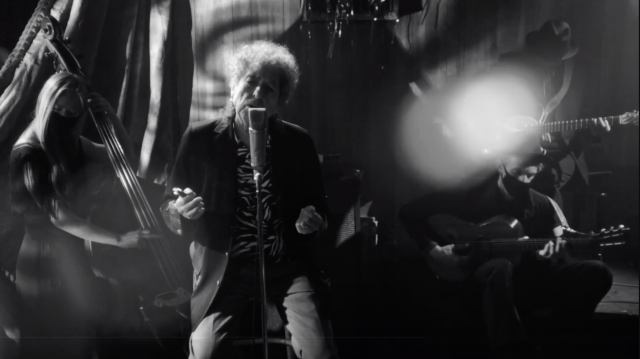
Bob Dylan’s bizarre Shadow Kingdom delighted and confounded fans
BEST INCOMPREHENSIBLE MUSIC PRESENTATION Shadow Kingdom: The Early Songs of Bob Dylan. Leave it to the enigma that is Bob Dylan to present a virtual production that had fans wondering whether any of it was recorded live, as microphones hid Dylan’s mouth throughout and the unidentified masked musicians might or might not have been actually playing their instruments; the lively chat ranged from angry fans wanting their money back to devotees proclaiming it was the best twenty-five bucks they had spent during the pandemic.
BEST DUET
Dorit Chrysler and Alexander Calder, “Calder Plays Theremin,” Museum of Modern Art. Berlin-based composer and sound artist Dorit Chrysler activated two works in MoMA’s “Alexander Calder: Modern from the Start” exhibition by using four theremins and a Moog Model 15 analog synthesizer to create a gorgeous eight-minute suite in four movements.
BEST BIRTHDAY TRIBUTE TO A LATE ROCK STAR “A Bowie Celebration: Just for One Day!,” Rolling Live Studios. Pianist Mike Garson transformed the annual David Bowie birthday tribute into a superstar online event, with Bowie songs performed by such Bowie acolytes as Yungblud, Michael C. Hall, Ian Hunter, Anna Calvi, Boy George, Trent Reznor, Perry Farrell, Macy Gray, Adam Lambert, Andra Day, Duran Duran, Peter Frampton, David Sanborn, Rick Wakeman, Ian Astbury, William Corgan, Gary Oldman, Gavin Rossdale, Joe Elliott, Bernard Fowler, Corey Glover, and Catherine Russell, among others.
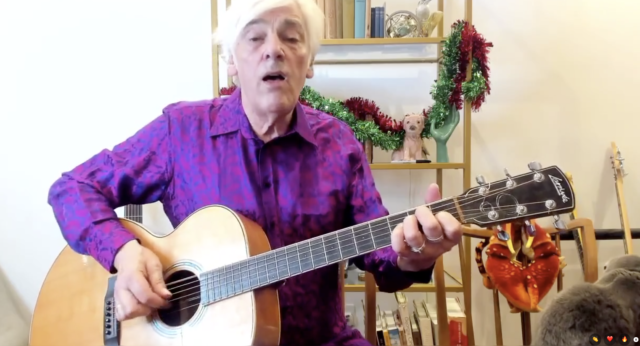
Robyn Hitchcock played a series of home gigs in Nashville and London, joined by his partner and pets (including Perry the lobster)
BEST INFORMAL AT-HOME MUSIC SERIES
Robyn Hitchcock, Live from Tubby’s House. Taking a page out of British raconteur Richard Thompson’s book, who performed living-room concerts from his Jersey home with his partner, singer-songwriter Zara Phillips, fellow British raconteur Robyn Hitchcock performed a series of home concerts from Nashville and London over Mandolin and StageIt, accompanied by his wife, singer-songwriter Emma Swift, her pup Daphne, and their beloved cats, Ringo Baez and Tubby Grossman, a follow-up to their 2020 Live from Sweet Home Quarantine shows.
BEST INDOOR DANCE FILMED ON A STAGE
Yin Yue Dance Company, Ripple, 92nd St. Y. Harkness Promise Award recipient Yin Yue’s Ripple, filmed live in front of an audience at 92Y’s Kaufmann Concert Hall, was a gorgeously flowing multipart work that was followed by a fascinating talk with the company.
BEST OUTDOOR DANCE FILMED ON A STAGE STREB Extreme Action, Jacob’s Pillow. Elizabeth Streb and her Extreme Action team returned to Jacob’s Pillow for the first time in twenty years, presenting twelve repertory works filmed live on the outdoor stage in front of an audience, with Streb offering commentary between pieces, an excellent aperitif to the company’s stirring live show at Manhattan West.
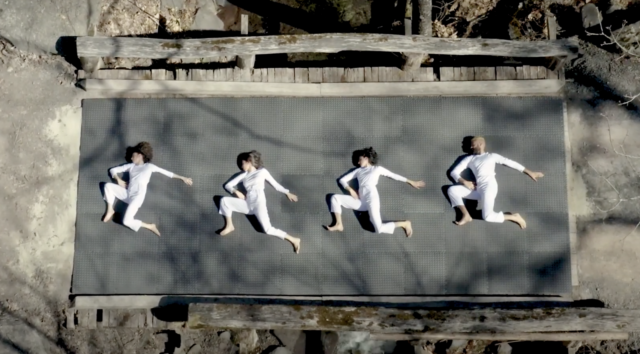
Stephen Petronio Co. remimagines Trisha Brown’s Group Primary Accumulation for its digital Joyce season
BEST OUTDOOR DANCE NOT ON A STAGE
Stephen Petronio Company, Accumulation, Joyce Digital Season. As part of its digital season at the Joyce, Stephen Petronio continued his Bloodlines program, in which he interprets seminal works by important choreographers, with a mesmerizing outdoor mixed-gender performance of Trisha Brown’s Group Primary Accumulation, filmed from high above, as if the four dancers are just another part of the natural world.
BEST DANCE ABOUT EMERGING FROM LOCKDOWN
Stefanie Batten Bland, Kolonial, Baryshnikov Arts Center. For her BAC digital commission, Stefanie Batten Bland contributed the filmed piece Kolonial, in which she and six other dancers try to burst out of a trapped isolation.
BEST ONLINE DANCE FESTIVAL “WOMEN / CREATE! A Virtual Festival of Dance,” New York Live Arts. The ninth annual “WOMEN / CREATE!” festival went digital with impressive works by Karole Armitage, Meagan King, Sidra Bell, Jennifer Muller, Tatiana Desardouin, and Jacqulyn Buglisi, followed by a rousing discussion.
BEST BALLET FILMED ONSTAGE
George Balanchine’s Emeralds, San Francisco Ballet. I let out a gasp as the curtain rose on San Francisco Ballet’s glorious version of George Balanchine’s Emeralds, the most dancers I had seen onstage together since the pandemic lockdown had started, and then gasped over and over again at the beautiful production, with stunning costumes and spectacular movement.
BEST ONLINE ART PROGRAM
David Zwirner, Program; Hauser & Wirth, .Philip Guston: On Edge. David Zwirner’s all-day online symposium featured discussions with artists, critics, curators, filmmakers, designers, and others, including Barry Jenkins, Hilton Als, Emily Bode, and Peter Schjeldahl, along with visits to Zwirner galleries around the world. Meanwhile, in conjunction with its superb exhibition “Philip Guston 1969-1979,” Hauser & Wirth hosted “Philip Guston: On Edge,” a symposium at the SVA Theatre that included William Kentridge responding to Guston’s The Studio as well as other strong presentations by Trenton Doyle Hancock and Rachel Rossin and conversations with Charles Gaines, Art Spiegelman, Max Hollein, Massimiliano Gioni, George Condo, Katy Siegel, Randy Kennedy, and Jasmine Wahi.
BEST ART MEDITATION
Pace Gallery, Monday Meditation at the Rothko Chapel. Pace offered a lovely opportunity to reflect on life from wherever you were while watching a peaceful shot inside Houston’s nondenominational Rothko Chapel as part of its fiftieth anniversary.
BEST ONLINE ARTS DISCUSSION SERIES
The New Museum, “Grief and Grievance: Art and Mourning in America.” Even if you weren’t ready yet to venture into arts institutions, the New Museum supplemented its outstanding “Grief and Grievance” exhibition with a series of talks with more than a dozen of the participating artists, all of which are still available online for free.
BEST LIVESTREAMED OPERA
White Snake Projects, Death by Life: A Digital Opera in One Act and A Survivor’s Odyssey: The Journey of Penelope and Circe. Cerise Lim Jacobs’s activist opera company, White Snake Projects, continued its inspiring, barrier-breaking livestreamed digital presentations with Death by Life, which dealt with systemic racism and mass incarceration, and A Survivor’s Odyssey: The Journey of Penelope and Circe, an inventive take on Odysseus which places the power in the hands of the women characters.
BEST DIGITAL OPERA FILMS Opera Philadelphia,Soldier Songs, The Island We Made, We Need to Talk, Blessed, Save the Boys. Opera Philadelphia redefined what opera could be in an online world during the pandemic lockdown, presenting a series of spectacular filmed operas about loneliness, legacy, and personal identity in these hard times; The Island We Made contained some of the most stunning visuals of the year.
Audience members take photos of themselves using props sent to their home in The Wandering
BEST PARTICIPATORY OPERA The Wandering, Actor and curator Calista Small, baritone and actor Jeremy Weiss, designer Charlotte McCurdy, theater artist Christine Shaw, filmmaker Lara Panah-Izadi, and animator Zach Bell took a unique look at the life of Austrian composer Franz Schubert in a multipart, multidisciplinary immersive production that included props sent to the at-home audience.
BEST OPERA MINISERIES
Boston Lyric Opera, Desert In. Boston Lyric Opera’s Desert In is a tantalizing and titillating eight-part soap opera that combines loss and loneliness with the supernatural, with Justin Vivian Bond as the lounge singer, Jon Orsini as the son, Jesus Garcia as Rufus, Edward Nelson as his new husband, Ion, Alan Pingarrón as Federico, Isabel Leonard as Cass, and Talise Trevigne as Sunny, all delighting in the delicious dastardly doings.
MOST ADVENTUROUS OPERA ADAPTATION
Boston Lyric Opera / Operabox.tv, The Fall of the House of Usher. Director James Darrah’s inventive virtual adaptation of Philip Glass and Arthur Yorinks’s 1988 opera, The Fall of the House of Usher, combined puppets, stop-motion animation, the refugee crisis, and a mysterious host in retelling Edgar Allan Poe’s classic tale of the demise of a once-prominent family.
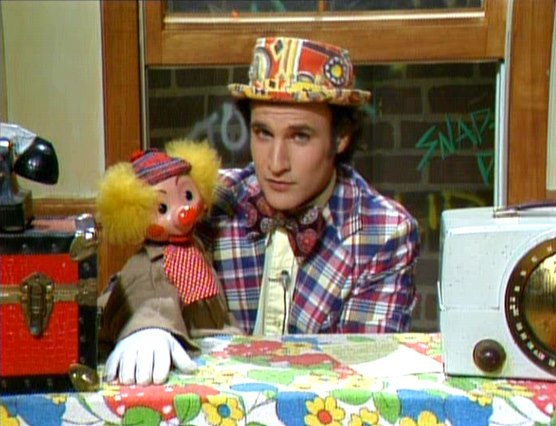
Uncle Floyd is back with Tuesday night watch parties of clips from old episodes
BEST VIRTUAL TV WATCH PARTY This Was the Uncle Floyd Show. David Bowie, John Lennon, Iggy Pop, Paul Simon, and the Ramones were among the fans of The Uncle Floyd Show, a faux-kiddie program that ran on various outlets, from local cable access channels to NBC, from 1974 to 1998, a supremely low-budget panoply of improvised sketches, music parodies, beloved puppets, and appearances by internationally renowned rock stars; the shows were never rerun and will never be available on DVD, so Floyd and his right-hand man, Scott Gordon, are hosting fifty-minute livestreamed clip compilations over StageIt hosted by tech Luddite Uncle Floyd Vivino himself, with a rousing, worshipful chat featuring longtime fans and some of the original cast and crew members. Snap it, pal!!
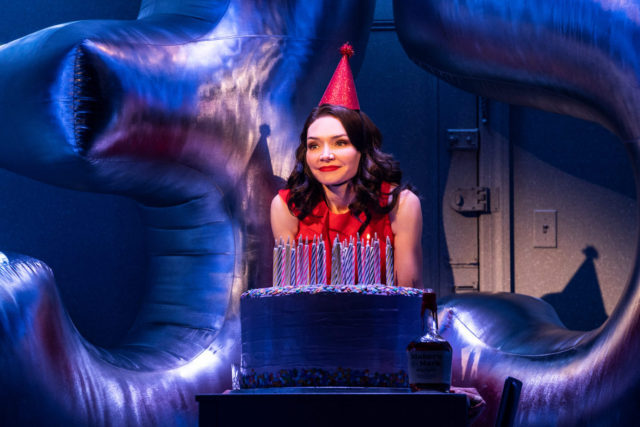
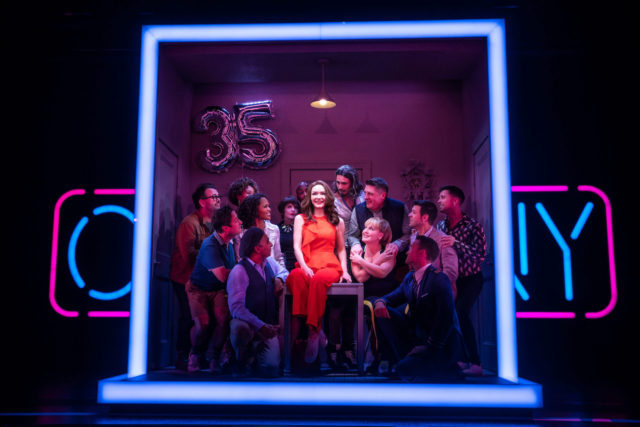
Bobbie (Katrina Lenk) is not exactly thrilled about turning thirty-five in Company (photo by Matthew Murphy)
COMPANY
Bernard B. Jacobs Theatre
242 West 45th St. between Broadway & Eighth Ave.
Tuesday – Sunday through July 31, $59 – $299 companymusical.com
Originally slated to open on Broadway on March 22, 2020 — Stephen Sondheim’s ninetieth birthday — Marianne Elliott’s reimagining of composer and lyricist Sondheim and book writer George Furth’s beloved Company finally arrives at the Bernard B. Jacobs Theatre, two weeks after Sondheim’s sad, sudden passing just as we all could use, er, a little company. Having never seen the iconic musical before — it debuted on Broadway in 1970 and was revived in 1995 and 2006 — I cannot compare it to any of those editions or focus on the well-publicized changes to this new version, primarily involving several gender switches, most importantly to the main character, who has gone from Bobby the man to Bobbie the woman. But what I can report is that Elliott’s inventive adaptation has a fine first act and an utterly spectacular second.
Bobbie, played with a nagging trepidation by Katrina Lenk, is turning thirty-five and none too happy about it. After receiving a flurry of birthday messages, she says, “How many times do you get to be thirty-five? Eleven? Okay, come on. Say it and get it over with. It’s embarrassing. Quick. I can’t stand it.”
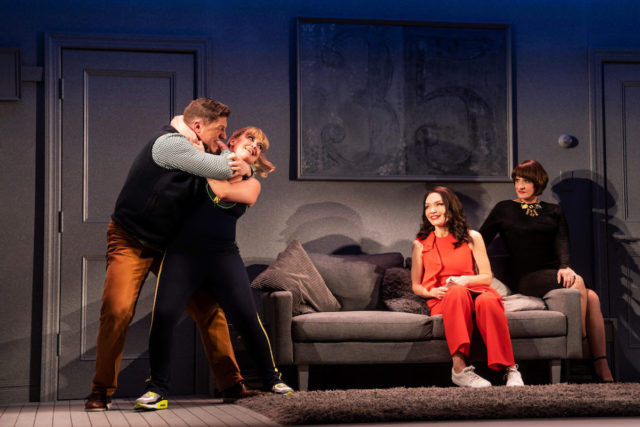
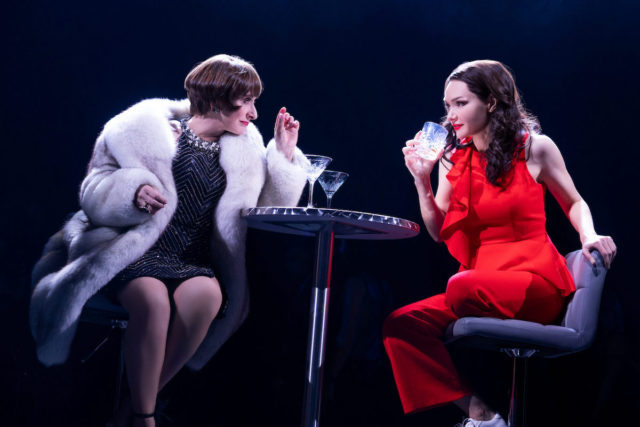
Harry (Christopher Sieber) and Sarah (Jennifer Simard) battle as Bobbie (Katrina Lenk) and Joanne (Patti LuPone) look on in Sondheim-Furth revival (photo by Matthew Murphy)
Bobbie is tired of being the third wheel. She puts a mylar “35” balloon on her wall and it ticks like a biological clock. Her married and engaged friends, some with kids, attempt to entertain her but they have their own lives away from her. She is spending more and more time with bottles of Maker’s Mark to try to make her forget her loneliness. She’s attracted to a dimwitted flight attendant, Andy (Claybourne Elder), who doesn’t exactly fulfill her needs.
She visits with Sarah (Jennifer Simard) and Harry (Christopher Sieber), who get into a riotous jiu-jitsu battle; Susan (Rashidra Scott) and Peter (Greg Hildreth), who, on their terrace, announce they’re getting divorced; Jenny (Nikki Renée Daniels) and David (Christopher Fitzgerald), who get high and discuss Bobbie’s possible fear of being hitched (“It’s not like I’m avoiding marriage. It’s avoiding me, if anything. I’m ready,” she insists); Jamie (Matt Doyle) and Paul (Etai Benson), who are getting married but Jamie is suddenly having doubts; her former lover Theo (Manu Narayan), who has made the kind of important decision Bobbie is unable to; her friend P.J. (Bobby Conte Thornton), who is in love with New York itself; and the older Joanne (Patti LuPone) and her third husband, Larry (Terence Archie), who party at a nightclub. “The phone is a phenomenon. Really. The best way for two people to be connected and detached at the same time,” Bobbie says. Joanne responds, “Second only to marriage.”
The story goes back and forth in time — the script explains, “The narrative is conveyed in a stream of consciousness technique and time moves both backwards and forwards, encompassing the past, present and future” — as Bobbie contemplates the state of her existence as she turns thirty-five, alone in the big city. “One’s impossible, two is dreary, / Three is company, safe and cheery,” she tries to convince herself. “Here is the church, / Here is the steeple, / Open the doors and / See all the crazy, married people!”
Friends gather to celebrate Bobbie’s (Katrina Lenk) birthday in Company (photo by Matthew Murphy)
Two-time Tony winner Elliott (The Curious Incident of the Dog in the Night-Time,Angels in America) has reconceptualized Company in ways that go beyond mere gender switching and diverse casting; this Company emphasizes individuality, confinement, isolation, and fear through magnificent staging constructed around Bunny Christie’s ingenious set; much of the action takes place in and around claustrophobic rectangular spaces framed by fluorescent lights. (The lighting is by Neil Austin.) Bobbie, wearing a sensational sexy red pantsuit (Christie also designed the costumes), is trapped physically and psychologically in each scenario, from a tiny room in her apartment to the club to a street where every door is numbered “35.” Turning thirty-five and still being single is a nightmare that follows her wherever she goes.
Bobbie’s friends represent parts of herself as well as a potential companion. “Someone is waiting, / Sweet as David, / Funny and charming as Peter. Larry . . . / Someone is waiting, / Cute as Jamie, / Sassy as Harry / And tender as Paul,” she sings in “Being Alive,” adding, “Did I know him? Have I waited too long? / Maybe so, but maybe so has he.”
As portrayed by Tony winner Lenk (The Band’s Visit,Indecent), Bobbie is not after our sympathy or even our compassionate understanding; no mere old maid, she serves as a reminder of the uncertainty and isolation we all experience, whether coupled or not, regardless of how happy we might be. The scene in which Bobbie, in bed with Andy, sees one possible outcome of her life unfold before her is horrifyingly funny, whether you live alone or are married with kids; it’s a tour de force for both Elliott and the ensemble.
Joanne (Patti LuPone) has a bit of important advice for Bobbie (Katrina Lenk) in Broadway revival (photo by Matthew Murphy)
Two-time Tony winner LuPone (Evita,Gypsy) brings the house down just by saying, “I’d like to propose a toast,” prior to singing “The Ladies Who Lunch.” The signature role of Joanne has previously been performed by Elaine Stritch, Debra Monk, Sheila Gish, Lynn Redgrave, and Barbara Walsh, while the roll call of male Bobbys includes Dean Jones, George Chakiris, Larry Kert, Boyd Gaines, Adrian Lester, Raúl Esparza, and Neil Patrick Harris.) The rest of the cast is exemplary as well, with shout-outs to Simard’s brownie-desiring Sarah, two-time Tony nominee Fitzgerald’s puppy-dog-eyed David, and Doyle’s breathlessly fast-paced rendition of “Getting Married Today.”
Liam Steel’s choreography is fun, as are illusions by Chris Fisher. One oddity is that characters often enter and exit the stage through the aisles, which are also frequented by theater staffers holding signs telling the audience to keep their masks on, momentarily diverting our attention while also reminding us of the situation we’re still in.
David Cullen’s orchestrations honor Sondheim’s complex melodies, performed by a fourteen-piece band conducted by Joel Fram that hovers above the stage. The second act explodes with an electrifying “Side by Side by Side” and never lets up through Bobbie’s closing soliloquy, “Being Alive,” an able metaphor for what we all need right now. Winner of three Olivier Awards — for Set Design (Christie), Supporting Actress in a Musical (LuPone), and Musical Revival — Company is more than just grand company in these troubled times, when we can all benefit from being together once again.
It’s been three quarters of a century since the Holocaust ended, so there are fewer and fewer survivors and witnesses alive to tell the true stories of what happened in the camps of Eastern Europe during WWII. Meanwhile, antisemitism continues to surge around the world amid Holocaust deniers and politicians who misuse and abuse the horror for soundbites and social media memes. Arlekin Players Theatre investigates these issues in its latest interactive online show, Witness. An immersive work that explores antisemitism and desperate migration, the play relates the fate of the MS St. Louis, the German ship that carried more than nine hundred Jewish refugees in May 1939, to the problems of today.
The luxury liner was transporting men, women, and children fleeing the approaching Holocaust, but the ship was turned away by Cuba, Canada, and the United States. Conceived and directed by Arlekin founder and Russian Jewish immigrant Igor Golyak and written by Moscow-based Nana Grinstein with Blair Cadden and Golyak, Witness puts the audience on board the St. Louis, where it begins with a talent show that is based on actual events.
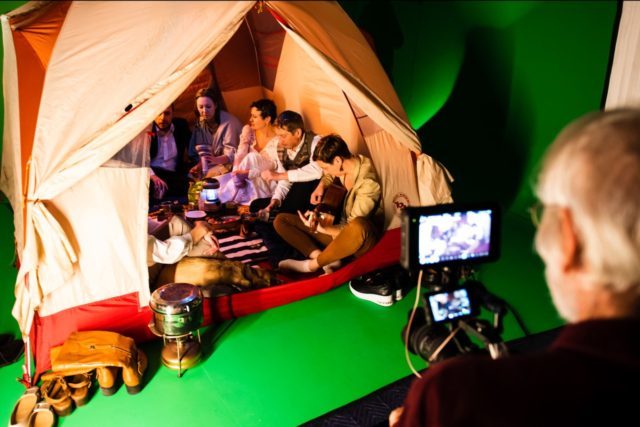
The emcee (Gene Ravvin) believes he is in the present, in a green-screen studio, as he introduces the parade of performers: Liesl Joseph (Esther Golyak) and Gisela Klepl (Elizabeth Sarytchev), who perform “Skating on Glass!” as older versions of themselves (Rimma Gluzman and Polina Vikova) recall Kristallnacht in voice-over; Fritz Buff (Alex Petetsky), who constructs a house of cards and anticipates “joyful days” ahead; Fira (Julia Shikh), who boils a book banned in the USSR; a magician named Marik (Misha Tyutyunik) and his assistant (Jenya Brodskaia); and superheroes Anna (Anna Furman), Olga (Olga Aronova), and Vika (Vika Kovalenko), who call themselves the Elusive Avengers. The audience at home votes on each performance and gains points as they participate.
During each skit, the audience can click on pop-ups to learn more about the contestants, all of whom were real, as well as the actors portraying them. Short biographical sketches include their immigration status and, in the case of the passengers, their fate after the ship was refused entry to America. News crawls onscreen range from the 1930s to the 1990s, which initially confuse the emcee until he figures out what is going on. “The good news is that not only those Jews who left Hamburg in 1939 are sailing with us but also all the Jews that left anywhere are also here,” he explains. “First wave, second wave, third wave. A whole ocean of waves. From USSR, from Germany, from Spain, from Hungary. Yesterday, today, tomorrow, and always. We are all together, ladies and gentlemen. We’re all together. If there is a place to leave, the Jews will find a way.”
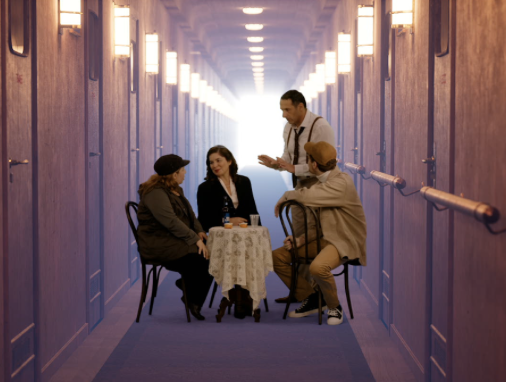
After the talent show, the emcee walks through a long, narrow hallway on the ship, encountering people discussing antisemitism, assimilation, the Tree of Life synagogue shooting, dual loyalty, and Israel’s right to exist and defend itself as well as frightening vignettes occurring in some of the cabins. Every word of dialogue is based on interviews Golyak conducted with nearly a hundred people; the narrative is smartly organized to avoid clichés, stereotypical rhetoric, and didactic moralizing.
“So basically what they are is Jews who think if we just bend over a little more, if we just assimilate a little bit better than we did in Germany, that somehow miraculously everything will be different than it was in Germany,” Leah (Lauren Elias) says. “And it’s not going to be. I mean, come on. It feels like the only acceptable party line for Israeli people and Jewish people right now is like, ‘Oh my god. We’re sorry we didn’t all die in World War Two. We know that would have been so much easier for you. We are so sorry for the inconvenience.’”
Joseph (Nathan Malin), talking with Leah and Rachel (Anne Gottlieb) about the public reaction to the real-life stabbing of an Orthodox rabbi in Brighton, admits, “Unless you want to tar yourself as unwanted and as a bad person, you keep your mouth shut and you just duck your head, you know?”
Camera operator Austin de Besche films some of the cast during the making of Witness
Lady Liberty (Darya Denisova) occasionally appears to share her thoughts as the emcee repeats, “This can’t happen here. This can’t happen here!” Leah responds, “No, no, no, it can. And it does.”
Arlekin, which has previously dazzled viewers with the one-woman State vs. Natasha Banina and the daring hybrid chekhovOS /an experimental game/ (featuring Jessica Hecht and Mikhail Baryshnikov), a pair of livestreamed interactive shows that pushed the boundaries of online productions, again breaks new ground through its Zero Gravity (zero-G) Virtual Theater Lab with Witness. Set designer and costumer Anna Fedorova, virtual designer Daniel Cormino, sound designer Viktor Semenov, and director of photography and editor Anton Nikolaev make it feel like it’s all taking place on board the St. Louis, with rolling waves and flying birds outside as the ocean liner heads toward its supposed destination.
During the talent show, the audience on the ship looks like ghosts, which in essence is what they are today. At one point, the screen goes dark for several minutes as binaural recordings play through your headphones, as if you’re a passenger, not knowing what’s coming next, or from where. It sent chills through my bones.
As always with Arlekin’s works, each presentation is followed by a talkback in which members of the cast and crew delve into the making of the work, although Golyak is careful not to give away too many secrets. Some of the discussions include experts on antisemitism and the Holocaust, and the audience is encouraged to share experiences in the lively chat. The night I saw Witness, numerous people (including me) described instances of antisemitism they have encountered. At Yad Vashem, the Holocaust Remembrance Center in Jerusalem, it is noted, “Bearing witness, so they will know, until the last generation.” A compelling and necessary piece of sociopolitical documentary theater, Witness reminds us all just how important that is.
Candace Bushnell holds nothing back in charming journey through her life and career (photo by Joan Marcus)
IS THERE STILL SEX IN THE CITY?
Daryl Roth Theatre
101 East Fifteenth St. at Union Square
Tuesday – Sunday through February 6, $69 [ed. note: show closed December 19 due to Covid] istherestillsexinthecity.com www.darylroththeatre.com
“Good news only” is how Candace Bushnell always answers the phone in her one-woman show, Is There Still Sex in the City? Good news only it will be.
The ninety-minute play is an endearing, self-aware production in which Bushnell, now sixty-three, shares intimate details of her life and career, centering around the gargantuan success she has had with the creation of Carrie Bradshaw (Sarah Jessica Parker), Samantha Jones (Kim Cattrall), Charlotte York (Kristin Davis), and Miranda Hobbes (Cynthia Nixon), the fictional characters on the HBO smash Sex and the City, based on her series of columns and 1996 book of the same name. The play might be timed to capitalize on the return of Carrie, Charlotte, and Miranda in the brand-new follow-up, And Just Like That . . . ,” but Is There Still Sex in the City? stands on its own as an entertaining, appropriately gossipy public confessional from a writer who changed the way the country looked at the lifestyles of women of all ages, sexual and otherwise.
Bushnell, who prefers to be known as Candi (“with a little circle where the dot goes”), leads us from her childhood in Connecticut, where her father pitied her because she was flat-chested — “I’m afraid no man is ever going to love you,” he warns — to her freshman-year flight to New York City when she was nineteen, determined to abandon college and become a writer and win the Pulitzer Prize.
At first she relates, “This New York is not my boyfriend. Pimps stalk Penn Station looking for runaways. Heroin addicts are nodding out on the streets. There’s three card monte, pickpockets, boomboxes, and Hare Krishna parades. It’s dirty. There’s no pooper scooper law, and there’s dog poop everywhere.” But it isn’t long before she is hanging out with the rich and famous, partying at Studio 54, jetting off to Europe, reveling in the abundant sex and drugs — and eventually telling everybody about it, first as Stripe Savage, writing such pieces as “How to Act in a Disco,” then under her real name in a must-read column for the New York Observer.
Candace Bushnell answers the question Is There Still Sex in the City? in one-woman show (photo by Joan Marcus)
“This New York is my boyfriend,” she says later. “Who needs a man when Manhattan itself is abuzz? Maybe it’s the cosmos. Maybe it’s the cocaine.” Her bestselling book, Sex and the City, becomes a hot HBO show, but that doesn’t necessarily result in personal fulfillment as her relationships with Melrose Place creator Darren Star, a much older famous writer, the unnamed actual Mr. Big, and others ultimately fizzle. But she learns to take matters into her own hands as she shares what she is doing today, which is a long jump from where she thought she would be — while still working toward that Pulitzer.
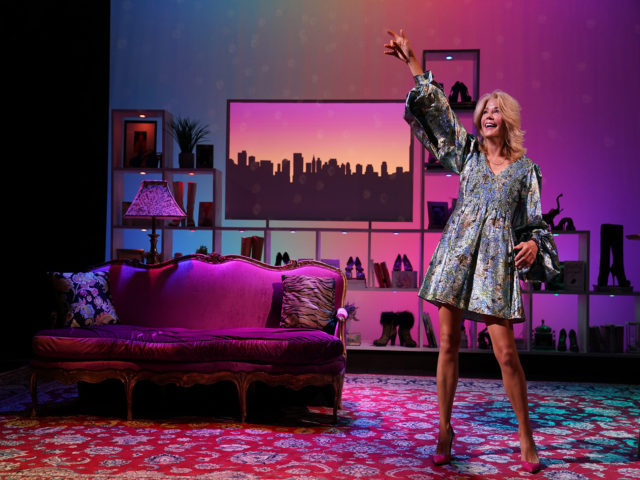
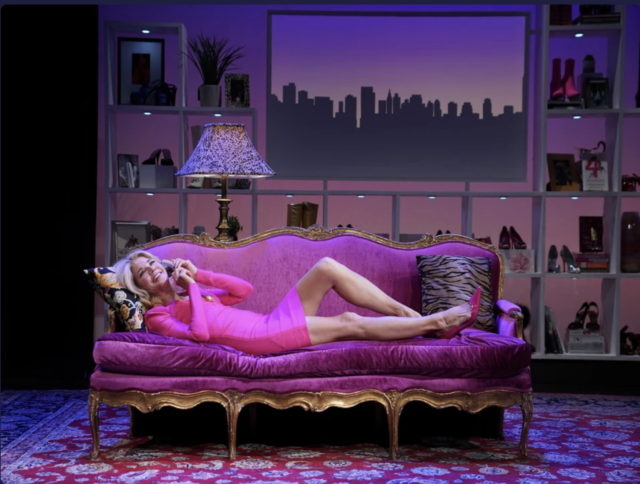
Directed by choreographer Lorin Lotarro (A Taste of Things to Come) with a spicy sweet sense of humor, Is There Still Sex in the City? answers many of the questions people have about Bushnell and her life. It features popular period songs by Sheryl Crow, Cyndi Lauper, Donna Summer, MC Hammer, and Right Said Fred, a parade of fantastic outfits courtesy of costume designer Lisa Zinni, an adorable set by Anna Louizos with an elegant royal couch, a monitor with projections (old photos, TV clips, animation) by Caite Hevner, and stacks of cubes with books, knickknacks, and shoes — lots and lots of shoes, all of which, Bushnell admits, are from her own closet — colorfully lit by Travis McHale.
Bushnell occasionally plays “Real or Not Real,” asking the audience to call out their responses to such questions as “Did I sleep with the hot Calvin Klein underwear model from episode 2?” She doesn’t mind receiving random hoots and hollers and shouts of support, particularly as she reveals her ten life lessons, the first of which is: “I’m a feminist. A mini Gloria Steinem. Have been ever since kindergarten, where I discovered women could only have four jobs: nurse, teacher, secretary, or librarian.”
Bushnell is so warm and gracious that you will forgive a missed line reading here and there, and the Daryl Roth Theatre in Union Square is far too big for such an intimate production. But Is There Still Sex in the City? is a fab treat, a funny and candid New York story that everyone can relate to in one way or another, whether you are a fan of Sex and the City or have never watched or read it. And before or after the show, you can enjoy a cosmo in the downstairs Candi Bar. Like Bushnell says, “Good news only!”
[ed. note: The good news only went so far, as the show had to close on December 19 after Bushnell contracted Covid-19. The plan is for it to eventually return to New York City when the tour gets up and running again.]