this week in theater

FAIRYCAKES

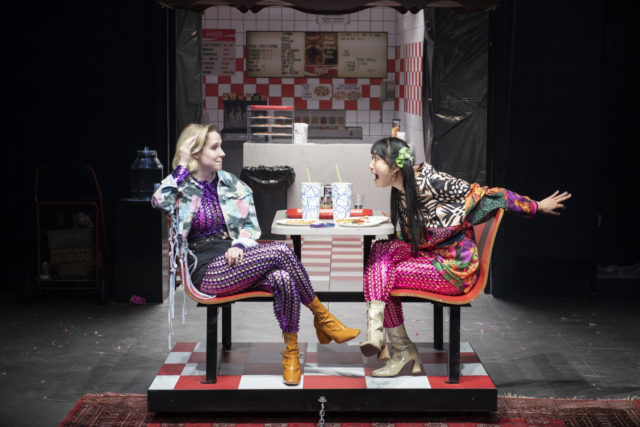
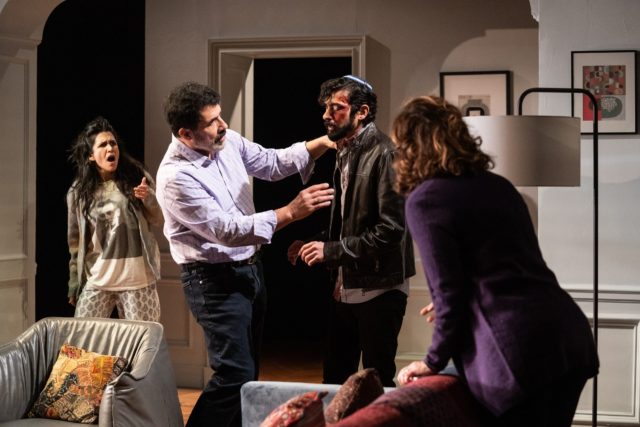
Titania (Julie Halston) faces a crisis with her daughters in Fairycakes (photo © Matthew Murphy)

FAIRYCAKES
Greenwich House Theater
27 Barrow St. at Seventh Ave.
Tuesday – Sunday through November 21,
www.fairycakestheplay.com

I came specially armed to see Douglas Carter Beane’s Fairycakes at the Greenwich House Theater earlier this week. There wasn’t a lot of positive buzz surrounding the campy musical, and its initial closing date of January 2, 2022, was quickly revised to November 21, 2021, a fact unfortunately visible at the entrance. My companion for the evening was a good friend who swore by Xanadu, the Tony-nominated 2007 Broadway musical, about Greek muses in leg warmers on roller skates, for which Beane had written the book. If anyone was going to see the potential inherent joys in Fairycakes, it was her.

Alas, we both agreed in this case that Beane’s new show is a hot mess with a convoluted narrative that feels like a high school senior play, albeit with a handful of superb actors. The cast, highlighted by the wonderful Kristolyn Lloyd, is exuberant, probably because they truly love performing the material and not because they’re glad they have to do so for a much shorter period of time than originally contracted for.

Fairycakes is a chaotic mashup of Shakespeare’s A Midsummer Night’s Dream and classic fairy tales, written and directed by five-time Tony nominee Beane, whose previous shows include The Little Dog Laughed, The Nance, Lysistrata Jones, and Sister Act as well as the 1995 film To Wong Foo, Thanks for Everything! Julie Newmar. The music is by Beane’s longtime collaborator Lewis Flinn, with corny, repetitive choreography by Ellenore Scott. The ornate, DIY costumes are by Gregory Gale. It all unfurls on Shoko Kambara and Adam Crinson’s goofy set, with a movable wooden doorway behind which characters sometimes hide (although depending on where you sit, their sudden appearance might not be a surprise), a tree stump, and a forest backdrop.

On a magical night, the bare-chested Puck (Chris Myers) waves an aphrodisiacal flower around the characters, creating unexpected romantic pairings involving Gepetto (Mo Rocca), Pinocchio (Sabatino Cruz), Cinderella (Kuhoo Verma), pirate Dirk Deadeye (Arnie Burton), Prince Viktor (Jason Tam), Sleeping Beauty (Z Infante), and Peter Pan (Jamen Nanthakumar). Meanwhile, Oberon (Burton) and Titania (Julie Halston) are in a fight that, if they don’t resolve, will lead to the death of their children, Peaseblossum (Lloyd), Moth (Jackie Hoffman), Cobweb (Infante), and Mustardseed (Ann Harada). Also flitting about are a tinkling fairy (Hoffman), a cricket (Nanthakumar), a mermaid (Harada), a changeling (Nanthakumar), Cupid (Tam), an evil stepmother (Nanthakumar) and her plotting stepdaughters (Rocca and Cruz), Aurora, Goddess of the Dawn (Verma), and Queen Elizabeth I.

Until a switch in the second act, everyone speaks in stilted, self-referentially cutesy verse with far too many forced rhymes, and the narrative veers off into confusing subplots exacerbated by the inability of Beane to use the actual names of the characters from Peter Pan, the legacy of which is carefully protected by the J. M. Barrie estate.

That said, there were people in the audience the night my friend and I went who were having a great deal of fun, especially one person sitting behind us who was snapping, calling out gleefully, hooting, and snorting in approval. I wish we were watching what he was watching.

TAMMANY HALL

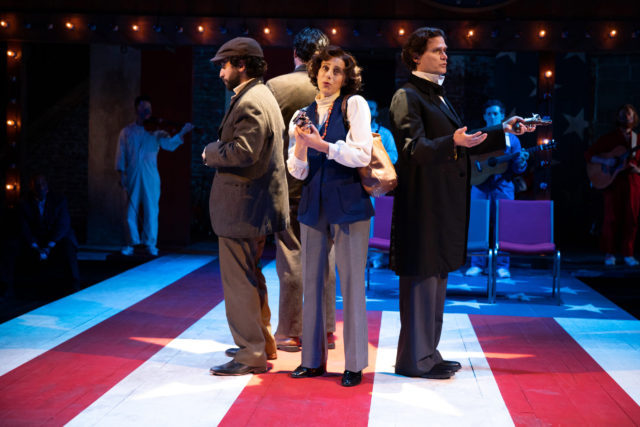
Jimmy “Beau James” Walker (Martin Dockery) and Fiorello “the Little Flower” La Guardia (Christopher Romero Wilson) step into the ring in Tammany Hall (photo by Maria Baranova)

TAMMANY HALL
SoHo Playhouse
15 Vandam St.
Wednesday – Sunday thorugh January 9, $93.75
www.sohoplayhouse.com

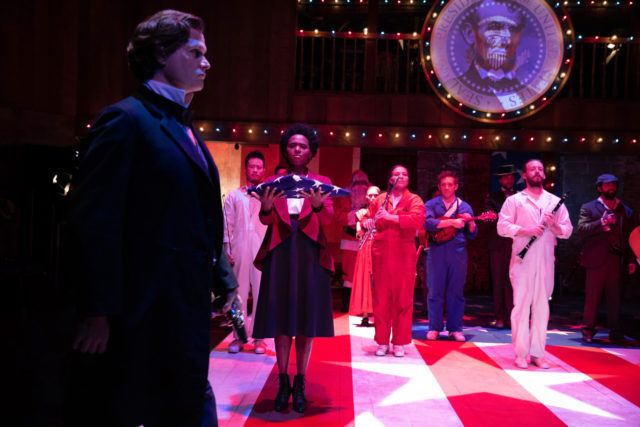
Tammany Hall is a rousing immersive production that puts audience members right in the middle of a fierce political battle — in 1929, between incumbent mayor Jimmy “Beau James” Walker (Martin Dockery) and Harlem congressman Fiorello “the Little Flower” La Guardia (Christopher Romero Wilson). The exciting and high-energy show takes place throughout SoHo Playhouse, renamed the Huron Club; numerous rooms have been repurposed by Dan Daly, from a central space with a boxing ring where a debate occurs to secret offices, a theater, the rooftop, and a bar — it might be the Prohibition Era, but the drinks are flowing.

It’s election night, November 5, 1929, a week after the Black Tuesday stock market crash. Gentleman Jimmy is running for his second term, backed by the powerful Tammany Hall machine, pitted against upstart reformer La Guardia, who wants to rid city government of corruption, patronage, and graft. The outcome appears to have already been decided — er, rigged — since Tammany Hall is Walker’s home turf and he is surrounded by sycophants and supporters. As the audience, which has been given ballots, finds seats around the ring, various characters come up and talk to them individually; how you relate to these brief chats could lead to what story you follow and how involved you get. There are at least three separate threads; I highly recommend that people in your group head off in different directions to compare notes later, as one participant will not be able to see everything by themselves.

“We got to get through the debate,” Tammany Hall operative Olvany (Isaac J Conner) says to guests. “We got to let La Guardia have his say, but we know Walker will have him down and out in the first round. It’s really a done deal and I know we can count on you, right? Of course we can.” Team Walker also includes the mayor’s mistress, Betty Compton (Marie Anello), who wants to become a popular entertainer; her fellow performer Marion “Kiki” Roberts (Chloe Kekovic); gangster Legs Diamond (Nathaniel J. Ryan); the wealthy, connected “Battery” Dan Finn (Andrew Broaddus); pianist and musical director Smarty (Sami Petrucci); choreographer Ritzi (Charley Wenzel), Judge Joseph Crater’s girlfriend; and Tammany Hall fixture Curry (Shahzeb Hussain).

Virtually on his own in enemy territory, La Guardia tells onlookers, “It feels like classic Tammany Hall, this. This overbearing architecture and antechambers and club exclusive access — I can’t stand it. Sure, that could just be a personal thing, but politics are made up of people and people building buildings and people choosing to build buildings like this — to make people feel privileged for being allowed to see inside them, inside the club. . . . We should all have access all the time. To the workings. To the truth. All these curtains and panels and smoke and mirrors, that’s hooey. Simple, open, transparency. It’s not a lot to ask for.”

Meanwhile, Isidor Jacob Kresel (Jesse Castellanos) and Valentine (Natasa Babic) appear to be recruiting people for undisclosed missions. It all comes together for a grand finale in an illegal downstairs speakeasy.

SoHo Playhouse is transformed into the Huron Club on election night, 1929, for immersive production (photo by Maria Baranova)

As with nearly all immersive productions, the more you put into it, the more you get out of it. You don’t have to participate; the actors are trained to select those who show more interest in lending a hand and getting in on the act. I loved every scintillating second as Kresel’s right-hand man, helping him and the Little Flower in their attempt to take down Tammany.

The many rooms of the Huron Club, built on property John Jacob Astor bought from Aaron Burr on Van Dam St., are brought to wonderful life by Daly, with clever touches everywhere you look, many referencing gambling; the lighting is by Emily Clarkson, with songs by Gavin Whitworth, sound by Megan Culley, and fanciful period costumes by Grace Jeon, all of which makes it feel like you’ve stepped into 1929 New York. Created and directed by Darren Lee Cole (Fleabag, Killer Joe) and Alexander Flanagan-Wright (The Great Gatsby, Orpheus), Tammany Hall is a sordid tale of power, greed, and hubris that fits right in with our current political climate, perverted by the rampant questioning of the legitimacy of America’s electoral process and the prevalence of big money. The tall and wiry Dockery is appropriately dapper, smarmy, and self-satisfied as Walker, while Wilson portrays La Guardia with a fiery passion and determination.

Perhaps it’s all summed up best by Ritzi, who says near the end, “I need a drink. You need a drink? The bar’s reopened. Tammany Hall still stands.” But not for long.

GNIT

Peter Gnit (Joe Curnutte) takes a break on a mountainside in New York premiere of Gnit (photo © Henry Grossman)

GNIT
Theatre for a New Audience, Polonsky Shakespeare Center
262 Ashland Pl. between Lafayette Ave. & Fulton St.
Tuesday – Sunday through November 21, $20-$125
866-811-4111
www.tfana.org

In Will Eno’s 2014 Broadway play, The Realistic Joneses, Jennifer tells John, “I think you have a nice way with words.” Eno has demonstrated his own “nice way with words” throughout his career; probing language and communication is ingrained in his MO. Such is the case with the New York premiere of his 2013 play, Gnit (pronounced “Guh-nit”), which opened today at Theatre for a New Audience’s Polonsky Shakespeare Center, in a sparkling version directed by longtime Eno collaborator Oliver Butler.

Gnit is an imaginative, clever adaptation of Henrik Ibsen’s 1867 five-act verse play, Peer Gynt, which was inspired by a Norwegian fairy tale. The title character, Peter Gnit (Joe Curnutte), is on a search for his “true self,” encountering a series of unusual people who speak with him in offbeat patterns; they converse in non sequiturs, repetition, and abstraction with a deadpan glibness. “Do you know who I am?” he asks a stranger, who answers, “Yes, I do. Actually, let me be more honest, here — no, I don’t. I’m sure you’re someone.” When an outdoorswoman (Christy Escobar) tells him, “You’re just like everyone else,” Peter responds, “Me? No. That’s probably the problem. I’m not enough like everyone else.” A woman in green (Escobar) says to him, “You look like a person.” Peter replies, “Well, I try to be myself. Because, really, that’s just a large part of who I am.”

But he has no idea who he is and no understanding of how to relate to others. Even his name is a question. “‘Gnit?’ I’ve heard about you. I’ve always wondered about that name — where’s it from?” Solvay (Jasmine Batchelor) asks. “It’s a typo,” Peter admits. And his beloved, sickly mother (Deborah Hedwall) explains, “When you begin sentences with the word ‘I,’ I’m not even sure you know who you’re talking about. Because maybe I didn’t hold you enough when you were little.”

The play opens with Peter returning home to discover his childhood sweetheart, Sarah (Escobar), is getting married to a man named Moynihan (Jordan Bellow) that very day. He sneaks into the wedding to try to stop it, where he encounters Town, ingeniously portrayed by David Shih in hysterical monologues in which he plays numerous people gossiping about this and that, drinking, and complaining, switching between characters like a machine gun. Peter also meets Solvay, who he instantly falls in love with even though he is there to run away with the bride. He is soon off on an adventure that will take him around the world, chancing upon a sexy woman on a mountainside (Escobar), a witchy lady (Escobar) and her father (Shih), an international businessman (Shih), an unsympathetic bartender (Batchelor), a cigarette girl selling maps (Escobar), a beggar (Hedwall), a shackled man (Bellow) in a psychiatric clinic, and a disembodied voice that calls itself the Middle.

Peter (Joe Curnutte) is late to see his mother (Deborah Hedwall) in Will Eno play (photo © Gerry Goodstein)

No matter where he is or what happens to him, he proceeds at an even keel, as if he’s walking through his life without actually fully engaging in it, unconcerned about how he treats anyone and shunning all responsibilities. “Can you tell me what you were born for? Honestly? Because I can’t,” his mother says to him. He responds, “I’m on a journey to discover, to uncover, the authentic self,” but it’s a narcissistic, egotistical solo trip, one on which he chooses to ignore anyone and anything beyond his own immediate needs and desires, never thinking about tomorrow or how his actions might impact others. “It does take a certain temerity to see yourself at the center of it all,” a stranger (Bellow) acknowledges.

Gnit made its world premiere at the Humana Festival in Louisville in March 2013 and has been slightly revised for its New York debut, which was supposed to happen in March 2020 but was put on hold because of the pandemic. Curnutte is superb as Peter, melding the wackiness of Zach Braff with the hotness of David Boreanaz; the audience wants to hate Peter but we just can’t help but root for him no matter how awful he gets. The rest of the cast dazzles, playing more than thirty characters among them, swirling around Curnutte, pulling off seemingly impossible quick changes as they appear, disappear, and reappear in the blink of an eye. (Ásta Bennie Hostetter and Avery Reed designed the costumes, with lighting by Amith Chandrashaker, sound by Lee Kinney, and original music by Tony and Grammy nominee Daniel Kluger.)

Kimie Nishikawa’s lush set recalls Beckett’s Happy Days and Waiting for Godot, a clearly fake landscape with a projection of a lake and mountains in the back, signifying the great world beyond Peter’s home. For the former, Beckett called for an “expanse of scorched grass rising centre to low mound. Gentle slopes down to front and either side of stage . . . Very pompier trompe-l’oeil backcloth to represent unbroken plain and sky receding to meet in far distance.” Also, just as Winnie, in Happy Days, is buried at the top of the mound, Gnit opens with Peter’s mother in bed vertically, the lower half of her body hidden. And in a specific nod to Godot, a solitary tree in Nishikawa’s set changes after intermission. Eno has counted Beckett as one of his inspirations; his dialogue is nothing if not Beckett-esque. In addition, the facades of small houses occasionally lower from the ceiling (don’t miss how a framed image in Peter’s house matches the projection).

Town (David Shih) shares a toast with Peter (Joe Curnutte) in retelling of Ibsen classic (photo © Gerry Goodstein)

The search for identity, how we communicate, and the concept of home, explored with a wry sense of humor and, at times, outright slapstick, have been fundamental in many of Eno’s works, from Wakey, Wakey and The Realistic Joneses to Pulitzer finalist Thom Pain (based on nothing) and Title and Deed. They are even more central in Gnit, in which the telling is just as important as the story.

Obie winner Butler (What The Constitution Means to Me, The Amateurs) knows just where Eno is coming from, guiding the 110-minute show with an unending, endearing charm. At one point, Peter says, “There is a limit to the magic powers of language.” In the skillful hands of Eno and Butler, I would have to disagree.

THE AMAZING ADVENTURES OF A WOMAN IN NEED

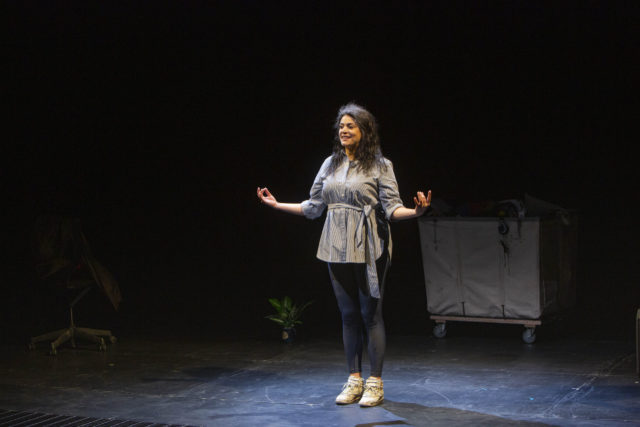
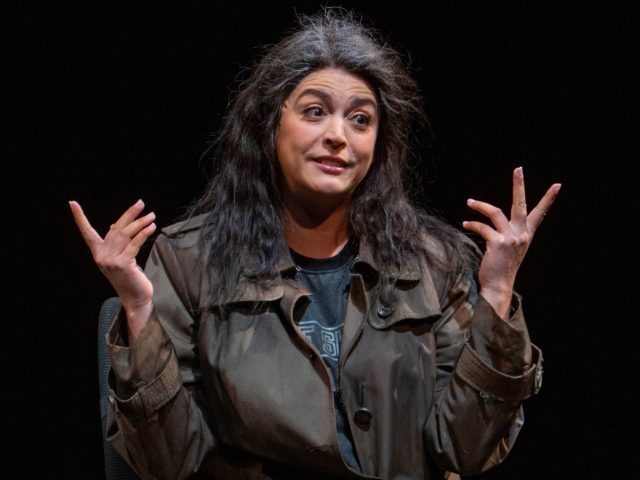
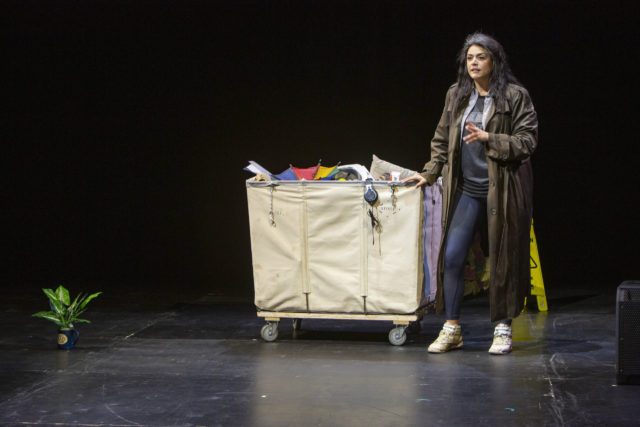
Naima Mora portrays different versions of herself in The Amazing Adventures of a Woman in Need (photos by Harris Davey)

Who: Naima Mora
What: On-demand livestreamed solo show The Amazing Adventures of a Woman in Need
Where: Vimeo
When: Through November 11, $10
Why: In the prologue to her debut solo show, The Amazing Adventures of a Woman in Need, Naima Mora, wearing jeans and a tight white tank top, holding a pink rose, describes the day in Harlem in 2002 when she realized she needed to turn her unhappy, unsatisfying life around. “I sit alone in my room, on my bed, wondering how I got here, wondering why I’m in this hell of a city, wondering why I’m killing myself to be here, wondering why my hair is falling out, wondering why I partied all night shoveling drugs up my nose, wondering why I’m sabotaging myself,” she says. “And then, I have to cradle myself, be gentle with myself, fall in love with myself, breathe and try to forget the last eight hours, and then forgive myself: forgive myself for being a drunk, for wanting insatiable fun to fill a void and forget the disappointment that I have with myself. And to myself, in my room, on my bed, guilt having settled in, and a little bit of a panic attack, just a little bit, I think to myself, I forgive you. I forgive you for being a fucking mess.”

Mora then admits, “Now, I’ve lived many lives: a supermodel, a crazy woman, and a gold digger, but I still haven’t really lived. So why not tell my story. I need to tell my story. I need to get this shit out of my body and out of my head. I need to rid myself of this self-inflicted destruction.” For the next seventy-five minutes, Mora portrays each of those characters, Penelope the supermodel, who can’t get a runway job anymore; the quirky Joanne, who suffers miscarriages and spends time in a psychiatric hospital; and Marisol Yanette Arnelis Rodriguez Lopes, a ritualistic woman facing too much solitude, offering such life lessons as “Get Your Hands Off My Peach Fuzz” and “Checkmate the Seduction: Train the Eggplant.” The set features a chair, a table, and a couch, a few props, and a screen on which photographs are projected.

An America’s Next Top Model winner, actress, author, and inspirational speaker, Mora who was born in Detroit in 1984, is barely recognizable in the roles, immersing herself fully into them, each with very different costumes, accents, hair, and movement. Directed and cowritten by Brooklyn native Marishka S. Phillips, The Amazing Adventures of a Woman in Need is a deeply intimate tale that also provides a roadmap for personal introspection; watching Mora deal with her issues so openly is likely to encourage audiences to do the same.

The show was recorded live with an audience at the Triad Theater on October 16 and continues on demand through November 11. Mora bravely puts herself out there as she battles her demons in public; she also traced the development of the play on social media. In a Twitter post, she wrote, “My director is pushing me to my limits this week. Asking me to expand and literally stretch my artistic muscle for our show coming up in just 2 days!!! This has truly been a transformative experience.”

MORNING SUN

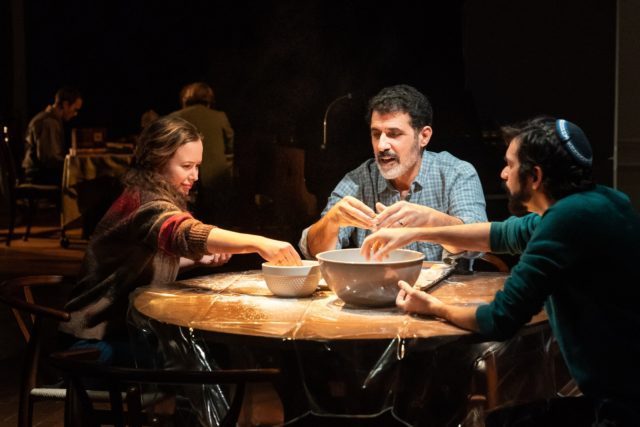
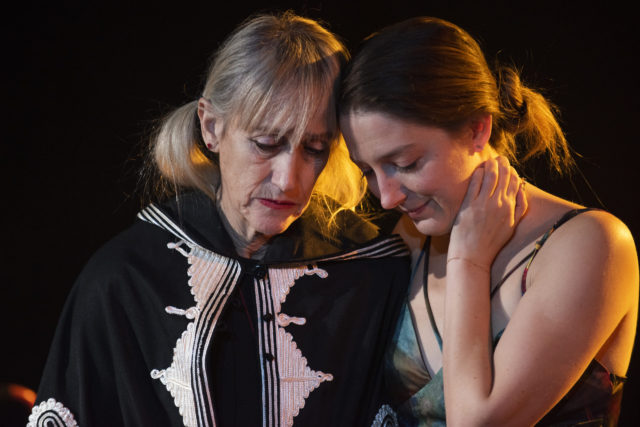
Edie Falco, Marin Ireland, and Blair Brown are extraordinary as three generations of one family in Morning Sun (photo © Matthew Murphy 2021)

MORNING SUN
Manhattan Theatre Club
MTC at New York City Center – Stage I
131 West 55th St. between Sixth & Seventh Aves.
Tuesday – Sunday through December 19, $99-$109
212-581-1212
www.manhattantheatreclub.com

Tony winner Simon Stephens’s Morning Sun opened tonight at New York City Center’s Stage I, starring three sensational actresses: Tony winner and Emmy nominee Blair Brown, Emmy winner and Tony nominee Edie Falco, and Tony nominee Marin Ireland. They play three generations of women in the McBride clan: Falco is Charley McBride, Brown is her mother, Claudette, and Ireland is Charley’s daughter, Tessa. The script identifies them as 1, 2, and 3, respectively; while Falco is Charley throughout the hundred-minute Manhattan Theatre Club production, Brown and Ireland also portray numerous other characters, including friends, relatives, and lovers, reenacting moments from the past without changing costumes and altering their demeanor only slightly if at all. It sometimes takes a few lines for the audience to figure out one of these transitions, to discern who is speaking, but that’s part of the play’s attraction.

The structure can’t help but call to mind Edward Albee’s 1991 Pulitzer Prize–winning play, Three Tall Women, in which a trio of sensational actresses — most recently Glenda Jackson, Laurie Metcalf, and Alison Pill in the show’s 2018 Broadway debut — portrayed three generations of unnamed women who the script identifies as A, B, and C. From the very start of Morning Sun, however, Stephens references not only Edward Albee but also artist Edward Hopper, and it’s clear that these women live in a different social class than the triad of Three Tall Women and that Stephens’s project is very different from Albee’s.

The show begins with an obtuse conversation that sets the mood and signals what is to come next:

Charley: Am I safe?
Tessa: You ask yourself.
Claudette: And I can’t really understand your question.
Charley: I want to know if I’m safe.
Claudette: Please be quiet.
Charley: I’m very scared. I’m very confused it’s very bright here please just tell me whether or not I am safe.
Claudette: I don’t understand what you’re trying to tell me.
Tessa: Here. Hold her carefully.
Claudette: The way your face scrunches up and the noise that you make and how I know I’m supposed to feel and the difference between that and how I actually do feel —
Charley: Just tell me.
Claudette: Here. Come here. Come here.
Charley: Am I safe? That’s all I’m asking. It’s not a very difficult question to understand, is it? Is it? It’s not. No. It isn’t.

Charley McBride (Edie Falco) and Brian (Marin Ireland) discuss Edward Hopper in Manhattan Theatre Club world premiere Morning Sun (photo © Matthew Murphy 2021)

In chronological order, Claudette, Charley, and Tessa discuss seminal moments in their lives, reflecting on their successes and failures, as one character often narrates what is happening to the other in the second person. Tessa tells her grandmother, “One morning at the end of summer you take a train to Penn Station walk two blocks up Seventh and get a job in the Macy’s haberdashery department. That night you find a rent controlled fifth floor walk-up on Eleventh Street in the West Village. Two bedrooms. A railroad apartment with a tub in the kitchen and a view of the courtyard to the south side of the building. And if you crane your neck you can see the Hudson.” Claudette says, “I love it completely. . . . And I never live anywhere else. . . . For the rest of my life.”

The women introduce us to Claudette’s brother-in-law, Stanley; her husband, Harold; Charley’s best friend, Casey; an airplane pilot in a bar; a museum guard named Brian; and others, looking back as if they are all ghosts. Indeed, the play takes place in a nonspecific time, a kind of way station, where some of the characters have already passed away. At one point, Uncle Stanley tells Charley that the Cherry Lane Theatre is haunted. “There’s no such thing as ghosts,” Charley says. “Don’t you think?” he responds. “No I don’t. And there’s no way of making me think otherwise. So don’t try,” she says. “If there’s no such thing as ghosts, then why do they need a ghost light?” he asks. Charley: “What’s a ghost light?” Stanley: “It’s a light they keep on in the theater all night to keep the ghosts away.” A moment later, Stanley adds, “A ghost is an interruption,” which evokes the eighteen months of the pandemic lockdown, when theaters were empty, ghost lights on.

Place is essential to the play, which is set in Claudette’s West Village apartment. To the left is a clothes closet, to the right a piano and a working kitchen with running water and electricity, and in the center is a large, open area with a couch, a chair, and a bench, backed by half a dozen high-set windows. (The set is by dots, with lighting by Lap Chi Chu, sound by Lee Kinney and Daniel Kluger, and costumes by Kaye Voyce.) The characters move about the space almost like ghosts, occasionally appearing like they’re in a Hopper painting. The show is named after Hopper’s 1952 canvas Morning Sun, in which a lonely woman (the model is Hopper’s wife, painter Jo Nivison, the only female who ever posed for him) sits on a bed facing an open window, her hands gripping her legs, feet in front of her, the light forming an ominous rectangle on the wall. She peers outside as if there’s something she’s lost, something she can’t get back. It’s reminiscent of such other Hopper works as Cape Cod Morning, Western Motel, Eleven A.M., Morning in a City, and A Woman in the Sun, which all feature women seemingly trapped in an isolation they can’t escape.

Claudette was born and raised in Nyack, Hopper’s hometown in Rockland County. The titular painting plays a key role in the narrative, such as when Charley meets Brian, the museum guard, while looking at it. Charley tells him, “I like finding Edward Hopper paintings and thinking this is where I came from. Morning Sun. I like the strange expression on the woman’s face and wondering what she’s staring at and if she’s thinking about what she’s staring at or if her face is just kind of frozen because she’s gone to somewhere in her head that she can’t ever talk about.” Referring to the edifice that can be seen through the window, Brian points out, “I like trying to figure out what that building is.” Charley offers, “It could be a prison.”

Impeccably directed by Lila Neugebauer (The Wolves, Edward Albee’s At Home at the Zoo, The Waverly Gallery), the show also made me think of Hopper’s New York Movie, in which a woman, bathed in light, hand on chin, stands just outside the seating area of a theater, perhaps contemplating whether she wants to sit down and join the crowd, be part of something. In the age of Covid, it now evokes the pandemic lockdown and the tentative return of audiences to theaters, but it also relates to the loneliness that Claudette, Charley, and Tessa experience in their daily lives; they might have one another in this surreal conversation happening onstage, but they each harbor fears of being alone.

Marin Ireland is extraordinary playing Tessa McBride and several other characters in latest Simon Stephens play (photo © Matthew Murphy 2021)

They rejoice in New York City — among the locations mentioned are the White Horse Tavern, Peter McManus, Shea Stadium, the old Penn Station, Wollman Rink, Washington Square Park the New School, and the High Line — but they bond to Joni Mitchell’s “Song to a Seagull,” in which Mitchell sings, “I came to the city / And lived like old Crusoe / On an island of noise / In a cobblestone sea / And the beaches were concrete / And the stars paid a light bill / And the blossoms hung false / On their store window trees.” The three women are together, but they are alone.

Brown (Copenhagen, Arcadia, Mary Page Marlowe), Falco (The True, Frankie and Johnny in the Clair de Lune), and Ireland (Reasons to Be Pretty, Blue Ridge, On the Exhale) are exquisite, portraying their complex characters with a gentle ease that is intoxicating, as if we’re spending quality time in front of a great painting. The drama leisurely but compellingly proceeds at a calm pace as the characters move about the stage, sometimes gathering at the small table in the kitchen, other times sitting so far apart it is as if they are in separate canvases, hung nearby on a wall.

Stephens is a writer with breathtaking skill, whether penning a charming two-character drama about a pair of loners who meet at a London Tube station (Heisenberg), a major spectacle about the murder of a pooch (The Curious Incident of the Dog in the Night-Time), an intimate one-man show dealing with horrific tragedy (Sea Wall), a postapocalyptic nightmare told with blindfolds and through headphones (Blindness), or a profound exploration into the lives of three generations of New York women. Morning Sun is a masterful artistic rendering of three ordinary, intertwined lives continually trying to find their unique path while battling solitude, like an Edward Hopper painting come to life, the subjects ever peering out the window, considering what is, what was, and what could have been.

Talking with Casey about Tessa, Charley says, “I want her to look back on me when she’s an adult and know that I did my best for her and that I always tried even if sometimes I let her down.” Casey replies, “We all let each other down,” to which Charley responds, “But that I did my very, very best.” What more can we ask of each other, in life and in art?

BERTOLT BRECHT’S THE MOTHER (a learning play)

Pelagea Vlasov (Kate Valk) has some qualms with the butcher (Ari Fliakos) and his wife (Erin Mullin) in The Mother (photo by Nurith Wagner-Strauss / Wiener Festwochen)

THE MOTHER
The Wooster Group
The Performing Garage
33 Wooster St. between Grand & Broome Sts.
Tuesday – Saturday through November 20, $40
Return engagement: February 18 – March 19, $30-$40
thewoostergroup.org

It’s hard to believe that in its nearly half-century existence, the Wooster Group has never before presented a work by Bertolt Brecht, the German modernist whose revolutionary ideas about theater appear to be right in line with the experimental Soho company’s vision. So it’s exciting not only that the Wooster Group is now tackling Brecht’s seldom-performed 1932 play, The Mother, but has done such a fine job with it.

Not to be confused with Brecht’s more well known anti-Fascist Mother Courage, The Mother is one of Brecht’s Lehrstücke, a learning play meant to bring the actors and the audience together while also taking a social stand. “The aim was to teach certain forms of political struggle to the audience,” Brecht wrote in 1933 about the show when it was at the Schriften zum Theater. “It was addressed mainly to women. About fifteen thousand Berlin working-class women saw the play, which was a demonstration of methods of illegal revolutionary struggle.”

Based on Maxim Gorky’s 1906 novel, the play is built around the simple and illiterate Pelagea Vlasov (Kate Valk), who just wants to make tea and soup and protect her son, Pavel (Gareth Hobbs), who recently had his pay cut by a nickel an hour. “Me, I’m no help to him anymore,” she says. “I’m a burden.”

Pavel is involved with a pair of radicals, Semjon (Ari Fliakos) and Masha (Erin Mullin), who are illegally handing out leaflets calling for a strike against the powerful Suklinov factory. They are assisted by a teacher named Fyodor (Jim Fletcher) who doesn’t believe that their actions will lead to any viable change.

“Like the crow in the snowstorm, feeding her baby, she can’t feed her, what does she do? No way out, no way out. And crows are the smartest animal in the world, after humans,” the teacher talk-sings. “Whatever you do / It won’t be sufficient. / The situation’s bad / It gets worse. / It can’t go on like this / But what is the way out?”

The Wooster Group rehearses its unique interpretation of Bertolt Brecht’s The Mother (photo by Erin Mullin)

When she discovers what Pavel is up to, Pelagea turns courageous, demanding to hand out the leaflets herself so her son can be safe. A policeman (Fletcher) starts sniffing around, so Pelagea moves in with the teacher, who is not thrilled that his calm life has suddenly been upended. After the workers’ representative, Karpov (Fliakos), returns with an unsatisfactory deal, the revolutionaries sing, “Good, this is the breadcrumb / Ah, but where is / The whole loaf?” Events get ever-more dangerous as Pelagea takes up the cause, praising Communism, while the police, factory sympathizers, and strikebreakers loom in every corner.

In true Wooster Group style, The Mother is wildly unpredictable, hysterically funny, and emotionally poignant, winding itself in and out of Brecht’s words. Addressing the audience following the song “Praise of Communism,” the teacher explains about Brecht, “You know, for somebody who says he doesn’t want emotions in the theater, there’s a lot of emotion in that song, you know — it’s the end of madness, it’s the end of crime, is that not sentimental?” Props are smashed and then replaced. Projections by Irfan Brkovic on the back wall and a monitor focus on the factory town and a rallying flag, with original music by Amir ElSaffar.

The set, built by Joseph Silovsky, consists of a long table where the characters often sit, interacting with a laptop and the script itself; a small room where Pelagea worries about her son; a clothesline used for multiple purposes; a chalkboard where Fyodor writes important words; two doors that are labeled “Way” and “Out,” a sly reference to the song “The Question of the Way Out”; and a keyboard played by Pavel. There’s also a monitor above the audience that shows old crime movies, dictating the pace and enhancing the themes for the performers. Cofounding artistic director Elizabeth LeCompte ably brings those disparate elements together through eighty tense minutes and eleven scenes, including “What can a mother do?,” “The Mother gets a lesson in economics,” and “The war is here.”

WG founding member Valk and Fletcher (the teacher, the policeman, the prison guard, a strikebreaker) are always a joy to watch, and they lead the way in this stellar production. Fliakos (Semjon, Karpov, the gatekeeper, jobless Gorski, Vasil the butcher) and Mullin (Masha, the butcher’s wife, the Bible lady) stand right with them through minor costume changes and musical breaks. No one portrays the worker Smilgin because, as the narrator explains, they didn’t have enough money in the bank.

Speaking of money, LeCompte points out in a program note that a “spirit of repurposing” guided the show. “Nearly everything in the production has been repurposed from previous Wooster Group works. This includes performers, ideas, set elements, and all but two props: the aqua typewriter and yellow telephone. In addition to Brecht and Gorky, the company used such sources as educational media (PeeWee’s Playhouse, Kukla, Fran, and Ollie), Slavoj Žižek’s YouTube videos, the 1958 German version for the Berliner Ensemble, Rainer Werner Fassbinder’s Mother Küsters Goes to Heaven, Quentin Tarantino’s Once Upon a Time in Hollywood, books by and about Brecht, and 1930s gangster movies on TCM.

Continuing at the Performing Garage through November 20 (the show is back for a return engagement February 18 – March 19), The Mother was initially supposed to premiere in 2020, but the group took advantage of the additional pandemic downtime by continuing to work on it. (It debuted in June 2021 at Vienna’s Wiener Festwochen.) During the lockdown, I watched several videos Wooster posted about their progress, and their process, not all of which made the final cut — if a production like this can ever be called final. The script has a warning that “it may contain text that no longer appears or has been changed, and it may lack text that has been added for a given performance.”

Just as Brecht, in writing The Mother, was teaching about political struggle and theatrical form (he called the play “a piece of anti-metaphysical, materialistic, non-Aristotelian drama — that is, dramatically seen, of a very highly developed type”), the Wooster Group is teaching political struggle and Brecht himself to the audience, which is seated on mats on risers, with no backs. It’s been done previously as a melodrama, a call to action, and a politically driven full-on musical, but the Wooster Group has made it into something else entirely.

SHEEP #1

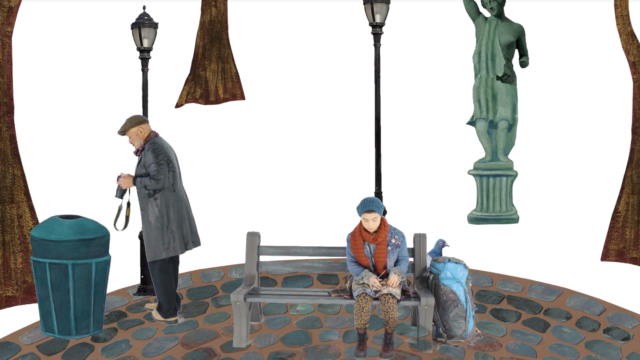
Sachiyo Takahashi’s Sheep #1 is at Japan Society November 4-7 (photo © Skye Morse-Hodgson)

SHEEP #1
Japan Society
333 East 47th St. at First Ave.
November 4-7, $23
212-715-1258
www.japansociety.org

Shortly after crash landing in the Sahara Desert, the isolated pilot narrator of Antoine de Saint-Exupéry’s Le Petit Prince recalls, “You can imagine my surprise when I was awakened at daybreak by a funny little voice saying, ‘Please . . . Draw me a sheep . . .’” After several failures, the pilot draws a picture of a crate, explaining that the sheep is inside. The boy, aka the little prince, is very happy, noting, “Where I live, everything is very small.”

Japan-born, Brooklyn-based visual artist Sachiyo Takahashi uses that section of Saint-Exupéry’s classic book, which also explores differences between grown-ups and children, in Sheep #1, which runs November 4–7 at Japan Society. Sachiyo tells the story using small puppets from Nekaa Lab, which she founded in 2006, projected onto a screen to make them look life-size (or bigger). The cast includes Sheep, who claims not to act but to play, and Rabbit, who says Nekaa Lab is “an eternal playground for the curious mind.” Among the other lab members (stuffed toys and figurines) are Cat and Polar Bear.

Sheep #1 is an example of Sachiyo’s Microscopic Live Cinema-Theatre, which tells stories using objects, live music, and camera projections and is able to, in Cat’s words, “even magnify the hidden emotions.” The wordless show, which made its US debut at the Tank in 2018, will be performed and projected live by Sachiyo, with pianist Emile Blondel playing original music with excerpts from Franz Schubert on Friday and Saturday and bassist Kato Hideki playing an original score on Thursday and Sunday, accompanying Sachiyo’s electroacoustic soundtrack.

The opening-night show will be followed by a reception with the artists. Sachiyo, who has been awarded several grants from the Jim Henson Foundation, has previously staged such works as Everything Starts from a Dot and Not Outside, which also starred Sheep, in addition to performing as Miya Okamoto in such Shinnai-bushi sung-storytelling presentations as Shinnai Meets Puppetry: One Night in Winter and the upcoming The Emotions.