this week in lectures, signings, panel discussions, workshops, and Q&As

MOBILE UNIT’S SUMMER OF JOY

THE PUBLIC THEATER’S MOBILE UNIT
Multiple locations in all five boroughs
July 31 – August 29, free
publictheater.org

The Public Theater’s Mobile Unit is back on the road after being sidelined by the pandemic lockdown last year, bringing free pop-up Shakespeare to locations across the five boroughs. “I always felt that we should travel,” Public founder Joseph Papp said once upon a time. “I wanted to bring Shakespeare to the people.” The Public has been doing just that in one form or another since 1957; this summer the Mobile Unit, in its tenth year, will be bringing two productions to plazas and squares from July 31 to August 29. Each presentation begins with the National Black Theatre’s Stage for Healing and Resilience, which will provide a space for reflection, meditation, and sharing. That will be followed by Verses @ Work — The Abridged Mix, Mobile Unit in Corrections artist Malik Work’s one-man show that incorporates verse, video, live music, musical theater, jazz, hip-hop, spoken word, and dance. Coproduced by the Public with NBT and directed by Vernice Miller, the autobiographical piece, inspired in part by Homer’s Odyssey, was nominated for a 2017 Audelco Award for Best Solo Performance and was turned into a film; Work has also staged a one-man adaptation of Timon of Athens and teaches Shakespeare, acting, and hip-hop theater. The free afternoon concludes with the hourlong Shakespeare: Call and Response; conceived by director Patricia McGregor, it features Sofia Jean Gomez, Teresa Avia Lim, Reza Salazar, and Work interacting with the audience through text, music, dance, and improv, playing multiple roles anchored by an MC and DJ duo rapping in iambic pentameter, with scenic design by Diggle, costumes by Katherine O’Neill, sound by Jorge Olivo, and choreography by Paloma McGregor (Patricia’s sister).

“The Mobile Unit is the purest expression of the Public’s conviction that the culture belongs to everyone. Our return this summer is a thrilling and responsive artistic expression born from this historical moment. We are responding to the call of community and creating a unifying embodiment of theater for this city,” Public artistic director Oskar Eustis said in a statement. Mobile Unit director Karen Ann Daniels added, “It is essential for the Mobile Unit to build something that could speak to the moment — a unique format that would reinvigorate our communal spaces and our connection to each other. We all came to the table with a strong sense that it is only through the creation of our art, and inviting our community’s participation in it, that we could offer healing, resilience, and the unbridled joy of the simple act of gathering.” The tour begins July 31 and August 1 at Astor Plaza, moving August 5-6 to Roberto Clemente Plaza, August 7-8 to Johnny Hartman Plaza, August 12 and 28-29 to Osborn Plaza, August 13 and 20 to Albee Square, August 14-15 to 125th Street Plaza, August 19 and 26-27 to Minthorne Street, and August 21-22 to Myrtle/Wyckoff Plaza; all shows are at 4:30 except for August 7-8, which start at 2:00. Also joining in the “Summer of Joy” will be the People’s Bus, a community-led initiative that repurposes a retired NYC prisoner transport vehicle into a mobile center that provides “resources and education to restore and build trust in our democracy.”

ALICE NEEL: PEOPLE COME FIRST

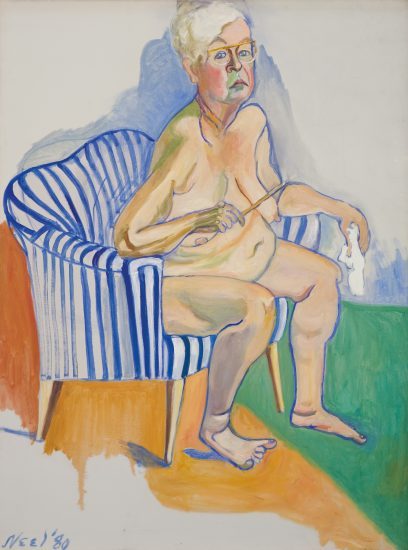
Alice Neel, Self‑Portrait, oil on canvas, 1980 (National Portrait Gallery, Smithsonian Institution, Washington, DC / © the Estate of Alice Neel)

ALICE NEEL: PEOPLE COME FIRST
Met Fifth Ave.
1000 Fifth Ave. at 82nd St.
Through August 1, pay-what-you-wish to $25
www.metmuseum.org

I well remember going to El Museo del Barrio for its fortieth anniversary reopening back in the fall of 2009 after an extensive renovation. I was blown away by the centerpiece of the exhibition “Nexus New York,” a section devoted to the relationship between American painter Alice Neel and Cuban artist Carlos Enríquez, who were married in 1925. Neel is now the subject of a revelatory show continuing at the Met Fifth Ave. through August 1, “Alice Neel: People Come First,” which focuses on her portraiture, from the men in her life to the women and children who evince the beauty and fragility of pregnancy and motherhood.

Neel was born in Merion Square, Pennsylvania, in 1900, lived with Enríquez’s family in Cuba for a short time, then came back to America, where she resided in Greenwich Village before moving to Spanish Harlem for more than two decades. She had two children with Enríquez: Santillana, who died of diphtheria before the age of one, and Isabetta, who Enríquez took back to Cuba when he left Neel in 1930. A few years later, after Neel had a breakdown and spent time in a sanitorium, a relationship with sailor and heroin addict Kenneth Dolittle ended with his destruction of hundreds of her drawings, watercolors, and personal items. She attempted suicide at least twice. In 1939, she had a son, Richard, with the younger, married Puerto Rican musician José Santiago Négrón, following a 1937 miscarriage. In 1941, Neel had another son, Hartley, with Communist activist Sam Brody, whom she was with on and off for fifteen years.

Her biography is integral in appreciating the Met survey, which is expertly curated by Kelly Baum and Randall Griffey with Brinda Kumar. Stretching across eight thematic galleries, the show is filled with what Neel simply called “pictures of people” but were so much more than that, canvases alive with brutal honesty and an unwavering eye for personal identity. As she said in 1950, “For me, people come first. I have tried to assert the dignity and eternal importance of the human being.” In doing so, she also takes back the power of being a woman in what was deemed a man’s world, inherently battling discrimination, class and gender bias, and even, to a point, abstraction in portraits as well as still lifes, landscapes, and city scenes.
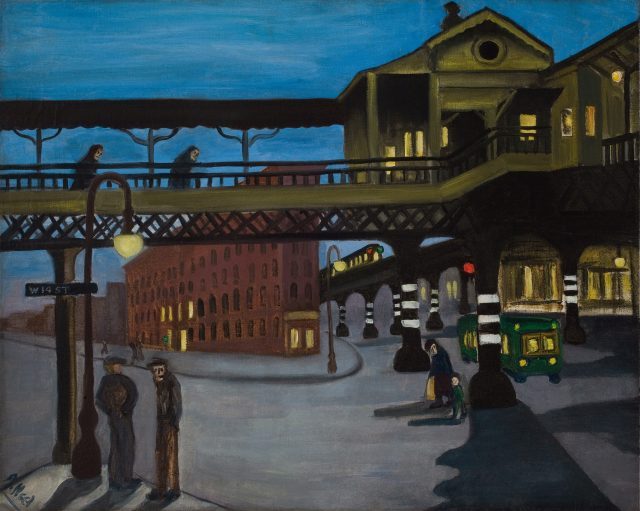
Alice Neel, Ninth Avenue El, oil on canvas, 1935 (Cheim and Read, New York / © the Estate of Alice Neel)

“Alice Neel: People Come First” is divided into “New York City,” “Home,” “Counter/Culture,” “The Human Comedy,” “Art as History,” “Motherhood,” “The Nude,” and “Good Abstract Qualities.” Her unflinching works do what only the finest portraits do, whether the realism of Hans Holbein, the idiosyncratic nature of Pablo Picasso, the elegance of John Singer Sargent, the royal gaze of Diego Velázquez, or the reimagining of the Old Masters of Kehinde Wiley. “One of the reasons I painted was to catch life as it goes by, right hot off the griddle, because when painting or writing are good, it’s taken right out of life itself, to my mind,” she says in a passage on the audio guide taken from an old interview. “The road that I pursued, and the road that I think keeps you an artist, was that no matter what happened to me, you still keep on painting; you just should keep on painting no matter how difficult it is, because this is all part of experience, and the more experience you can have, the better it is, unless it kills you, and then you know you’ve gone too far.”

The show consists of more than one hundred of Neel’s paintings and drawings, displaying her immense skill at creating compelling, intensely psychological narratives out of the every day. In 1933’s Investigation of Poverty at the Russell Sage Foundation, painted when Neel was employed in FDR’s Public Works of Art Project, a woman dressed in black, a homeless mother of seven, sits in the center of a room, head bowed, hands held up to her face, as ten men in suits, two women, and a priest are gathered around her, unsure if there is anything they can do to help her. The painting is accompanied by a rare preparatory sketch of two of the men, who themselves have come to ask for assistance from the foundation. In the same year’s Synthesis of New York — The Great Depression, which had been slashed by Dolittle but was repaired, men, women, and children with skulls for faces walk under the el train as two angelic mannequins, one headless, perhaps from the commercial building at the middle of the canvas, hold up a sunlike object on a gray, cloudy day. In Thanksgiving (1965), a decrepit-looking turkey is in the corner of a kitchen sink as if just another object like the nearby can of Ajax. A trio of still lifes, including Black Bottles (1977), are bright and colorful, providing contrast to many of the darker works.

But it’s the portraits that are at the heart of the exhibition. Neel’s 1970 painting of Pop Art icon Andy Warhol shows the shirtless bon vivant sitting on a sketched couch, hands folded on his knees, eyes closed, breasts sagging, scars from his recent shooting clearly visible. In Kenneth Fearing (1935), the poet, novelist, and essayist, cigarette dangling from his mouth, dominates his surroundings like a giant, with a skeleton in the left of his chest because, Neel said, “His heart bled for the grief of the world.” Works such as Puerto Rican Girl on a Chair (1949), Mercedes Arroyo (1952), and Georgie Arce No. 2 (1955) capture the people in her neighborhood, from activist to kids on the street.
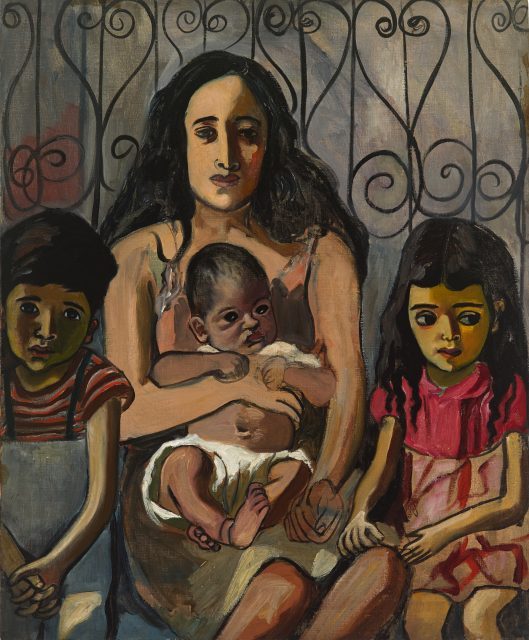
Alice Neel, The Spanish Family, oil on canvas, 1943 (Estate of Alice Neel / © the Estate of Alice Neel)

The canvases of pregnant women and mothers with their children are what take the exhibition to another level. There are no smiles in The Spanish Family (1943), in which Négrón’s sister-in-law, Margarita, is seen with her three children. A vertical painting of Isabetta from 1934-35 depicts the young child, not yet six, standing naked, defiantly with hands on her hips; it was painted from a photograph, as mother and daughter never had a close relationship. In a sign of the times, the wall label explains, “The frank nudity of the young child disconcerted viewers then and continues to raise legitimate questions now around consent and children’s bodily autonomy.” In Margaret Evans Pregnant (1978), a naked Margaret Evans, her belly bulging with twins, is on a gold duvet, staring at the viewer, part of her reflected in a mirror behind her. In the ink on paper Mother and Child (1956), a woman is lifting her blouse so her infant can suckle. The subject of Pregnant Maria (1964) evokes the classic reclining nude, as a naked woman, belly bursting, breasts swollen, reveals her body, flaunting her sexuality.

There are two paintings of Neel’s son Hartley, one from 1943, with a young, blue-eyed Hartley on a rocking horse, the other from 1966, with an assured, grown Hartley on a chair, wearing a T-shirt, his hands clasped on his head, his face very similar to a 1943 painting of her son Richard, also in a chair, his left leg crossed over his right. Neither appears completely relaxed or comfortable.

Three works explore Neel as a mother and a daughter. In the ink and gouache City Hospital (1954), Neel’s mother is hunched over in a wheelchair in a hospital ward in the last year of her life. In Well Baby Clinic (1928-29), Neel returns to the hospital ward for lower-class women where she gave birth to Isabetta; the two are in the far middle right amid swirling activity. And finally, in her 1980 Self-Portrait, Neel is fully nude, sitting in a blue-and-white-striped chair, holding a slender paintbrush in her right hand, a white cloth in her left. She leans forward, her sagging skin at the center of the canvas, her lips downturned, her feet at awkward angles on a floor separated into different colors. It took her five years to finish what would be her only painted self-portrait. “Life begins at seventy!” she once declared. Neel passed away in 1984 at the age of eighty-four, leaving behind a legacy that is well served by this extraordinary retrospective.

(You can watch several virtual programs about the show on the Met website, including “Alice Neel and Spanish Harlem or El Barrio” with artist Miguel Luciano and curator Susanna Temkin, “Hilton Als on Alice Neel” with Als and Baum, and “Alice Neel and Gay Liberation” with Griffey. In addition, the audio guide features contributions from artist Jordan Casteel and curator Jasmine Wahl.)

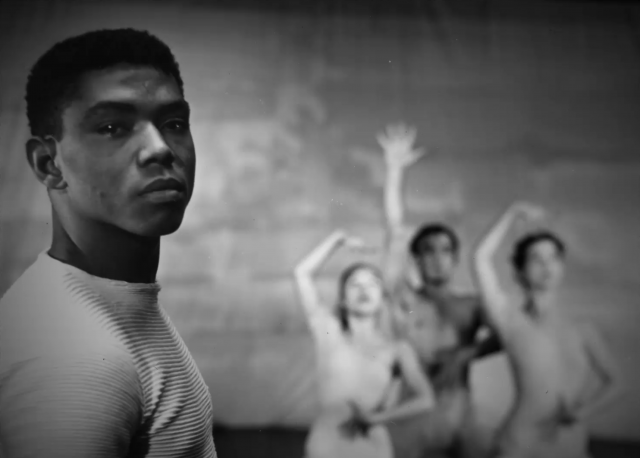
AILEY

The life and career of Alvin Ailey is explored in new documentary opening in theaters July 23

AILEY (Jamila Wignot, 2021)
Angelika Film Center
18 West Houston St.
Film Society of Lincoln Center, Elinor Bunin Munroe Film Center, Howard Gilman Theater
144 West 65th St. between Broadway & Amsterdam Ave.
Opens July 23
neonrated.com/films/ailey

“We’re gonna do something, we’re gonna create . . . whatever it is, it gotta be good,” choreographer Rennie Harris says at the beginning of Ailey. The American Masters documentary, which opens July 23 at the Angelika and Lincoln Center, is good but sometimes overshadowed by how it could have been better.

Directed by Jamila Wignot’s (Town Hall, Walt Whitman) and edited by Annukka Lilja, the film cuts back and forth between rare archival footage of Alvin Ailey, who was born in Texas in 1931 and died from AIDS in 1989 at the age of fifty-eight; new interviews with former members of the Alvin Ailey American Dance Theater; and Harris and the company rehearsing Lazarus, the Philadelphia-born choreographer’s specially commissioned 2018 ballet celebrating the life and legacy of Ailey. “Mr. Ailey talked about blood memories — what his parents went through, what his parents’ parents went through, what his folk went through. And that was a major key for me — memory. That was the anchor,” Harris, the troupe’s inaugural artist-in-residence, explains about his motivation in creating the company’s first two-act ballet.

The film focuses on how Kennedy Center Honoree Ailey’s personal experiences directly impacted his work, from being raised by a single mother in difficult circumstances, to his homosexuality, to fighting racial injustice and being an important influence on the Black community, incorporating traditional African movement and American jazz to construct pieces unlike any ever seen before. “Alvin entertained my thoughts and dreams that a Black boy could actually dance,” former AAADT company member George Faison remembers. “It was a universe that I could go into, I could escape to, that would allow me to do anything that I wanted to.”

In a 1988 interview, Ailey says, “You have to be possessed to do dance,” and he was from an early age. The documentary includes clips from such works as 1958’s Blues Suite, a party set to traditional songs performed by Brother John Sellers; 1969’s Masekela Langage, which takes on racial violence and the prison system; 1971’s Cry, a solo for Judith Jamison that was a birthday present for Ailey’s mother; 1971’s Flowers, inspired by the life of Janis Joplin; 1979’s Memoria, a tribute to his late friend and colleague Joyce Trisler; and 1983’s Fever Swamp, Bill T. Jones’s athletic piece for six male dancers. The film also digs deep into Ailey’s most famous ballet, Revelations, the 1960 masterpiece that explores the richness of Black cultural heritage. “We didn’t have to go out on the street and protest; our protest was on the stage,” Faison says. “This was our march to freedom.”

In addition to Jones, Jamison, and Faison, also sharing stories about Ailey are current AAADT artistic director Robert Battle, original company member Carmen de Lavallade, former rehearsal directors and associate artistic directors Mary Barnett and Masazumi Chaya, stage manager and executive director Bill Hammond, and former company dancers Don Martin, Linda Kent, Sylvia Waters, Hope Clark, and Sarita Allen. Barnett calls Ailey’s dances “a reenactment of life,” while de Lavallade, who is shown dancing with Ailey back in the 1950s, notes, “Sometimes your name becomes bigger than yourself. Alvin Ailey — do you really know who that is, or what it is?”

The film would have benefited by Wignot (Town Hall, Walt Whitman) spending more time with Harris and the current Ailey dancers preparing Lazarus, which premiered in 2018 as part of the “Ailey Ascending” sixtieth anniversary season. The scenes were shot at the company’s home studio on West Fifty-Fifth St., a sharply white, brightly lit space with windows on two sides, in contrast to the grainy black-and-white videos and personal photographs tracing Ailey’s life and career that are spread throughout the film.

Last week, Rosalynde LeBlanc and Tom Hurwitz’s Can You Bring It: Bill T. Jones and D-Man in the Waters opened at Film Forum, a thrilling look at the 1989 dance by Bill T. Jones/Arnie Zane Company that dealt with the AIDS crisis; the documentary details the original conception of D-Man in the Waters while also following Loyola Marymount dancers as they get ready to perform the piece in 2016, as the directors zero in on humanity’s evolving relationship with tragedy and art across generations. In Ailey, that connection is much less clear, and the contemporary rehearsal scenes feel out of place, especially without the grand finale of a fully staged production of Harris’s homage. (You can watch a brief excerpt of Lazarus made during the pandemic here. AAADT will also be performing August 17-21 at the BAAND Together Dance Festival on Lincoln Center’s Restart Stage at Damrosch Park, featuring Lazarus and Revelations, and the company just announced that its annual New York City season will take place December 1-19 at City Center.)

Even so, Ailey offers a compelling portrait of one of the most important choreographers of the twentieth century, an extraordinary man who changed the way we look at dance and Black culture. Wignot will be at the Angelika for Q&As at the 7:30 screening on July 23 and the 12:45 show on July 24; she will also be at the Howard Gilman Theater at Lincoln Center for a Q&A with Battle, moderated by National Black Justice Coalition executive director David Johns, on July 23 at 6:15 and with Waters, moderated by author, professor, and Shubert board member Pamela Newkirk, on July 24 at 6:15.

TICKET GIVEAWAY: CROSSOVERS LIVE! WITH BRIAN STOKES MITCHELL

Who: Brian Stokes Mitchell, Vanessa Williams, Daniel J. Watts, Marc Shaiman, Bernadette Peters, Kristin Chenoweth, David Hyde Pierce, more
What: Ticket giveaway for Crossovers Live! with Brian Stokes Mitchell
Where: Stellar
When: Premiering monthly July 26 – December 20, $15-$100 per show, six-show bundle $49-$500; use code BBS10 to save $10 on any six-show bundle through July 21 (benefiting the Actors Fund)
Why: Brian Stokes Mitchell was already a Broadway and television star when he reached a new stratosphere of fame for his nightly renditions of “The Impossible Dream” early in the 2020 pandemic lockdown in New York City. Delivered from the window of his Upper West Side apartment after the 7:00 pm clap for health-care workers, Stokes’s performances were part of his vocal retraining after a serious bout with Covid-19. He sang one of the hit songs from Man of La Mancha, a show that earned him a 2003 Tony nomination for Best Actor in a Musical, an award he had won in 2000 for Kiss Me Kate. The Seattle-born Mitchell, who has appeared in such other Broadway musicals as Jelly’s Last Jam, Kiss of the Spider Woman, and Ragtime and such TV series as Mr. Robot, Glee, and Trapper John, M.D. (in addition to a ton of voiceovers on animated programs), is now hosting his own online talk show, Crossovers Live!, which will stream live monthly July through December and be available on demand for a limited time.

In a promotional video, Mitchell — who has also been nominated for a Grammy, formed Black Theatre United in June 2020 with Audra McDonald, LaChanze, Billy Porter, Anna Deavere Smith, and others, and received the key to the city for his extensive work during the coronavirus crisis as chairman of the board of the Actors Fund — asks, “Do you like movies? TV shows? Miniseries? How about theater? Do you like theater? Like, really like theater? Do you like any medium that actors, composers, singers, writers, dancers could be on? We asked Vanessa Williams, Marc Shaiman, Bernadette Peters, Kristin Chenoweth, David Hyde Pierce, and more to talk about crossing over from stage to screen. And they all accepted because they love audiences, and audiences love them, and we all just love each other. You get it.” The show premieres July 26 with Williams (Soul Food, Kiss of the Spider Woman) and Daniel J. Watts (Tina: The Tina Turner Musical, The Last O.G.), followed August 30 with composer Shaiman (Hairspray, Mary Poppins Returns), September 27 with Peters (Annie Get Your Gun, The Jerk), October 25 with Chenoweth (Wicked, Glee), November 22 with Hyde Pierce (Spamalot, Fraser), and December 20 with a Holiday Finale. A minimum of ten percent of the net proceeds will benefit the Actors Fund.

TICKET GIVEAWAY: Tickets for Crossovers Live! with Brian Stokes Mitchell are $15 each, $25 for the show and access to the VIP chat room, and $100 for the Super VIP Livestream, which adds in signed merchandise. The six-show bundle is $49/$99/$500.

However, twi-ny is giving away two standard six-show bundles ($49) and one VIP bundle ($99) for free. In order to be eligible, you must like Crossovers Live! on Facebook and Instagram and, in addition, send your name, phone number, and favorite play, television show, or movie with Brian Stokes Mitchell in it to contest@twi-ny.com by Thursday, July 22, at 3:00 pm. All entrants must be twenty-one years of age or older; three winners will be selected at random. As Mitchell sings, “And the world will be better for this / Oh, that one man, scorned and covered with scars / Still strong with his last ounce of courage / To reach the unreachable, the unreachable / The unreachable star.”

RIDE SHARE

Marcus (Kamal Angelo Bolden) is on a dangerous road in Writers Theatre’s Ride Share

RIDE SHARE
Writers Theatre
Through July 25, $40-$100
Live Zoom talkback July 25 at 4:00
www.writerstheatre.org
www.blacklivesblackwords.org

“I hate my life,” Marcus (Kamal Angelo Bolden) says early on in the virtual one-man show Ride Share, a psychological thriller streaming from Chicago’s Writers Theatre through July 25.

Marcus believed he was on the right road, doing everything correctly. The thirty-three-year-old Black man had just married a lovely woman, Joselyn, at an $85,000 wedding and returned from their honeymoon in Aruba imagining only brightness in his future. He gets called in to work, expecting to be made partner after having put in twelve dedicated, difficult years. Instead, Craig, a white Yale grad who married the boss’s niece, informs Marcus that he is being laid off. “He tells me that I should . . . count this as a blessing, this leaves your path wide open for a great adventure ahead of you. Oh, and by the way, there’s a box waiting for [you] at the front desk.”

Devastated and desperate for money, Marcus becomes a driver for every ride-share company he can find. He shuttles passengers around Chicago in his white Kia from four to ten every morning and again from seven at night till past midnight, jeopardizing his relationship not only with his new wife but with his sanity. Standing atop his car, he details his preoccupation with his rating, like a day trader or a compulsive gambler:

“From the start, ratings have been the bane of my existence. In three months, I’ve earned the ranking of a platinum-level driver. I’ve driven 647 trips with a rating of 4.9, with 629 five-star reviews, 10 four-stars, 4 three-stars, 3 two-stars, and 1 one-star review. I watch these ratings like a hawk. It’s gotten so bad that now I tell people I’m gonna give them five stars in hopes that they do the same. I check these ratings after every ride. I check them again before I go to bed; my wife thinks that I’m obsessed with these ratings. She says, ‘You pay more attention to your ratings than you do to me.” I say, ‘Well, you’re not gonna downgrade me from platinum to blue. She laughed and then she said, ‘You better be careful because your ratings aren’t the only things that could turn blue.’ I love her so much. She’s my everything.”

He spends his down time trying to create better opportunities, learning Spanish by listening to Latin music and hanging out with the other drivers at the airport. “All of us waiting. Waiting for just one ride. Waiting to control our own destinies, waiting on the America dream, waiting.” As his disdain for his passengers grows, particularly for snarky businesspeople and young white women, so does information about a new disease, Covid-19. Then fate steps in when Craig enters his vehicle and Marcus admits to himself that he always has an additional passenger sitting next to him, which he calls his dark rider. “No one can see him but me, our eyes lock, ten generations of rage staring back at me, his mouth gaping wide, uttering nothing but yet I hear his whispers,” he says. Suddenly the road ahead is filled with sin and temptation.

Written by Reginald Edmund and directed by Simeilia Hodge-Dallaway, the cofounders of the activist Black Lives, Black Words International Project, Ride Share, part of BLBW’s Plays for the People series, is a tense and uneasy journey into the mind of a man who has been rejected by a society that refuses to see him for who he is as an individual, as a unique human being. When seen at all, he is judged by the color of his skin and the type of car he drives, representations of systemic racism and income inequality. Bolden (Jitney, Detroit ’67) effectively captures the angst and fear that so many Black men and other people of color have felt so acutely over the last sixteen months (not to mention the decades before), during a pandemic that has led to isolation and economic hardship, as well as a reckoning for racial injustice.

At times, cinematographer Tannie Xin Tang brings the camera right up to Marcus’s mouth, making palpable the years of anguish and torment, ready to emerge and explode at any moment. Edited by Lesley Kubistal, with music and sound by CHXLL Sounds and scenic design by Alexandra Regazzoni, the eighty-minute hybrid work is informed by an ever-threatening claustrophobia that envelops the viewer, sitting at home, where not everyone is always as safe as they think they are. Marcus often is shown looking into his rearview mirror, watching out for what is chasing him, while the road ahead becomes continually darker. The ride can get bumpy, but the ultimate destination is as startling as it is, unfortunately, all too believable.

THE MURDER ON THE LINKS

Who: L.A. Theatre Works
What: All-star audio play based on Agatha Christie novel
Where: LATW online
When: Available starting July 1, $20 (nine-play season $150)
Why: In the 1990s, L.A. Theatre Works focused its attention on audio plays, “producing world classics, modern masterpieces, contemporary, and original works that speak to the issues of our times.” Audio plays have flourished during the pandemic lockdown, with excellent productions from the Public Theater, Keen Company, and Gideon Media, among many others. So the time is right for LATW’s digital 2020-21 nine-play season, which has included audio versions of The Thanksgiving Play by Larissa FastHorse, Life on Paper by Kenneth Lin, Extinction by Hannie Rayson, Bump by Chiara Atik, A Weekend with Pablo Picasso by Herbert Sigüenza, For Us All by Jeanne Sakata, No-No Boy by Ken Narasaki, and A Good Day at Auschwitz by Stephen Tobolowsky.

Alfred Molina and Simon Helberg star in LATW audio adaptation of The Murder on the Links (photos by Matt Petit and Derek Hutchison)

The final work is Kate McAll’s audio theater adaptation of The Murder on the Links, based on Agatha Christie’s 1923 novel, which featured John Moffat as Belgian detective Hercule Poirot in a 1990 BBC Radio 4 version and David Suchet as the intrepid detective in a 1996 episode of Agatha Christie’s Poirot for British television. Here Alfred Molina stars as Poirot, with Simon Helberg as Poirot’s bestie, Capt. Arthur Hastings. The two men travel to France to meet with Paul Renauld, only to find out he has been murdered — and their quest soon leads to another body. The cast also features Adhir Kalyan as Jack Renaud, Joanne Whalley as Madame Daubreuil, Kevin Daniels as Detective Giraud, Edita Brychta as Madame Renauld and Françoise, Anna Lyse Erikson as Leonie, Darren Richardson as a sergeant, a doctor, and others, Jocelyn Towne as Cinderella and Marthe Daubreuil, and Matthew Wolf as Monsieur Hautet; the download includes access to a digital video of a table read. Recorded in West Hollywood in April 2021, The Murder on the Links is directed and produced by Erikson, with original music by John Biddle, editing by Charles Carroll, and foley sound by Jeff Gardner. Each LATW play can be downloaded for $20; all nine are available for $150 and come with such bonuses as a video conversation with LATW founding members Ed Asner, Richard Dreyfuss, Hector Elizondo, Stacy Keach, Marsha Mason, and JoBeth Williams.

INAUGURAL DRAMA BOOK SHOP IN-PERSON SIGNING — IN THE HEIGHTS: FINDING HOME

Who: Lin-Manuel Miranda, Quiara Alegría Hudes, Jeremy McCarter
What: Book signing
Where: The Drama Book Shop, 266 West Thirty-Ninth St. between Seventh & Eighth Aves.
When: Wednesday, July 21, 2:00 (tickets on sale Friday, July 16, 10:00 am)
Why: In 2002, a theater group started rehearsing a new musical in the tiny Arthur Seelen Theatre in the basement of the Drama Book Shop, which was founded in 1917 by the Drama League and was bought by Arthur and Rozanne Seelen in 1958. With the future of the beloved store in jeopardy, it was purchased in January 2019 by two of the primaries involved with that rehearsal, director Thomas Kail and writer Lin-Manuel Miranda, along with producer Jeffrey Seller and theater impresario James L. Nederlander. The production was In the Heights, cowritten by Quiara Alegría Hudes, the Broadway smash that was nominated for thirteen Tonys and won four, including Best Musical. Delayed by the pandemic lockdown, the new store, designed by David Korins, opened June 10 on West Thirty-Ninth St., and it is celebrating with its first in-store book signing, a rather big one.

On July 21 at 2:00, composer-lyricist-star Miranda, librettist Hudes, and theater writer Jeremy McCarter will be signing copies of their new tome, In the Heights: Finding Home (Penguin Random House, June 2021, $40), following up on the virtual launch that took place last month. The book opens with an introduction by McCarter that begins, “The actors took their bows, the crowd finished cheering, and everybody headed for the doors. Spotting a friend, I cut across the lobby. I asked, Did you just see what I just saw? Or words to that effect. It’s been fourteen years, so I can’t remember exactly what I said that night. But I do remember exactly how In the Heights made me feel.” The show was turned into a major motion picture that was released on June 10, in theaters and on HBO Max, to wide acclaim and a casting controversy. Limited tickets for the bookstore event, in which the authors will not sign anything other than the books and no photos with them are allowed, go on sale July 16 at 10:00 am, and they’re likely to go fast, so don’t hesitate if you want to keep sharing that feeling.